
Travel Medical and Evacuation from Lebanon
Travel Medical and Evacuation from Lebanon

Jason Stolz CLTC, CRPC, DIA, CAA
Lebanon is a country of extraordinary contrasts — a small nation on the eastern Mediterranean with a cultural and intellectual tradition that has made Beirut one of the Arab world’s most historically cosmopolitan cities, a cuisine that travels the globe, a mountain landscape that shifts from sea-level beaches to ski slopes within an hour, and family and cultural ties that bring Lebanese diaspora members back from every continent. It is also a country navigating one of the most severe economic crises of any nation in the modern era, a banking system that collapsed, a currency that lost the overwhelming majority of its value, and a healthcare system whose public hospitals, pharmaceutical supply chains, and specialist workforce have all been significantly strained by the combined effects of the economic collapse and the aftermath of the 2020 Beirut port explosion. For travelers visiting Lebanon for leisure or family connection, business professionals on Beirut assignments, expats and students on extended stays, NGO and humanitarian staff supporting Lebanon’s response to multiple overlapping crises, and journalists and researchers — the travel medical planning question is not “Is Lebanon dangerous?” but rather “What happens if a serious medical event occurs in a country where healthcare access has become more uncertain, and how do I ensure there is a structured response pathway already in place?” Travel medical and evacuation insurance from Lebanon is that pathway — the coverage and coordination infrastructure that closes the gap between what the current Lebanese healthcare environment can reliably provide and what a serious medical emergency may require.
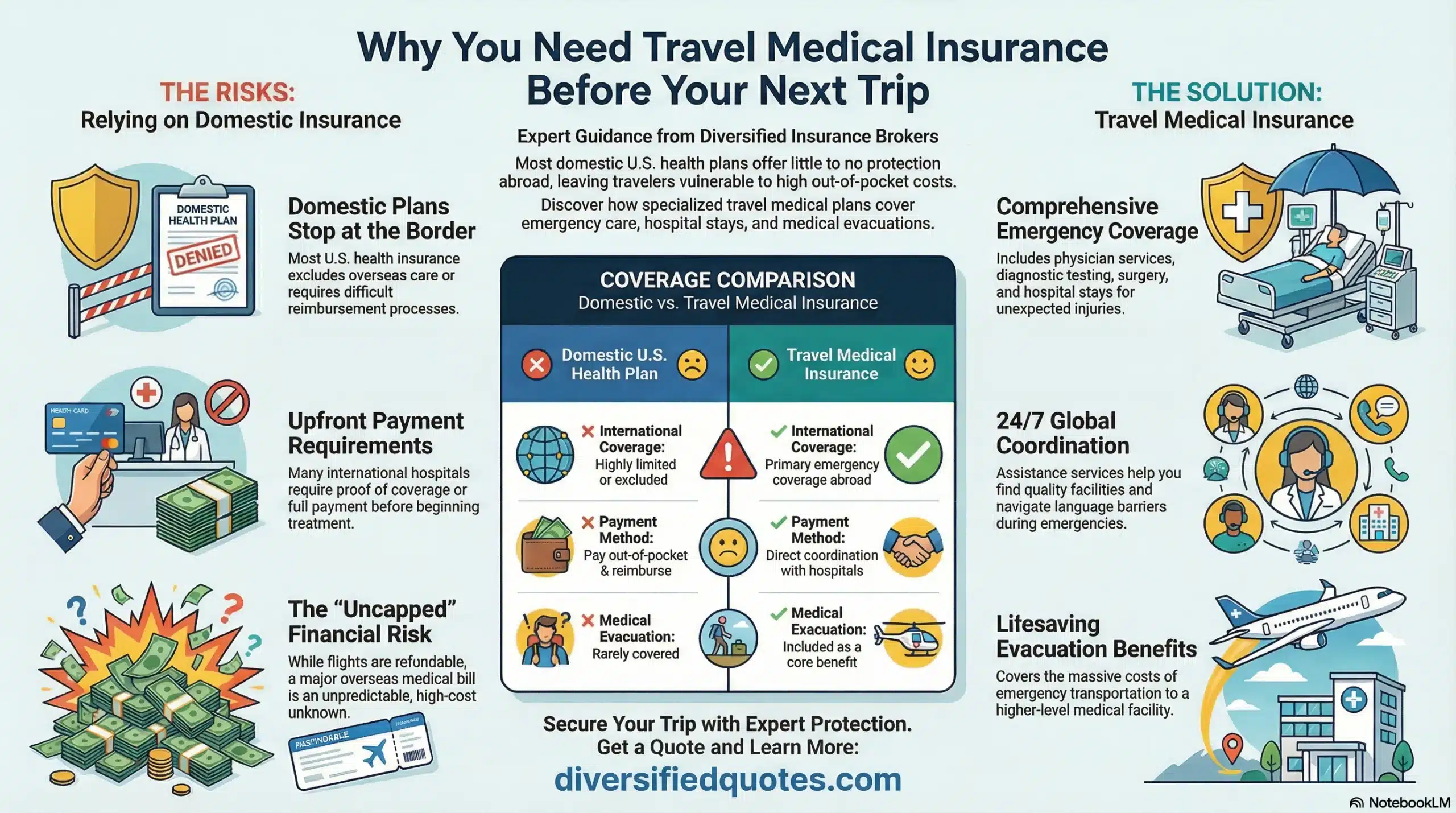
At Diversified Insurance Brokers, we help travelers compare international medical plans focused on real-world emergency performance: meaningful emergency medical benefits, clear evacuation language, and 24/7 assistance coordination that functions as the operational engine of the coverage rather than a support feature. For Lebanon specifically, where even Beirut’s historically excellent private hospital sector — the American University of Beirut Medical Center, Clemenceau Medical Center, and Hôtel-Dieu de France — has been affected by economic strain on medical supply chains, physician emigration, and the Beirut explosion’s physical and institutional damage, the assistance team’s ability to rapidly assess what is available and what the patient’s condition actually requires is more important than ever. Our overview of travel medical insurance explains how these plans work when domestic insurance does not follow you internationally. Our guide to emergency medical evacuation insurance covers how evacuation decisions are made, what triggers approval, and why the assistance process is a core component of the coverage value. If your Lebanon stay extends beyond a typical trip, international health insurance covers coverage structures designed for longer-term international residence rather than short-trip emergency protection.
Travel Medical & Evacuation Coverage for Lebanon
Apply online for travel medical insurance that includes emergency care and evacuation coordination for Lebanon travel and extended stays.
Why Travel Medical and Evacuation Coverage Matters More in Lebanon Now
Lebanon’s healthcare situation has changed substantially in recent years in ways that make pre-travel medical planning more consequential than it was a decade ago. The country’s private hospital sector was historically one of the best in the Arab world — AUBMC and Clemenceau in particular offered specialty capabilities that made Beirut a regional medical hub, serving patients from Syria, Jordan, and the Gulf who came specifically for medical treatment. That reputation was built on real specialty depth: cardiology, oncology, neurosurgery, transplant medicine, and complex surgical capability that few other Arab cities could match. The economic crisis of 2019-2020, the Beirut port explosion of August 2020, and the subsequent currency collapse have degraded some of that capacity in ways that are real but not uniform: the best Beirut hospitals are still meaningfully capable for many emergencies, but pharmaceutical availability has become unpredictable for some medications, some specialist staff have emigrated, some equipment maintenance has been deferred, and the financial reality of treating non-resident patients at Lebanese hospitals has changed in complex ways given the currency situation.
For travelers in Beirut and the immediate metropolitan area, the practical implications are: Lebanon still has meaningful emergency care capability but with more uncertainty around specific medications, specific specialists, and specific advanced diagnostic availability than before the crisis. For travelers in Lebanon’s regions — the Bekaa Valley, northern Tripoli governorate, southern Lebanon, and the mountainous interior — the available care outside Beirut was always more limited and the distance to Beirut’s specialist facilities creates meaningful evacuation probability for any serious event. Cyprus is the most accessible evacuation destination for Lebanon cases where the clinical requirement does not demand specialist infrastructure — Larnaca and Nicosia have private hospitals capable of handling many acute events in a European-standard environment, and direct ferry and air connections from Beirut make Cyprus a practical first-stage option for stable patients. Amman, Jordan is the primary evacuation destination for cases requiring specialist care at or beyond AUBMC’s current capability — Amman’s private hospital sector, including Jordan Hospital, Arab Medical Center, and King Hussein Cancer Center, has benefited from Lebanese specialist emigration and now provides some of the region’s highest-quality specialty care. What is the primary reason people buy travel medical insurance covers the risk assessment framework underlying coverage decisions for international travelers in complex and changing destination environments.
Lebanon Travel Medical: Coverage Priorities by Location and Traveler Type
| Lebanon Location / Traveler Type | Medical Access Reality | Most Critical Coverage Priority | Primary Evacuation Route |
|---|---|---|---|
| Beirut / greater metropolitan area | AUBMC, Clemenceau, and Hôtel-Dieu de France provide meaningful emergency care; specialist availability and pharmaceutical supply more variable than pre-crisis; private patient billing affected by currency situation | Emergency medical limits for Beirut private hospital care; evacuation to Amman or Cyprus for events exceeding current Beirut capability; assistance team familiarity with Lebanon’s current healthcare financial environment | Cyprus (Nicosia/Larnaca) for stable patients needing European-standard care; Amman for specialist events; Istanbul for some complex cases |
| Bekaa Valley — tourism / wine / agriculture | Regional hospitals in Zahlé and surrounding area provide basic emergency care; approximately 60-90 minutes from Beirut by road; wine tourism, outdoor activities, and summer heat create specific injury and illness risk | Evacuation coordination from Bekaa back to Beirut for specialist events; activity coverage for outdoor excursions; assistance team guidance for Bekaa-specific hospital options | Beirut as primary staging point for all Bekaa cases; Cyprus or Amman for international specialty care |
| Northern Lebanon / Tripoli governorate | Tripoli has some hospital infrastructure; historically underserved relative to Beirut; 2-hour drive from Beirut; economic crisis effects on northern hospitals more pronounced than in capital | Evacuation from north Lebanon to Beirut or directly to Cyprus; higher evacuation limits given distance from Beirut specialist facilities; pre-existing condition terms review | Beirut for stabilization; Cyprus or Amman for specialist international care |
| Expats / students / extended stay | Longer stays increase cumulative medical probability; medication resupply unpredictable for some drugs; university student health services limited; economic crisis affects cost structures for non-resident patients | Coverage structure appropriate for extended stay duration; medication supply chain planning; pre-existing condition terms for chronic conditions; evacuation pathway clarity for serious events | Amman as primary for most serious events; Cyprus for stable patients; repatriation to US or Europe for highest-complexity cases after stabilization |
| NGO / humanitarian / journalist | Multi-region movement across Lebanon including conflict-adjacent southern Lebanon; dual medical and security risk profile; organizational coverage coordination requirements | War exclusion review for southern Lebanon; security vs. medical evacuation distinction; group coverage for organizational deployments; maximum evacuation limits for conflict-adjacent operations | Beirut as staging; Cyprus or Amman for international evacuation; assistance team routing judgment for southern Lebanon cases |
What Travel Medical Coverage Does and Why Evacuation Is Central to Lebanon Planning
Travel medical coverage for Lebanon addresses the two major financial exposure categories that a serious international emergency creates. Emergency medical benefits cover eligible treatment at whatever facility is accessible — emergency room care, hospital admission, physician and specialist fees, diagnostic testing, imaging, emergency surgical procedures, and medically necessary prescriptions. In Lebanon’s current environment, where private hospital billing at the best facilities has become more complex given the currency situation and where some medications that were previously reliably available have become harder to source, the assistance team’s practical knowledge of which facilities are currently functioning at which level matters for directing initial care as much as the financial limit on the benefit schedule.
Evacuation benefits address the escalation problem — the coordinated transport from initial care to the nearest facility capable of providing the required level of care. For Lebanon, where even Beirut’s best hospitals may have gaps in specific specialty capabilities compared to their pre-crisis standard, the evacuation pathway to Cyprus or Amman is a realistic planning element rather than a theoretical contingency. Cyprus offers the closest European-standard care environment — Nicosia’s private hospitals and Larnaca’s medical facilities handle many acute events that exceed what Lebanon can currently provide, and the 30-minute flight or overnight ferry from Beirut makes Cyprus practical for stable but serious cases. Amman, Jordan handles the most complex specialty cases — Jordan’s private hospital sector has expanded significantly and provides cardiac surgery, advanced oncology, complex orthopedic procedures, and neurosurgical capability at a level that makes it the regional standard for highest-acuity events from Lebanon and surrounding countries. Travel medical and evacuation from Syria covers the neighboring country where Lebanon frequently served as an evacuation destination — useful regional context for travelers whose itinerary spans both countries. Travel medical and evacuation insurance for Israel and the insurance for Afghanistan page cover other Levantine and Middle Eastern destinations where travelers assessing Lebanon coverage often want comparative regional context.
Health Risks, Pre-Existing Conditions, Security Context, and Practical Planning
Lebanon’s health risk profile for international travelers includes standard travel health exposures — gastrointestinal illness from food and water, respiratory infections, falls and physical injury from urban navigation and outdoor activities — alongside destination-specific considerations that have grown more significant in the post-crisis environment. Medication availability has become a genuine planning concern: some common Western medications that were reliably available at Lebanese pharmacies before the crisis are now intermittently out of stock or available only in limited quantities. Travelers who rely on regular medications should bring a supply sufficient for the full stay plus a meaningful buffer, and should carry a physical medication list with generic drug names and dosages that can be shared with any treating provider. Power outages — which became frequent in Lebanon’s electricity crisis — affect some medical equipment and facility operations in ways that travelers with home medical equipment needs should plan around explicitly.
The security environment in Lebanon creates the same medical-versus-security evacuation distinction that applies in other conflict-adjacent destinations. Lebanon’s southern border areas have been affected by regional conflict dynamics, and travelers in southern Lebanon — particularly near the Blue Line border zone — face elevated security risk in addition to medical access limitations. Standard travel medical plans respond to medical necessity; they do not respond to security threats that do not involve a concurrent medical emergency. Travelers in southern Lebanon or near conflict-adjacent areas who want protection against both medical and security evacuation scenarios must address both with separate appropriate coverage products. Travel and medical insurance for high-risk travel covers how to evaluate coverage across both categories for complex destinations like Lebanon. For Lebanon’s pharma and medication planning dimension, travelers can also benefit from knowing that the assistance team’s knowledge of current Lebanese hospital pharmaceutical availability — which shifts frequently with import financing — is a practical support resource beyond the financial benefit. For the broader regional context, our pages on travel medical and evacuation from Egypt, travel medical and evacuation from Morocco, and travel medical and evacuation from Iran cover other Middle Eastern and North African destinations where travelers building multi-country regional coverage will find useful comparative context. Travel medical insurance for large groups covers organizational deployments with multiple staff in Lebanon simultaneously. Travel medical insurance for religious groups covers faith-based travel to Lebanon — a meaningful category given Lebanon’s significance to multiple religious traditions. How to get the best travel medical insurance rates covers the comparison methodology for identifying the most appropriate and cost-efficient plan for a given Lebanon itinerary.
Get Covered Before You Travel
Apply online now to secure travel medical and evacuation coverage for Lebanon.
Related Travel Medical Pages
Use these pages to compare plan types, understand evacuation coordination, and match coverage structure to how you travel.
Related Destination Pages
Compare how coverage needs change based on medical access, distance to advanced care, and travel logistics across different destinations.
Talk With an Advisor Today
Choose how you’d like to connect—call or message us, then book a time that works for you.
Schedule here:
calendly.com/jason-dibcompanies/diversified-quotes
Licensed in all 50 states • Fiduciary, family-owned since 1980
Frequently Asked Questions: Travel Medical and Evacuation Insurance for Lebanon
Where would a medical evacuation from Lebanon typically go?
For stable patients who need European-standard care beyond what is currently reliably available in Lebanon, Cyprus — specifically Nicosia and Larnaca — is the most practical first-stage destination given the 30-minute flight or overnight ferry from Beirut and Cyprus’s private hospital sector. For cases requiring specialist care at a level matching Lebanon’s pre-crisis AUBMC standard, Amman, Jordan is the primary evacuation destination — Jordan Hospital, Arab Medical Center, and King Hussein Cancer Center now provide some of the region’s most complete specialty coverage, and they have benefited from Lebanese specialist emigration. Istanbul is an alternative for some specialist events given Turkish specialty hospital infrastructure and accessible air connections from Beirut. For the highest-complexity cases requiring European tertiary care, onward routing from Cyprus or Amman to European centers is possible after stabilization. The assistance team selects the destination based on the patient’s specific clinical condition and the specialty capability required at the time of the event.
Has Lebanon’s economic crisis changed what travel medical coverage needs to address?
Yes — Lebanon’s economic crisis has changed the practical coverage picture in several ways that travelers and long-stay visitors need to understand. First, pharmaceutical availability has become unpredictable for some medications, making pre-trip medication supply planning more important than it was before the crisis. Second, the billing and payment reality at Lebanese private hospitals has changed given the currency collapse and the distinction between old lira accounts and fresh dollar transactions — the assistance team’s familiarity with the current Lebanese hospital financial environment is practically valuable in ways that go beyond general international billing knowledge. Third, some specialist capabilities that made Beirut a regional medical hub have been reduced by physician emigration, creating a higher probability that serious specialty events require evacuation to Cyprus or Amman rather than treatment at AUBMC or Clemenceau. Coverage that addresses the current Lebanon reality — rather than Lebanon’s pre-crisis reputation as a strong regional medical hub — is what actually provides the protection travelers need.
What is the difference between medical evacuation and security evacuation for Lebanon travel?
Medical evacuation activates when a physician certifies that the patient’s condition requires care not available locally — a clinically driven decision coordinated by the assistance team based on medical necessity. Security evacuation removes individuals from Lebanon because of non-medical threats: escalating conflict, security incidents, political deterioration, or personal danger independent of any health condition. Standard travel medical plans cover medical evacuation and do not cover security evacuation. For travelers in Lebanon’s southern areas near the Blue Line border zone, and for journalists, NGO staff, and others whose work brings them to security-sensitive areas, the distinction is practically consequential — both risks may be present simultaneously, and separate security evacuation coverage is required to address the non-medical risk. Our guide to travel and medical insurance for high-risk travel covers how to build coverage for both categories.
What coverage limits should I carry for Lebanon travel?
Emergency medical limits of $100,000 or more are a reasonable baseline for Lebanon travel, reflecting the cost of inpatient care at Beirut’s best private hospitals plus continuing treatment at the Cyprus or Amman receiving facility. For evacuation and repatriation, limits of $250,000 or more are commonly recommended because a Lebanon evacuation to Cyprus or Amman can reach $20,000 to $60,000 or more depending on the patient’s condition and transport modality, and highest-complexity cases with onward European routing accumulate higher costs. The evacuation limit is the more consequential figure to examine for Lebanon travel given that even Beirut-based serious events may require international transfer. For travelers in Lebanon’s regions outside Beirut — the Bekaa, northern Lebanon, or southern areas — higher evacuation limits are appropriate because the logistics of reaching Beirut as a staging point before the international segment adds cost and transport complexity.
How should travelers in Lebanon prepare to use their coverage in an emergency?
The preparation steps that most improve emergency outcomes in Lebanon are: storing the assistance team’s 24/7 contact in phone contacts, on a physical card with the passport, and with a home contact who can initiate the call from outside Lebanon if needed. Carrying prescription medications in sufficient supply with a physical list of drug names, dosages, and prescribing diagnoses — because medication resupply in Lebanon is genuinely less reliable than before the crisis. Having a basic understanding of which Beirut private hospitals are currently most functional so that initial care decisions can be informed rather than completely improvised. And contacting the assistance team as early as possible in any developing serious situation — before transport has been self-arranged — because most plans require evacuation to be coordinated through the assistance provider to apply. Early assistance team contact gives the team the maximum window to evaluate options and manage the logistics before clinical urgency forces faster and more constrained decisions.
Do pre-existing conditions affect coverage for travelers in Lebanon?
Pre-existing condition terms vary significantly between travel medical plans and require explicit review before purchasing Lebanon coverage — particularly because Lebanon’s current healthcare environment means that conditions requiring specific medications or specialist management are more likely to encounter access gaps than they would have before the economic crisis. Some plans exclude pre-existing conditions entirely. Some offer limited coverage for acute flare-ups of conditions that were stable during a defined lookback period. Some offer waivers when purchased within a defined window after the initial trip commitment. The medication availability concern makes this review especially important for travelers with chronic conditions in Lebanon: discovering that a medication needed for an emergency is unavailable locally, combined with a pre-existing condition exclusion that prevents the plan from covering the associated treatment, creates a compounding gap. Addressing both — medication supply planning and pre-existing condition coverage terms — before departure is the complete preparation for chronic condition travelers to Lebanon.
Is short-term travel medical coverage the right choice for a long stay in Lebanon?
For stays of a few weeks or less, short-term travel medical insurance is typically the most practical and cost-efficient choice — designed specifically for the emergency coverage needs of temporary international travel. For stays of several months or longer — students at AUB or LAU, expats on assignment, development professionals on extended contracts — the comparison between short-term travel medical and longer-term international health insurance becomes more meaningful. International health insurance is structured more like a global major medical plan, often providing broader outpatient access, better coverage for ongoing medication management, and continuity of care across a longer period. Our guide to international health insurance covers how these longer-term structures differ from travel medical plans and helps travelers and expats identify which structure is more appropriate for their specific Lebanon stay duration and coverage expectations.
About the Author:
Jason Stolz, CLTC, CRPC, DIA, CAA and Chief Underwriter at Diversified Insurance Brokers (NPN 20471358), is a senior insurance and retirement professional with more than 25 years of real-world experience helping individuals, families, and business owners protect their income, assets, and long-term financial stability. As a long-time partner of the nationally licensed independent agency Diversified Insurance Brokers, Jason provides trusted guidance across multiple specialties—including fixed and indexed annuities, long-term care planning, personal and business disability insurance, life insurance solutions, Group Health, Travel Medical and Evacuation Insurance, and short-term health coverage. Diversified Insurance Brokers maintains active contracts with over 100 highly rated insurance carriers, ensuring clients have access to a broad and competitive marketplace.
His practical, education-first approach has earned recognition in publications such as VoyageATL, and contributions from his agency featured in Kiplinger and GoBankingRates— highlighting his commitment to financial clarity and client-focused planning. Drawing on deep product knowledge and years of hands-on field experience, Jason helps clients evaluate carriers, compare strategies, and build retirement and protection plans that are both secure and cost-efficient. Visitors who want to explore current annuity rates and compare options across multiple insurers can also use this annuity quote and comparison tool.
Explore More Travel Medical Insurance Options: Browse our complete guide to Africa & Middle East Travel Medical Insurance — covering medical evacuation coverage for Africa, Middle East & high risk destinations.
Last Reviewed: June 18, 2026 |
Reviewed by: Jason Stolz, CLTC, CRPC, DIA, CAA
Chief Underwriter, Diversified Insurance Brokers, Inc. | NPN: 20471358 | Diversified Insurance Brokers, Inc. — Licensed in all 50 states
Fact Checked by: Tonia Pettitt, CMIP©
Medicare Specialist, Diversified Insurance Brokers, Inc. | NPN: 14374308 | Diversified Insurance Brokers, Inc. — Licensed in all 50 states
Did you find this content helpful? Leave us a Google review — it helps others find trustworthy guidance too.
Editorial Standards: Diversified Insurance Brokers maintains rigorous editorial standards to ensure accuracy, clarity, and independence in all content. Learn more about our editorial standards and commitment to transparency.
