
Travel Medical and Evacuation from Iran
Travel Medical and Evacuation from Iran

Jason Stolz CLTC, CRPC, DIA, CAA
Traveling to Iran can be an unforgettable experience — whether you are there for business, academic work, family visits, journalism, cultural travel, or long-term projects. The country offers some of the world’s most extraordinary historical and architectural heritage: the Naqsh-e Jahan Square in Isfahan, the vast Persian carpet bazaars of Tehran and Tabriz, the ancient ruins of Persepolis near Shiraz, the Alborz mountain range rising behind the capital, and a cultural depth that draws researchers, journalists, architects, historians, and diaspora families from every continent. At the same time, Iran is a destination where trip planning needs to be practical and risk-aware. Medical care quality varies significantly by city and region, language and payment barriers can complicate care access for foreign visitors in ways that do not exist in more internationalized systems, U.S. economic sanctions create specific complications for financial transactions including insurance payments and medical billing that require careful pre-trip coordination, and in a serious situation the best outcome may require logistics and coordination that go well beyond local treatment. That is why travel medical and evacuation insurance from Iran matters — not just as a bill-payer for clinic visits, but as a functioning emergency plan that can move with you and respond quickly when conditions shift.
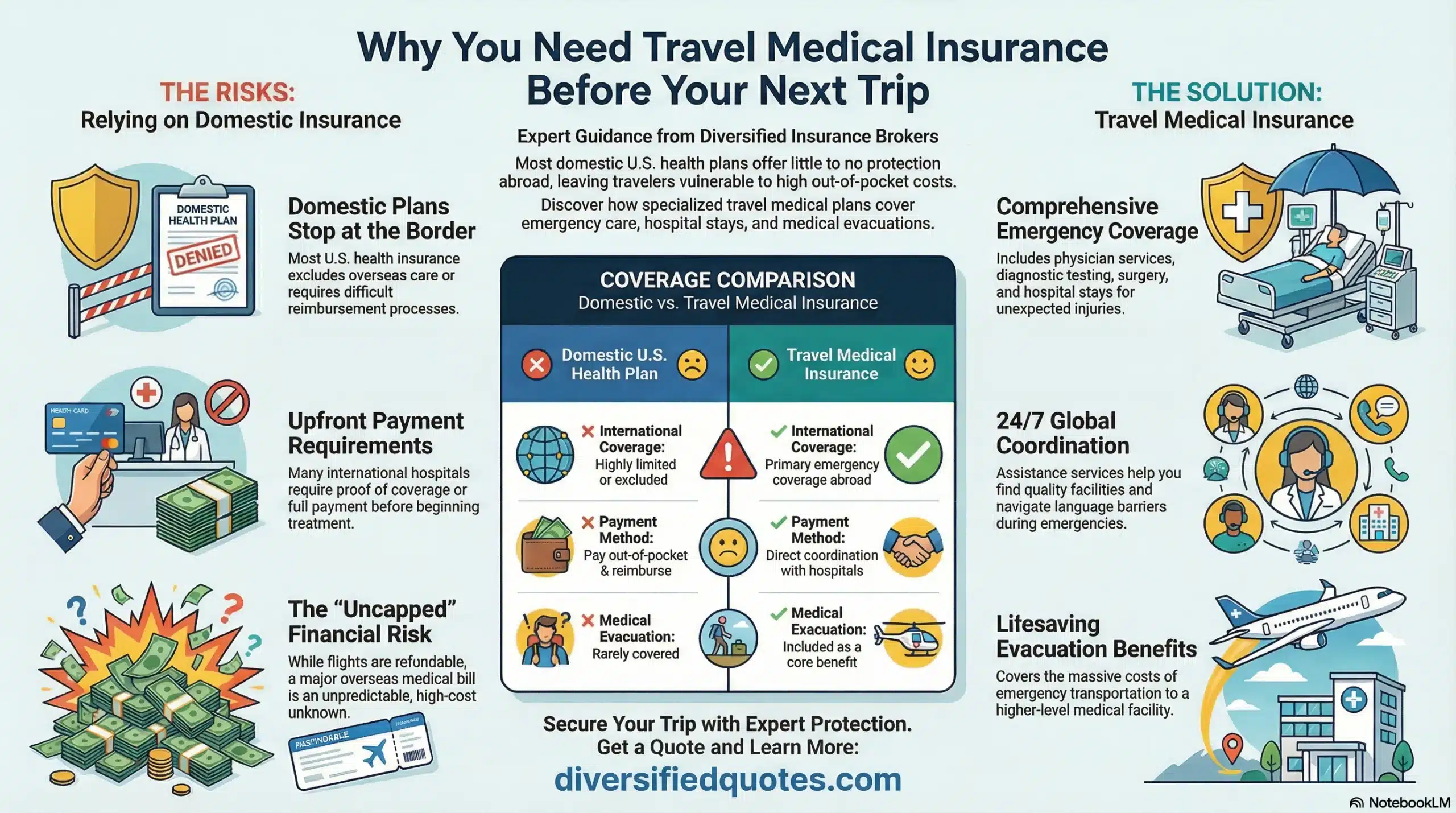
Many travelers approach travel insurance as a simple reimbursement product — something that might cover a clinic visit or a prescription and then end. In destinations with higher operational complexity like Iran, the most valuable part of travel medical coverage is the combination of emergency medical benefits and coordinated evacuation support backed by a 24/7 assistance team that understands the specific logistical realities of the destination. In a real crisis, the logistics matter as much as the benefit limits: if you cannot access the right level of care where you are, you need a plan that can coordinate next steps, route you appropriately, and handle emergency arrangements through a structured assistance process that does not require you to improvise under pressure. At Diversified Insurance Brokers, we help travelers, expatriates, students, contractors, and organizations compare travel medical coverage that includes meaningful evacuation support and assistance team capability matched to the operational realities of complex destinations. For a foundational overview of how these policies work, our resource on travel medical insurance explains what these policies are designed to cover, why some travelers benefit from higher limits, and why a lower-cost plan can become the more expensive choice when it is missing the benefits that matter most during a major event. For travelers on longer-term assignments whose stays begin to resemble a temporary relocation, international health insurance covers the longer-duration alternative built with broader day-to-day medical benefits and different renewability structures.
Get Travel Medical & Evacuation Coverage for Iran
Apply online in minutes. If your trip includes remote regions, extended stays, or higher-risk work, choose limits that assume evacuation could be needed — not just routine care.
Coverage rules, exclusions, and evacuation authorization requirements vary by plan. Always follow the insurer’s assistance process during emergencies.
Why Iran Requires More Careful Coverage Planning Than Most Destinations
Iran’s healthcare landscape presents a set of planning considerations that are meaningfully different from those travelers encounter in most other international destinations, and understanding each one before selecting coverage is essential to ensuring the plan actually functions when it is needed. Tehran has the most capable medical infrastructure in the country, with a developed public hospital system — including the Imam Khomeini Hospital Complex, Shariati Hospital, and Milad Hospital — and a growing private clinic sector serving the capital’s more than 15 million people. For events in Tehran that require emergency care within the capability range of the public and private hospital systems, the physical medical infrastructure is more developed than many travelers expect. Isfahan, Shiraz, Mashhad, and Tabriz also have meaningful regional hospital infrastructure relative to their populations. The coverage planning problem for Iran is not primarily about hospital quality in the capital. It is about four interconnected challenges that affect how a travel medical plan functions in practice for foreign visitors.
The first challenge is payment and sanctions complexity. U.S. economic sanctions create significant complications for financial transactions involving Iran, including insurance payments and medical billing. Most U.S.-issued insurance plans cannot make direct payments to Iranian medical providers, which means even well-intentioned direct billing arrangements that work in other countries may not be executable in Iran under current sanctions frameworks. Travelers need to understand in advance how their specific plan handles this — whether the expectation is reimbursement after payment, whether the assistance team has established workarounds for Iranian provider billing, and what documentation requirements the plan imposes. This is a critical pre-purchase question that should be explicitly answered by the carrier or assistance team before the policy is purchased, not assumed from general coverage descriptions. The second challenge is language. Farsi is Iran’s national language, and while English proficiency exists among educated urban populations and some medical professionals, navigating the billing, consent, and coordination aspects of a medical event in a foreign language without institutional support from an assistance team creates delays and errors that can affect both care quality and claims processing. The third challenge is geographic scale. Iran is a very large country — roughly the size of Alaska — and the distance from remote regions like the southeastern Sistan-Baluchestan province, the northwestern border areas near Tabriz, or the central desert regions to Tehran’s hospital infrastructure is substantial. A serious event in these areas creates an evacuation scenario as the primary response regardless of what local care is nominally available. The fourth challenge is political and security context. Iran’s political environment creates specific security risk considerations for some traveler categories — journalists, dual nationals, academics researching sensitive topics — that go beyond standard travel health risk and that may require separate security evacuation consideration independent of the medical coverage plan. For the framework for evaluating both medical and security coverage for complex destinations, our guide to travel and medical insurance for high-risk travel covers how plan design should account for both risk categories.
Iran Travel Medical: Coverage Priorities by Location and Traveler Type
| Iran Location / Traveler Type | Medical Access Reality | Most Critical Coverage Priority | Primary Evacuation Route |
|---|---|---|---|
| Tehran — business / diplomatic / academic | Most developed hospital infrastructure in Iran; Imam Khomeini, Shariati, and Milad hospitals plus private clinics; still limited for highest-complexity specialty events; sanctions complicate direct billing with foreign insurers | Pre-confirmed reimbursement or assistance team payment workaround for Iranian providers; high evacuation limits for events exceeding Tehran capability; war/conflict exclusion review for dual nationals and higher-risk traveler categories | Istanbul as primary — direct flights, Acibadem and Memorial hospital networks; Dubai as secondary; Ankara for some cases; European routing for highest-complexity events |
| Isfahan / Shiraz / Mashhad — cultural tourism | Regional hospital infrastructure in each city; meaningful for basic emergency care; specialist depth limited; tourism circuit creates concentrated visitor volume at sites far from major hospitals; air connections to Tehran available | Intra-Iran transport to Tehran for serious events; evacuation to Istanbul or Dubai for events exceeding Iranian hospital capability; assistance team knowledge of regional airport connectivity | Tehran as staging for most serious regional events; Istanbul or Dubai for international specialist care via Imam Khomeini International Airport |
| Tabriz / northwestern Iran | Tabriz has meaningful hospital infrastructure; proximity to Turkish border creates alternative evacuation corridor not available in other Iranian regions; Kurdish and Azerbaijani border areas have variable access | Turkish border crossing evacuation pathway awareness; assistance team familiarity with Tabriz-to-Turkey routing; war exclusion review for border-adjacent areas | Turkey via border crossing or Tabriz airport direct to Istanbul; faster Turkey routing than Tehran routing for some northwestern Iran cases |
| Remote interior / southeastern Iran | Vast distances from Tehran and major cities; minimal medical infrastructure in central desert and southeastern provinces; Sistan-Baluchestan province has specific security considerations; air transport required for any serious event | Maximum evacuation limits; air transport as only viable serious event response; highest assistance team capability required; security evacuation coverage for southeastern provinces | Air charter to Tehran for staging; Istanbul or Dubai for international specialist care; multi-leg logistics managed by assistance team |
| Journalists / dual nationals / academics | Standard medical access plus heightened detention risk for some traveler categories; political context creates dual medical and security risk profile that standard travel medical plans do not fully address | Explicit war/conflict exclusion review; security evacuation coverage assessment separate from medical coverage; assistance team with Iran-specific operational experience; legal assistance availability for detention scenarios | Istanbul as primary for medical; security evacuation routes and processes differ from medical evacuation and require separate product evaluation |
How Medical Evacuation Works From Iran and Where It Goes
Medical evacuation from Iran is operationally more complex than from most Middle Eastern destinations, and the complexity stems primarily from the sanctions environment rather than from geographic inaccessibility. Imam Khomeini International Airport south of Tehran has international air connections to Istanbul, Dubai, Doha, Kuala Lumpur, and other hubs — meaning air access for international medical evacuation exists and is not the primary obstacle. The obstacle is the financial and authorization layer: arranging, paying for, and documenting a medical evacuation in a way that complies with applicable sanctions regulations, insurer authorization requirements, and Iranian government exit procedures simultaneously requires an assistance team that has established operational protocols specifically for Iran rather than generic Middle East experience. For travelers in Tehran, the evacuation sequence for a serious event typically involves initial stabilization at the best available Tehran hospital, assistance team contact as early as possible, clinical assessment in consultation with the treating physician, identification of the receiving facility — almost universally Istanbul’s Acibadem or Memorial hospital networks for most event types, or Dubai’s international private hospital sector for some cases — transport arrangement, and continuous family communication throughout. Istanbul is the primary destination for the large majority of serious Iran evacuations because of direct air connections, established Iran evacuation receiving protocols at the major private hospital networks, and the cultural and linguistic familiarity that reduces care coordination friction for Iranian-background patients compared to Dubai or European alternatives.
For travelers not in Tehran when a serious event occurs — in Isfahan, Shiraz, Mashhad, Tabriz, or more remote locations — the evacuation chain adds at least one additional stage: transport to Tehran for staging before the international leg, or in some cases direct international routing from a regional airport if clinical urgency makes Tehran staging impractical. Tabriz represents a unique case in Iran’s evacuation geography because its proximity to the Turkish border creates the possibility of a ground crossing to Turkey as an alternative to air evacuation — an option that some assistance teams have used for specific clinical scenarios where road transport is faster and safer than the logistics of air ambulance arrangement. Understanding which assistance teams have operational experience with Iran-specific evacuation logistics — including the Tabriz-Turkey ground corridor, the financial transaction workarounds required under sanctions, and the authorization documentation Iranian authorities require for patient exit — is one of the most important plan selection criteria for Iran travel that most generic travel insurance comparison resources do not address. For comparison context on the primary receiving destination, our page on travel medical and evacuation from Lebanon covers Beirut’s historical role as a regional medical hub and the evacuation routing shifts that have occurred as Lebanon’s economic crisis has reduced its capability — useful context for understanding why Istanbul has become the dominant Iran evacuation receiving destination. Our pages on travel medical and evacuation from Pakistan and travel medical and evacuation from Afghanistan cover the two regional neighbors with the most comparable sanctions-and-logistics evacuation complexity profiles.
Health Risks, Sanctions Implications, Pre-Existing Conditions, and Practical Planning
Iran’s health risk profile for international travelers includes both standard international travel health exposures and some destination-specific considerations. Air quality in Tehran and other major Iranian cities is a genuine respiratory health concern — Tehran’s air pollution levels are among the highest of any major global city, and travelers with asthma, chronic obstructive pulmonary disease, or other pulmonary conditions who spend extended time in the capital may experience condition exacerbation that requires medical management. The Iranian plateau’s variable altitude — Isfahan sits at approximately 1,590 meters, Tehran at 1,191 meters — creates altitude-related considerations for travelers with cardiac history. Heat illness in Iran’s desert regions, including the Lut Desert and central plateau areas, creates genuine summer travel health risk for travelers on archaeological or adventurous itineraries. Gastrointestinal illness from food and water exposure, road traffic accidents on Iran’s road network, and acute exacerbations of pre-existing conditions under the physical and logistical demands of Iran travel are the most common claim categories across traveler types. Drug interactions and medication availability present a specific planning challenge: some Western medications are not available in Iran due to sanctions-related pharmaceutical import restrictions, and travelers who rely on specific branded medications should carry sufficient supply plus a meaningful buffer and should travel with generic name documentation that Iranian pharmacies and physicians can work with.
The sanctions dimension of pre-trip coverage planning cannot be overemphasized. Before purchasing any travel medical plan for Iran, travelers should explicitly confirm three things: that the plan covers Iran as a named destination, that the assistance team has operational experience with Iran-specific evacuation logistics and payment workarounds, and that the plan’s reimbursement process can be executed in a way that does not require the insurer to make direct payments to Iranian providers in violation of applicable regulations. Different carriers handle this differently, and the answer affects how the plan actually functions during a real event — not just whether it theoretically covers Iran on a destination list. Travelers should treat this as a pre-purchase verification requirement rather than an assumption. For the health risk assessment framework underlying these planning decisions, our resource on what is the primary reason people buy travel medical insurance covers how destination-specific risk factors should shape coverage selection. For travelers whose Iran trip is part of a broader regional or multi-continent itinerary, our pages on travel medical and evacuation from Egypt, travel medical and evacuation from Colombia, travel medical and evacuation from Nigeria, and travel medical and evacuation from Cuba cover other complex destinations where sanctions, payment logistics, or infrastructure limitations create comparable coverage planning considerations. For travelers evaluating coverage across the full spectrum of high-complexity destinations including Iran, our guide to high-risk travel insurance covers how plan design scales with destination risk profile. How to get the best travel medical insurance rates covers the comparison methodology for identifying the most appropriate and cost-efficient plan for a given Iran itinerary and traveler profile.
Get Covered Before You Travel to Iran
Apply online now to secure travel medical and evacuation protection designed for international travel and emergency coordination.
For any emergency, always contact the insurer’s assistance team as soon as possible to coordinate care and required authorizations.
Related Travel Medical Pages
Related Destination Pages
Talk With an Advisor Today
Choose how you’d like to connect—call or message us, then book a time that works for you.
Schedule here:
calendly.com/jason-dibcompanies/diversified-quotes
Licensed in all 50 states • Fiduciary, family-owned since 1980
Travel Medical and Evacuation from Iran — FAQs
Most plans cover emergency medical treatment for unexpected illness or injury arising during travel — including emergency hospitalization, emergency physician services, medically necessary diagnostics and imaging, and covered prescriptions tied to the covered event. They also include medical evacuation to the nearest appropriate facility when adequate care is not available at the traveler’s current location, and many plans include repatriation benefits when a return home is medically necessary and authorized through the assistance process. What is covered, what is excluded, how benefit limits apply, and how the assistance process is structured all vary meaningfully across plans — which is why comparing plan details rather than just headline premium matters significantly for Iran travel. Plans that appear similar on a quote screen can behave very differently once you are in a real emergency situation overseas.
In a serious medical situation in Iran, the best outcome may require transfer to a higher-capability facility — which can involve complex logistics, medical escorts, specialized transport, and routing to an appropriate receiving facility. Evacuation benefits protect against large out-of-pocket transport costs and provide structured assistance coordination so that decisions and approvals are handled correctly through the insurer’s process rather than improvised under stress. The costs of medical evacuation can be substantial even when distances seem manageable on a map, because the operational reality involves specialized medical crews, appropriate aircraft, receiving facility coordination, and timing logistics that are difficult and expensive to arrange independently. Travelers with meaningful evacuation coverage have the financial and logistical backstop that makes the difference between a manageable emergency and a financially devastating one.
Many travel medical plans exclude pre-existing conditions unless the policy includes specific language that applies — such as an “acute onset of pre-existing conditions” benefit that covers sudden unexpected flare-ups of an existing condition requiring emergency treatment. This benefit typically has defined look-back periods, stability requirements, and eligibility rules that determine whether a given condition and event qualify. Other plans exclude pre-existing conditions entirely, covering only new sudden illnesses and injuries that arise during travel. For travelers with ongoing health conditions or stable chronic issues heading to Iran, identifying plans that offer meaningful pre-existing condition coverage — and reading the exact policy language carefully — is a critical step rather than an afterthought. Assuming coverage applies without verifying is one of the most common and costly mistakes travelers make during the plan selection process.
Common exclusions on travel medical plans that are particularly relevant for Iran trips include elective or non-urgent care, treatment that does not meet the policy’s definition of medically necessary, certain high-risk activities that may be excluded by endorsement, evacuations arranged independently without following the insurer’s authorization process, and pre-existing conditions unless a specific benefit provision applies. Some plans also have exclusions related to travel to destinations under certain government advisories — which is worth verifying for Iran specifically before purchasing, since advisory levels can affect policy eligibility or benefit applicability. The exact exclusions vary by plan and insurer, so reviewing the actual policy document rather than relying on marketing summaries is important for any high-complexity destination.
In most serious situations, the first step is to seek immediate medical attention at the nearest available facility. The second step — when safe and physically possible — is to contact the insurer’s 24/7 assistance team as quickly as possible. That team is responsible for case management, coordination with treating facilities, medical review to determine when evacuation is appropriate, identification of the correct receiving facility, and authorization of covered transport. Following the assistance process is not procedural formality — it is typically a prerequisite for evacuation benefits to be payable under most plan structures. Evacuation arranged independently, without contacting the assistance team and receiving authorization, is frequently not reimbursable regardless of medical necessity. Understanding this requirement before you travel is one of the most important operational steps in travel medical planning.
Not necessarily. Evacuation means transport to the nearest appropriate facility capable of treating the condition — and that facility may be within Iran if an adequate higher-capability facility is accessible. In other situations, particularly if the traveler is in a remote region or requires specialized care not available locally, the nearest appropriate facility may be in a neighboring country or may require transport back to the home country. The determination is based on medical necessity, available facilities, the traveler’s specific condition, and the policy’s definitions — not simply on geography or preference. Repatriation home, when it is medically authorized and appropriate, is a separate benefit that applies after stabilization and may involve commercial medical escort rather than dedicated air medical transport, depending on the traveler’s condition and policy terms.
Some travel plans include security evacuation benefits, but many do not — and even among those that do, the triggers, definitions, and covered transportation types vary significantly. Security evacuation is typically triggered by specific covered events such as civil unrest, natural disasters, or threat-based situations that meet the policy’s defined criteria. It is not a general “I feel unsafe” benefit and is not triggered by subjective discomfort or generalized concern. For travelers heading to Iran where security conditions can be relevant depending on the timing and nature of the trip, understanding whether security evacuation is included, what events specifically trigger it, and what the coverage structure provides is worth investigating during plan selection rather than assuming it is automatically included. If this benefit is important for your trip, confirm its inclusion explicitly before purchasing.
Coverage limits should reflect your trip length, how remote your travel may be within Iran, the nature of your activities, and the realistic possibility that evacuation could be required — not just routine care. Short trips concentrated in Tehran can often be structured with moderate limits. Multi-week itineraries that include travel across multiple regions, remote project sites, or areas further from major hospital infrastructure warrant higher medical limits and more meaningful evacuation limits. A useful exercise is to think through what a serious hospitalization and full medical evacuation would actually cost for your specific route and ask whether the plan limits you are considering would actually cover that scenario. Travelers on extended assignments should also evaluate whether a short-term travel policy or a longer-term international medical plan better fits the duration and nature of the stay.
Keep a copy of your full policy document or a detailed benefits summary, the insurer’s 24/7 assistance hotline number, your insurance ID card or certificate number, your passport and any relevant travel documents, and a way to store and access medical documentation and receipts digitally. If you have ongoing prescriptions, keep a summary of your current medications with generic names and dosages — generic names are more universally recognizable across different pharmacy systems. If you have relevant medical history that could affect emergency treatment decisions, keeping a brief medical summary in both English and, if possible, Farsi can reduce communication delays in a critical situation. In many travel emergencies, what delays reimbursement and coordination most is not insufficient coverage — it is missing documentation at the wrong moment when the assistance team needs to verify the situation and authorize next steps.
Most travelers should purchase travel medical and evacuation coverage as soon as the trip is confirmed — ideally when travel dates are known but well before departure. Purchasing early ensures coverage is in place if a pre-departure event affects the trip, and some plans offer additional benefits such as trip cancellation or interruption coverage that may only be available when purchased within a defined window after the initial trip deposit. For Iran specifically, where trip parameters may change or evolve during the planning process, having coverage secured early also provides peace of mind during the pre-departure period. There is no meaningful advantage to waiting — the plan does not improve or become less expensive closer to departure. Completing the comparison and purchasing well ahead of departure gives you time to review the policy document, understand the assistance process, and ask questions before the trip begins rather than scrambling to understand coverage details from overseas.
About the Author:
Jason Stolz, CLTC, CRPC, DIA, CAA and Chief Underwriter at Diversified Insurance Brokers (NPN 20471358), is a senior insurance and retirement professional with more than 25 years of real-world experience helping individuals, families, and business owners protect their income, assets, and long-term financial stability. As a long-time partner of the nationally licensed independent agency Diversified Insurance Brokers, Jason provides trusted guidance across multiple specialties—including fixed and indexed annuities, long-term care planning, personal and business disability insurance, life insurance solutions, Group Health, Travel Medical and Evacuation Insurance, and short-term health coverage. Diversified Insurance Brokers maintains active contracts with over 100 highly rated insurance carriers, ensuring clients have access to a broad and competitive marketplace.
His practical, education-first approach has earned recognition in publications such as VoyageATL, and contributions from his agency featured in Kiplinger and GoBankingRates— highlighting his commitment to financial clarity and client-focused planning. Drawing on deep product knowledge and years of hands-on field experience, Jason helps clients evaluate carriers, compare strategies, and build retirement and protection plans that are both secure and cost-efficient. Visitors who want to explore current annuity rates and compare options across multiple insurers can also use this annuity quote and comparison tool.
Explore More Travel Medical Insurance Options: Browse our complete guide to Africa & Middle East Travel Medical Insurance — covering medical evacuation coverage for Africa, Middle East & high risk destinations.
Last Reviewed: June 18, 2026 |
Reviewed by: Jason Stolz, CLTC, CRPC, DIA, CAA
Chief Underwriter, Diversified Insurance Brokers, Inc. | NPN: 20471358 | Diversified Insurance Brokers, Inc. — Licensed in all 50 states
Fact Checked by: Tonia Pettitt, CMIP©
Medicare Specialist, Diversified Insurance Brokers, Inc. | NPN: 14374308 | Diversified Insurance Brokers, Inc. — Licensed in all 50 states
Did you find this content helpful? Leave us a Google review — it helps others find trustworthy guidance too.
Editorial Standards: Diversified Insurance Brokers maintains rigorous editorial standards to ensure accuracy, clarity, and independence in all content. Learn more about our editorial standards and commitment to transparency.
