
Travel Medical and Evacuation from Venezuela
Travel Medical and Evacuation from Venezuela

Jason Stolz CLTC, CRPC, DIA, CAA
Travel to Venezuela can be meaningful for family visits, business assignments, academic work, humanitarian deployments, and long-stay projects — but it requires realistic planning around healthcare access and what happens if a serious medical event occurs during the trip. Even in larger Venezuelan cities, the availability of specialists, advanced diagnostics, reliable medication supply, and consistent hospital operations can vary significantly depending on the facility, the region, and current local conditions. Outside of the best-resourced private clinics in Caracas and a handful of other urban centers, getting appropriate advanced care quickly can be difficult — particularly when traveling far from urban centers, when local resources are under strain, or when the specific care required exceeds what is available at the nearest facility. That practical reality is why travel medical and evacuation insurance from Venezuela is strongly recommended for visitors, contractors, NGO staff, family travelers, and anyone who wants a clear, professionally coordinated plan in place for medical emergencies rather than attempting to navigate an unfamiliar and potentially resource-constrained healthcare system independently under pressure.
This page focuses specifically on emergency medical coverage paired with medical evacuation coordination — not on non-medical evacuation, security extraction, or political relocation, which are separate products addressing different categories of risk. If you suffer a serious illness or injury, the right plan helps cover eligible emergency treatment costs and coordinates transport to the nearest facility capable of providing the appropriate level of care — whether that is within Venezuela when adequate local resources are available, or in a nearby country when the required care is not accessible locally. Medical evacuation under these plans is not available on request or personal preference: evacuation requires physician certification of medical necessity and is coordinated through the plan’s 24/7 assistance provider based on the patient’s clinical condition and the treatment capabilities of available facilities. Setting that expectation clearly before departure prevents the most consequential misunderstanding travelers encounter about this type of coverage. Emergency medical evacuation insurance covers the mechanics of how evacuation works in detail — what triggers it, how medical necessity is determined, why the assistance team’s operational capability matters as much as the financial limit, and what travelers should confirm before purchase. High-risk travel insurance covers the specialized coverage options for destinations where conditions create elevated risk profiles that standard travel plans may not be designed to address. Travel and medical insurance for high-risk travel covers the broader planning framework for complex destinations where the care pathway and the assistance team’s operational capability are primary determinants of real-world protection value.
Apply for Venezuela Travel Medical Coverage
Get emergency medical and medical-evacuation-only protection in minutes.
Why Coverage Matters in Venezuela
Venezuela’s medical landscape is uneven in ways that create specific risks for international travelers that do not exist in destinations with more consistently resourced healthcare infrastructure. In some areas, private clinics may be available and capable of handling routine emergencies, but accessing timely care can still involve practical barriers — upfront deposit requirements, limited appointment availability for specialists, delays for imaging and diagnostic testing, inconsistent medication inventory, and gaps in surgical or intensive care capacity that vary by facility and by day. In other areas, particularly outside major urban centers, capacity constraints and infrastructure limitations can make it genuinely difficult to secure the level of treatment that a serious medical event requires, even when a facility exists. The question for travelers in Venezuela is not simply “Is there a hospital?” — it is whether that hospital can actually treat the specific condition the patient presents with at the moment it occurs, and whether the patient has a coordinated plan to reach a higher level of care if the answer is no.
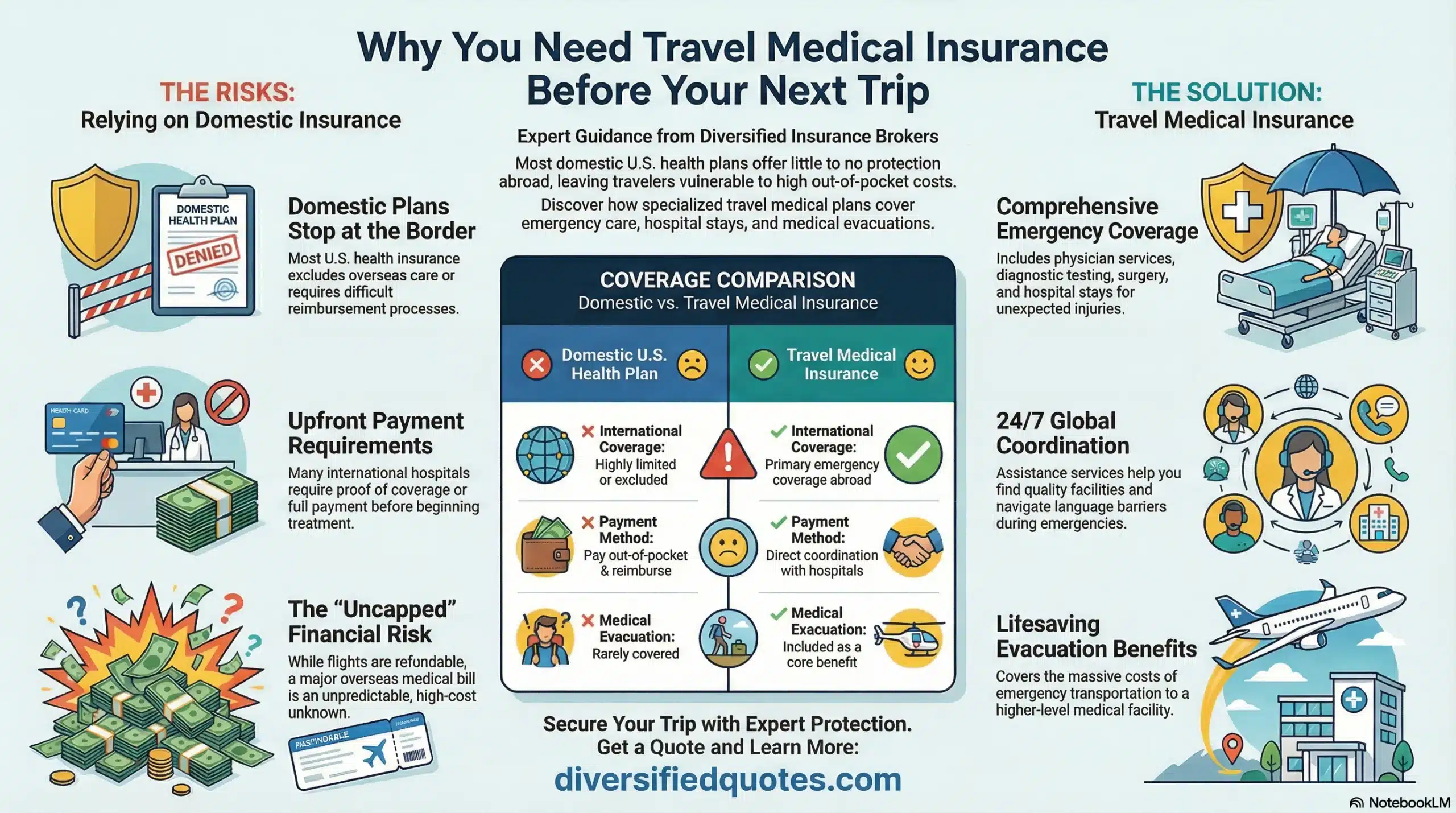
Travel medical insurance helps protect against the worst-case financial exposure from unexpected illness or injury — covering eligible treatment costs at whatever care level is accessible. Medical evacuation coverage addresses the continuity-of-care problem that arises when the nearest accessible facility cannot deliver what the patient needs. The cost of air ambulance services, cross-border transfers, medical escorts, receiving facility coordination, and clinical handoff management accumulates quickly in an evacuation scenario and cannot be managed without institutional relationships and operational experience that most travelers do not independently have. Without coverage and 24/7 assistance coordination, travelers can face large out-of-pocket costs and dangerous delays at exactly the moment when speed and coordinated decision-making are most critical. What is the primary reason people buy travel medical insurance covers the risk assessment framework that underlies the coverage decision for international travelers across different destination types. Cheap travel insurance covers where budget-oriented plans typically reduce coverage and which benefit categories — frequently evacuation limits and assistance team quality — are trimmed first, often eliminating precisely the protection that matters most in serious emergencies in complex destinations like Venezuela.
Venezuela Travel Medical: Coverage Structure and Key Priorities
| Coverage Factor | Venezuela-Specific Context | What Adequate Coverage Provides | Risk of Inadequate Coverage |
|---|---|---|---|
| Emergency medical treatment | Private clinics in major cities can provide reasonable emergency care but typically require upfront deposits or payment guarantees; outside major cities, quality and capability vary substantially | Pays eligible expenses for physician evaluation, urgent care, diagnostics, hospitalization, surgery, and prescriptions; may include direct-pay coordination with facilities to reduce upfront personal payment demands | Large out-of-pocket costs, treatment delays while payment is negotiated, and no financial protection against the full cost of a serious medical event |
| Medical evacuation coordination | Evacuation from Venezuela most commonly routes to Colombia (Bogotá, Cúcuta, or Barranquilla) or Panama — cross-border coordination requires established relationships with receiving facilities and transport providers | Assistance team manages the full logistics chain — receiving facility identification and acceptance, transport coordination, border documentation, and clinical handoff — without requiring the traveler to negotiate independently | Traveler or family attempting to independently arrange a complex international medical evacuation with no institutional relationships, regional knowledge, or established protocols for this specific environment |
| Medical vs. non-medical evacuation | Venezuela’s security environment creates pressure to conflate medical evacuation with security extraction — standard travel medical plans respond only to medically necessary events, not to general security concerns or political conditions | Clear pre-departure understanding of what medical evacuation covers, what it excludes, and what separate security evacuation products address when non-medical risk is also a concern | Traveler discovering during a non-medical crisis that the medical plan does not activate, with no separate security extraction product in place and no clear pathway for removal from a non-medical danger situation |
| Assistance team quality | In a destination where communication infrastructure can be inconsistent and local care options may change rapidly, the assistance team’s operational experience and regional relationships are critical to effective emergency response | 24/7 assistance team with documented operational experience in Latin America, established relationships with Colombian and Panamanian receiving facilities, and capacity to coordinate care when standard communication channels are impaired | Plan with high financial limits backed by a weak or understaffed assistance infrastructure — provides nominal coverage but fails to deliver the operational coordination that makes the coverage genuinely useful in practice |
| Pre-existing condition terms | In a destination where any medical condition may require evacuation, a claim denial based on pre-existing condition exclusion is especially consequential — the traveler is left with full cost of treatment and evacuation | Pre-departure review of the plan’s pre-existing condition definition, lookback window, and stability requirements; acute-flare coverage for stable conditions when criteria are met; full coverage for new conditions throughout the trip | Claim denied for the event most likely to affect the specific traveler, leaving them responsible for the full cost of a serious medical event in one of the region’s more logistically complex evacuation environments |
What “Medical Evacuation Only” Actually Means
Medical evacuation is a coordinated clinical service — not simply a flight or a way to leave a destination when conditions feel uncomfortable. In a real emergency, the process begins with triage and stabilization at the nearest accessible clinic or hospital that can safely evaluate the patient’s initial condition. From there, the assistance team works with treating physicians to determine whether the facility can deliver the care the patient’s condition requires. If it cannot — if the local facility lacks the necessary surgical capability, the specialist required, appropriate ICU monitoring, reliable diagnostic imaging, or the medications the condition demands — the assistance team initiates coordination of transfer to the nearest appropriate facility capable of providing the required level of care.
The transport method depends on the patient’s medical stability and the available infrastructure: ground ambulance transport within Venezuela to a facility with better capability, air ambulance when the patient’s condition requires it and the logistics allow, or commercial transport with medical escort when the patient is stable enough for that level of transfer. The assistance team manages receiving facility identification and acceptance, medical handoff documentation, transport logistics, and communication with the patient’s family, employer, or organization throughout the process. This coordination is what converts a policy document into an effective real-world emergency response — and it is what most travelers cannot replicate independently from an unfamiliar country under emergency conditions. The “only” in medical evacuation only is the equally important part: evacuation that is not driven by medical necessity — departure due to political conditions, security concerns, personal discomfort, or preference for care in a different country — is not covered under standard medical evacuation benefits. Travelers who want protection against non-medical security-driven departure must purchase separate specialized security evacuation coverage independently. Travel medical and evacuation from Colombia covers the most common evacuation destination from Venezuela — understanding Colombia’s facilities and evacuation infrastructure from the Venezuela side of the border is practical planning context for any traveler considering this coverage. Travel medical and evacuation from Cuba covers another Latin American destination where similar medical infrastructure challenges create comparable evacuation planning priorities — useful context for travelers operating across multiple regional destinations.
What Emergency Medical Coverage Helps Pay For
Emergency medical benefits are designed for sudden and unexpected medical events that occur during the covered trip period — not for planned medical treatment, routine care, or conditions that existed and were being actively treated before the trip began. Eligible emergency benefits typically include urgent physician evaluation, urgent care and emergency room treatment, diagnostic testing including laboratory work and imaging tied to a covered condition, inpatient hospitalization including room, board, and nursing care, surgical procedures when medically necessary, and prescription medications related to a covered illness or injury. The financial protection this provides is meaningful in Venezuela where private facility costs can be substantial relative to what a traveler might expect, and where deposit or upfront payment demands are common before care proceeds regardless of the patient’s condition.
Even when local care is available, travelers frequently encounter secondary logistical problems that compound the medical event itself: limited specialist availability in the needed field, delays for diagnostic imaging when equipment is shared or under maintenance, inconsistent medication supply that may not include the specific drug the condition requires, or the need to move to a different city for a higher level of care after initial stabilization. Emergency medical coverage helps address eligible treatment costs across these scenarios, while the evacuation benefit addresses the larger question of how the patient reaches appropriate care when the initial facility cannot provide it. These two components function most effectively when treated as a paired protection strategy — the medical benefit covering costs at the initial point of care and the evacuation benefit coordinating the pathway to the right level of care when the initial point is insufficient. International health insurance covers the longer-term alternative for travelers on extended assignments where a comprehensive ongoing health plan is more appropriate than a short-term emergency-focused travel medical plan. International travel health coverage covers the full range of international medical protection options and helps travelers identify which product category fits their specific trip length and care access requirements. How to get the best travel medical insurance rates covers the comparison methodology that produces the most appropriate and cost-efficient coverage for a given destination and traveler profile without sacrificing the protections that matter most in serious emergencies.
The Assistance Team: Why It Is the Most Critical Component
When travelers evaluate travel insurance, they typically focus on the stated financial limits and the premium cost — and treat the assistance services as a secondary feature rather than a primary one. In higher-risk destinations like Venezuela, that evaluation order is backwards. The assistance team’s operational capability — their established relationships with receiving facilities in Colombia and Panama, their operational knowledge of current border access conditions and transport logistics, their authority to coordinate care without requiring the traveler to manage negotiations independently, and their capacity to maintain communication when standard channels are impaired — is often the most consequential variable in determining whether coverage translates into effective real-world emergency response.
During a medical emergency in Venezuela, a traveler is simultaneously managing the stress of the medical event itself, potentially impaired communication infrastructure, an unfamiliar healthcare system, the need for rapid care decisions, and possibly language barriers with local providers. The assistance team provides the institutional capability that allows those decisions to be made effectively: identifying the most appropriate available facility, coordinating admission, managing the deposit or payment process when the patient has coverage, determining when evacuation is clinically appropriate, and managing every logistics element of that evacuation process. Treating the assistance hotline as the first call during any serious medical event — contacted as early as possible after immediate stabilization is underway — gives the team the maximum window to coordinate effectively before conditions change in ways that complicate the logistics of the situation. Travel medical and evacuation insurance for Afghanistan covers one of the most operationally comparable destinations in terms of local medical infrastructure limitations and evacuation complexity — useful parallel context for travelers evaluating what strong assistance coordination actually looks like in practice. Travel medical and evacuation insurance for Gaza and travel medical and evacuation from Ukraine cover other destinations where assistance team quality is similarly determinative of real-world protection value — reinforcing the pattern that in complex destinations, the assistance infrastructure matters as much as the financial limit.
Who Should Consider Travel Medical and Evacuation Coverage for Venezuela
Travel medical and evacuation coverage for Venezuela is appropriate across a broad range of traveler types whose reasons for visiting vary significantly but whose medical risk exposure shares the same fundamental characteristic: if a serious medical event occurs, the local response may be insufficient and a coordinated path to higher-level care will be required. Tourists and family visitors represent a large category of Venezuela travelers, and the family connection that brings many travelers to Venezuela is itself a reason to have a clear emergency plan — because a medical emergency during a family visit creates emotional pressure that makes independent care coordination especially difficult. Business travelers on short assignments face the same medical risk as any other traveler but with the added complication that a hospitalization creates professional disruption that the assistance team can help manage by communicating with the traveler’s organization about the situation and the timeline.
Contractors and consultants traveling between Venezuelan cities face cumulative medical risk from frequent movement between locations with varying medical infrastructure quality — and the itinerary complexity that creates more opportunities for a medical event to occur in a location that is not near the best available care. NGO and humanitarian staff deployed to Venezuela for short or extended assignments typically have the most acute coverage requirements because their work locations may be in areas with limited access to even basic stabilization care and their organizations may require specific minimum coverage levels as a condition of deployment. Travelers with itineraries that include remote coastal regions, the Llanos, or less urbanized areas benefit most from strong evacuation coverage because the distance to appropriate care in those areas is greatest and the consequences of a serious event occurring without a coordinated evacuation pathway are most severe. Families traveling together value having a coordinated assistance team available because when a child or older traveler becomes ill, the decisions that must be made quickly and confidently require expert guidance that reduces uncertainty and prevents delay. Travel medical insurance for large groups covers the structural and underwriting considerations for organizations deploying multiple staff members to Venezuela simultaneously. Travel medical insurance for religious groups covers the specific considerations for faith-based travelers and organized religious group travel to Venezuela.
Smart Pre-Travel Planning Steps for Venezuela
Travel medical insurance provides the most effective protection when it is treated as an active component of travel preparation rather than a document filed away after purchase. Before departure, confirm that policy dates cover the full travel window — including arrival days, departure days, and any buffer for delays that are common when traveling through Venezuelan airports or ground border crossings. Confirm the plan’s geographic scope explicitly covers Venezuela and any transit or intermediate countries that may serve as evacuation points, as some plans have regional restrictions that affect coverage in specific destinations. Save the policy number and 24/7 assistance hotline in multiple locations simultaneously: in phone contacts, in a physical printed document kept separate from electronic devices, in an email to yourself accessible from any device, and shared with a trusted contact at home and with any organizational coordinator who can assist with communication if the traveler is incapacitated. In Venezuela’s environment, where connectivity can be inconsistent and device integrity cannot be assumed, redundancy in contact information storage has direct practical consequence for response speed during an emergency.
Prescription medication supply should be sufficient for the full planned stay plus a meaningful buffer for unexpected delays — medication resupply in Venezuela is not reliable and specific medications may not be available in the country regardless of how common they are at home. Maintain a physical copy of prescription lists, basic medical history, and any relevant diagnostic information that a treating provider who does not have access to prior records can use for clinical decision-making. Plan for the practical reality that some facilities will require upfront payment or deposit guarantees before proceeding with care — understanding how the specific plan handles direct payment versus reimbursement allows preparation of an appropriate financial backstop before that demand arises rather than during an emergency. If there is meaningful medical history that could affect coverage, reviewing the plan’s pre-existing condition definition, lookback period, and stability requirements before purchase is essential — the goal is understanding the boundaries of coverage before traveling, not discovering a consequential exclusion while seeking urgent care. Travel medical and evacuation from Sudan, travel medical and evacuation from South Sudan, and travel medical and evacuation from Russia cover destinations with comparable operational preparation requirements — useful reference context for travelers who operate across multiple complex regional environments and want to understand how pre-travel planning principles apply consistently across different destinations.
Get Covered for Travel to Venezuela
Apply online for emergency medical and medical-evacuation-only benefits.
Related Travel Medical Pages
Explore more travel medical and evacuation resources to compare coverage options, limits, and exclusions before you travel.
High-Risk Travel Insurance
High-Risk Travel Medical
International Health Insurance
Cheap Travel Insurance
International Travel Health Coverage
Travel Medical Insurance for Large Groups
Travel Medical Insurance for Religious Groups
Why People Buy Travel Medical Insurance
How to Get the Best Travel Medical Insurance Rates
Related Destination Pages
If you are traveling to a higher-risk region, these destination pages help you understand why evacuation coverage matters and what to expect.
Travel Medical and Evacuation — Cuba
Travel Medical and Evacuation — Afghanistan
Travel Medical and Evacuation — Gaza
Travel Medical and Evacuation — Ukraine
Travel Medical and Evacuation — Sudan
Travel Medical and Evacuation — South Sudan
Travel Medical and Evacuation — Russia
Talk With an Advisor Today
Choose how you’d like to connect—call or message us, then book a time that works for you.
Schedule here:
calendly.com/jason-dibcompanies/diversified-quotes
Licensed in all 50 states • Fiduciary, family-owned since 1980
Frequently Asked Questions: Travel Medical and Evacuation Insurance for Venezuela
Where would a medical evacuation from Venezuela typically go?
Medical evacuations from Venezuela most commonly route to Colombia — particularly to Bogotá, which has extensive specialty medical capability and is the most established regional evacuation hub for Venezuelan medical cases, or to border cities like Cúcuta and Barranquilla when the patient’s location and transport logistics make those routes more practical. Panama City is another common evacuation destination when specific specialty care not available in Colombia is required. The specific destination is determined by the patient’s clinical condition, the treatment requirements of the case, available transport infrastructure, and receiving facility capacity at the time of the event. The assistance team selects the destination that best meets the patient’s clinical needs given current conditions — not the closest geographic option or the most convenient option for the patient’s family.
Will travel medical insurance cover me if the political situation deteriorates during my trip?
Standard travel medical insurance covers medical events — illness and injury that require emergency treatment — regardless of the political conditions surrounding the event. If you become medically ill or injured during a period of political instability, your medical coverage applies normally to the treatment of that medical condition. What standard travel medical plans do not cover is non-medical evacuation — departure from Venezuela because of political instability, security concerns, government travel advisories, or personal safety concerns that are not tied to a specific medical event requiring clinically necessary transport. Travelers who want protection against being removed from Venezuela due to non-medical security threats must purchase separate specialized security evacuation coverage. The two products address different categories of risk and must be evaluated and purchased independently.
What should I do first if a medical emergency happens in Venezuela?
Get to the nearest available facility for immediate triage and stabilization — not necessarily the ideal facility, but the one that can safely evaluate the patient’s condition and provide initial care while the next decision is assessed. Once immediate stabilization is underway, contact the assistance provider’s 24/7 hotline as early as possible. Early contact gives the assistance team the maximum time to evaluate care options, identify receiving facilities if evacuation is indicated, and initiate logistics before conditions change in ways that complicate the coordination. Provide your location, a description of the condition and current symptoms, the name and location of the treating facility, and your policy number. Follow the assistance team’s guidance on next steps — evacuation coverage is typically contingent on the assistance team coordinating the transport rather than the traveler arranging it independently.
Does travel medical insurance cover medication if I cannot find my prescription in Venezuela?
Travel medical insurance covers prescription medications related to a covered medical event that arises during the trip — meaning a new illness or injury that occurs while traveling. It does not typically cover the cost of medications for pre-existing conditions the traveler was already managing before the trip began. Coverage for medications tied to pre-existing conditions depends on the specific plan’s pre-existing condition terms and whether any acute-flare provisions apply to the specific situation. The most practical pre-travel step for any traveler on regular medications is to bring a sufficient supply for the full trip plus a meaningful buffer for delays, since medication resupply in Venezuela is unreliable and specific drugs — including common medications widely available elsewhere — may not be obtainable in the country during an emergency.
Can I purchase travel medical insurance for Venezuela if I am already in the country?
Some carriers offer coverage to travelers already abroad, though the options available after departure are more limited than those available before leaving home. Plans purchased after arrival may include waiting periods before coverage becomes effective, may exclude conditions that developed after the original departure date, and typically carry higher premiums than pre-departure plans for equivalent coverage levels. The most comprehensive options — including the broadest evacuation benefits, pre-existing condition waiver eligibility where applicable, and the widest range of plan designs — are available when purchased before leaving home. Travelers already in Venezuela without coverage should contact a travel insurance specialist promptly rather than assuming equivalent coverage cannot be obtained or that waiting will produce better options.
About the Author:
Jason Stolz, CLTC, CRPC, DIA, CAA and Chief Underwriter at Diversified Insurance Brokers (NPN 20471358), is a senior insurance and retirement professional with more than 25 years of real-world experience helping individuals, families, and business owners protect their income, assets, and long-term financial stability. As a long-time partner of the nationally licensed independent agency Diversified Insurance Brokers, Jason provides trusted guidance across multiple specialties—including fixed and indexed annuities, long-term care planning, personal and business disability insurance, life insurance solutions, Group Health, Travel Medical and Evacuation Insurance, and short-term health coverage. Diversified Insurance Brokers maintains active contracts with over 100 highly rated insurance carriers, ensuring clients have access to a broad and competitive marketplace.
His practical, education-first approach has earned recognition in publications such as VoyageATL, and contributions from his agency featured in Kiplinger and GoBankingRates— highlighting his commitment to financial clarity and client-focused planning. Drawing on deep product knowledge and years of hands-on field experience, Jason helps clients evaluate carriers, compare strategies, and build retirement and protection plans that are both secure and cost-efficient. Visitors who want to explore current annuity rates and compare options across multiple insurers can also use this annuity quote and comparison tool.
Explore More Travel Medical Insurance Options: Browse our complete guide to Europe, Asia & Pacific Travel Medical Insurance — covering medical evacuation coverage for Europe, Asia, Australia & Pacific destinations.
Last Reviewed: June 17, 2026 |
Reviewed by: Jason Stolz, CLTC, CRPC, DIA, CAA
Chief Underwriter, Diversified Insurance Brokers, Inc. | NPN: 20471358 | Diversified Insurance Brokers, Inc. — Licensed in all 50 states
Fact Checked by: Tonia Pettitt, CMIP©
Medicare Specialist, Diversified Insurance Brokers, Inc. | NPN: 14374308 | Diversified Insurance Brokers, Inc. — Licensed in all 50 states
Did you find this content helpful? Leave us a Google review — it helps others find trustworthy guidance too.
Editorial Standards: Diversified Insurance Brokers maintains rigorous editorial standards to ensure accuracy, clarity, and independence in all content. Learn more about our editorial standards and commitment to transparency.
