
Travel Medical and Evacuation from South Sudan
Travel Medical and Evacuation from South Sudan

Jason Stolz CLTC, CRPC, DIA, CAA
South Sudan is the world’s youngest nation, having gained independence only in the second decade of this century, and it remains one of the most logistically challenging environments on the planet for travelers who need access to consistent and capable medical care. The country’s healthcare infrastructure reflects its history: facilities that were limited at independence have been further strained by years of internal conflict, population displacement, humanitarian crisis, and the ongoing challenge of building institutional capacity in a post-conflict state. Travelers who come to South Sudan — and meaningful numbers do, for humanitarian work, development projects, infrastructure and energy contracts, journalism, consulting, religious mission, or long-term expatriate assignments — frequently operate in environments where the medical resources available at any given location may be severely constrained relative to what a serious medical event requires. In practical terms, the most important travel-health question in South Sudan is not simply “Do I have coverage?” It is: if something happens, how quickly can the patient reach the right level of care — and who coordinates the evacuation pathway if local resources are not adequate to provide definitive treatment? Travel medical and evacuation insurance from South Sudan is the coverage framework designed specifically to answer that question with institutional support rather than improvised response.
Even in Juba, South Sudan’s capital and the most resourced location in the country, the medical infrastructure falls well short of what travelers from developed countries would expect for serious illness or injury. Private clinics in Juba can provide basic care, and international organizations operating in South Sudan have invested in improving medical access for their staff — but advanced specialty care including complex surgery, advanced diagnostic imaging, intensive care monitoring, and reliable specialist availability is not consistently available even in the capital. Outside Juba, in the oil-producing regions of Unity State and Upper Nile, in the agricultural and pastoral regions of Jonglei and Warrap, and in the border areas near Uganda, Kenya, Ethiopia, and the DRC, healthcare infrastructure ranges from minimal to nonexistent in many locations. The realistic medical response plan for a serious emergency in most South Sudan locations is initial stabilization at whatever is locally available, followed by coordinated evacuation to Nairobi, Kampala, or Addis Ababa — the three East African regional medical hubs that handle the majority of South Sudan medical evacuations — and the coverage and assistance infrastructure that makes that evacuation achievable is what distinguishes a managed medical emergency from a crisis that compounds on itself under time pressure. Emergency medical evacuation insurance covers the full mechanics of evacuation coverage — what triggers it, how medical necessity is determined, why the assistance team’s operational capability matters as much as the dollar limit, and what to confirm before purchase. High-risk travel insurance covers the specialized coverage considerations for destinations where conditions create elevated risk profiles that standard plans are not designed to address. Travel and medical insurance for high-risk travel covers the broader planning framework for complex destinations where the care pathway and the assistance team’s operational capability are the primary determinants of real-world protection value.
Traveling to South Sudan?
Apply today for travel medical and evacuation insurance to protect yourself during your stay.
Why Coverage Is Essential in South Sudan
South Sudan presents a combination of risk factors that makes the case for travel medical and evacuation coverage not just compelling but genuinely urgent for anyone traveling there with a serious work or operational purpose. Medical facilities across most of the country are sparse, underfunded, and constrained by limited equipment, severe staffing shortages, and inconsistent supply chains for basic medications and consumables. The healthcare system has been unable to develop the institutional capacity required for advanced care because of the combination of systemic poverty, conflict disruption, and the physical and logistical challenges of deploying resources across one of Africa’s largest and least-developed countries. A traveler who experiences a serious cardiac event, significant trauma, a severe infection requiring ICU-level monitoring, or a condition requiring advanced diagnostic imaging in most parts of South Sudan is not facing the question of which hospital to choose — they are facing the question of whether any facility within reach can provide the care their condition requires.
The logistics reality compounds the healthcare access challenge in ways that travelers from developed countries rarely anticipate until they are in the field. In many parts of South Sudan, transport routes are difficult, seasonally impassable during rains, subject to security constraints, and simply lacking the infrastructure of paved roads and reliable vehicles that make emergency transport feel manageable in other environments. Juba itself has road and air access to the outside world, but the road network beyond Juba deteriorates rapidly, and reaching a remote field location — an oil site in Unity State, an NGO base in Jonglei, a research or development project in Western Equatoria — may involve combinations of dirt roads, small aircraft, and river transport that are not compatible with standard emergency response timelines. In that environment, travel medical and evacuation coverage functions as the operational infrastructure that coordinates the sequence of decisions and logistics required to move a patient from initial stabilization to definitive care — and that coordination value is at least as important as the financial value of the coverage itself. What is the primary reason people buy travel medical insurance covers the risk assessment framework that underlies the coverage decision for international travelers, particularly in destinations where the gap between available care and required care is structural rather than incidental.
South Sudan Travel Medical: Coverage Priorities by Region and Traveler Type
| Region / Traveler Type | Medical Access Reality | Most Critical Coverage Priority | Primary Evacuation Route |
|---|---|---|---|
| Juba — business / short assignments | Best available private clinic access in South Sudan; still limited for complex specialty care, advanced imaging, and ICU-level monitoring; international organization clinic access may be available for some traveler categories | Emergency medical limits for Juba private clinic care; evacuation to Nairobi or Kampala for specialty events exceeding Juba capability; 24/7 assistance team with East Africa operational experience | Nairobi as primary — direct flights available; Kampala as secondary; Addis Ababa for some case types based on available transport and specialty requirements |
| Oil sector — Unity State / Upper Nile | Company medical facilities at oil installations provide basic care; remote from Juba; access often via chartered aircraft only; serious events require immediate evacuation planning | Highest evacuation limits; air ambulance capability from remote airstrips; assistance team familiar with oil sector South Sudan logistics and charter flight coordination from Unity/Upper Nile sites | Charter to Juba as staging point; onward to Nairobi or Kampala for specialty care; some cases routed directly to Nairobi if charter range permits |
| NGO / humanitarian — field deployments | Variable by specific field location; may range from basic NGO clinic access to extremely limited care; movement constraints during security incidents; cumulative exposure from long deployments | Organizational group coverage or high-limit individual plan; assistance team with South Sudan field operations experience; war/hostilities exclusion review essential; organizational deployment coordination capability | Routing depends on field location; Juba as central staging point when accessible; direct Kenya, Uganda, or Ethiopia routing when Juba access is compromised by security conditions |
| Journalists / consultants — mobile operations | Movement between multiple South Sudan locations with varying medical access; time-sensitive work schedules that may conflict with careful medical decision-making; elevated injury risk from field reporting environments | Evacuation coverage with rapid activation; assistance team capability to coordinate from any South Sudan location including remote areas; clear documentation process that does not create claim delays for urgent situations | Nairobi as primary given air connectivity; assistance team routing judgment essential for cases arising outside Juba in areas with constrained transport options |
| Extended assignment / expat | Long deployment period increases cumulative medical probability substantially; ongoing medication needs face supply chain disruption risk; need for a coverage framework extending beyond short-trip emergency structure | Policy continuity and extendability; pre-existing condition terms appropriate for the traveler’s health profile; organizational group coverage for multi-person deployments; annual or renewable structure for long-term residents | East Africa regional hub routing consistent with Juba-based evacuation; field-specific routing for extended assignments outside Juba based on deployment location |
Emergency Medical Evacuation: The Benefit That Most Often Determines Outcomes
Emergency medical evacuation is the benefit that most consistently determines whether a serious medical event in South Sudan has a manageable outcome or a catastrophic one — and understanding what evacuation coverage actually involves is more important for South Sudan travel than for virtually any other civilian travel destination. Most policy language describes evacuation to the “nearest appropriate facility,” which means the receiving destination is selected based on the medical capability required to treat the patient’s specific condition, not on geographic convenience or the nearest country border. In South Sudan, for the large majority of serious medical events, the nearest appropriate facility is outside the country — because the care required is not available within South Sudan’s current healthcare infrastructure regardless of how close the patient is to Juba.
Evacuation from South Sudan is not a single-step process. It typically involves initial stabilization at whatever local resource is nearest — an NGO clinic, a company medical facility, a small mission hospital, or a government facility with basic capability — followed by ground or air transport to Juba as a staging point, followed by international air transport to Nairobi, Kampala, or Addis Ababa where the receiving hospital has the specialist capability the condition requires. That multi-leg sequence involves the assistance team coordinating receiving facility identification and acceptance, staging logistics at Juba, international transport arrangement (which may be air ambulance, medical escort on commercial service, or charter depending on clinical stability and available options), border documentation for medically supervised international transport, and ongoing communication with the patient’s organization and family throughout the process. A single serious South Sudan evacuation involving multiple legs can reach $50,000 to $150,000 or more in logistics costs before the receiving hospital’s treatment costs begin — which is why evacuation limits of $250,000 to $500,000 or more are the appropriate planning target for South Sudan travel rather than the minimum available limits that many travelers default to when cost is the primary selection criterion. Travel medical and evacuation from Sudan covers South Sudan’s northern neighbor with comparable infrastructure limitations and evacuation routing through the same East African hubs — useful context for travelers or organizations operating across both countries. Travel medical and evacuation from Uganda covers the western neighbor and one of the primary secondary evacuation destinations for South Sudan cases where Nairobi routing is not available or appropriate. Travel medical and evacuation insurance for Afghanistan covers the global comparator for complex humanitarian and contractor deployment environments where the same coverage evaluation priorities apply in a different regional context.
Pre-Existing Conditions, Security Versus Medical Evacuation, and Coverage Terms
Pre-existing condition terms are especially consequential for South Sudan travel because the medical events most likely to require evacuation — cardiac events, severe respiratory crises, complications from chronic conditions — are also the events most likely to have a pre-existing condition connection for travelers with any meaningful medical history. Every travel medical plan defines pre-existing conditions through its own specific language, and the definition controls claim eligibility in ways that general descriptions do not capture. Some plans exclude pre-existing conditions entirely from coverage. Some offer limited acute-flare coverage for conditions that were stable during a defined lookback period with no new treatment, medication change, or medical advice. Some offer waivers when coverage is purchased within a defined window after the initial trip deposit or enrollment requirement. For a traveler whose chronic medical history could plausibly be connected to an emergency event — cardiac history, asthma or COPD, diabetes, seizure history, inflammatory bowel disease, prior significant surgeries — plan selection should be based on the actual pre-existing condition language in the specific plan under evaluation rather than on assumptions about coverage that may not be accurate.
Security evacuation versus medical evacuation is the other critical distinction that must be understood clearly before a South Sudan deployment. Medical evacuation under a travel medical plan activates when a physician certifies that the patient’s condition requires care not available locally and that transport to a higher-capability facility is medically appropriate. Security evacuation — departure from South Sudan because of conflict escalation, political instability, armed threats, or deteriorating security conditions that create personal danger independent of any medical condition — is not covered by standard travel medical plans. Travelers and organizations who want protection against both categories must purchase separate specialized security evacuation coverage independently from travel medical coverage. In South Sudan’s environment, where security conditions and medical logistics challenges can emerge simultaneously, having clarity about which product covers which scenario before the deployment begins is essential for building a complete protection framework rather than discovering a consequential gap when it is too late to address it. Travel medical and evacuation from Nigeria, travel medical and evacuation from Burundi, and travel medical and evacuation from Congo cover neighboring and regional African destinations where the same coverage evaluation priorities apply — useful for travelers and organizations managing deployments across multiple complex East and Central African operating environments. Travel medical and evacuation from Angola and travel medical and evacuation from Ivory Coast cover West African destinations with comparable infrastructure profiles — relevant for organizations whose portfolio of deployments spans both East and West Africa.
Who Travels to South Sudan and Why Coverage Matters for Each Group
Humanitarian workers and NGO staff represent the largest and most consistently present international traveler category in South Sudan, and their coverage requirements are the most demanding given the nature of their field deployment environments. Organizations including UN agencies, international NGOs, and bilateral development organizations have staff deployed across South Sudan’s most challenging and remote operational areas — precisely the locations where medical infrastructure is most limited and the evacuation probability for a serious event is highest. Organizations deploying multiple staff simultaneously benefit significantly from group travel medical structures that provide consistent coverage across the full roster. Travel medical insurance for large groups covers the structural and underwriting considerations for group plans when organizational deployment size and administrative coordination requirements affect the coverage approach. Travel medical insurance for religious groups covers the faith-based travel context for mission organizations operating in South Sudan — a meaningful and consistent category of South Sudan visitor.
Oil sector workers and contractors represent another large and well-defined traveler category with specific coverage needs. South Sudan’s oil production infrastructure is concentrated in Unity State and Upper Nile State — remote locations with company-managed medical facilities that provide basic care but require evacuation for serious events. Oil company contractors frequently have employer-mandated minimum coverage requirements, and the coverage needs for remote oil field operations are among the highest-demand in the South Sudan environment. Journalists, documentary crews, and consultants working in South Sudan face the combination of mobility across multiple locations with variable medical access and operational timelines that may compress medical decision-making. Business travelers to Juba for commercial, government, or international organization meetings face a more controlled operational environment but still face the private-patient billing reality of Juba’s clinics and the evacuation requirement if their condition exceeds local capability. Travel medical and evacuation from Niger and travel medical and evacuation from Sierra Leone cover other sub-Saharan African destinations where comparable coverage evaluation priorities apply for humanitarian, NGO, and contractor traveler categories. How to get the best travel medical insurance rates covers the comparison methodology for identifying the most appropriate and cost-efficient coverage for a given destination and traveler profile. International health insurance covers the longer-term alternative for extended South Sudan assignments where a comprehensive ongoing health plan is more appropriate than a short-term emergency travel medical structure. International travel health coverage covers the full product category spectrum for travelers evaluating which type of international medical protection matches their specific deployment profile.
Get Covered for Your Trip to South Sudan
Apply online now for travel medical and evacuation coverage.
Related Travel Medical Pages
If you are comparing plan types or building a multi-country route, these pages help you line up coverage design with real-world medical access and evacuation needs.
Related Destination Pages
These destination pages help you compare how needs change based on infrastructure, distance to care, and travel logistics.
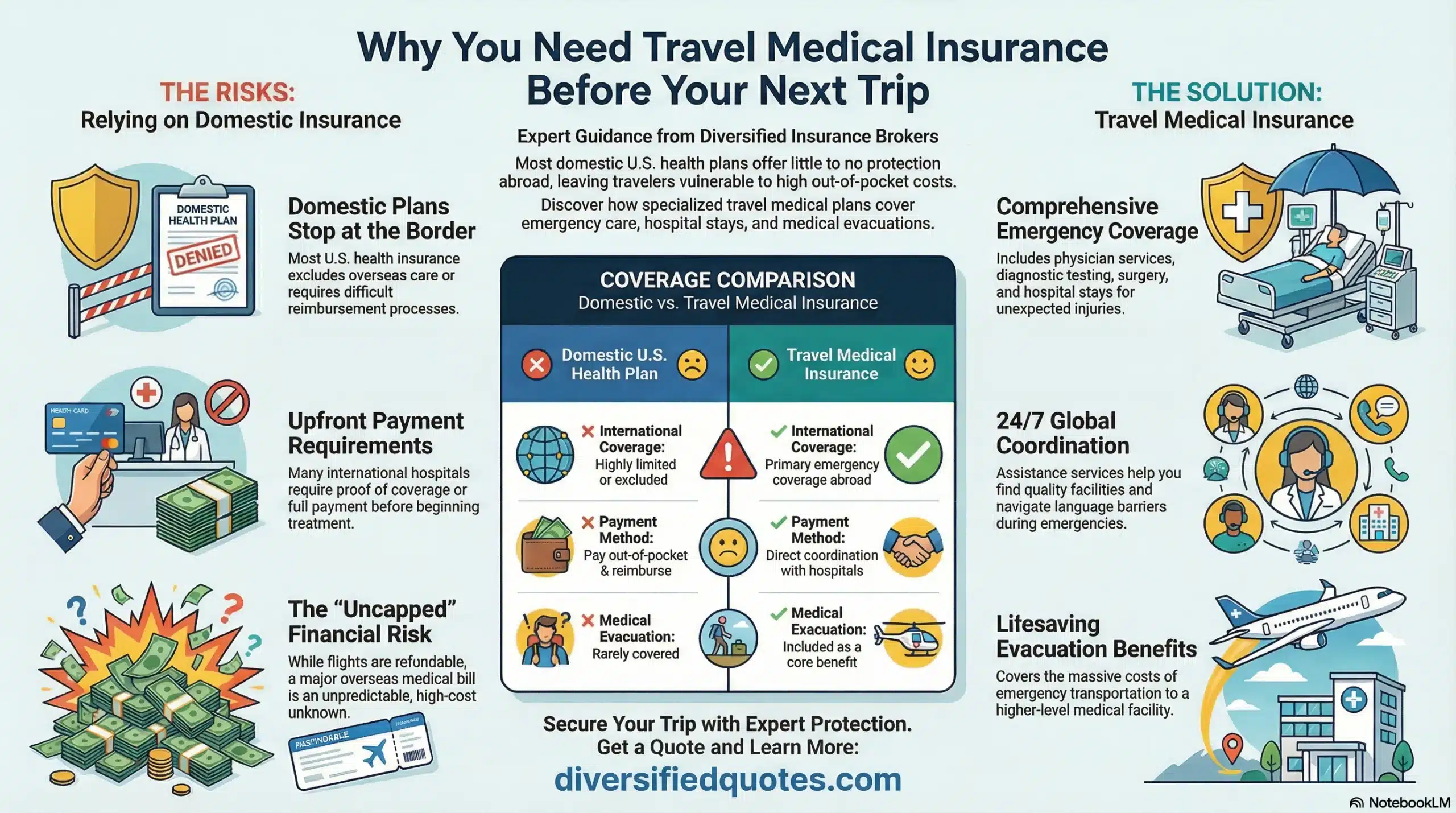
Talk With an Advisor Today
Choose how you’d like to connect—call or message us, then book a time that works for you.
Schedule here:
calendly.com/jason-dibcompanies/diversified-quotes
Licensed in all 50 states • Fiduciary, family-owned since 1980
Frequently Asked Questions: Travel Medical and Evacuation Insurance for South Sudan
Where would a medical evacuation from South Sudan typically go?
The primary evacuation destination from South Sudan is Nairobi, Kenya — which has the most accessible combination of direct air connections from Juba, extensive specialty medical capability at facilities including Aga Khan Hospital Nairobi, Nairobi Hospital, and Karen Hospital, and long-established East African medical evacuation infrastructure. Kampala, Uganda is the primary secondary destination for cases where Nairobi routing is not available or where the patient’s location in western South Sudan makes Ugandan routing more practical. Addis Ababa, Ethiopia serves as an alternative for some case types depending on transport availability and specific clinical requirements. For most evacuations, Juba serves as a staging point where the patient is transferred from a local or regional clinic to an appropriate air transport connection for the international leg of the evacuation — the assistance team manages the full logistics chain including the Juba staging coordination.
Does travel medical insurance cover conflict-related injuries in South Sudan?
This depends on the specific war and hostilities exclusion language in the specific plan under consideration — there is no universal answer applicable to all travel medical plans. Some plans exclude injuries sustained as a direct result of war, civil war, or armed conflict regardless of the traveler’s role or circumstances. Other plans are drafted more broadly and provide coverage for civilian travelers who sustain injuries in conflict-affected areas without direct participation in the conflict. The language varies significantly between carriers and between plan designs, and confirming how the specific plan treats conflict-zone injuries before purchasing is essential for South Sudan travel — particularly for humanitarian workers, journalists, and contractors whose assignments may take them to active or recently active conflict areas. This must be verified in actual policy exclusion language rather than assumed from general descriptions or marketing materials.
What evacuation and medical limits should I target for South Sudan travel?
Emergency medical limits of $100,000 or more are a reasonable baseline for South Sudan travel, reflecting the potential cost of inpatient care at the best available local facilities plus treatment at the receiving facility in Nairobi or Kampala after evacuation. For evacuation and repatriation, limits of $250,000 to $500,000 or more are commonly recommended because a serious South Sudan evacuation involving multiple transport legs — ground or air to Juba, international air ambulance or escorted commercial flight to Nairobi, and receiving hospital care — can reach $50,000 to $150,000 or more in logistics costs before receiving hospital treatment costs begin. Travelers operating outside Juba in remote oil sector, NGO field, or conflict-adjacent locations should target the higher end of that range because the logistics complexity and transport distance involved are greater than for Juba-based operations.
What is the difference between medical evacuation and security evacuation in South Sudan?
Medical evacuation transports a patient to the nearest appropriate medical facility when the patient’s condition requires care not available locally — triggered by physician certification of medical necessity and coordinated by the plan’s assistance team based on clinical criteria. Security evacuation removes individuals from South Sudan because of non-medical threats: armed conflict, instability, government action, or personal safety risks that exist independent of any medical condition. Standard travel medical plans cover medical evacuation and do not cover security evacuation. In South Sudan, where both categories of risk coexist and can emerge simultaneously, travelers and organizations who want protection against both must purchase separate specialized security evacuation coverage independently. The two products address different risk categories and cannot substitute for each other.
How should organizations structure coverage for staff deployed across multiple South Sudan field locations?
Organizations deploying multiple staff across different South Sudan locations benefit from group travel medical plans that provide consistent coverage across the full roster rather than managing individual policies for each staff member. Group plans simplify enrollment and documentation administration, ensure consistent benefit levels including evacuation limits appropriate for South Sudan’s most remote deployment locations, and facilitate organizational coordination when a staff medical event requires institutional-level response. Organizations should confirm that the group plan covers all South Sudan regions including conflict-affected areas where staff may be deployed, that evacuation limits are adequate for the most remote locations, that war and hostilities exclusion language is appropriate for the specific deployment context, and that the assistance team has documented operational experience in South Sudan. Staff with significant pre-existing medical conditions should review individual eligibility under group plan terms before deployment.
About the Author:
Jason Stolz, CLTC, CRPC, DIA, CAA and Chief Underwriter at Diversified Insurance Brokers (NPN 20471358), is a senior insurance and retirement professional with more than 25 years of real-world experience helping individuals, families, and business owners protect their income, assets, and long-term financial stability. As a long-time partner of the nationally licensed independent agency Diversified Insurance Brokers, Jason provides trusted guidance across multiple specialties—including fixed and indexed annuities, long-term care planning, personal and business disability insurance, life insurance solutions, Group Health, Travel Medical and Evacuation Insurance, and short-term health coverage. Diversified Insurance Brokers maintains active contracts with over 100 highly rated insurance carriers, ensuring clients have access to a broad and competitive marketplace.
His practical, education-first approach has earned recognition in publications such as VoyageATL, and contributions from his agency featured in Kiplinger and GoBankingRates— highlighting his commitment to financial clarity and client-focused planning. Drawing on deep product knowledge and years of hands-on field experience, Jason helps clients evaluate carriers, compare strategies, and build retirement and protection plans that are both secure and cost-efficient. Visitors who want to explore current annuity rates and compare options across multiple insurers can also use this annuity quote and comparison tool.
Explore More Travel Medical Insurance Options: Browse our complete guide to Africa & Middle East Travel Medical Insurance — covering medical evacuation coverage for Africa, Middle East & high risk destinations.
Last Reviewed: June 17, 2026 |
Reviewed by: Jason Stolz, CLTC, CRPC, DIA, CAA
Chief Underwriter, Diversified Insurance Brokers, Inc. | NPN: 20471358 | Diversified Insurance Brokers, Inc. — Licensed in all 50 states
Fact Checked by: Tonia Pettitt, CMIP©
Medicare Specialist, Diversified Insurance Brokers, Inc. | NPN: 14374308 | Diversified Insurance Brokers, Inc. — Licensed in all 50 states
Did you find this content helpful? Leave us a Google review — it helps others find trustworthy guidance too.
Editorial Standards: Diversified Insurance Brokers maintains rigorous editorial standards to ensure accuracy, clarity, and independence in all content. Learn more about our editorial standards and commitment to transparency.
