
Group Health Insurance for Volunteer Organizations
As an Independent Group Health Insurance Broker, we compare fully insured, level-funded, and self-funded options across carriers to find the lowest cost coverage for your business.
Group Health Insurance for Volunteer Organizations

Jason Stolz CLTC, CRPC, DIA, CAA
Group health insurance for volunteer organizations is a legitimate and achievable goal for many mission-driven nonprofits and community organizations — but it requires understanding a set of eligibility rules, structural options, and administrative realities that differ meaningfully from how group health works in a standard for-profit employer context. The most important foundational fact for any volunteer organization researching group health coverage is this: traditional group health insurance is built around the concept of common-law employees, not volunteers. Organizations that are entirely volunteer-run with no paid staff typically do not qualify for traditional small group health plans, because there is no employee group for the carrier to insure. However, many volunteer organizations do employ paid staff — executive directors, program coordinators, development officers, administrative team members — and for those organizations, group health insurance for volunteer organizations becomes fully accessible through the same carrier markets available to any small employer.
The further nuance that makes group health insurance for volunteer organizations planning more complex than standard employer benefits is the range of hybrid organizational structures common in the nonprofit sector: part-time paid staff alongside full-time volunteers, stipend-based program participants who occupy an ambiguous classification zone between employee and volunteer, board members with varying levels of financial involvement, and multi-state operations where some staff work remotely. Each of these structural realities affects which coverage options are available, which employees qualify, and which plan designs satisfy both carrier participation requirements and ACA compliance obligations. At Diversified Insurance Brokers, we help volunteer-based nonprofits evaluate which group health structure fits their actual staffing model — not a theoretical ideal — and identify compliant plan options that fit within the financial reality of mission-driven budget constraints. Our resource on group health insurance fundamentals covers the baseline framework that applies across all employer types, and our resource on small business group health insurance covers the small-group market specifically relevant to most volunteer organizations.
Get a Group Health Review for Your Volunteer Organization
We’ll confirm employee eligibility rules for your organization, explain which coverage structures are realistically available, and help you identify compliant group health options that fit your staffing model and budget.
Request a Group Health ReviewDo Volunteer Organizations Qualify for Group Health Insurance?
Group health insurance for volunteer organizations is available whenever the organization has at least one common-law employee — the legal standard that determines whether someone is an employee for benefits and tax purposes, rather than an independent contractor or volunteer. Most carriers also require a minimum of two employees who are eligible and who enroll, though the specific minimum enrollment requirements vary by carrier, state, and plan type. The key threshold question for any volunteer organization is not “do we have people who work for us” but “do we have people who work for us and meet the legal definition of an employee for group health insurance purposes.”
The IRS common-law employee test focuses on whether the organization controls both what work is done and how that work is done. Someone who follows the organization’s schedule, uses its equipment, works at its direction, and receives regular compensation — regardless of whether that compensation is called a “stipend” — is more likely to be classified as an employee than as a volunteer. By contrast, someone who contributes time entirely at their own discretion, receives only reimbursement for out-of-pocket expenses, and directs their own activities is more clearly a volunteer for these purposes. The classification line is not always obvious, particularly for long-term organizational volunteers who take on substantial operational roles — and organizations that misclassify their workforce create compliance exposure that can surface at exactly the wrong time, such as during a benefits claim or an audit.
For volunteer organizations that do have paid employees, group health insurance for volunteer organizations proceeds through the same eligibility framework as any other small employer. The organization must be a legal entity (corporation, LLC, nonprofit corporation, or similar structure), must be able to demonstrate an employer-employee relationship through payroll records, and must meet the carrier’s minimum participation requirements. Our resource on minimum employees for group health insurance covers the specific thresholds that carriers apply and explains how participation requirements interact with the total eligible employee count in small organizations.
Employees vs. Volunteers — The Classification That Determines Group Health Eligibility
| Role Type | Group Health Eligibility | Key Classification Factors | Alternative Coverage Options |
|---|---|---|---|
| Paid full-time staff (Executive Director, Program Manager, Operations Coordinator) | Eligible — typically the core of group health eligibility | W-2 compensation, defined hours, organization-directed work, regular payroll | Group plan is primary option; ICHRA alternative if group plan not feasible |
| Paid part-time staff (below carrier’s minimum hours threshold, typically 30 hrs/week) | Conditional — many group plans require minimum weekly hours; part-time may be excluded from group but eligible for ICHRA | Hours worked per week; carrier’s minimum eligibility threshold; W-2 vs 1099 | ICHRA for part-time class; marketplace individual coverage; short-term medical |
| Stipend-based program participants or AmeriCorps members | Ambiguous — depends on stipend structure, IRS classification, and nature of arrangement; legal review recommended before extending group plan eligibility | Whether stipend is W-2 compensation or non-wage; direction and control; organizational dependency | Program-specific coverage (some AmeriCorps programs have dedicated health options); ICHRA if W-2 classification applies |
| Board members (unpaid or nominal compensation for service) | Generally not eligible — board service is not typically an employment relationship for group health purposes | Volunteer service rather than employment; no W-2 relationship in most cases | Individual marketplace coverage; their own employer coverage if otherwise employed; Medicare if age-eligible |
| Regular volunteers (no compensation beyond expense reimbursement) | Not eligible for group health plan — volunteers are not employees for group insurance purposes | No W-2 employment relationship; self-directed activities; expense reimbursement only | Volunteer accident/liability insurance (separate product category); individual coverage through marketplace |
| Independent contractors (1099) providing regular services | Carrier-dependent — some carriers allow 1099 contractors to be added to a group plan; many do not. Eligibility varies by carrier and state. Including 1099 workers carries worker misclassification risk and potential MEWA compliance issues that require legal review before enrollment | No W-2 relationship by default; carrier policy governs whether 1099 workers can be included; employer contributions toward contractor premiums may be taxable to the contractor; Section 125 pre-tax premium treatment generally unavailable for 1099s | Individual marketplace coverage; self-employed health insurance deduction on contractor’s own tax return; ICHRA if organization wants to reimburse rather than enroll; association health plans if contractor qualifies through a trade or professional association |
The classification table clarifies the central design challenge of group health insurance for volunteer organizations: the coverage that most organizations want to provide broadly — to everyone who contributes meaningfully to the mission — is legally restricted to the subset of those contributors who qualify as common-law employees under the IRS definition. Attempting to extend group health eligibility beyond that defined employee group creates compliance risk that can produce coverage disputes, carrier audit problems, or IRS reporting issues. The correct approach is to design the group health plan around the accurate employee classification, then address the broader organizational coverage need through separate tools — volunteer accident insurance, ICHRA for specific employee classes, or individual marketplace guidance for those who need coverage but do not qualify for the group plan.
Coverage Structure Options for Volunteer Organizations with Paid Staff
Group health insurance for volunteer organizations with qualifying paid employees can take several structural forms, and the right structure depends on the organization’s employee count, budget, administrative capacity, and the diversity of its workforce demographics. The four primary structures available to most volunteer organizations are: traditional fully insured group health, level-funded group health, QSEHRA (Qualified Small Employer Health Reimbursement Arrangement), and ICHRA (Individual Coverage HRA). Understanding what each structure is, how it works, and who it fits best allows organizational leadership to make an informed selection rather than defaulting to the first product they are quoted.
Traditional fully insured group health insurance is the most familiar structure and the most straightforward to administer. The organization selects a group health plan from a carrier, pays a defined monthly premium per enrolled employee, and the carrier bears the financial risk of the group’s health claims. In exchange for this risk transfer, the carrier charges premiums based on employee demographics, location, and plan design — and the employer has no direct exposure to individual claims costs beyond the premium. For group health insurance for volunteer organizations with relatively small employee counts, fully insured small-group plans provide predictability and simplicity that supports lean nonprofit administrative teams. The downside is that premium increases at renewal — driven by general healthcare cost trends and any changes in the enrolled group — are entirely outside the organization’s control.
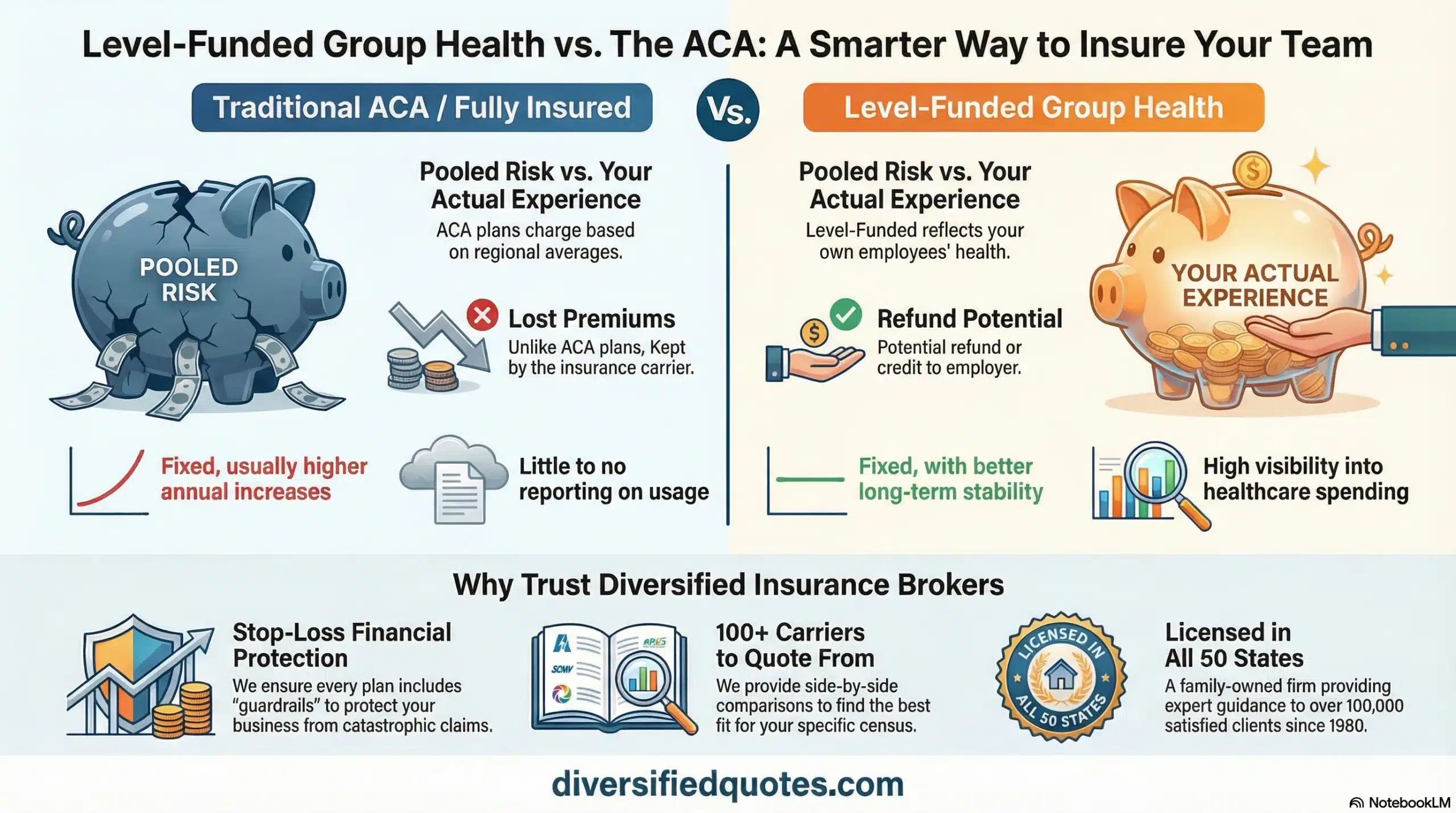
Level-funded group health plans represent a hybrid structure between fully insured and self-funded that is increasingly available to smaller employers, often at groups of five or more employees. In a level-funded structure, the organization pays a fixed monthly amount — like a traditional premium — but that amount is divided between a claims fund, stop-loss insurance, and administrative fees. If the group’s claims come in below the projected level by year-end, the organization receives a refund or credit on unused claims fund dollars. If claims exceed the stop-loss threshold, the stop-loss insurance protects the organization from excess exposure. Level-funded plans can provide more pricing transparency and the upside of favorable claims experience, but they require slightly more understanding of the funding mechanics and are not available in all states. Our resource on why group level funding covers this structure in detail, and our resource on what is self-funded group health insurance covers the full self-funded framework that level-funded is designed to approximate for smaller groups.
The QSEHRA and ICHRA structures represent a fundamentally different approach — reimbursement-based rather than plan-based. Instead of the organization purchasing a group health plan and enrolling employees in it, the organization establishes a defined monthly dollar allowance and reimburses employees tax-free for their individual health insurance premiums and qualifying medical expenses. Employees purchase their own ACA-compliant individual coverage through the marketplace or directly from carriers, and the organization reimburses them up to the defined allowance. These structures are particularly valuable for group health insurance for volunteer organizations contexts where the employee count is too small for traditional group plan participation requirements, where geographic diversity makes a single network plan impractical, or where employees have existing marketplace coverage they prefer to maintain.
QSEHRA — The Group Health Alternative for Small Volunteer Nonprofits Under 50 Employees
The Qualified Small Employer Health Reimbursement Arrangement (QSEHRA) was created under the 21st Century Cures Act and allows organizations with fewer than 50 full-time equivalent employees to reimburse employees tax-free for individual health insurance premiums and qualifying medical expenses — without operating a traditional group health plan. For many small volunteer organizations that have paid staff but struggle to meet group plan participation requirements or simply cannot afford the full premium cost of a traditional group plan, the QSEHRA represents the most practical entry point for group health insurance for volunteer organizations of that scale.
The QSEHRA mechanics are straightforward: the organization sets a defined monthly reimbursement allowance for employees, employees purchase ACA-compliant individual health coverage through the marketplace or directly from carriers, and the organization reimburses documented qualifying expenses up to the allowance — tax-free to the employee and deductible to the organization as a business expense. Annual contribution limits are set by the IRS each year (these limits are adjusted annually and should be confirmed with a current IRS publication or benefits advisor before implementation). Employers cannot offer a traditional group health plan alongside a QSEHRA to the same employees — it is one or the other for any given employee class.
For group health insurance for volunteer organizations that qualify, the QSEHRA’s primary advantages are budget control (the maximum employer cost is the defined allowance, not variable claims), administrative simplicity compared to operating a group plan, and flexibility for employees who may prefer to choose their own coverage rather than accept a single plan selected by the organization. The primary limitations are the employee count cap (fewer than 50 FTEs) and the annual contribution limits, which may not fully reimburse employees at higher income levels who are not eligible for marketplace subsidies. Organizations with 50 or more employees must use an ICHRA rather than a QSEHRA if they want a reimbursement-based approach.
ICHRA — Flexible Reimbursement for Any-Size Volunteer Organization
The Individual Coverage HRA (ICHRA), established under a 2019 federal rule effective in 2020, extends the reimbursement-based approach to employers of any size — including volunteer organizations with just one or two W-2 employees. Unlike the QSEHRA, the ICHRA has no employee count limit, no maximum contribution limit, and allows employers to structure different reimbursement amounts for different employee classes (full-time vs. part-time, salaried vs. hourly, employees in different geographic locations). For group health insurance for volunteer organizations with diverse staffing structures — full-time leadership staff, part-time program staff, and remote employees in multiple states — the ICHRA’s class-based design provides coverage flexibility that a single group plan often cannot accommodate.
The data suggests the ICHRA is gaining significant adoption: research as of 2025 found that approximately 83% of organizations offering an ICHRA or QSEHRA previously offered no health coverage at all. This pattern reflects how these reimbursement tools have opened health benefits access to small organizations — including many nonprofit and volunteer organizations — that found traditional group plan participation requirements or premium costs prohibitive. For a volunteer organization with three full-time paid employees and two part-time employees, an ICHRA can provide each employee with a defined monthly allowance to purchase individual coverage through the marketplace, at a total employer cost that is precisely defined and fully budgetable without any exposure to variable claim costs.
ICHRA can also be offered alongside a traditional group plan to different employee classes — for example, a volunteer organization could offer group health insurance to its full-time staff and an ICHRA to its part-time staff. The key compliance requirement is that the same class of employees cannot be offered both a group plan and an ICHRA simultaneously as alternatives. Our resource on group health insurance cost for small business covers the premium benchmarks that help organizations evaluate whether ICHRA reimbursement levels are competitive with what a traditional group plan would cost, and our resource on how to set up group health insurance for employees covers the implementation process for both group plan and reimbursement-based approaches.
Why Group Health Insurance Matters Even for Budget-Constrained Volunteer Organizations
Group health insurance for volunteer organizations is not a luxury benefit for well-funded nonprofits — for organizations that employ any paid staff, it is often one of the most consequential retention and recruitment factors that organizational leadership controls. The nonprofit sector frequently competes for executive directors, program managers, development professionals, and administrative leaders against private-sector employers who offer significantly higher base compensation. In that competitive context, a meaningful health benefits package can be the deciding factor for qualified candidates who are genuinely motivated by the organization’s mission but cannot afford to take a position that leaves them without health coverage for themselves or their family.
The organizational stability argument is equally compelling. Research consistently shows that employees who lack adequate healthcare access are more likely to delay treatment for manageable conditions, more likely to experience extended illness that affects work capacity, and more likely to experience financial stress related to healthcare costs — all of which affect performance and retention in ways that directly impact mission delivery. For volunteer organizations where a single executive director or program leader carries significant institutional knowledge and community relationships, losing that person due to a benefits gap can set organizational capacity back by years. Group health insurance for volunteer organizations is an investment in continuity, not merely a compensation line item.
The 2025 average annual premium benchmarks provide useful context for budget planning: national average self-only group health premiums were approximately $9,325 per year, and family coverage averaged approximately $26,993 per year. Employers typically contribute a portion of this cost — the specific percentage varies by organization, but many small nonprofits contribute 50% to 75% of self-only premiums and a lower percentage of dependent coverage costs. Our resource on top questions employers ask about group health insurance covers the employer contribution and participation mechanics that most directly affect how these costs land in the organization’s actual budget.
Participation Requirements — The Small-Group Challenge for Volunteer Organizations
One of the most practically challenging aspects of group health insurance for volunteer organizations is meeting carrier participation requirements with a small eligible employee count. Most group health insurance carriers require that a minimum percentage of eligible employees enroll in the plan — commonly 50% to 75% of eligible employees who do not have other group coverage. In a large organization, a 70% participation requirement is usually manageable even with some opt-outs. In an organization with three eligible employees, a 70% participation requirement means at least two of the three must enroll — and if one waives coverage because they are covered under a spouse’s plan, the math may not work unless the carrier’s rules credit spousal coverage as a valid waiver.
Volunteer organizations with very small employee counts — two, three, or four eligible employees — need to understand participation requirements at the point of selecting a carrier and plan, not after enrollment falls short of the threshold. Employees who waive coverage because they have other group health coverage (such as a spouse’s employer plan) typically count as valid waivers and do not negatively affect participation rate calculations. Employees who waive for any other reason are typically counted against participation. Our resources on group health insurance for 2-person business and group health insurance for 10 employees cover how participation requirements and plan availability change at specific organization sizes — directly relevant for volunteer organizations building coverage from a small base of eligible employees.
ACA Compliance Obligations for Volunteer Organizations Offering Group Health
Volunteer organizations offering group health insurance for volunteer organizations must comply with the same ACA requirements applicable to any employer of their size. For organizations with fewer than 50 full-time equivalent employees — the majority of volunteer-based nonprofits — there is no ACA employer mandate requiring health insurance to be offered. However, if group health insurance is offered, it must comply with ACA requirements including essential health benefits coverage (for fully insured small-group plans), prohibition on annual and lifetime benefit limits, coverage of preventive services without cost-sharing, dependent coverage to age 26, and prohibition on pre-existing condition exclusions. These requirements apply whether the employer is a for-profit business or a tax-exempt nonprofit organization.
For organizations with 50 or more full-time equivalent employees — applicable large employers (ALEs) under the ACA — the employer mandate applies regardless of nonprofit status: the organization must offer minimum essential coverage to full-time employees or face potential penalties. The ALE determination uses a specific calculation that counts both full-time employees and full-time equivalent employees calculated from part-time hours — meaning a volunteer organization with 30 part-time paid staff could qualify as an ALE even if no single employee works full-time. Any volunteer organization approaching this threshold should confirm their ALE status annually.
Compliance also includes administrative obligations: maintaining enrollment records, providing required plan documents and summary plan descriptions to enrolled employees, coordinating COBRA continuation coverage rights when employees leave, and meeting state-specific requirements that may exceed federal minimums. Our resource on what is the primary reason to buy group health insurance covers the compliance and protection framework from the employer perspective.
Get Group Health Options for Your Volunteer Organization
Tell us your staffing model, employee count, and budget parameters — we’ll outline compliant group health structures with realistic eligibility and cost expectations specific to volunteer-based organizations.
Request Group Health OptionsRelated Group Health Planning Resources
Explore group health structure guides, cost benchmarks, and implementation resources for small organizations and nonprofits.
Financial Protection Essentials for Nonprofit Organizations
Explore group health options by organization type and size — and connect to related planning resources for nonprofit staff and leadership.
Talk With an Advisor Today
Choose how you’d like to connect—call or message us, then book a time that works for you.
Schedule here:
calendly.com/jason-dibcompanies/diversified-quotes
Licensed in all 50 states • Fiduciary, family-owned since 1980
Frequently Asked Questions: Group Health Insurance for Volunteer Organizations
Can a volunteer organization offer group health insurance?
Yes — if the organization has at least one common-law employee. Group health insurance for volunteer organizations is available to any organization that employs qualifying paid staff who meet the carrier’s eligibility requirements, regardless of the organization’s nonprofit or volunteer-driven nature. Purely volunteer-run organizations with no paid staff typically do not qualify for traditional group health insurance because there is no employee group to insure. Organizations with as few as one or two qualifying paid employees can often access small-group coverage, ICHRA, or QSEHRA structures depending on their staffing model and state of operation.
Can volunteers be covered under a group health plan?
Generally no. Group health insurance is structured around the concept of common-law employees, and volunteers who are not compensated through W-2 payroll do not qualify as employees for group health purposes — even when they contribute significant time and effort. Extending group health eligibility to volunteers creates compliance risk related to plan terms, carrier eligibility rules, and IRS classification requirements. The appropriate coverage for volunteers’ health-related risk within an organizational context is typically addressed through separate tools such as volunteer accident insurance, which covers injury or illness occurring during volunteer activities — not the same as comprehensive group health insurance but designed specifically for the volunteer relationship.
What is the difference between QSEHRA and ICHRA for volunteer organizations?
Both are reimbursement-based alternatives to traditional group health plans that allow employers to provide tax-free allowances for employees to purchase individual ACA-compliant coverage. The key differences: QSEHRA is only available to organizations with fewer than 50 full-time equivalent employees, has IRS-set annual maximum contribution limits (adjusted yearly), and cannot be offered to the same employees who have a traditional group plan. ICHRA is available to any employer with at least one W-2 employee regardless of size, has no maximum contribution limit, can be offered to different employee classes with different allowance amounts, and can coexist alongside a traditional group plan for different employee classes. For most small volunteer organizations under 50 employees, QSEHRA is the simpler implementation; for larger or more structurally complex organizations, ICHRA provides greater flexibility.
How many employees does a volunteer organization need for group health insurance?
Most traditional group health carriers require a minimum of two eligible employees, with a participation requirement — commonly 50% to 75% of eligible employees who do not have other group coverage must enroll. Some carriers accept groups as small as one employee in specific states or product lines. For ICHRA and QSEHRA reimbursement structures, the minimum is one W-2 employee. The practical challenge for group health insurance for volunteer organizations is meeting participation requirements with a very small eligible employee base — if only two or three employees are eligible and one waives coverage because they have spousal coverage, the remaining enrollment count must still satisfy the carrier’s percentage threshold. Our resource on minimum employees for group health insurance covers these thresholds in detail.
Do ACA employer mandate requirements apply to volunteer organizations?
Yes, if the organization qualifies as an Applicable Large Employer (ALE) — defined as having 50 or more full-time equivalent employees when counting both full-time employees and a calculation-based equivalent for part-time hours. Nonprofit status and tax-exempt status do not exempt an organization from the ACA employer mandate. Most small volunteer organizations with small paid staff teams do not reach the ALE threshold. However, volunteer organizations that employ many part-time paid staff alongside core full-time leadership should calculate their FTE count annually to confirm their ALE status, because the FTE calculation can aggregate part-time hours in ways that push an organization above the 50-employee threshold even when no single employee works full-time.
How do volunteer organizations typically control group health insurance costs?
The most effective cost-control approaches for group health insurance for volunteer organizations are structural rather than reactive. Choosing a plan design with moderate deductibles and strong preventive care coverage reduces both claims costs and employee cost-sharing friction. Setting employer premium contributions at a level the organization can sustain year-over-year prevents the disruptive benefit reductions that damage morale and retention. Reviewing renewal terms early — at least 90 days before renewal — gives the organization time to evaluate alternatives rather than accepting whatever rate increase the carrier proposes. For organizations where group plan participation requirements are challenging, ICHRA or QSEHRA structures provide budget-defined maximum employer costs without claims exposure. Level-funded plans can provide refunds for favorable claims years, but require more administrative engagement with plan performance data.
About the Author:
Jason Stolz, CLTC, CRPC, DIA, CAA and Chief Underwriter at Diversified Insurance Brokers (NPN 20471358), is a senior insurance and retirement professional with more than 25 years of real-world experience helping individuals, families, and business owners protect their income, assets, and long-term financial stability. As a long-time partner of the nationally licensed independent agency Diversified Insurance Brokers, Jason provides trusted guidance across multiple specialties—including fixed and indexed annuities, long-term care planning, personal and business disability insurance, life insurance solutions, Group Health, Travel Medical and Evacuation Insurance, and short-term health coverage. Diversified Insurance Brokers maintains active contracts with over 100 highly rated insurance carriers, ensuring clients have access to a broad and competitive marketplace.
His practical, education-first approach has earned recognition in publications such as VoyageATL, and contributions from his agency featured in Kiplinger and GoBankingRates— highlighting his commitment to financial clarity and client-focused planning. Drawing on deep product knowledge and years of hands-on field experience, Jason helps clients evaluate carriers, compare strategies, and build retirement and protection plans that are both secure and cost-efficient. Visitors who want to explore current annuity rates and compare options across multiple insurers can also use this annuity quote and comparison tool.
Explore More Group Health Insurance Options: Browse our complete guide to Group Health Insurance by Industry — covering law firms, consulting, construction, medical practices, schools & more from 100+ carriers.
Last Reviewed: June 13, 2026 |
Reviewed by: Jason Stolz, CLTC, CRPC, DIA, CAA
Chief Underwriter, Diversified Insurance Brokers, Inc. | NPN: 20471358 | Diversified Insurance Brokers, Inc. — Licensed in all 50 states
Fact Checked by: Tonia Pettitt, CMIP©
Medicare Specialist, Diversified Insurance Brokers, Inc. | NPN: 14374308 | Diversified Insurance Brokers, Inc. — Licensed in all 50 states
Did you find this content helpful? Leave us a Google review — it helps others find trustworthy guidance too.
Editorial Standards: Diversified Insurance Brokers maintains rigorous editorial standards to ensure accuracy, clarity, and independence in all content. Learn more about our editorial standards and commitment to transparency.
