
What is the Primary Reason To Buy Group Health Insurance
As an Independent Group Health Insurance Broker, we compare fully insured, level-funded, and self-funded options across carriers to find the lowest cost coverage for your business.
What is the Primary Reason To Buy Group Health Insurance

Jason Stolz CLTC, CRPC, DIA, CAA
The primary reason to buy group health insurance is to give employees affordable access to healthcare while building the stable, competitive workforce that every business depends on to operate and grow. When an employer offers group coverage, employees are pooled under a single insurance policy, and that shared-risk structure allows carriers to offer broader coverage and more predictable premiums than any individual could obtain independently. According to the KFF 2025 Employer Health Benefits Survey, employer-sponsored insurance covers approximately 154 million Americans under the age of 65 — making group health coverage the foundation of the healthcare system for working-age adults in this country. The average annual premium for a single employee in 2025 was $9,325, and for family coverage $26,993, with employers absorbing a significant portion of that cost as a business expense while employees contribute the remainder through pre-tax payroll deductions. The scale and structure of that arrangement is not incidental — it reflects how decisively group coverage has become the standard through which most Americans access care, and how central the employer’s decision to offer it is to whether employees in any given workplace have meaningful healthcare access at all.
For employers, the primary reason to offer group health insurance is not compliance — it is competitive survival. Group health insurance is the most in-demand employee benefit in the American labor market, consistently ranked above retirement plans, paid time off, flexible schedules, and every other category of workplace perk. Research from ADP shows that 82% of employees rank group health insurance as their single most important benefit, and 93% rank it in their top three. These are not abstract preferences — they translate directly into hiring outcomes, retention rates, and the organizational stability every business needs to execute its long-term strategy. Healthcare costs are simultaneously one of the largest financial concerns for both employers and employees, and the shared-risk structure of group insurance is the mechanism that makes those costs manageable at scale. Without group coverage, routine medical visits, prescription medications, diagnostic tests, and preventive care become expensive enough to delay or avoid — with consequences that compound over time into workforce health problems, productivity losses, and absenteeism that ultimately cost employers more than the premiums would have. Businesses evaluating how healthcare costs are actually structured can begin with our overview of is health insurance expensive, which explains how coverage design affects what employers and employees pay in total.
Speak With an Insurance Advisor
Why Group Health Insurance Is the Primary Reason Employers Invest in Benefits
Group health insurance occupies a category by itself in employee benefits — not because it is the most complex benefit to administer, but because it is the one that employees weight most heavily when deciding where to work and whether to stay. The research on this is unambiguous. According to a 2025 Selerix Benefits Survey, employees satisfied with their benefits are five times more likely to say they will remain with their employer. They are also 3.5 times more likely to trust company leadership — and trust is one of the strongest independent predictors of long-term retention regardless of compensation level. Perhaps most strikingly, 73% of surveyed employees say benefits matter as much or more than salary when deciding whether to stay in a role or accept a competing offer. That dynamic means that an employer who competes only on wages and neglects benefits quality is systematically losing talent to employers who understand that total compensation includes what the job provides for the employee’s health and financial security.
ADP’s employee benefits research adds another dimension: when employees feel genuinely cared for at work, they report being 17% more engaged, 17% more loyal, 12% more productive, and 29% more holistically healthy than employees who do not feel that their employer cares about them. Group health insurance is the most tangible and most valued signal an employer can send that they are invested in employee well-being at a meaningful level — more tangible than a mission statement, more credible than a wellness app, and more impactful than most other benefits combined. Employee retention was the number one HR priority for organizations in 2025 according to Aflac’s research — which means the benefit that most directly drives retention is also the strategic priority that employers most need to address well. These two facts are not a coincidence; they reinforce each other.
Many employers also build complementary protections into their benefits programs alongside health coverage. Organizations evaluating total benefit design often add policies such as key person disability insurance to protect the business itself from financial disruption if a critical employee becomes unable to work — pairing workforce healthcare protection with business continuity protection at the organizational level. Broader financial risk management, including investment risk analysis for the business itself, is also often evaluated alongside employee benefits because the goal is reducing financial uncertainty across all dimensions of the organization’s exposure, not just healthcare alone.
The Core Advantages of Group Health Insurance — Side by Side
Before examining each reason to offer group health insurance in depth, the table below maps the primary motivations employers have for buying group coverage against what each advantage actually produces for the business and for employees — so the full case for group health insurance is visible across all dimensions, not reduced to a single rationale.
| Primary Reason | What It Produces for Employees | What It Produces for the Business | The Cost of Not Offering It |
|---|---|---|---|
| Affordable Healthcare Access | Group buying power lowers per-person premiums well below what individuals could obtain independently; employees access preventive care, physician services, prescriptions, and hospital treatment without catastrophic out-of-pocket exposure | A healthier workforce takes fewer sick days and performs at a higher sustained level; employees who access preventive care address health concerns before they become disabling or expensive — reducing the operational disruption that unmanaged health conditions create | Uninsured employees delay or avoid care — producing presenteeism, absenteeism, and long-term workforce instability that costs more in lost productivity than the premiums would have cost the employer |
| Employee Recruitment | Candidates actively compare benefits packages when evaluating competing offers; strong coverage signals that the employer is financially stable and invested in the workforce beyond wage-level competition | Expands the pool of qualified candidates willing to consider the offer; differentiates the employer from competitors offering wage-only packages in markets where skilled candidates have multiple options and evaluate total compensation carefully | 38% of job seekers have turned down a position specifically because the benefits package wasn’t competitive — employers without health coverage permanently lose this segment of the candidate pool to employers who offer it |
| Employee Retention | Employees satisfied with benefits are 5x more likely to stay; 73% say benefits matter as much or more than salary when deciding whether to stay or leave; health coverage creates financial security that reduces the incentive to seek employment elsewhere | Reduces the cost of turnover — replacing an employee costs 50% to 200% of their annual salary when recruiting, onboarding, lost productivity, and institutional knowledge drain are fully tallied; retaining existing employees preserves operational continuity and team effectiveness | High turnover undermines operational consistency, signals workforce instability to remaining employees, and creates a self-reinforcing cycle of departures that worsens without structural investment in the benefits that prevent it |
| Tax Efficiency | Employee premium contributions are paid with pre-tax dollars through payroll deductions — reducing taxable income and making the employee’s effective share of coverage cost lower than the nominal deduction amount suggests | Employer premium contributions are 100% tax-deductible as a business expense and avoid payroll taxes — making group health coverage more tax-efficient than an equivalent salary increase, which is taxable to both employer and employee | Employers who offer only wage compensation pay more in payroll taxes for the same total cost while delivering less value per dollar to employees — making wage-only competition structurally less efficient than benefits-inclusive compensation |
| Risk Pooling and Pricing Stability | No individual medical underwriting — employees with pre-existing conditions receive the same coverage as healthy employees, removing the barrier that makes individual coverage inaccessible or prohibitively expensive for many workers | Shared risk across the group produces more predictable annual premium patterns than individually underwritten policies; employers can budget for benefits costs with greater confidence across planning cycles | Individual market coverage — even when available — costs more, covers less, and excludes employees with health conditions through underwriting; employees are exposed to volatility that affects their financial security and workplace focus |
| Workforce Productivity | Employees with healthcare access seek preventive and routine care that keeps minor issues from becoming major ones; reduced financial anxiety about medical costs improves focus, engagement, and sustained performance | Employees who feel cared for are 12% more productive and 17% more engaged; healthier employees take fewer sick days and maintain higher output — reducing the management burden of chronic absenteeism and presenteeism | Uninsured employees experience financial stress from medical costs that reduces workplace performance regardless of their effort level — productivity losses that the employer absorbs indirectly even without paying for coverage |
How Group Health Insurance Works — The Mechanics Behind the Advantage
Group health insurance operates differently from individual health insurance in ways that create the advantages outlined above. Instead of evaluating each employee individually for health risk, carriers assess the overall risk profile of the entire employee group — factoring in workforce demographics, geographic location, group size, and industry sector. Because risk is shared across all enrolled employees, the carrier’s actuarial exposure is more predictable than it would be with individual underwriting, and that predictability allows them to offer coverage at lower per-person rates than individual applicants could obtain. The practical consequence is that every employee in the group — including those with chronic conditions, prior diagnoses, or other health history that would make individual coverage expensive or unavailable — receives the same coverage as the healthiest person in the group, at the same premium rate.
Most employers share the cost of health insurance premiums with their employees through a defined contribution structure. The employer pays a fixed percentage of the monthly premium — typically between 70% and 80% for employee-only coverage — and employees contribute the remainder through pre-tax payroll deductions. According to the KFF 2025 survey, average premiums for 2025 were $9,325 for single coverage and $26,993 for family coverage, with employees contributing approximately $1,337 for single coverage and $6,296 for family on average. The premium-sharing arrangement is itself part of the benefit’s value: employees receive coverage whose total cost significantly exceeds what they pay, while the employer’s contribution comes with tax deductibility and payroll tax exclusion that make the effective net cost lower than the nominal premium amount suggests.
Group plans typically offer several coverage tiers that allow employees to select the level of protection that best fits their needs — varying by deductible, copayment structure, out-of-pocket maximum, and in some cases network breadth. Some employers offer multiple plan types simultaneously: a PPO with broader network flexibility at a higher premium alongside an HDHP at a lower premium that qualifies employees for Health Savings Account contributions. That optionality allows a diverse workforce with different financial situations and healthcare usage patterns to make informed choices rather than being forced into a single design that fits some employees well and others poorly. Some plans also include supplemental benefits such as dental coverage, vision insurance, mental health access, or telemedicine services — which have grown significantly in value as telehealth adoption became normalized among working adults.
Employers may also evaluate income protection options that complement the healthcare coverage they provide. Policies such as disability income insurance for physicians and professionals address the income gap that health insurance alone does not cover if an employee becomes unable to work due to illness or injury — an exposure that health coverage protects against in terms of medical bills but leaves unaddressed in terms of lost wages and business continuity.
The Recruitment Advantage — Why Benefits Win Candidates That Wages Cannot
Healthcare benefits have become a decisive factor in candidate decision-making in a way that was not always true in earlier labor markets. As the cost of individual health insurance has risen — premiums increased 7% in 2025 and are projected to rise as much as 18% in 2026 according to Aflac — the value of employer-sponsored group coverage has grown correspondingly. A candidate who can access $27,000 per year in family health coverage through an employer at a fraction of what it would cost to purchase individually is receiving a form of compensation that is both practically valuable and extremely difficult to replicate outside the employer relationship. That reality has made health benefits a central evaluation criterion for candidates who are making careful, long-term decisions about where to place their professional commitment.
The competitive dimension of this advantage is significant for employers of all sizes. In skilled labor markets, qualified candidates typically receive multiple offers or have the practical ability to generate them. The evaluation they perform across competing opportunities includes salary, career development, culture, and management quality — but it also includes benefits, and specifically healthcare, with a weight that often surprises employers who have focused their competitive thinking primarily on compensation. Research consistently shows that candidates routinely accept lower base salaries from employers with stronger benefits packages, particularly when healthcare quality, premium contribution structure, and dependent coverage are compared side by side. An employer who offers strong healthcare coverage can compete for talent at a salary level that would otherwise be insufficient if the offer were wage-only. That calculus changes the economics of talent acquisition for businesses that understand and leverage it.
Conversely, the cost of not being competitive on healthcare benefits is not zero. According to the 2025 Selerix Benefits Survey, 38% of job seekers have turned down a position specifically because the benefits package was not competitive enough — a permanent, structural loss of access to a significant fraction of the qualified candidate pool. Employers who operate without competitive health benefits are not simply leaving money on the table. They are systematically filtering out candidates who have the professional sophistication to evaluate total compensation, which in most industries correlates closely with the quality of candidates most valuable to the business.
The Retention Equation — What Turnover Actually Costs and What Benefits Prevent
Employee retention is the output that group health insurance most reliably produces, and the financial stakes of retention are larger than most employers intuitively estimate. Research from Work Institute and related analyses estimates that replacing an employee typically costs approximately 33% of that employee’s annual base salary when recruiting, onboarding, and the lost productivity period are fully accounted for. Broader analyses from Gallup and industry studies put the range at 50% to 200% of annual salary depending on role complexity, seniority, and the specialized skills required — with technical, managerial, and client-facing roles at the higher end. For an employer with a workforce of 50 employees at an average salary of $60,000, even a 15% annual turnover rate with conservative replacement cost assumptions represents a material six-figure annual expense that compounds year over year if root causes are not addressed.
Benefits quality is one of the most controllable root causes of voluntary turnover. According to the 2025 Selerix Benefits Survey, employees satisfied with their benefits are five times more likely to indicate they will stay with their employer than employees who are dissatisfied with their benefits. That multiplier means that investing in benefits quality is not simply a cost — it is a turnover-prevention mechanism with a calculable return. An employer who improves benefits quality and as a result reduces annual voluntary turnover from 20% to 12% on a 50-person workforce has avoided approximately four departures per year — each of which would have cost between $20,000 and $120,000 to replace depending on the role. The premium investment in better health coverage typically recaptures its cost in avoided turnover expense within the first year for most organizations with meaningful departure rates.
The retention dynamic also operates through trust and organizational culture in ways that extend beyond the purely financial calculation. ADP’s research demonstrates that employees who feel cared for by their employer are 17% more loyal and 17% more engaged than those who do not — and group health insurance is one of the most tangible and credible signals an employer can send that they are invested in employee well-being rather than simply extracting labor. MetLife’s research reinforces this: employees who feel their employer genuinely cares about them are approximately 1.3 times more likely to stay and 1.2 times more productive — which means the engagement and productivity benefits of offering strong health coverage compound on top of the direct retention benefits. The full ROI of group health insurance includes not just reduced turnover but also the sustained performance improvement of a workforce that feels supported.
The Tax Efficiency Argument — Why Health Benefits Beat Wage Increases
The tax treatment of group health insurance creates a structural advantage for employers that makes it the most efficient form of compensation increase available in most circumstances. Employer premium contributions are 100% tax-deductible as a business expense — reducing the company’s taxable income dollar for dollar. Unlike salary increases, employer health contributions avoid payroll taxes entirely, including the employer’s share of Social Security (6.2%) and Medicare (1.45%) taxes. The effective cost of a dollar invested in group health premiums is therefore lower than the effective cost of a dollar added to wages, even before accounting for the employee tax benefits.
On the employee side, premium contributions are paid through pre-tax payroll deductions under a Section 125 cafeteria plan arrangement — reducing the employee’s taxable income by the amount of their premium contribution. An employee in the 22% federal income tax bracket who contributes $2,000 per year in health premium deductions effectively saves $440 in federal income tax plus applicable state income taxes plus their share of FICA on that amount. The net cost of their coverage to them is meaningfully lower than the gross deduction amount. Employers who offer HSA-qualified high-deductible health plans create an additional layer of tax efficiency: employees can contribute to Health Savings Accounts on a pre-tax basis (up to $4,300 for self-only coverage and $8,550 for family coverage in 2025), allowing funds set aside for healthcare to grow tax-free and be withdrawn tax-free when used for qualified medical expenses.
The combined effect of these tax treatments means that a dollar invested in group health premiums delivers more total compensation value to the employee at lower net cost to the employer than the same dollar added to wages. An employer who understands this arithmetic uses it to compete more effectively for talent on a constrained budget — offering a total compensation package that is genuinely more valuable than the wage component alone suggests, because the benefits component includes tax efficiency that wage increases do not provide. For small businesses in particular, this arithmetic matters considerably: best group health insurance options for 2-person businesses addresses how even very small employers can access this tax advantage through structures designed for their group size.
Productivity, Absenteeism, and Presenteeism — The Hidden ROI of Group Coverage
The productivity argument for group health insurance is often stated in general terms but deserves more specific examination because it reflects a real and quantifiable operational impact. Absenteeism — employees missing work due to illness — is an obvious productivity cost, but it is also the more visible and therefore the more commonly discussed one. Presenteeism — employees arriving at work while sick, injured, or managing untreated health conditions, and performing below their effective capacity as a result — is a larger and less visible productivity drain that affects operations in ways that are harder to measure but no less real. Employees who lack health insurance coverage tend to delay seeking care for both conditions, which means that health issues that could be resolved in one or two physician visits accumulate into more significant problems that ultimately require more time away from work to address.
Access to preventive care — annual physicals, cancer screenings, blood pressure monitoring, diabetes management, and mental health support — is the mechanism through which group health insurance reduces the long-term cost of workforce health problems. An employee who sees a physician annually and has their chronic conditions monitored consistently is far less likely to experience the acute health events that produce extended absences than an employee who avoids care due to cost until a condition has progressed to a crisis. Employers who fund that preventive access through group health insurance are not simply being generous — they are investing in the workforce’s sustained operational capacity in a way that returns value through reduced absenteeism, more consistent performance, and lower turnover driven by health-related departures.
Mental health access has become a particularly important dimension of this productivity argument as awareness of mental health’s impact on workplace performance has grown. According to 2025 Aflac research, 90% of employers now offer some form of mental health coverage in their benefits programs — a near-universal adoption rate that reflects how decisively the employer community has recognized that mental health support is not a discretionary benefit but a workforce productivity investment. Employees managing untreated anxiety, depression, or stress-related conditions perform below their capacity consistently, and the cost of that underperformance accumulates in ways that dwarf the cost of the mental health benefits that would address it.
Group Health Insurance for Small Businesses — Why It Is More Accessible Than Most Assume
A persistent misconception in the small business community is that group health insurance is a benefit reserved for organizations above a certain size threshold — that small employers simply cannot access the same coverage structures that large corporations offer. This is not accurate. Many carriers offer group health insurance plans specifically designed for small businesses, and employers with as few as two employees may qualify for group coverage depending on the insurer’s guidelines and applicable state regulations. The group risk-pooling advantage — lower per-person premiums due to shared risk — scales across group sizes, including very small groups, though the premium advantage relative to individual coverage is smaller for two-person groups than for 50-person groups because the risk pool is shallower.
For small businesses, the recruitment and retention advantages of offering health coverage may be proportionally more significant than they are for large employers, because small businesses are competing for talent against larger organizations that typically offer more comprehensive benefits packages by default. A small employer who offers strong health coverage can compete for candidates who would otherwise default to larger employers on the assumption that small businesses cannot match their benefits. Conversely, a small employer who offers no health coverage is systematically disadvantaged against any competitor of any size who does offer it — and the 38% of candidates who have declined positions due to inadequate benefits represents a large enough share of the qualified candidate pool to represent a meaningful recruiting constraint.
Some employers integrate healthcare coverage with broader financial education resources for their employees, providing access to information on topics like Social Security advice for employees approaching retirement, or resources on financial risk management and long-term planning such as the long-term care planning playbook. These complementary resources reinforce the message that the employer cares about employees’ comprehensive financial security — not just their immediate healthcare access — which compounds the cultural and retention benefits of the health coverage itself.
Plan Design Choices — How Employers Structure Group Health Coverage
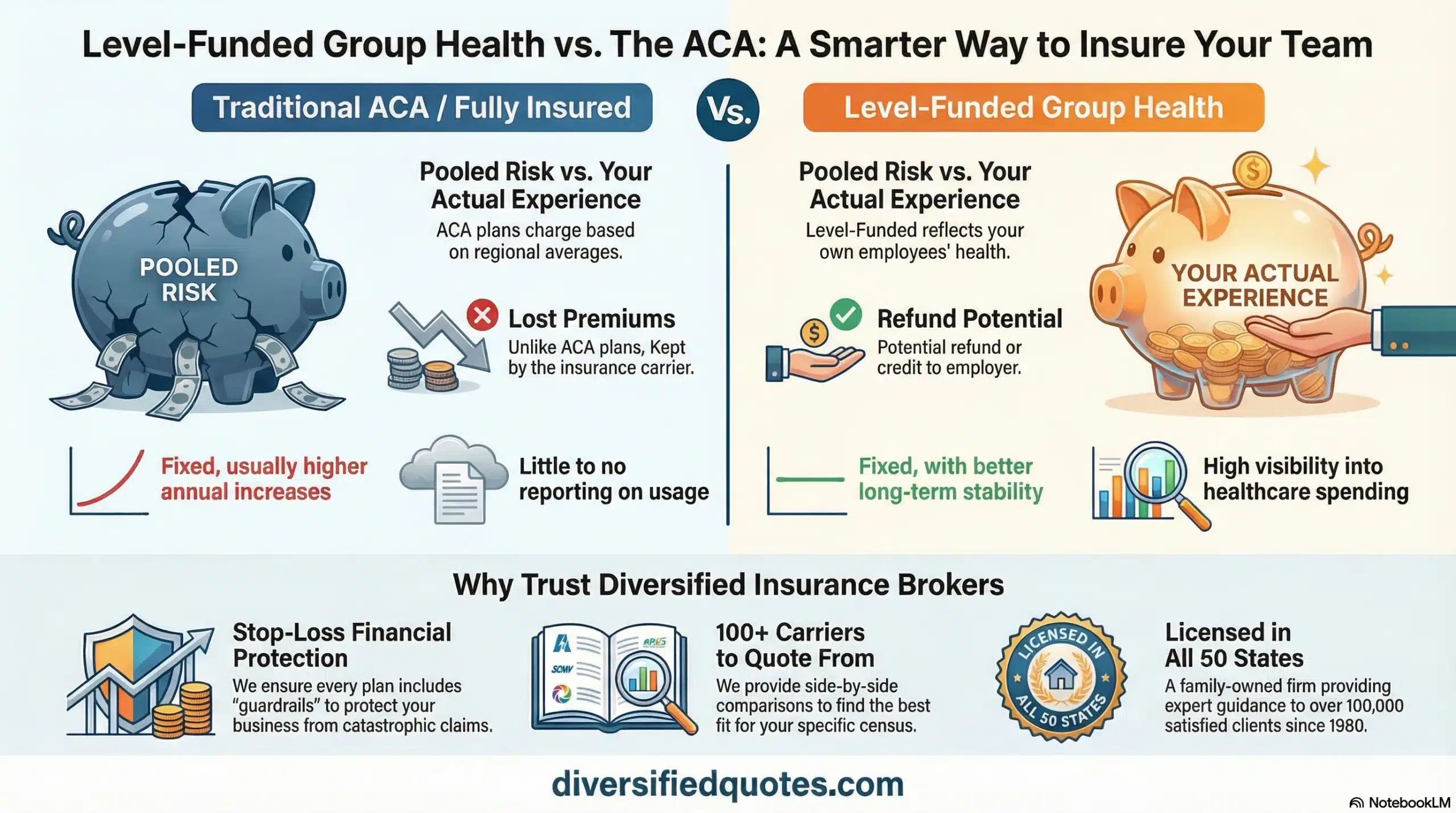
Offering group health insurance is not a single decision — it is a series of plan design decisions that together determine how much value employees actually receive and how much the coverage costs the employer in total. The most fundamental choice is between fully-insured and self-funded or level-funded plan structures. In a fully-insured plan, the employer pays a fixed premium to the carrier and the carrier assumes all claim risk. In a self-funded arrangement, the employer directly funds employee claims, typically with stop-loss insurance to cap exposure at a defined level for any single large claim or for aggregate claims in a plan year. Level-funded plans occupy a middle position: the employer pays a fixed monthly amount that covers expected claims, administrative costs, and stop-loss coverage, with a refund of unused claims funding at year end if actual claims come in below projections.
For smaller employers, fully-insured group plans are typically the most practical starting point because they provide premium predictability without requiring the cash flow reserves that absorbing self-funded claims exposure demands. As group size grows, level-funded and self-funded arrangements become progressively more financially attractive because the employer’s ability to benefit from a healthy workforce’s lower-than-average claims experience increases with group size. Working with an independent broker who can model the expected cost under each structure — and who understands which carriers offer the most favorable premium structures for a specific employer’s workforce demographics and geography — is the most reliable way to ensure the plan design decision is made with adequate information rather than defaulting to the most familiar option.
Beyond the funding structure, employers choose among plan network types — PPO plans with broader provider access, HMO plans with lower premiums and defined network requirements, and HDHP plans that qualify employees for HSA contributions — and set contribution levels that determine how much of the premium cost is shared with employees. Many employers also evaluate supplemental benefits that complement the core health plan: dental and vision coverage, life insurance, short-term and long-term disability coverage, and employee assistance programs that provide mental health support and financial counseling. Each of these decisions shapes both the value employees perceive in the benefits package and the total cost the employer bears — which is why the design process benefits significantly from professional guidance rather than purely reactive renewal management year over year. Evaluating financial risk management tools such as downside protection strategies alongside benefits cost planning helps employers think about their full financial exposure in a coordinated way rather than treating benefits costs in isolation from broader business financial management.
The Long-Term Workforce Case — Why Group Health Insurance Is a Strategic Investment
The primary reason to buy group health insurance ultimately extends beyond the immediate tactical advantages of recruitment, retention, tax efficiency, and productivity. It is a strategic investment in the organizational quality and workforce stability that determine whether a business can execute its long-term goals. A business that consistently attracts strong candidates, retains experienced employees, maintains a healthy and engaged workforce, and operates with lower turnover and absenteeism than its competitors has a fundamental operational advantage that compounds over time. The quality of the workforce — measured in experience, institutional knowledge, skill depth, and operational reliability — is the most consequential factor in most businesses’ performance, and health benefits are one of the most direct and credible investments an employer can make in the conditions that allow a high-quality workforce to develop and persist.
Medical emergencies and unmanaged health costs are among the leading causes of personal financial hardship for American households. Employees who carry significant uninsured medical exposure bring financial stress into the workplace that affects their focus, their decision-making, and their engagement with their work — regardless of how much they value their job or their professional commitment. Group health insurance removes that exposure, replacing it with predictable, manageable cost-sharing that allows employees to address health needs as they arise rather than delaying care and accumulating both health and financial risk simultaneously. The business benefit of that dynamic is not just that employees are healthier in a biological sense — it is that employees who are not financially stressed about healthcare are more mentally present, more focused, and more productive in every dimension of their work.
Many organizations complement their healthcare benefits with broader financial wellness programming. Topics such as retirement income planning, long-term care preparation, and financial risk management are increasingly recognized as belonging in the employee benefits conversation alongside health coverage — because the financial security that makes employees genuinely stable and focused extends well beyond the medical domain. Resources like Social Security advice, the long-term care planning playbook, and information about windfall elimination provisions relevant to government employees give workers the tools to build strong long-term financial foundations alongside the health coverage that protects their immediate well-being. Together, these resources position the employer as genuinely invested in employees’ complete financial security — which is the culture that produces the retention, engagement, and loyalty that every business needs from its workforce to perform at its potential over time.
Related Pages
Talk With an Advisor Today
Choose how you’d like to connect—call or message us, then book a time that works for you.
Schedule here:
calendly.com/jason-dibcompanies/diversified-quotes
Licensed in all 50 states • Fiduciary, family-owned since 1980
FAQs: What Is the Primary Reason to Buy Group Health Insurance?
What is the primary reason employers buy group health insurance?
The primary reason employers buy group health insurance is to give employees affordable access to healthcare while building the stable, competitive workforce that every business depends on. Group coverage pools employees under a single policy, and that shared-risk structure allows carriers to offer broader coverage at lower per-person premiums than individuals could obtain independently. For most employers, the decision is driven by three reinforcing objectives: recruitment (attracting candidates who evaluate benefits alongside compensation), retention (keeping skilled employees who would leave for employers with stronger benefits), and productivity (maintaining a workforce that is healthy, financially secure, and fully focused rather than distracted by unmanaged healthcare costs and medical debt). Research from ADP shows that 82% of employees rank group health insurance as their single most important workplace benefit, and 93% rank it in their top three — data that makes the primary reason to buy it straightforward: it is what employees value most, and what employers who want to attract and retain good people need to offer.
How does group health insurance help with employee retention specifically?
Group health insurance improves employee retention through two mechanisms: direct financial security and cultural signaling. The direct mechanism is straightforward — employees with good employer-sponsored health coverage have less financial incentive to change jobs than employees who are evaluating whether a competing employer’s benefits would better protect their household. According to the 2025 Selerix Benefits Survey, employees satisfied with their benefits are five times more likely to say they will stay with their employer, and 73% say benefits matter as much or more than salary when deciding whether to remain in a role or accept a new position. The cultural mechanism is equally important: employees who feel their employer is genuinely invested in their well-being are more loyal, more engaged, and more productive — ADP research shows that employees who feel cared for at work are 17% more loyal and 17% more engaged than those who do not. Group health insurance is the most credible and most tangible signal an employer can send of that investment, which makes its cultural retention effect compounding over time. The financial cost of not retaining employees — replacing an employee typically costs 50% to 200% of their annual salary when recruiting, onboarding, lost productivity, and institutional knowledge drain are fully accounted for — means that even a modest improvement in retention driven by better health benefits typically recaptures its premium cost within the first year.
What are the tax advantages of offering group health insurance for employers?
Group health insurance offers employers a combination of tax advantages that makes it the most tax-efficient form of compensation increase available in most circumstances. Employer premium contributions are 100% tax-deductible as a business expense, reducing the company’s taxable income dollar for dollar. Unlike salary increases, employer health premium contributions are not subject to payroll taxes — including the employer’s 6.2% Social Security contribution and 1.45% Medicare contribution — which means the net cost of a dollar invested in group health premiums is lower than the net cost of adding the same dollar to wages. Employees benefit as well: their premium contributions are paid through pre-tax payroll deductions, reducing their taxable income, and employees enrolled in HSA-qualified high-deductible health plans can contribute to Health Savings Accounts on a pre-tax basis — with 2025 limits of $4,300 for self-only coverage and $8,550 for family coverage. The combined effect is that a dollar invested in group health coverage delivers more total compensation value to the employee at lower net cost to the employer than the same dollar added to wages, making group health insurance structurally superior to wage competition as a benefits delivery mechanism for both parties.
Can small businesses offer group health insurance competitively?
Yes — many carriers offer group health insurance plans specifically designed for small businesses, and employers with as few as two employees may qualify depending on the insurer and state regulations. The misconception that group coverage is only accessible to large corporations causes many small employers to forgo a benefit that is both within reach and strategically important for their ability to compete for talent. Small businesses often need the recruitment and retention advantages of group coverage more urgently than large employers, because they are competing for candidates who may default to larger organizations on the assumption that small businesses cannot match their benefits. A small employer who offers strong health coverage can attract and retain candidates who would otherwise not consider the opportunity — and an independent broker who specializes in small-group placements can identify carriers whose pricing and plan structures are most favorable for the specific employee count, workforce demographics, and geographic market involved. Our resource on best group health insurance options for 2-person businesses addresses the specific plan types and structures available to the smallest employers in detail.
About the Author:
Jason Stolz, CLTC, CRPC, DIA, CAA and Chief Underwriter at Diversified Insurance Brokers (NPN 20471358), is a senior insurance and retirement professional with more than 25 years of real-world experience helping individuals, families, and business owners protect their income, assets, and long-term financial stability. As a long-time partner of the nationally licensed independent agency Diversified Insurance Brokers, Jason provides trusted guidance across multiple specialties—including fixed and indexed annuities, long-term care planning, personal and business disability insurance, life insurance solutions, Group Health, Travel Medical and Evacuation Insurance, and short-term health coverage. Diversified Insurance Brokers maintains active contracts with over 100 highly rated insurance carriers, ensuring clients have access to a broad and competitive marketplace.
His practical, education-first approach has earned recognition in publications such as VoyageATL, and contributions from his agency featured in Kiplinger and GoBankingRates— highlighting his commitment to financial clarity and client-focused planning. Drawing on deep product knowledge and years of hands-on field experience, Jason helps clients evaluate carriers, compare strategies, and build retirement and protection plans that are both secure and cost-efficient. Visitors who want to explore current annuity rates and compare options across multiple insurers can also use this annuity quote and comparison tool.
Explore More Group Health Insurance Options: Browse our complete guide to Small Business Group Health Insurance — covering getting started, costs, how to set up, best rates & working with a broker from 100+ carriers.
Last Reviewed: June 20, 2026 |
Reviewed by: Jason Stolz, CLTC, CRPC, DIA, CAA
Chief Underwriter, Diversified Insurance Brokers, Inc. | NPN: 20471358 | Diversified Insurance Brokers, Inc. — Licensed in all 50 states
Fact Checked by: Tonia Pettitt, CMIP©
Medicare Specialist, Diversified Insurance Brokers, Inc. | NPN: 14374308 | Diversified Insurance Brokers, Inc. — Licensed in all 50 states
Did you find this content helpful? Leave us a Google review — it helps others find trustworthy guidance too.
Editorial Standards: Diversified Insurance Brokers maintains rigorous editorial standards to ensure accuracy, clarity, and independence in all content. Learn more about our editorial standards and commitment to transparency.
