
Social Security Advice
Social Security Advice

Smart Social Security advice can add meaningful lifetime income — not because of secret loopholes or complex maneuvers, but because timing, coordination, and sequencing decisions that seem straightforward in isolation compound across decades of retirement in ways that permanently shape household financial security. Social Security is one of the few income sources in retirement that is designed to last for life, adjusts automatically for inflation, and cannot be outlived regardless of how long the beneficiary lives or what financial markets do during that period. That combination of longevity protection and purchasing-power preservation makes Social Security filing and coordination decisions among the most financially consequential choices most retirees will ever make — and the permanence of those decisions means that getting them right from the beginning matters far more than any individual year’s investment return. At Diversified Insurance Brokers, our advisors help households evaluate filing ages, coordinate spousal and survivor benefits, align Social Security with Medicare timing and premium exposure, and sequence Social Security with taxes and retirement income withdrawals so every piece of the retirement income structure works together rather than inadvertently working against each other.
Many retirees are surprised to discover how rarely Social Security decisions are truly isolated from the rest of their financial picture. Filing earlier or later changes how much must be withdrawn from retirement accounts, which affects portfolio longevity and sequence-of-returns vulnerability in the early retirement years. It can change Medicare premium exposure through the IRMAA calculation that sets income-related premium surcharges. It can influence how much of the Social Security benefit itself becomes subject to income tax based on provisional income calculations that include other retirement distributions. For married couples, the higher earner’s filing decision often becomes the surviving spouse’s benefit years or even decades later — meaning the decision has household consequences that extend far beyond the individual filer’s retirement phase and affect the financial security of the surviving household member during a period of reduced resources and potential additional care needs. The right strategy is rarely just about maximizing a monthly check today. It is about building durable, inflation-protected lifetime income that supports real retirement risks, including longevity that exceeds most people’s pessimistic assumptions, healthcare costs that continue rising faster than general inflation, and market uncertainty that makes portfolio-dependent income inherently unstable as a sole retirement income foundation. Are you leaving Social Security benefits on the table covers the most common missed optimization opportunities that reduce lifetime household benefits for people who never realized the trade-offs they were making in their filing decisions.
Ensure you are receiving the absolute top rates
Current Fixed Annuity Rates
Compare today’s best fixed annuity rates from top carriers.
Current Bonus Annuity Rates
See which annuities offer the highest upfront bonus today.
Request an Annuity Quote
Submit our annuity request form to get personalized rate options.
Lifetime Income Calculator
Use our calculator to see how much guaranteed income your annuity can provide.
Schedule an Appointment with a Social Security Expert
Get a personalized filing and coordination strategy based on your age, work status, spouse, retirement timeline, and income needs.
Social Security Planning Services
Prefer to talk first? Call 800-533-5969
Why Social Security Planning Has Long-Term Financial Impact
For most retirees, Social Security becomes the foundation layer of retirement income — the guaranteed, inflation-adjusted income floor on which the rest of the retirement income structure rests. Unlike portfolio withdrawals, Social Security does not depend on market performance for its continuation, cannot be depleted by a sequence of bad investment years, and does not require active management to maintain its payment stream throughout retirement. Unlike many pensions, it includes cost-of-living adjustments that preserve purchasing power over a retirement that may span twenty-five to thirty years or more. Because of these structural advantages, optimizing this income stream often reduces pressure on every other part of a retirement plan in ways that compound significantly over time. When Social Security is optimized — when filing is coordinated with spousal benefits, Medicare timing, tax management, and retirement account withdrawal sequencing — retirees typically withdraw less from investment accounts in the early years of retirement, which reduces the portfolio’s exposure to sequence-of-returns risk during the period when that risk is most consequential for long-term financial sustainability.
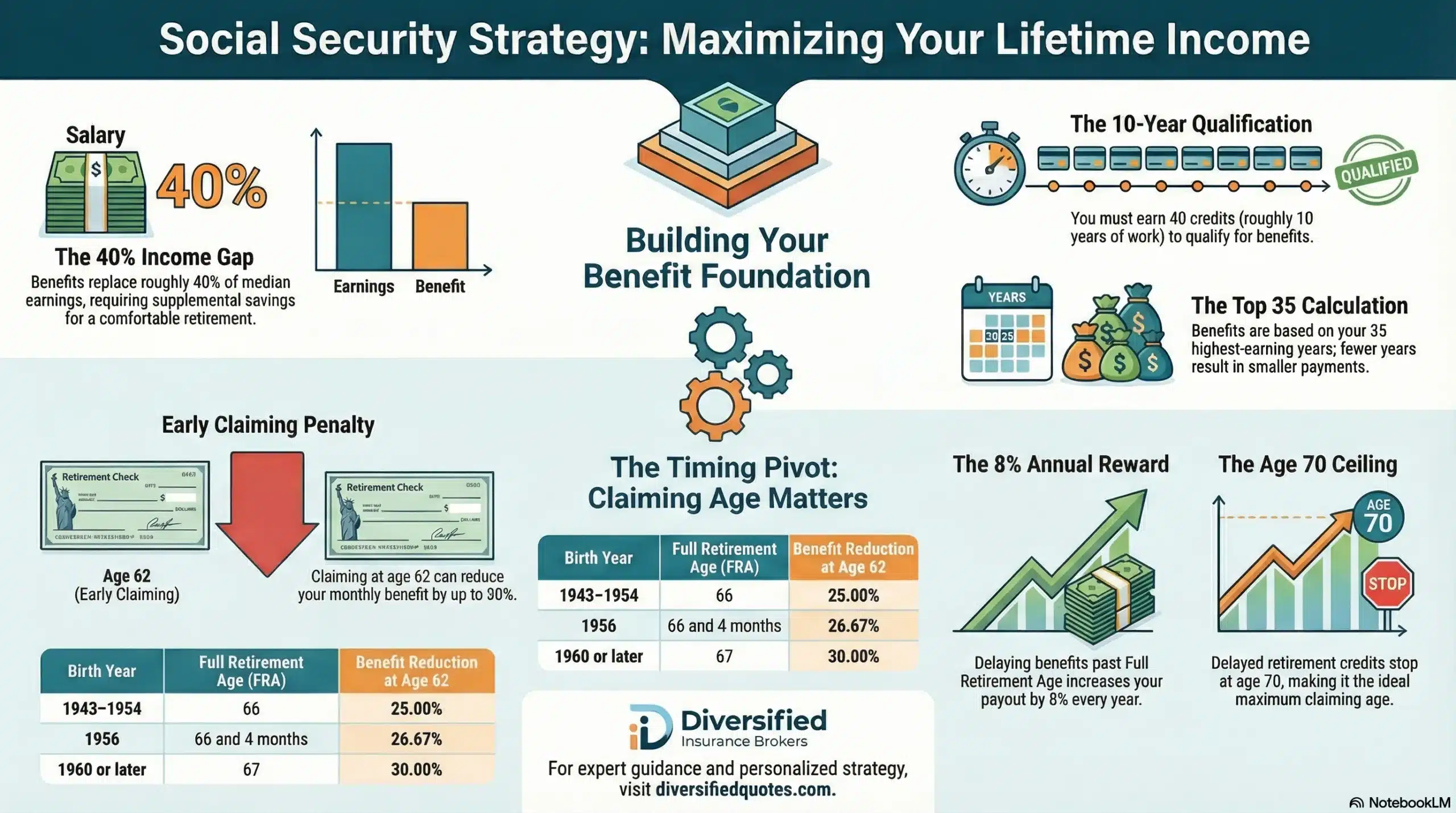
The permanence of Social Security filing decisions makes the planning dimension even more important. Most households should approach the filing decision as effectively irreversible — while limited correction mechanisms exist for those who file early and change their mind within the first twelve months, in practice the vast majority of filers live with their initial decision for the rest of their lives. Filing early permanently reduces the base benefit by a fixed percentage for every month before full retirement age — a reduction that applies not only to the filer’s monthly check but to any cost-of-living adjustments calculated on that reduced base, meaning the permanence compounds over time rather than remaining static. Filing later permanently increases the benefit through delayed retirement credits that accrue at approximately eight percent per year from full retirement age through age seventy — a guaranteed, permanent, inflation-adjusted increase that no financial product can replicate with comparable certainty. For married couples, the higher earner’s filing decision typically becomes the survivor benefit the surviving spouse receives after the first spouse passes — meaning a decision made at one point in time can affect household income for decades beyond the filer’s retirement phase, determining the surviving spouse’s financial security during a period of reduced household income and potentially elevated care costs. How Medicare and Social Security work together covers the direct financial connection between these two systems and how Social Security filing timing interacts with Medicare premium calculations and enrollment windows. What is IRMAA covers the Medicare Income-Related Monthly Adjustment Amount that can significantly increase Medicare premium costs for retirees with higher income — a cost that Social Security claiming strategy can directly influence through its effect on income level and composition.
Social Security Timing: Key Variables Compared
| Variable | File Early (Age 62) | File at FRA | Delay to Age 70 |
|---|---|---|---|
| Monthly benefit | Permanently reduced — typically 25–30% below FRA benefit for those born 1960 or later | Full primary insurance amount — no reduction penalty, no delayed credit | Permanently increased — approximately 24–32% above FRA benefit depending on birth year |
| Earnings test | Withholds $1 for every $2 earned above the annual exempt amount if still working | No earnings test from FRA onward — unlimited earning while collecting | No earnings test — and continued earning during delay builds earnings record for potential recomputation |
| Survivor benefit impact | Surviving spouse receives the permanently reduced amount — lower lifetime protection for the household | Surviving spouse receives the FRA benefit amount — full primary insurance amount becomes the survivor benefit | Surviving spouse receives the maximized delayed benefit — strongest long-term household survivor protection |
| Break-even horizon | Starts collecting sooner but total lifetime benefits lower if living past break-even age | Eliminates early reduction — break-even vs early filing typically reached in mid-to-late 70s | Requires surviving to break-even vs FRA — but maximizes total lifetime income for long-lived individuals |
| Bridge income need | None — begins collecting immediately without need for alternative income source | Moderate — must fund income from FRA through any delay period if retiring before FRA | Highest — must fund retirement income from retirement date through age 70 without Social Security |
| Medicare coordination | Can collect Social Security before Medicare eligibility — both must be managed independently | FRA may align with Medicare eligibility window depending on birth year — coordinates naturally for some filers | Medicare enrollment at 65 regardless of Social Security delay — five-year gap requires active management |
| Tax implications | Lower benefit may keep provisional income below taxation thresholds in some scenarios | Moderate benefit subject to same provisional income calculation — depends on other retirement income level | Higher benefit more likely to push provisional income above taxation thresholds — requires income coordination |
Who Gains the Most from Professional Social Security Advice
While virtually every retiree benefits from reviewing their Social Security strategy before filing, certain households have significantly more financial leverage in the decision and therefore more to gain from professional analysis. Pre-retirees choosing between early filing at sixty-two, filing at full retirement age, and delaying toward seventy often see the largest lifetime benefit differences between scenarios — differences that can amount to hundreds of thousands of dollars in total lifetime benefits for higher earners with favorable longevity prospects. Many people approach this decision focused exclusively on break-even math — the point at which total cumulative delayed benefits exceed total cumulative early benefits — but the more important and broader consideration is long-term household income durability and survivor protection. A decision that maximizes early cash flow can simultaneously minimize the survivor benefit the household will depend on for potentially twenty years after the first spouse passes, which is a trade-off that break-even analysis does not capture.
Married couples derive the most household value from coordinated claiming strategies because the higher earner’s benefit typically becomes the surviving spouse’s income floor for the rest of the survivor’s life. Strategic timing of the higher earner’s benefit — optimized in coordination with the lower earner’s benefit and the household’s bridge income resources — can increase total lifetime household income while substantially improving financial stability during widowhood. The difference between an optimized claiming strategy and an uncoordinated one can be particularly large for households where one spouse earned significantly more than the other over their careers, because the higher earner’s benefit is the one that determines the survivor’s income floor and the lower earner’s benefit opportunity through the spousal benefit calculation.
Widowed individuals represent another category with disproportionate benefit from professional analysis, because survivor benefit eligibility rules include timing considerations that can permanently affect the benefit amount received. A widow or widower who claims survivor benefits before their own full retirement age receives a reduced survivor benefit; one who delays within the defined window may receive a larger amount. The interaction between the survivor’s own retirement benefit and the survivor benefit from the deceased spouse’s record — including the timing strategy for switching between them — creates genuine complexity that is worth understanding in detail before making any filing decision. Strategies for claiming Social Security for widows covers the timing rules and optimization approaches specifically for surviving spouses navigating both their own record and the inherited survivor benefit. Survivor benefits for children covers the additional benefits available to dependent children in families with a deceased parent — benefits that are frequently missed by families who are unaware of the eligibility rules during a period when they are focused on the immediate loss rather than on benefit optimization. Survivor benefits for disabled adults covers the benefit eligibility rules for adult children who are disabled and may qualify for benefits on a deceased parent’s record.
Divorced individuals also represent a category with significant planning leverage because divorced spousal benefits involve duration requirements, remarriage rules, and timing considerations that interact with the divorced individual’s own filing decision in ways that are not always intuitive. A divorced spouse who was married for at least ten years may be eligible for benefits based on the ex-spouse’s record without affecting the ex-spouse’s benefits or requiring the ex-spouse’s cooperation — but the benefit amount and timing rules require careful evaluation to optimize the outcome. Divorced spousal benefits timing covers the specific eligibility requirements and timing considerations that determine when and how much a divorced individual can claim based on their former spouse’s record. How remarriage affects Social Security spousal benefits covers the impact of subsequent marriage on eligibility for both divorced spousal and survivor benefits — a consideration that is particularly important for individuals who are in or considering a subsequent marriage relationship.
How Filing Age Shapes Retirement Income Architecture
The choice between filing early, at full retirement age, or delaying toward age seventy is not simply a question of monthly check size — it is a decision about the architecture of the entire retirement income structure and how different components interact to produce household financial security across potentially thirty or more years of retirement. Early filing at sixty-two creates immediate cash flow without any bridge income requirement, but permanently reduces the monthly benefit by twenty-five to thirty percent for those born in 1960 or later — a reduction that compounds over time as cost-of-living adjustments are applied to the lower base amount rather than the full primary insurance amount that would have been available at full retirement age. Over a long retirement, the cumulative impact of that base reduction can be significant even after accounting for the additional years of smaller checks received.
Filing at full retirement age eliminates the early reduction penalty and delivers the full primary insurance amount that was earned through the working record, without any requirement to have delayed or to self-fund the gap years. For many households, FRA represents a reasonable default — it preserves the full earned benefit without requiring the planning and bridge income management that delay demands. Delaying beyond full retirement age generates delayed retirement credits — guaranteed, permanent increases of approximately eight percent per year from FRA to age seventy — that can substantially increase the monthly benefit and therefore the household’s guaranteed lifetime income floor. For higher earners with good longevity prospects, the delayed benefit provides a stronger income foundation that reduces dependence on portfolio withdrawals, supports larger Roth conversion windows in the pre-benefit years, and maximizes the survivor benefit available to a spouse who may outlive the primary earner by a decade or more. Delayed retirement credits and Social Security payout increases and delayed retirement credits and benefit growth cover the mechanics of how the credit accrual works and what the actual monthly and lifetime benefit differences look like across different delay periods and earnings histories.
The critical planning requirement for delay is a credible bridge income plan for the years between retirement and age seventy. Some households use systematic retirement account withdrawals as the bridge, often coordinating those withdrawals with Roth conversion strategies in the years before Social Security’s provisional income calculation would make large Roth conversions more expensive. Some use part-time work income to partially or fully cover living expenses during the delay period. And some use guaranteed income products — fixed annuities, income annuities, or hybrid products — to provide a predictable income floor during the bridge years that reduces dependence on market performance at the precise period when sequence-of-returns risk is most consequential. How Social Security and annuities work together covers the specific coordination strategies between guaranteed annuity income and Social Security benefits in a comprehensive retirement income architecture. Retirement income calculator provides a tool for modeling different income combinations including Social Security at different ages alongside other retirement income sources. Lifetime income annuities covers the guaranteed income structures that can serve as bridge income during the delay period while providing longevity protection that complements the maximized Social Security benefit.
Social Security Taxation and Income Coordination
Social Security benefit taxation is based on a provisional income calculation — adjusted gross income plus nontaxable interest plus fifty percent of Social Security benefits — that can cause up to eighty-five percent of benefits to become subject to income tax when provisional income exceeds defined thresholds. For many retirees, this taxation dynamic interacts directly with the filing timing decision and the retirement account withdrawal sequencing strategy in ways that significantly affect after-tax retirement income. A retiree who files early and begins receiving Social Security while also taking taxable IRA distributions may find that the combination pushes provisional income above taxation thresholds, making the Social Security benefit partially taxable at the same time IRA distributions are also fully taxable as ordinary income — a compounding tax cost that effective income sequencing can reduce or eliminate.
The years between retirement and the Social Security filing date — whether at FRA or after a deliberate delay — often represent the most valuable window for Roth conversion planning, because those years typically have lower taxable income than the post-Social-Security period when the combination of Social Security, RMDs, and other income sources pushes AGI higher. Converting traditional IRA assets to Roth during these lower-income pre-Social-Security years at modest marginal rates can significantly reduce the future RMD burden that would otherwise push provisional income above taxation thresholds after Social Security begins. The net effect of well-coordinated Roth conversion and Social Security timing is a meaningfully lower lifetime tax cost on retirement income — often tens of thousands of dollars across a multi-decade retirement. Is Social Security taxable covers the provisional income formula and the income thresholds at which different benefit inclusion rates apply. How to reduce taxes on Social Security covers the specific strategies — income sequencing, Roth conversions, qualified charitable distributions — that can minimize the portion of Social Security benefits subject to income tax. Roth conversion windows explained covers the multi-year conversion planning framework that creates the most tax-efficient coordination between Roth account growth and Social Security timing. How MAGI affects Social Security and Medicare covers the income calculation that simultaneously drives Social Security benefit taxation and Medicare IRMAA premium surcharges — making this the central coordination point for retirement income planning. Social Security income limits covers the earnings test thresholds that apply before full retirement age for individuals who continue working while collecting benefits.
Special Situations That Require Deeper Social Security Analysis
Several specific planning situations produce Social Security outcomes that diverge significantly from standard single-filer analysis and require detailed evaluation before any filing decision is made. The Windfall Elimination Provision and the Government Pension Offset are two provisions that can substantially reduce Social Security benefits for individuals who earned pension income from employment not covered by Social Security — commonly including certain public-sector positions, some state and local government roles, and specific international employment arrangements. Many individuals affected by these provisions are unaware of them until they request a benefit estimate and discover the reduction, at which point the options for planning around the impact are limited compared to what would have been available with earlier awareness. Windfall Elimination Provision guide covers the specific mechanics of the WEP reduction and how it interacts with the earnings record calculation. Government Pension Offset explained covers the GPO reduction that specifically affects spousal and survivor benefits for individuals receiving a non-covered government pension.
Self-employed individuals face a distinct set of Social Security considerations because their earnings record is determined by what they report as net self-employment income rather than by employer payroll reporting — creating both more control over the earnings record and more risk of inadvertently under-crediting the record through business structure decisions, compensation arrangements, or expense categorizations that reduce taxable SE income without fully accounting for the long-term Social Security cost of a weaker earnings record. Social Security benefits for self-employed covers the specific earnings record, entity structure, and filing considerations for business owners and self-employed individuals. Retirees who continue working after beginning Social Security — whether by choice or necessity — need to understand how earned income affects benefit amounts before full retirement age and how the earnings test works in practice. Does working past 65 affect Social Security benefits covers the specific rules that apply to working retirees at different ages and benefit stages. Earnings test after full retirement age covers how the earnings test functions before FRA and how withheld benefits are credited back after FRA through a permanent benefit increase.
Build Your Social Security Income Plan
We build filing timelines that coordinate with Medicare, taxes, and retirement income so you can make decisions confidently.
Prefer to talk now? Call 800-533-5969
Related Social Security Pages
These pages expand on Social Security timing rules, benefit coordination, and Medicare connections that commonly affect claiming decisions.
Schedule a Free Consultation
Choose a time that works for you. We’ll review your situation, model filing options, and map a clear plan.
Frequently Asked Questions: Social Security Advice
What is the most important Social Security decision most retirees face?
For most retirees, the single most financially consequential Social Security decision is the filing age — specifically the choice between claiming early at sixty-two, at full retirement age, or delaying toward seventy. This decision permanently affects the monthly benefit amount for the rest of the filer’s life and, for married individuals, determines the survivor benefit their spouse may receive for decades after the first spouse passes. For higher earners with good longevity prospects and married households, delaying typically maximizes lifetime household income and provides the strongest financial protection for the surviving spouse. The right answer depends on individual longevity expectations, bridge income availability, household income needs, and Medicare coordination — which is why personalized analysis produces better outcomes than general rules.
How does Social Security filing timing affect Medicare premiums?
Medicare Part B and Part D premiums are determined by MAGI from two years prior through the IRMAA calculation. Roth conversion strategies executed in the years before Social Security begins — when income is often lower — can reduce the MAGI that feeds IRMAA calculations in subsequent years, potentially reducing Medicare premium costs during the years when Social Security benefits are also active and making the IRMAA calculation most consequential. Conversely, large one-time income events — Roth conversions, capital gains realizations, or deferred compensation payouts — in a single year can push MAGI above IRMAA thresholds and increase Medicare premiums for the following two years. Coordinating Social Security timing, Roth conversion windows, and other income events with the two-year IRMAA look-back is one of the most valuable dimensions of integrated Social Security and retirement income planning.
Should a married couple always have the higher earner delay to age 70?
For most married households where the higher earner has favorable longevity prospects and the household has adequate bridge income resources, delaying the higher earner’s benefit to seventy maximizes both lifetime individual income and the survivor benefit the spouse will receive after the higher earner passes. However, this is not a universal rule. Households with significant health concerns that reduce longevity expectations, households without adequate bridge income to fund the delay period without financial hardship, and households where the lower earner’s own benefit is sufficiently large that the spousal and survivor benefit calculations are less important may find a different strategy more appropriate. The correct approach is to model the household outcomes across multiple filing age combinations — including both spouses’ ages — rather than applying a general rule about the higher earner’s behavior without evaluating the full household picture.
How does Social Security interact with retirement account withdrawal strategy?
Social Security timing interacts with retirement account withdrawal strategy primarily through the provisional income calculation that determines how much of Social Security becomes taxable. Taxable IRA and 401(k) distributions count toward provisional income, meaning coordinating the timing and amount of those distributions relative to when Social Security begins directly affects the tax cost of receiving Social Security benefits. The pre-Social-Security years — particularly when there is a delay period between retirement and age seventy — often represent the most advantageous window for Roth conversions, because income is lower than it will be once Social Security, required minimum distributions, and other income sources combine in the post-Social-Security period. Systematic Roth conversions during this window can reduce the future RMD burden and create more tax-free income in later years that does not push provisional income above Social Security taxation thresholds.
Can guaranteed income from annuities complement a Social Security delay strategy?
Yes — guaranteed annuity income can serve as bridge income during the period between retirement and the optimal Social Security activation age, allowing a retiree to delay Social Security without depending on market performance or excessive portfolio withdrawals during the years when sequence-of-returns risk is most consequential. A fixed annuity providing predictable income through the bridge years allows the delayed Social Security benefit to accumulate its full delayed retirement credits while the household’s basic income needs are covered without market exposure. Once the maximized Social Security benefit begins, the combined guaranteed income from both sources provides a stronger floor than either could deliver alone — reducing the withdrawal demand on the remaining investment portfolio and improving the probability of long-term financial sustainability across a multi-decade retirement.
About the Author:
Jason Stolz, CLTC, CRPC, DIA, CAA and Chief Underwriter at Diversified Insurance Brokers (NPN 20471358), is a senior insurance and retirement professional with more than 25 years of real-world experience helping individuals, families, and business owners protect their income, assets, and long-term financial stability. As a long-time partner of the nationally licensed independent agency Diversified Insurance Brokers, Jason provides trusted guidance across multiple specialties—including fixed and indexed annuities, long-term care planning, personal and business disability insurance, life insurance solutions, Group Health, Travel Medical and Evacuation Insurance, and short-term health coverage. Diversified Insurance Brokers maintains active contracts with over 100 highly rated insurance carriers, ensuring clients have access to a broad and competitive marketplace.
His practical, education-first approach has earned recognition in publications such as VoyageATL, and contributions from his agency featured in Kiplinger and GoBankingRates— highlighting his commitment to financial clarity and client-focused planning. Drawing on deep product knowledge and years of hands-on field experience, Jason helps clients evaluate carriers, compare strategies, and build retirement and protection plans that are both secure and cost-efficient. Visitors who want to explore current annuity rates and compare options across multiple insurers can also use this annuity quote and comparison tool.
Explore All Social Security Planning Guides: Browse our complete Social Security Planning guide — covering filing strategies, spousal benefits, survivor benefits, taxes, WEP, GPO & more.
Last Reviewed: June 16, 2026 |
Reviewed by: Jason Stolz, CLTC, CRPC, DIA, CAA
Chief Underwriter, Diversified Insurance Brokers, Inc. | NPN: 20471358 | Diversified Insurance Brokers, Inc. — Licensed in all 50 states
Fact Checked by: Tonia Pettitt, CMIP©
Medicare Specialist, Diversified Insurance Brokers, Inc. | NPN: 14374308 | Diversified Insurance Brokers, Inc. — Licensed in all 50 states
Did you find this content helpful? Leave us a Google review — it helps others find trustworthy guidance too.
Editorial Standards: Diversified Insurance Brokers maintains rigorous editorial standards to ensure accuracy, clarity, and independence in all content. Learn more about our editorial standards and commitment to transparency.
