
Windfall Elimination Provision Guide
Windfall Elimination Provision Guide

If you have been researching how a pension from a job where you did not pay Social Security taxes might affect your Social Security retirement benefit, you may be searching for information that changed significantly in early 2025. The Windfall Elimination Provision was repealed. On January 5, 2025, President Biden signed the Social Security Fairness Act (H.R. 82) into law, eliminating WEP effective for months after December 2023. Retroactive payments to affected beneficiaries were finalized by the Social Security Administration as of July 7, 2025. If you were subject to WEP before the repeal, you should have received a retroactive payment covering the period from January 2024 forward, and your ongoing monthly benefit should now reflect the standard Social Security formula that applies to all workers — without the WEP reduction. The Government Pension Offset, which reduced spousal and survivor benefits for people receiving non-covered government pensions, was eliminated by the same legislation and is similarly no longer in effect.
This guide does three things: it explains what WEP was and how it worked — because millions of Americans spent years planning around a rule that shaped their filing decisions, and understanding the history informs current decisions; it explains what the repeal means for current and future beneficiaries; and it maps the planning moves that matter most now that WEP and GPO are no longer in effect. If you delayed filing Social Security because WEP made the delayed benefit less attractive, or if you structured a retirement income plan around a WEP-reduced Social Security number, those calculations may need to be revisited. At Diversified Insurance Brokers, we help retirees and pre-retirees work through exactly this kind of recalculation — identifying whether the repeal changes the optimal filing age, whether previous planning assumptions still hold, and how to coordinate Social Security timing with pension income, taxes, Medicare, and the rest of the retirement income picture.
This is also a guide for people who heard about the repeal but are not sure whether it applies to their specific situation, whether their benefit has been recalculated correctly, or whether the planning strategy they built before the repeal still makes sense. If you are also comparing filing ages and want to understand how delaying increases benefits, start with delayed retirement credits — then return here to understand how the WEP repeal changes the baseline you are building that decision from.
Get a Social Security Timing Review (WEP Repeal Impact Included)
We’ll confirm whether the WEP repeal changes your benefit calculation, verify retroactive payment accuracy, and map a filing sequence that fits taxes, Medicare timing, and household income goals.
The Social Security Fairness Act: WEP and GPO Are Repealed
The most important thing to understand about WEP in 2025 and beyond is that it no longer applies to anyone. The Social Security Fairness Act (H.R. 82) was signed into law on January 5, 2025, eliminating both the Windfall Elimination Provision and the Government Pension Offset — the companion rule that had reduced spousal and survivor Social Security benefits for people receiving non-covered government pensions. The repeal is effective for benefits payable for months after December 2023, making the elimination retroactive to January 2024. The SSA finalized retroactive payments to affected beneficiaries as of July 7, 2025.
For the approximately 2.1 million beneficiaries who were subject to WEP at its peak, this is a meaningful financial change. In 2024, the maximum WEP reduction reached $587 per month — a reduction that, applied over years of retirement, represented tens of thousands of dollars in lifetime income. Under the standard Social Security formula restored by the repeal, the first tier of the benefit calculation — previously reduced from 90% to as low as 40% for workers with 20 or fewer years of substantial covered earnings — returns to the standard 90% factor for all workers. For workers whose WEP reduction was at or near the maximum, the restoration to the standard formula represents a meaningful, ongoing monthly benefit increase for the rest of their life.
The GPO repeal is covered in depth in our Government Pension Offset guide, which reflects the Social Security Fairness Act. Many households had both WEP and GPO concerns — the WEP reducing the worker’s own benefit and the GPO reducing spousal or survivor benefits — and the repeal of both rules together changes the household benefit picture significantly. If you are coordinating a household filing strategy that was built around both rules, that conversation belongs alongside the GPO resource and the broader framework for maximizing Social Security benefits.
What WEP Was — The Historical Record
Understanding WEP’s history matters because it shaped filing decisions for millions of workers over the 42 years it was in effect, and because the repeal does not automatically undo those planning choices. Workers who claimed Social Security early specifically to manage WEP’s impact on a delayed benefit, workers who structured retirement income plans around a WEP-reduced Social Security number, and workers who declined to pursue additional covered employment because they believed WEP made it irrelevant — all of these individuals may need to revisit their planning assumptions in light of the repeal.
WEP was enacted as part of the Social Security Amendments of 1983. The rule targeted a structural quirk in Social Security’s benefit formula. The standard formula is deliberately progressive: it applies a 90% factor to the first tier of Average Indexed Monthly Earnings, a 32% factor to the second tier, and a 15% factor to the third tier. The 90% first-tier factor is the mechanism by which Social Security achieves its income-replacement objectives for lower-income workers. Workers with split careers between non-covered and covered employment could appear to Social Security’s formula as lifetime low-wage workers even when they had substantial total career earnings — because Social Security only sees covered earnings. A worker who spent 25 years in a non-covered teacher retirement system and 10 years in covered employment would appear to have only 10 years of earnings on their Social Security record, a profile that would receive the generous 90% first-tier replacement rate intended for low-wage workers. WEP reduced the first-tier factor for these workers, on the theory that the high replacement rate was an unintended benefit for workers who had substantial non-covered pension income. Even under WEP, delayed retirement credits still applied to the WEP-adjusted amount — the credits built on a smaller baseline, but they still grew it, which is why filing age strategy remained relevant even for WEP-affected workers.
The substantial earnings ladder — how WEP phased out between 20 and 30 years
WEP was graduated based on years of substantial earnings in Social Security-covered employment — where substantial earnings meant meeting a defined annual threshold (approximately $31,275 in 2024). Workers with 20 or fewer years of substantial covered earnings faced the maximum WEP reduction — the 40% first-tier factor instead of the standard 90%. Workers with between 21 and 29 years of substantial covered earnings received a graduated improvement: each additional year above 20 raised the first-tier factor incrementally, from 45% at 21 years up to 85% at 29 years. Workers with 30 or more years of substantial covered earnings were entirely exempt from WEP — the standard 90% factor applied to them as to all other covered workers. Understanding this structure explains why workers close to 30 years of substantial earnings had a powerful incentive for additional covered work during the WEP era — a consideration that no longer applies following the repeal, though it remains relevant for understanding benefit history on a mixed-career record.
The half-pension cap — how WEP was bounded
Even at maximum strength, WEP’s reduction was not unlimited. The half-pension cap prevented the WEP reduction from exceeding one-half of the monthly amount of the non-covered pension. This guardrail protected workers with smaller non-covered pensions from experiencing a disproportionately large Social Security reduction. Workers with modest non-covered pensions sometimes experienced a WEP reduction smaller than the maximum because the half-pension cap constrained it. Understanding this cap helps explain why different workers experienced very different WEP reductions depending on the size of their non-covered pension — which is also why blanket assumptions about WEP’s impact were unreliable and personalized calculations were always necessary.
What the Repeal Means for Current Beneficiaries
If you were subject to WEP before the repeal and were already receiving Social Security benefits, your monthly payment should have been recalculated at the standard formula rate and any difference paid retroactively from January 2024 forward. If you are not certain whether your benefit was recalculated correctly, the most reliable step is to check your payment history on the SSA’s My Social Security portal and compare your current monthly amount to what your statement projected before any WEP reduction was applied. Discrepancies should be addressed directly with the SSA before they compound over time.
If your household was also subject to the GPO — which in some cases reduced spousal or survivor benefits to zero — those benefits have been restored. Households where a surviving spouse’s benefit was previously eliminated by the GPO now have access to the full calculated survivor benefit. This can be a significant income change for widowed beneficiaries who had been living without survivor benefits they were otherwise entitled to. Claiming strategies for widows and widowers may look significantly different following the GPO repeal — particularly for those who had previously been told their survivor benefit was unavailable due to a non-covered government pension.
For workers who have not yet filed for Social Security and had planned their filing strategy around a WEP-reduced benefit, the repeal changes the baseline benefit amount used in filing age comparisons. A worker who previously projected a WEP-reduced benefit of $800 per month at Full Retirement Age may now be looking at a standard benefit of $1,300 or more. That difference can materially alter which filing age produces the best lifetime income outcome, and the filing age decision that made sense under WEP may not be the optimal decision without it. When to start taking Social Security benefits explains the fundamental comparison framework that should be applied to the corrected benefit amount.
Who Was Affected by WEP — and Who Should Review Their Benefits Now
WEP most commonly affected people who spent a meaningful portion of their career in a retirement system where Social Security taxes were not withheld, then also earned enough credits in covered work to qualify for a Social Security benefit. The most common categories included certain state and local government employees, teachers in the 15 states where teaching was not covered by Social Security (including California, Texas, Ohio, Massachusetts, and others), some public safety professionals with non-covered pensions, federal workers under legacy retirement structures, and in some cases workers with non-covered foreign employment. The rule also applied to some workers in non-profit organizations that had historically waived Social Security participation.
Workers who are self-employed and had questions about WEP should also verify their covered earnings records. Self-employment income counts toward Social Security only when properly reported and Social Security self-employment taxes paid — and Social Security benefits for self-employed workers often involve more complex earnings record verification than employment-based benefits. Any self-employed worker with a non-covered pension who previously believed WEP applied should confirm their current benefit calculation and earnings record accuracy now that the repeal is in effect.
If you are not sure whether your pension was non-covered, the simplest practical step is confirming with your HR or benefits office whether Social Security taxes (FICA) were withheld from your paycheck during those years. A pension system that functions separately from Social Security is typically the clearest indicator. Filing decisions should never be based on guessing about coverage status — confirming it from payroll or benefits records is the only reliable approach, and doing so before making permanent filing decisions prevents costly errors. The Social Security filing checklist provides a practical framework for organizing this kind of verification before a permanent claiming decision is made.
How Social Security Benefits Now Work for Mixed-Career Workers
With WEP repealed, Social Security retirement benefits for workers who receive non-covered pensions are now calculated using the same standard progressive formula that applies to all other workers. Social Security calculates your retirement benefit using your 35 highest years of indexed earnings from covered employment, converts those earnings into an Average Indexed Monthly Earnings figure, and applies the standard three-tier formula. In 2025, the standard formula applies a 90% factor to the first $1,226 of monthly AIME, a 32% factor to the portion between $1,226 and $7,391, and a 15% factor to any amount above that. The sum of these three components produces the Primary Insurance Amount — the benefit payable at Full Retirement Age.
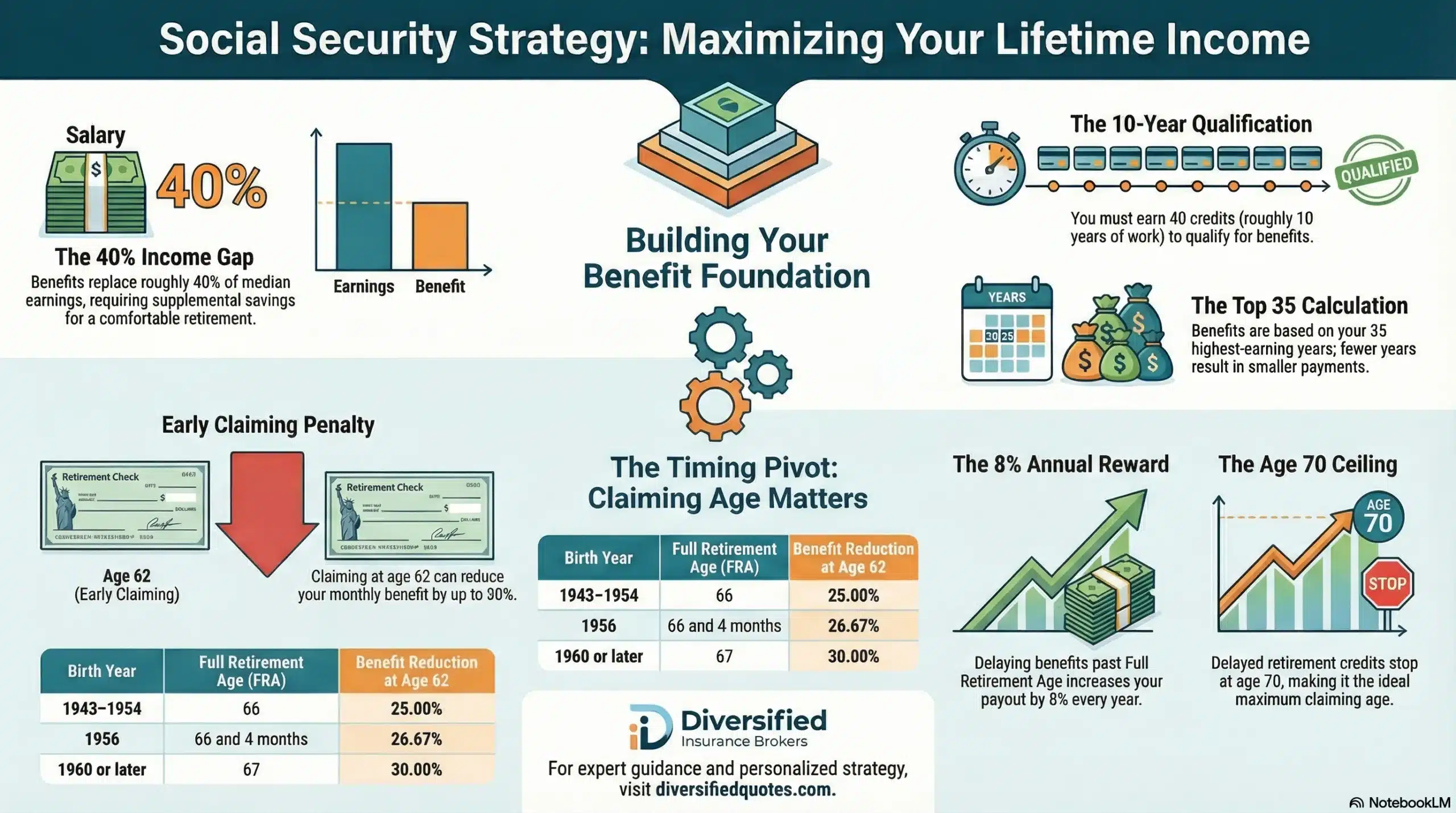
The normal claiming-age adjustments still apply to the now-standard benefit. Filing before Full Retirement Age permanently reduces the monthly benefit. Filing after FRA accumulates delayed retirement credits that permanently increase the monthly benefit — and because the baseline PIA is now higher for previously WEP-affected workers, the absolute dollar value of those delay credits is also higher than it was under the WEP formula. For workers whose WEP reduction was near the maximum, the difference between filing at FRA and at age 70 on the standard-formula PIA can be several hundred dollars per month more than the same comparison would have produced under the WEP-adjusted baseline. The delayed retirement credits resource explains year-by-year how those credits accumulate past FRA.
The earnings test remains in place and is separate from WEP. If you are still working and considering filing before Full Retirement Age, the earnings test can temporarily withhold benefits in certain cases based on current wages — which is a different mechanism from WEP’s formula adjustment. Earnings test rules after FRA explains how that works and how it interacts with the filing age decision. Workers who are still employed and coordinating benefit timing with ongoing income need to evaluate both the earnings test and their filing age comparison to avoid temporary benefit withholding that was not anticipated.
What the Repeal Does Not Change
The Social Security Fairness Act eliminated WEP and GPO but did not change other aspects of Social Security’s structure. The standard eligibility rules — 40 credits to qualify, Full Retirement Age based on birth year, early and late filing adjustments — remain in place. The deemed filing rules also remain in effect, preventing many people from filing for only one type of benefit when eligible for multiple types simultaneously. Deemed filing is an important consideration for households coordinating filing strategies, particularly when one spouse has a significantly higher own benefit and the timing of spousal benefit access matters for cash flow. The repeal does not allow strategies that deemed filing prohibits.
Spousal benefit eligibility rules are unchanged. The eligibility requirements for claiming on a current spouse’s record — including the requirement to be married for at least one year and the age requirements — remain as they were before the repeal. The difference the repeal makes for spousal households is that the worker’s own benefit, which forms the basis of the spousal calculation, may now be higher because it is no longer WEP-reduced. For divorced-spouse benefits, eligibility rules are similarly unchanged, but the base benefit amount from which divorced-spouse benefits are calculated may be higher for workers who were previously WEP-affected. Spousal benefits after divorce explains those eligibility and timing rules under the current framework.
The Social Security income limits — the earnings test thresholds that determine whether benefits are temporarily withheld for early filers who continue working — are also unchanged. Workers considering filing before FRA while still earning income should verify how the earnings test applies to their specific situation before making a permanent filing decision. A strategy that looks good on paper can become complicated if the earnings test triggers benefit withholding that was not anticipated.
Household Filing Strategy After WEP Repeal
The Social Security Fairness Act does not automatically produce the optimal filing strategy for every household it affects — it changes the inputs to that calculation, which means the optimal strategy itself may change. Workers who built their entire retirement income timeline around a WEP-reduced Social Security benefit may find that the higher post-repeal benefit changes when it makes sense to file, how it coordinates with pension income, and how it affects tax planning for Social Security income. Previous planning assumptions may no longer reflect the household’s actual financial picture, and rebuilding the analysis from the corrected benefit amount is necessary before any permanent filing decision is made.
Household coordination is especially important when both spouses had benefits affected by WEP or GPO. In some cases, the larger-earning spouse’s delayed filing strategy was designed to maximize the survivor benefit available to the surviving spouse — a particularly important consideration for widowed beneficiaries planning long-term income security. With GPO eliminated, surviving spouses who previously had no survivor benefit access due to a non-covered pension now have access to the full calculated survivor benefit. That change can significantly alter the household filing sequence that produces the best combined lifetime income — a calculation that requires modeling both benefit timelines together rather than each spouse’s benefit in isolation. Claiming strategies for widows addresses how survivor benefit planning and filing age interact under the current post-repeal framework.
Tax Planning After WEP Repeal
The WEP repeal increases Social Security benefits for affected workers, and that income increase can affect the tax situation in ways that deserve careful attention before the higher benefit begins. Social Security income is potentially taxable when combined income — adjusted gross income plus non-taxable interest plus half of Social Security benefits — exceeds certain thresholds. Up to 50% of Social Security benefits may be taxable when combined income is between $25,000 and $34,000 for single filers (or $32,000 to $44,000 for married filing jointly). Up to 85% may be taxable when combined income exceeds those upper thresholds. Workers receiving a non-covered pension plus a restored standard-formula Social Security benefit often find their combined income pushes well into the 85% taxable zone, particularly when other retirement income sources are also present.
Workers who previously had WEP-reduced Social Security income may have stayed below a taxability threshold that they will now exceed with the higher post-repeal benefit. Strategies such as Roth conversions in lower-income years, qualified charitable distributions from IRAs to reduce taxable income, and careful timing of distributions from tax-deferred accounts can reduce the effective tax burden on the restored Social Security income — but these strategies need to be implemented before the income arrives rather than discovered retrospectively at tax time. Reducing taxes on Social Security explains the key strategies and how combined income is calculated.
Medicare premium brackets add another layer to this coordination. IRMAA surcharges apply to Medicare premiums for beneficiaries whose income in a prior year exceeded defined thresholds, and a higher Social Security benefit increases income in the year it is received — which can affect Medicare premiums two years later. For households whose pension and Social Security income together push them above IRMAA thresholds for the first time, understanding the bracket structure before the income change occurs is a meaningful planning advantage. How Medicare and Social Security work together covers this interaction in detail.
Building a Stable Retirement Income Plan After WEP Repeal
For workers whose retirement income plan was built around a WEP-reduced Social Security number, the repeal creates an opportunity to rebuild that plan on a more accurate foundation. In some cases, the higher benefit may reduce the need for other guaranteed income sources that were sized to compensate for a smaller Social Security check. In other cases, the higher benefit reinforces the case for delaying Social Security to maximize a now-larger baseline, while bridging the gap before filing begins with other income sources. The right approach depends on the household’s total income picture, tax situation, and the interaction between pension timing, Social Security timing, and other retirement income sources. Lifetime income planning addresses the sequencing and coordination challenges that remain relevant regardless of WEP’s repeal — because income sequencing, distribution timing, and coverage of the bridge period between retirement and Social Security filing are planning challenges that exist independent of which Social Security formula was applied.
Pre-retirees who are 5 to 10 years from retirement and had built their financial model around WEP-reduced Social Security should revisit every assumption in that model. This includes the projected Social Security amount, the optimal filing age, the tax treatment of combined income, and the role of supplemental income sources in the overall plan. A structured review starting with an accurate current benefit estimate from the SSA and working outward from there is the most reliable approach. The full filing framework — comparing ages, modeling household income, and coordinating with Medicare timing — is addressed in our overview of when to start taking Social Security benefits.
Step-by-Step WEP Planning Checklist — Post-Repeal
Step 1: Verify your current benefit reflects the repeal. Pull your payment history and current monthly amount from the SSA My Social Security portal. If you were previously subject to WEP and your benefit has not increased, or if you have not received a retroactive payment for January 2024 forward, contact the SSA directly to resolve the discrepancy before it compounds further.
Step 2: Verify your earnings record for accuracy. The standard formula benefit is calculated from your covered earnings record, and errors in that record — missing years, incorrect amounts — translate directly into an incorrect benefit. Self-employed workers should be particularly careful that Social Security self-employment earnings are correctly recorded across all applicable years. Address any errors before your benefit is finalized whenever possible.
Step 3: Recalculate the optimal filing age using the corrected benefit amount. Compare filing at 62, FRA, and 70 using the standard formula PIA rather than the WEP-reduced amount. The year-by-year income difference at each age can shift significantly when the baseline benefit changes substantially. The filing age comparison framework is covered at when to start taking Social Security benefits, and the mechanics of delay credits are explained at delayed retirement credits.
Step 4: Map the household benefit picture including restored GPO benefits. If your household was affected by GPO in addition to WEP, the restoration of spousal and survivor benefits changes the household income picture and the optimal filing sequence. For households still coordinating spousal filing decisions, deemed filing rules remain in effect and must be factored into timing decisions. If divorce is part of the picture, spousal benefits after divorce explains eligibility and timing under the current framework.
Step 5: Address tax and Medicare coordination. A higher Social Security benefit changes combined income and potentially changes tax liability and Medicare premium calculations. Model the income in the year you plan to file — including pension income, Social Security, and any other income sources — to identify whether tax planning strategies should be implemented before filing. Start with how to reduce taxes on Social Security, then work through Medicare and Social Security coordination for IRMAA implications.
Step 6: Review survivor benefit planning with the updated numbers. The WEP and GPO repeal changes the benefit amounts on which survivor planning is based. Claiming strategies for widows and widowers should be revisited with corrected benefit amounts — particularly for households where GPO had previously reduced or eliminated survivor benefit access entirely.
Step 7: Make a deliberate decision and document it. Once you have an accurate benefit amount, an updated filing age comparison, and a clear view of the tax and Medicare implications, make the filing decision with the full picture in front of you. Keep the supporting numbers and reasoning in a simple record. The Social Security filing checklist provides a practical framework for organizing documents and timing, and our Social Security services page explains how a personalized review can confirm every step before you lock in a permanent decision.
Need help navigating WEP?
We’ll confirm whether the Social Security Fairness Act has been correctly applied to your record, verify retroactive payment accuracy, and map a filing sequence that fits your pension start date, work plans, Medicare timing, and taxes.
Schedule a Social Security Survivor Benefits Review
We are not affiliated with or endorsed by the Social Security Administration. Educational purposes only.
FAQs: Windfall Elimination Provision — History and Repeal
Is the Windfall Elimination Provision still in effect?
No — WEP is no longer in effect. The Social Security Fairness Act (H.R. 82) was signed into law on January 5, 2025, eliminating the Windfall Elimination Provision effective for months after December 2023. The Social Security Administration finalized retroactive payments to affected beneficiaries as of July 7, 2025, covering the difference between what beneficiaries were paid under the WEP reduction and what they should have received under the standard formula from January 2024 forward. If you were subject to WEP before the repeal and are currently receiving Social Security benefits, your monthly payment should now reflect the standard formula — with the 90% first-tier factor applied to the first tier of your Average Indexed Monthly Earnings — rather than the reduced WEP factor. If your benefit has not been updated or you have not received a retroactive payment, contacting the SSA to verify your record is the appropriate next step. The Government Pension Offset, which affected spousal and survivor benefits, was repealed by the same legislation and is similarly no longer in effect.
What was WEP and who did it affect?
The Windfall Elimination Provision was a rule enacted in 1983 that reduced Social Security retirement benefits for workers who received a pension from employment where Social Security taxes were not withheld (called “non-covered” employment) and who also qualified for Social Security benefits from covered employment. The standard Social Security formula applies a 90% factor to the first tier of Average Indexed Monthly Earnings — a progressive design intended to provide higher income replacement rates for lower-wage workers. WEP reduced that first-tier factor for mixed-career workers, from 90% down to as low as 40% for workers with 20 or fewer years of substantial covered earnings, on the theory that the full 90% replacement rate was an unintended benefit for workers who had substantial non-covered pension income. The reduction was graduated: workers with 21 to 29 years of substantial covered earnings faced partial WEP reduction, and workers with 30 or more years were entirely exempt. At its peak, WEP affected approximately 2.1 million beneficiaries, with a maximum monthly reduction of $587 in 2024. Workers most commonly affected included certain state and local government employees, teachers in the 15 states where teaching was not covered by Social Security, public safety professionals with non-covered pensions, and some federal employees.
Does the WEP repeal change the optimal Social Security filing age?
Yes, potentially — the WEP repeal can change which filing age produces the best lifetime income outcome for previously affected workers, because the baseline benefit amount used in that calculation has changed. Workers who planned their filing strategy around a WEP-reduced benefit may find that the higher post-repeal benefit changes whether it is advantageous to file early, at Full Retirement Age, or to delay to age 70. The year-by-year income comparison between filing ages is sensitive to the baseline benefit amount: a larger baseline means delay credits build on a higher number, which increases the absolute dollar value of delay and can make the waiting period financially worthwhile in cases where it was not before. Conversely, workers who delayed filing specifically because delay was more valuable on a WEP-reduced base — and are now wondering whether early filing would have been better under the standard formula — should model both scenarios with the corrected benefit amount before making any conclusions. The optimal filing age comparison should be rebuilt from scratch using the correct current benefit amount, not extrapolated from calculations made under the WEP-reduced baseline.
How does WEP’s repeal interact with taxes and Medicare premiums?
The WEP repeal increases Social Security benefits for affected workers and households, and that income increase can trigger new tax and Medicare premium considerations that were not present before the repeal. Social Security income is potentially taxable — up to 85% can be included in taxable income — when combined income (adjusted gross income plus non-taxable interest plus half of Social Security benefits) exceeds defined thresholds. Workers who previously received a WEP-reduced benefit that kept their combined income below these thresholds may now find their combined income has crossed into partially or fully taxable territory with the higher post-repeal benefit. Additionally, Medicare premium brackets under IRMAA are based on income from two years prior; a significant income increase in the year the repeal takes effect can affect Medicare premiums two years later. For households receiving a pension plus the restored Social Security benefit plus other retirement income, the combined income effect on both tax liability and Medicare premium brackets deserves deliberate planning. Proactive strategies — including Roth conversions in lower-income years, qualified charitable distributions from IRAs, and careful distribution sequencing from tax-deferred accounts — can reduce the effective tax burden on the restored Social Security income, but they need to be implemented before the income arrives rather than addressed retrospectively at tax time.
About the Author:
Jason Stolz, CLTC, CRPC, DIA, CAA and Chief Underwriter at Diversified Insurance Brokers (NPN 20471358), is a senior insurance and retirement professional with more than 25 years of real-world experience helping individuals, families, and business owners protect their income, assets, and long-term financial stability. As a long-time partner of the nationally licensed independent agency Diversified Insurance Brokers, Jason provides trusted guidance across multiple specialties—including fixed and indexed annuities, long-term care planning, personal and business disability insurance, life insurance solutions, Group Health, Travel Medical and Evacuation Insurance, and short-term health coverage. Diversified Insurance Brokers maintains active contracts with over 100 highly rated insurance carriers, ensuring clients have access to a broad and competitive marketplace.
His practical, education-first approach has earned recognition in publications such as VoyageATL, and contributions from his agency featured in Kiplinger and GoBankingRates— highlighting his commitment to financial clarity and client-focused planning. Drawing on deep product knowledge and years of hands-on field experience, Jason helps clients evaluate carriers, compare strategies, and build retirement and protection plans that are both secure and cost-efficient. Visitors who want to explore current annuity rates and compare options across multiple insurers can also use this annuity quote and comparison tool.
Explore All Social Security Planning Guides: Browse our complete Social Security Planning guide — covering filing strategies, spousal benefits, survivor benefits, taxes, WEP, GPO & more.
Last Reviewed: June 20, 2026 |
Reviewed by: Jason Stolz, CLTC, CRPC, DIA, CAA
Chief Underwriter, Diversified Insurance Brokers, Inc. | NPN: 20471358 | Diversified Insurance Brokers, Inc. — Licensed in all 50 states
Fact Checked by: Tonia Pettitt, CMIP©
Medicare Specialist, Diversified Insurance Brokers, Inc. | NPN: 14374308 | Diversified Insurance Brokers, Inc. — Licensed in all 50 states
Did you find this content helpful? Leave us a Google review — it helps others find trustworthy guidance too.
Editorial Standards: Diversified Insurance Brokers maintains rigorous editorial standards to ensure accuracy, clarity, and independence in all content. Learn more about our editorial standards and commitment to transparency.
