
When Should You Start Taking Social Security Benefits?
When Should You Start Taking Social Security Benefits?
One of the most important retirement decisions you will ever make is when to begin drawing your Social Security benefits. While you can claim as early as age 62, your monthly payment will be permanently reduced if you do. On the other hand, waiting until full retirement age — or even age 70 — can significantly increase your lifetime income. The key question is not simply “When can I file?” but rather, “How does this decision fit into my complete retirement income strategy?” Social Security is not an isolated choice. It interacts with taxes, Medicare timing, spousal and survivor planning, retirement account withdrawals, annuities, continued employment, and your long-term income security. Getting this decision right can mean the difference between running tight later in retirement and creating a durable, inflation-adjusted income foundation that supports you and your spouse for decades.

Claiming at 62, FRA, or 70 — The Core Trade-Off Table
| Decision Point | Claim at 62 (Early) | Claim at FRA (66–67) | Claim at 70 (Maximum) |
|---|---|---|---|
| Monthly Benefit Amount | Permanently reduced by 25–30% compared to FRA benefit. Reduction percentage depends on birth year and exact claiming age. | 100% of your Primary Insurance Amount (PIA) — the baseline benefit calculated from your 35 highest earnings years. | Permanently increased by approximately 24–32% above FRA benefit (8% per year for 3–4 years beyond FRA depending on birth year). |
| Total Benefits Received if You Live to 80 | Receives 18 years of payments but at a permanently reduced amount. May total more in early years if longevity is below average. | Receives 13–14 years of payments at full amount. Break-even vs. early claiming is typically around age 78–80. | Receives 10 years of higher payments. Break-even vs. FRA claiming typically around age 82–84. Strongest outcome for long livers. |
| Spousal and Survivor Benefit Impact | Permanently reduces the survivor benefit your spouse can claim after your death — often the most financially damaging long-term consequence for married couples. | Survivor receives the FRA benefit amount. Better than early claiming for spousal protection. | Survivor inherits the maximum possible inflation-adjusted benefit. For couples where one spouse is the significantly higher earner, this is often the most powerful protection strategy available. |
| Earnings Test (If Still Working) | Benefits may be temporarily withheld if earnings exceed the annual exempt amount ($22,320 in 2024 — confirm current figure with SSA). Withheld benefits are recredited at FRA. | No earnings test after reaching FRA — you can work and earn any amount without benefit reduction. | No earnings test — but delaying while working continues to build your earnings record, potentially increasing your PIA further. |
| Tax Exposure | Lower benefit may push less of the benefit into taxable territory. However, early claiming with continued employment can push combined income above thresholds. | FRA benefit may be partially taxable depending on combined income from other sources. | Higher monthly benefit more likely to be partially taxable, but the larger amount typically produces more after-tax income than smaller taxable-but-lower early amounts. |
| Best For | Health is uncertain; lower longevity expectations; immediate income need; single retiree with no survivor concerns; short break-even horizon calculation favors early. | Average health and longevity expectations; balanced spousal coordination; income from other sources covers FRA gap from 62; comfortable midpoint for most planning scenarios. | Strong health and longevity; married higher earner focused on survivor protection; able to fund expenses from retirement accounts, annuities, or other sources during the deferral period. |
Why This Decision Is So Permanent — And So Consequential
Many retirees underestimate how permanent this choice is. Once you claim, your benefit level is largely locked in for life, subject only to cost-of-living adjustments. That filing age also affects spousal benefits and survivor income. For married couples, this is not one decision — it is a coordinated strategy involving two lifetimes. For single individuals, it can determine whether later-life income feels stable or strained. For self-employed individuals, filing timing can be even more nuanced due to income patterns and tax coordination — a dimension explored in our guide on Social Security benefits for self-employed individuals. The right claiming age depends on your health, longevity expectations, income needs, tax environment, work status, and the structure of your overall retirement plan.
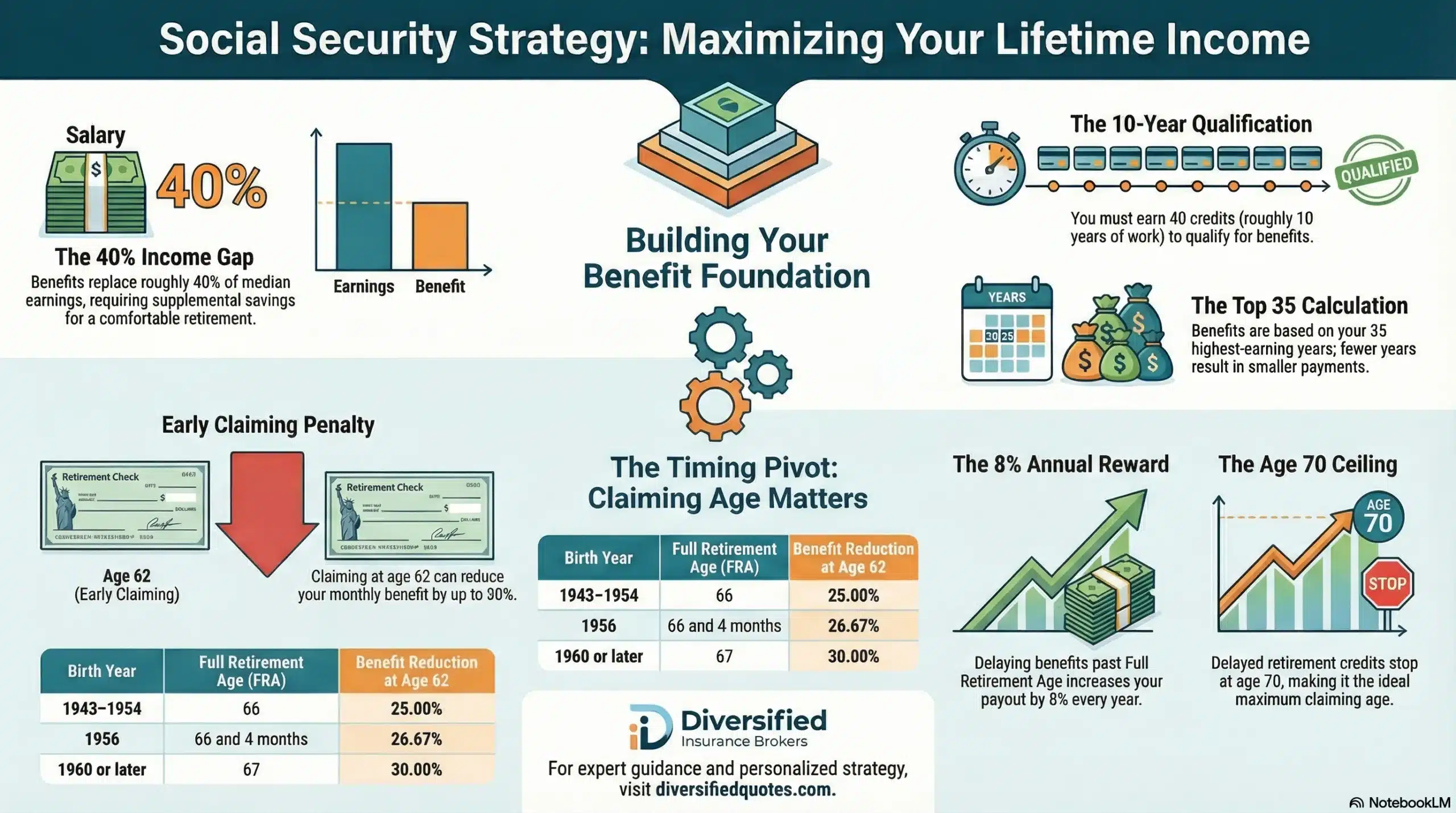
If you claim at 62, your benefit may be reduced by as much as 25–30% compared to your full retirement age (FRA) benefit. FRA varies depending on birth year, generally between 66 and 67 for most current retirees. If you delay beyond FRA, you earn delayed retirement credits — approximately 8% per year until age 70. That increase is permanent. For someone with strong longevity expectations or a spouse who may outlive them, those delayed credits can substantially improve lifetime household income. The increase is not just theoretical — it directly boosts the surviving spouse’s income if you are the higher earner. That is why coordinating filing decisions is critical for married couples and widows, and why we provide additional strategy guidance in our resource on strategies for claiming Social Security for widows and survivor benefits.
Understanding Full Retirement Age — Your FRA by Birth Year
Full retirement age is the specific age at which you qualify for 100% of your Primary Insurance Amount — the benefit calculated from your 35 highest earning years, indexed for wage growth. The FRA is not the same for everyone: it depends entirely on birth year. For individuals born in 1943 through 1954, FRA is 66. For those born between 1955 and 1959, FRA increases by two months per birth year (66 and 2 months for 1955, 66 and 4 months for 1956, and so on). For anyone born in 1960 or later, FRA is 67. This distinction matters directly for the reduction calculation: claiming before your specific FRA produces a reduction percentage based on how many months before FRA you file, not simply how many years before 67 you are. A person born in 1960 who files at 62 faces the full 30% reduction; a person born in 1955 filing at the same age 62 faces a smaller reduction because their FRA is 66 and 2 months, not 67. Knowing your specific FRA is the mathematical foundation for any meaningful Social Security analysis.
Delaying Is Not Automatically “Better” — When Early Claiming Makes Sense
Delaying is not automatically the right choice. If you need income immediately to reduce withdrawals from retirement accounts, claiming earlier may preserve investment assets. If your health is uncertain or longevity expectations are lower based on family history or current medical status, claiming sooner may provide greater lifetime value. The break-even calculation — the age at which cumulative delayed benefits exceed cumulative early benefits — typically falls between age 78 and 84 depending on the claiming ages compared and the benefit amounts involved. If you do not expect to live past that break-even age, early claiming produces more total lifetime benefits. If you continue working before FRA, the earnings test may temporarily reduce benefits, adding complexity to the timing decision. And if you delay Social Security while drawing from IRAs or 401(k)s, you may be able to strategically manage taxes in lower-income years before required minimum distributions begin. Understanding RMD rules after SECURE 2.0 is directly relevant to this coordination.
Tax Coordination — How Benefits Interact With Your Other Income
One of the most overlooked elements of Social Security planning is tax coordination. Social Security benefits can be taxable depending on your combined income — technically your “provisional income,” which is adjusted gross income plus non-taxable interest plus 50% of Social Security benefits. When provisional income is below $25,000 for single filers ($32,000 for married filing jointly), no Social Security benefits are taxable. When it falls between those thresholds and $34,000 (single) or $44,000 (married), up to 50% of benefits may be taxable. Above those upper thresholds, up to 85% of benefits may be taxable. These thresholds are not indexed for inflation — they have been fixed since 1993 — meaning more retirees become subject to benefit taxation every year as income levels rise.
Filing earlier or later changes how benefits interact with IRA withdrawals, Roth conversions, pensions, and annuity income. Sometimes delaying Social Security while strategically withdrawing from traditional retirement accounts — or performing Roth conversions — can smooth your long-term tax burden. Our guide on how to minimize Social Security taxes covers the specific income management strategies that can reduce the taxable portion of benefits. The window between retirement and Social Security claiming is one of the best tax-planning opportunities available — income is often lower, RMDs have not yet begun, and Roth conversion ladders can be built at favorable tax rates. Coordinating Social Security timing with that window deliberately produces better after-tax outcomes than treating the claiming decision as standalone.
Medicare Timing — The Separate but Parallel Decision
Another key consideration is Medicare timing. Most Americans become eligible for Medicare at 65, regardless of when they claim Social Security. Filing for Social Security does not automatically mean you should file for Medicare at the same time, and vice versa. Coordinating Medicare enrollment with your Social Security strategy is essential to avoid penalties and gaps in coverage. If you delay Social Security but turn 65 before claiming, you must actively enroll in Medicare Part B during your Initial Enrollment Period to avoid the Part B late enrollment penalty — a permanent 10% premium increase for each 12-month period you were eligible but not enrolled. For a deeper look at how Medicare timing integrates with retirement income planning, review what to know before you enroll in Medicare and our comparison guide on Medicare Advantage vs. Medicare Supplement.
Married Couples — Coordinating Two Lifetimes of Income
For married couples, strategy matters even more than for singles. The higher earner’s decision often determines the survivor’s long-term financial protection. If the higher earner delays benefits to age 70, the surviving spouse inherits that larger inflation-adjusted income after the higher earner’s death — potentially for 20 or 30 years. If the higher earner claims early, the permanently reduced benefit may become the survivor’s sole income source after the lower earner’s benefit is lost and the higher earner’s reduced benefit becomes the survivor benefit. In households where one spouse earned significantly more, this becomes a cornerstone planning decision that affects not just today’s income but the surviving spouse’s financial independence for the rest of their life.
The sequencing of who claims first also matters. A common strategy for couples: the lower earner claims early at 62 to provide some household income during the deferral period, while the higher earner delays to 70 to maximize both the lifetime benefit and the survivor benefit. This approach funds the bridge period from the lower earner’s benefit and eventually provides the maximum possible inflation-adjusted income through the higher earner’s delayed benefit. Couples who treat Social Security as a joint lifetime income strategy — rather than two separate filing decisions — often create significantly stronger long-term outcomes than those who file simultaneously or independently without coordination.
Single Retirees — The Break-Even and Longevity Decision
Single retirees face a fundamentally different dynamic. Without survivor considerations, the decision becomes more directly tied to personal longevity and immediate income needs. The break-even age between claiming at 62 versus 70 is approximately age 82 to 84 for most retirees — meaning if you expect to live beyond that age, delayed claiming produces more total lifetime benefits. If you expect to live into your 90s, the difference in lifetime benefit between claiming at 62 versus 70 can easily exceed $100,000 or more depending on your PIA. If longevity is uncertain or income is needed immediately, the calculation shifts in favor of earlier claiming. Even then, the decision should integrate with retirement account withdrawals, annuity income, pensions, and investment strategy. For single retirees without pension income, exploring pension alternatives and annuity options for retirees without pensions clarifies how Social Security interacts with other income sources in a retirement income architecture that provides stability for a full lifetime.
Divorce and Claiming — Spousal Benefits for Non-Married Individuals
Divorced individuals have access to spousal benefit provisions that many retirees are unaware of. If you were married for at least 10 years, you may be eligible for a spousal benefit based on your ex-spouse’s earnings record — without affecting the benefit your ex-spouse or their current spouse receives. The spousal benefit is up to 50% of the ex-spouse’s PIA at their FRA, and it is available to you as early as age 62. To receive the divorced spousal benefit, you must be at least 62 years old, unmarried, and your ex-spouse must also be at least 62 (though they do not have to be receiving benefits themselves if you have been divorced for at least two years). If you were married multiple times, each marriage lasting at least 10 years, you can claim based on whichever ex-spouse’s record produces the highest benefit — subject to the usual eligibility rules. If your own Social Security benefit exceeds the divorced spousal benefit, you receive your own benefit. The divorced spousal benefit is also relevant to survivor planning: if your ex-spouse dies, you may be eligible for a divorced survivor benefit structured similarly to a married survivor benefit. For households navigating these more complex claiming scenarios, reviewing how to maximize Social Security benefits across all eligible benefit types provides a framework for identifying the highest-value claiming strategy for your specific situation.
Guaranteed Income Layering — How Social Security Fits the Bigger Picture
Many retirees overlook the role of guaranteed income layering. Social Security forms the inflation-adjusted base of retirement income. Some retirees supplement that base with pensions or annuity income strategies to create stable monthly cash flow. When structured correctly, layering guaranteed income sources can reduce market stress and provide clarity around spending. Understanding the benefits of annuities within this income layering framework helps clarify which tools solve which problems: Social Security handles the inflation-adjusted lifetime income floor, while fixed annuities and income annuities can supplement that floor with additional guaranteed income that reduces dependence on volatile investment portfolios. The impact of sequence-of-returns risk on portfolio sustainability is directly reduced by each additional guaranteed income stream — because more spending needs are covered by sources that do not require portfolio withdrawals, the portfolio itself can be given time to recover from market downturns rather than being depleted by forced selling during downturns. Understanding how long your IRA will last under different withdrawal scenarios is a critical complement to the Social Security timing decision — the two analyses together answer the most important retirement question: will the money last?
At Diversified Insurance Brokers, we approach Social Security filing decisions as part of a coordinated retirement income strategy. We look at your expected expenses, other income sources, tax exposure, spousal coordination, Medicare timing, and longevity assumptions. We stress-test different claiming ages and illustrate how each affects lifetime income. We do not rely on a generic age-based answer. You can learn more about our Social Security planning services at our Social Security services page.
Ready to model your optimal Social Security claiming strategy?
Request Your Personalized Social Security Review
Related Pages
Explore Social Security, Medicare, retirement income, and financial planning resources to build a complete retirement strategy.
Financial Protection Essentials
Understand annuity guarantees, interest rate examples by investment size, and how retirement income strategies work in practice.
Schedule an Appointment with a Social Security Expert
Get personalized guidance on your claiming age, spousal and survivor benefits, the earnings test, taxes, and how Medicare timing fits in. We’ll help you avoid costly missteps and build a strategy focused on maximizing lifetime value.
🔗 Explore: Social Security Services · Maximize Benefits · Benefits for Self-Employed
Can I change my mind after filing for Social Security?
Yes — but with significant limitations. The Social Security Administration allows a one-time withdrawal of your application within the first 12 months of claiming. To withdraw, you must repay all benefits received, including any benefits paid to family members based on your record. After the 12-month window closes, your claiming decision is permanent and cannot be reversed. If you have already passed the 12-month withdrawal window but have not yet reached age 70, a second option is available: voluntary suspension. At your full retirement age or later, you can suspend your benefits — stopping payments while simultaneously earning delayed retirement credits of 8% per year until age 70, at which point benefits automatically resume at the higher amount. Voluntary suspension does not require repaying previously received benefits, but it also does not credit you for the early filing reduction — it only adds delayed credits from the suspension date forward. The practical implication: if you claimed early and have second thoughts, the 12-month withdrawal window is the only way to fully undo the decision. After that window, voluntary suspension can partially recover lost delayed credits but cannot restore the early filing reduction that was permanently applied.
How does the Social Security earnings test work if I claim early and keep working?
The earnings test applies to Social Security beneficiaries who claim before their full retirement age and continue working. In the years before your FRA, the SSA withholds $1 in benefits for every $2 you earn above the annual exempt amount (which is adjusted annually — confirm the current figure with ssa.gov). In the calendar year you reach FRA, a higher exempt amount applies and the withholding ratio changes to $1 for every $3 of earnings above that higher threshold, applied only to earnings before your FRA birthday. After you reach FRA, the earnings test no longer applies — you can earn any amount without any benefit reduction. Crucially, benefits withheld under the earnings test are not permanently lost. Once you reach FRA, the SSA recalculates your benefit to credit you for the months your benefit was withheld, effectively increasing your monthly payment going forward. This recalculation does not perfectly restore all withheld amounts in present-value terms, but it does meaningfully offset the short-term reduction for those who claimed early and worked significantly. The earnings test is one of the most misunderstood aspects of Social Security — many early claimers who continue working do not realize that what appears to be a permanent penalty is actually a temporary withholding with a partial recrediting mechanism at FRA.
What is the Social Security break-even age, and should I rely on it to make my decision?
The break-even age is the age at which cumulative lifetime benefits from a delayed filing strategy equal cumulative lifetime benefits from an earlier filing strategy. For example, if claiming at 62 produces $2,000/month and claiming at 70 produces $3,300/month (after the full reduction at 62 and the full delay credits to 70), the break-even is approximately the age where total cumulative payments from the 70-claim strategy catch up to the total cumulative payments already received from the 62-claim strategy. For most retirees, the break-even between 62 and 70 falls somewhere around age 80 to 84, with the exact age depending on the specific benefit amounts and time value of money assumptions used. The break-even analysis is a useful starting point for longevity-based decision making, but it has important limitations as a standalone decision tool. First, it ignores survivor benefits — the break-even for the higher earner’s claiming decision is dramatically different when survivor protection for a spouse is included, because the survivor receives the higher earner’s benefit for the rest of their life after the higher earner dies. Second, it ignores taxes — because delayed benefits are larger, they may push more income into a taxable tier, reducing the net advantage. Third, it uses a fixed actuarial assumption that may not reflect your specific health and longevity. Break-even analysis provides a useful data point, but it should be one input into a comprehensive analysis rather than the sole deciding factor.
Should I delay Social Security if my spouse is much younger than I am?
A significant age gap between spouses is one of the most compelling arguments for the higher earner to delay Social Security to age 70, even beyond standard longevity arguments. The reason: when the older spouse dies, the surviving younger spouse will inherit the older spouse’s Social Security benefit as the survivor benefit and may receive it for an extremely long period. Consider a scenario where the older spouse is 10 years older and the higher earner — if the older spouse claims at 62 at a 30% permanent reduction and dies at age 82, the younger spouse faces the next 20 to 30 years of their retirement on a benefit permanently reduced by 30%. If the older spouse had delayed to 70 instead, the surviving younger spouse receives a benefit that is 76% higher than the early-claiming amount — an income difference that compounds annually with cost-of-living adjustments over 20 to 30 years of survivor income. The financial impact of this decision for a young surviving spouse is often the single largest determinant of long-term retirement security in a couple with a meaningful age gap. The longer the potential survivor income horizon, the more heavily the analysis should weigh the survivor benefit optimization over the present-value break-even calculation.
How does delaying Social Security interact with Roth conversions?
The period between retirement and the Social Security claiming date — particularly in years before RMDs begin — is one of the most valuable windows for Roth conversion planning, and the two strategies interact directly. When you delay Social Security and fund early retirement expenses from traditional IRA or 401(k) withdrawals, you are drawing down pre-tax accounts in years when your taxable income may be lower than it will be later — before Social Security income, before RMDs, and potentially before pension income begins. Those lower-income years allow Roth conversions at lower marginal tax rates: converting traditional IRA money to Roth at a 12% or 22% rate today avoids future RMD distributions that might be taxed at 24% or higher later, and avoids having those distributions push Social Security benefits into higher taxable tiers. The interaction is bidirectional: Roth conversions in the delay period increase current taxable income, which must be managed to avoid pushing Social Security provisional income above taxability thresholds. Modeling the Roth conversion amounts against the Social Security taxability tiers simultaneously — using the combined income thresholds as guardrails — produces the most tax-efficient outcome across the full deferral period. Our guide on how to minimize Social Security taxes and our resource on RMDs after SECURE 2.0 cover both dimensions of this coordination.
About the Author:
Jason Stolz, CLTC, CRPC, DIA, CAA and Chief Underwriter at Diversified Insurance Brokers (NPN 20471358), is a senior insurance and retirement professional with more than 25 years of real-world experience helping individuals, families, and business owners protect their income, assets, and long-term financial stability. As a long-time partner of the nationally licensed independent agency Diversified Insurance Brokers, Jason provides trusted guidance across multiple specialties—including fixed and indexed annuities, long-term care planning, personal and business disability insurance, life insurance solutions, Group Health, Travel Medical and Evacuation Insurance, and short-term health coverage. Diversified Insurance Brokers maintains active contracts with over 100 highly rated insurance carriers, ensuring clients have access to a broad and competitive marketplace.
His practical, education-first approach has earned recognition in publications such as VoyageATL, and contributions from his agency featured in Kiplinger and GoBankingRates— highlighting his commitment to financial clarity and client-focused planning. Drawing on deep product knowledge and years of hands-on field experience, Jason helps clients evaluate carriers, compare strategies, and build retirement and protection plans that are both secure and cost-efficient. Visitors who want to explore current annuity rates and compare options across multiple insurers can also use this annuity quote and comparison tool.
Explore All Social Security Planning Guides: Browse our complete Social Security Planning guide — covering filing strategies, spousal benefits, survivor benefits, taxes, WEP, GPO & more.
Last Reviewed: June 25, 2026 |
Reviewed by: Jason Stolz, CLTC, CRPC, DIA, CAA
Chief Underwriter, Diversified Insurance Brokers, Inc. | NPN: 20471358 | Diversified Insurance Brokers, Inc. — Licensed in all 50 states
Fact Checked by: Tonia Pettitt, CMIP©
Medicare Specialist, Diversified Insurance Brokers, Inc. | NPN: 14374308 | Diversified Insurance Brokers, Inc. — Licensed in all 50 states
Did you find this content helpful? Leave us a Google review — it helps others find trustworthy guidance too.
Editorial Standards: Diversified Insurance Brokers maintains rigorous editorial standards to ensure accuracy, clarity, and independence in all content. Learn more about our editorial standards and commitment to transparency.
