
Social Security Benefits for Self Employed
Social Security Benefits for Self Employed

When you are self-employed, you are responsible for every dimension of your financial life — including payroll, taxes, and retirement planning that most employees never have to think about because their employer handles it automatically. The good news is that Social Security still works for self-employed individuals in fundamentally the same way it works for W-2 employees. Your net earnings from self-employment can create credits toward retirement benefits, disability coverage, and survivor benefits using the same underlying formula that applies to everyone who pays into the system. The difference is that you are the one responsible for how income is reported, how it is taxed, and how consistently it is credited to your earnings record over the years — which means you have more control over your benefit than a typical employee does, but also more opportunities to accidentally shortchange your future benefit through decisions that seem advantageous in the short term but erode the foundation of your Social Security income over time.
The self-employed version of payroll is self-employment tax. That SE tax is what feeds the Social Security benefit formula over your working lifetime — not revenue, not gross business income, but the net earnings from self-employment that you report on Schedule SE and pay SE tax on. If your goal is to keep more lifetime income and build the strongest possible retirement benefit, you need to understand how your business structure, your compensation decisions, your filing timeline, and your retirement cash-flow plan all connect — because these are not independent decisions and the interaction between them can meaningfully affect the monthly check you eventually receive. For a broad strategic foundation, how to maximize Social Security benefits covers the optimization framework, and are you leaving Social Security benefits on the table covers the most common missed opportunities that reduce lifetime benefits for people who never realized the trade-offs they were making. At Diversified Insurance Brokers, our advisors help self-employed owners model filing ages, map income sequencing, and coordinate Social Security with Medicare and taxes so your filing decision supports the entire retirement income picture rather than creating problems in areas you did not anticipate.
Ensure you are receiving the absolute top rates
Current Fixed Annuity Rates
Compare today’s best fixed annuity rates from top carriers.
Current Bonus Annuity Rates
See which annuities offer the highest upfront bonus today.
Request an Annuity Quote
Submit our annuity request form to get personalized rate options.
Lifetime Income Calculator
Use our calculator to see how much guaranteed income your annuity can provide.
Schedule an Appointment with a Social Security Expert
Get a personalized timing and coordination plan based on your earnings history, business structure, work plans, Medicare timeline, and household income needs.
Social Security Services Schedule a Free Consultation
Prefer to talk first? Call 800-533-5969
How Self-Employment Tax Builds Your Social Security Benefit
Social Security retirement, disability, and survivor benefits are all built on your earnings record — the cumulative history of wages and self-employment income on which Social Security taxes were paid over your working lifetime. When you are self-employed, the earnings that count are your net profit from self-employment, generally any amount at or above $400 in a given year, which is reported with your annual tax return and calculated on Schedule SE. Those net earnings feed into the calculation of your Average Indexed Monthly Earnings — commonly referred to as AIME — which is the inflation-adjusted average of your highest earning years used to determine your Primary Insurance Amount, or PIA. The PIA is the foundation for your monthly retirement benefit at full retirement age, and it is the number from which early filing reductions and delayed filing credits are calculated.
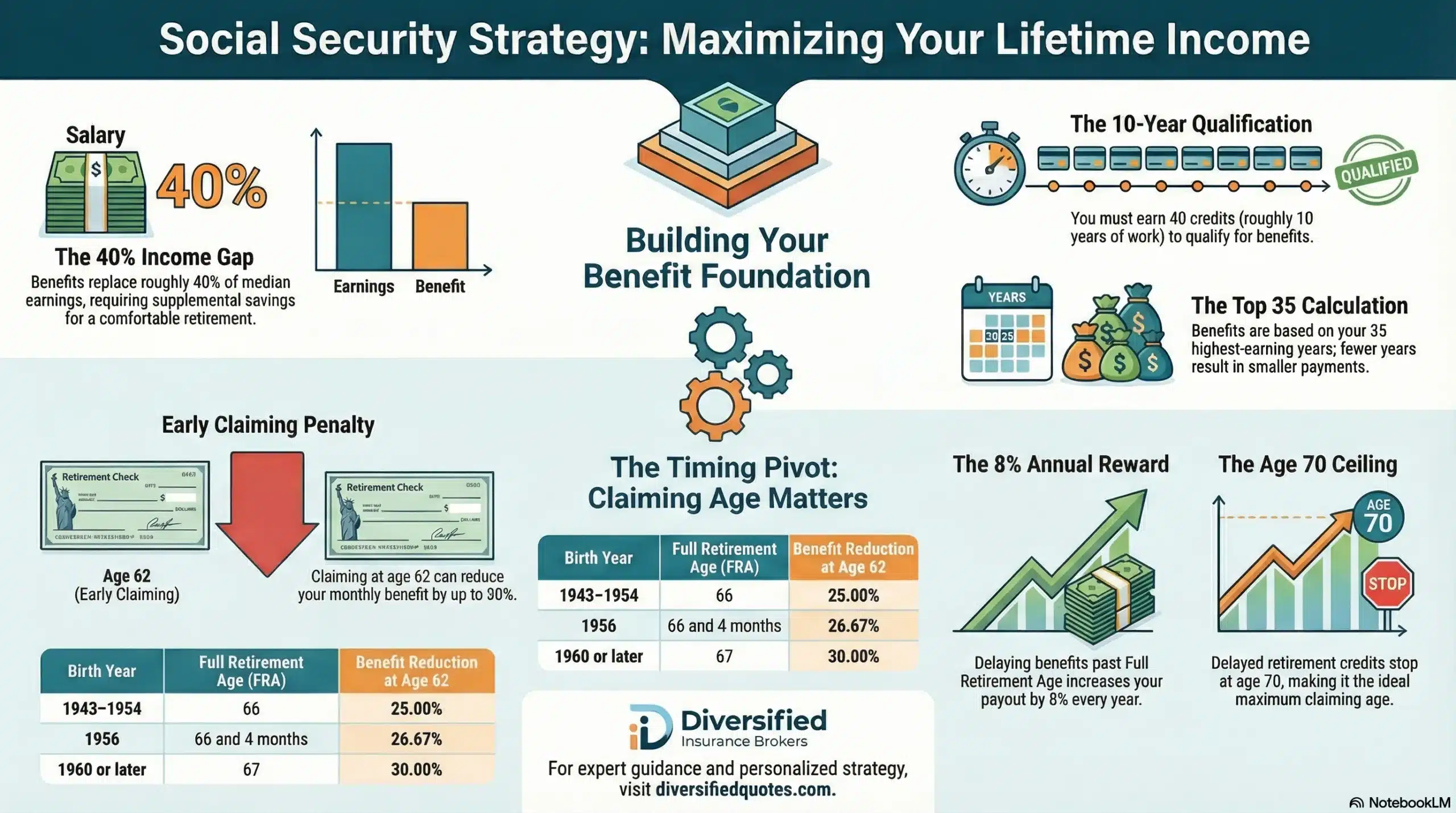
The practical point that most self-employed individuals underestimate is the thirty-five year rule. Social Security’s benefit formula uses your highest thirty-five years of inflation-adjusted earnings to calculate the AIME. If you have fewer than thirty-five years of credited earnings — which is common for individuals who spent early career years in non-covered employment, who had extended periods of business start-up losses, or who structured their business to minimize taxable compensation — then zero earnings years are included in the calculation to fill the thirty-five year count. Each zero year drags down the AIME directly, reducing the PIA and every monthly check that flows from it for the rest of your life. Many business owners focus appropriately on minimizing current-year taxes but do not fully internalize the long-term cost of systematically low credited earnings — a trade-off that may save a few thousand dollars in SE tax today while permanently reducing an inflation-adjusted guaranteed income stream that will pay benefits for potentially twenty to thirty years in retirement.
Entity structure decisions interact directly with Social Security crediting in ways that require active attention rather than passive reliance on default outcomes. With an S-Corporation, the W-2 wages you pay yourself as reasonable compensation generally feed your Social Security earnings record — those wages are subject to payroll taxes including the employee and employer shares of Social Security tax. Distributions from the S-Corp, by contrast, are not subject to self-employment or payroll taxes and do not create Social Security credits. This structure creates a legitimate tax efficiency opportunity — reducing payroll taxes by taking some business income as distributions rather than salary — but it also creates a risk if the reasonable compensation level is set so low that the earnings record is materially under-credited relative to what the business income actually supports. The IRS has established reasonable compensation requirements for S-Corp owners, and setting compensation at the minimum defensible level solely to reduce payroll taxes may create audit exposure while simultaneously building a weaker Social Security base than the business income would otherwise support. Sole proprietors and partners in partnerships do not have this salary-versus-distribution choice — their full net self-employment earnings are subject to SE tax and credited to their Social Security record, which eliminates the under-crediting risk but also eliminates the tax efficiency opportunity that S-Corp owners manage. Disability insurance for self-employed covers the companion income protection planning that self-employed individuals need — because Social Security disability benefits are also tied to the same earnings record that determines retirement benefits, and a weak earnings record reduces disability protection alongside retirement income simultaneously.
Self-Employed Social Security: Key Planning Variables
| Planning Variable | How It Affects Self-Employed Owners | Key Decision Points |
|---|---|---|
| SE tax and earnings record | Net self-employment income credited to earnings record; zero or low-income years reduce the 35-year average and permanently shrink the benefit | How many low or zero years exist; whether a strong final working year could replace a low early year in the 35-year calculation |
| Business entity structure | S-Corp W-2 wages credit the record; distributions do not. Sole proprietors and partners credit full net earnings automatically | Whether S-Corp reasonable compensation is set high enough to maintain adequate earnings crediting alongside distribution tax efficiency |
| Filing age | Claims can begin at 62, full retirement age, or as late as 70; self-employed owners often have more flexibility to control income during gap years than W-2 employees | Longevity expectations, bridge income availability, Medicare timing, and household survivor benefit considerations |
| Social Security taxation | Provisional income from continued business income, consulting, rentals, and investment income can push Social Security benefits into taxable territory | Income sequencing across retirement years; Roth conversion windows before benefits begin; timing of retirement account withdrawals relative to benefit start |
| Medicare coordination | Medicare enrollment at 65 is required to avoid penalties regardless of Social Security filing status; IRMAA surcharges tied to income two years prior affect premium costs | Whether marketplace or group coverage transitions cleanly to Medicare; Part B and D enrollment timing relative to business coverage wind-down |
| Annual recomputation | SSA recomputes benefits annually if new earnings replace lower years in the 35-year record; self-employed filers who continue working after claiming can see benefit increases | Whether continued self-employment after filing will produce earnings strong enough to replace lower historical years and trigger a benefit increase |
Claiming Ages and Smart Timing for Business Owners
Social Security benefits can be claimed as early as age sixty-two, at full retirement age — which is sixty-seven for individuals born in 1960 or later — or as late as age seventy. Many self-employed owners have more timing flexibility than W-2 employees because they can control work volume, shift revenue timing, gradually reduce their client load, or maintain a light practice while transitioning toward full retirement. That flexibility can make timing decisions significantly more powerful than they are for employees who must file at a specific point because employment ends and income stops on a fixed schedule. For a self-employed owner, filing is not forced by a job ending — it is a strategic choice about when to begin a permanent income stream that will continue for the rest of their life and potentially their spouse’s life as well.
Delaying benefits beyond full retirement age generates delayed retirement credits — an increase of approximately eight percent per year from FRA to age seventy, which is a guaranteed, permanent, inflation-adjusted increase that no investment product can replicate with the same certainty. For households with average or better longevity expectations — and actuarial data consistently shows that healthy individuals who reach their early sixties have substantial remaining life expectancy — the breakeven analysis typically favors delay when the comparison is between total lifetime dollars received under different claiming scenarios. The higher delayed benefit also increases survivor protection for a surviving spouse: when the higher-earning spouse delays and receives a larger benefit, the surviving spouse’s eventual survivor benefit is calculated on that larger amount, potentially providing significantly stronger income security for the surviving household member. Delayed retirement credits and Social Security payout increases covers exactly how the credit accrual works and what the long-term benefit difference looks like across different delay periods. When should you start taking Social Security benefits covers the full comparison framework across claiming ages including tax, longevity, and household planning trade-offs. The key enabler for delay is building a plan for the gap years between retirement and age seventy — which is where bridge income planning with annuities or systematic portfolio withdrawal becomes essential for self-employed owners who want the delay benefit but cannot self-fund the gap purely from savings.
Taxes on Social Security for the Self-Employed
Social Security benefits can become taxable — partially or significantly — when the recipient’s combined income, also called provisional income, exceeds defined thresholds. Provisional income is calculated as adjusted gross income plus nontaxable interest plus half of Social Security benefits. For married couples filing jointly, up to fifty percent of benefits may be taxable when provisional income exceeds thirty-two thousand dollars, and up to eighty-five percent of benefits may be taxable when provisional income exceeds forty-four thousand dollars. For single filers, the corresponding thresholds are twenty-five thousand and thirty-four thousand dollars — amounts that many retirees cross even with modest investment and distribution income. Self-employed retirees are especially likely to cross these thresholds because income may continue from active business operations, consulting engagements, rental properties, dividends, interest, or the deferred recognition of business asset sales — income streams that do not stop automatically when Social Security benefits begin and that can accumulate into provisional income calculations in ways that create larger tax bills than anticipated.
The planning objective for most self-employed retirees is not to eliminate taxes on Social Security — which is rarely achievable once multiple income sources are active — but to control the provisional income level so that the taxation of benefits does not spike unexpectedly or unnecessarily. Smoothing taxable income across years, avoiding large one-time income events in years when Social Security benefits are also active, and coordinating the timing of retirement account withdrawals around the year benefits start are all practical strategies that can reduce the effective tax rate on Social Security income without requiring heroic income reduction. Roth conversion strategies executed in the years before benefits begin can also create more flexibility later — qualified Roth distributions do not count toward provisional income in the same way taxable IRA distributions do, which means a portfolio that includes a meaningful Roth component gives the retiree more control over provisional income in the years when Social Security benefit taxation would otherwise be most burdensome. How to reduce taxes on Social Security covers the specific strategies and income thresholds in detail. Is Social Security taxable covers the calculation framework and the income levels at which different inclusion rates apply. Roth conversion windows explained covers the pre-retirement conversion planning that creates flexibility in Social Security taxation in later years. What is IRMAA covers the Medicare premium surcharge calculation that responds to the same income increases that affect Social Security taxation — creating a double threshold effect that makes AGI management during retirement particularly consequential for self-employed individuals with multiple income streams.
Coordination With Medicare and Health Coverage
Many self-employed owners transition from marketplace coverage, private individual plans, or small-group options to Medicare at sixty-five. A common and consequential misconception is that Medicare enrollment must match the Social Security filing date. In reality, the programs interact but do not need to start at the same time, and failing to understand the distinction can result in both financial penalties and coverage gaps that are difficult to correct after the fact. Medicare Part B enrollment has a seven-month initial enrollment window centered on the sixty-fifth birthday — and missing that window can result in a permanent premium surcharge of ten percent for every twelve-month period the enrollment was delayed, applied for as long as the individual has Part B coverage. This penalty applies regardless of when Social Security benefits begin, which means an owner who delays Social Security to sixty-eight but does not enroll in Medicare Part B at sixty-five can face a thirty percent permanent premium surcharge that has nothing to do with the Social Security claiming decision.
The enrollment exception that protects individuals from this penalty is active coverage under a qualifying employer group health plan based on current employment — which can apply to a self-employed owner who is actively operating their business and covering themselves under a bona fide group health plan. Whether a specific business arrangement qualifies for this exception depends on the structure of the coverage and the employment relationship, which is why understanding the specific Medicare enrollment rules before the sixty-fifth birthday is essential for self-employed owners who plan to continue working past that age. How Medicare and Social Security work together covers the timeline interaction between the two programs in detail. Does working past 65 affect Social Security benefits covers how continued self-employment income interacts with both Medicare enrollment timing and Social Security benefit calculations for owners who maintain active business operations beyond the traditional retirement age. Medicare calculator provides a quick starting point for comparing Medicare plan options as the coverage transition approaches. How MAGI affects Social Security and Medicare covers the income calculation that simultaneously affects both Social Security benefit taxation and Medicare IRMAA surcharges — the connection that makes retirement income sequencing particularly consequential for self-employed retirees with multiple income sources.
Spousal, Survivor, and Business-Owner Household Nuances
Social Security planning for self-employed individuals is almost always a household decision rather than an individual one, and the household dimension introduces considerations that single-filer analysis misses entirely. A lower-earning spouse — or a spouse who worked fewer years or primarily outside the paid workforce — may qualify for a spousal benefit equal to up to fifty percent of the higher earner’s PIA, but only while the higher earner is collecting benefits. The higher earner’s benefit at the time of their death generally becomes the survivor benefit for the surviving spouse — meaning the higher earner’s filing age decision has permanent consequences not only for their own monthly income but for the financial security of the surviving household member for potentially decades after the higher earner passes. For self-employed households where one spouse has a substantially larger earnings record, the claiming decision for the higher earner carries the largest long-term household value of any single Social Security planning choice.
For couples where both spouses have participated materially in the business, how compensation and earnings are structured for each spouse can affect the future earnings record of each independently. If only one spouse is recognized as receiving compensation in a business where both contribute meaningfully, the non-compensated spouse may have a weaker earnings record than the economic reality of their contribution warrants — reducing their own future retirement benefit and also potentially reducing the spousal benefit calculation if the household arrangement is examined closely. Deemed filing rules also add complexity for married couples — when one spouse files for their own retirement benefit, they may be simultaneously deemed to have filed for spousal benefits if they are eligible, which eliminates certain timing strategies that were available before legislative changes. Divorced spousal benefits timing covers the duration and timing rules that apply when divorce history is relevant to the household’s benefit calculation. How remarriage affects Social Security spousal benefits covers the impact of subsequent marriage on benefit eligibility for individuals with prior marriage history. Deemed filing rules for Social Security covers the mandatory simultaneous filing provisions that affect spousal benefit strategies for married couples.
WEP and GPO: Special Rules for Self-Employed Filers With Non-Covered Work History
If a self-employed individual also earned a pension from work that was not covered by Social Security — certain public-sector roles including some state and local government positions, specific international employment arrangements, or a limited number of private employer structures that opted out of Social Security coverage historically — two rules can reduce the Social Security benefits available to them and their household. The Windfall Elimination Provision can reduce the individual’s own retirement benefit by modifying the PIA formula in a way that reduces the benefit relative to what it would be for someone with an identical earnings record but no non-covered pension. The Government Pension Offset can reduce a spousal or survivor benefit — sometimes dollar for dollar based on two-thirds of the non-covered pension amount — which can significantly affect the household planning picture for individuals who receive both a government pension and Social Security spousal or survivor benefits.
Many self-employed professionals who previously worked in public-sector roles or in employment structures with non-covered pension arrangements are surprised by these rules when they encounter them at or near filing age — at which point the planning options are limited compared to what would have been available with earlier awareness. If either provision applies to your history, modeling its impact well before the filing decision is the most effective approach, because it can materially change the relative value of different claiming strategies and the household income picture in retirement. Windfall Elimination Provision guide covers the mechanics, the modified formula, and the calculation approach in detail. Government Pension Offset explained covers how the GPO reduction works, which benefits it affects, and what the practical impact looks like across different household income scenarios.
Filing Steps for Self-Employed Individuals
Filing for Social Security is procedurally straightforward — the application is available online through the SSA website and can typically be completed in thirty to sixty minutes — but self-employed filers benefit from a more thorough pre-filing checklist than W-2 employees because the earnings record for self-employed individuals is more likely to contain inconsistencies, delayed reporting, missing years, or understatements that will permanently affect the benefit calculation if not corrected before filing. The first step is always verifying that the earnings record at SSA is accurate and complete. The Social Security Administration maintains an online account system — My Social Security — where individuals can review their recorded earnings year by year against their own tax records. If any year is missing or shows lower earnings than the net self-employment income reported on that year’s Schedule SE, the discrepancy should be investigated and corrected through the SSA’s formal correction process before a benefit application is submitted.
After verifying the earnings record, identifying the optimal filing month involves more than simply selecting the month of a birthday milestone. Benefits can be requested to begin in any month after eligibility is established, and the best month often depends on real cash-flow needs, the timing of Medicare enrollment, whether additional SE earnings in the current year would replace a low year in the thirty-five-year record, and how the benefit start month interacts with the annual income tax calculation in that year. The earnings test — which withholds a portion of benefits for individuals who collect before full retirement age and continue working above the exempt amount — also affects which month makes most financial sense for self-employed owners who are reducing rather than eliminating business income in the years before full retirement age. After the earnings test withholding period, the withheld benefits are added back to future monthly checks through a permanent adjustment, but the cash flow effect during the withholding period requires planning to avoid disrupting the household budget. Earnings test after full retirement age covers how the test works before FRA and what changes after FRA when no earnings limit applies. Social Security annual recomputation covers how SSA automatically reviews earnings each year after filing and adjusts benefits upward if new earnings replace lower years in the thirty-five-year record — a mechanism that rewards self-employed owners who maintain strong earnings after filing. How to apply for Social Security covers the complete step-by-step application process. Social Security filing checklist provides the organized pre-application checklist for confirming all preparation steps are complete before submitting. Social Security income limits covers the earnings test thresholds and how they interact with pre-FRA collecting for individuals who remain partially active in their business.
Bridge Income Planning: Funding the Years Before Benefits Begin
Many self-employed owners understand the mathematical case for delaying Social Security — the permanent increase in the monthly benefit from delaying past FRA is real, meaningful, and guaranteed in a way that no market investment can replicate. The biggest practical friction point is also simple: what funds the gap years between retirement or reduced work and the age seventy benefit start? For some owners, continued part-time consulting or business activity provides income that makes the gap manageable without touching savings. For others, systematic withdrawal from retirement accounts — IRAs, SEP-IRAs, or Solo 401(k)s built over years of self-employment — provides the bridge. And for some households, guaranteed income tools are part of the explicit design — because reducing market dependency in the years immediately before and after Social Security begins is one of the most important risk management decisions in early retirement planning.
A fixed annuity providing guaranteed bridge income during the delay period allows the self-employed owner to delay Social Security without subjecting the household to market sequence-of-returns risk during the years when that risk is most consequential for long-term portfolio survival. The annuity delivers predictable, non-market-dependent income through the bridge years, and once the maximized Social Security benefit begins, the annuity income and the Social Security income together form a strong guaranteed income floor that reduces the withdrawal demand on the remaining investment portfolio throughout retirement. How Social Security and annuities work together covers the specific coordination strategies between guaranteed annuity income and Social Security benefits in retirement income planning. Annuities overview covers the full range of annuity structures available for income planning. Lifetime income annuities covers the specific annuity types that provide guaranteed income for life — the same longevity protection that makes delayed Social Security so valuable in the first place, applied to the bridge income period as well. Guaranteed income from annuities covers how different annuity structures generate dependable income and how to evaluate them in the context of a retirement income plan that also includes Social Security.
Get a Self-Employed Social Security Review
We’ll verify your earnings history, model your best filing timeline, and coordinate the decision with taxes, Medicare, and your business wind-down plan.
Prefer to talk now? Call 800-533-5969
Related Social Security Pages
Use these pages to connect self-employed earnings, filing strategy, recomputation, and household coordination.
Related Medicare and Retirement Income Pages
These resources help self-employed retirees coordinate benefits with healthcare timing and long-term income design.
Frequently Asked Questions: Social Security Benefits for Self-Employed
How does self-employment income affect Social Security benefits differently than W-2 wages?
For self-employed individuals, the earnings that build the Social Security record are net self-employment income — gross business revenue minus allowable business expenses — on which self-employment tax is paid. W-2 employees have the employer and employee shares of payroll taxes withheld automatically, but self-employed individuals pay both shares through SE tax on Schedule SE. The underlying benefit formula — AIME based on the highest thirty-five years of inflation-adjusted earnings, then converted to PIA — is identical for both groups. The practical difference is that self-employed individuals must actively manage what is reported as net SE income, because business structure decisions, compensation choices, and expense categorizations all affect how much income is credited to the earnings record rather than this being handled automatically by an employer payroll system.
Does an S-Corporation structure hurt or help my Social Security benefit?
It depends on how compensation is structured. S-Corp W-2 wages paid to the owner-employee are subject to payroll taxes and credited to the Social Security earnings record. Distributions from the S-Corp are not subject to payroll taxes and do not build the earnings record. This creates a legitimate opportunity to reduce payroll taxes by taking some income as distributions rather than salary — but it also creates a risk if the salary is set so low that the earnings record is materially under-credited. The IRS requires reasonable compensation for S-Corp owner-employees, and the right compensation level balances tax efficiency with maintaining an adequate earnings record for both Social Security retirement benefits and Social Security disability protection, which are both tied to the same earnings history.
When should a self-employed business owner file for Social Security?
Self-employed owners typically have more timing flexibility than W-2 employees because they can control work volume and income during the transition to retirement. The optimal filing age depends on longevity expectations, bridge income availability, Medicare enrollment timing, household survivor benefit considerations, and whether additional strong earnings years before filing would replace low years in the thirty-five-year record and increase the base benefit. For households with average or better longevity, delaying from full retirement age to seventy captures approximately eight percent per year in delayed retirement credits — a permanent, inflation-adjusted increase. The key challenge is funding the gap years, which is where bridge income planning with annuities or systematic portfolio withdrawal becomes essential.
Can I continue working as self-employed and still collect Social Security?
Yes — but if you collect before full retirement age and continue earning above the annual exempt amount, the earnings test withholds a portion of benefits for each dollar earned above the threshold. The withheld amounts are not permanently lost; SSA credits withheld months back to the benefit calculation after full retirement age, resulting in a permanent increase in the monthly benefit going forward. After full retirement age, there is no earnings test and no limit on how much you can earn while collecting benefits. Additionally, if continued self-employment earnings in post-filing years are strong enough to replace lower years in the thirty-five-year record, SSA’s annual recomputation process will adjust the benefit upward automatically — meaning continued productive self-employment after filing can actually increase the monthly benefit over time.
What is the most important pre-filing step for a self-employed individual?
Verifying that the Social Security Administration’s earnings record accurately reflects all years of net self-employment income is the most important pre-filing step. Because self-employed income is reported through annual tax filings rather than real-time payroll, there can be delays or discrepancies between what was reported to the IRS and what appears in the SSA earnings record. Any missing or understated year permanently reduces the benefit if not corrected before the application is submitted — once benefits begin, correcting prior-year under-crediting becomes significantly more complicated. Reviewing the My Social Security account earnings history against personal tax records — particularly Schedule SE from prior years — and filing a formal correction request for any discrepancies before submitting the application ensures the benefit calculation is based on accurate earnings rather than an incomplete record.
About the Author:
Jason Stolz, CLTC, CRPC, DIA, CAA and Chief Underwriter at Diversified Insurance Brokers (NPN 20471358), is a senior insurance and retirement professional with more than 25 years of real-world experience helping individuals, families, and business owners protect their income, assets, and long-term financial stability. As a long-time partner of the nationally licensed independent agency Diversified Insurance Brokers, Jason provides trusted guidance across multiple specialties—including fixed and indexed annuities, long-term care planning, personal and business disability insurance, life insurance solutions, Group Health, Travel Medical and Evacuation Insurance, and short-term health coverage. Diversified Insurance Brokers maintains active contracts with over 100 highly rated insurance carriers, ensuring clients have access to a broad and competitive marketplace.
His practical, education-first approach has earned recognition in publications such as VoyageATL, and contributions from his agency featured in Kiplinger and GoBankingRates— highlighting his commitment to financial clarity and client-focused planning. Drawing on deep product knowledge and years of hands-on field experience, Jason helps clients evaluate carriers, compare strategies, and build retirement and protection plans that are both secure and cost-efficient. Visitors who want to explore current annuity rates and compare options across multiple insurers can also use this annuity quote and comparison tool.
Explore All Social Security Planning Guides: Browse our complete Social Security Planning guide — covering filing strategies, spousal benefits, survivor benefits, taxes, WEP, GPO & more.
Last Reviewed: June 16, 2026 |
Reviewed by: Jason Stolz, CLTC, CRPC, DIA, CAA
Chief Underwriter, Diversified Insurance Brokers, Inc. | NPN: 20471358 | Diversified Insurance Brokers, Inc. — Licensed in all 50 states
Fact Checked by: Tonia Pettitt, CMIP©
Medicare Specialist, Diversified Insurance Brokers, Inc. | NPN: 14374308 | Diversified Insurance Brokers, Inc. — Licensed in all 50 states
Did you find this content helpful? Leave us a Google review — it helps others find trustworthy guidance too.
Editorial Standards: Diversified Insurance Brokers maintains rigorous editorial standards to ensure accuracy, clarity, and independence in all content. Learn more about our editorial standards and commitment to transparency.
