
Delayed Retirement Credits: Boost Your Social Security
Delayed Retirement Credits: Boost Your Social Security

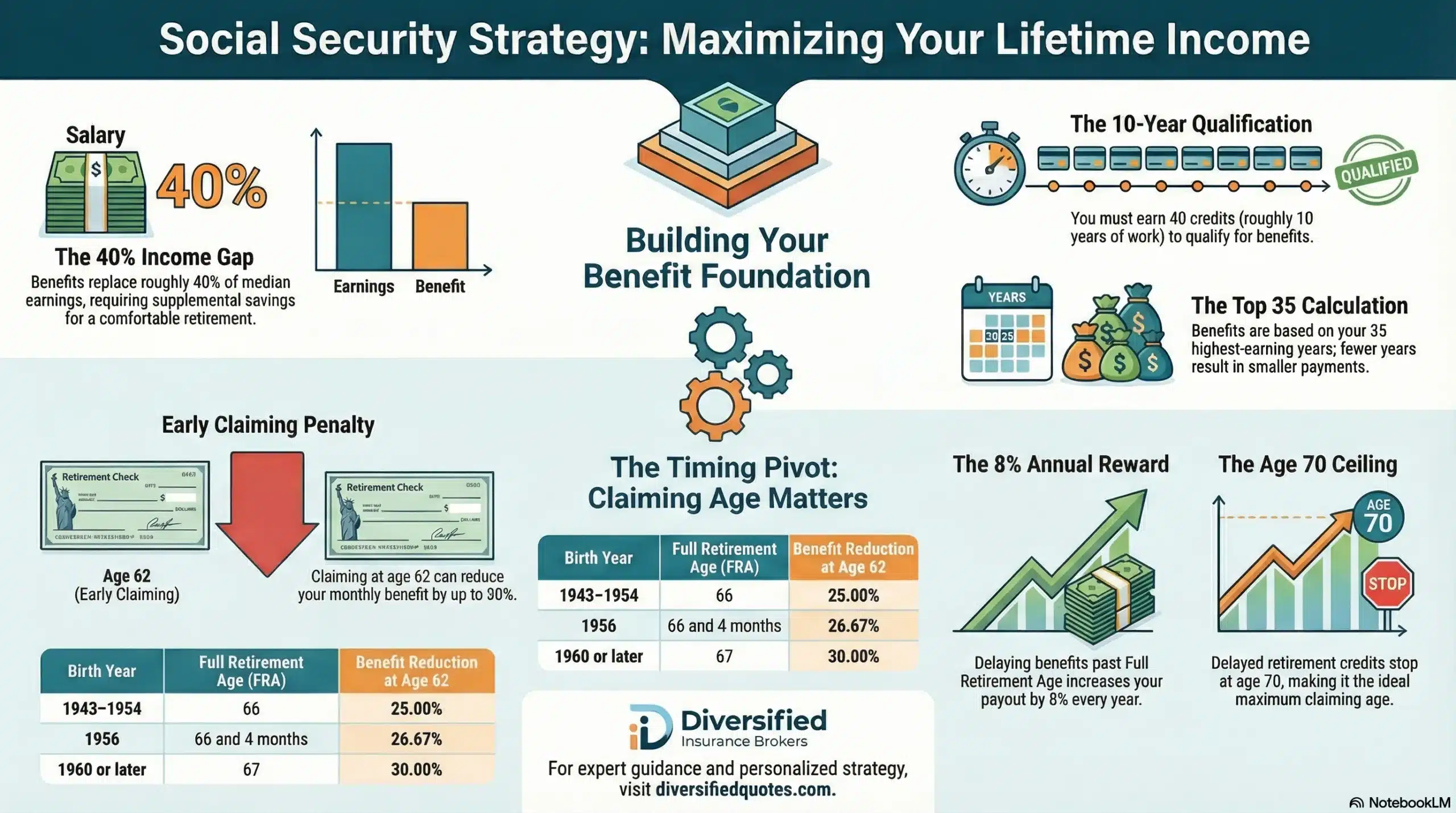
Delayed retirement credits are the Social Security Administration’s mechanism for rewarding workers who choose to wait beyond their Full Retirement Age (FRA) before claiming retirement benefits. For every month a worker delays claiming after FRA — up to the maximum of age 70 — the benefit amount increases by two-thirds of one percent, which produces a guaranteed increase of approximately eight percent per year. That rate of return, applied to a benefit that is inflation-adjusted, tax-advantaged relative to most investment income, and guaranteed for life, makes delayed retirement credits one of the most powerful income-enhancement tools available in retirement planning for workers who can afford the delay period. The permanent, compounding nature of the increase means a worker who claims at 70 instead of 67 not only receives a 24% larger initial check but also receives 24% more from every future cost-of-living adjustment — an advantage that compounds across potentially decades of retirement and generates meaningfully larger lifetime income for those who live to average or above-average life expectancy.
Understanding delayed retirement credits requires more than knowing the eight-percent figure. The decision to delay involves bridge income planning, tax sequencing during the deferral period, Medicare coordination, spousal and survivor benefit strategy, and the interaction between higher guaranteed Social Security income and the investment withdrawals and annuity income that make up the rest of the retirement income picture. At Diversified Insurance Brokers, Jason Stolz, CLTC, CRPC, DIA, CAA helps clients coordinate Social Security timing with the full retirement income plan — not just the Social Security calculation in isolation. Our resource on how to maximize Social Security benefits covers the complete claiming strategy framework that delayed retirement credits sit within, and our resource on Social Security planning services covers the full range of claiming decisions — including spousal coordination, survivor benefit planning, and tax-efficient claiming timing — that determine lifetime benefit outcomes.
Model Your Delayed Retirement Credit Scenarios
We compare early claiming, FRA claiming, and delayed credit scenarios side by side — coordinated with taxes, Medicare, bridge income, and survivor protection.
Start Social Security Planning Call 800-533-5969Delayed Retirement Credit Impact — Benefit by Claiming Age
The table below illustrates exactly how claiming age affects the monthly benefit for a worker with a Primary Insurance Amount (PIA) of $2,000 at Full Retirement Age of 67 — the FRA that applies to workers born in 1960 or later. Every dollar shown reflects the permanent starting benefit the worker would receive for the rest of their life, with cost-of-living adjustments applied to each amount beginning in subsequent years. Note: SSA benefit calculations are approximate due to rounding and monthly accrual; figures shown represent the established DRC rate of 2/3% per month delayed after FRA.
| Claiming Age | Months from FRA (67) | Benefit Adjustment | Monthly Benefit (PIA = $2,000) | Annual Benefit | vs. Age-70 Delay |
|---|---|---|---|---|---|
| Age 62 (earliest) | −60 months early | −30% reduction | $1,400/month | $16,800/year | −$12,960/year |
| Age 63 | −48 months early | −25% reduction | $1,500/month | $18,000/year | −$11,760/year |
| Age 64 | −36 months early | −20% reduction | $1,600/month | $19,200/year | −$10,560/year |
| Age 65 | −24 months early | −13.3% reduction | $1,733/month | $20,800/year | −$8,960/year |
| Age 66 | −12 months early | −6.7% reduction | $1,867/month | $22,400/year | −$7,360/year |
| Age 67 — FRA (baseline) | 0 — no adjustment | 100% — full PIA | $2,000/month | $24,000/year | −$5,760/year |
| Age 68 | +12 months DRC | +8% DRC | $2,160/month | $25,920/year | −$3,840/year |
| Age 69 | +24 months DRC | +16% DRC | $2,320/month | $27,840/year | −$1,920/year |
| Age 70 (maximum) | +36 months DRC | +24% DRC maximum | $2,480/month | $29,760/year | Baseline maximum |
Sample rates for illustrative comparison. Actual benefits depend on individual earnings record, birth year, FRA, and SSA calculation rules. Early claiming reductions assume FRA of 67 (born 1960 or later).
The table makes the DRC opportunity concrete: for a worker with a $2,000 PIA at FRA, every additional year of delay after age 67 adds $160 to the monthly benefit — permanently, with COLA applied to the higher base. The difference between claiming at 62 and claiming at 70 is $1,080 per month ($12,960 per year) in starting benefit — an amount that compounds with inflation for the rest of the retiree’s life. For married couples, that starting benefit difference becomes even more significant when the higher earner’s benefit determines the surviving spouse’s lifetime income after one partner passes. Our resource on guaranteed income at age 70 covers the full income picture at 70 — including how Social Security, annuity income, and portfolio withdrawals fit together — and our resource on guaranteed income at age 65 covers the comparable picture for those who retire earlier and need bridge income while DRCs accumulate.
How Delayed Retirement Credits Work — The Mechanics
Delayed retirement credits are earned automatically by every eligible worker who delays claiming Social Security retirement benefits past their Full Retirement Age. The Social Security Administration does not require any filing, election, or formal application to receive delayed retirement credits — the system simply calculates the benefit based on the actual claiming date, and the higher benefit that results from delayed claiming is built into the permanent payment from the first check forward. The accrual rate of two-thirds of one percent per month after FRA — equivalent to eight percent per year — is set by statute and applies uniformly regardless of a worker’s earnings history, PIA, or total benefit amount.
The monthly accrual matters because it means the claiming decision is not simply a binary choice between year-based claiming ages but a month-by-month calculation that allows precisely timed claiming to align with retirement dates, pension start dates, severance timelines, and tax planning windows. A worker who retires in March at age 68 but claims Social Security in June — three months into their 68th year — receives exactly those three additional months of delayed credits beyond the full year earned by claiming on the birthday month itself. Over a 36-month maximum DRC accumulation window between FRA at 67 and the age-70 ceiling, every month of additional delay produces a two-thirds percent permanent benefit increase that is visible in each subsequent lifetime payment. Our resource on Social Security planning services covers the month-specific claiming optimization that produces the best outcome for individual retirement timelines.
Full Retirement Age — The Foundation of DRC Calculations
Full Retirement Age is the SSA’s designation for the age at which a worker’s benefit is equal to their Primary Insurance Amount — the amount calculated from their lifetime earnings record with no early-claiming reduction and no delayed credit enhancement. FRA is the baseline from which all other benefit calculations reference: early claiming reduces the PIA by a percentage based on how many months before FRA the worker claims; delayed retirement credits add a percentage based on how many months after FRA the worker delays. The FRA varies by birth year: workers born between 1943 and 1954 have an FRA of 66; workers born between 1955 and 1959 have an FRA that increases in two-month increments (66 and 2 months, 66 and 4 months, through 66 and 10 months); and workers born in 1960 or later have an FRA of 67.
The FRA distinction matters enormously for DRC calculations because it determines exactly when the eight-percent annual enhancement begins accruing. A worker born in 1958, with an FRA of 66 years and 8 months, begins accruing delayed retirement credits in the month after that FRA date — not at age 67. This means the worker has a slightly longer window for DRC accumulation before the age-70 maximum is reached, which produces a slightly different dollar outcome than the table above (which uses FRA of 67) even for the same PIA. Accurate DRC planning requires using the specific FRA for the worker’s birth year, not a generic assumption. Our comprehensive resource on how to maximize Social Security benefits covers the full FRA calculation table by birth year and how it feeds into the complete benefit optimization framework.
Who Benefits Most From Earning Delayed Retirement Credits
Delayed retirement credits produce the most lifetime value for workers who expect to live well past the break-even age, higher earners in married households whose benefit will likely determine the surviving spouse’s income, retirees who have adequate bridge income sources to cover expenses during the delay period, and individuals who want to strengthen the guaranteed income floor that reduces dependence on portfolio withdrawals during volatile market periods.
In married households, the higher earner’s benefit occupies an especially critical strategic position because it often becomes the survivor benefit that the lower-earning spouse receives for the rest of their life after the higher earner dies. Every dollar of delayed retirement credit the higher earner accumulates before claiming becomes a permanently higher survivor benefit for the spouse — which can span decades of the surviving spouse’s retirement. This survivor protection dynamic means that even a higher earner with modest life expectancy expectations may benefit from delaying to protect a younger or healthier spouse. Our resource on widow claiming strategies covers the specific mechanics of how survivor benefits interact with DRCs, including the rules that govern when and how a surviving spouse claims based on the deceased worker’s benefit. Our resource on what is a spousal inherited IRA covers the adjacent asset protection consideration — how IRA assets are handled at the first death — that is often planned in parallel with survivor Social Security strategy.
Workers who are concerned about sequence of returns risk — the vulnerability that portfolio withdrawals create when poor market performance coincides with early retirement — often benefit significantly from maximizing delayed retirement credits. A higher permanent guaranteed benefit from Social Security reduces the amount that must be withdrawn from investment portfolios during retirement, which reduces the exposure to selling assets at depressed values during bear markets. The guaranteed, inflation-adjusted income stream that a maximized Social Security benefit provides functions similarly to a pension alternative for workers who do not have traditional defined benefit pension income — providing the income floor that makes market volatility in the portfolio tolerable rather than threatening.
Break-Even Analysis — The Right Framework and Its Limits
Break-even analysis is the most commonly used tool for evaluating whether delayed retirement credits produce enough additional lifetime income to justify the years of foregone benefits during the delay period. The basic calculation compares the total cumulative benefits received under different claiming scenarios: early claiming produces more checks but smaller ones; delayed claiming produces fewer checks at a higher amount. The break-even age is the point at which cumulative lifetime benefits under the delayed strategy surpass cumulative benefits under the early strategy. For most people, the break-even between FRA claiming and age-70 claiming falls between ages 80 and 83 depending on the specific benefit amounts and tax treatment of benefits.
Break-even analysis is a useful starting framework but an incomplete decision tool because it captures only the pure income math without the full household planning context. It does not account for the survivor benefit dimension — which can dramatically shift the calculus for married couples even if the higher earner’s own life expectancy is modest. It does not account for the COLA compounding advantage of a higher starting benefit — which produces progressively larger absolute-dollar differences as inflation applies in each successive year. It does not account for the reduced portfolio withdrawal pressure that a higher guaranteed benefit creates, which has risk-management value beyond the nominal dollar comparison. And it does not account for the income and tax planning opportunities that arise during the delay period — particularly the ability to make strategic Roth conversions or other tax moves while income is lower before Social Security begins. Our resource on Roth conversions covers the tax planning opportunities during the SS delay period that can produce long-term tax savings that rival or exceed the direct Social Security benefit comparison itself.
Building Bridge Income While Delayed Retirement Credits Accumulate
The practical obstacle to earning maximum delayed retirement credits is creating enough income to cover living expenses during the years between retirement and age 70. For workers who retire at 65 or 66 and choose to delay claiming until 70, the bridge period spans four to five years — a meaningful period that requires a deliberate income strategy rather than an improvised response to cash flow needs. The bridge income source chosen during this period also affects tax planning, portfolio sustainability, and how the subsequent Social Security income interacts with other retirement income sources.
Several bridge income strategies are commonly used alongside a delayed retirement credit plan. Strategic IRA withdrawals during the pre-Social Security years allow retirees to draw from tax-deferred accounts at potentially lower marginal rates — particularly if income is below the threshold that would trigger Social Security taxation — while simultaneously creating space for Roth conversion activity that reduces future RMD pressure. Our resource on does inheritance affect RMDs covers the RMD planning context that interacts with this IRA drawdown strategy. For retirees who need structured, predictable bridge income without depending on market performance during the delay period, certain annuity structures provide stable income payments on a defined schedule that coordinates naturally with a planned Social Security claiming date. Our resource on what is a deferred income annuity covers the specific structure that allows a retiree to deposit premium now and schedule guaranteed income to begin at a defined future date — precisely the bridge-then-transition structure that complements a delayed retirement credit strategy. Our broader resource on guaranteed income from annuities covers all income conversion structures across product types.
For retirees who separated from employment before 59½ and are considering accessing IRA funds during the bridge period, our resource on what is a 72(t) distribution covers the Substantially Equal Periodic Payment framework that allows structured early IRA access without penalty — a potential bridge income source for early retirees who are delaying Social Security. Our resource on how to replace my income after I retire covers the comprehensive bridge income architecture that combines these sources into a coherent plan. Our resource on deferred annuity calculator provides the modeling tool for projecting what an annuity funded during the bridge period would generate at the planned Social Security activation date.
Tax Coordination During the Delayed Retirement Credit Accumulation Period
The years between retirement and Social Security claiming represent one of the most valuable tax planning windows available to retirees — a period during which income may be lower than at any other point in retirement, creating opportunity to take action that reduces the long-term tax cost of retirement income. The precise interaction between delayed retirement credits and tax planning depends on the retiree’s other income sources, their future RMD trajectory, their state income tax situation, and their estate planning goals — but the general principle is that deliberately managing income during the bridge period can produce tax savings that rival or exceed the direct benefit of the DRC enhancement itself.
Roth conversions during the bridge period are the most commonly discussed tax optimization opportunity. When Social Security income is zero and other income sources are moderate, the retiree may find that substantial IRA-to-Roth conversion can be executed at lower marginal tax rates than would apply after Social Security begins, after the portfolio grows, or when RMDs force distributions that push income into higher brackets. Each dollar converted to Roth during the bridge period reduces the future pre-tax IRA balance subject to RMDs, reduces the future taxable income from those RMDs, and reduces the potential tax on Social Security benefits — since Social Security provisional income rules include IRA distributions but exclude Roth withdrawals. Our resource on Roth conversions covers this window in detail and is particularly relevant for retirees whose delayed retirement credit strategy creates a multi-year low-income period before the higher SS benefit begins.
Medicare Coordination — What to Know When Delaying Social Security
Delaying Social Security past age 65 requires active Medicare enrollment rather than the automatic enrollment that occurs when Social Security is already active at Medicare eligibility. Workers who delay Social Security past 65 must enroll in Medicare Part A and Part B during their Initial Enrollment Period (IEP) — the seven-month window centered on their 65th birthday — to avoid late enrollment penalties that permanently increase Part B premiums. Failing to enroll at 65 simply because Social Security hasn’t started yet is one of the most common and costly administrative errors in delayed retirement credit planning.
The premium payment mechanism also differs when Social Security has not started. Workers who are actively enrolled in Medicare but have not yet begun Social Security benefits pay their Part B premiums directly to Medicare rather than having them deducted from a monthly Social Security check. This requires setting up a direct payment account and ensuring it is funded — a practical administrative step that is easy to miss if the retiree assumed the premium would simply be deducted automatically. Our comprehensive resource on the Medicare playbook covers the complete enrollment rules, premium payment mechanics, and coverage coordination details that apply during the pre-Social Security Medicare period, and our resource on how Medicare and Social Security work together covers the coordination rules that apply once benefits begin together.
COLA Compounding — Why a Higher Starting Benefit Matters More Over Time
Cost-of-living adjustments apply to Social Security benefits on an annual basis, and they apply to the actual benefit amount the retiree receives — not to the original PIA. This means a retiree who starts with a higher benefit due to delayed retirement credits receives a larger absolute-dollar COLA increase in every future year compared to a retiree with the same PIA who claimed earlier at a reduced rate. The difference is not just the percentage but the compounding of a higher base: two percent applied to $2,480 produces $49.60 in annual increase, while two percent applied to $1,400 produces $28 — a difference that persists and grows in every subsequent year. Over 20 or 30 years of retirement, the cumulative COLA advantage of a DRC-enhanced benefit can add up to tens of thousands of dollars in additional lifetime income relative to the same earnings history claimed earlier.
This COLA compounding effect is particularly meaningful for retirees who are concerned about inflation eroding the purchasing power of their retirement income — a concern that our resource on annuity payout calculator addresses through the lens of guaranteed income products that also provide inflation protection options. Our resource on lifetime income planning covers the full income architecture that combines maximized Social Security with annuity income and portfolio withdrawals to create a comprehensive retirement income strategy resistant to both market volatility and inflation pressure. Our resource on long-term care insurance covers the health-related financial risk that can devastate retirement income regardless of how well Social Security is optimized — relevant for retirees whose longevity planning includes the possibility of extended care needs.
Voluntary Suspension — Earning DRCs After Claiming Has Already Started
Workers who have already begun receiving Social Security retirement benefits at or after their Full Retirement Age have a specific option available to them: voluntary suspension. A worker who requests voluntary suspension effectively pauses their benefit payments — no checks are received during the suspension period — and earns delayed retirement credits at the standard two-thirds percent per month rate for each month the suspension continues, up to the age-70 maximum. At the end of the suspension period, the benefit is recalculated to include the accumulated DRCs from the suspension months, producing a permanently higher monthly payment going forward.
Voluntary suspension is available only at or after FRA — it cannot be used to earn DRCs for months before FRA. Additionally, voluntary suspension affects payments to other beneficiaries who receive benefits on the worker’s record: a spouse who receives spousal benefits based on the worker’s record will generally see those spousal benefits also suspended during the worker’s voluntary suspension period. This spousal payment interaction makes voluntary suspension a household decision that requires full coordination rather than a unilateral worker decision. For retirees who claimed at FRA but subsequently find themselves with better health, unexpected income, or a revised longevity outlook, voluntary suspension provides a mechanism for course correction that many people are not aware of until they specifically inquire with a knowledgeable advisor.
When Delaying for Delayed Retirement Credits Does Not Make Sense
Delayed retirement credits produce maximum value when the retiree lives long enough past the break-even age, has adequate bridge income to avoid financial stress during the delay period, and has a household structure where the higher benefit translates to meaningful survivor protection. When one or more of those conditions is absent, the case for maximizing DRCs weakens and the case for earlier claiming strengthens.
Workers with serious health conditions that significantly reduce life expectancy may be better served by claiming earlier — capturing the benefit during a shorter expected lifespan rather than delaying for an enhanced benefit that may not be received long enough to exceed the break-even threshold. Workers who have no bridge income available and would face financial hardship during the delay period are not well positioned to delay — the economic stress of inadequate income during the bridge period can cause greater harm than the benefit enhancement is worth. Single retirees without dependents who would benefit from survivor protection have a smaller household incentive for delay than married households where survivor benefit optimization is a central concern. And workers whose Social Security benefit is a modest portion of total retirement income — because portfolio income, pension income, or annuity income already provides a secure income floor — may find the relative value of an additional $160 per month from DRCs less compelling than the liquidity and flexibility of earlier claiming.
The right claiming decision is always specific to the household — its income sources, health outlook, tax situation, and the relationship between Social Security’s guaranteed income and the other components of the retirement plan. Our resource on Social Security planning services covers the full decision framework for coordinating all these variables into a claiming strategy tailored to the specific household rather than a generic rule of thumb. And our resources on annuity options and pension alternatives cover how annuity-based guaranteed income complements Social Security regardless of the claiming age chosen — providing the income floor components that work in combination with whatever Social Security benefit level the timing decision produces.
Build a Social Security Strategy That Fits Your Plan
We coordinate DRC timing with taxes, Medicare, bridge income, and survivor protection — not just the monthly benefit comparison.
Review Your Social Security StrategyRelated Social Security Planning
Claiming strategy, spousal coordination, survivor benefit planning, and maximization resources.
Related Retirement Income Planning
Bridge income strategies, annuity options, and Medicare coordination for the pre-Social Security years.
Financial Protection Essentials
Indexed annuity education, inclusive life insurance access, employer coverage strategies, and international travel protection planning.
Schedule a Free Consultation
Get a personalized claiming plan that coordinates DRCs, spouse/survivor timing, and Medicare decisions.
FAQs: Delayed Retirement Credits
Do I earn delayed retirement credits if I wait before my FRA?
No — delayed retirement credits only accrue for months of delay after Full Retirement Age. Waiting between age 62 and FRA avoids the early-claiming reduction penalty, but it does not earn delayed retirement credits. Those are two separate mechanisms: months before FRA reduce the benefit from the PIA baseline; months after FRA increase the benefit from that same baseline at two-thirds percent per month. A worker who claims exactly at FRA receives their full PIA with no reduction and no enhancement. Only claims filed after FRA benefit from delayed retirement credits — with the maximum DRC enhancement of 24% (36 months at 2/3% per month) earned by claiming at age 70 when FRA is 67.
How much does each year of delay after FRA increase my benefit?
Each full year of delay after Full Retirement Age adds exactly eight percent to the monthly benefit, based on the accrual rate of two-thirds of one percent per month. Because delayed retirement credits accrue monthly rather than annually, a worker who claims at 68 and 3 months earns 15 months of credits at two-thirds percent each — a 10% enhancement rather than simply “one year” worth of credits. The table on this page shows the benefit amounts for the standard claiming ages (68, 69, and 70), but any specific claiming month produces an exact credit calculation based on the precise number of months elapsed after FRA. The maximum delayed retirement credit is reached at age 70 — 36 months after FRA at 67 — producing the 24% enhancement shown in the table. Waiting beyond age 70 does not produce additional credits; there is no benefit to delaying past 70 for purposes of DRC accumulation.
Can I suspend my benefits after I’ve already started claiming to earn more credits?
Yes — at or after Full Retirement Age, a worker who has already begun receiving Social Security benefits can request a voluntary suspension. During the suspension, monthly benefit payments stop and delayed retirement credits accrue at the standard two-thirds percent per month rate for each month of suspension, up to the age-70 maximum. When the suspension ends — either by the worker requesting reinstatement or automatically at age 70 — the benefit is recalculated to include the DRCs earned during the suspension period. One important household implication: other beneficiaries who receive payments on the worker’s record — such as a spouse receiving spousal benefits — will generally also have their payments suspended during the worker’s voluntary suspension period. This makes voluntary suspension a decision that requires full household coordination rather than an individual worker decision, and the spousal payment interruption must be factored into whether the strategy produces a net benefit for the household.
Should both spouses delay to 70 to maximize delayed retirement credits?
Not necessarily — the optimal strategy for married couples often involves having the higher earner delay to maximize DRCs while the lower earner claims earlier to support household cash flow during the bridge period. This approach balances two objectives simultaneously: generating bridge income to reduce pressure on portfolio withdrawals while the higher earner continues accumulating credits, and maximizing the higher earner’s benefit to optimize both that earner’s lifetime income and the survivor benefit the lower-earning spouse would receive after the higher earner passes. The specific ages at which each spouse should claim depend on the gap between their respective benefits, their respective life expectancy outlooks, their other income sources, and their tax situation — none of which can be resolved by a generic rule about both claiming at 70. Our resource on widow claiming strategies covers how survivor benefit timing interacts with these household decisions.
Do spousal benefits increase if the worker delays to 70?
Spousal benefits during both spouses’ lifetimes are calculated based on the worker’s Primary Insurance Amount at FRA — not the worker’s actual delayed benefit amount. A spouse who claims a spousal benefit while both partners are alive typically receives up to 50% of the worker’s PIA, regardless of whether the worker earned delayed retirement credits. Delaying does not increase the spousal benefit during the worker’s lifetime. However, the survivor benefit — the benefit the lower-earning spouse receives after the higher earner dies — is based on the higher earner’s actual benefit including any delayed retirement credits. This is the key distinction: DRCs increase the survivor benefit meaningfully but do not increase the concurrent spousal benefit. For households evaluating the DRC decision, the survivor benefit impact is often the more financially significant consideration than the spousal benefit impact, particularly when the lower-earning spouse is younger or in better health and likely to survive for many years after the higher earner’s death.
How do cost-of-living adjustments interact with delayed retirement credits?
Cost-of-living adjustments apply to the actual benefit amount the retiree receives — meaning they apply to a DRC-enhanced benefit rather than to the original PIA. A retiree who receives $2,480 per month due to delayed retirement credits receives more absolute dollars from each year’s COLA than a retiree receiving $2,000 at FRA or $1,400 at age 62, even when the COLA percentage is identical for all three. A 3% COLA adds $74.40 to the age-70 claimer’s monthly check, $60 to the FRA claimer’s, and $42 to the age-62 claimer’s — every year, forever. This compounding effect means that the total lifetime advantage of delayed retirement credits grows in both dollar and percentage terms with every year of retirement, and is particularly significant for retirees who live into their 80s and 90s when cumulative COLA differences become very large in absolute terms. Retirees who are concerned about inflation eroding purchasing power over a long retirement benefit most from the COLA compounding advantage of a DRC-maximized benefit.
Is there any reason to wait past age 70 to claim?
No — delayed retirement credits stop accruing at age 70. There is no benefit to delaying past 70 for DRC purposes; every month between 70 and an actual later claiming date simply represents foregone benefit payments without any corresponding credit accumulation. Workers who reach 70 without having filed for benefits should file promptly to begin receiving the maximum DRC-enhanced benefit. The SSA does not pay retroactive delayed retirement credits for months past age 70 simply because the worker delayed filing. In fact, a worker who delays filing past age 70 may be entitled to up to six months of retroactive benefits under certain conditions, which the SSA can pay as a lump sum — but this is different from earning additional credits, and the retroactive period still cannot predate age 70. Age 70 is the DRC ceiling, and planning should treat it as the objective endpoint for delayed retirement credit accumulation.
Can taxes change whether delaying for DRCs is worthwhile?
Yes — tax considerations can meaningfully affect the net value of delayed retirement credits in several ways. Higher Social Security benefits trigger Social Security taxation more quickly: up to 85% of Social Security benefits are taxable when provisional income (adjusted gross income plus tax-exempt interest plus half of Social Security) exceeds $34,000 for single filers or $44,000 for joint filers. A retiree who earns maximum DRCs and receives $2,480 per month may find that more of their Social Security benefit is taxable than a retiree claiming at FRA — reducing the net cash advantage of the higher gross benefit. Conversely, the years between retirement and age-70 claiming represent an opportunity to make Roth conversions at lower marginal rates — when Social Security income is zero and other income may be modest — reducing the future pre-tax IRA balances that generate RMDs and create tax complications. Our resource on Roth conversions covers this tax planning opportunity in detail, and modeling the complete tax picture — including provisional income at different claiming ages and different Roth conversion amounts — is essential for understanding whether the DRC strategy produces the best net outcome for a specific household.
About the Author:
Jason Stolz, CLTC, CRPC, DIA, CAA and Chief Underwriter at Diversified Insurance Brokers (NPN 20471358), is a senior insurance and retirement professional with more than 25 years of real-world experience helping individuals, families, and business owners protect their income, assets, and long-term financial stability. As a long-time partner of the nationally licensed independent agency Diversified Insurance Brokers, Jason provides trusted guidance across multiple specialties—including fixed and indexed annuities, long-term care planning, personal and business disability insurance, life insurance solutions, Group Health, Travel Medical and Evacuation Insurance, and short-term health coverage. Diversified Insurance Brokers maintains active contracts with over 100 highly rated insurance carriers, ensuring clients have access to a broad and competitive marketplace.
His practical, education-first approach has earned recognition in publications such as VoyageATL, and contributions from his agency featured in Kiplinger and GoBankingRates— highlighting his commitment to financial clarity and client-focused planning. Drawing on deep product knowledge and years of hands-on field experience, Jason helps clients evaluate carriers, compare strategies, and build retirement and protection plans that are both secure and cost-efficient. Visitors who want to explore current annuity rates and compare options across multiple insurers can also use this annuity quote and comparison tool.
Explore All Social Security Planning Guides: Browse our complete Social Security Planning guide — covering filing strategies, spousal benefits, survivor benefits, taxes, WEP, GPO & more.
Last Reviewed: May 26, 2026 |
Reviewed by: Jason Stolz, CLTC, CRPC, DIA, CAA
Chief Underwriter, Diversified Insurance Brokers, Inc. | NPN: 20471358 | Diversified Insurance Brokers, Inc. — Licensed in all 50 states
Fact Checked by: Tonia Pettitt, CMIP©
Medicare Specialist, Diversified Insurance Brokers, Inc. | NPN: 14374308 | Diversified Insurance Brokers, Inc. — Licensed in all 50 states
Did you find this content helpful? Leave us a Google review — it helps others find trustworthy guidance too.
Editorial Standards: Diversified Insurance Brokers maintains rigorous editorial standards to ensure accuracy, clarity, and independence in all content. Learn more about our editorial standards and commitment to transparency.
