
Is Premium Financing Life Insurance Safe?
Is Premium Financing Life Insurance Safe?

Jason Stolz CLTC, CRPC, DIA, CAA
Is premium financing life insurance safe? The honest answer is: it can be exceptionally safe when structured conservatively for the right financial profile, and genuinely dangerous when used without disciplined design, realistic assumptions, and a defined exit strategy. Premium financing is not a mainstream insurance strategy. It is reserved for affluent families, business owners, and estate planning environments where large permanent death benefits are required but preserving liquidity is equally important. Instead of writing large annual premium checks from personal assets — which can tie up capital, disrupt investment portfolios, and create unnecessary liquidity pressure — a bank or specialty lender provides the funds to pay premiums, the borrower posts collateral, and the insured maintains access to capital that might otherwise be absorbed by insurance costs. When coordinated properly, this structure can improve estate efficiency, enhance the internal rate of return on transferred wealth, and prevent forced liquidation of appreciating assets. When structured aggressively — with optimistic projections, insufficient liquidity reserves, or inadequate monitoring — leverage risk can compound over years in ways that are difficult to unwind without material financial cost. The structure itself is neutral. The safety is entirely a function of how it is designed, who it is designed for, and how rigorously it is managed.
Understanding premium financing safety requires recognizing that it is fundamentally a leverage strategy layered onto permanent life insurance. Unlike term life insurance purchased for income replacement or simplified underwriting products like no-exam policies, premium financing requires two separate and rigorous underwriting processes simultaneously. Insurance carriers evaluate the insured’s health, lifestyle, and long-term mortality risk. Banks evaluate the borrower’s net worth, liquidity profile, income stability, asset composition, and creditworthiness before issuing financing. This dual-review process is intentional — it is designed to ensure that borrowers have sufficient financial depth to sustain interest payments across changing rate environments, maintain collateral requirements as the loan balance evolves, and absorb unexpected policy performance deviations without catastrophic financial consequences. When both underwriting processes produce strong results, and when the policy design uses conservative assumptions rather than optimistic growth projections, premium financing becomes a stable long-term estate planning mechanism comparable in sophistication to the advanced life insurance structures that high-net-worth families use for multi-generational wealth transfer. The full premium financing pros and cons analysis covers where this strategy excels and where it creates risks that simpler alternatives avoid.
See Real-Term Rates Side by Side
Life Insurance Quoter
Interest Rate Risk — The Most Misunderstood Variable in Premium Financing Safety
Interest rate exposure is the variable that most frequently distinguishes safe premium financing structures from dangerous ones — and the most common source of avoidable problems in arrangements that were designed during low-rate environments without adequate stress testing. Many financing arrangements use floating rates tied to prevailing benchmark rates, which means borrowing costs can rise materially when credit markets shift. A structure that penciled out favorably at a 4% borrowing rate may look very different at 6% or 8%, particularly when the loan balance has grown through accrued unpaid interest over several years. The difference between a financing arrangement that weathers rate cycles and one that fails under them is almost always whether higher-rate scenarios were explicitly modeled and planned for at the time of design — not as footnotes to the primary illustration, but as the primary planning basis.
Responsible structuring stress-tests multiple rate environments rather than building projections around a single assumed rate. Some arrangements negotiate interest rate caps that limit exposure above a defined ceiling. Others structure fixed-rate components for portions of the financing period to reduce volatility. The carrier-side policy performance assumption is an equally critical variable. When the crediting rate inside the permanent policy — typically an indexed universal life policy in most premium financing arrangements — is projected at aggressive historical averages rather than at conservative mid-range assumptions, the illustration appears more favorable on paper than it is likely to prove in practice. The policy’s credited interest may track below the assumed rate in years with unfavorable index performance, while the loan balance may grow faster than projected if interest accrues rather than being paid currently. These two compounding forces — slower-than-projected policy growth and faster-than-projected loan growth — can create a gap between illustrated and actual policy loan ratios that the borrower must address through additional collateral, additional cash contribution, or restructuring. How premium financing works within an estate planning framework covers how these scenarios are managed within properly structured arrangements. The comparison to split dollar life insurance — another advanced leverage-based insurance structure — is useful for understanding how cost sharing and risk allocation differ across complex policy-level financing strategies.
Collateral Requirements — How Financial Strength Transforms Leverage from Risk to Tool
Collateral management is the component of premium financing that most directly separates appropriate candidates from inappropriate ones. In most arrangements, the policy’s developing cash value serves as the primary collateral during the later years of the financing period, when the policy has been in force long enough for cash value to have grown to a meaningful percentage of the loan balance. During the early years — particularly the first three to five years when the cash value is still developing and the ratio of loan balance to policy value is at its least favorable — lenders typically require outside collateral contributions: financial assets pledged to secure the loan beyond what the policy itself can support. The borrower must be willing and able to pledge those additional assets without disrupting their broader financial plan, and must be capable of maintaining those pledges even if asset values fluctuate during a market downturn at the same time that financing rates are rising.
This is why premium financing is appropriate only for individuals with multi-million-dollar net worth, diversified liquidity across multiple asset classes, and stable income that is not dependent on the financing arrangement performing exactly as illustrated. When those conditions are met, collateral requirements become manageable safeguards rather than stress points — the lender’s legitimate risk management process produces documentation and structure that reinforces the borrower’s own planning discipline. When those conditions are not met, a rate spike, a policy underperformance, or a simultaneous asset market decline can create collateral calls that the borrower cannot satisfy without disrupting other aspects of their financial plan. The strategy then shifts from structured leverage within a comprehensive estate framework to a financially threatening obligation with limited exit options. For business owners evaluating premium financing alongside other life insurance structures, life insurance for business owners covers the full range of corporate applications where permanent life insurance serves a planning function — both with and without external financing.
What Makes Premium Financing Actually Safe — The Five Non-Negotiable Design Elements
| Design Element | What It Means in Practice | What Happens When It Is Missing |
|---|---|---|
| Conservative Policy Assumptions | Policy illustrations built on mid-range or below-average crediting rates rather than historical highs; multiple scenarios modeled including stress cases | Policy grows slower than illustrated, loan-to-value ratio deteriorates, borrower faces collateral calls or policy restructuring |
| Interest Rate Stress Testing | Financing costs modeled at significantly higher rates than current market; rate cap negotiated where possible; fixed-rate component considered | Rising rates increase loan balance faster than projected, eroding the margin between policy value and outstanding debt |
| Adequate Outside Liquidity | Borrower maintains liquid assets sufficient to meet collateral calls, interest payments, and other financial needs without relying on the policy’s projected performance | Collateral shortfall requires forced liquidation of other assets at potentially unfavorable prices during a market downturn |
| Defined Exit Strategy | Clear plan for loan resolution documented at inception: policy cash value repayment, death benefit repayment, refinancing, or asset liquidation at a defined future date | Borrower reacts to circumstances rather than executing a predetermined plan, increasing the probability of suboptimal outcomes under stress |
| Annual Monitoring and Review | Annual in-force illustrations, updated interest calculations, collateral reviews, coordination with estate attorneys and tax advisors; adjustments made proactively | Deviations from the original plan compound undetected until a material problem emerges that is expensive or impossible to correct without significant cost |
The Exit Strategy — The Most Overlooked Component of Premium Financing Safety
The exit strategy is the planning element most commonly underspecified in premium financing arrangements — and the one whose absence creates the most severe consequences when market conditions change or the arrangement underperforms relative to projections. A responsibly designed premium financing structure documents the loan resolution plan at inception rather than leaving it to be determined later: how and when the loan will be repaid, what assets will fund the repayment, what triggers would indicate the need to accelerate repayment or restructure the arrangement, and what the financial consequences of each exit scenario look like under different rate and policy performance assumptions.
The most common exit paths are repayment from accumulated policy cash value as it grows to exceed the loan balance, repayment at the insured’s death from the tax-free death benefit (net of the outstanding loan), planned asset liquidation at a defined future date, or refinancing the bank loan into a different structure when initial financing terms expire. Each of these paths has different financial implications, different tax characteristics, and different requirements for the policy’s performance and the borrower’s asset position. Without modeling each path explicitly and maintaining ongoing tracking of which path is most likely to be available given current conditions, a borrower cannot make informed decisions about when to adjust the strategy. This is why premium financing is not appropriately managed as a “set it and forget it” arrangement. Its safety is preserved through annual review — updated illustrations, interest rate tracking, collateral monitoring, and coordination with the estate planning team — not through the initial transaction alone.
When Premium Financing Is Not the Right Tool
The safety of premium financing is inseparable from the suitability of the candidate. For households seeking coverage amounts below $5 million, for those with limited liquidity outside the assets that would be pledged as collateral, for those uncomfortable with the documentation and monitoring discipline required, or for those whose financial profiles would not withstand a simultaneous rate increase and policy underperformance without material financial stress, premium financing introduces risks that are disproportionate to any benefit it provides. In those situations, simpler permanent life insurance structures — whole life, guaranteed universal life, or indexed universal life purchased with personal premium payments — achieve the same death benefit protection and estate planning objectives without leverage risk.
Understanding how the underlying policy types work is essential regardless of whether financing is used. How whole life insurance works and whole life insurance with cash value cover the permanent policy structures most commonly used as the insurance component in financing arrangements. What a Modified Endowment Contract is covers the IRS classification that governs the tax treatment of cash value access — an important element in any structure that involves policy loans or financing repayment from accumulated cash value. Indexed universal life in qualified plans covers how IUL policies — the most commonly used policy type in premium financing — interact with qualified retirement plan structures for high-income business owners who are evaluating financing alongside other tax-advantaged planning strategies. For a comprehensive needs analysis to determine whether simpler structures achieve your objectives before evaluating financing, how much life insurance you actually need is the foundational starting point.
Request a Premium Financing Review
We can model conservative scenarios, evaluate collateral requirements, stress-test rate environments, and coordinate with your estate planning team to determine whether the structure aligns with your long-term liquidity and wealth transfer goals.
Questions? Call 800-533-5969
Talk With an Advisor Today
Choose how you’d like to connect—call or message us, then book a time that works for you.
Schedule here:
calendly.com/jason-dibcompanies/diversified-quotes
Licensed in all 50 states • Fiduciary, family-owned since 1980
Frequently Asked Questions: Is Premium Financing Life Insurance Safe?
What are the biggest risks in premium financing life insurance?
The three risks that most commonly cause premium financing arrangements to underperform or fail are interest rate increases, policy performance shortfalls, and collateral insufficiency — and all three can compound simultaneously if market conditions deteriorate. Interest rate risk is present in any arrangement using floating rates: if borrowing costs rise materially above what was modeled in the original illustration, the loan balance can grow faster than projected, eroding the margin between the outstanding debt and the policy’s developing cash value. Policy performance risk occurs when the permanent policy credits interest at rates below the illustrated assumption — possible in indexed products when index returns are low or when participating whole life dividend scales are reduced. Collateral risk occurs when the combination of these two factors creates a gap between the loan balance and the policy’s cash value that must be filled with outside assets the borrower either does not have available or cannot liquidate without disrupting other financial plans. Any one of these risks is manageable in a well-designed arrangement. All three occurring simultaneously in a poorly designed arrangement can produce financial consequences that are difficult to exit without material loss.
Who is the right candidate for premium financing?
Premium financing is appropriate for individuals who meet all of the following conditions: death benefit need of $5 million or more, making the premium cost significant enough that financing provides material capital efficiency; multi-million-dollar net worth with diversified liquidity across multiple asset classes, providing the financial depth to maintain collateral requirements without disrupting other financial plans; stable and predictable income independent of the financing arrangement’s performance; high comfort with financial complexity, documentation requirements, and ongoing monitoring discipline; and a genuine estate planning, business succession, or wealth transfer objective that justifies the structural complexity the financing introduces. The absence of any one of these conditions significantly increases the risk profile of the arrangement. Premium financing is not appropriate for individuals who are primarily interested in the size of the death benefit relative to the premium cost without the financial profile to sustain the arrangement through adverse market conditions.
What should a premium financing illustration show before I commit?
A responsible premium financing illustration should show multiple scenarios rather than a single optimistic projection. At minimum, it should show: the base case at assumed crediting and borrowing rates; a stress scenario with borrowing rates 200 to 300 basis points higher than the base case; a stress scenario with policy crediting rates meaningfully below the illustrated rate; a combined stress scenario showing both higher borrowing costs and lower policy performance simultaneously; the loan-to-value ratio in each scenario across 5-, 10-, 15-, and 20-year time horizons; and the projected collateral requirements in each scenario during the early years when the policy’s cash value is insufficient to fully secure the loan. If the illustration provided shows only the favorable scenario at an assumed rate, or if the combined stress scenario produces a loan-to-value ratio that would trigger collateral calls the borrower cannot comfortably meet, those are material design problems that should be addressed before commitment — not after the financing is in place.
What is the exit strategy and why does it matter so much?
The exit strategy is the documented plan for how and when the financing loan will be resolved — and it is the element most commonly underspecified in arrangements that subsequently run into problems. Without a defined exit strategy, the borrower has no predetermined framework for evaluating whether the arrangement is performing as expected or what actions to take when it is not. The most common exit paths are repayment from accumulated policy cash value once it grows to exceed the loan balance, repayment at death from the tax-free death benefit net of the outstanding loan, planned liquidation of other assets at a defined future date, or refinancing when initial financing terms expire. Each path has different financial implications, tax characteristics, and requirements for policy performance. A responsible design documents the most likely exit path at inception, models what the arrangement looks like under that exit path across different rate and performance scenarios, and establishes annual review checkpoints at which the exit strategy is re-evaluated against current conditions. Premium financing managed without a defined exit strategy is leverage without an endpoint — a structure that transforms from a planning tool into an open-ended financial obligation when circumstances change.
How does premium financing compare to simply paying premiums directly from assets?
The core financial logic of premium financing is opportunity cost arbitrage: if the assets that would otherwise pay premiums can earn a higher after-tax return than the financing cost, then borrowing to pay premiums is mathematically advantageous over time, while also preserving the liquidity and investability of those assets. In a simplified example, an investor with assets earning 8% who can borrow at 5% to pay premiums is theoretically 3% better off (before taxes and fees) by financing than by liquidating assets for premium payments. The actual comparison is more complex and depends on the specific asset being preserved, its tax basis, the after-tax cost of borrowing, the policy’s crediting rate, the loan’s trajectory over time, and the estate and income tax implications of each approach. The analysis also depends critically on the accuracy of the assumptions: if the assets underperform, the borrowing rate rises, or the policy credits below projection, the arbitrage can narrow or reverse. Premium financing is most defensible when the opportunity cost of liquidating the preserved asset is genuinely high — illiquid business interests, appreciated real estate, or portfolio positions with embedded gains — rather than simply liquid cash that could be redirected to premium payments without disrupting other plans.
About the Author:
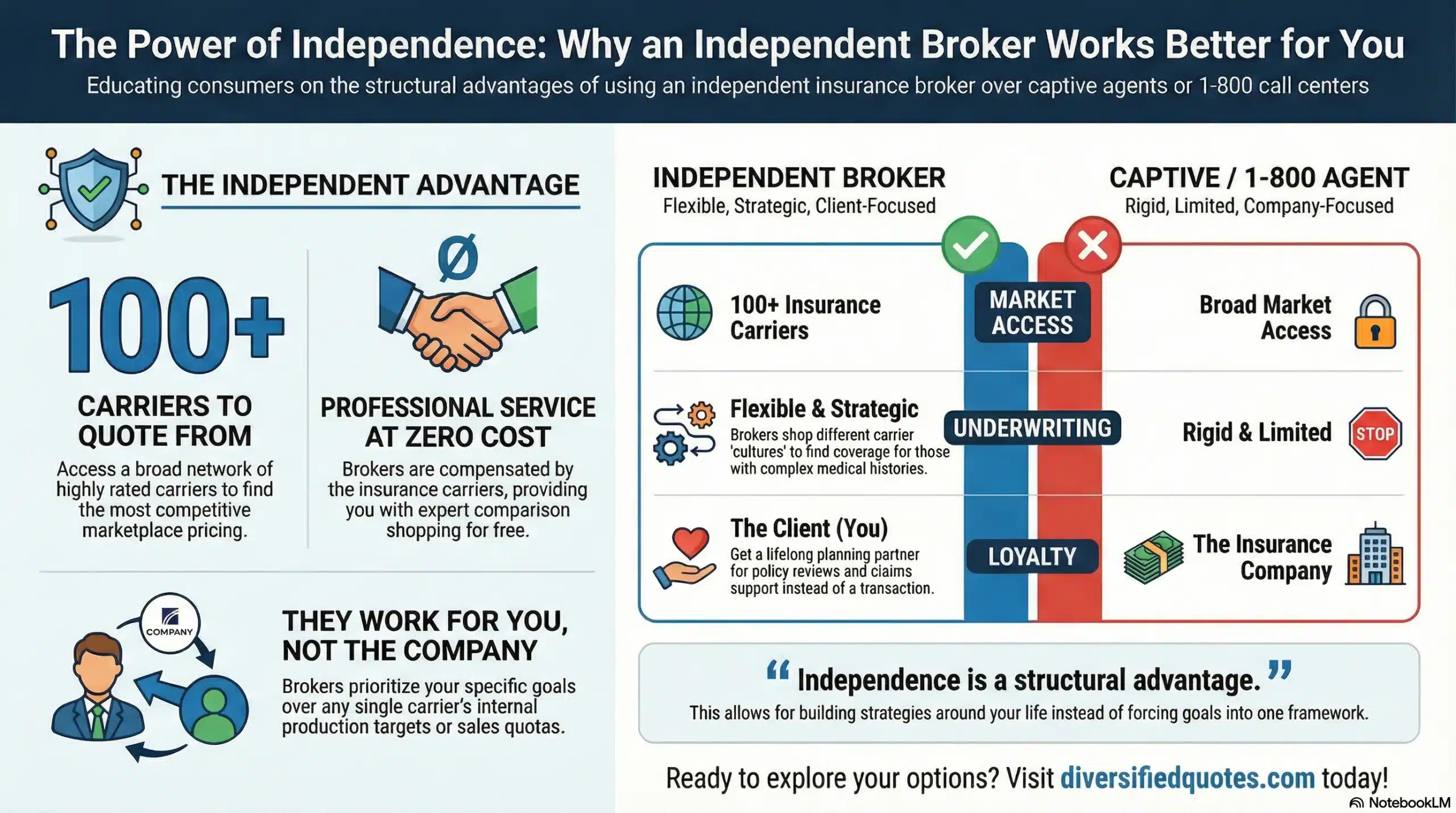
Jason Stolz, CLTC, CRPC, DIA, CAA and Chief Underwriter at Diversified Insurance Brokers (NPN 20471358), is a senior insurance and retirement professional with more than 25 years of real-world experience helping individuals, families, and business owners protect their income, assets, and long-term financial stability. As a long-time partner of the nationally licensed independent agency Diversified Insurance Brokers, Jason provides trusted guidance across multiple specialties—including fixed and indexed annuities, long-term care planning, personal and business disability insurance, life insurance solutions, Group Health, Travel Medical and Evacuation Insurance, and short-term health coverage. Diversified Insurance Brokers maintains active contracts with over 100 highly rated insurance carriers, ensuring clients have access to a broad and competitive marketplace.
His practical, education-first approach has earned recognition in publications such as VoyageATL, and contributions from his agency featured in Kiplinger and GoBankingRates— highlighting his commitment to financial clarity and client-focused planning. Drawing on deep product knowledge and years of hands-on field experience, Jason helps clients evaluate carriers, compare strategies, and build retirement and protection plans that are both secure and cost-efficient. Visitors who want to explore current annuity rates and compare options across multiple insurers can also use this annuity quote and comparison tool.
Explore More Life Insurance Options: Browse our complete guide to Business Life Insurance — covering buy-sell agreements, key person, contract indemnity & group life from 100+ carriers.
Last Reviewed: June 14, 2026 |
Reviewed by: Jason Stolz, CLTC, CRPC, DIA, CAA
Chief Underwriter, Diversified Insurance Brokers, Inc. | NPN: 20471358 | Diversified Insurance Brokers, Inc. — Licensed in all 50 states
Fact Checked by: Tonia Pettitt, CMIP©
Medicare Specialist, Diversified Insurance Brokers, Inc. | NPN: 14374308 | Diversified Insurance Brokers, Inc. — Licensed in all 50 states
Did you find this content helpful? Leave us a Google review — it helps others find trustworthy guidance too.
Editorial Standards: Diversified Insurance Brokers maintains rigorous editorial standards to ensure accuracy, clarity, and independence in all content. Learn more about our editorial standards and commitment to transparency.
