
Group Health Insurance for Accounting Firms
Group Health Insurance for Accounting Firms

Jason Stolz CLTC, CRPC, DIA, CAA
Group health insurance for accounting firms requires a more deliberate plan architecture than most benefit advisors present. Accounting firms operate in a competitive talent environment where benefits are compared directly across peer firms — and where the plan’s day-to-day performance during busy season matters as much as its annual premium. A dispensary employee who never thinks about their health insurance and a CPA who manages one client’s entire financial picture are very different users of employer benefits. Accounting professionals pay attention. They read the plan documents. They notice if the network doesn’t include their doctor, if the pharmacy formulary changes without clear notice, or if renewal communications are late and unclear. Getting the plan right for accounting firms means understanding the workforce and the business cycle — not just selecting the lowest-premium option from a carrier comparison spreadsheet.
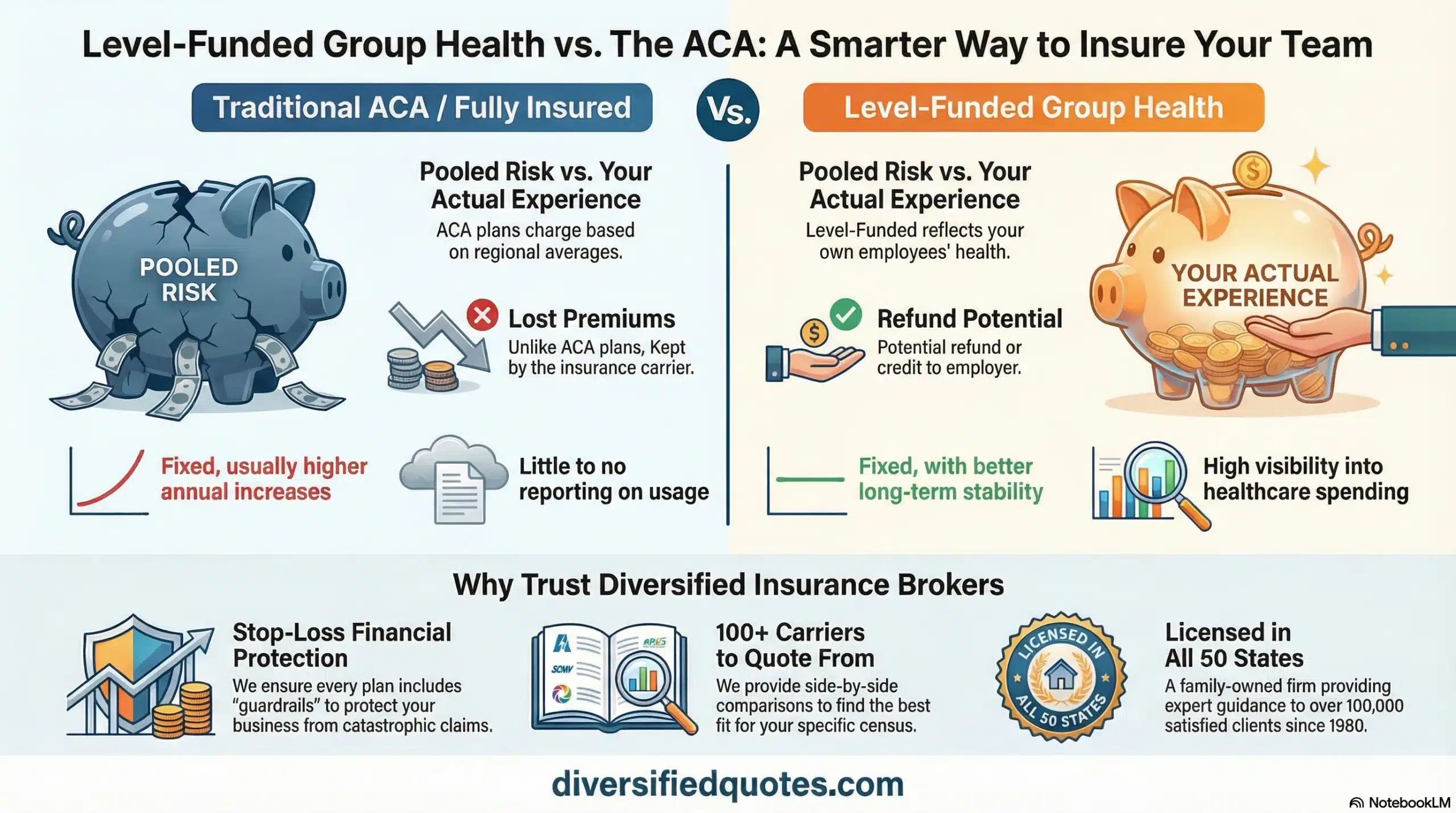
At Diversified Insurance Brokers, Jason Stolz, CLTC, CRPC, DIA, CAA helps CPA firms, bookkeeping practices, and multi-office advisory groups build group health plans that are sustainable at renewal, competitive in the talent market, and operationally simple during the firm’s most demanding periods. The foundation of that work is a clear-eyed comparison of the three plan funding structures that accounting firms are most commonly choosing between: fully insured, level-funded, and self-funded. Our resource on group medical insurance covers the foundational framework for understanding how these structures differ, and our resource on why group level funding covers the specific case for level-funded arrangements that many professional service firms find most compelling once they understand the mechanics.
Get a Side-by-Side Group Health Proposal for Your Firm
We compare fully insured, level-funded, and self-funded options from 100+ carriers — with clear tradeoffs framed for accounting firm decision-makers.
Request a Group Health Proposal Call 800-533-5969Group Health Plan Structures for Accounting Firms — Feature Comparison
The choice between fully insured, level-funded, and self-funded plans is the most consequential decision in accounting firm benefits planning — and the one most commonly made without a clear side-by-side comparison of what each structure actually delivers. The table below maps the key features that matter for accounting firm decision-makers across all three plan types.
| Feature | Fully Insured | Level-Funded | Self-Funded |
|---|---|---|---|
| Monthly cost predictability | Highest — fixed premium regardless of claims; simplest cash flow budgeting | High — fixed monthly level payment with stop-loss protection prevents catastrophic exposure | Variable — firm pays actual claims plus administrative costs; stop-loss limits maximum exposure |
| Claims cost visibility | None — carrier retains claims data; firm has no visibility into what’s driving costs | Strong — detailed claims reporting typically included; firm can see cost drivers and plan around them | Maximum — complete claims data transparency through third-party administrator |
| Savings potential from low claims year | None — carrier retains any surplus from premium over claims; no refund or savings pathway | Possible — some structures return surplus if claims run favorably; firm may benefit from an efficient claims year | Maximum — all claims savings accrue directly to the employer; highest upside for consistent low utilizers |
| Stop-loss / catastrophic protection | Inherent — the insured premium transfers all risk to the carrier; no separate stop-loss needed | Built in — stop-loss coverage is a structural component of the level-funded arrangement; limits exposure | Separate stop-loss policy required — firm must purchase appropriate specific and aggregate stop-loss to limit catastrophic exposure |
| Plan design flexibility | Limited — plan design options constrained by carrier’s available products; less customization available | Moderate to high — more plan design flexibility than fully insured; TPA relationship enables customization | Maximum — employer can design virtually any benefit structure; complete control over plan terms |
| Administrative complexity | Lowest — carrier handles all claims and administration; minimal employer HR burden | Low to moderate — TPA handles day-to-day; employer reviews reports but doesn’t adjudicate claims | Highest — employer assumes fiduciary responsibility; requires TPA, stop-loss, and active governance |
| Renewal dynamics | Entirely carrier-driven — employer has limited negotiating leverage; increases reflect broad market factors and internal claims history the employer cannot see | More employer-driven — actual claims data creates negotiating basis; efficient firms often see more stable renewals | Most employer-driven — full claims visibility enables proactive management; stop-loss shopping adds competitive pressure |
| Typical minimum group size | 2–5 eligible employees at most carriers; accessible for very small firms | Often 5–25+ employees at most TPA programs; some programs available for smaller groups | Typically 50–100+ employees for viable self-funded economics; smaller groups need specialized programs |
| State insurance regulation | Fully state-regulated — mandated benefits, rate filings, and state requirements apply | ERISA-governed in many states — may avoid some state mandated benefits; depends on structure | ERISA-governed — federal law applies rather than state insurance regulation; avoids state mandated benefit requirements |
| Best suited for accounting firms | Smaller firms (2–15 employees), first-time plan sponsors, firms that prioritize simplicity and maximum risk transfer over cost optimization | Mid-size firms (10–75 employees) with stable workforces and financial literacy culture; firms ready for more transparency and potential savings without self-funded complexity | Larger accounting firms (50+ employees) with internal HR capacity, willingness to take active plan governance role, and strong claims history to validate the economics |
The table’s most important column for most accounting firms is the level-funded column — because it represents the structural upgrade that most CPA firms with 10–75 employees are best positioned to make. Level-funded plans combine the monthly payment predictability that accounting firm financial management requires with the claims data transparency that allows the firm to understand what is actually driving benefit costs and to take proactive action before the next renewal. Our resource on what is self-funded group health insurance covers the self-funded mechanics that underlie level-funded structures, and our resource on pros and cons of self-funded group health provides the comprehensive tradeoff analysis for firms evaluating whether to go fully self-funded or remain in a level-funded hybrid structure.
What Makes Accounting Firms Different — and Why It Changes the Plan Decision
Accounting firms are not generic professional service firms. They have specific workforce characteristics, seasonal business dynamics, and cultural tendencies that make certain plan structures and benefit designs work significantly better than others. Understanding these differences is the starting point for building a plan that actually serves the firm rather than simply checking the “we offer health insurance” box.
The seasonal reality of accounting work is perhaps the most operationally significant characteristic. Tax preparation season, fiscal year-end audit cycles, and quarterly client reporting deadlines create compressed periods of extended hours and elevated stress that affect employee health behavior and plan utilization. Mental health services, urgent care visits, and primary care appointments all tend to cluster around and immediately after these high-intensity periods. A plan that creates administrative friction — unclear network coverage, confusing prior authorization requirements, pharmacy coverage surprises — becomes a productivity and morale issue at the moment the firm can least afford it. Plan design simplicity and employee education are therefore higher-priority considerations for accounting firms than for businesses with more uniform year-round workloads.
The financial literacy of the accounting workforce is an advantage that distinguishes these firms from most employer benefit plan participants. CPA professionals who understand deductibles, out-of-pocket maximums, and tax-advantaged accounts do not need to be talked out of confusion — they need clear, accurate information to make good decisions. When employers explain an HDHP/HSA structure clearly and transparently, accounting professionals often understand and value it more quickly than employees in other industries. This means that more sophisticated plan designs — which other employers shy away from due to communication complexity — are often viable for accounting firms when the education component is handled correctly.
Partnership and ownership structures add a layer of complexity to eligibility and contribution design that many group health plans are not built around. Partners with different compensation structures, equity tiers, or self-employment tax treatment may have different benefit eligibility and contribution implications than W-2 staff accountants and administrative employees. The plan must be designed to accommodate that reality while remaining compliant, simple to administer, and equitable in how different employee classes experience the benefit. Our resource on how to get group health insurance for the self-employed covers the specific considerations that apply when partners or principals have self-employment tax structures rather than standard W-2 payroll — relevant for the partner class of most CPA firms.
Who This Guide Is For — Firm Size and Readiness
The plan structure that fits a two-partner accounting practice is genuinely different from the structure that fits a 60-person regional firm. Understanding where your firm sits on the size and complexity spectrum is the first step to choosing the right approach rather than defaulting to what worked at a previous employer or what a colleague recommended without context.
Very small accounting firms — typically 2–15 employees — are almost always best served by fully insured plans initially because the economics of self-funding or level-funding require a sufficient group size to produce meaningful claims data and statistical stability. Fully insured plans for small groups are administratively simple, require minimal internal HR infrastructure, and are accessible through most carriers at very low employee counts. Our resource on minimum employees for group health insurance covers the specific carrier requirements that determine which plan types are available at different employee counts, and our resource on small business group health insurance covers the evaluation framework for smaller accounting firms evaluating their first plan. Our resource on small employer group health insurance covers the benchmarking context — what typical contribution strategies and plan designs look like in the small employer market.
Mid-size accounting firms — typically 15–75 employees — are in the sweet spot for level-funded plan consideration. At this size, the group is large enough to generate meaningful claims data while still maintaining predictable monthly costs through the level-funded payment structure. This is where most firms that have been fully insured for several years begin asking whether the transparency and potential savings of a level-funded arrangement would outperform their current renewal trajectory. Our resource on why group level funding covers the specific case for level-funded structures in detail, and our resource on how much health insurance does my business need covers the coverage adequacy analysis that determines whether the current plan design matches what the firm’s workforce actually needs.
Larger accounting firms — 75+ employees — typically have sufficient scale to evaluate true self-funding and may find that the combination of claims visibility, plan design flexibility, and direct financial alignment between claims efficiency and renewal cost produces better long-term outcomes than any insured alternative. For firms at this size considering self-funding, our resource on what is self-funded group health insurance and our resource on pros and cons of self-funded group health provide the structural analysis for that evaluation.
Network Selection — The Most Under-Evaluated Decision
Network selection is the most commonly under-evaluated decision in employer health plan design — and it is the one most likely to create employee dissatisfaction if done wrong. A plan with excellent premium economics that requires employees to change established physician relationships or that provides inadequate coverage near where employees actually live produces member complaints, productivity friction, and eventually attrition that far outweighs any premium savings. For accounting firms specifically, where provider relationships and mental health continuity may be particularly important during high-stress periods, network adequacy is not a negotiable feature.
The correct network analysis starts by understanding where employees live and where they seek care — not where the office is located. Accounting firms frequently have employees who commute significant distances or who live in different metropolitan areas than the firm’s primary offices. A network that covers downtown Chicago well may leave suburban employees with inadequate access. A geographically distributed firm should evaluate network coverage across all employee zip codes, not just the firm’s primary location.
Carrier selection is related to but distinct from network selection. Different carriers use different network structures — broad national PPO networks, regional HMO networks, tiered networks that charge different cost-sharing based on provider tier — and these structural differences produce very different employee experiences. The carrier whose brand is most recognizable is not necessarily the one whose network provides the best access for the firm’s specific employee geography. Our resource on best independent group health broker covers why independent comparison across multiple carrier options produces better network selection outcomes than single-carrier enrollment — the carrier-selection advantage that applies with particular force when employee geography is complex.
Plan Design — HDHP, PPO, HSA, and the Two-Option Strategy
Plan design is where benefits become real for employees — and where accounting firms have a structural advantage they often underuse. The financial literacy of accounting professionals means that more sophisticated plan designs, when explained accurately, are accessible to this workforce in a way that can produce both better employee satisfaction and better claims efficiency.
The HDHP paired with a Health Savings Account (HSA) is particularly well-suited to accounting firm workforces when implemented with clear communication and employer HSA contributions. Accounting professionals understand pre-tax savings vehicles, tax-advantaged accounts, and the long-term value of HSA accumulation better than most employee populations. A firm that contributes meaningfully to employee HSAs — $1,000–$2,000 per year for individuals — can position this as a total compensation advantage while reducing average per-employee premium costs. The keys to successful HDHP/HSA implementation are transparent education (how the deductible works, how preventive care functions, what preventive vs. diagnostic means) and consistent annual messaging that does not change the plan structure without adequate notice. Our resource on creditable coverage and employer size covers the regulatory context that affects plan design decisions — including ACA requirements that interact with HDHP design.
The two-option strategy — offering a core plan at a sustainable employer contribution alongside a buy-up plan that employees can choose at a higher employee premium — is one of the most effective tools for maintaining recruiting competitiveness without locking the firm into the richest and most expensive option for every employee. This structure preserves genuine choice, enables contribution stability, and creates a natural mechanism for annual adjustments that does not require eliminating any option — just adjusting the contribution split or plan parameters in modest increments. For accounting firms that are competing against large firms with generous benefits, the two-option strategy allows the firm to credibly say “we offer multiple plan options” while managing the total employer cost to a sustainable level.
Contribution Strategy, Partner Compensation, and Retention
Contribution strategy is the hidden driver of long-term plan performance. The percentage of premium the employer pays for employee coverage (and the separate question of whether and how much the employer contributes to dependent coverage) determines enrollment decisions, participation rates, and ultimately whether the plan’s risk pool is healthy and well-distributed or skewed toward high utilizers. Too little employer contribution produces thin enrollment and adverse selection. Too much employer contribution creates unsustainable payroll costs that eventually force disruptive cuts.
For accounting firms, a strong baseline contribution is typically 75–100% of employee-only premium, with dependent coverage offered at a meaningful employee share. This structure keeps the employer’s cost predictable and manageable while ensuring that healthy employees enroll rather than waiving coverage — which is the enrollment pattern that keeps the risk pool stable and renewals predictable. When the employer is paying a meaningful share and the plan is designed simply and clearly, enrollment rates tend to be higher and the population better distributed across utilization levels.
Partner-led structures introduce compensation nuance that requires specific design attention. Partners who are categorized as self-employed for tax purposes may have different premium deductibility rules and ACA compliance implications than W-2 employees. When the partner class and employee class have meaningfully different coverage expectations or compensation structures, the contribution strategy may need to include separate class definitions rather than applying a uniform contribution percentage across all firm members. Handling this correctly protects the firm’s compliance posture while ensuring that partners receive the benefits they expect and employees receive a competitive and clearly communicated benefit.
Renewal Management — Building Predictability Instead of Reacting to It
Renewals are where poorly designed plans become annual emergencies and well-designed plans become reliable business assets. The most common renewal failure pattern for accounting firms is identical to the pattern in most professional service businesses: the plan was set up several years ago with minimal strategic structure, claims have increased each year without any visible lever for the employer to pull, and the renewal increase arrives as an unpleasant surprise during tax season or at fiscal year-end when leadership attention is divided.
The structural fix is not carrier-switching for its own sake — it is building the information and architecture that allows the firm to understand what is driving costs and to take action before the renewal is finalized. Level-funded and self-funded arrangements create that information. Fully insured plans do not. When the firm can see that specialty pharmacy is driving 30% of claims, or that a small number of members account for disproportionate utilization, or that the network design is sending employees to higher-cost settings unnecessarily, the renewal conversation shifts from “how much will we pay this year” to “what should we change to manage this cost over time.”
For firms currently in fully insured plans with recurring double-digit renewal increases, the question is not just “is the next carrier cheaper” — it is “does the new structure give us the transparency to manage this over the next three to five years.” Switching from fully insured to level-funded often produces an immediate premium savings but, more importantly, provides the claims data infrastructure that makes future renewals manageable rather than reactive. Our comparable resource for professional service firms in adjacent markets — group health insurance for law firms and group health insurance for physician practices — covers how these same renewal dynamics play out in similarly credentialed professional firm contexts where the workforce characteristics closely parallel those of accounting firms.
Complementary Benefits That Support Accounting Firm Recruiting
Medical coverage is the centerpiece of an accounting firm benefits package, but it rarely stands alone in a competitive talent environment. The most effective accounting firm benefits strategies layer complementary benefits alongside the core medical plan — each addressing a distinct employee priority without creating administrative complexity that overwhelms the HR function. Dental and vision coverage are the most common additions, with dental ranking consistently among the most valued employee benefits across all professional demographics. Our resource on best dental insurance rates covers the dental plan comparison framework for employer group arrangements. Disability insurance — both short-term and long-term — protects employee income during illness or injury and signals that the firm takes the welfare of its people seriously beyond the minimum compliance requirements. Our resource on disability insurance services covers the employer and individual disability planning options that complement group medical coverage in a comprehensive firm benefits strategy.
Request a Group Health Proposal for Your Accounting Firm
Tell us your employee count, current plan situation, and budget parameters. We’ll compare fully insured, level-funded, and self-funded options with clear tradeoffs — sized for your firm’s specific situation.
Request a Group Health ProposalRelated Pages
Group health resources for small firms, professional service contexts, level-funded planning, and comparable industry guides.
Financial Protection Essentials
Medicare planning resources, dental insurance, retirement plan transitions, and specialized insurance for accounting firm staff and retirees.
Talk With an Advisor Today
Choose how you’d like to connect—call or message us, then book a time that works for you.
Schedule here:
calendly.com/jason-dibcompanies/diversified-quotes
Licensed in all 50 states • Fiduciary, family-owned since 1980
FAQs: Group Health Insurance for Accounting Firms
How many employees does an accounting firm need for group health insurance?
Most carriers require at least two eligible full-time employees to offer a group health plan, though the specific minimum varies by state, carrier, and plan type. Some states require at least one W-2 employee (the owner alone typically does not count) while others are more flexible. For fully insured small group plans, two to five eligible employees is the most common carrier minimum. Level-funded plans typically require a larger group — often 10 or more enrolled employees — to produce the claims data that makes the structure meaningful. Self-funded plans are generally most viable at 50 or more employees where claims volume provides statistical stability and the economics of the structure outperform insured alternatives. Our resource on minimum employees for group health insurance covers the specific carrier requirements that determine eligibility at different employee counts, including how part-time employees are treated and how participation requirements interact with the eligible employee minimum. For very small accounting practices below the group minimum, our resource on how to get group health insurance for the self-employed covers alternatives that may be available.
Can firm partners be covered under a group health plan?
Yes — partners can typically be covered under a group health plan, but the eligibility and premium deductibility rules depend on the firm’s legal structure and how partnership compensation is classified. For accounting firms organized as general partnerships or LLPs, partners are typically treated as self-employed rather than W-2 employees, which affects how they may or may not be counted toward participation requirements and how their premium contributions are deducted. For firms organized as S-corporations or professional corporations, shareholders with more than 2% ownership have specific tax treatment for health insurance premiums under IRS rules that must be handled correctly in payroll. For firms organized as partnerships with a mix of equity partners and non-equity salaried staff, the contribution strategy may need to differentiate between partner and employee classes to handle compensation and benefits expectations fairly and correctly. Our resource on how to get group health insurance for the self-employed covers the eligibility mechanics for self-employed principals, and the correct approach for most multi-partner CPA firms is to confirm the firm’s specific entity classification with the benefits broker before plan enrollment to ensure eligibility rules and premium treatment are handled correctly from the first policy period.
Are level-funded plans a good fit for accounting firms?
Level-funded plans are often an excellent fit for accounting firms in the 10–75 employee range for two reasons that align specifically with accounting firm characteristics. First, the financial transparency of level-funded plans — detailed monthly claims reporting, visibility into cost drivers, and the data infrastructure to manage renewal discussions with real evidence — matches the financial literacy culture of accounting firms. Firm leadership and office managers who can read a profit and loss statement can also read a claims report and take action based on what it shows. Second, the stable monthly payment structure of level-funded plans addresses the cash flow predictability priority that accounting firms share with most professional service businesses — the firm knows exactly what its monthly benefit cost will be, and catastrophic claims exposure is capped by the stop-loss component of the arrangement. Our resource on why group level funding covers the specific case for level-funded arrangements, and our resource on what is self-funded group health insurance covers the self-funded mechanics that underlie level-funded structures — context that helps accounting firm decision-makers evaluate how the structure actually works rather than accepting a surface-level description.
How do seasonal or part-time staff affect eligibility?
Group health insurance eligibility is typically limited to full-time employees — most carriers and plan documents define full-time as working a specified number of hours per week (commonly 30 hours under ACA definitions, though some plans use 35 or 40 hours). Seasonal employees and part-time staff generally do not count toward the eligible employee minimum required by the carrier, and they are typically excluded from the plan unless the employer chooses to extend coverage to them. This exclusion is both practical and deliberate: including part-time or seasonal workers in the group health plan increases the employer’s premium cost and can affect the risk pool if seasonal workers enroll primarily when they have known health events. For accounting firms that use seasonal staff during tax season, the most common approach is to define the full-time eligibility threshold clearly, communicate it to all staff, and offer information about marketplace plan options for those who are not eligible for the group plan. ACA employer shared responsibility rules — which apply to firms with 50 or more full-time equivalent employees — have specific requirements about which employees must be offered coverage, and firms approaching that threshold should confirm their obligations with a benefits advisor before the annual benefits cycle.
Can accounting firms offer multiple plan options to employees?
Yes — and for most accounting firms competing for credentialed professional talent, offering multiple plan options is a strategically important recruiting tool rather than an administrative luxury. The two-option structure — a core plan with a sustainable employer contribution alongside a buy-up plan that employees can elect at a higher employee premium — accomplishes several objectives simultaneously. It preserves employee choice, which matters in a workforce of professionals who value autonomy and who compare benefits across employers. It reduces the employer’s average per-employee cost compared to paying 100% of the richest plan for every employee. It creates flexibility at renewal — when adjustments are needed, the firm can modify the contribution split or the plan parameters without eliminating any option, which reduces the perception of benefit cuts. And it signals that the firm has thought about benefits as a retention tool rather than just a compliance checkbox. The practical design of a two-option strategy requires that the employer contribution structure be positioned so that the core plan is genuinely affordable for all income levels and the buy-up plan is positioned as an upgrade for employees who value richer coverage rather than as the only reasonable option — this framing determines whether employees experience the structure as a benefit or a reduction.
How often can an accounting firm change its group health plan?
Most group health plans renew annually, and the renewal window is the standard opportunity to review carrier options, plan structures, contribution strategies, and any plan design changes. Outside of the annual renewal, mid-year plan changes are generally possible only under limited qualifying circumstances — such as a significant change in the firm’s workforce size, merger or acquisition, or a qualifying change in employee circumstances. The practical implication is that the annual renewal is the primary planning opportunity and should be approached as a strategic exercise rather than a reactive one. For accounting firms, the renewal timeline can conflict with the busiest periods of the fiscal year — if the plan renews in March or April, leadership may be too occupied with tax season to give the renewal the attention it deserves. Starting the renewal evaluation 90–120 days before the effective date gives the firm adequate time to gather claims data (in level-funded plans), compare alternatives, communicate changes clearly to employees, and make enrollment run smoothly before the new plan year begins. Our resource on small employer group health insurance covers the renewal benchmarking context that helps accounting firms evaluate whether their current plan structure and pricing are competitive with what the market offers for comparable employer groups.
About the Author:
Jason Stolz, CLTC, CRPC, DIA, CAA and Chief Underwriter at Diversified Insurance Brokers (NPN 20471358), is a senior insurance and retirement professional with more than 25 years of real-world experience helping individuals, families, and business owners protect their income, assets, and long-term financial stability. As a long-time partner of the nationally licensed independent agency Diversified Insurance Brokers, Jason provides trusted guidance across multiple specialties—including fixed and indexed annuities, long-term care planning, personal and business disability insurance, life insurance solutions, Group Health, Travel Medical and Evacuation Insurance, and short-term health coverage. Diversified Insurance Brokers maintains active contracts with over 100 highly rated insurance carriers, ensuring clients have access to a broad and competitive marketplace.
His practical, education-first approach has earned recognition in publications such as VoyageATL, and contributions from his agency featured in Kiplinger and GoBankingRates— highlighting his commitment to financial clarity and client-focused planning. Drawing on deep product knowledge and years of hands-on field experience, Jason helps clients evaluate carriers, compare strategies, and build retirement and protection plans that are both secure and cost-efficient. Visitors who want to explore current annuity rates and compare options across multiple insurers can also use this annuity quote and comparison tool.
Explore More Group Health Insurance Options: Browse our complete guide to Group Health Insurance by Industry — covering law firms, consulting, construction, medical practices, schools & more from 100+ carriers.
Last Reviewed: May 27, 2026 |
Reviewed by: Jason Stolz, CLTC, CRPC, DIA, CAA
Chief Underwriter, Diversified Insurance Brokers, Inc. | NPN: 20471358 | Diversified Insurance Brokers, Inc. — Licensed in all 50 states
Fact Checked by: Tonia Pettitt, CMIP©
Medicare Specialist, Diversified Insurance Brokers, Inc. | NPN: 14374308 | Diversified Insurance Brokers, Inc. — Licensed in all 50 states
Did you find this content helpful? Leave us a Google review — it helps others find trustworthy guidance too.
Editorial Standards: Diversified Insurance Brokers maintains rigorous editorial standards to ensure accuracy, clarity, and independence in all content. Learn more about our editorial standards and commitment to transparency.
