
How to Get Group Health Insurance for the Self Employed
How to Get Group Health Insurance for the Self Employed

Jason Stolz CLTC, CRPC, DIA, CAA
Getting group health insurance as a self-employed person is one of the most frequently misunderstood areas in small business benefits — and the misunderstanding creates real financial harm. Many self-employed individuals assume they are limited to the individual health insurance marketplace and pay individual market rates that are often higher than what a comparable group plan would cost, while missing the tax deductions and plan design advantages that group coverage provides. The reality is that several distinct pathways to group-style coverage exist for self-employed individuals, and the optimal pathway depends on business structure, whether any employees or working owners are on payroll, state-specific market rules, and whether a reimbursement-based approach better suits the operation than a traditional group plan. At Diversified Insurance Brokers, Jason Stolz, CLTC, CRPC, DIA, CAA, works with self-employed business owners, independent contractors, sole proprietors, and small professional practices across all fifty states to evaluate every available option and select the structure that produces the best coverage at the most defensible long-term cost.
The starting point is understanding what “group health insurance” actually requires. A group health plan is a health insurance arrangement established by an employer or group of employers for the benefit of employees and their dependents. The key legal element is the employer-employee relationship — not the number of people covered. A business with two participating members can potentially qualify for a group plan in many states. A sole proprietor with no employees cannot sponsor a group plan in most standard markets, but may access group-equivalent coverage through reimbursement arrangements, association health plans, or by adding an eligible employee. Our companion resource on 2-person group health insurance covers the minimum group threshold in detail, and the resource on group health insurance for a 2-person business addresses the specific plan options available at that minimum group size.
Compare Group Health Options for the Self-Employed
Find out which pathway fits your business structure — group plan, reimbursement arrangement, or hybrid strategy — with a no-obligation comparison.
Request a Group Health QuotePathway One: The 2-Person Group — Owner Plus One W-2 Employee
The most direct pathway to traditional group health insurance for a self-employed individual is establishing a group of two: the business owner plus at least one W-2 employee who is not the owner’s spouse in most state markets, and who is not a part-owner of the business. In most states, this two-person arrangement satisfies the minimum group size requirement for small group health insurance, giving the owner access to group-rated coverage, multiple plan design options, and the employer contribution structure that produces tax advantages unavailable on individual market plans.
The critical requirements for this pathway are that the employee must be a genuine W-2 employee — not a 1099 independent contractor — and must be offered coverage and enrolled in the plan. The employee’s spouse and the business owner’s spouse typically do not count as eligible employees for group qualification purposes in most states, which is why this pathway requires a legitimately hired non-owner employee. For businesses that genuinely need part-time or administrative help, hiring a family member (other than a spouse), a contract-to-hire individual, or a part-time assistant who works at least twenty hours per week can serve both the business need and the group qualification requirement simultaneously. Some states have specific minimum hours requirements — typically twenty to thirty hours per week — for an employee to qualify as eligible under a group plan. Our resource on minimum employees for group health insurance covers how this threshold works by state context, and the resource on best group health insurance options for 2-person businesses identifies the specific carrier and plan options available at this minimum group size.
Pathway Two: Working Owner Groups — Multi-Owner Businesses
For businesses with multiple owners who are both actively working in the business, some states and carriers recognize working owners as eligible group members even without any non-owner W-2 employees. This pathway is most commonly available for S-corporations with two or more shareholders, LLCs with two or more members who receive wages through the entity, and partnerships where both partners receive guaranteed payments for services. The specific rules vary significantly by state, by carrier, and by how the business is legally structured — what works in one state may not work in another, and what a carrier’s underwriting guidelines accept may differ from the general state market rules.
For S-corporation owners, the health insurance treatment has additional complexity. A shareholder-employee who owns more than two percent of the S-corporation is treated as a partner for self-employed health insurance deduction purposes — premiums paid by the corporation for their coverage must be included in the shareholder-employee’s W-2 wages, and the shareholder then deducts the premiums on their individual return as a self-employed health insurance deduction above the line. This treatment is different from a C-corporation owner, where the corporation can deduct one hundred percent of health insurance premiums as a business expense without including them in the owner’s W-2. The business structure decision affects both health insurance access and tax treatment in ways that justify coordination with a tax advisor before finalizing any coverage arrangement. Our resource on whether 1099 contractors can get group level funding addresses the eligibility question for non-W-2 business relationships specifically.
Coverage Pathways for the Self-Employed: Comparison
| Coverage Pathway | Who Qualifies | Tax Treatment | Strengths | Limitations |
|---|---|---|---|---|
| Traditional group plan (2-person+) | Owner plus at least one eligible W-2 non-owner employee | Employer premiums fully deductible; employee premiums pre-tax through Section 125 | Richest plan designs; broadest carrier options; group rates below individual market | Requires genuine W-2 employee; participation minimums; annual enrollment windows |
| QSEHRA | Employers with fewer than 50 FTEs who do not offer a group health plan | Employer reimbursements tax-free; deductible as business expense | Simple to set up; employees choose their own plans; no minimum participation | Annual caps ($6,350 individual / $12,800 family in 2025); reduces ACA premium tax credits dollar-for-dollar |
| ICHRA | Employers of any size; employees must have individual coverage | Employer reimbursements tax-free; no contribution caps | No contribution limits; can be offered alongside group plan to different employee classes | If affordable, employees lose ACA premium tax credit eligibility; requires individual coverage documentation |
| Self-employed health insurance deduction (individual market) | Schedule C sole proprietors, partners, S-corp 2%+ shareholders without employer coverage available | 100% premium deduction above-the-line on personal return; reduces adjusted gross income | Simplest; available without any employees; individual plan flexibility | Individual market rates; less plan design choice; does not provide group plan advantages for employees |
| Association health plan | Self-employed and small businesses with industry association membership | Similar to small group employer plan tax treatment | Group purchasing power without direct employment relationship requirement | Association membership required; state regulatory variation; plan options limited to association’s negotiated coverage |
Pathway Three: QSEHRA — The Reimbursement Alternative for Micro-Businesses
The Qualified Small Employer Health Reimbursement Arrangement is a congressionally created alternative to traditional group health insurance specifically designed for employers with fewer than fifty full-time equivalent employees who do not offer a group health plan. A QSEHRA allows the employer to reimburse employees tax-free for individual health insurance premiums and qualified medical expenses, up to the IRS annual contribution limits. For 2025, those limits are $6,350 for individual coverage and $12,800 for family coverage per year. For 2026, the limits increase to $6,450 for individual and $13,100 for family.
The QSEHRA’s primary advantages are simplicity and flexibility. The employer does not need to select, underwrite, or administer a specific health plan — each employee purchases their own individual coverage from any source and submits documentation for reimbursement. Setup is straightforward, and administration is manageable even for a business owner without dedicated HR staff. The QSEHRA also produces genuine tax efficiency: employer contributions are deductible as a business expense and not subject to payroll taxes, and reimbursements received by employees are tax-free provided employees maintain minimum essential coverage. The constraint is the annual contribution cap, which limits the maximum reimbursement the employer can provide — and the interaction with ACA premium tax credits, where QSEHRA amounts reduce the employee’s available marketplace subsidy dollar-for-dollar. Our resource on ACA alternatives for company healthcare covers QSEHRA alongside other non-traditional coverage structures, and the resource on ACA subsidy alternatives addresses the tax credit interaction in detail.
Pathway Four: ICHRA — Flexible Reimbursement Without Contribution Caps
The Individual Coverage Health Reimbursement Arrangement, established by federal rule in 2020, allows employers of any size to reimburse employees for individual health insurance premiums and qualified medical expenses with no annual contribution cap. Unlike the QSEHRA, the ICHRA is not restricted to employers with fewer than fifty employees, can be offered alongside a traditional group plan to different employee classes, and allows employers to set different reimbursement amounts for different employee categories. The trade-off is that if the ICHRA is deemed affordable under ACA affordability standards — defined as the lowest-cost self-only Silver plan available to the employee costing less than 9.02 percent of household income for 2025 — the employee is not eligible for ACA marketplace premium tax credits.
For self-employed business owners evaluating the ICHRA, the critical question is whether employees would be better served by the employer’s reimbursement or by marketplace premium tax credits. In states with strong individual markets and significant ACA subsidy availability for moderate-income employees, an unaffordable ICHRA that preserves premium tax credit eligibility may produce better total compensation for employees than a full ICHRA contribution. In high-cost markets where individual premiums are very high even with subsidies, a generous ICHRA contribution that exceeds available subsidies may be more valuable. This calculation varies by state, employee income level, and family composition — making the ICHRA evaluation genuinely case-by-case rather than universally superior or inferior to QSEHRA or traditional group coverage.
Why Group Coverage Typically Beats Individual Market Coverage for Self-Employed Owners
The economic case for obtaining group-style coverage rather than purchasing on the individual market is strongest for self-employed individuals who are not eligible for meaningful ACA premium tax credits — typically those with income above the subsidy eligibility thresholds or those whose household income is above four hundred percent of the federal poverty level. For these individuals, individual market premiums are unsubsidized and often substantially higher than what comparable group coverage would cost for the same demographic profile, for two structural reasons. First, individual market pricing is community-rated within broader pools that include older and sicker individuals, while small group level-funded plans price the specific group’s demographic. A self-employed owner who is forty years old and in excellent health with a young, healthy employee may find level-funded group pricing significantly below unsubsidized individual market rates. Second, group coverage through a Section 125 cafeteria plan allows employee premium contributions to be made pre-tax — reducing both the employee’s income tax and the employer’s payroll tax base — a benefit that individual market premiums do not provide for employees.
For self-employed owners themselves, the self-employed health insurance deduction provides a meaningful tax benefit for individual market premiums — a Schedule C sole proprietor deducts one hundred percent of health insurance premiums paid above the line on their personal return, reducing adjusted gross income without requiring itemization. This deduction is available for premiums paid for the owner, the owner’s spouse, and dependents, provided the plan is established under the business and the owner is not eligible for employer-sponsored coverage through any other source. Our resource on level-funded health insurance tax benefits covers the comparative tax treatment of group versus individual market coverage for self-employed businesses, and the resource on why group level funding works covers why level-funded small group plans often outperform both traditional fully insured plans and individual market alternatives for qualifying businesses.
Documentation Requirements for Group Plan Application
Self-employed business owners applying for a small group health plan face documentation requirements that are more rigorous than for mid-size employer groups, because carriers have more difficulty verifying the legitimacy of the employer-employee relationship at very small group sizes. Anticipating and preparing these documents before application dramatically accelerates the underwriting process and reduces the risk of denial on technical grounds. The standard documentation package for a 2-person group application includes business formation documents establishing the legal entity — articles of incorporation, articles of organization, or a partnership agreement — the employer identification number assigned by the IRS, proof of payroll for the eligible employee such as payroll records, bank statements showing payroll disbursements, or recent payroll tax filings (Form 941), and documentation confirming the employee works the minimum required hours per week.
Carriers may also request prior-year business tax returns to verify the business has been operating legitimately, particularly for newly formed entities. Some carriers will not issue group coverage to businesses formed within the past twelve months regardless of documentation quality, which is an important timing consideration for newly self-employed individuals who are planning coverage around a business formation date. For businesses that have been operating for one or more years with documented payroll history, the documentation requirements are generally straightforward. Our resource on how to set up group health insurance for employees covers the enrollment mechanics and documentation steps in detail for businesses ready to move forward with a group plan application.
Disability Insurance: The Protection Self-Employed Owners Most Often Miss
While navigating health insurance options, self-employed individuals often overlook the financial risk that is statistically more likely to affect their income during working years than any other: disability. Unlike employees who typically have employer-sponsored group disability coverage, self-employed owners have no automatic income replacement protection if an illness or injury prevents them from working. Social Security Disability Insurance is available but requires total disability, carries a five-month waiting period and extended approval timeline, and provides an average benefit of approximately $1,582 per month — far below what most self-employed professionals need to sustain their household and business operations during a disability. Our resources on disability insurance for the self-employed, disability insurance for 1099 workers, and the specialized product for protecting business fixed costs during a disability at business overhead disability insurance address the complete income and business protection architecture that self-employed individuals need beyond health coverage alone.
Use the options below to jump to the group health page that matches your workforce size.
Talk With an Advisor Today
Choose how you’d like to connect—call or message us, then book a time that works for you.
Schedule here:
calendly.com/jason-dibcompanies/diversified-quotes
Licensed in all 50 states • Fiduciary, family-owned since 1980
Frequently Asked Questions: Group Health Insurance for the Self-Employed
Can a sole proprietor with no employees get group health insurance?
A sole proprietor with genuinely no employees cannot sponsor a traditional group health plan in most state markets because there is no employer-employee relationship to form the basis of a group. Traditional group health insurance requires at least one eligible employee in addition to the business owner, and the owner’s spouse typically does not count as an eligible employee for group qualification purposes under current ACA rules. However, several alternatives provide access to group-quality or tax-advantaged coverage. The most straightforward option is the individual market combined with the self-employed health insurance deduction — a sole proprietor deducts one hundred percent of health insurance premiums paid for themselves, their spouse, and dependents above the line on their personal return, reducing adjusted gross income without itemizing. If the sole proprietor’s business genuinely needs at least part-time help, hiring a non-spouse W-2 employee who works the carrier’s minimum required hours per week — typically twenty to thirty — may open access to a 2-person group plan that provides group-rated coverage and employer contribution tax efficiency. Our resource on 2-person group health insurance covers this pathway in detail.
What is a QSEHRA and is it better than a group health plan for a self-employed owner?
A Qualified Small Employer Health Reimbursement Arrangement is a federal benefit tool that allows employers with fewer than fifty full-time equivalent employees to reimburse workers tax-free for individual health insurance premiums and qualified medical expenses, up to IRS annual limits. For 2025, the limits are $6,350 for individual coverage and $12,800 for family coverage per year. The employer deducts the reimbursement as a business expense, and employees receive it tax-free provided they maintain minimum essential coverage. Whether a QSEHRA is better than a group health plan depends on the specific situation. A QSEHRA is simpler to administer, requires no group participation minimums, and allows each employee to select their own individual plan. A traditional group plan typically offers richer coverage choices, broader network options, and the ability to use level-funded structures that provide year-end refunds for low-claim years. For very small operations — one or two people — where a full group plan’s administrative and participation requirements are burdensome, a QSEHRA can be a practical alternative. For businesses with five or more employees and relatively healthy demographics, a level-funded group plan often produces better total economics than the QSEHRA contribution cap allows. See our companion resource on ACA alternatives for company healthcare for a broader comparison.
Can I put my spouse on payroll to qualify for group health insurance?
No — under current ACA small group market rules, the owner’s spouse does not count as an eligible employee for purposes of satisfying the minimum group size requirement. Before the ACA, some carriers and states allowed spousal payroll arrangements to qualify for group coverage, but that pathway was largely closed. The eligible employee who enables a 2-person group qualification must be someone other than the owner’s spouse, a business partner who is also an owner, or any individual who holds an ownership interest in the business. A genuine non-owner, non-spouse W-2 employee who works the carrier’s minimum required hours is the required second group member. Business partners or co-owners may qualify in multi-owner working arrangements that some carriers recognize as group-eligible — but this depends on state market rules, carrier underwriting guidelines, and how the business entity is structured. Our resource on group health insurance for a 2-person business covers the specific eligibility rules for the most common 2-person structures.
How does the self-employed health insurance deduction work?
The self-employed health insurance deduction under Section 162(l) of the Internal Revenue Code allows self-employed individuals to deduct one hundred percent of health insurance premiums paid for themselves, their spouse, and dependents directly on their federal income tax return as an above-the-line deduction — meaning it reduces adjusted gross income without requiring itemization. Qualifying business structures include Schedule C sole proprietors, general partners receiving guaranteed payments from a partnership, members of an LLC taxed as a sole proprietorship or partnership, and S-corporation shareholders who own more than two percent of the corporation stock when premiums are properly included in W-2 wages. Two conditions must be met: the individual must have net self-employment income or wages from an S-corporation for the year, and the individual must not have been eligible for employer-sponsored coverage through any other employer (including a spouse’s employer) during the months the deduction is claimed. Eligibility for coverage — not actual enrollment — disqualifies the deduction for those months. This means a self-employed individual whose spouse is offered employer health insurance cannot claim the deduction even if they chose not to enroll in the spouse’s plan. For S-corporation owners, the mechanics of properly routing premiums through the corporation and W-2 require coordination with a tax professional to ensure correct treatment.
What is the difference between a QSEHRA and an ICHRA for self-employed businesses?
Both the QSEHRA and ICHRA allow employers to reimburse employees tax-free for individual health insurance premiums and qualified medical expenses, but they differ in important ways. A QSEHRA is available only to employers with fewer than fifty full-time equivalent employees and cannot be offered if the employer also provides a traditional group health plan. It has annual IRS contribution caps — $6,350 individual and $12,800 family for 2025. All eligible employees must receive the same reimbursement terms, and QSEHRA amounts reduce employees’ ACA marketplace premium tax credits dollar-for-dollar. An ICHRA is available to employers of any size, has no annual contribution caps, can be offered alongside a traditional group plan to specific employee classes, and allows different contribution amounts for different employee categories. The trade-off is the tax credit interaction: if the ICHRA offer is deemed affordable under ACA standards, employees cannot receive marketplace premium tax credits at all. For small self-employed businesses with lower-income employees who qualify for significant ACA subsidies, a QSEHRA’s dollar-for-dollar credit reduction may be preferable to an ICHRA that eliminates eligibility entirely. For higher-income employees where subsidies are minimal or unavailable, the ICHRA’s uncapped contributions may produce better outcomes. See our ACA subsidy alternatives resource for further context.
Does group health insurance cost more or less than individual market coverage for self-employed owners?
For self-employed owners who are not eligible for ACA premium tax credits — typically those with income above the subsidy eligibility thresholds — group health insurance often costs less than unsubsidized individual market coverage for equivalent coverage quality, for two reasons. First, small group level-funded plans price the specific group’s demographic profile rather than pooling the group with a broader individual market risk pool that includes older and sicker individuals. A self-employed owner in their thirties or forties in good health with a similarly healthy employee may find level-funded group pricing meaningfully below individual market community-rated premiums. Second, employer contributions to group coverage are deductible as a business expense, and employee premium contributions made through Section 125 cafeteria arrangements are pre-tax, reducing both income tax and payroll tax obligations in ways that individual market premium payments do not replicate for employees. For self-employed owners who do qualify for significant ACA subsidies, the individual market with subsidy can produce lower net costs than unsubsidized group coverage — but this comparison changes as income fluctuates year to year. Our resource on group health insurance cost for small business provides current market pricing benchmarks for evaluating this comparison.
What other insurance should a self-employed person have beyond health coverage?
Self-employed individuals face several financial risks that health insurance alone does not address. The most significant and most commonly uninsured risk is disability — the inability to work and earn income due to illness or injury. Social Security Disability Insurance is available but requires total disability, carries a five-month waiting period and extended approval process, and provides an average benefit of approximately $1,582 per month — insufficient for most self-employed professionals to sustain household and business expenses. Individual disability insurance with an own-occupation definition provides income replacement specifically for the inability to perform the duties of the insured’s own occupation, which is the correct protection for a skilled professional or specialized business owner. Business overhead expense disability insurance separately covers fixed business operating costs — office rent, equipment leases, employee salaries, and insurance premiums — during a disability when the owner cannot generate revenue, protecting the business from closure while the owner recovers. Life insurance completes the protection architecture for self-employed owners with dependents, providing death benefit protection at a time when no employer-sponsored group life is available. Our resources on disability insurance for the self-employed, business overhead disability insurance, and Social Security benefits for the self-employed provide the full protection framework beyond health coverage.
How does level-funded group health insurance work for a small self-employed business?
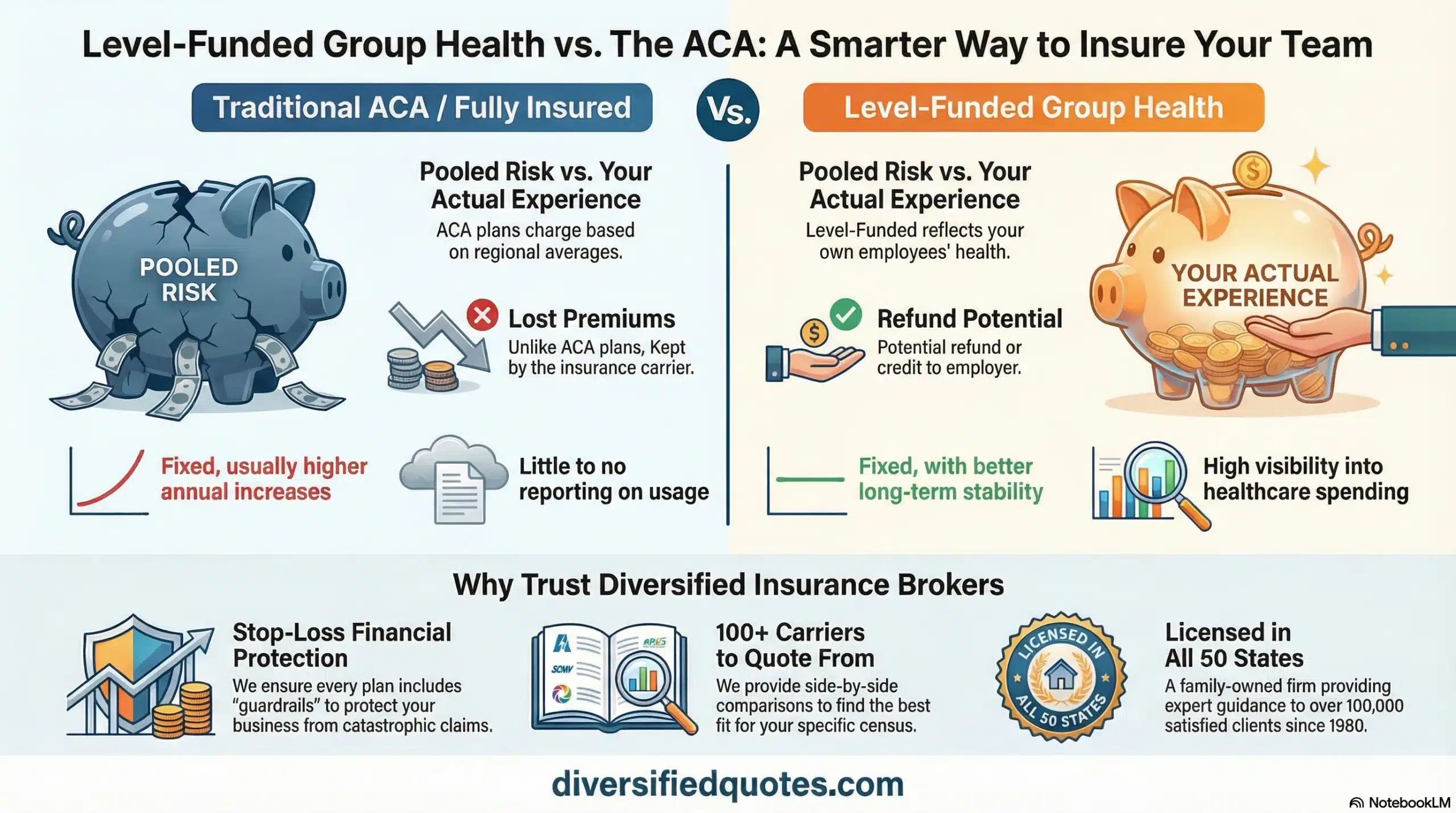
Level-funded group health insurance is available to self-employed businesses that have established a qualifying group of at least two participants — typically the owner plus one eligible W-2 employee. The level-funded structure divides the monthly premium into three components: a claims fund allocation (the group’s expected annual claims spread over twelve monthly payments), a stop-loss insurance premium (which protects against claims exceeding the funded budget, both for individual high-cost claimants and in aggregate), and an administrative fee. The monthly amount is fixed and predictable, identical in structure to a fully insured plan. At year-end, if actual claims came in below the funded claims budget, the employer receives a refund of the unused balance. If claims exceeded the budget, stop-loss insurance covers the difference. For a self-employed business owner with a small, healthy group, level funding can produce meaningful cost advantages over fully insured coverage through risk-specific underwriting that prices the actual group demographics rather than pooling into a broader community-rated market. The ERISA status of a level-funded plan also provides exemption from certain state premium taxes. The minimum group size for level funding varies by carrier — some carriers offer it starting at five participants, others at two or three. Our resource on why group level funding works covers the full structure and advantages.
About the Author:
Jason Stolz, CLTC, CRPC, DIA, CAA and Chief Underwriter at Diversified Insurance Brokers (NPN 20471358), is a senior insurance and retirement professional with more than 25 years of real-world experience helping individuals, families, and business owners protect their income, assets, and long-term financial stability. As a long-time partner of the nationally licensed independent agency Diversified Insurance Brokers, Jason provides trusted guidance across multiple specialties—including fixed and indexed annuities, long-term care planning, personal and business disability insurance, life insurance solutions, Group Health, Travel Medical and Evacuation Insurance, and short-term health coverage. Diversified Insurance Brokers maintains active contracts with over 100 highly rated insurance carriers, ensuring clients have access to a broad and competitive marketplace.
His practical, education-first approach has earned recognition in publications such as VoyageATL, and contributions from his agency featured in Kiplinger and GoBankingRates— highlighting his commitment to financial clarity and client-focused planning. Drawing on deep product knowledge and years of hands-on field experience, Jason helps clients evaluate carriers, compare strategies, and build retirement and protection plans that are both secure and cost-efficient. Visitors who want to explore current annuity rates and compare options across multiple insurers can also use this annuity quote and comparison tool.
Explore More Group Health Insurance Options: Browse our complete guide to Small Business Group Health Insurance — covering getting started, costs, how to set up, best rates & working with a broker from 100+ carriers.
Last Reviewed: June 11, 2026 |
Reviewed by: Jason Stolz, CLTC, CRPC, DIA, CAA
Chief Underwriter, Diversified Insurance Brokers, Inc. | NPN: 20471358 | Diversified Insurance Brokers, Inc. — Licensed in all 50 states
Fact Checked by: Tonia Pettitt, CMIP©
Medicare Specialist, Diversified Insurance Brokers, Inc. | NPN: 14374308 | Diversified Insurance Brokers, Inc. — Licensed in all 50 states
Did you find this content helpful? Leave us a Google review — it helps others find trustworthy guidance too.
Editorial Standards: Diversified Insurance Brokers maintains rigorous editorial standards to ensure accuracy, clarity, and independence in all content. Learn more about our editorial standards and commitment to transparency.
