
Minimum Employees for Group Health Insurance
As an Independent Group Health Insurance Broker, we compare fully insured, level-funded, and self-funded options across carriers to find the lowest cost coverage for your business.
Minimum Employees for Group Health Insurance

Jason Stolz CLTC, CRPC, DIA, CAA
The minimum number of employees required for group health insurance is two in most states — specifically, two unrelated W-2 employees who are not married to each other and who meet the carrier’s full-time hours threshold. This threshold exists because group health insurance is structured around risk pooling: spreading medical costs across a defined group of covered individuals produces more predictable pricing and allows carriers to extend coverage on a guaranteed-issue basis for small groups without individual health underwriting. A single owner or owner-spouse combination cannot form a qualifying group under most state rules and most carrier underwriting standards, because two related individuals do not represent the genuine employer-employee dynamic that makes risk pooling function as intended. The moment a business adds one unrelated W-2 employee who meets the hours and documentation requirements, the door to small group health insurance opens — along with meaningful tax advantages, access to employer-sponsored network pricing, and the ability to attract and retain employees with competitive benefits.
Understanding the two-employee minimum correctly requires understanding several layers of qualification beyond the simple headcount. The employees must be W-2 employees, not 1099 independent contractors. They must typically be working a minimum number of hours per week — most commonly 30 hours, though some carriers lower this to 20 hours depending on the plan design. The employer must meet minimum contribution requirements — paying at least 50% of the employee-only premium in most markets. And the enrolled employees must represent sufficient participation of the total eligible employee population — most carriers require 70% of eligible employees to enroll, with employees who waive coverage because they have other qualifying coverage (a spouse’s employer plan, Medicare, Medicaid) typically excluded from the participation denominator. These layers of qualification are what create the planning work involved in confirming eligibility, and why a business owner who has “two employees” may still face questions from carriers about documentation and structure before a group plan is approved. Our about page covers our full approach to helping small businesses navigate this process correctly from the start.
This page covers the complete framework for group health insurance eligibility based on minimum employee count: who counts, who doesn’t count, how participation and contribution requirements work alongside the headcount minimum, how different business structures affect owner and employee classification, and what alternatives are available for businesses that don’t yet meet the traditional group eligibility standards. For businesses with exactly two employees, our dedicated resource on 2-person group health insurance covers the documentation standards and participation mechanics specific to the smallest qualifying groups. For broader plan design and carrier comparison, our small employer group health insurance guide covers plan types, network differences, and cost structures across the small group market.
See If Your Business Qualifies for Group Health Insurance
We review your payroll, ownership structure, and state requirements to confirm eligibility and compare carriers. Nationwide, no obligation.
Request a Group Health ConsultationThe Two-Employee Standard — Why Most States Set This Threshold
The two-employee minimum for group health insurance reflects the fundamental risk-pooling principle that makes group coverage economically viable and administratively defensible. Insurance carriers price small group coverage on a community-rated or modified community-rated basis — meaning premium rates reflect the risk profile of the enrolled group rather than the individual health status of each member. For this community-rated pricing to be actuarially sustainable, the group must represent a genuine employer-employee relationship rather than a single individual attempting to access group pricing by satisfying a formal minimum on paper. Two unrelated W-2 employees who work regular hours and are compensated through payroll represent that genuine relationship; a sole owner with no staff does not, regardless of the business structure.
The regulatory framework that governs this minimum comes from a combination of state small group market regulations and carrier underwriting standards. Under the Affordable Care Act, small group coverage is generally guaranteed-issue — carriers cannot deny coverage to qualifying small groups based on the health status of employees — but the definition of a qualifying small group still requires meeting the participation and contribution standards that confirm the group represents a real employer-employee dynamic. Different states define “small group” differently for regulatory purposes: most states define it as 1 to 50 full-time equivalent employees, while California, Colorado, New York, and Vermont extend the small group definition to 1 to 100 employees. Working with a best independent group health broker ensures you interpret your state’s specific rules correctly and structure your payroll and documentation appropriately before submitting an application. Our broader resource on what it means to be an independent insurance agent covers why independence matters when evaluating options across multiple carriers.
Who Counts as an Employee — The Critical Classification Questions
The headcount minimum of two is less important than the question of who actually qualifies to be counted. Carriers and state insurance departments apply specific criteria to determine which individuals in a business count toward the eligible employee minimum and which do not. Getting the classification right before applying for coverage prevents underwriting delays, documentation requests, and potential application rejections.
| Worker Type | Counts Toward Minimum? | Key Requirements | Documentation Typically Required |
|---|---|---|---|
| Full-time W-2 employee (unrelated to owner) | Yes — primary qualifying category | Typically 30+ hours per week; genuine employment relationship; receiving W-2 wages | IRS Form 941, payroll reports, W-2s |
| Part-time W-2 employee | Sometimes — carrier-dependent | Some carriers allow 20-29 hours; many require 30+; varies by plan design | Payroll records showing hours worked |
| 1099 independent contractor | No | Independent contractors are not W-2 employees and do not count regardless of hours or relationship | N/A — not eligible |
| Sole proprietor / single-member LLC owner | No — cannot form a group alone | Must have at least one unrelated W-2 employee to qualify | N/A until qualifying employee added |
| Owner-spouse / co-owning spouse | No — does not count as separate employee in most states | Married co-owners count as one unit regardless of separate W-2 | N/A — not a qualifying separate employee |
| S-Corp owner (>2% shareholder) | Conditionally — may be covered but classification is complex | Treated as self-employed for tax; may be covered but requires at least one unrelated W-2 employee | Payroll records, Schedule K-1, corporate filings |
| LLC partner / general partner | Sometimes — depends on state and carrier | Active partners with guaranteed payments may count; documentation of active participation required | Schedule K-1, partnership agreement, guaranteed payment records |
| C-Corp employee-owner | Yes — most straightforward owner classification | C-Corp owners receiving W-2 wages are classified as employees; most flexibility of any structure | W-2, corporate payroll records |
Classification rules vary by state and carrier. Always verify with the specific carrier underwriting guidelines for your state and business structure before submitting an application. Our second opinion group health quote review is available for businesses that want an independent evaluation of their eligibility and current carrier options.
Participation Requirements — How Many Employees Must Enroll
Meeting the minimum employee count is necessary but not sufficient to qualify for and maintain small group health insurance. Carriers impose participation requirements — minimum percentages of eligible employees who must enroll in the plan — to ensure the risk pool is representative of the full employee population rather than skewed toward only those with anticipated high healthcare needs. Without participation requirements, adverse selection would push healthy employees to remain on cheaper individual plans while sick employees enrolled in the group plan, dramatically increasing the carrier’s claim exposure and driving premiums higher for everyone who does enroll. Understanding the difference between group coverage and individual plans is an important context here — our resource on group vs. individual coverage covers how group and individual markets differ in pricing and underwriting approach.
Most carriers require that 70% of eligible employees — those who have not waived coverage due to having qualifying coverage elsewhere — enroll in the group plan. Some carriers set this threshold at 50%; others set it as high as 75%. The calculation typically excludes employees who waive coverage because they are already covered by another qualifying health plan — most commonly a spouse’s employer plan, Medicaid, Medicare, or CHIP. An employee who declines coverage simply because they don’t want it does not reduce the participation denominator in most carrier calculations, while an employee with credible alternative coverage who formally waives does. The practical impact is significant: a business with 10 eligible employees where 4 have credible alternative coverage and formally waive has an adjusted eligible population of 6, and must enroll at least 4 or 5 of those 6 to meet participation. Understanding this waiver distinction — and documenting it correctly — is one of the most important administrative tasks in the group plan setup process.
Contribution Requirements — What the Employer Must Pay
In addition to the employee participation threshold, carriers require that the employer contribute a minimum percentage of each enrolled employee’s premium. Most carriers require the employer to pay at least 50% of the employee-only premium — meaning the employer covers the employee’s individual enrollment, not necessarily their dependents. Some carriers require a higher employer contribution, particularly in competitive small group markets where underwriters want to confirm the employer has genuine financial commitment to the plan. The ACA defines affordability standards for coverage: for 2025, employer-sponsored health coverage must not exceed 9.02% of an employee’s household income to be considered affordable, up from 8.39% in 2024 — a threshold that affects whether employees are eligible for ACA marketplace subsidies if they opt out of the employer plan.
The contribution requirement confirms the employer is genuinely offering the plan as an employer benefit rather than nominally sponsoring it while expecting employees to pay the full cost. For very small employers — those with 2 to 10 employees — the dollar impact of the 50% contribution requirement can be significant, because the employer is paying meaningful premium amounts for a small number of covered employees. Understanding the contribution math before committing to a group plan helps employers budget accurately and avoid surprise premium obligations after the plan is in place. Our resource on what insurance companies do with your money provides additional context on how carriers price and manage risk, which helps employers understand what drives premium levels and how their group’s characteristics affect the cost of coverage over time.
Small Group vs. Large Group — The Regulatory Distinction
The minimum employee count threshold sits within a broader regulatory framework that distinguishes small group coverage from large group coverage under the ACA. In most states, a small employer is one with 1 to 50 full-time equivalent employees. California, Colorado, New York, and Vermont use a higher threshold of 1 to 100 employees for the small group market definition. Small group plans under the ACA must cover the ten essential health benefits, must use community rating, and are guaranteed-issue to qualifying small groups regardless of employee health status. The ACA’s employer mandate adds another layer: applicable large employers with 50 or more full-time equivalent employees are required to offer affordable minimum essential coverage to full-time employees or face potential tax penalties. Employers below the 50-employee threshold have no federal mandate, but many choose group coverage because of the competitive advantages, tax benefits, and employee retention value it provides.
The comparison between group and individual coverage structures matters for employees as well as employers. When individual market premiums are elevated — particularly for older employees — group pricing often delivers better value. Our small employer group health insurance resource covers how plan design choices (HMO, PPO, metallic tiers, deductible structures) affect both employer cost and employee value in the small group market. Industry-specific considerations also affect plan design — contractors, construction businesses, and employers with variable workforces face unique eligibility challenges that our group health insurance for construction crews guide addresses directly for that sector.
Business Structure and Owner Eligibility — How Entity Type Changes the Picture
The business entity structure significantly affects how owners are classified for group health insurance purposes and whether they can count toward the employee minimum or receive coverage under a group plan. Sole proprietors who have no W-2 employees cannot qualify for group health insurance under any standard market structure, because there is no employer-employee relationship. To access group coverage, the sole proprietor must hire at least one legitimate W-2 employee who is not a spouse, document the employment relationship with payroll records, and satisfy the carrier’s hours and contribution requirements. Once that employee is on payroll, the sole proprietor can typically be covered under the group plan as the employer.
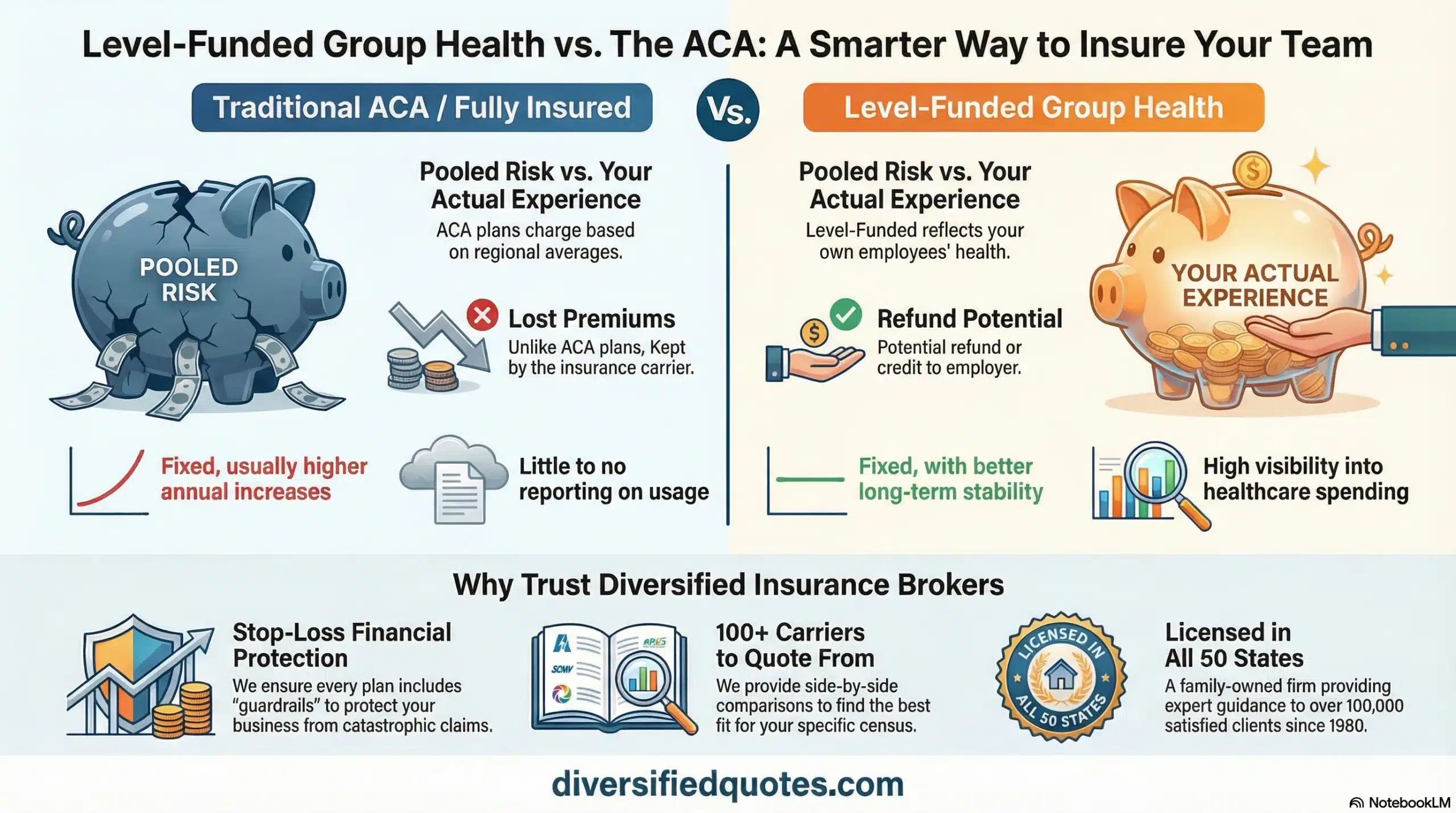
S-Corporations present a nuanced classification situation. Shareholders owning more than 2% of an S-Corp are treated as self-employed for federal income tax purposes under IRS rules, which affects premium tax treatment. However, an S-Corp can still maintain a group health plan if at least one unrelated W-2 employee is also covered. C-Corporations have the most straightforward owner classification: owners who receive W-2 wages are classified as employees, premiums are deductible to the corporation, and the value of the health benefit is excluded from the employee-owner’s taxable income. Partnerships and multi-member LLCs may count active partners with documented guaranteed payments toward eligibility in some states and with some carriers, but classification is more variable across carrier underwriting guidelines. For businesses evaluating whether alternative funding structures might be a better fit, our resource on what is self-funded group health insurance covers level-funded and partially self-insured plans, and our overview of why group level funding covers how that approach compares to fully insured options for employers with larger or more predictable workforces.
How Spouses and Family Members Factor Into the Count
One of the most common misconceptions about the two-employee minimum is the assumption that an owner and their working spouse can form a qualifying group of two. In most states and under most carrier underwriting standards, a husband and wife who jointly own and operate a business are treated as a single unit — not as two separate qualifying employees — regardless of whether they have separate W-2s. Their shared household and shared ownership interest make them effectively the same “risk unit” for insurance purposes, and carriers apply a spousal exception that prevents the couple from satisfying the two-employee minimum on their own.
Children and other relatives who are genuine W-2 employees performing real job duties at bona fide wages may qualify as the second employee in some circumstances, but carriers scrutinize family employment arrangements carefully. The documentation standard for a relative employee is typically higher than for an unrelated employee — carriers may require more complete payroll records, documented job duties, and compensation consistent with market rates for the role. The safest path for employers with family members on payroll is maintaining clear, consistent payroll records and documented job descriptions — the same standards that would protect any employer in a tax or benefits audit. For a detailed look at the two-employee case specifically, our 2-person group health insurance resource addresses the documentation and participation mechanics for the smallest qualifying groups.
The Special Enrollment Window — November 15 to December 15
One of the most useful planning tools for small employers who are struggling to meet participation requirements is the annual special enrollment window for small group coverage. Between November 15 and December 15 of each year, small group health plans are available on a guaranteed-issue basis through the Small Business Health Options Program (SHOP) and in many state markets, with participation requirements temporarily relaxed or waived. During this window, a qualifying small employer can secure group coverage even if fewer than the normal threshold of eligible employees enroll — making it a critical planning opportunity for businesses that have a genuine employer-employee relationship but face participation challenges because some employees have existing coverage elsewhere or because the group is very small.
Planning ahead — understanding whether your business is likely to face participation challenges and timing the initial application to coincide with the special enrollment window if needed — prevents a situation where the application is ready but the participation threshold prevents approval during a standard enrollment period. Working with an independent group health broker who is familiar with both the standard and special enrollment requirements in your state is the most reliable resource for navigating this timing dimension accurately. If you already have a group health quote and want an independent evaluation of whether it is competitive and structured correctly for your employee count and state, our second opinion group health insurance quote review provides that analysis without obligation.
Documentation Requirements — What Carriers Ask for to Confirm Eligibility
The documentation process for small group health insurance is where many otherwise-qualifying employers encounter delays or complications. Carriers require documentary evidence of the employer-employee relationship because the risk pooling and guaranteed-issue nature of small group coverage depends on the integrity of the group composition. The most common documentation requirements include IRS Form 941 (the Employer’s Quarterly Federal Tax Return), which shows payroll activity and employee count, along with recent payroll reports showing employee names, hours worked, and compensation. For businesses with owners in complex structures, Schedule K-1 filings from partnership returns, corporate tax returns, or guaranteed payment records from LLC operating agreements may be required. Some carriers also request bank statements confirming that payroll is genuinely occurring. For very new businesses with limited payroll history, documentation requirements may extend to business formation documents alongside whatever payroll records are available.
QSEHRA and ICHRA — Alternatives for Businesses That Don’t Yet Qualify
For businesses that don’t yet meet the traditional group health insurance eligibility requirements, two federal alternatives offer meaningful access to employer-sponsored health benefits without requiring a qualifying group plan. The Qualified Small Employer Health Reimbursement Arrangement (QSEHRA) is specifically designed for small businesses with fewer than 50 full-time equivalent employees. Under QSEHRA, the employer reimburses employees for individual health insurance premiums and qualified medical expenses up to annual IRS limits — with no participation requirement. Employees purchase their own individual plans and submit receipts for reimbursement. QSEHRA has no participation threshold, making it an accessible option for employers who can’t meet traditional group participation standards. The Individual Coverage Health Reimbursement Arrangement (ICHRA) is a more flexible version that applies to employers of any size, allows higher reimbursement limits, and can be structured differently for different employee classes. For employers considering alternative funding as they grow toward the full group threshold, our resource on why group level funding covers how these structures compare to fully insured group plans once the employee count grows into the range where level-funded plans become cost-effective.
Tax Advantages of Group Health Insurance — The Financial Case for Qualifying
The tax treatment of group health insurance makes it one of the most financially efficient forms of employee compensation available to businesses of any size. For the employer, premiums paid for employee health coverage are generally fully deductible as a business expense — reducing the company’s taxable income dollar-for-dollar. For employees, the value of employer-sponsored health coverage is excluded from federal income tax and FICA payroll taxes — meaning an employee who receives meaningful employer health contributions is receiving that benefit entirely tax-free, which is significantly more valuable than receiving the same amount as taxable wages. This exclusion is particularly valuable in competitive labor markets where attracting and retaining employees is challenging, because the after-tax value of health benefits substantially exceeds the after-tax value of equivalent cash compensation for most employees.
For small employers evaluating the full financial case for qualifying for group coverage — including the deductibility of employer contributions, payroll tax savings, and the competitive hiring advantage — working with an experienced independent broker provides the comprehensive cost analysis that a single-carrier agent cannot. Our best independent group health broker resource covers what to look for in an independent group health advisor, and our broader resource on what makes an independent insurance agent genuinely independent explains why carrier access breadth matters for employers comparing group health options across the full market.
Confirm Your Employee Count and Compare Rates
Our advisors verify eligibility, explain participation rules, and provide side-by-side group health quotes. Nationwide, no obligation.
Get Group Health Plan Options
Related Group Health Insurance Resources
Talk With an Advisor Today
Choose how you’d like to connect—call or message us, then book a time that works for you.
Schedule here:
calendly.com/jason-dibcompanies/diversified-quotes
Licensed in all 50 states • Fiduciary, family-owned since 1980
FAQs: Minimum Employees for Group Health Insurance
What is the minimum number of employees needed for group health insurance?
In most states, the minimum is two unrelated W-2 employees who are not married to each other and who meet the carrier’s full-time hours requirement (typically 30 hours per week, though some carriers allow 20-29 hours). The two employees must represent a genuine employer-employee relationship documented by payroll records. A sole owner without W-2 employees does not meet the minimum. A married couple co-owning a business counts as one unit, not two, under most carrier underwriting standards.
Can a husband and wife qualify as a group?
No, in most states and under most carrier underwriting standards. Married couples who jointly own a business are treated as a single unit — not as two separate qualifying employees — regardless of whether they have separate W-2s. Their shared household and shared ownership interest make them effectively the same risk unit for insurance purposes. To form a qualifying group, at least one of the two required employees must be unrelated to the owner and not a spouse.
Do 1099 independent contractors count toward the minimum?
No. Only W-2 employees count toward the employee minimum for group health insurance. Independent contractors compensated via 1099 are not employees and do not satisfy the employer-employee relationship that group coverage requires. Converting a 1099 contractor to a W-2 employee (with appropriate payroll documentation and tax compliance) is one approach employers sometimes take to reach the minimum, but the conversion must be genuine — reflecting a real change in working relationship — rather than a documentation-only change for insurance purposes.
What is the employee participation requirement for group health insurance?
Most carriers require 70% of eligible employees to enroll in the group plan — though this threshold ranges from 50% to 75% depending on the carrier and state. The calculation typically excludes employees who formally waive coverage because they have other qualifying health insurance (such as a spouse’s employer plan, Medicare, Medicaid, or CHIP). An employee who declines coverage without qualifying alternative coverage does not reduce the participation denominator. During the annual special enrollment window (November 15 – December 15), participation requirements are generally relaxed or waived for small group coverage.
How much must an employer contribute to employee premiums?
Most carriers require the employer to contribute at least 50% of the employee-only premium (not necessarily dependent coverage). Some carriers require a higher minimum contribution. For 2025, the ACA defines affordable employer-sponsored coverage as not exceeding 9.02% of an employee’s household income — a threshold relevant for determining whether employees are eligible for marketplace subsidies if they decline the employer plan. The employer contribution requirement exists to confirm that the employer is genuinely sponsoring the plan as an employee benefit rather than requiring employees to bear the full cost.
What happens if I can’t meet the minimum employee requirement?
Several alternatives are available for businesses that don’t yet qualify for traditional group health insurance. QSEHRA (Qualified Small Employer Health Reimbursement Arrangement) allows businesses with fewer than 50 employees to reimburse employees for individual health insurance premiums without a group plan and without a participation requirement. ICHRA (Individual Coverage HRA) is available to employers of any size with similar flexibility. Association Health Plans allow businesses in the same industry or geographic area to band together for group purchasing power. And for businesses approaching the qualifying threshold, hiring one additional unrelated W-2 employee may open access to full group coverage with the associated tax advantages.
What documents do carriers require to verify group eligibility?
Most carriers require IRS Form 941 (Employer’s Quarterly Federal Tax Return) showing payroll activity and employee count, along with recent payroll reports showing employee names, hours worked, and compensation. For business owners in complex structures — S-Corps, partnerships, LLCs — Schedule K-1 filings, corporate tax returns, or operating agreement documentation may be required. Some carriers also request bank statements confirming payroll transactions. New businesses with limited payroll history may need to provide business formation documents alongside whatever payroll records are available. Assembling documentation before application submission is the most effective way to prevent underwriting delays.
About the Author:
Jason Stolz, CLTC, CRPC, DIA, CAA and Chief Underwriter at Diversified Insurance Brokers (NPN 20471358), is a senior insurance and retirement professional with more than 25 years of real-world experience helping individuals, families, and business owners protect their income, assets, and long-term financial stability. As a long-time partner of the nationally licensed independent agency Diversified Insurance Brokers, Jason provides trusted guidance across multiple specialties—including fixed and indexed annuities, long-term care planning, personal and business disability insurance, life insurance solutions, Group Health, Travel Medical and Evacuation Insurance, and short-term health coverage. Diversified Insurance Brokers maintains active contracts with over 100 highly rated insurance carriers, ensuring clients have access to a broad and competitive marketplace.
His practical, education-first approach has earned recognition in publications such as VoyageATL, and contributions from his agency featured in Kiplinger and GoBankingRates— highlighting his commitment to financial clarity and client-focused planning. Drawing on deep product knowledge and years of hands-on field experience, Jason helps clients evaluate carriers, compare strategies, and build retirement and protection plans that are both secure and cost-efficient. Visitors who want to explore current annuity rates and compare options across multiple insurers can also use this annuity quote and comparison tool.
Explore More Group Health Insurance Options: Browse our complete guide to Small Business Group Health Insurance — covering getting started, costs, how to set up, best rates & working with a broker from 100+ carriers.
Last Reviewed: June 2, 2026 |
Reviewed by: Jason Stolz, CLTC, CRPC, DIA, CAA
Chief Underwriter, Diversified Insurance Brokers, Inc. | NPN: 20471358 | Diversified Insurance Brokers, Inc. — Licensed in all 50 states
Fact Checked by: Tonia Pettitt, CMIP©
Medicare Specialist, Diversified Insurance Brokers, Inc. | NPN: 14374308 | Diversified Insurance Brokers, Inc. — Licensed in all 50 states
Did you find this content helpful? Leave us a Google review — it helps others find trustworthy guidance too.
Editorial Standards: Diversified Insurance Brokers maintains rigorous editorial standards to ensure accuracy, clarity, and independence in all content. Learn more about our editorial standards and commitment to transparency.
