
How to Choose the Right Group Health Plan
As an Independent Group Health Insurance Broker, we compare fully insured, level-funded, and self-funded options across carriers to find the lowest cost coverage for your business.
How to Choose the Right Group Health Plan

Jason Stolz CLTC, CRPC, DIA, CAA
Choosing the right group health plan is one of the most consequential decisions a business owner makes each year — not because the choice is made once and forgotten, but because it repeats annually and compounds. The wrong structure means overpaying a carrier for a plan designed primarily to protect the insurer’s profitability rather than the employer’s budget. The right structure means owning the financial outcome of your group’s actual health experience, keeping the surplus when your team has a good year, and accessing the data that tells you where costs are actually going. Most business owners default to fully insured group health plans out of familiarity and simplicity, never learning that a structurally superior alternative has existed for decades and is now accessible to groups as small as five employees. That alternative is level-funded group health insurance — a hybrid model that combines the cost predictability employers want with the data transparency, plan flexibility, and year-end refund potential that fully insured plans categorically cannot offer.
The group health decision begins with understanding that not all plan structures are created equal — and that the default option presented by a single carrier or a captive agent almost never represents the best available outcome. At Diversified Insurance Brokers, Jason Stolz, CLTC, CRPC, DIA, CAA, works with businesses across all fifty states to evaluate the full spectrum of group health plan structures, from fully insured to level-funded to self-funded, and design the approach that generates the best combination of coverage quality, employee experience, and long-term cost management for each employer’s specific workforce and budget profile. The right group health plan is not the cheapest plan — it is the plan structure that gives you the greatest control over what you pay and what you get for it.
Find Out If Level Funding Is Right for Your Group
Get a no-obligation analysis comparing what your group would pay under a fully insured plan versus a level-funded structure.
Request a Group Health Plan ComparisonThe Three Group Health Plan Structures: What Each One Actually Means
Before evaluating which group health plan structure is right for a specific business, every employer needs a clear understanding of what the three primary funding models actually are — because the differences are structural and consequential, not cosmetic. The funding model determines who bears the financial risk of your employees’ health claims, who keeps the money when claims run low, and who has access to the data that drives the plan’s real cost over time.
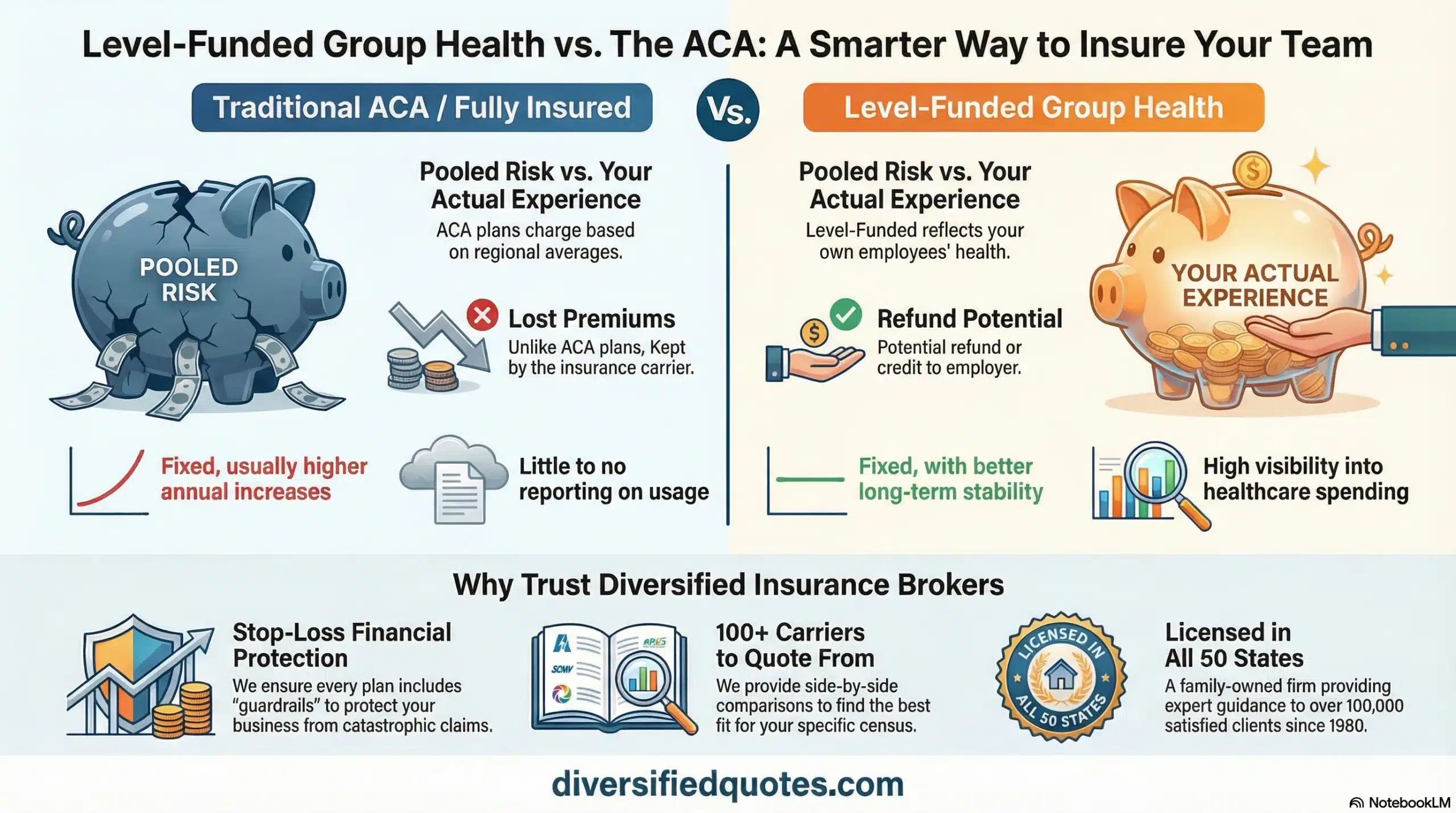
A fully insured group health plan is the traditional model. The employer pays a fixed monthly premium to an insurance carrier, and in exchange the carrier assumes all financial responsibility for employee health claims. If your group has an excellent year — minimal hospitalizations, few specialist visits, low prescription spend — the carrier keeps every dollar of unused premium as profit. The employer receives nothing back. The carrier’s renewal quote the following year reflects market pricing, community rating trends, and its own actuarial assumptions, not your group’s actual claim performance. This is the model most business owners are familiar with, and it has one significant structural flaw: it permanently transfers the financial benefit of a healthy workforce to the carrier while leaving the employer exposed to consistent annual premium increases regardless of how well their group actually performed.
A self-funded group health plan sits at the opposite end of the spectrum. The employer directly pays all employee health claims as they are incurred, retaining full financial responsibility for the group’s medical costs. Stop-loss insurance protects against catastrophic individual claims (specific stop-loss) and against aggregate claims that exceed a defined annual threshold (aggregate stop-loss). Self-funding provides maximum transparency and maximum savings potential for groups with favorable claim histories, but it also carries meaningful cash flow risk for smaller employers and requires more sophisticated plan management through a Third Party Administrator (TPA). Our resource on what self-funded group health insurance is covers the mechanics of this model in detail, and the companion page on the pros and cons of self-funded group health is worth reviewing before evaluating whether a group is ready for that level of risk assumption.
Level-funded group health insurance is the hybrid that delivers the best attributes of both models without requiring the scale or risk tolerance that full self-funding demands. It is the structure that the majority of well-informed employers with healthy workforces should be on — and the fact that it remains underutilized reflects a gap in how group health insurance is typically sold, not a gap in its value.
How Level Funding Works: The Mechanics That Make It Superior
In a level-funded plan, the employer pays a fixed monthly amount — predictable and budget-friendly, just like a fully insured premium. That fixed payment is divided into three components: a claims fund allocation (the estimated cost of employee medical claims divided across twelve monthly installments), a stop-loss insurance premium (which protects the employer if claims exceed expectations), and an administrative services fee paid to the TPA or carrier managing the plan. The employer knows exactly what they are paying each month, and that number does not fluctuate during the plan year regardless of how many claims are filed.
At the end of the plan year, the surplus calculation occurs — and this is where level funding fundamentally parts ways with fully insured coverage. If actual employee claims were lower than the funded claims budget, the employer receives a refund of the unused claims fund balance. In a fully insured plan, that same surplus would belong to the carrier. In a level-funded plan, it belongs to the employer. This refund potential — which can range from modest credits to substantial checks depending on how well the group performed — is the most direct financial advantage of level funding, and it represents real money that employers on fully insured plans surrender every year without realizing it. According to UnitedHealthcare data, employers on level-funded structures paid an average of approximately nineteen percent less than comparable fully insured groups. That gap represents the combined effect of risk-based underwriting, exemption from certain state premium taxes, and refund potential that fully insured pricing structurally excludes.
The stop-loss insurance embedded in the level-funded structure is what makes this model accessible and practical for small and mid-size employers who cannot absorb catastrophic claim exposure. Specific stop-loss coverage protects against any individual employee’s claims exceeding a defined threshold — commonly $20,000 to $50,000 per person — ensuring that a single serious illness or injury cannot devastate the employer’s financial position. Aggregate stop-loss coverage provides a ceiling on the group’s total annual claims, protecting against the scenario where multiple employees have high-cost health events simultaneously. The mechanics of how this protection works are covered in detail through our resource on understanding stop-loss insurance in level-funded plans. Taken together, the fixed monthly structure and the stop-loss protection create a model that is genuinely predictable on the cost side while genuinely rewarding on the performance side — a combination that fully insured plans cannot replicate. The comprehensive explanation of all the financial advantages is available through our resource on why group level funding works.
Level Funded vs. Fully Insured: Head-to-Head Comparison
| Plan Feature | Level-Funded Plan | Fully Insured Plan |
|---|---|---|
| Monthly cost predictability | Fixed — same every month | Fixed — same every month |
| Year-end surplus if claims are low | Employer receives refund | Carrier keeps all surplus |
| Claims data access | Full monthly transparency | Minimal; often blocked by carrier |
| Underwriting basis | Group-specific health experience | Community or modified community rating |
| Protection against high claims | Stop-loss insurance (specific and aggregate) | Carrier absorbs all claim risk |
| State premium tax exemption | Generally exempt (ERISA plan) | Subject to state premium taxes |
| Plan design flexibility | High — custom networks, deductibles, tiers | Low — carrier-defined plan designs |
| Renewal based on your actual claims | Yes — healthy groups are rewarded | No — market trends drive increases |
| Minimum group size | As few as 5 employees (varies by carrier) | Typically 2+ employees |
The Claims Data Advantage: Why Transparency Changes Everything
One of the most underappreciated advantages of level-funded group health insurance is not the refund potential — it is the claims data. When a business operates on a fully insured plan, the carrier holds the claims data and is under no obligation to share meaningful utilization information with the employer. You receive a renewal quote and an aggregate rate increase, but you rarely learn which cost categories drove the increase, whether it was prescription spend, specialist visits, or emergency room utilization, or whether specific benefit design changes could have redirected employees toward more cost-effective care pathways. You are, in effect, managing a major expense line with no information about what is driving it.
A level-funded plan fundamentally changes this dynamic. Because the employer is the plan sponsor under ERISA, they have access to detailed monthly claims reports showing utilization patterns, cost drivers, high-cost claimant trends (within HIPAA privacy rules), prescription spend by category, and emergency versus preventive care ratios. This data is not just interesting — it is actionable. An employer who learns that emergency room visits are a disproportionate cost driver can respond with nurse hotline programs that redirect after-hours care. An employer who sees high prescription costs in a specific therapeutic category can work with the TPA to implement formulary management or alternative sourcing strategies. The claims data transparency that level funding provides is what enables employers to actually manage their health plan as a business asset rather than simply receiving a bill from a carrier each month.
According to research from the benefits consulting community, level-funded plans grew from representing approximately seven percent of small-firm coverage to thirty-seven percent of small-firm coverage between 2019 and 2025, according to Kaiser Family Foundation Employer Health Benefits Survey data. That adoption curve reflects a genuine market recognition that the transparency and refund structure of level funding delivers superior value for employers who take the time to understand it. For most well-run businesses with reasonably healthy workforces, level funding is not an advanced or exotic option — it is the right foundational structure, and fully insured coverage is what they should be moving away from. Our resources on the tax benefits of level-funded health insurance and whether small groups can get health insurance refunds provide the financial detail that supports this shift.
Who Level Funding Works Best For — and When Fully Insured Still Makes Sense
Level-funded group health insurance is not the right structure for every employer in every situation, and honest guidance requires acknowledging when fully insured coverage is the more appropriate choice. Level funding produces its strongest results for employers with workforces that are relatively young and healthy, groups with low historical claims utilization, businesses whose owners are motivated to engage with their claims data and make plan management decisions throughout the year, and companies that have experienced repeated renewal increases on fully insured plans without any corresponding improvement in coverage quality. For these groups — and they represent the majority of small to mid-size businesses with functioning wellness cultures and moderate healthcare consumption — level funding is structurally superior to fully insured coverage on both cost and transparency grounds.
Fully insured coverage remains the more appropriate choice for certain specific situations. Groups with employees who have known chronic conditions requiring predictably high ongoing treatment costs may find that level-funded underwriting produces premiums that are not competitive with community-rated fully insured options, because level-funded pricing reflects the actual health risk of the specific group. Very small groups of two or three employees, where a single high-cost claim can exceed the entire claims fund and create significant stop-loss complications, may find the administrative and financial predictability of fully insured coverage more practical. Groups where the employer has no bandwidth for plan management engagement and simply needs a set-and-forget solution may also find fully insured coverage operationally simpler. In these cases, fully insured plans serve as a reasonable fallback — but they should be the fallback, not the default starting point. Our resource on group health insurance cost for small business helps employers understand how level-funded and fully insured pricing compares for groups of various sizes.
Level Funding and the Self-Employed: A Frequently Overlooked Opportunity
One of the most common misconceptions about level-funded group health plans is that they are only available to businesses with traditional W-2 employee populations. In fact, some level-funded structures are available to self-employed individuals and businesses with non-traditional workforce compositions. Understanding whether 1099 contractors can access group level funding is important for businesses that rely heavily on independent contractors or have mixed W-2 and 1099 workforces. The eligibility rules vary by carrier and state, but the opportunity exists in more situations than most business owners assume. For self-employed individuals without any employees, separate pathways for getting group health insurance as a self-employed person exist outside the traditional level-funded structure, though the financial logic of group-style coverage often applies across both contexts.
The tax treatment of level-funded plan contributions also merits attention for self-employed business owners and S-corporation owners who fund their own health coverage. Because level-funded plans are ERISA plans — not insurance contracts subject to state regulation — they carry different tax characteristics than fully insured premiums in certain contexts. Our resource on level-funded health insurance tax benefits covers how employers can deduct their level-funded contributions, how surplus refunds are treated for tax purposes, and how the ERISA status of the plan affects compliance obligations. For ACA-compliant alternatives to traditional group structures, our resource on ACA alternatives for company healthcare covers the full landscape of options beyond the standard carrier marketplace.
The Group Health Decision by Business Size
The right group health plan structure varies with employer size, not because the fundamental logic changes, but because the available options and the risk tolerance appropriate for each size bracket differ meaningfully. For very small employers — groups of two to ten employees — level funding is available from select carriers and offers meaningful advantages over fully insured community-rated plans for groups with healthy demographics. Our resources on group health insurance for a two-person business and group health insurance for ten employees address the specific options and minimum participation requirements at the smallest end of the market. For groups between twenty and fifty employees, level funding typically becomes fully competitive with fully insured pricing for healthy groups and often demonstrably cheaper on a net-of-refund basis when claims performance is favorable. Our resources on group health insurance for twenty employees, thirty employees, and fifty employees cover the size-specific considerations in detail.
For larger employers with fifty to one hundred or more employees, level funding transitions naturally toward fuller self-funding territory where the employer’s statistical pool is large enough to make direct claims management financially meaningful. Group health insurance for one hundred employees covers the funding structure and plan design options for mid-market employers who have outgrown the small group market but have not yet built the internal infrastructure for full self-funding. Industry-specific employer groups — law firms, construction companies, physician practices, accounting firms, and consulting firms — each carry distinct workforce demographics and claims utilization patterns that affect level-funded pricing significantly. Our industry-specific resources on group health for law firms, group health for construction firms, group health for physician practices, and group health for consulting firms help employers in those sectors understand how their workforce profile maps to specific plan structures.
Beyond the Medical Benefit: Building a Complete Employee Benefits Package
The group health plan is the anchor benefit that drives enrollment and employee satisfaction, but a complete employee benefits package integrates several additional coverages that protect employees and the business more comprehensively. Group life insurance provides a death benefit to employee families at a fraction of individual market cost, typically with guaranteed issue provisions that eliminate underwriting for eligible employees. Group long-term care insurance addresses the risk of extended nursing or home care needs that health insurance and Medicare do not adequately cover, at group pricing that substantially undercuts individual LTC premiums. Dental and vision coverage — available through our resource on dental and vision insurance options — rounds out the benefit package in a way that employees value highly even when the employer contribution is modest.
Disability income protection is among the most frequently overlooked gaps in employee benefit packages. Disability income insurance for key person employees and guaranteed issue group disability insurance provide income replacement when employees cannot work due to illness or injury — a risk that statistics consistently show is far more common during working years than premature death. An employer who invests in a well-structured level-funded medical plan and then leaves disability, life, and dental coverage unaddressed has built an incomplete benefits architecture. The most competitive employers in the labor market understand that the total benefits package — not the medical plan alone — determines their ability to recruit and retain quality employees. Working with an independent group health broker who can design and manage the full benefits package rather than a single product line produces the most coherent and cost-effective result.
The Independent Broker Advantage in Group Health Insurance
The same structural dynamic that makes independent broker access valuable in life insurance and annuity markets applies with equal force in group health insurance. A captive agent representing a single carrier presents one funding structure at one price point, evaluated through that carrier’s proprietary lens. An independent broker who works with multiple level-funded carriers, fully insured carriers, and TPA networks can run a genuine cross-market comparison that identifies which structure — and which carrier within that structure — produces the optimal combination of coverage quality, cost, and refund potential for a specific group’s demographics and healthcare needs.
For employers who already have a group health plan and want to know whether they are on the best available structure, a second opinion on their existing group health insurance quote from an independent broker frequently reveals that significant savings are available through a level-funded restructuring that their current broker has never proposed. Our team at Diversified Insurance Brokers approaches every group health engagement by first determining whether level funding is appropriate — and if so, running a market comparison across multiple level-funded carriers to identify the most competitive option before presenting any recommendation. The resource on why working with an independent group health insurance broker matters explains this process in detail, and the resource on how to get the best group health insurance rates covers the specific strategies that independent comparison produces in competitive outcomes. For employers just beginning this process, our resource on how to set up group health insurance for employees provides the foundational process from first evaluation through first plan effective date.
Talk With an Advisor Today
Choose how you’d like to connect—call or message us, then book a time that works for you.
Schedule here:
calendly.com/jason-dibcompanies/diversified-quotes
Licensed in all 50 states • Fiduciary, family-owned since 1980
Frequently Asked Questions: How to Choose the Right Group Health Plan
What is a level-funded group health plan and how is it different from a fully insured plan?
A level-funded group health plan is a hybrid between fully insured and self-funded coverage. The employer pays a fixed monthly amount — predictable and budget-friendly, identical in structure to a fully insured premium — but that monthly payment is divided into three components: a claims fund allocation, a stop-loss insurance premium, and an administrative services fee. If actual employee claims during the plan year are lower than the funded claims budget, the employer receives a refund of the unused balance at year-end. In a fully insured plan, that same surplus belongs to the carrier and is retained as profit. Level-funded plans also provide the employer with detailed monthly claims data showing exactly how the healthcare dollars are being spent — information that fully insured carriers are not required to share and typically withhold. The combination of refund potential, data transparency, plan design flexibility, and risk-based underwriting based on your specific group’s health profile makes level funding structurally superior to fully insured coverage for most healthy small to mid-size employer groups.
How does stop-loss insurance protect employers on a level-funded plan?
Stop-loss insurance is the mechanism that makes level funding viable for employers who cannot absorb catastrophic healthcare cost exposure. It comes in two forms within a level-funded structure. Specific stop-loss coverage protects against any individual employee’s claims exceeding a defined threshold — commonly $20,000 to $50,000 per person, depending on group size and negotiated terms — meaning the employer funds claims up to that amount and the stop-loss carrier pays everything above it. Aggregate stop-loss coverage provides a ceiling on the group’s total annual claims, protecting against the scenario where multiple employees simultaneously have high-cost health events that collectively exceed the group’s funded claims budget. Together, these two protections ensure that even in a worst-case health year, the employer’s maximum financial exposure is known and capped in advance. This is why level-funded plans can offer predictability that rivals fully insured plans while retaining the savings and transparency advantages of self-funded structures. The stop-loss premium is one of the three components included in the fixed monthly payment, so the protection is built into the structure from the beginning without requiring a separate purchase decision.
What size group needs to be to qualify for level funding?
Level-funded plans are available from some carriers for groups as small as five employees, and minimum group requirements vary by carrier and state. The smallest groups face the most significant underwriting scrutiny because a single high-cost claim in a group of five represents a much larger percentage of the claims fund than the same claim in a group of fifty. As group size increases, the statistical pool becomes more stable, underwriting assumptions become more reliable, and level-funded pricing becomes increasingly competitive with fully insured alternatives. For groups between twenty and fifty employees, level funding is typically fully cost-competitive with fully insured options for groups with reasonably healthy demographics, and the refund potential creates meaningful downside cost advantages in good health years. Groups above fifty employees are typically strong candidates for level funding and, for the largest among them, may ultimately be better served by moving toward fuller self-funding as their claims pool becomes statistically robust enough to manage directly. The minimum employee threshold for any specific carrier and plan year should be confirmed before beginning the quoting process.
When does fully insured group health insurance make more sense than level funding?
Fully insured coverage is the more appropriate structure in specific situations where level-funded underwriting would produce an uncompetitive or impractical result. Groups with employees who have known chronic conditions requiring predictably high ongoing treatment — multiple employees managing cancer treatment, complex cardiovascular conditions, or expensive specialty drug regimens — may find that risk-based level-funded underwriting generates premiums higher than community-rated fully insured pricing, because the carrier is pricing the specific group’s known risk exposure rather than pooling it across a broad market. Very small groups of two or three employees, where a single serious illness can represent the entire claims fund, may find the fully insured model operationally simpler and financially more predictable. Groups where the employer has no capacity or interest in engaging with monthly claims data and plan management decisions may prefer the administrative simplicity of fully insured coverage. In all of these situations, fully insured plans serve as a reasonable option — but they should be the fallback after a level-funded analysis demonstrates that the structure is not advantageous for that specific group, not the starting assumption before any comparison is made.
How much can a small business actually save by switching to a level-funded plan?
The savings potential on a level-funded plan comes from two distinct sources: lower baseline premiums driven by risk-specific underwriting rather than community rating, and year-end surplus refunds when actual claims fall below the funded budget. On the baseline premium side, UnitedHealthcare data suggests that employers on level-funded structures paid an average of approximately nineteen percent less than comparable fully insured groups — though this figure varies substantially depending on the group’s specific demographics and health experience. On the refund side, a group that funds one hundred thousand dollars in claims across the plan year and only incurs seventy thousand dollars in actual claims could receive the thirty thousand dollar difference back at year-end. A fully insured employer paying the equivalent premium in that same year receives no refund regardless of how low claims were. The exact savings for any specific group depend on its current fully insured premium, its demographic profile, available level-funded carrier pricing, and the actual claims experience during the plan year. A comparative analysis run by an independent broker produces a concrete projected savings range based on actual market quotes rather than generic estimates.
What compliance obligations do level-funded plans create for employers?
Because level-funded plans are ERISA plans — not state-regulated insurance contracts — they carry federal compliance obligations that fully insured plans handle on the employer’s behalf. As the plan sponsor under ERISA, the employer is responsible for maintaining and distributing a Summary Plan Description, filing Form 5500 annually for groups meeting the threshold, providing Summaries of Benefits and Coverage, managing COBRA administration, ensuring HIPAA compliance in how claims data is handled, and meeting ACA reporting requirements through Form 1095-C (for applicable large employers) or Form 1095-B. The ERISA preemption of state insurance law that makes level-funded plans exempt from state premium taxes and certain state mandates is the same preemption that shifts compliance responsibilities to the employer. In practice, the TPA managing the level-funded plan handles most of these compliance functions as part of the administrative services agreement, and a qualified benefits broker familiar with level-funded structures can guide the employer through the obligations that remain their direct responsibility. These compliance requirements are real but manageable — and for most employers, they are worth the cost savings and data transparency advantages the structure provides.
What employee benefits should I offer alongside group health insurance?
Group health insurance is the foundational employee benefit, but a competitive benefits package extends beyond medical coverage to address the full spectrum of financial risks employees and their families face. Group life insurance provides death benefit protection at group pricing — typically with guaranteed issue provisions that allow eligible employees to obtain coverage without individual underwriting, making it more accessible than individual life insurance for employees with health conditions. Group disability insurance provides income replacement when employees cannot work due to illness or injury — a risk that statistics show is more likely during working years than premature death but that most employers do not address through group coverage. Dental and vision coverage are consistently ranked among the benefits employees value most, even when the employer contribution is modest, because out-of-pocket dental and vision costs are frequent and tangible. Group long-term care insurance addresses the risk of extended care needs that health insurance does not cover, at group pricing that substantially undercuts individual LTC premiums. The most competitive employers treat the benefits package as an integrated system — anchored by a well-structured level-funded medical plan and complemented by life, disability, dental, and vision coverage that together create a retention-driving benefits experience rather than a minimum-compliance checkbox.
How do PPO, HMO, and HDHP plan designs interact with the level-funded structure?
The level-funded structure refers to how the plan is funded — the financial mechanism governing premium payments, claims responsibility, and refund potential — while PPO, HMO, and HDHP refer to the plan design that determines how employees access care and share costs. These two dimensions are independent and can be combined. A level-funded plan can be designed with PPO network access, HMO managed care structures, or High Deductible Health Plan cost-sharing structures. The choice of plan design within a level-funded structure depends on the employer’s network access priorities, employee preferences, and cost-sharing strategy. PPO designs offer employees broader provider choice and out-of-network access at higher cost. HMO designs restrict to in-network providers but typically carry lower premiums and more predictable employee cost-sharing. HDHPs pair with Health Savings Accounts to create a tax-advantaged employee cost-sharing mechanism that can reduce overall plan cost. One of the advantages of level-funded structures over fully insured plans is greater plan design flexibility — the employer can often customize deductibles, copayments, and network tiers more granularly than fully insured carrier product shelves typically allow, creating a plan design that more precisely matches workforce needs and budget goals.
About the Author:
Jason Stolz, CLTC, CRPC, DIA, CAA and Chief Underwriter at Diversified Insurance Brokers (NPN 20471358), is a senior insurance and retirement professional with more than 25 years of real-world experience helping individuals, families, and business owners protect their income, assets, and long-term financial stability. As a long-time partner of the nationally licensed independent agency Diversified Insurance Brokers, Jason provides trusted guidance across multiple specialties—including fixed and indexed annuities, long-term care planning, personal and business disability insurance, life insurance solutions, Group Health, Travel Medical and Evacuation Insurance, and short-term health coverage. Diversified Insurance Brokers maintains active contracts with over 100 highly rated insurance carriers, ensuring clients have access to a broad and competitive marketplace.
His practical, education-first approach has earned recognition in publications such as VoyageATL, and contributions from his agency featured in Kiplinger and GoBankingRates— highlighting his commitment to financial clarity and client-focused planning. Drawing on deep product knowledge and years of hands-on field experience, Jason helps clients evaluate carriers, compare strategies, and build retirement and protection plans that are both secure and cost-efficient. Visitors who want to explore current annuity rates and compare options across multiple insurers can also use this annuity quote and comparison tool.
Explore More Group Health Insurance Options: Browse our complete guide to Small Business Group Health Insurance — covering getting started, costs, how to set up, best rates & working with a broker from 100+ carriers.
Last Reviewed: June 11, 2026 |
Reviewed by: Jason Stolz, CLTC, CRPC, DIA, CAA
Chief Underwriter, Diversified Insurance Brokers, Inc. | NPN: 20471358 | Diversified Insurance Brokers, Inc. — Licensed in all 50 states
Fact Checked by: Tonia Pettitt, CMIP©
Medicare Specialist, Diversified Insurance Brokers, Inc. | NPN: 14374308 | Diversified Insurance Brokers, Inc. — Licensed in all 50 states
Did you find this content helpful? Leave us a Google review — it helps others find trustworthy guidance too.
Editorial Standards: Diversified Insurance Brokers maintains rigorous editorial standards to ensure accuracy, clarity, and independence in all content. Learn more about our editorial standards and commitment to transparency.
