
Group Long Term Care
As an Independent Long Term Care Insurance Broker, we compare traditional, hybrid, and partnership-qualified policies across dozens of carriers to find the structure that actually fits your situation.
Group Long Term Care Insurance

Jason Stolz CLTC, CRPC, DIA, CAA
Group long-term care insurance is an employer-sponsored benefit that addresses one of the most financially disruptive risks in retirement planning — the cost of extended care that Medicare does not cover and personal savings often cannot absorb. A nursing home, assisted living facility, memory care unit, or professional home health aide can cost thousands of dollars per month, often for years. Traditional health insurance covers acute medical treatment; it does not cover the custodial and daily living support that defines the majority of long-term care need. Medicare provides a limited skilled nursing benefit following a qualifying hospital stay but does not cover extended custodial care. The gap between what standard insurance covers and what real long-term care actually costs falls entirely to the individual — or to the family — unless intentional planning has put a coverage structure in place. Group long-term care coverage offered through an employer allows employees to address this risk during their working years, when they are generally more insurable, when group enrollment can simplify access, and when premium economics are most favorable. Our resources on long-term care insurance services, does Medicare cover long-term care, and Medicare vs. long-term care insurance cover the foundational coverage gap that group LTC addresses.
The group context creates a planning advantage that the individual market does not replicate. When an employer offers long-term care coverage during an initial enrollment window, many programs allow employees to obtain coverage through guaranteed issue or simplified underwriting — meaning that health history that would complicate or block individual LTC applications may not be a barrier during the group enrollment period. For employees with minor health conditions, family medical risk factors, or prescription profiles that would make individual shopping difficult at their current or future age, the group enrollment window can be the only realistic opportunity to obtain meaningful LTC protection at standard terms. Beyond enrollment access, group programs also benefit from the structure of workplace benefits communication — employees can be educated, reached, and enrolled at scale through HR systems, benefits meetings, and enrollment platforms, creating enrollment efficiency that individual market purchases require entirely from the consumer.
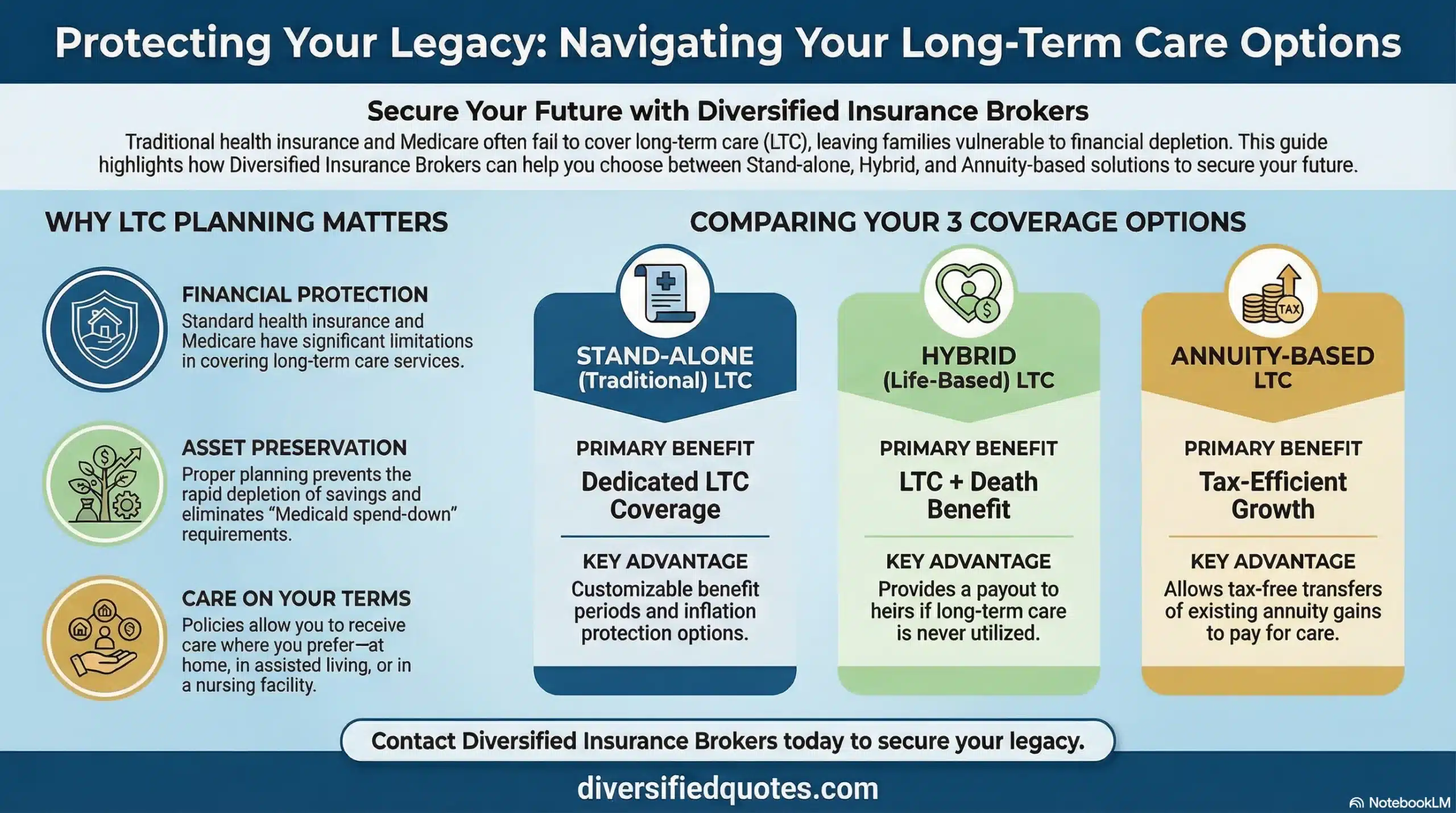
The design landscape for group long-term care has evolved significantly in recent years. Traditional stand-alone group LTC policies — which paid a monthly benefit toward care costs and had no residual value if coverage was never used — have been joined by hybrid and linked-benefit structures that combine a permanent life insurance policy or annuity with an LTC or chronic illness benefit rider. These hybrid designs address the most common emotional barrier to LTC purchase: the concern about paying premiums for coverage that may never be used. In a hybrid design, the policy retains value whether or not care is needed — through the life insurance death benefit or annuity contract value that remains if long-term care benefits are never activated. Most group long-term care offered through employers today is built on some version of this hybrid architecture, because it simultaneously solves the access, value, and simplicity problems that have historically limited group LTC enrollment. Our resources on understanding hybrid long-term care insurance and how to qualify for long-term care insurance cover the product structure and underwriting framework in depth.
Request a Group Long-Term Care Consultation
We review your employee population, outline plan designs from leading carriers, and build a customized proposal for voluntary, employer-paid, or hybrid funding structures.
Group LTC Plan Designs — Three Structures Compared
Group long-term care programs are not one-size-fits-all. Three primary plan structures dominate the market for employer-sponsored LTC — each with different premium economics, benefit mechanics, residual value, and employee engagement characteristics. Understanding the distinctions helps employers select the design that best matches their workforce demographics, benefits philosophy, and budget.
| Dimension | Traditional Stand-Alone Group LTC | Hybrid / Linked-Benefit Group LTC (Life Insurance Chassis) | Individual LTC (for Comparison) |
|---|---|---|---|
| Product Structure | Stand-alone LTC insurance policy with no life insurance component; benefit exists solely for long-term care | Permanent life insurance policy with an LTC or chronic illness benefit rider; policy provides life insurance death benefit if LTC benefits are not used | Either traditional stand-alone LTC or hybrid structure; purchased outside the employer context through individual underwriting |
| Enrollment and Underwriting | Often guaranteed or simplified issue during initial enrollment window — major advantage for employees with health history that would restrict individual access | Simplified or guaranteed issue during group enrollment window; underwriting determines benefit level rather than binary accept/deny in some designs | Full medical underwriting — detailed health questionnaire, possible medical records review, pharmacy check; health conditions can result in rating, exclusions, or decline |
| Residual Value If Care Never Needed | None — premiums are paid for pure insurance protection; if care is never needed, no residual cash value or death benefit remains | Life insurance death benefit remains if LTC benefits are not used — the “use it or lose it” objection is largely resolved because the policy retains value through the life insurance component | Depends on structure — traditional individual LTC has no residual value; individual hybrid policies retain life insurance or annuity value if LTC is not needed |
| Premium Structure | Lower initial premium for equivalent LTC benefit; historically subject to rate increase risk as the insurance company adjusts pricing based on claims experience | Higher premium than traditional LTC alone; premiums typically guaranteed (not subject to increase) because the chassis is permanent life insurance with fixed cost of insurance components | Varies — traditional individual LTC premiums have historically been subject to rate increases; individual hybrid premiums generally fixed |
| Portability | Generally portable — employees can continue the policy by paying premiums directly after leaving the employer | Fully portable — permanent life insurance policy belongs to the insured; continues with the employee regardless of employment status | Fully portable by definition — individual policy is never employer-tied |
| Spouse and Family Eligibility | Varies by program — many group LTC programs allow spouses and eligible family members to enroll, sometimes on simplified underwriting basis | Varies by program — spouse participation at group enrollment terms can provide a planning advantage for household LTC risk | Individual policies are purchased per person; couple designs or shared care riders available but require separate applications and underwriting for each person |
| Best Planning Fit | Employers who want maximum LTC benefit per premium dollar for employees who value pure coverage without life insurance component; works best when employees understand “insurance without savings” trade-off | Employers who want higher enrollment rates by addressing the “use it or lose it” objection; works best for employees who benefit from the dual-purpose value of life insurance plus LTC in a single premium | Individuals who are healthy, proactive planners shopping for the most comprehensive or competitive individual LTC terms; the benchmark for comparison to group options |
Plan design features, underwriting availability, employer funding structures, and premium mechanics vary by carrier, program design, employer group size, and state. This table reflects general market patterns; specific program terms must be confirmed with the issuing carrier before any enrollment or implementation decision. Individual LTC column is included for comparison context only — individual policies require separate underwriting outside any group enrollment window.
Why Group Enrollment Creates Access That Individual Insurance Cannot
The most significant advantage of group long-term care coverage is not the premium or the benefit design — it is access. Long-term care insurance underwriting is among the most health-sensitive in the insurance market. Carriers evaluate not only current health conditions but also family history, medications, body mass index, cognitive function, and activities of daily living. Conditions that are common and well-controlled — type 2 diabetes, hypertension, arthritis, depression history, or certain cardiac conditions — can result in a rating (higher premium), exclusion rider (condition excluded from benefits), or outright decline in the individual market. As people age and accumulate medical history, the percentage of applicants who are declined increases significantly. Employees who delay individual LTC planning until their late 50s or 60s may find that the individual market is no longer accessible on standard terms for their specific health profile.
Group enrollment windows, particularly during initial offering periods, often provide guaranteed issue or simplified issue access that bypasses this barrier. A guaranteed issue enrollment means the carrier accepts all eligible employees within the defined eligibility class during the window without medical underwriting — no health questions, no medical records review, no pharmacy data check. A simplified issue enrollment asks limited health questions but avoids the full underwriting interrogation of individual policies. Either approach can create coverage access for employees who would face difficulty or denial in the individual market. This is especially meaningful for employees with family history of Alzheimer’s, Parkinson’s, or other neurological conditions that are weighted heavily in LTC underwriting even when the employee has no current diagnosis. It is also meaningful for employees in their 50s who have been deferring the conversation and now face more underwriting friction than they would have encountered at age 45. Our resource on long-term care insurance after age 80 covers the underwriting challenges that escalate with age, which provides important context for why group access during working years is a planning advantage worth communicating to employees explicitly.
Hybrid and Linked-Benefit LTC — The Architecture Behind Modern Group Plans
The architecture behind most modern group long-term care programs is the hybrid or linked-benefit policy — a permanent life insurance chassis with an embedded LTC or chronic illness benefit rider. Understanding this structure explains both the premium economics and the enrollment psychology of current group LTC designs. In a hybrid structure, the employee pays a premium into a permanent life insurance policy — whole life, universal life, or indexed universal life — that carries both a death benefit and an LTC or chronic illness acceleration rider. If the employee later meets the LTC benefit eligibility criteria (typically inability to perform two or more activities of daily living or a severe cognitive impairment), the LTC rider allows the policy to pay benefits toward care costs, typically as monthly cash benefits up to a defined maximum. These LTC payments reduce the remaining death benefit. If the employee never needs LTC, the full death benefit passes to named beneficiaries. If care is needed and the death benefit is fully consumed by LTC claims, some policy designs provide a continuation of LTC benefits beyond the death benefit base for a defined additional period.
This structure resolves the primary objection that kills traditional LTC enrollment: “What if I pay for years and never use it?” In a hybrid design, the answer is clear — if care is never needed, the life insurance death benefit provides value to the estate or beneficiaries. The premium is not “wasted” regardless of health trajectory. For employers, this feature meaningfully improves enrollment rates and employee satisfaction because the coverage is perceived as a multi-purpose financial tool rather than a pure insurance expense. Our resource on understanding hybrid long-term care insurance covers the specific design variants — life insurance with LTC acceleration, annuity-based linked-benefit products, and the key distinctions between an LTC rider and a chronic illness rider — that determine how benefits are calculated and paid during a claim. Our resource on permanent life insurance covers the underlying life insurance chassis mechanics that form the foundation of hybrid LTC designs.
Benefit Triggers — What Actually Activates Coverage
Employees often assume long-term care coverage is reserved for nursing home admission — and many decline to enroll because they expect to “never end up in a nursing home.” This assumption misunderstands how modern LTC benefits are triggered. The eligibility criteria for most LTC policies center on functional impairment rather than care setting, and the most common care setting for initial LTC is not a facility — it is the employee’s own home. The two standard benefit triggers are the inability to perform a defined number of Activities of Daily Living (ADLs) without substantial assistance, and severe cognitive impairment that requires supervision for health and safety regardless of physical functional status. Most policies require inability to perform two or more of the standard ADLs — bathing, dressing, toileting, transferring, eating, and continence — before benefits activate. Our resource on what are activities of daily living covers the ADL framework in detail.
The care setting implications of these triggers are important for employee education: once functional eligibility is established, the policy typically pays benefits whether care is received at home from a professional caregiver, at an adult day program, in an assisted living facility, in a memory care unit, or in a skilled nursing facility. The policy does not dictate the care setting — the family and care team do. This means the first years of LTC need — when a person needs help with some ADLs at home but does not yet need institutional care — are often covered by a well-designed group LTC policy. Our resource on what are in-home care services covers how home care typically functions as the first layer of a care plan and how LTC benefits interface with professional home care arrangements.
Cash Benefits — Why the Payment Structure Matters at Claim Time
Not all long-term care benefit structures perform equally when a claim occurs. Traditional reimbursement-model LTC policies pay benefits only after the insured submits documentation of qualified expenses — care invoices, billing records, and provider credentials must be reviewed and approved before the policy pays. During a claim, families are managing the care recipient’s needs, coordinating caregivers, and navigating the emotional weight of a family health crisis. Adding an administrative documentation process to that environment can create friction that makes the benefit harder to use when it is most needed. Many modern group LTC designs, particularly those built on hybrid and linked-benefit chassis, pay benefits as cash or indemnity — meaning the policy pays the defined monthly benefit amount once the insured qualifies, without requiring the submission and review of individual care bills. The family receives the cash and directs it toward the actual care arrangement, whether that is a professional home health aide paid privately, a contribution toward assisted living fees, supplemental support for a family caregiver, or coordination of layered care approaches that blend paid and unpaid support. This flexibility makes the benefit more useful in the real-world care patterns that most families experience — which rarely conform to the clean structure that reimbursement systems assume.
Tax Advantages for Employers and Employees
Group long-term care insurance can produce meaningful tax advantages for both the employer and the covered employees depending on the business structure and how premiums are funded. For employers, long-term care insurance premiums paid on behalf of employees are generally deductible as an ordinary business expense — similar to group health insurance premiums — and are not included in the employee’s taxable income when structured correctly. This means the employer’s cost of providing the benefit is reduced by the applicable tax rate, making the effective net cost of the benefit lower than the gross premium. For C-corporations specifically, employer-paid LTC premiums are typically fully deductible as a business expense and excluded from the employee’s gross income. S-corporation owners, partners in partnerships, and sole proprietors face slightly different treatment — generally, premiums paid for the owner may be deductible as an adjustment to gross income on the individual return, subject to the IRS age-based eligible LTC premium limits which are adjusted annually. Employees who pay their own LTC premiums through payroll deduction may also be able to include the qualified premium amount as a medical expense deduction, subject to the applicable income threshold, up to the IRS age-based limits. Benefits received under a tax-qualified LTC policy are generally tax-free when used for qualified long-term care services. Our resources on tax advantages of long-term care insurance and tax benefits of long-term care insurance cover the deductibility rules and how to structure group LTC for maximum tax efficiency. Consult a qualified tax advisor for treatment specific to your business entity and situation.
Employer Funding Structures — Voluntary, Employer-Paid, and Combination
Group long-term care can be structured in three primary employer funding models, and the right choice depends on benefits philosophy, budget, workforce demographics, and participation goals. A voluntary structure places the full premium cost on the employee, with the employer providing the group enrollment window, simplified underwriting access, and payroll deduction mechanics. The employer’s cost is primarily administrative — plan design, communication, enrollment support — rather than premium. Voluntary structures are the most common because they allow any employer to offer meaningful LTC access without a direct budget commitment, and many employees genuinely value the access and simplified enrollment enough to elect coverage. An employer-paid structure provides a core level of LTC benefit funded by the employer as part of the compensation package — typically a modest base benefit that all eligible employees receive without election — often with an employee buy-up option to increase coverage levels. This model signals the highest level of employer commitment to employee wellbeing and generates the strongest participation and retention impact. A combination or match structure provides partial employer contribution toward the premium — the employer pays a defined portion and the employee pays the balance through payroll deduction — occupying the middle ground between full employer funding and pure voluntary. For employers evaluating the business case for LTC benefits, each model can be analyzed against total cost, participation projections, tax treatment, and the anticipated impact on recruitment, retention, and productivity. Our resource on best independent long-term care insurance broker covers the broker evaluation process for employers seeking an independent comparison across carriers and funding structures.
The Caregiving and Productivity Connection
Group long-term care insurance addresses a workplace cost that rarely appears in benefits ROI calculations but is genuinely present: the productivity impact of employee caregiving. Approximately one in five working Americans is providing unpaid care for an adult family member — a spouse, parent, in-law, or other relative who needs help with daily activities or supervision. Employees who are caregiving while working frequently experience schedule disruption, reduced productivity, increased absenteeism, higher stress, and in some cases voluntary or involuntary reduction in work hours. When a key employee’s caregiving responsibility escalates into a crisis — a parent hospitalized, a spouse needing memory care placement, a family LTC cost that creates financial stress — the organizational disruption can be significant and difficult to anticipate. Group long-term care insurance does not eliminate the caregiving need, but it reduces the financial crisis component of that need for both the employee-caregiver and the care recipient. When a family has a defined plan and a funded benefit pool to draw on, decisions can be made from a position of planning rather than pure crisis. For organizations that are thinking about employee financial wellness in a complete way, LTC planning connects directly to retirement readiness and overall financial resilience. Our resources on pre-retirement planning checklist and how to protect your funds in retirement cover the broader financial protection framework that group LTC supports.
A Successful Group LTC Program Requires Education, Not Just Enrollment
The most common reason a well-designed group LTC program achieves low participation is insufficient benefits education. Long-term care is a topic most people defer because it does not feel urgent and because the subject matter involves aging, decline, and mortality — all topics people are motivated to avoid. An enrollment window without meaningful education before it typically produces low participation, because employees who have never thought about long-term care risk do not suddenly recognize the need during a two-week open enrollment period. Effective group LTC rollouts invest in communication before the enrollment window opens: workforce-specific education sessions, practical examples of what care costs look like and how benefits could address them, clear messaging about the enrollment window’s limited nature and why acting now is different from acting later in the individual market, and accessible one-on-one guidance for employees who have questions about their specific health history and eligibility. The organizations that achieve meaningful LTC participation treat the benefit education as a multi-step engagement, not a single announcement. When employees understand what LTC risk means for their family, what the coverage actually does, and why the group enrollment window is a rare planning opportunity, participation follows. Our resource on getting a second opinion on your long-term care insurance quote covers the evaluation process for employees already in the market and looking to benchmark existing coverage.
Talk With an Advisor Today
Choose how you’d like to connect—call or message us, then book a time that works for you.
Schedule here:
calendly.com/jason-dibcompanies/diversified-quotes
Licensed in all 50 states • Fiduciary, family-owned since 1980
FAQs: Group Long Term Care Insurance
Group long term care insurance is employer-sponsored coverage that helps employees pay for home care, assisted living, memory care, or skilled nursing facility costs if they develop the inability to perform daily living activities or a qualifying cognitive impairment. Unlike individual long term care policies purchased independently, group coverage is offered through the workplace as part of the benefits package — typically with simplified or guaranteed underwriting during initial enrollment windows, payroll deduction for premium payment, and the ability to extend coverage to spouses and eligible family members. Most modern group long term care designs are built on a permanent life insurance chassis with a long term care or chronic illness benefit, creating a linked-benefit structure that provides value whether or not long term care is ever needed — the life insurance benefit passes to beneficiaries if care is never required, while the care benefit activates if qualifying needs develop.
Benefits under a group long term care policy are typically triggered when one of two eligibility criteria is met. The first is functional limitation: the insured cannot perform a defined number of activities of daily living — typically two or more of the six standard ADLs (bathing, dressing, toileting, transferring, eating, and continence) — without substantial assistance from another person. The second is cognitive impairment: a severe decline in cognitive function, most commonly associated with Alzheimer’s disease or other dementias, that requires substantial supervision to protect the insured’s safety. Once either eligibility criterion is confirmed through the carrier’s assessment process, the policy begins paying benefits that can be applied to care costs in whatever setting is appropriate — in the home, in an assisted living community, in a memory care facility, or in a skilled nursing setting. Eligibility is about the individual’s functional or cognitive status, not about the care setting, which is why modern long term care coverage addresses home-based care as centrally as it addresses facility-based care.
During the initial enrollment window that accompanies a group long term care program launch, many designs offer guaranteed issue or significantly simplified underwriting that allows employees to enroll without the full medical underwriting process — no medical exams, no bloodwork, no attending physician statements, and no extensive health history questionnaires. This simplified access is one of the primary advantages of the group environment, because individual long term care insurance is an underwriting-intensive product that can be significantly more difficult to qualify for as employees age and health history accumulates. After the initial enrollment window closes, employees who did not enroll during the guaranteed or simplified period may face standard individual underwriting requirements when they want to enroll later, which may be more restrictive and more expensive. The initial enrollment window represents the most favorable access opportunity for most employees, which is why benefits communication should strongly encourage enrollment at the time of initial offering rather than deferring the decision.
Yes — many group long term care programs extend enrollment eligibility to spouses and, in some designs, to other eligible family members such as parents or parents-in-law. Spousal enrollment is particularly valuable because long term care is fundamentally a two-spouse risk: even if only one spouse develops significant care needs, the financial impact affects the entire household — typically including the ability of the healthy spouse to maintain their own retirement security without depleting shared assets on care costs. When spouses can enroll during the same group enrollment window, they often have access to simplified underwriting that reflects the group environment rather than full individual underwriting standards, making this an opportunity for the whole household to address a shared risk at more favorable terms than individual market applications might produce. Employers who communicate the spousal enrollment opportunity effectively typically see stronger overall participation because employees understand they are protecting their household rather than only their own future care needs.
Most modern group long term care programs pay benefits as a monthly cash or indemnity payment rather than as a reimbursement for documented care expenses. Once the insured meets the eligibility criteria and the benefit period begins, the policy pays a defined monthly amount that the insured and their family can apply to care costs in whatever combination and setting is most appropriate — professional home caregivers, adult day programs, assisted living fees, memory care facility costs, or skilled nursing expenses. Cash benefit payment structures eliminate the documentation burden of tracking and submitting individual care expense receipts, which reduces administrative friction during what is typically an already stressful period for the family. The flexibility of cash benefits also accommodates the real-world pattern of long term care, where families often combine professional caregiving with family-provided support and need the financial resources to manage that combination fluidly rather than only paying for pre-approved professional care categories.
Yes — portability is a defining feature of well-designed group long term care programs and a key differentiator from group health insurance, which typically ends when employment ends. Although coverage is offered through the employer and premiums are paid through payroll deduction during employment, the policy is typically an individually owned contract in the insured’s name. When employment ends for any reason — job change, retirement, reduction in hours, or separation — the employee can generally continue the coverage by transitioning to direct billing and paying premiums personally, retaining the coverage that was secured at their enrollment age and health profile without needing to requalify medically. This portability is especially important because long term care needs typically arise long after an employee has left the sponsoring employer — the coverage that was put in place during employment needs to remain in force decades later for the benefit to serve its intended purpose. Employees who understand portability during enrollment are more likely to view the benefit as a personal long-term asset worth maintaining rather than something that ends with their current job.
Because most modern group long term care designs are built on a permanent life insurance chassis — specifically a whole life or universal life policy with a long term care or chronic illness benefit rider — many policies do accumulate cash value over time according to the policy’s growth mechanics. The cash value builds within the life insurance component of the policy and is subject to the specific terms of that policy’s growth design. If care is never needed during the insured’s lifetime, the life insurance benefit — which may be the original face amount or may be reduced depending on whether any long term care benefits were paid and how the policy’s benefit accounting works — generally passes to named beneficiaries income-tax free. The multi-use nature of these designs means that premiums paid are not “lost” if care is never needed: either the long term care benefit activates to cover care costs, or the life insurance benefit provides value to beneficiaries. This is one of the primary reasons linked-benefit designs are easier to communicate and easier for employees to value than traditional stand-alone long term care insurance, where premiums have no recovery mechanism if care is never needed.
Offering group long term care insurance creates several distinct employer advantages that extend beyond benefits package differentiation. From a talent strategy perspective, it addresses a financial risk that employees genuinely worry about but rarely take action on independently, creating a benefit that feels substantively valuable rather than duplicative of what employees could easily obtain on their own. From a workforce productivity perspective, it reduces the future crisis intensity of employee caregiving situations — employees who have a plan for their own potential care needs, and potentially for a spouse’s care needs, are better positioned to manage those situations without the compounded stress of financial unpreparedness. From a benefits equity perspective, it extends meaningful financial protection to employees at all compensation levels for a risk that is agnostic to income — a long term care need affects a moderate-income employee’s retirement security as severely as a high-income employee’s. And from a competitive differentiation standpoint, group long term care remains a relatively uncommon employer benefit, which means offering it creates genuine distinctiveness in competitive hiring environments.
Premiums for group long term care coverage are driven primarily by the employee’s age at enrollment, the benefit level selected, the plan features included, and the participation structure the employer establishes. Age at enrollment is the most significant pricing driver: employees who enroll earlier lock in lower premiums that reflect a younger age and typically a cleaner health profile, and those premiums are generally locked in for the life of the policy — they do not increase automatically with age the way they would if the employee waited and purchased coverage later. Group pricing is typically more favorable than comparable individual LTC policy pricing, particularly when enrollment participation is strong across the group. Employers have flexibility in how they structure the funding: fully voluntary plans where employees pay all premiums through payroll deduction, partially employer-subsidized plans where the employer covers a base benefit and employees can elect additional coverage, or fully employer-paid plans where the benefit is treated as a standard component of the compensation package. Payroll deduction is the most effective premium mechanism for sustained participation because it eliminates the administrative friction and payment discontinuity that cause individual insurance policies to lapse.
Long term care is one of the most financially disruptive risks to retirement security — not because it is universal, but because when it occurs it can erode decades of savings in a compressed period while simultaneously creating enormous practical and emotional stress for the household. A prolonged care need — whether for the employee, a spouse, or both — can accelerate retirement asset depletion, force the healthy spouse to make rushed financial decisions under pressure, interfere with planned legacy goals, and change the financial trajectory of the entire retirement in ways that cannot easily be corrected. Group long term care coverage gives employees a way to address this risk while they are still working, still insurable at reasonable terms, and still in a position to build a plan proactively rather than reactively. It also creates a defined financial resource — a pool of care benefit dollars — that reduces dependence on personal retirement savings to cover care costs, protecting the retirement assets that were intended for income, lifestyle, and legacy rather than for care financing. For employers who already invest in retirement plan education, group long term care is a natural complement that protects the outcomes those retirement plans are designed to produce.
About the Author:
Jason Stolz, CLTC, CRPC, DIA, CAA and Chief Underwriter at Diversified Insurance Brokers (NPN 20471358), is a senior insurance and retirement professional with more than 25 years of real-world experience helping individuals, families, and business owners protect their income, assets, and long-term financial stability. As a long-time partner of the nationally licensed independent agency Diversified Insurance Brokers, Jason provides trusted guidance across multiple specialties—including fixed and indexed annuities, long-term care planning, personal and business disability insurance, life insurance solutions, Group Health, Travel Medical and Evacuation Insurance, and short-term health coverage. Diversified Insurance Brokers maintains active contracts with over 100 highly rated insurance carriers, ensuring clients have access to a broad and competitive marketplace.
His practical, education-first approach has earned recognition in publications such as VoyageATL, and contributions from his agency featured in Kiplinger and GoBankingRates— highlighting his commitment to financial clarity and client-focused planning. Drawing on deep product knowledge and years of hands-on field experience, Jason helps clients evaluate carriers, compare strategies, and build retirement and protection plans that are both secure and cost-efficient. Visitors who want to explore current annuity rates and compare options across multiple insurers can also use this annuity quote and comparison tool.
Explore More Long Term Care Insurance Options: Browse our complete guide to How to Buy, Qualify & Coverage Details — covering how to buy, who qualifies, policy types, shared benefits, partnership plans & more from top carriers.
Last Reviewed: June 4, 2026 |
Reviewed by: Jason Stolz, CLTC, CRPC, DIA, CAA
Chief Underwriter, Diversified Insurance Brokers, Inc. | NPN: 20471358 | Diversified Insurance Brokers, Inc. — Licensed in all 50 states
Fact Checked by: Tonia Pettitt, CMIP©
Medicare Specialist, Diversified Insurance Brokers, Inc. | NPN: 14374308 | Diversified Insurance Brokers, Inc. — Licensed in all 50 states
Did you find this content helpful? Leave us a Google review — it helps others find trustworthy guidance too.
Editorial Standards: Diversified Insurance Brokers maintains rigorous editorial standards to ensure accuracy, clarity, and independence in all content. Learn more about our editorial standards and commitment to transparency.
