
What are In Home Care Services
What are In Home Care Services

Jason Stolz CLTC, CRPC, DIA, CAA
What are in-home care services? In-home care refers to a wide range of support services delivered directly in a person’s home to help them remain safe, independent, and comfortable as they age or manage health challenges. Rather than relocating to assisted living or a nursing facility, individuals receive help where they live — often allowing them to maintain routines, dignity, and familiarity for much longer than would be possible without support.
At Diversified Insurance Brokers, we speak with families every day who are trying to answer a difficult question: “How do we keep Mom or Dad at home safely without exhausting retirement savings?” In-home care is often the first step in the long-term care journey. Understanding what services exist, how care evolves over time, what qualifies as care under different policy types, and how it is typically paid for is critical to avoiding both financial strain and caregiver burnout. Most families do not face one big long-term care event. They face a series of changes that build gradually — one fall that reduces mobility, one medication mistake that creates risk, one episode of memory loss that changes supervision needs, or one hospitalization that makes daily tasks suddenly harder. In-home care is frequently the bridge that helps a person remain at home through these transitions, structured in layers so families do not have to jump straight from no help to full-time care overnight.
Planning for In-Home Care?
See how long-term care insurance can help pay for care at home — before care becomes urgent and options narrow.
What In-Home Care Services Typically Include
In-home care is not a single service. It is a spectrum of support that can be scaled up or down as needs change. Some individuals require only occasional help with errands and meals, while others eventually need hands-on assistance multiple times per day, supervision for cognitive decline, or a combination of caregiving and medical visits. The key advantage of in-home care is flexibility: families can build a plan that fits a person’s actual needs without forcing an immediate move to a residential facility.
Most in-home care begins as non-medical custodial support. This may include help with bathing, dressing, grooming, toileting, transferring, and mobility. It often also includes meal preparation, laundry, light housekeeping, and companionship. These services may sound simple, but they frequently determine whether a person can remain safe at home or becomes at risk for falls, malnutrition, isolation, or medication errors. As care needs increase, families often add layers. Medication reminders may evolve into full medication management support, supervision may become necessary for wandering risk, and caregivers may coordinate with adult children, physicians, and therapists. For some situations — especially after hospitalization — physician-ordered home health services such as skilled nursing or therapy may also be layered in, often on a short-term basis. One of the most important planning insights is that care needs tend to rise gradually until a trigger moment forces a major change. Families who start care earlier — before the trigger moment — usually have better outcomes, more control over scheduling, and less financial disruption.
Activities of Daily Living and Why They Matter for In-Home Care
Care decisions are often guided by a person’s ability to perform activities of daily living (ADLs). ADLs include bathing, dressing, toileting, transferring, continence, and eating. Difficulty with two or more ADLs is commonly used by long-term care insurance policies as a trigger for benefits, especially when the impairment is expected to last a defined period. Equally important are instrumental activities of daily living — IADLs — which include managing medications, preparing meals, shopping, handling finances, doing household chores, using transportation safely, and communicating with providers. Losing independence with IADLs is often the earliest signal that the independent living phase is shifting, even if a person can still bathe and dress on their own.
This distinction matters because families often wait until ADLs are clearly impaired before acting. In reality, the time to plan is usually when IADLs begin to slip — when the household still has more options, more schedule flexibility, and more ability to select the right caregivers without urgent pressure. From an insurance perspective, ADL impairment and cognitive impairment are the benefit triggers that determine when a policy begins paying. Understanding these definitions ahead of time helps families avoid confusion during a claim and helps them structure documentation in a way that supports benefits when they are needed. For a comprehensive overview of what qualifies for coverage, our resource on who qualifies for long-term care insurance explains the underwriting and benefit trigger criteria that apply at the time of application and at the time of claim.
Who Provides In-Home Care Services
In-home care can be delivered through different provider models, each with advantages, tradeoffs, and different levels of oversight. Choosing the right model depends on care intensity, how quickly the family needs help, and whether reliability or cost is the primary priority. Home care agencies typically supply non-medical caregivers and handle scheduling, background checks, payroll, supervision, and replacement staffing when someone calls out. Agency care often costs more per hour, but the tradeoff is reliability, accountability, and reduced administrative burden on the family — especially important when care needs become frequent and there is little room for missed shifts.
Home health agencies provide skilled medical services ordered by a physician, including nursing visits, physical therapy, occupational therapy, speech therapy, and wound care. Home health is generally medical and short-term in nature — it is not the same as long-term custodial support, but it can be an important bridge after hospital discharge. Private caregivers hired directly can reduce hourly costs, but families take on responsibilities such as screening, scheduling, payroll taxes, documentation, and backup staffing. Family caregiving is also a reality for many households, with adult children often providing transportation, medication oversight, appointment coordination, and weekend coverage. The challenge is that family caregiving can drift from support to a full second job without a structured plan — which is why defined hours, documented care needs, and a layered approach often reduce conflict and burnout over time.
The Real Cost of In-Home Care and the Medicare Gap
In-home care costs vary widely by region, hours of care, and the level of hands-on assistance required. One of the biggest misconceptions is that care will remain part-time forever. In many real-world cases, families begin with a few hours a week, then increase to daily support, then add evenings, and eventually find themselves paying for extended coverage to ensure safety. That progression can be financially manageable if planned, but disruptive if it arrives unexpectedly without a funding strategy in place. It is also important to understand the difference between medical home health and custodial home care. Medical home health services — such as skilled nursing visits after surgery — may be covered under health insurance rules in limited circumstances. Long-term custodial care, such as ongoing help with bathing and supervision, is generally not covered by traditional health insurance.
The Medicare question comes up constantly when families first encounter in-home care costs. Medicare coverage generally focuses on short-term medically necessary services, not ongoing assistance with daily living — our resource on whether Medicare covers long-term care explains this gap in detail. Similarly, our resource on whether Medicare and long-term care insurance are the same thing clarifies the distinct roles of each program — confusion between these two is one of the most common planning mistakes families make. Our resource on whether Medicare covers nursing home care provides parallel context for facility-based care, helping families understand the full spectrum of what government programs do and do not cover across care settings. When families understand the Medicare gap early, they stop treating in-home care as a temporary expense and start treating it as a planning category — which leads to better decisions around insurance design, retirement income strategy, and how to preserve assets for a spouse.
How Long-Term Care Insurance Supports Care at Home
Modern long-term care insurance is designed to support care in the setting most people prefer: their home. Once benefit triggers are met — typically ADL impairment or cognitive impairment — policies may reimburse for home health aides, personal care assistance, skilled nursing visits, adult day care, and care coordination depending on contract structure. How effectively a policy supports long-term in-home care is determined by several design variables: the benefit amount (expressed as a daily or monthly maximum), the elimination period or waiting period, whether the policy has inflation protection and how that inflation is calculated over time, and whether the benefit pool can be used across both home-based and facility-based settings as needs evolve.
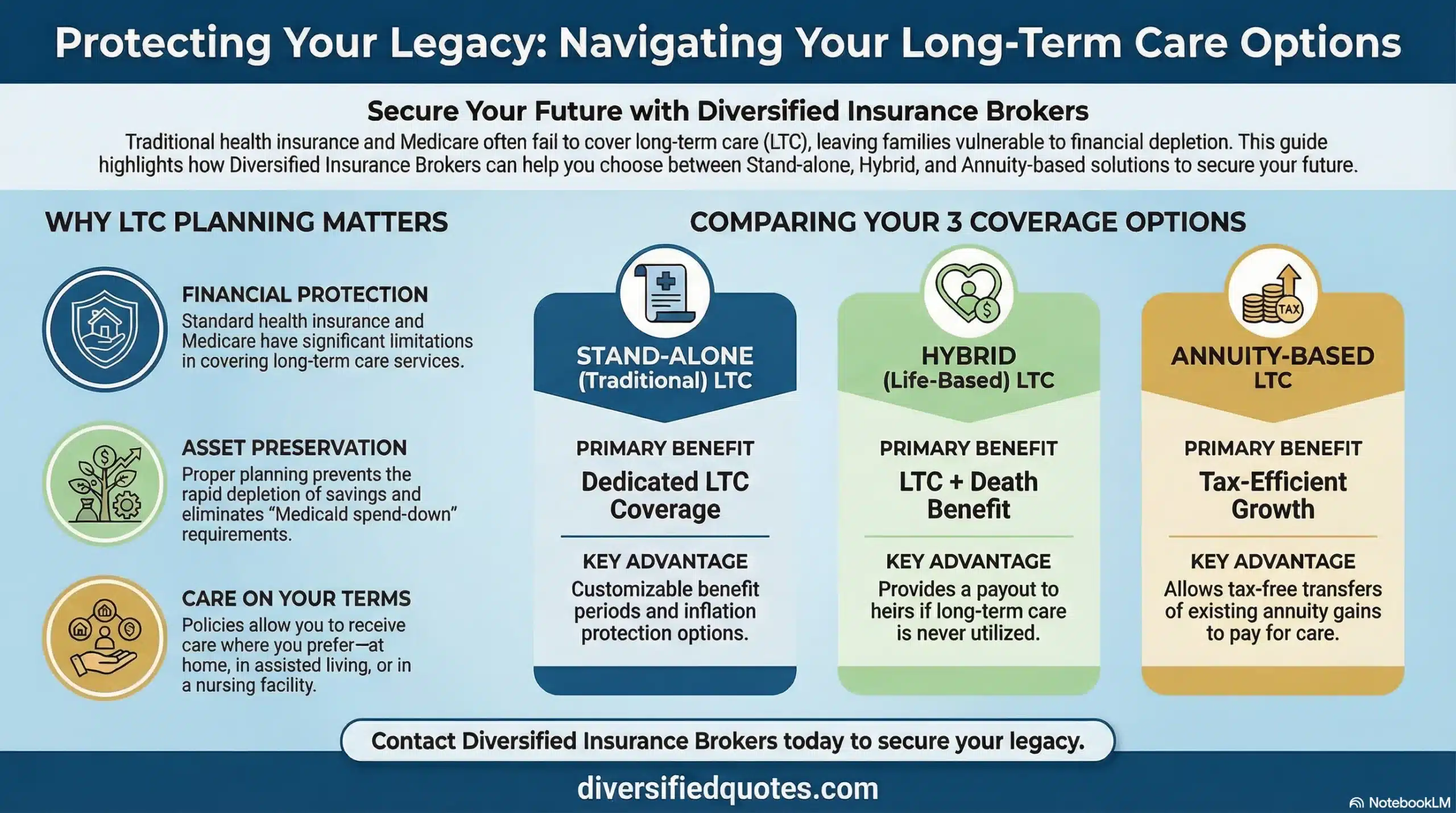
For couples, coordination features can also matter significantly. Some families use shared benefit designs so that if one spouse needs more care than expected, the other’s unused benefit pool can extend coverage. Others prefer return-of-premium structures for predictability and legacy planning. State partnership-qualified long-term care insurance designs are another important option that can provide additional Medicaid asset protection for policyholders who exhaust their benefits — creating meaningful planning advantages for households where asset preservation is a priority alongside care funding. For families who want to understand whether traditional LTC insurance or a hybrid life-LTC or annuity-LTC design is the better fit, our resource on annuities with long-term care benefits and our resource on fixed annuities with long-term care benefits cover how these hybrid structures work as planning alternatives.
Is Long-Term Care Insurance Worth the Cost for In-Home Care Planning?
One of the most common questions families ask when learning about in-home care costs is whether long-term care insurance is actually worth buying. The answer depends on the household’s assets, income structure, care risk tolerance, and health profile at the time of application. Our resource on whether long-term care insurance is worth the cost addresses this question directly and honestly — covering both the scenarios where traditional coverage delivers exceptional value and the scenarios where alternatives may be more appropriate. For households evaluating whether their assets are sufficient to self-fund care without insurance, our resource on self-insured long-term care covers the specific conditions under which self-funding is genuinely viable and the risks it carries. For those who are older or have health conditions that make traditional LTC underwriting difficult, our resources on guaranteed issue long-term care insurance and whether you can still get long-term care insurance after age 60 explain what options remain available and what coverage looks like when underwriting has become more restrictive.
For families who want to understand how much coverage to purchase rather than simply whether to purchase it, our resource on how much long-term care insurance is needed covers the key planning variables. For those evaluating whether a short-term care policy might provide a more accessible starting point for protection before a full LTC policy, our resource on short-term care insurance alternatives covers the role these products can play within a broader care funding strategy. And for households that specifically want coverage designed to never exhaust — policies structured to pay benefits for the entire duration of care regardless of how long it lasts — our resource on LTC insurance with lifetime benefits explains how these designs work and who they serve best.
Signs It May Be Time to Consider In-Home Care
Families often wait for a crisis before adding support. However, warning signs frequently appear well in advance. These may include missed medications, declining hygiene, frequent falls or near-falls, unexplained bruises, spoiled food in the refrigerator, unpaid bills, repeated scams or suspicious financial activity, driving concerns, or noticeable memory changes. Sometimes the signs are less obvious: a parent may stop attending social activities, avoid leaving the house, or begin isolating — behaviors that can accelerate cognitive decline and depression, which then increases physical risk. A parent may also mask challenges during short visits, meaning adult children only discover the full picture once a serious incident occurs.
Introducing support earlier almost always improves outcomes because the person receiving care has time to build trust with caregivers and adjust to routines gradually. It is far easier to accept care when it feels like assistance and safety rather than a forced reaction to a crisis. From a planning standpoint, earlier care also reduces the likelihood of urgent decisions that lead to higher costs and fewer options — the conditions that most often exhaust family resources and force choices that no one wanted to make.
How In-Home Care Typically Evolves Over Time
In-home care rarely stays static. Most families start with companionship and light support — meal prep, housekeeping, errands, and occasional transportation. As mobility changes, care shifts toward hands-on assistance with bathing, dressing, toileting, and transferring. At this point, caregiver scheduling becomes more important because missed coverage increases safety risk. If cognitive decline becomes a factor, supervision needs can rise quickly — wandering, confusion about appliances, medication errors, and unsafe driving become active concerns. Families sometimes add adult day programs for structure and social engagement during daytime hours and use home care for mornings, evenings, and weekends. Later, some individuals require overnight support or continuous coverage. This is often the point when families weigh the cost of extended in-home care against assisted living or skilled nursing.
The value of planning early is that families can make each step intentionally instead of being forced into the most expensive or least preferred option by a crisis timeline. Effective care planning looks beyond today’s needs and asks the hard questions most families avoid: How long could care be self-funded? Who coordinates caregivers and medical providers if needs escalate? What happens if a spouse or adult child can no longer provide informal support? What if care lasts longer than expected? How do you protect retirement income so the healthy spouse remains financially stable while the other receives care? Long-term care insurance is often used to answer these questions by creating a dedicated pool of funds for care at home and beyond — designed to preserve choice so the household is not forced to pick the lowest-cost care setting simply because assets are running out.
Want a Home-Care Focused LTC Plan?
We’ll compare traditional and hybrid LTC options and show how benefits can be designed specifically for care at home.
Request Your Long-Term Care ReviewRelated Long-Term Care Planning Pages
Talk With an Advisor Today
Choose how you’d like to connect—call or message us, then book a time that works for you.
Schedule here:
calendly.com/jason-dibcompanies/diversified-quotes
Licensed in all 50 states • Fiduciary, family-owned since 1980
What Are In-Home Care Services — Frequently Asked Questions
In-home care services provide support in your own home with daily activities like bathing, dressing, meals, mobility, medication reminders, and sometimes basic medical tasks. The goal is to help you or your loved one remain safe and independent without moving to a facility. In-home care is not a single service — it is a spectrum of support that can be structured, scaled, and adjusted as needs change over time. Most people begin with light assistance — help with meals, errands, and housekeeping — and gradually add more hands-on personal care as mobility or cognition changes. The defining advantage of in-home care is that it allows individuals to remain in a familiar environment, maintain established routines, and receive help that matches actual needs rather than being placed in a facility before facility-level care is truly necessary.
Home care and home health are often used interchangeably in conversation, but they refer to meaningfully different services with different payment sources and different provider types. Home care — sometimes called custodial or personal care — means non-medical help with daily activities: bathing, dressing, grooming, meal preparation, light housekeeping, medication reminders, and companionship. These services support independence and safety but do not require clinical training. Home health is medical or therapy-based care ordered by a physician: skilled nursing visits, wound care, physical therapy, occupational therapy, or speech therapy. Home health is typically short-term and provided after a hospitalization or a qualifying medical event. Home health may be covered by Medicare or insurance under specific conditions. Long-term custodial home care is generally not covered by Medicare and must be funded through long-term care insurance, personal savings, or other structured planning.
In-home care can be provided through several models, each with different levels of oversight, reliability, and cost. Licensed home care agencies supply caregivers and manage scheduling, background checks, payroll, supervision, and backup staffing when someone is unavailable. Agency care typically costs more per hour, but the reliability and reduced administrative burden on the family are often worth the difference — especially when care is daily or when missed coverage creates real safety risk. Home health agencies provide physician-ordered medical and therapy services for short-term clinical needs. Private caregivers hired directly by the family can reduce costs but require the family to manage screening, scheduling, payroll taxes, documentation, and backup arrangements. Family members often provide informal care alongside paid services — transportation, medication oversight, appointment coordination — but family caregiving without structure can quickly become unsustainable. A formal care plan with defined roles and documented needs helps prevent caregiver burnout regardless of which provider model is used.
Many long-term care insurance policies do pay for in-home care once you meet the benefit triggers specified in the contract. The most common benefit triggers are the inability to perform a defined number of activities of daily living — typically two or more — without substantial assistance, or a diagnosis of cognitive impairment that requires supervision for safety. Once triggered, covered services may include home health aides, personal care attendants, adult day care, care coordination, and sometimes homemaker services depending on the policy structure. The key design variables that determine how well a policy supports in-home care are the daily or monthly benefit maximum, the elimination period before benefits begin, and whether the policy has inflation protection. Modern policies are generally designed to be setting-flexible — meaning the benefit pool can be used for home care, adult day programs, assisted living, or skilled nursing as needs evolve rather than being restricted to a single care setting.
Medicare may cover short-term home health services that are medically necessary and ordered by a physician after a qualifying event — such as skilled nursing visits, physical therapy, or occupational therapy following a hospitalization. However, Medicare does not cover ongoing custodial care: help with bathing, dressing, meal preparation, housekeeping, or supervision for cognitive impairment. Long-term non-medical in-home care — which is what most people actually need as they age — is typically not a Medicare benefit. This gap is one of the most consequential planning surprises families face. Many families assume Medicare or supplemental insurance will cover in-home care costs, only to discover when care is actually needed that it will not. Understanding this gap early and building a specific funding strategy for custodial care is one of the most important steps in retirement planning for households that want to protect both care access and financial security.
The number of hours depends entirely on your care needs and your funding capacity — there is no fixed maximum imposed by the care model itself. Some individuals start with a few hours per week focused on errands, meal preparation, and companionship. Others progress to daily personal care visits of several hours, evening check-ins, or extended daily coverage. In advanced care situations, some households use near-continuous or live-in care. A professional care assessment — conducted by a care manager, agency, or geriatric specialist — can help determine an appropriate initial schedule based on current needs and risk factors. It is worth knowing in advance that care hours almost always increase over time, which means the initial schedule rarely reflects what the household will eventually need. Planning and funding strategies should account for this progression rather than being built around the lowest level of care currently needed.
Common warning signs that in-home care should be considered include missed or double-dosed medications, declining hygiene or personal care, unexplained weight loss, frequent falls or near-falls, unusual bruises or injuries, spoiled food in the refrigerator, unpaid or forgotten bills, responses to scams or suspicious financial activity, concerns about safe driving, and noticeable changes in memory or judgment. Sometimes the signs are subtler: withdrawal from social activities, increased isolation, or reluctance to leave the house. These behavioral changes can accelerate both cognitive decline and physical deterioration, making earlier intervention more important than it may initially appear. A parent or spouse may successfully mask challenges during short visits, meaning adult children often discover the true picture only after a serious incident forces a crisis response. Addressing these warning signs with targeted support — even a few hours of weekly help — is almost always easier, less expensive, and less disruptive than waiting for the crisis that finally makes the need undeniable.
In some situations, yes — through private arrangements, certain state-administered Medicaid waiver programs, or specific long-term care insurance policy designs that allow benefit payments to family caregivers. However, the rules vary widely across states, Medicaid programs, and individual insurance contracts. Not every long-term care insurance policy will pay family members who provide care — many policies require that caregivers be licensed professionals or agency employees. Some state programs allow adult children or spouses to be compensated for care under defined eligibility and training requirements. Before relying on this approach as part of a care plan, it is important to verify whether your specific policy or program allows it, what documentation and training requirements apply, and whether the arrangement will hold up under a formal benefit review. Assuming family caregiver payments are available without confirming the rules often creates financial and logistical problems precisely when care needs are highest.
When evaluating an in-home care agency, the most important factors are state licensing and regulatory compliance, caregiver background check and screening processes, caregiver training standards and continuing education requirements, how the agency handles scheduling and backup coverage when a caregiver is unavailable, their supervision and quality assurance process, and how they document care and communicate with family members. It is also important to ask how the agency develops and updates a care plan, how they handle changes in a client’s care needs over time, and what their process is when concerns about a caregiver arise. Asking for references from families with similar care needs can provide useful perspective. The lowest-cost agency is not always the best choice — reliability and communication quality are the factors that matter most when care is frequent and when the stakes of a missed shift or undocumented change are high.
Effective planning for future in-home care costs starts with a realistic estimate of what care could cost in your geographic area and how long you might need support across different levels of care intensity. From there, the planning conversation should evaluate which funding sources are available — long-term care insurance, hybrid life-LTC or annuity-LTC policies, earmarked savings, or some combination — and how those sources can be structured to cover the most financially exposed years of a potential care journey. A thoughtful plan should also address what happens if care lasts longer than expected, how a spouse’s financial security is protected while one partner receives care, and how the plan connects with the household’s retirement income and estate goals. At Diversified Insurance Brokers, our long-term care planning process helps families estimate future care costs, evaluate policy designs from multiple carriers, and coordinate care funding with overall retirement and asset protection strategy — so decisions are made proactively rather than reactively under the pressure of an active care situation.
About the Author:
Jason Stolz, CLTC, CRPC, DIA, CAA and Chief Underwriter at Diversified Insurance Brokers (NPN 20471358), is a senior insurance and retirement professional with more than 25 years of real-world experience helping individuals, families, and business owners protect their income, assets, and long-term financial stability. As a long-time partner of the nationally licensed independent agency Diversified Insurance Brokers, Jason provides trusted guidance across multiple specialties—including fixed and indexed annuities, long-term care planning, personal and business disability insurance, life insurance solutions, Group Health, Travel Medical and Evacuation Insurance, and short-term health coverage. Diversified Insurance Brokers maintains active contracts with over 100 highly rated insurance carriers, ensuring clients have access to a broad and competitive marketplace.
His practical, education-first approach has earned recognition in publications such as VoyageATL, and contributions from his agency featured in Kiplinger and GoBankingRates— highlighting his commitment to financial clarity and client-focused planning. Drawing on deep product knowledge and years of hands-on field experience, Jason helps clients evaluate carriers, compare strategies, and build retirement and protection plans that are both secure and cost-efficient. Visitors who want to explore current annuity rates and compare options across multiple insurers can also use this annuity quote and comparison tool.
Browse More Resources: Return to our complete Wealth Strategies & General Resources guide — covering wealth building, tax strategies, fiduciary, wills & broker resources.
Last Reviewed: June 19, 2026 |
Reviewed by: Jason Stolz, CLTC, CRPC, DIA, CAA
Chief Underwriter, Diversified Insurance Brokers, Inc. | NPN: 20471358 | Diversified Insurance Brokers, Inc. — Licensed in all 50 states
Fact Checked by: Tonia Pettitt, CMIP©
Medicare Specialist, Diversified Insurance Brokers, Inc. | NPN: 14374308 | Diversified Insurance Brokers, Inc. — Licensed in all 50 states
Did you find this content helpful? Leave us a Google review — it helps others find trustworthy guidance too.
Editorial Standards: Diversified Insurance Brokers maintains rigorous editorial standards to ensure accuracy, clarity, and independence in all content. Learn more about our editorial standards and commitment to transparency.
