
Who Qualifies for Long Term Care Insurance
As an Independent Long Term Care Insurance Broker, we compare traditional, hybrid, and partnership-qualified policies across dozens of carriers to find the structure that actually fits your situation.
Who Qualifies for Long Term Care Insurance

Jason Stolz CLTC, CRPC, DIA, CAA
Who qualifies for long-term care insurance? In most cases, people who are still living independently, managing their health reasonably well, and able to perform everyday tasks without assistance can qualify. Long-term care underwriting is different from life insurance underwriting because the carrier is not just evaluating mortality risk — they are evaluating the probability that you will need help with daily living activities, or supervision due to cognitive decline, in the years ahead. According to research published in the National Institutes of Health, approximately 30% of financially qualified applicants in the target age range of 50 to 71 are declined for medical reasons — which means applying at the right time and with the right carrier selection matters as much as any other factor in the process.
At Diversified Insurance Brokers, we help clients nationwide understand what long-term care insurers are actually evaluating, which medical and lifestyle factors matter most, and how to position an application to maximize approval odds and avoid unnecessary declines. The goal is not only to get approved — it is to get approved into a plan design that fits your budget and provides meaningful protection for the duration of care that matters most.
Check Your Long Term Care Insurance Eligibility
We’ll help you understand underwriting expectations and compare options from carriers that are most favorable to your health profile.
How Long-Term Care Underwriting Works
Long-term care insurance is designed to help pay for care when you can no longer safely manage certain daily living activities on your own, or when cognitive impairment creates a supervision need. Because of that, underwriting focuses heavily on independence rather than on any single diagnosis. A carrier wants to see that you are currently functioning well, that your medical conditions are stable, and that there are no strong indicators of near-term need for care. Denial rates increase significantly with age — roughly 12% of applicants aged 40 to 48 are declined, compared to approximately 47% of applicants aged 70 or older, according to industry data. This progression reflects the direct relationship between age, health complexity, and the probability of functional decline that underwriters are evaluating.
Most underwriting decisions are based on a combination of age, health history, current medications, build, recent physician visits, and mobility or balance indicators. Carriers also look for signs that you already need help at home, rely on a walker or wheelchair, have experienced frequent falls, or have a documented cognitive impairment. Even when a person feels fine subjectively, underwriting evaluates the risk of functional decline rather than just the diagnosis list. The process typically includes a health questionnaire, prescription database review, medical record checks as needed, and in many cases a telephone or in-person interview that may include a brief cognitive screen. The evaluation always returns to the same core question: are you currently independent and likely to remain so long enough for the coverage to make actuarial sense for the carrier?
Basic Eligibility Requirements Most Carriers Look For
Age matters but is not the whole story. Most applicants shop for long-term care coverage between ages 50 and 70, and some carriers will consider applicants into the mid-70s depending on health and plan type. The bigger issue is not whether you are “too old” but whether you are still healthy enough to qualify for a plan you can keep. Applying earlier typically expands carrier options, improves pricing, and reduces the probability that a health change between now and the application date has eliminated options. Older applicants can still qualify when overall health and daily function are strong — but the margin for health complexity is narrower.
Current independence is the foundation of approval. Long-term care insurers generally want applicants who can perform the six basic activities of daily living — bathing, dressing, eating, toileting, transferring, and continence — without hands-on assistance from another person. If you already need help with these tasks, underwriting becomes significantly more difficult because that pattern signals near-term claim risk. Mobility and balance are particularly important decision points. Carriers pay close attention to fall history, gait stability, and use of assistive devices. A person can have several manageable medical conditions and still qualify, but repeated falls or progressive mobility impairment can lead to a decline because those factors directly correlate with future care needs.
Medical stability matters more than a perfect history. Many people assume any diagnosis produces a decline — in reality, insurers often approve applicants with common conditions when those conditions are well-managed, consistent, and not creating functional limitations. The underwriting challenge typically comes from uncontrolled conditions, frequent complications, multiple recent hospitalizations, or conditions strongly associated with cognitive decline or loss of independence.
Common Medical Conditions and How They Typically Affect LTC Eligibility
Every carrier has its own underwriting guide, but predictable patterns exist in how long-term care underwriters view different medical histories. Instead of thinking in terms of “approved” or “declined,” it helps to think in terms of what the condition indicates about future independence — because that is how underwriters evaluate it.
High blood pressure and cholesterol are frequently viewed as manageable risks when well-controlled and supported by consistent follow-up care. Underwriters focus on complications. If blood pressure is controlled and there is no history of stroke, heart failure, or significant vascular disease, many applicants with these conditions still qualify without difficulty. Type 2 diabetes is often acceptable when controlled — particularly when A1C has been stable, there are no significant complications, and the person remains active and independent. Risk increases meaningfully when diabetes is poorly controlled, has led to neuropathy affecting balance, has caused kidney concerns, or is paired with significant cardiovascular disease.
Build and weight can influence outcomes primarily because severe obesity increases the probability of mobility impairment, sleep apnea complications, joint deterioration, and other issues that raise care risk. The key point is not the number alone — it is whether weight is contributing to functional limitations, shortness of breath with minimal exertion, or increased fall risk. Cancer history is often evaluated by recency, severity, and ongoing treatment needs. Many applicants qualify after being in remission for a meaningful period with stable follow-up, especially when there is no ongoing aggressive therapy and daily function is intact. Underwriters may be cautious with recent cancers, metastatic history, or treatment side effects that impact mobility or cognition.
Cognitive impairment and dementia diagnoses are among the most difficult categories for traditional long-term care underwriting. Even when there is no formal diagnosis, carriers may decline if the interview suggests significant memory impairment or if the medical record contains documented cognitive concerns. Applicants who already have a dementia diagnosis cannot purchase traditional long-term care insurance — this is not a carrier preference but a fundamental actuarial constraint, because cognitive decline is directly tied to long-duration care needs and supervision requirements that represent the highest-cost claims. Stroke and severe neurological concerns are evaluated based on residual deficits. If meaningful impairment exists — weakness, balance issues, speech difficulties, or functional limitations — approval becomes harder. If there was a remote event with full recovery and strong current function, options may still exist, but underwriting will generally be more cautious.
Quick Reference: How Conditions Are Typically Viewed in LTC Underwriting
The table below reflects common underwriting tendencies across the major long-term care carriers. It is not a guarantee of any specific outcome — every application is evaluated individually — but it illustrates how carriers generally think about independence risk for these common conditions.
| Condition | Typical Underwriting Outlook | What Underwriters Are Evaluating |
|---|---|---|
| High Blood Pressure / High Cholesterol | Often acceptable when well-managed | Complications matter more than the diagnosis — no stroke, heart failure, or significant vascular disease history improves outlook considerably |
| Type 2 Diabetes | Often acceptable when controlled; more cautious with complications | A1C stability, absence of neuropathy affecting balance, no significant kidney involvement, and intact daily function are the primary favorable signals |
| Obesity / Significant Build Concerns | Varies; more difficult when severe or tied to mobility limitations | Whether weight is creating functional limitations — shortness of breath with minimal exertion, fall risk, joint deterioration — matters more than the BMI number alone |
| Cancer History | Often possible when stable and sufficiently past treatment | Recency, stage, treatment completion, and functional status post-treatment; metastatic history or ongoing aggressive therapy significantly increases difficulty |
| Dementia / Alzheimer’s / Documented Cognitive Impairment | Typically declined for traditional LTC; automatic decline with formal diagnosis | Cognitive decline correlates directly with long-duration care needs and supervision requirements — even early indicators trigger additional screening and often result in a decline |
| Stroke / Severe Neurological Conditions | Often difficult depending on residual deficits and fall risk | Remote event with full recovery and strong current function may still qualify; meaningful residual weakness, balance issues, or speech impairment significantly reduces options |
| Fall History / Significant Mobility Impairment | One of the most significant standalone decline triggers | Repeated falls or progressive mobility impairment directly signals near-term care risk regardless of other diagnoses — this factor can override otherwise manageable medical conditions |
| Sleep Apnea | Often acceptable when documented as treated and compliant | Documented CPAP use and compliance are favorable; untreated sleep apnea with cognitive or cardiac complications is more difficult |
What Carriers Are Really Trying to Avoid
Long-term care insurers are primarily trying to avoid issuing coverage when there are strong near-term indicators of needing care. That often includes current assistance needs at home, frequent falls, significant balance impairment, advanced degenerative neurological conditions, or documented cognitive impairment. It can also include patterns that suggest progressive decline — repeated hospitalizations with slow recovery, increasing reliance on family support for daily tasks, or multiple conditions interacting in ways that collectively raise functional risk above what any single diagnosis would suggest.
This is why the same diagnosis can lead to different outcomes depending on functional status. Two people can both have arthritis, diabetes, and high blood pressure. One can still qualify easily while the other struggles because they have had multiple falls, cannot climb stairs, or need help dressing. Underwriting is not primarily diagnosis-based — it is independence-based. The carrier is asking whether you are living your daily life without significant assistance from others, and whether the evidence in your medical record supports that answer.
Not Sure If Your Health History Will Qualify?
We can help you identify which carriers tend to be more favorable for your situation and outline alternatives if traditional LTC is tight.
How to Improve Your Chances of Approval
Most people improve their approval odds by applying earlier than they originally planned. The reason is simple: underwriting is easier when you are healthier, and you typically have more carrier choices. Even small health changes that feel normal in your late 60s can dramatically reduce options compared to applying a few years sooner. Applying in your mid-50s rather than your early 70s can be the difference between multiple competitive carrier options and a very limited selection or a decline.
Accuracy matters throughout the process. Long-term care underwriting includes prescription database reviews and medical record checks when needed. Providing complete and consistent health information helps avoid delays, misunderstandings, or avoidable declines based on inconsistencies between the application and the medical record. If you are unsure how a condition will be viewed, it is often better to frame the history clearly and show stability rather than minimizing it and creating a mismatch that triggers a more intensive review later in the process.
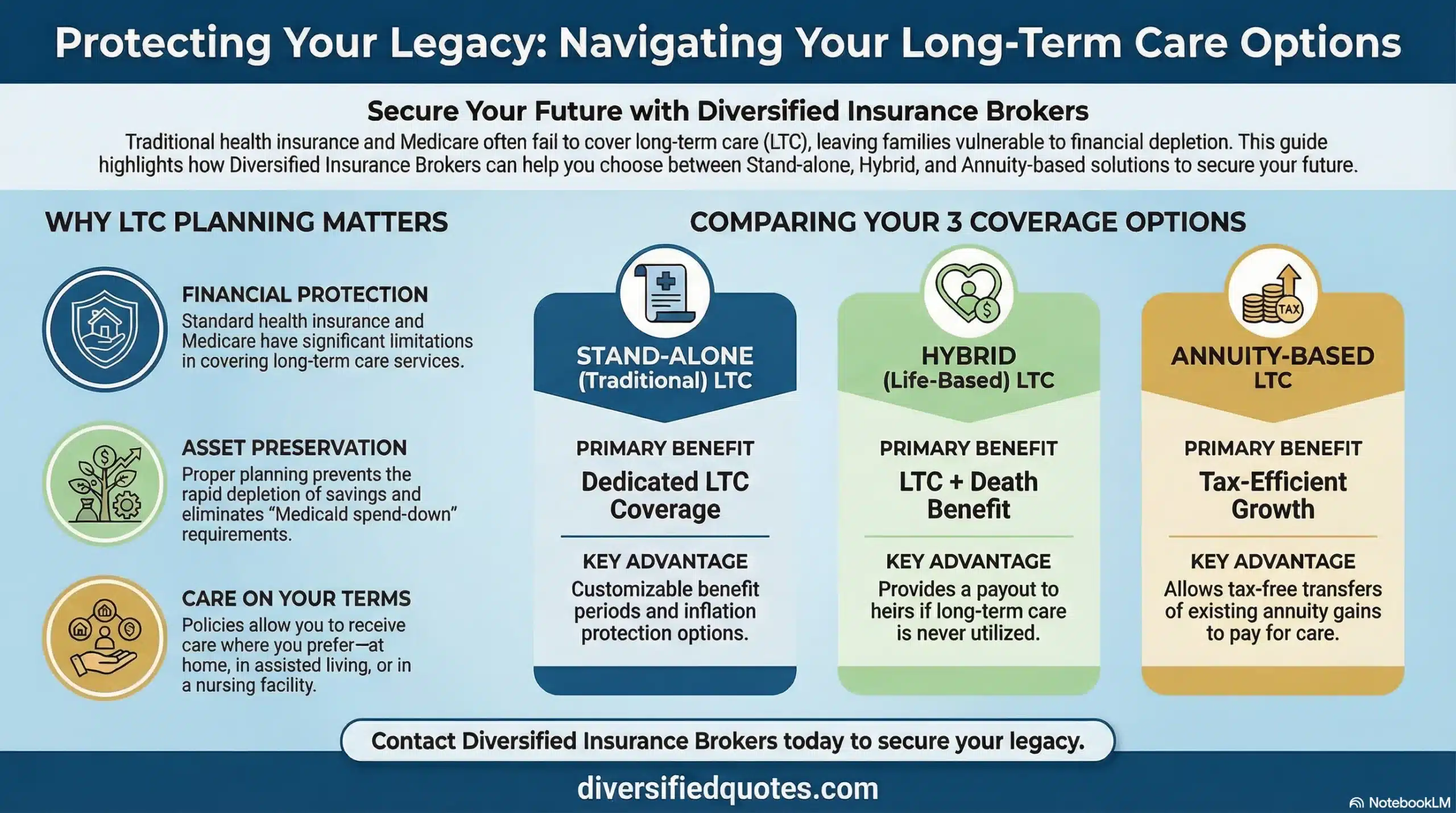
Plan type can also matter when traditional underwriting is tight. Traditional long-term care coverage is the most direct form of protection, but when underwriting is challenging, some families explore other plan designs. Hybrid life insurance with long-term care benefits can provide a “care or death benefit” structure with underwriting that may be more accessible in some health situations. Non-qualified long-term care annuities are often evaluated when the goal is asset repositioning with LTC protection rather than stand-alone insurance coverage. LTC insurance with lifetime benefits is commonly explored by families worried about extended-duration claims where a defined benefit period might run out.
Why Working With an Independent Broker Can Change Outcomes
Two applicants with similar health profiles can see very different underwriting outcomes depending on which carrier they apply to first and how the application is positioned. Carriers do not evaluate risk identically — small differences in underwriting philosophy can matter significantly for certain health conditions, particularly those that fall into gray areas rather than clear approvals or clear declines. This is why working with an independent agency reduces the chance of submitting to the wrong first carrier and ending up with an unnecessary decline on your record that subsequent carriers will see. A decline on your MIB (Medical Information Bureau) record from one carrier can complicate applications to others even when a different carrier would have viewed the same profile more favorably.
At Diversified Insurance Brokers, we help you compare plan designs and carrier fit, explain the tradeoffs between premium, benefit period, elimination periods, and inflation protection, and guide you through the process with clear expectations about what underwriting is likely to find. The goal is clarity and efficiency — so you can choose intentionally rather than guessing which carrier to approach and hoping the outcome is favorable. If you want to understand long-term care protection more broadly, start here: long-term care insurance. If you want to explore an alternative structure that some families evaluate when traditional underwriting is tight: fixed annuities with long-term care benefits.
Related Long-Term Care Planning Pages
Explore long-term care education, cost planning, and qualification guidance to help you make confident coverage decisions.
Related LTC Funding & Hybrid Strategy Pages
Compare hybrid, annuity-linked, and tax-efficient long-term care funding approaches used in retirement planning.
Talk With an Advisor Today
Choose how you’d like to connect—call or message us, then book a time that works for you.
Schedule here:
calendly.com/jason-dibcompanies/diversified-quotes
Licensed in all 50 states • Fiduciary, family-owned since 1980
FAQs: Who Qualifies for Long Term Care Insurance?
Who qualifies for long-term care insurance?
Most people who are living independently, managing their daily activities without hands-on assistance from another person, and do not have documented cognitive impairment can qualify for long-term care insurance. The six activities of daily living — bathing, dressing, eating, toileting, transferring, and continence — are the functional benchmark underwriters use. If you can perform these without substantial assistance, and your medical conditions are stable and not creating progressive functional limitations, you are generally in the range of approval. Age matters but is not the only factor — applicants in their 50s and early 60s typically have the most options and the strongest pricing, while applicants in their late 60s and early 70s can still qualify when overall health and daily function are strong. According to industry research, approximately 30% of financially qualified applicants aged 50 to 71 are declined for medical reasons, which means the underwriting process is real and preparation matters. Working with an independent broker who understands how different carriers evaluate specific health profiles improves the probability of applying to the right carrier on the first attempt.
What conditions automatically disqualify you from long-term care insurance?
A formal dementia or Alzheimer’s diagnosis is among the most consistent automatic disqualifiers for traditional long-term care insurance — carriers will not issue a policy once cognitive impairment is documented because the claim probability is immediate and the expected duration is long. Even without a formal diagnosis, carriers may decline if the application interview suggests significant memory issues or if the medical record contains documented cognitive concerns. Beyond cognitive conditions, other situations that typically produce declines include: currently needing hands-on assistance with two or more activities of daily living, a history of multiple recent falls or progressive mobility impairment, advanced Parkinson’s disease or ALS, recent stroke with significant residual deficits, active cancer treatment in most cases, oxygen dependence, and insulin-dependent diabetes with significant complications including neuropathy that affects balance. These are not arbitrary — each condition directly correlates with high near-term care probability, which is what long-term care underwriters are specifically trying to identify and screen. When traditional LTC is not available due to health history, hybrid alternatives such as hybrid life insurance with long-term care benefits or non-qualified long-term care annuities may still be accessible depending on the specific profile.
What is the best age to apply for long-term care insurance?
The ideal window for most applicants is between ages 55 and 65. Applying in this range typically provides the widest carrier selection, the most competitive premiums, and the strongest likelihood of qualifying without health complications that accumulate with age. Premiums are based on age at issue and do not increase based on aging alone after the policy is in force — which means every year you delay locking in coverage, you are accepting both a higher starting premium and the risk that a health change eliminates options entirely before you apply. Denial rates rise sharply with age: roughly 12% of applicants in their 40s are declined, while approximately 47% of applicants at age 70 or older are declined. Waiting until a health scare motivates action is one of the most common and costly mistakes in long-term care planning — by then, the options that would have been available five years earlier may no longer exist. For families who feel they waited too long for traditional LTC, exploring affordable hybrid long-term care policies or LTC insurance with lifetime benefits can identify what is still accessible based on current health.
Can I qualify for long-term care insurance if I have diabetes or a cancer history?
Yes — many applicants with controlled Type 2 diabetes or a past cancer history can qualify for traditional long-term care insurance, though the outcome depends on specifics that underwriters evaluate carefully. For Type 2 diabetes, the most favorable profile involves stable A1C levels, no significant complications such as neuropathy that affects balance or kidney involvement, and intact daily function without limitation. Poorly controlled diabetes, complications that affect mobility or cognition, or diabetes combined with significant cardiovascular disease makes the application more difficult. For cancer history, the most favorable profile involves a meaningful remission period after treatment completion, no current aggressive therapy, clear follow-up, and daily function that is fully intact. The specific cancer type, stage, and treatment matter — some cancer types are viewed more favorably than others after remission, while metastatic history or treatment side effects that affect mobility or cognition make traditional approval significantly more difficult. In both cases, working with an independent broker who understands which carriers evaluate these conditions most favorably — rather than applying to the first carrier that comes up in a search — can be the difference between an approval and a decline that complicates future applications.
About the Author:
Jason Stolz, CLTC, CRPC, DIA, CAA and Chief Underwriter at Diversified Insurance Brokers (NPN 20471358), is a senior insurance and retirement professional with more than 25 years of real-world experience helping individuals, families, and business owners protect their income, assets, and long-term financial stability. As a long-time partner of the nationally licensed independent agency Diversified Insurance Brokers, Jason provides trusted guidance across multiple specialties—including fixed and indexed annuities, long-term care planning, personal and business disability insurance, life insurance solutions, Group Health, Travel Medical and Evacuation Insurance, and short-term health coverage. Diversified Insurance Brokers maintains active contracts with over 100 highly rated insurance carriers, ensuring clients have access to a broad and competitive marketplace.
His practical, education-first approach has earned recognition in publications such as VoyageATL, and contributions from his agency featured in Kiplinger and GoBankingRates— highlighting his commitment to financial clarity and client-focused planning. Drawing on deep product knowledge and years of hands-on field experience, Jason helps clients evaluate carriers, compare strategies, and build retirement and protection plans that are both secure and cost-efficient. Visitors who want to explore current annuity rates and compare options across multiple insurers can also use this annuity quote and comparison tool.
Explore More Long Term Care Insurance Options: Browse our complete guide to How to Buy, Qualify & Coverage Details — covering how to buy, who qualifies, policy types, shared benefits, partnership plans & more from top carriers.
Last Reviewed: June 20, 2026 |
Reviewed by: Jason Stolz, CLTC, CRPC, DIA, CAA
Chief Underwriter, Diversified Insurance Brokers, Inc. | NPN: 20471358 | Diversified Insurance Brokers, Inc. — Licensed in all 50 states
Fact Checked by: Tonia Pettitt, CMIP©
Medicare Specialist, Diversified Insurance Brokers, Inc. | NPN: 14374308 | Diversified Insurance Brokers, Inc. — Licensed in all 50 states
Did you find this content helpful? Leave us a Google review — it helps others find trustworthy guidance too.
Editorial Standards: Diversified Insurance Brokers maintains rigorous editorial standards to ensure accuracy, clarity, and independence in all content. Learn more about our editorial standards and commitment to transparency.
