
Hybrid Long Term Care Insurance
As an Independent Long Term Care Insurance Broker, we compare traditional, hybrid, and partnership-qualified policies across dozens of carriers to find the structure that actually fits your situation.
Hybrid Long Term Care

Jason Stolz CLTC, CRPC, DIA, CAA
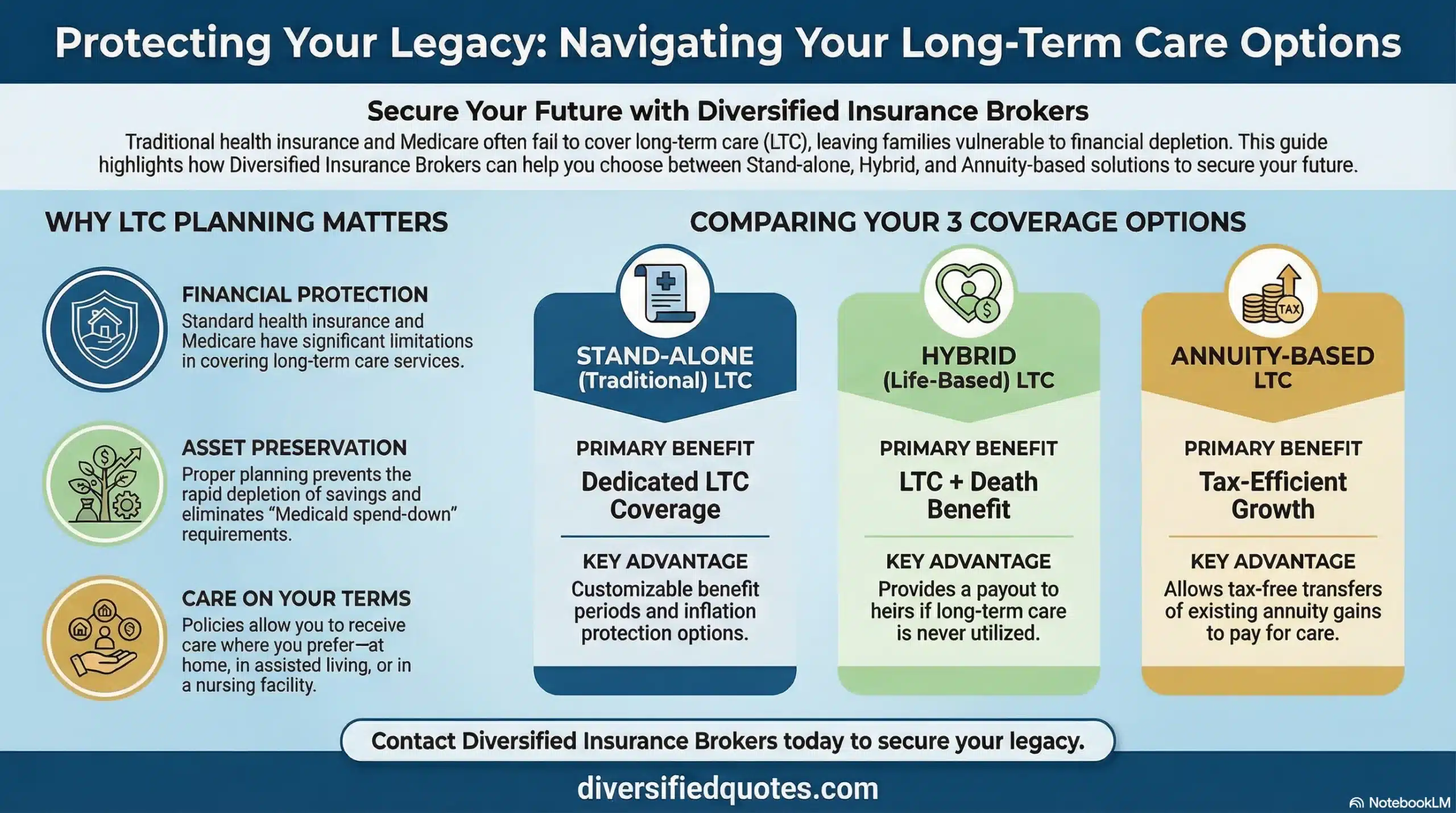
Hybrid long-term care insurance — also called asset-based or linked-benefit LTC — is a product category that combines long-term care coverage with a life insurance or annuity chassis, creating a dual-outcome structure: if qualifying care is eventually needed, the contract pays LTC benefits to cover care costs; if care is never needed and the insured passes away, a life insurance death benefit or annuity value goes to the named beneficiaries. This structure directly addresses the primary emotional objection most families have to standalone long-term care insurance — the “use it or lose it” concern. With a traditional standalone LTC policy, a policyholder who pays premiums for twenty years and never requires qualifying care receives nothing from the policy. With a hybrid design, the value is preserved in one form or another: as a care fund when needed, or as a legacy asset when care is not. That structural guarantee of preserved value — either as LTC benefits or as a death benefit — is the defining feature that has driven hybrid LTC to become the dominant form of long-term care planning in the current market. Our resource on hybrid life insurance with long-term care benefits covers the life insurance chassis version in detail, and our resource on annuity with long-term care benefits covers the annuity chassis version.
The hybrid LTC market centers on two product chassis that produce the same planning outcome — dual-purpose protection — through different structural approaches. Life-based hybrid LTC policies are structured as permanent life insurance (typically universal life or whole life) with long-term care acceleration built in. When the insured qualifies for LTC benefits, the policy accelerates a portion of its death benefit to pay for care, and in many designs extends benefits well beyond the original death benefit through an extension of benefits rider. If care is never needed, the full death benefit goes to the named beneficiaries. Annuity-based hybrid LTC policies hold the premium as an annuity that generates a separate pool of long-term care benefits. If care is never needed, the annuity value is available for surrender, annuitization, or as a death benefit. The practical differences between these two chassis — in how premiums are structured, how underwriting works, how benefits are calculated, and which planning assets most efficiently fund each — determine which design fits a specific household’s situation. Our resource on understanding hybrid long-term care insurance provides a thorough product-design deep dive, and our resource on hybrid life vs. traditional long-term care insurance covers the complete comparison between these two approaches to LTC planning.
Long-term care is one of the most significant financial risks in retirement and one of the least planned for. The U.S. CareScout survey reports national median nursing home costs at approximately $315 per day for a semi-private room and $355 per day for a private room — costs that accumulate rapidly during a multi-year care episode and can exhaust a retirement portfolio that was otherwise well-structured for a thirty-year retirement. Medicare provides very limited long-term custodial care coverage, and most families discover the gap only when care is already needed. Our resource on does Medicare cover long-term care covers exactly what Medicare does and does not pay for in extended care scenarios. A well-designed hybrid LTC plan addresses this exposure without creating the premium increase risk that has plagued traditional standalone LTC policies, without the “use it or lose it” structural concern, and with the flexibility to serve either a care-funding or a legacy role depending on what life ultimately requires. Our resource on long-term care planning strategies covers the full planning landscape from which hybrid LTC is drawn.
Get a Hybrid LTC Comparison
We compare life-based and annuity-based hybrid LTC designs across multiple carriers — showing pool size, monthly benefit, premium structure, and what each contract does if care is never needed.
Request a Personalized LTC ComparisonThree Approaches to Long-Term Care Funding — Compared
Most families approach long-term care planning by evaluating three options: hybrid LTC, traditional standalone LTC insurance, and self-funding. Each has a different cost structure, a different risk profile, and a different planning role. The table below maps all three across the dimensions that determine which approach fits a specific household’s goals.
| Feature | Hybrid LTC Insurance (Asset-Based) | Traditional Standalone LTC Insurance | Self-Funding (Self-Insurance) |
|---|---|---|---|
| Premium structure | Single premium or limited-pay (typically 10 or 20 years or pay-to-age-65); premiums generally guaranteed not to increase as long as scheduled payments are made | Ongoing monthly or annual premiums; NOT guaranteed — carriers have historically raised traditional LTC premiums significantly; buyer bears future rate increase risk | No premium — uses existing portfolio assets to pay care costs as they occur; full exposure to care cost inflation and market timing risk |
| “Use it or lose it” concern | Eliminated — if LTC benefits are never used or not fully used, the remaining death benefit (life chassis) or annuity value (annuity chassis) goes to beneficiaries; value is preserved either way | Yes — if care is never needed, premiums paid are not returned; the policy has no residual value; buyers who don’t claim get nothing for their premium payments | No concern — if care is never needed, the assets remain in the portfolio and can be spent or inherited normally |
| LTC benefit leverage | Strong — a $90,000 single premium can generate $463,000+ in LTC benefit pool in well-designed contracts; the leverage ratio depends on age, health, carrier, and design; extension of benefits riders amplify coverage beyond the base death benefit | Highest per premium dollar — traditional LTC provides the most LTC coverage per premium dollar for buyers who accept the premium increase risk and “use it or lose it” structure | None — no leverage; a self-insurer must have $400,000-$600,000 or more in liquid assets to absorb a major care event without materially affecting retirement income or spousal finances |
| Premium increase risk | Generally protected — most hybrid designs guarantee premiums will not increase; this is one of the primary advantages over traditional LTC for buyers who experienced or fear premium increases | Material risk — traditional LTC carriers have raised premiums 50-150%+ on many legacy blocks of business; future increases possible on any traditional policy even after purchase | Not applicable — no premium structure; but care costs do inflate and must be funded from a portfolio that also must generate retirement income |
| Health underwriting | Required — hybrid LTC policies require health underwriting; cannot be purchased without qualifying; older or less healthy applicants may be declined or rated; annuity-based chassis may have less stringent underwriting than life-based | Required — traditional LTC policies also require underwriting; generally similar standards to hybrid; guaranteed issue traditional LTC is very limited | Not applicable — no policy to purchase; but health conditions that make LTC expensive are precisely what make self-funding most risky |
| Liquidity and access to principal | Limited — single premium is repositioned into the policy and not fully liquid; most contracts include return of premium provisions, but surrender charges may apply; the policy trades liquidity for LTC leverage and premium guarantee | None — ongoing premiums are a cost with no cash value; the premium budget is spent on coverage, not repositioned | Full — assets remain in the portfolio; complete liquidity but also complete exposure to care cost without the benefit leverage that insurance provides |
| Best fit | Households with a lump sum available to reposition; buyers concerned about premium increases; those who want LTC protection without the “use it or lose it” structure; couples seeking shared benefit pooling; IRA or qualified fund repositioning strategies | Buyers on a smaller premium budget who accept future rate change risk; those who want maximum LTC coverage per dollar of annual outlay; households where a large lump sum is not available but monthly budget for premium exists | Households with very substantial liquid assets ($1M+) and the discipline to preserve them specifically for care costs; those who accept the full financial risk of a major care event without insurance leverage |
LTC costs, insurance premiums, and product designs vary by state, age, health, and carrier. The comparison above reflects general market patterns as of current analysis. Specific hybrid LTC contract terms, benefit amounts, and premium structures require carrier-specific illustrations. Traditional LTC premium increase history does not guarantee future increases; all policy terms are subject to state insurance regulation. Consult a licensed LTC specialist before any coverage decision.
Life-Based Hybrid LTC — The Universal Life and Whole Life Chassis
Life-based hybrid LTC policies are the dominant form in the current market, structured as permanent life insurance — universal life or whole life — with long-term care acceleration built into the contract. The fundamental design is straightforward: the policy has a death benefit that serves as the base pool of LTC coverage. When the insured meets the qualifying trigger — inability to perform at least two of the six Activities of Daily Living (ADLs) or a qualifying cognitive impairment — the policy begins accelerating the death benefit to pay for care. In most life-based designs, an extension of benefits rider dramatically amplifies the total available coverage beyond the base death benefit. A policy with a $200,000 death benefit might provide $600,000 or more in total LTC benefit pool when the extension rider is included. Our resource on what are activities of daily living covers the six ADLs and how the qualifying trigger is evaluated. The leading life-based hybrid products include Lincoln MoneyGuard III, Nationwide CareMatters II, Brighthouse SmartCare, Pacific Life Premier Care, and OneAmerica Asset-Care. Each carrier designs its product with different emphasis: Lincoln MoneyGuard III is recognized for overall flexibility and strong LTC leverage; Nationwide CareMatters II is known for the highest care coverage ratio and its cash indemnity option; Brighthouse SmartCare features automatic benefit increases; OneAmerica Asset-Care has the longest track record of any hybrid product in the market and is available on both life and annuity chassis. Our resource on affordable hybrid long-term care policies covers cost-effective design options across carriers.
Annuity-Based Hybrid LTC — Repositioning Existing Assets
Annuity-based hybrid LTC products hold the premium within an annuity contract that generates a separate pool of LTC benefits. The annuity accumulates on a tax-deferred basis, and the LTC benefit layer provides a multiplied benefit pool when care is needed. If care is never needed, the annuity value is available for surrender, annuitization for lifetime income, or payment as a death benefit. The primary planning use case for annuity-based hybrids is asset repositioning — a household that already holds a non-qualified annuity, a CD, or other liquid savings that are not needed for current income can reposition those assets into an annuity-based hybrid LTC product through a 1035 exchange (for existing non-qualified annuities) or a direct contribution. This approach converts an existing asset that was not earning meaningful LTC protection into a multi-purpose planning tool. Our resource on fixed annuity with long-term care benefits covers the fixed-interest annuity version, and our resource on non-qualified long-term care annuity covers the specific structure for non-qualified asset repositioning. Our resource on can you use qualified funds for long-term care insurance covers the more complex case of repositioning IRA or 401k dollars — which is possible but involves taxable distributions and requires a specific three-contract strategy to manage the tax impact.
Design Choices That Determine Coverage Quality
Two hybrid LTC policies with similar premium amounts can produce dramatically different benefit structures depending on how they are designed. Three variables drive the most meaningful differences. The first is the monthly benefit amount — the maximum the policy can pay per month for care. This must be matched to realistic care costs in the buyer’s geographic area. A $4,000 monthly benefit may be adequate in a lower-cost market; the same benefit may cover only a fraction of care costs in a high-cost urban area. The 2026 IRS per diem limit for tax-free indemnity LTC benefits is $430 per day — meaning indemnity-style hybrid policies can pay up to approximately $13,000 per month free of income tax regardless of actual care costs incurred. The second variable is the benefit period — the maximum number of months or years the monthly benefit can be paid. A two-year benefit period and a six-year benefit period at the same monthly maximum produce dramatically different total benefit pools. Extension of benefits riders allow life-based hybrids to provide benefit periods beyond the base death benefit alone. The third variable is inflation protection — whether the benefit amounts increase over time to track care cost inflation. Some hybrid policies include automatic benefit increases; others offer them as optional riders; others provide none. Our resources on long-term care insurance for couples and our resource on single-pay long-term care insurance cover the specific design considerations for the two most common buyer profiles.
Tax Advantages — The 7702B, Pension Protection Act, and 2026 Updates
Hybrid LTC products that are structured as qualified long-term care insurance under IRC Section 7702B provide tax-advantaged benefits on both sides: LTC benefits received are generally income-tax free under the qualified LTC contract rules, and in many structures the benefits themselves are not subject to income tax even when the policy was funded with pre-tax dollars. The 2006 Pension Protection Act specifically authorized 1035 exchanges from existing non-qualified annuities and life insurance policies directly into hybrid LTC products on a tax-free basis — making asset repositioning from existing non-LTC products into hybrid LTC a genuinely tax-efficient transaction. The 2026 IRS per diem limit of $430 per day for indemnity-style benefits is the current ceiling for tax-free receipt of benefits under an indemnity-structured contract. In 2026, SECURE 2.0 also introduced a new provision allowing penalty-free distributions of up to $2,600 from employer retirement plans specifically to pay qualified LTC insurance premiums — though IRS guidance confirming whether IRAs are covered remains pending. Our resources on tax advantages of LTC insurance and hybrid policies, are long-term care benefits taxable, and tax-free long-term care insurance cover the tax treatment in detail. Our resource on partnership qualified long-term care insurance covers the Medicaid asset protection benefit available in LTC Partnership states that qualifies on top of the federal tax treatment.
Who Is the Right Candidate for Hybrid LTC?
Hybrid long-term care insurance is most compelling for households that meet several converging conditions. Available lump sum or repositionable assets — whether savings, a maturing CD, a non-qualified annuity, or IRA dollars managed through the appropriate distribution strategy — are the starting point, because most hybrid designs require a meaningful single or limited-pay premium rather than an indefinite ongoing payment. Good enough health to qualify for underwriting is the second requirement — hybrid policies require health qualification, and the underwriting window closes as health conditions develop. Age 50-70 represents the most efficient underwriting window; buyers who wait until their late 70s or face serious health conditions may find that the annuity chassis offers a more accessible underwriting path than the life chassis. The “use it or lose it” objection is the emotional trigger that most commonly moves buyers from consideration to action — a buyer who genuinely dislikes the idea that decades of traditional LTC premiums could produce nothing if care never happens is the natural hybrid LTC buyer. Our resource on is long-term care insurance worth it covers the broader planning decision, our resource on self-insured long-term care covers the self-funding alternative for high-net-worth households evaluating whether to insure, and our resources on how much long-term care insurance costs, long-term care insurance services, long-term care insurance calculator, and get a 2nd opinion on your LTC quote cover the evaluation and comparison process. Our resource on affordable long-term care insurance for retirees covers budget-focused options for buyers who want hybrid coverage at the most efficient premium point.
Talk With an Advisor Today
Choose how you’d like to connect—call or message us, then book a time that works for you.
Schedule here:
calendly.com/jason-dibcompanies/diversified-quotes
Licensed in all 50 states • Fiduciary, family-owned since 1980
FAQs: Hybrid Long Term Care Insurance
What is hybrid long term care insurance?
Hybrid long term care insurance — also called asset-based or linked-benefit LTC — is a policy that combines a pool of long-term care benefits with a second form of financial value, either a life insurance death benefit or an annuity contract value. The defining structural advantage is that the policy has meaningful value regardless of whether care is ever needed. If the insured qualifies for LTC benefits and care is needed, the policy pays covered care expenses up to the monthly maximum and total benefit pool. If the insured never needs care, the residual value — death benefit or annuity contract value — passes to named beneficiaries or remains accessible within the contract.
This “either/or” value structure eliminates the “use it or lose it” objection that causes many people to hesitate on traditional standalone LTC insurance. It also typically provides greater premium predictability than traditional LTC, since most hybrid designs use fixed or limited-pay premium structures where future rate increases are not a feature of the product. Our resource on understanding hybrid long-term care insurance provides a comprehensive overview of how these policies are structured across the current marketplace.
How are hybrid LTC premiums structured?
Common funding structures include single premium (one lump-sum payment at purchase that immediately funds the full benefit pool), limited-pay periods of 5, 10, or 20 years where defined annual or monthly payments build the policy value over the payment period, and in some designs ongoing annual premiums similar to traditional LTC insurance. The most common approach for clients repositioning existing assets is single-premium funding — a CD, savings account, or existing non-qualified annuity is transferred or deposited into the hybrid at once, creating the full benefit pool immediately.
Many hybrid designs lock in both premiums and benefits at the time of purchase — the monthly benefit maximum, total benefit pool, and death benefit or residual contract value are guaranteed at issue and do not change based on future carrier rate actions. This is a meaningful structural advantage over traditional standalone LTC insurance, where some carriers have filed for significant rate increases on in-force policies. The rate certainty of hybrid designs is one of the primary reasons they have grown in market share among retirement-age buyers who want predictability in their financial plan.
Can I add inflation protection to a hybrid LTC policy?
Yes — most hybrid LTC carriers offer inflation protection options including 3% compound annual inflation, simple inflation at various rates, and in some designs indexed inflation riders. The availability and cost of inflation protection varies by carrier, product type, and the buyer’s age at purchase. For younger buyers — those in their 50s or early 60s who may be 15 to 25 years from their most likely care window — inflation protection is generally worth the additional cost because it preserves the real purchasing power of the benefit pool over the long horizon between purchase and claim.
For older buyers who are closer to potential care need and whose benefit is being sized relative to current care costs in their geographic market, the inflation protection calculus is different — a higher starting benefit with more modest or no inflation protection may produce better near-term value than a lower starting benefit with compound inflation. The right inflation approach is a design decision that should be modeled at realistic care cost inflation assumptions for the specific buyer’s timeline and geography, rather than defaulting to the most common option.
What if I never need long-term care?
With a life-based hybrid LTC policy, if care is never needed, the life insurance death benefit passes to named beneficiaries income-tax-free — typically equaling or approximating the original premium paid. This is the “either/or” value preservation feature that most fundamentally distinguishes hybrid designs from traditional standalone LTC insurance. The money is not “wasted” if care never occurs — it converts into a legacy benefit.
With an annuity-based hybrid LTC policy, if care is never needed, the annuity contract value — which has accumulated at the credited interest rate since purchase — passes to named beneficiaries or can be withdrawn by the contract holder subject to the annuity’s contract terms. In many annuity-based hybrid designs, the contract value at death represents the original deposit plus accumulated credited interest, potentially with some adjustment based on the contract’s LTC benefit election. Either way, the assets have not been “lost” to insurance premiums with no return — they have continued to hold and grow in value while providing LTC coverage as a benefit of the policy structure.
How do couples use shared benefits in hybrid LTC designs?
Some carriers offer hybrid LTC designs specifically structured for couples that allow one spouse to access unused benefits from the other’s policy if their care needs exceed their individual policy’s coverage. These shared designs are valuable because long-term care risk is not evenly distributed between spouses — one may need years of intensive care while the other remains healthy, and a shared benefit structure allows the household’s total benefit pool to be allocated where it is most needed rather than being constrained by individual policy limits.
In some designs, a couple’s shared benefit works through linked individual policies where each has their own death benefit and their own LTC pool, but rider provisions allow one spouse to draw from the other’s unused pool after exhausting their own. In other designs, a single joint policy creates one shared benefit pool that either spouse can access. The shared design typically costs more than a single individual policy but may be more economical than two separate maximum-benefit individual policies. Our resources on LTC insurance with shared benefits and LTC insurance for couples explain the shared benefit structures available across carriers.
What is the tax treatment of hybrid LTC benefits?
Hybrid LTC benefits paid for qualified long-term care services are generally income-tax-free when the policy qualifies as a tax-qualified LTC contract under IRC Section 7702B or when benefits are paid as accelerated death benefits for chronic illness under IRC Section 101(g). The specific provision that applies depends on how the hybrid policy is legally structured — life-based hybrids may use either Section 7702B extension-of-benefits riders or Section 101(g) chronic illness acceleration provisions, and annuity-based hybrids typically use Section 7702B qualified LTC structures.
For clients funding hybrid LTC with non-qualified annuity assets that carry significant built-in gains, the Pension Protection Act of 2006 created an important additional tax benefit: a properly structured 1035 exchange from a non-qualified annuity with accumulated gains into a qualifying LTC annuity converts those gains — which would otherwise be taxable as ordinary income when withdrawn — into LTC benefits received income-tax-free. This PPA provision permanently eliminates the deferred tax liability on annuity gains rather than merely deferring it further, making it one of the most tax-efficient strategies available for clients who own gain-laden non-qualified annuities and have unaddressed LTC exposure. Our resource on whether LTC benefits are taxable explains the full tax framework for hybrid and traditional LTC benefits.
How does hybrid LTC differ from traditional standalone LTC insurance?
The most important difference is value structure. Traditional standalone LTC insurance is pure care coverage — premiums fund exclusively the care risk, producing maximum care leverage per premium dollar but providing no residual value if care is never needed. Hybrid LTC pairs care coverage with a life insurance or annuity component that retains value regardless of care outcome — providing the “either/or” value preservation that eliminates the “use it or lose it” concern but typically at a higher cost per care-dollar than traditional LTC.
The second important difference is premium structure. Traditional LTC is typically an ongoing annual premium that can be subject to future rate increases if the carrier files for state approval. Most hybrid designs use fixed or limited-pay structures that lock in the premium obligation at purchase, providing rate certainty that traditional LTC cannot guarantee. The third difference is underwriting access — some annuity-based hybrid designs offer more flexible underwriting than traditional LTC or life-based hybrids, making hybrid LTC the only viable coverage option for some applicants with health complexity. Our resource on hybrid life vs. traditional long term care insurance provides a detailed comparison of the value tradeoffs across both structures.
Browse Hybrid & Annuity LTC Policies
About the Author:
Jason Stolz, CLTC, CRPC, DIA, CAA and Chief Underwriter at Diversified Insurance Brokers (NPN 20471358), is a senior insurance and retirement professional with more than 25 years of real-world experience helping individuals, families, and business owners protect their income, assets, and long-term financial stability. As a long-time partner of the nationally licensed independent agency Diversified Insurance Brokers, Jason provides trusted guidance across multiple specialties—including fixed and indexed annuities, long-term care planning, personal and business disability insurance, life insurance solutions, Group Health, Travel Medical and Evacuation Insurance, and short-term health coverage. Diversified Insurance Brokers maintains active contracts with over 100 highly rated insurance carriers, ensuring clients have access to a broad and competitive marketplace.
His practical, education-first approach has earned recognition in publications such as VoyageATL, and contributions from his agency featured in Kiplinger and GoBankingRates— highlighting his commitment to financial clarity and client-focused planning. Drawing on deep product knowledge and years of hands-on field experience, Jason helps clients evaluate carriers, compare strategies, and build retirement and protection plans that are both secure and cost-efficient. Visitors who want to explore current annuity rates and compare options across multiple insurers can also use this annuity quote and comparison tool.
Explore All Long Term Care Insurance Options: Browse our complete Long Term Care Insurance guide — covering hybrid policies, traditional LTC, costs, tax advantages & partnership plans from top carriers.
Last Reviewed: June 13, 2026 |
Reviewed by: Jason Stolz, CLTC, CRPC, DIA, CAA
Chief Underwriter, Diversified Insurance Brokers, Inc. | NPN: 20471358 | Diversified Insurance Brokers, Inc. — Licensed in all 50 states
Fact Checked by: Tonia Pettitt, CMIP©
Medicare Specialist, Diversified Insurance Brokers, Inc. | NPN: 14374308 | Diversified Insurance Brokers, Inc. — Licensed in all 50 states
Did you find this content helpful? Leave us a Google review — it helps others find trustworthy guidance too.
Editorial Standards: Diversified Insurance Brokers maintains rigorous editorial standards to ensure accuracy, clarity, and independence in all content. Learn more about our editorial standards and commitment to transparency.
