
Single Pay Long Term Care Insurance
As an Independent Long Term Care Insurance Broker, we compare traditional, hybrid, and partnership-qualified policies across dozens of carriers to find the structure that actually fits your situation.
Single Pay Long Term Care Insurance

Jason Stolz CLTC, CRPC, DIA, CAA
Single pay long-term care insurance lets you fund a complete long-term care strategy with one lump-sum premium — no ongoing payments, no annual premium increases to manage, and immediate clarity on what protection you have built. For many retirees and pre-retirees, writing a single check to establish years of potential care coverage — home health, assisted living, memory care, or skilled nursing facility care — is preferable to managing recurring premiums that may rise over time. The single-pay approach treats long-term care protection as a one-time planning decision rather than an ongoing financial obligation, which appeals to households that are already simplifying their financial lives in retirement and want fewer decisions to manage as they age.
Single pay LTC is not a single product — it is a funding method that can be applied across several different policy structures. Some designs function like traditional long-term care insurance with a defined monthly benefit and a defined benefit pool. Others are hybrid strategies that embed long-term care access inside a life insurance policy or an annuity contract, so that if care is never needed, the premium investment still produces value in the form of a death benefit or preserved account value. The right design depends on what the household wants most: maximum leverage for care expenses, certainty that the premium will produce value regardless of whether care is needed, the ability to reposition existing assets, or a combination of those goals. At Diversified Insurance Brokers, we compare single-pay and hybrid LTC designs from more than 100 top-rated carriers, using realistic local care cost projections and the actual contract mechanics that control real-world performance. Our long-term care playbook covers the complete planning framework, and our resource on how much long-term care insurance you need provides the benefit-sizing methodology that informs every single-pay design decision.
Compare Single-Pay and Hybrid LTC Designs
Get quotes from top carriers customized for your age, assets, and goals — side-by-side comparisons of single-pay, hybrid life/LTC, and annuity+LTC designs.
Request an LTC QuoteWhy Families Choose Single-Pay Long-Term Care Insurance
The most common reasons families choose single-pay long-term care insurance can be organized around three practical concerns: stability, simplicity, and control over existing assets. None of these is primarily about product mechanics — they are about how families want to manage a major retirement risk, and single-pay funding addresses each concern in a specific way.
Stability matters because long-term care is expensive, often unpredictable in timing, and frequently arrives when families are already managing other stressors. Care needs can develop gradually — a slow decline in mobility, a progressive cognitive condition — or suddenly, following a fall, stroke, or acute medical event. When care arrives, the last thing a household needs is uncertainty about whether the premium is still being paid or whether the coverage has been reduced because increases became unaffordable. A single-pay plan that is already fully funded eliminates that uncertainty. The plan exists. It is paid up. The household can focus on care decisions rather than payment decisions.
Simplicity matters because retirement planning already involves a significant number of ongoing decisions — Social Security timing, Medicare choices, investment allocation, tax distribution planning, estate planning. Each ongoing insurance premium is another recurring financial management task. Single-pay LTC reduces that task load by converting a recurring obligation into a completed decision. For households that are intentionally simplifying their financial lives as they age, this consolidation has genuine practical value.
Control over existing assets is often the most compelling driver for households that fund single-pay plans through asset repositioning rather than new cash. A matured CD, a low-yield savings account, a money market account earning minimal interest, or an older annuity that no longer fits the household’s retirement plan can be repositioned into a single-pay LTC strategy that creates meaningful leverage for care expenses. Instead of leaving those assets in a passive holding pattern, the repositioning converts their purpose — from “extra savings without a clear role” to “a funded protection strategy for one of retirement’s largest financial risks.” This concept is most powerful when the repositioning itself is structured tax-efficiently, which is where the 1035 exchange mechanism becomes relevant. Our resource on how 1035 exchanges work in annuity planning covers the tax-deferred repositioning process that many single-pay annuity+LTC strategies utilize.
Three Single-Pay LTC Design Approaches Compared
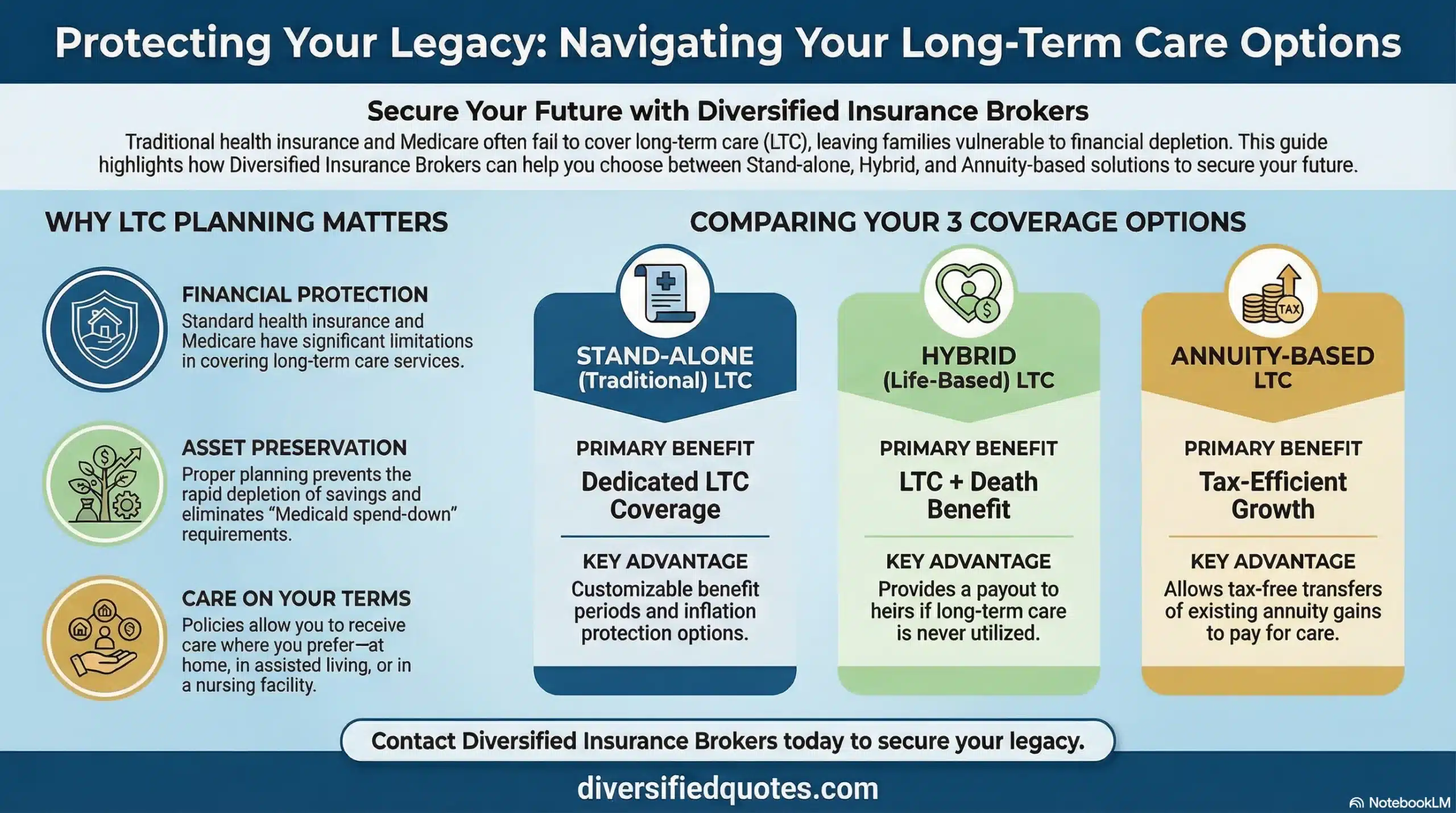
Single-pay long-term care insurance can be structured three primary ways — stand-alone traditional LTC, hybrid life+LTC, and hybrid annuity+LTC — each designed for a different combination of goals. Understanding the structural differences is essential before comparing specific carriers or products, because the design type determines what the premium actually accomplishes if care is never needed, how the benefits are funded during a claim, and what the tax treatment looks like.
Single-Pay LTC Design Approaches: Stand-Alone vs. Hybrid Life vs. Hybrid Annuity
| Design Type | How LTC Benefits Are Sourced | If Care Never Needed | Typical Tax Treatment | Best Fit |
|---|---|---|---|---|
| Stand-Alone Traditional LTC |
Defined benefit pool funded by single premium; reimbursement or indemnity payout. National Guardian Life has an excellent policy. |
Limited or no residual value; purpose-built for care coverage | Benefits generally tax-free for qualified care (tax-qualified policies) | Maximum LTC leverage per premium dollar; pure protection focus |
| Hybrid Life + LTC |
Life insurance death benefit accelerated for LTC expenses when eligible. Brighthouse Insurance Company is a standout option for this. |
Death benefit passes to heirs; legacy value preserved regardless of care outcome | LTC benefits generally tax-free; death benefit income-tax-free to heirs | LTC coverage plus legacy certainty; solves “use it or lose it” concern |
| Hybrid Annuity + LTC |
Annuity contract value leveraged or multiplied for LTC expenses when eligible. One America Insurance Company is a standout on this type of policy. |
Account value retained in annuity contract; “my money is still mine” concept preserved | Gains that would otherwise be taxable may pass tax-free when used for qualified LTC | Repositioning existing annuity or non-qualified assets; maintaining asset access |
Stand-alone traditional LTC is built specifically to maximize benefit leverage for care — its only purpose is to pay for care, which means the premium produces the largest monthly benefit pool relative to cost. Families who want maximum care coverage per dollar and who are not concerned about legacy value if care is never needed typically find stand-alone coverage the most efficient starting point. Our companion resource on whether long-term care insurance is worth it addresses the fundamental question of coverage value that informs this decision.
Hybrid life+LTC addresses the emotional objection that many families have to traditional LTC: the concern that premiums are wasted if care is never needed. A hybrid life+LTC policy pairs a life insurance death benefit with LTC accelerated benefits — if LTC is needed, the death benefit is drawn down to pay for care; if LTC is never needed, the full death benefit passes to heirs. The premium is never “lost.” For families who prioritize the certainty that the premium investment will produce value regardless of care outcome, hybrid life+LTC is often the preferred structure. Our resource on hybrid life insurance with long-term care benefits covers these designs in detail, and our broader hybrid long-term care overview covers the full hybrid landscape.
Hybrid annuity+LTC is the most natural fit for households that want to reposition existing assets — particularly an older non-qualified annuity or a cash holding that is not producing meaningful returns — into a structure that provides care leverage while preserving the sense that the asset is still accessible. Rather than surrendering the existing asset and paying tax on the gain, a 1035 exchange moves the value into an annuity contract with LTC benefits, deferring the tax while creating a new purpose for the money. If care is needed, the annuity value is multiplied for LTC expenses during the claim period. If care is not needed, the annuity contract and its accumulated value remain part of the household’s financial picture. Our resources on fixed annuity with long-term care benefits and annuity with long-term care benefits cover the annuity-based hybrid category.
How Single-Pay LTC Benefits Are Paid During a Claim
When a single-pay long-term care insurance claim begins, the benefit payout method affects flexibility, documentation requirements, and the types of care that are easiest to fund. The two most common benefit structures across all single-pay designs are reimbursement and indemnity, and the difference between them is practical rather than merely definitional.
Reimbursement-style benefits pay based on actual qualified expenses. You incur covered care costs — home health aide hours, assisted living facility fees, adult day care charges, memory care facility costs — and submit documentation or invoices, and the policy reimburses eligible costs up to the monthly benefit limit. Because reimbursement payments are tied to actual documented care costs, this structure is the most common in traditional LTC designs and is considered the standard for tax-qualified policies. The documentation requirement can feel administrative during an already stressful period, but it ensures benefits are used specifically for care rather than for other purposes.
Indemnity-style or “cash benefit” structures pay a defined monthly or daily amount once the policyholder qualifies for care — with less dependence on receipts or invoices for that amount. Once eligibility is certified, the policy pays the defined amount regardless of the exact care cost or care setting. This structure can increase flexibility significantly for families that use a combination of formal care (licensed agencies and facilities) and informal care (family members providing support), or for families whose care arrangements are not easily documented through traditional invoice systems. The tradeoff is that indemnity designs price differently and may have different tax treatment at higher benefit amounts, particularly if the daily benefit exceeds the IRS per-diem limit for tax-free LTC benefits.
The elimination period — the waiting period before benefits begin — is the other critical claim-timing decision. Most single-pay LTC designs include elimination periods of 30 to 90 days, during which care costs are covered by the household’s own reserves before the policy activates. Choosing the right elimination period requires matching the design to the household’s liquid reserves: a household with three to six months of accessible savings can absorb a 90-day elimination period without hardship, while a household with minimal liquid reserves may need a shorter elimination period to avoid a financial crisis during the coverage gap. For a complete explanation of elimination period mechanics and tradeoffs, our resource on LTC elimination periods explained covers the decision framework in detail.
Inflation Protection in Single-Pay Long-Term Care Insurance
Inflation protection is the design feature that most quietly determines whether a single-pay long-term care insurance plan feels adequate when care is actually needed years or decades after the premium is paid. Long-term care costs have historically risen faster than general consumer inflation, and a monthly benefit that covers meaningful care expenses today can fall significantly short of equivalent expenses in 15 or 20 years without a mechanism to grow the benefit over time.
Most inflation protection options in LTC work through a compound growth mechanism applied annually to the monthly benefit and the total benefit pool. Three percent compound growth is the most commonly selected option among buyers seeking a balance between inflation protection and affordability — a $6,000 monthly benefit grows to approximately $8,100 after 10 years and approximately $10,900 after 20 years at 3 percent compound. Five percent compound growth produces stronger protection — approximately $9,775 after 10 years and approximately $15,930 after 20 years — but at a meaningfully higher premium cost that must be evaluated against the household’s premium budget and the expected timeline before care begins.
For single-pay buyers using hybrid annuity+LTC designs, inflation protection may be structured differently than in traditional LTC policies — some designs build in a benefit multiplier or a defined growth rate on the LTC benefit pool that functions similarly to a compound inflation rider without the separate rider structure. The key evaluation question in any single-pay design with inflation provisions is to model what the monthly benefit and total pool look like at the age when care is most likely to be needed, not at the age of purchase. Our resource on LTC with limited-term vs. lifetime benefits covers how inflation interacts with benefit duration decisions across different design types.
For younger buyers in their 50s and early 60s, inflation protection is typically more important — the window before care begins is longer, giving compounding more time to matter and making the difference between 3 and 5 percent compound growth more consequential. For buyers in their late 60s and 70s purchasing single-pay coverage for nearer-term protection, the cost of inflation protection may outweigh the benefit, particularly if the household has other inflation-linked income sources that can adapt over time. Our resource on cost of long-term care by state provides the regional cost projections that make these inflation calculations concrete rather than theoretical.
Shared Care Riders and Couple Planning
Couples who use single-pay long-term care insurance face a distinctive planning challenge: either spouse could need care first, and the surviving spouse may need care years later — creating two separate potential care events over the household’s retirement timeline. Single-pay funding can address both events, but the coverage needs to be designed with the household-level risk in mind rather than treating each spouse as a fully independent risk.
Shared care riders are a complementary feature that significantly improves household resilience in single-pay couple designs. Rather than building two separate, fixed benefit pools that cannot interact, a shared care rider allows one spouse to access unused benefits from the other spouse’s policy if their own coverage is exhausted due to extended care needs. This pooling mechanism means the household’s combined benefit coverage adapts to whichever spouse needs more care, rather than being rigidly allocated based on predictions about who will need care and how much. The practical outcome is that couples can fund single-pay coverage more efficiently — rather than substantially overfunding each individual policy to ensure it is large enough for any eventuality, shared care allows each policy to be sized appropriately while the household’s combined pool provides the reserve needed for asymmetric care outcomes.
For couples where one spouse has a meaningfully higher health risk or perceived care need, single-pay funding with a shared care rider can allow the higher-risk spouse’s policy to be funded more conservatively while the shared pool supplements if needs exceed expectations. Our resource on shared care riders in LTC covers the specific mechanics of how these riders work across different carrier implementations, and our resource on long-term care insurance for couples covers the full couple planning framework within which single-pay shared-care strategies operate.
Funding Single-Pay LTC: Cash, 1035 Exchanges, and Asset Repositioning
Single-pay long-term care insurance can be funded with new cash from savings or other liquid assets, but a meaningful portion of single-pay plans are funded through asset repositioning strategies — particularly 1035 exchanges — that allow existing insurance or annuity values to move into a new structure without triggering immediate taxation on accumulated gains.
The 1035 exchange is the most common repositioning vehicle for single-pay annuity+LTC strategies. Section 1035 of the Internal Revenue Code allows for the tax-deferred transfer of certain life insurance and annuity contracts into new contracts of the same type — or in the case of annuity+LTC hybrids, into the hybrid structure that qualifies under the applicable rules. For a household with a non-qualified annuity that has accumulated substantial gain since purchase, a direct surrender would trigger ordinary income tax on the gain. A 1035 exchange moves the value into the new contract without the surrender triggering a taxable event, deferring the tax while repositioning the asset’s purpose from “passive savings” to “funded LTC protection.” Our resource on how 1035 exchanges work in annuity planning covers the exchange mechanics, documentation requirements, and the specific annuity-to-annuity pathway that most annuity+LTC repositioning follows.
Beyond 1035 exchanges, some families fund single-pay strategies through the surrender of older life insurance policies — particularly whole life or universal life policies that have accumulated cash value but no longer serve the household’s coverage purpose. The 1035 exchange pathway for life-to-life or life-to-annuity transfers can preserve the tax-deferred status of those accumulated values while repositioning them into a hybrid LTC structure. This is particularly compelling for households with older life insurance policies that were purchased for income replacement during working years — now that the income replacement need has been addressed by retirement assets, the life insurance cash value can be repositioned into care protection that is more relevant to the household’s current risk profile.
Matured certificates of deposit, low-yield money market balances, and Treasury holdings that have been rolled to lower rates can also fund single-pay strategies directly as new cash. For households where the primary motivation is “putting idle assets to work,” single-pay LTC funding is one of the few strategies that creates substantial leverage — turning a defined cash investment into a care benefit pool that may be many times the premium amount if care is needed. Our resource on self-insured long-term care covers the alternative of not purchasing coverage — which many families do implicitly — so the comparison between self-funding and single-pay strategies can be made explicitly rather than by default.
Who Is a Good Candidate for Single-Pay Long-Term Care Insurance
Single-pay LTC strategies are most naturally suited to households that have available assets that can be repositioned without disrupting lifestyle, and that prefer the certainty of a fully funded plan over the ongoing management of recurring premiums. Several specific household profiles recur consistently in single-pay planning.
The first profile is retirees who have accumulated more liquid savings than they need for near-term living expenses and want to put those assets to more purposeful work. A household with $500,000 in low-yield savings and monthly retirement income that already covers living expenses has essentially allocated those savings as a “just in case” reserve. Single-pay LTC converts a portion of that reserve into a funded care strategy with substantially more purchasing power for care expenses than the equivalent cash would provide if used directly for care.
The second profile is households with older annuities or life insurance policies that no longer fit the financial plan. These contracts may have been purchased for income replacement or accumulation goals that have since been achieved or superseded by the household’s retirement income structure. Rather than continuing to hold contracts that do not serve a clear current purpose, a repositioning into single-pay LTC structures can align the asset with the household’s most significant remaining financial risk. Our resource on annuity strategies for early retirees covers the broader repositioning framework within which single-pay LTC often appears.
The third profile is households that strongly dislike premium uncertainty and want to know the total cost of their long-term care protection at the time they make the decision. For these households, the ongoing premium structure of traditional annual-pay LTC — even when premiums are manageable — creates a form of financial anxiety that undermines the peace of mind the coverage is supposed to provide. Single-pay resolves this by establishing the total cost at inception. The household knows exactly what was paid and what protection exists, without the possibility of future increases changing the calculation. Our resource on how to qualify for long-term care insurance covers the underwriting requirements that determine eligibility for single-pay coverage across different design types.
Tax Treatment of Single-Pay Long-Term Care Insurance
The tax treatment of single-pay LTC strategies depends primarily on the design type chosen and how the benefits are structured within the policy contract. Traditional tax-qualified LTC policies — whether funded with a single premium or ongoing premiums — are designed so that benefits paid for qualified long-term care are generally excluded from the policyholder’s taxable income. The tax-qualified designation establishes the federal standard for benefit-trigger definitions that entitle benefits to this favorable treatment, and most traditional LTC policies sold today are structured to meet that standard.
Hybrid life+LTC designs carry additional tax features beyond the LTC benefit treatment. When LTC benefits are paid from a life insurance policy’s death benefit through an accelerated benefit provision, they are generally excluded from taxable income under the same tax-qualified LTC rules applicable to traditional LTC policies — provided the policy and the care situation meet the qualifying criteria. The death benefit that passes to heirs after the policyholder’s death is also generally income-tax-free under life insurance tax rules, making hybrid life+LTC potentially the most tax-efficient design type from both the care benefit and the legacy benefit perspectives.
Hybrid annuity+LTC designs have a distinct tax advantage that is specific to the annuity chassis. Annuities funded with after-tax dollars (non-qualified annuities) accumulate gains on a tax-deferred basis, but those gains are eventually taxable as ordinary income when distributed. However, when an annuity with LTC benefits pays those gains out as qualified LTC benefits rather than as standard distributions, the gains that flow through LTC payments may be excluded from taxable income — meaning the tax that would otherwise be due on the annuity gain may be permanently avoided by using the funds for qualified care. This tax treatment is one of the most compelling arguments for the annuity+LTC repositioning strategy, particularly for households with large non-qualified annuities carrying substantial accumulated gain. Our comprehensive resource on tax advantages of LTC insurance and hybrid policies covers the full tax framework across all design types.
How Single-Pay LTC Fits the Broader Retirement Plan
Single-pay long-term care insurance is not a standalone product decision — it is one component of a retirement protection strategy that works best when coordinated with the household’s income, assets, and estate planning. The most effective single-pay LTC strategies are built alongside rather than independently of the household’s broader retirement structure.
The coordination logic is straightforward: guaranteed retirement income sources cover fixed monthly expenses that recur regardless of whether a care event occurs; single-pay LTC benefits cover care-specific costs when care is needed; and liquid savings cover flexibility needs, unexpected expenses, and goals that neither income nor LTC is designed for. This three-layer structure keeps each component doing the job it does best, without requiring any single tool to solve all retirement financial problems simultaneously. Medicare covers acute medical care and skilled nursing on a short-term basis, but does not cover the extended custodial care that LTC insurance is designed to address — a distinction that surprises many households who assume Medicare provides broader long-term care coverage. Our resources on Medigap vs. Medicare Advantage and how to get Medicare while working cover the Medicare landscape that frames the LTC coverage gap.
Partnership-qualified LTC coverage adds another layer of estate planning relevance. Policies designed to meet state LTC partnership standards allow policyholders who exhaust their qualifying LTC benefits to protect a corresponding dollar amount of assets from Medicaid spend-down requirements — creating a meaningful asset protection strategy for households concerned about extended care costs eventually reaching Medicaid eligibility thresholds. Our resource on LTC partnership reciprocity covers how partnership qualification works across state lines for households that may need care in a state other than where they purchased coverage.
For households using income riders or guaranteed lifetime withdrawal benefits as part of their retirement income strategy, understanding how LTC costs interact with income planning is important. A care event that requires large withdrawals from an income-rider-based annuity can affect the rider’s guaranteed withdrawal amount if those withdrawals exceed the annual permitted amount. Designing the LTC coverage to fund care costs directly — rather than relying on income rider withdrawals to cover them — can preserve the income rider’s long-term performance and protect the household’s income floor. Our resource on guaranteed lifetime withdrawal benefits explained covers the income rider mechanics that interact with this LTC-and-income planning coordination. Annual review of beneficiary designations is also important as LTC strategies interact with estate plans — our annual beneficiary review checklist covers the documentation maintenance that keeps all components aligned.
Build a Single-Pay LTC Plan You’ll Feel Good About
We show clear side-by-side options — stand-alone, hybrid life+LTC, and annuity+LTC — matched to your care goals, asset situation, and retirement income structure.
Request My LTC QuoteRelated Pages: Long-Term Care Planning Resources
Continue researching single-pay designs, hybrid LTC options, and LTC planning strategy.
Financial Protection Essentials
Tools, calculators, and resources for LTC cost planning, Medicare coordination, and asset repositioning decisions.
Talk With an Advisor Today
Choose how you’d like to connect—call or message us, then book a time that works for you.
Schedule here:
calendly.com/jason-dibcompanies/diversified-quotes
Licensed in all 50 states • Fiduciary, family-owned since 1980
FAQs: Single Pay Long-Term Care Insurance
How does single-pay long-term care insurance work?
Single-pay long-term care insurance works by funding a complete LTC benefit structure with one upfront premium rather than ongoing annual or monthly payments. The single premium establishes a defined benefit pool, monthly benefit amount, and coverage duration that is immediately in force after underwriting approval and policy delivery. Once funded, the policy has no further premium obligations — the coverage exists in its paid-up form for the remainder of the policyholder’s life, subject to the contract terms and the care eligibility triggers.
When care is needed and the policyholder meets the policy’s eligibility criteria — typically the inability to perform two of the six activities of daily living without substantial assistance, or qualifying cognitive impairment — the policy begins paying benefits after any applicable elimination period. Benefits continue until the monthly benefit pool is exhausted, the benefit period ends, or the policyholder no longer meets eligibility criteria, depending on the specific contract.
For hybrid designs (life+LTC or annuity+LTC), the single premium funds the policy chassis along with the LTC benefit structure. If care is never needed, the life insurance death benefit or annuity account value remains intact and performs its primary function — passing value to heirs or serving as a retirement asset. If care is needed, the LTC benefit provisions activate and draw from or leverage the underlying contract value to fund care expenses.
What is the difference between stand-alone and hybrid single-pay LTC?
Stand-alone single-pay LTC is traditional long-term care insurance funded with a single premium rather than ongoing premiums. The policy’s only purpose is to pay for long-term care expenses — it is purpose-built to maximize the monthly benefit pool available for care relative to the premium invested. If care is never needed, the policy may have limited or no residual value beyond any return-of-premium provisions. Stand-alone designs typically produce the highest monthly benefit coverage per dollar of premium among the available design types, making them the most efficient choice for households whose primary objective is maximum care leverage.
Hybrid single-pay LTC combines long-term care benefits with either a life insurance policy (hybrid life+LTC) or an annuity contract (hybrid annuity+LTC). In a hybrid life+LTC design, the death benefit is accelerated to pay for care expenses when LTC eligibility is met — if care is never needed, the full death benefit passes to heirs. In a hybrid annuity+LTC design, the annuity contract value is leveraged or multiplied for LTC expenses during a qualifying claim — if care is never needed, the annuity value remains accessible as a retirement asset. Both hybrid designs address the “use it or lose it” concern that leads some families to hesitate on stand-alone LTC coverage.
The right choice depends on what the household wants most. Stand-alone single-pay is typically optimal when maximum LTC benefit leverage per dollar is the priority. Hybrid designs are typically preferred when the household wants to ensure the premium investment produces value regardless of whether care is needed, or when asset repositioning through a tax-efficient 1035 exchange makes the annuity+LTC chassis the most natural fit for existing assets.
Are benefits paid as reimbursement or indemnity?
Both reimbursement and indemnity (cash) structures exist across single-pay LTC designs, and the choice between them affects how flexible the plan is during an actual claim. Reimbursement benefits pay back eligible documented care expenses up to the monthly benefit cap — invoices or receipts from licensed care providers are submitted, and the policy reimburses covered costs. This structure is most common in traditional tax-qualified LTC policies and ensures benefits are directly tied to actual care expenditures. It requires more administrative management during a claim but is well-suited for households using formal care settings with professional providers.
Indemnity or cash benefits pay a defined monthly amount once the policyholder qualifies for care, without requiring invoice-level documentation for each payment. This flexibility is particularly valuable for families that plan to use a combination of formal and informal care — for example, a licensed home health agency for part of the week and a family member providing additional support. Indemnity benefits allow those informal care costs to be covered without requiring receipts, reducing the administrative burden during an already stressful period.
The tax treatment of indemnity designs at high benefit levels deserves attention. If indemnity cash benefits exceed the IRS annual per-diem threshold for tax-qualified LTC benefits, the excess above that threshold may be subject to income tax unless actual care costs equal or exceed the benefit paid. For most policyholders whose care costs are genuinely substantial, the per-diem limit is rarely an issue. But for buyers selecting high indemnity benefit amounts, understanding how the contract approaches the per-diem threshold and what documentation the carrier may require in that scenario is worth confirming during policy selection.
Do I still need inflation protection with a single-pay plan?
Yes — inflation protection is typically as important in a single-pay design as in any other LTC funding approach, and in some cases more so. Because a single-pay design is funded once at policy inception, the benefit levels established at that point are the foundation for all future coverage. Without an inflation protection mechanism, those benefit levels remain static in nominal dollar terms while the actual cost of care rises over time. A monthly benefit of $6,000 that adequately covers memory care facility costs today may cover substantially less of equivalent care in 15 years if costs rise at even moderate rates.
The most common inflation protection options — 3 percent and 5 percent compound annual growth — apply to both the monthly benefit and the total benefit pool, ensuring that the coverage keeps pace with rising costs. Three percent compound is the most commonly selected option among buyers seeking a sustainable balance between inflation protection and premium cost. Five percent compound provides stronger long-term protection at higher premium cost. For buyers in their 50s and early 60s purchasing single-pay coverage well before care is expected, the compounding effect over 15 to 20 years makes inflation protection meaningfully valuable. For older buyers purchasing single-pay coverage for nearer-term protection, the premium cost of inflation protection may outweigh the compounding benefit over a shorter horizon.
Some single-pay hybrid designs build growth mechanisms directly into the contract chassis — annuity+LTC designs may provide a defined growth rate on the LTC benefit multiplier, and life+LTC designs may include dividend participation or other mechanisms that increase the available LTC benefit pool over time. These built-in growth features should be evaluated against traditional compound inflation rider options to confirm which produces stronger benefit growth for the specific design and timeline being considered.
Can I fund single-pay LTC with a 1035 exchange?
Yes — 1035 exchanges are one of the most common and tax-efficient ways to fund single-pay annuity+LTC strategies. Section 1035 of the Internal Revenue Code allows for the tax-deferred transfer of existing annuity or life insurance cash values into a new annuity or life insurance contract of the same type, without triggering immediate taxation on any accumulated gain in the original contract. For a household with a non-qualified annuity that has grown substantially since purchase, a direct surrender would require reporting the full gain as ordinary income in the year of surrender. A 1035 exchange to an annuity+LTC structure moves the same value into the new contract without the surrender creating a taxable event — deferring the tax while repositioning the asset from passive savings into a funded LTC protection strategy.
The tax advantage of the 1035 exchange to an annuity+LTC design is potentially permanent, not just deferred. When the annuity contract pays LTC benefits during a qualifying claim, the gains that flow through as LTC benefit payments may be excluded from taxable income entirely — meaning the tax that would have been due on annuity surrender is avoided by using the funds for qualified care, rather than simply deferred to a later date. This combination of tax deferral at exchange and potential tax elimination at claim makes the annuity+LTC 1035 exchange one of the most tax-efficient repositioning strategies available to households with non-qualified annuities.
The same 1035 exchange pathway is available for life insurance cash values. A whole life or universal life policy with substantial accumulated cash value can be exchanged into a life+LTC hybrid or an annuity+LTC structure, preserving the tax-deferred status of the cash value while repositioning it from a coverage type that may no longer serve the household’s current needs to a design that addresses the most significant remaining retirement risk. Our resource on how 1035 exchanges work in annuity planning covers the specific procedural requirements for structuring these exchanges correctly.
Are single-pay LTC benefits taxable?
Benefits from tax-qualified single-pay LTC policies are generally received income-tax-free when the policyholder meets the policy’s eligibility criteria and the care qualifies under the contract’s definitions. The tax-qualified designation — established under federal law — sets the standard for benefit-trigger definitions and policyholder rights that entitle benefits to this favorable treatment. Most traditional LTC policies sold today, whether funded with a single premium or ongoing premiums, are structured to meet tax-qualified standards. Single-pay funding does not change the tax treatment of the benefits themselves.
For hybrid life+LTC designs, LTC benefits paid through the accelerated death benefit provision are generally also excluded from taxable income, provided the policy and the care circumstances meet the qualifying criteria. The death benefit remaining after the policyholder’s death is generally income-tax-free to beneficiaries under life insurance tax treatment. This dual tax efficiency — tax-free LTC benefits during the policyholder’s lifetime and income-tax-free death benefit to heirs — makes hybrid life+LTC one of the most tax-advantaged LTC structures available.
For hybrid annuity+LTC designs, the tax treatment of LTC benefits from the annuity chassis is potentially more favorable than standard annuity distributions. Gains in a non-qualified annuity are ordinarily taxable as ordinary income when distributed, but when those gains flow through as qualified LTC benefit payments, they may be excluded from taxable income — permanently avoiding the tax on those gains rather than merely deferring it. This is the mechanism that makes 1035 exchange repositioning into annuity+LTC designs particularly compelling for households with non-qualified annuities carrying large accumulated gains. Our comprehensive resource on tax advantages of LTC insurance and hybrid policies covers the full tax framework across all single-pay design types.
What if I never need long-term care?
The answer depends on which single-pay design you choose. For stand-alone traditional LTC insurance, the policy exists to pay for care — if care is never needed, the policy benefit pool is never accessed and may have limited or no residual value after the policyholder’s death, depending on whether any return-of-premium provision was included. Some stand-alone policies include return-of-premium features that return a portion of premiums paid to beneficiaries if the policyholder dies without having made claims — these features increase the policy’s premium cost but address the concern that the premium investment has no value if care is not needed. Our resource on long-term care insurance with return of premium covers this specific design.
For hybrid life+LTC designs, not needing care does not mean losing the premium — the death benefit that was available for LTC acceleration passes intact to beneficiaries after the policyholder’s death. The policy may have accumulated additional value through dividend participation or similar mechanisms depending on the specific design. The full death benefit, potentially reduced by any LTC benefits paid during the policyholder’s lifetime, passes to heirs as a tax-free death benefit under life insurance rules. This guaranteed legacy outcome regardless of care need is the primary reason families choose hybrid life+LTC over stand-alone coverage.
For hybrid annuity+LTC designs, not needing care means the annuity contract and its accumulated value continue as a retirement asset. The annuity value that was repositioned into the LTC design continues to grow under the annuity’s crediting structure, and can eventually be accessed through distributions, annuitization, or further repositioning if the LTC benefit is never activated. The household never “loses” the asset to unused coverage — the asset simply continues serving its financial role without activating the LTC benefit layer.
What factors most affect single-pay LTC pricing?
The six primary pricing factors for single-pay LTC insurance are age at application, health profile at application, monthly benefit level, benefit period (coverage duration), inflation protection selection, and whether the design is stand-alone or hybrid. These factors interact with each other to determine the single premium required for any specific coverage configuration.
Age and health are the most fundamental underwriting variables. Applying earlier in life — typically in the mid-50s or early 60s — produces the most favorable combination of lower risk (which translates to better pricing), broader availability of designs, and longer time for inflation protection to compound. Health history at the time of application determines whether coverage is available at standard rates, modified terms, or not at all. Conditions that would have been acceptable at younger ages may produce more restrictive underwriting outcomes at older ages, making timely application an important practical consideration.
Monthly benefit, benefit period, and inflation protection selection are the three design levers most directly within the buyer’s control. Higher monthly benefits, longer benefit periods, and stronger inflation protection each increase the single premium required — the relationship is direct and approximately proportional. Households that find target premium amounts higher than desired can adjust these three design elements to find a sustainable premium level without eliminating coverage entirely. Our resource on how much LTC insurance you need covers the benefit-sizing methodology that helps identify which design elements to prioritize when making these tradeoff decisions.
About the Author:
Jason Stolz, CLTC, CRPC, DIA, CAA and Chief Underwriter at Diversified Insurance Brokers (NPN 20471358), is a senior insurance and retirement professional with more than 25 years of real-world experience helping individuals, families, and business owners protect their income, assets, and long-term financial stability. As a long-time partner of the nationally licensed independent agency Diversified Insurance Brokers, Jason provides trusted guidance across multiple specialties—including fixed and indexed annuities, long-term care planning, personal and business disability insurance, life insurance solutions, Group Health, Travel Medical and Evacuation Insurance, and short-term health coverage. Diversified Insurance Brokers maintains active contracts with over 100 highly rated insurance carriers, ensuring clients have access to a broad and competitive marketplace.
His practical, education-first approach has earned recognition in publications such as VoyageATL, and contributions from his agency featured in Kiplinger and GoBankingRates— highlighting his commitment to financial clarity and client-focused planning. Drawing on deep product knowledge and years of hands-on field experience, Jason helps clients evaluate carriers, compare strategies, and build retirement and protection plans that are both secure and cost-efficient. Visitors who want to explore current annuity rates and compare options across multiple insurers can also use this annuity quote and comparison tool.
Explore More Long Term Care Insurance Options: Browse our complete guide to How to Buy, Qualify & Coverage Details — covering how to buy, who qualifies, policy types, shared benefits, partnership plans & more from top carriers.
Last Reviewed: June 23, 2026 |
Reviewed by: Jason Stolz, CLTC, CRPC, DIA, CAA
Chief Underwriter, Diversified Insurance Brokers, Inc. | NPN: 20471358 | Diversified Insurance Brokers, Inc. — Licensed in all 50 states
Fact Checked by: Tonia Pettitt, CMIP©
Medicare Specialist, Diversified Insurance Brokers, Inc. | NPN: 14374308 | Diversified Insurance Brokers, Inc. — Licensed in all 50 states
Did you find this content helpful? Leave us a Google review — it helps others find trustworthy guidance too.
Editorial Standards: Diversified Insurance Brokers maintains rigorous editorial standards to ensure accuracy, clarity, and independence in all content. Learn more about our editorial standards and commitment to transparency.
