
Tax Advantages of Long-Term Care Insurance and Hybrid Policies
Tax Advantages of Long-Term Care Insurance and Hybrid Policies

Jason Stolz CLTC, CRPC, DIA, CAA
Tax advantages of long-term care insurance and hybrid policies are often the hidden engine behind successful retirement planning. When a care claim occurs, the tax treatment of benefits and the ability to deduct premiums can mean the difference between a plan that flows smoothly and one that creates collateral damage to the rest of your retirement structure. Most families focus on “how much coverage” without asking “what is the after-tax cost” and “how will this affect my overall income picture when care happens.” That oversight can be expensive because the tax rules determine how much net financial relief a plan actually creates. At Diversified Insurance Brokers, we compare stand-alone long-term care insurance, life/LTC hybrids, and annuity-based hybrid designs with explicit attention to tax efficiency, because the best policy is the one that protects your health risk and protects your retirement plan from unnecessary tax complications. This guide walks through the major tax rules that drive LTC planning, explains how premium deductions work, shows why hybrid policies have different tax treatment than stand-alone coverage, and demonstrates how tax-aware funding strategies like 1035 exchanges can reposition assets into plans designed for tax-advantaged care payouts.
The Tax Advantage of Tax-Qualified LTC Insurance
The core tax advantage of properly structured long-term care insurance comes in two parts: how you pay for it (premiums) and how you receive benefits (payouts). Under Internal Revenue Code Section 7702(b), qualified long-term care insurance contracts receive favorable tax treatment that ordinary health insurance does not. When a policy meets the federal definition of “tax-qualified,” the premiums may be treated as a medical expense for itemizers, and more importantly, benefit payouts are generally received income-tax-free. This means that when care begins, policy reimbursements or indemnity payments function as net dollars—you’re not losing a portion to ordinary income tax the way you would if you withdrew the same amount from a traditional IRA.
This tax efficiency becomes particularly valuable for households whose retirement assets are concentrated in tax-deferred accounts—IRAs, 401(k)s, and deferred annuities. Without an LTC plan, the household’s only path to funding care is pulling more money from those accounts. Each additional withdrawal increases taxable income, potentially pushes the household into a higher tax bracket, increases the taxable portion of Social Security, and can trigger Medicare premium surcharges known as IRMAA. A tax-qualified LTC benefit can short-circuit this entire cascade. The household receives tax-free care dollars, reduces the need for taxable IRA withdrawals, keeps income and tax brackets more stable, and avoids triggering secondary tax increases that compound the financial stress of care. That’s not just a “nice feature.” That’s the core planning value of LTC for many families.
How Premium Deduction Limits Work
The IRS sets annual caps on how much of your long-term care insurance premiums can be deducted as a medical expense. These limits are structured on an age-based formula and are adjusted annually. The higher your age at the end of the tax year, the higher your potential deduction limit. For those age 70 and above, the limit is substantially higher than for those in their 50s, reflecting the higher premium costs for older applicants. However, there is an important constraint for individual filers: long-term care premium deductions only count as medical expenses, and total medical expenses must exceed 7.5% of your adjusted gross income (AGI) before any of them produce a deduction. This means you need to combine LTC premiums with other medical expenses—insurance, out-of-pocket care, prescriptions, dental, vision—to reach the threshold. Couples often benefit more because they can potentially deduct both spouses’ premiums, effectively doubling the available pool.
| Age at End of Tax Year | Individual Deduction Limit | Couple (Both Qualifying) | Notes |
|---|---|---|---|
| 40 or under | $460 | $920 | Premiums typically low at this age; deduction rarely a primary driver |
| 41–50 | $860 | $1,720 | Good time to buy; premium deductibility increasing with age |
| 51–60 | $1,620 | $3,240 | Peak planning window; deductions begin to matter more |
| 61–70 | $4,340 | $8,680 | Significant deduction potential; must still exceed 7.5% AGI floor |
| 71 and older | $5,430 | $10,860 | Highest deduction tier; combine with other medical expenses for maximum benefit |
Limits apply only to tax-qualified policies under IRC Section 7702(b). Figures reflect recent IRS guidance and are adjusted annually. Medical expenses must exceed 7.5% of AGI before any itemized deduction applies. Confirm current-year limits with your tax advisor.
Why Hybrid LTC Policies Have Limited Tax Advantages
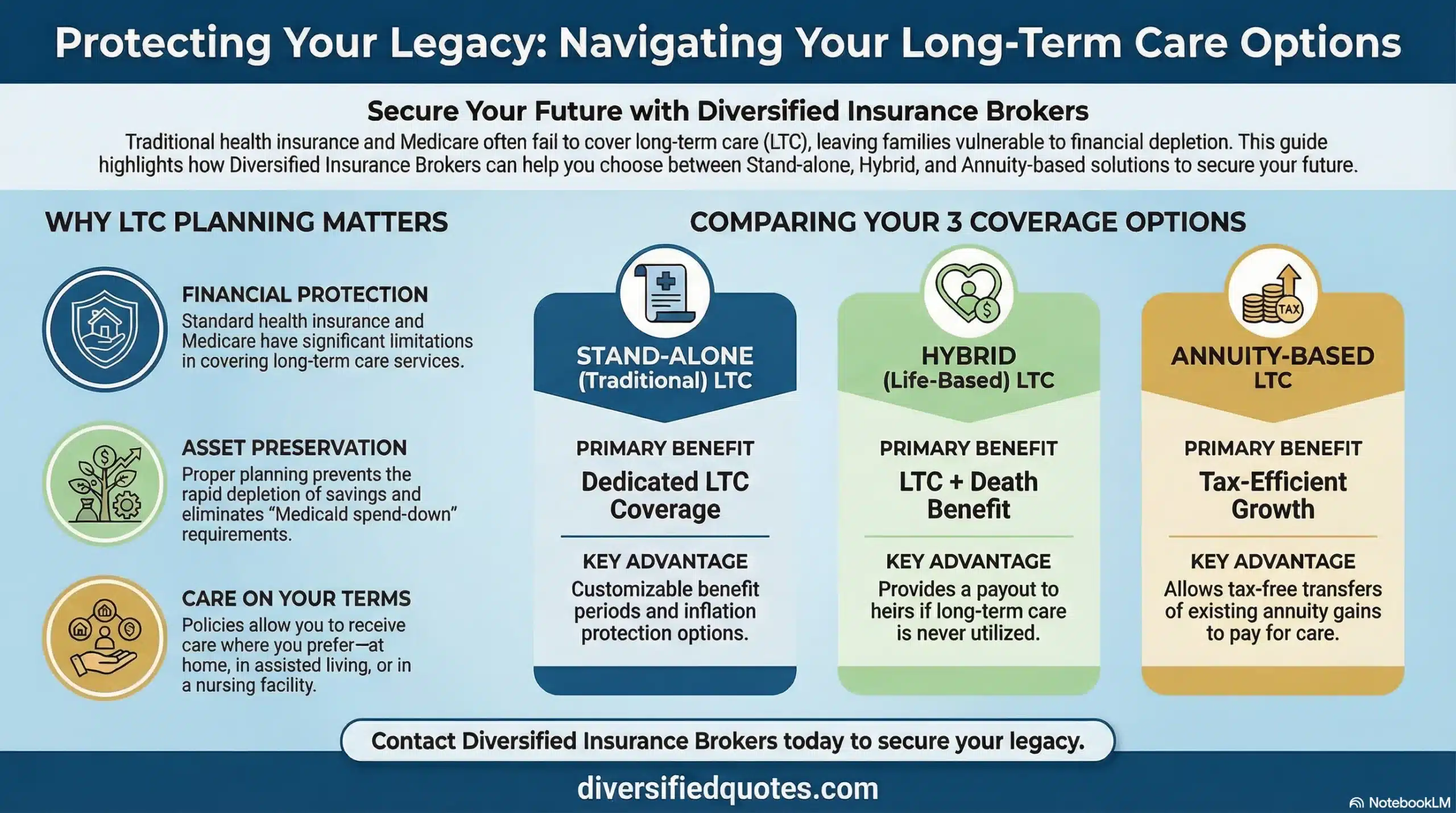
Hybrid long-term care policies—designs that combine a life insurance policy or annuity with an LTC rider—have become increasingly popular because they offer “use it or keep it” value: if care is needed, the policy pays LTC benefits; if care is never needed, value remains as a death benefit or annuity value depending on the chassis. This flexibility appeals to households that don’t want to “lose” premium dollars to a claim-dependent product. However, this multi-purpose design comes with a meaningful tax trade-off. Most popular hybrid policies do not qualify for premium deductions. The reason is structural: premiums are funding both an insurance benefit and a cash value or investment component. The IRS treats those differently, and the design requirements for a hybrid to achieve “tax-qualified” status under Section 7702(b) are strict. Most carriers do not construct their hybrids to meet those requirements.
This doesn’t mean hybrid policies lack tax advantages entirely. Benefit payouts from properly structured hybrids can still be received tax-free when used for qualified care. And the retained value—the death benefit or annuity balance if care is never used—provides a different kind of planning efficiency. But in terms of the upfront premium deduction, most households with hybrid LTC policies cannot count premiums as deductible medical expenses. The hybrid’s tax advantage shows up through benefit structure and asset repositioning, not premium deductibility. This is an important distinction when comparing a hybrid to a stand-alone policy on a true after-tax basis. Many households find that once they run the after-tax numbers, the comparison looks different than the gross premium figures suggest.
Tax-Free LTC Benefit Payouts: The Bigger Advantage
For many households, the premium deduction is secondary. The bigger tax advantage is the benefit itself. Under IRC Section 7702(b), qualified long-term care insurance benefits are generally received income-tax-free. This means that if your policy pays $8,000 per month for qualified long-term care, those benefits are typically not taxable income. You receive net dollars to pay for care without the ordinary income tax hit that would accompany an IRA withdrawal of the same amount. Compare the alternative: if you need $8,000 per month for care and you pull it from a traditional IRA, the full $8,000 is taxable as ordinary income. Depending on your tax bracket and state of residence, that could mean paying $2,000–$3,000 or more in federal and state income tax just to net the care costs you actually need. A tax-free LTC benefit avoids that entire secondary layer of taxation.
Over a multi-year care event—which is increasingly common as lifespans extend—this difference can preserve tens of thousands of dollars or more in household wealth. The tax efficiency compounds over time and makes a significant difference in the overall retirement picture. This is why tax-advantaged LTC planning often works best for households with substantial pre-tax retirement savings. The larger the IRA or 401(k) balance, the greater the value of avoiding taxable withdrawals through an LTC benefit. If your retirement assets are mostly in Roth accounts or after-tax investments, the benefit advantage is smaller because withdrawals carry less tax burden anyway. But for the majority of retirees whose primary savings are tax-deferred, tax-free LTC benefits can be transformational in preserving net wealth during care years.
How to Fund a Hybrid LTC Plan: 1035 Exchanges and Tax Efficiency
One of the most powerful tax-aware strategies for hybrid LTC planning is using a 1035 exchange to reposition an existing nonqualified annuity into a hybrid structure. This approach solves a real problem that many retirees face: they hold an old variable or fixed annuity with significant taxable gains that, if withdrawn, would trigger a substantial ordinary income tax bill. By exchanging that annuity into a life insurance policy or annuity-LTC hybrid through a 1035 exchange, the household avoids triggering the gain, repositions those dollars into a structure designed for care, and creates potential future LTC benefit payouts that may be structured in a tax-favored way.
The practical impact shows up clearly in the planning math. Suppose a household holds a $200,000 nonqualified annuity with $50,000 in taxable gains. A direct withdrawal would create a $50,000 taxable event—a significant tax bill with no immediate planning benefit. Instead, a 1035 exchange into an annuity-LTC hybrid with a care multiplier accomplishes multiple goals simultaneously: avoids the current taxable event, repositions the asset into a care-focused structure, creates potential tax-free care payouts if needed, and retains value as an annuity or death benefit if care is never used. From a tax perspective, it’s converting otherwise taxable dollars into tax-deferred or tax-free care access. This is sophisticated planning, and it’s exactly what many retirees need when they’re coordinating tax efficiency with care readiness. The key requirement: work with a tax advisor and an LTC specialist together to confirm the exchange structure and verify the receiving contract is designed to provide the tax treatment you’re expecting. Not all exchanges qualify, and not all hybrid products are constructed the same way. See nonqualified annuity LTC strategies for the full mechanics.
Business Owner Tax Advantages: C-Corps vs. Pass-Through Entities
Business owners often have access to more favorable LTC tax treatment than individual employees, and the specific advantage depends on entity type. C-Corporations can deduct 100% of qualified LTC premiums for owners and employees as a business expense, reducing corporate taxable income dollar-for-dollar before profit calculations. Pass-through entities—S-Corps, partnerships, and LLCs—offer a different advantage: owners avoid the 7.5% AGI floor that applies to individual filers. Premiums can be treated as a guaranteed payment or draw from the business, which is often more efficient than stacking on top of an already-large personal AGI. Self-employed sole proprietors may be able to deduct LTC premiums as a self-employed health insurance deduction taken above-the-line, which doesn’t depend on the medical expense threshold at all.
For business owners, the key planning question is: Can we structure LTC benefits through the business in a way that provides better tax outcomes than individual purchase? Often the answer is yes. Business owners have flexibility to cover selectively—just themselves, a spouse, or key employees—without the broad-coverage requirements that apply to group health insurance. That selectivity, combined with entity-type advantages, can materially reduce net cost compared to personal purchase. For owners thinking about benefits at the business level, see executive benefit planning for how LTC fits into broader ownership and compensation strategies.
New Opportunities for Funding LTC Insurance from Retirement Accounts
Recent tax law changes have created new pathways for funding LTC insurance from retirement accounts without the traditional early-withdrawal penalties that previously made this impractical. Depending on your plan type and circumstances, you may now have options—particularly if you are age 55 or older with an employer retirement plan—to access retirement funds for LTC premium payments. This represents a meaningful shift in how households can think about LTC funding without disrupting overall retirement strategies. The ability to fund LTC insurance from retirement accounts—even with the ordinary income tax that applies to the withdrawal—can be superior to the alternative of self-funding care from those same accounts later, because LTC benefits are tax-free while care withdrawals are not. Working with a tax professional to understand whether you qualify for these opportunities and how they interact with your broader plan is essential before taking action.
Coordinating LTC Tax Advantages with Overall Retirement Planning
Tax-smart LTC planning never happens in isolation. The tax advantages work best when coordinated with the bigger retirement picture: when you’re claiming Social Security, what your income sources look like, how your lifetime income is structured, and what you’re doing with income timing strategies. A household that carefully plans Roth conversions, Social Security timing, and LTC funding together can often achieve tax outcomes that are substantially stronger than treating each piece separately. Similarly, if you have return-of-premium LTC coverage or shared-benefit designs for a couple, the coordination becomes even more important because the tax treatment, benefit mechanics, and risk allocation all interact with each other.
Your beneficiary designations and ownership structures matter too, especially for couples. See community property planning for how ownership can affect long-term outcomes. Coordinate LTC planning with Medicare enrollment timing as well, because Medicare and LTC insurance serve different purposes and have filing rules that can interact in ways that affect coverage continuity. Choosing between Medigap and Medicare Advantage also affects what care gaps LTC coverage needs to fill. See Medicare vs. LTC insurance for the full context of how these pieces work together.
Who Benefits Most from Tax-Advantaged LTC Planning
Different households gravitate toward different LTC structures based on their tax situation and planning goals. Households with substantial pre-tax retirement savings benefit most from tax-qualified stand-alone LTC because the tax-free benefit payouts avoid forced taxable withdrawals. Households trying to preserve value in all scenarios—care or no care—often prefer hybrids even though premium deductions are limited, because the structure aligns with their comfort level and legacy goals. Business owners have specific advantages and should model outcomes under their entity type to understand the true net cost difference. Early retirees managing tax brackets before required minimum distributions begin often use annuity repositioning strategies and 1035 exchanges to coordinate LTC and income planning together. Those coordinating Social Security, disability, and retirement income together should include LTC tax planning as part of the same conversation rather than treating it as a separate purchase decision.
Bottom Line: Tax Efficiency as a Retirement Stability Tool
The tax advantages of long-term care insurance and hybrid policies are not abstract mechanics. They are practical tools that can preserve significant wealth over a care event and stabilize the retirement plan when care happens. Tax-free benefit payouts reduce forced taxable withdrawals. Premium deductions lower net cost for those who can use them. Business owner structures provide meaningful advantages that personal purchase cannot replicate. Sophisticated funding strategies like 1035 exchanges can reposition taxable assets into tax-advantaged care access. When LTC planning is done well and coordinated with the rest of the retirement plan, it reduces stress twice: it reduces the stress of “how do we pay for care?” and it reduces the stress of “what will this do to our retirement income and tax picture?” If you want clarity on what structure makes sense for your specific situation, the fastest path is a side-by-side comparison that shows the after-tax cost and after-tax benefit of each option. That’s what we do every day at Diversified Insurance Brokers: simplify the decision, compare realistic options, and build a plan that fits how retirement actually works.
Build Your Tax-Smart LTC Plan
We’ll compare stand-alone and hybrid options side by side and show you the real after-tax cost and after-tax benefit for your situation.
Stand-Alone LTC
Tax-qualified coverage with premium deductions and tax-free benefits for qualified care.
Hybrid LTC Policies
Retained value if care isn’t needed, tax-free benefits when it is—see the tradeoffs.
Request Your LTC Plan
We’ll model both options for your specific assets, tax situation, and timeline.
Compare Tax-Efficient LTC Strategies
Explore stand-alone, hybrid, and repositioning approaches tailored to your tax situation.
Coordinate LTC Planning With Broader Retirement Strategy
LTC tax advantages work best when integrated with Social Security, income timing, and withdrawal planning.
Talk With an Advisor Today
Choose how you’d like to connect—call or message us, then book a time that works for you.
Schedule here:
calendly.com/jason-dibcompanies/diversified-quotes
Licensed in all 50 states • Fiduciary, family-owned since 1980
FAQs: Tax Advantages of Long-Term Care Insurance and Hybrid Policies
Are qualified long-term care insurance benefits tax-free?
Yes. Qualified LTC benefits under IRC Section 7702(b) are generally received income-tax-free. This applies up to federal per-diem limits, which are adjusted annually. The key advantage is that your policy payouts are typically not taxable income when used for qualified long-term care services. This is particularly valuable because it means you can receive care benefits without increasing your overall taxable income for the year, which helps protect tax brackets and avoids triggering Medicare premium surcharges that are based on income thresholds.
Can I deduct LTC insurance premiums on my tax return?
Possibly. Tax-qualified LTC premiums may be deducted as medical expenses if you itemize deductions on Schedule A. However, there are two critical limitations. First, the IRS sets age-based limits on how much premium can be deducted—the older you are, the higher the limit. Second, your total medical expenses must exceed 7.5% of your adjusted gross income (AGI) before any medical expense deduction applies. For someone earning $100,000, medical expenses must exceed $7,500 before they provide a deduction. This means you need to combine LTC premiums with other medical expenses (insurance, out-of-pocket costs, prescriptions, dental, vision) to reach the threshold. Couples often do better because they can potentially deduct both spouses’ premiums if they meet the threshold collectively.
Do hybrid LTC policies qualify for premium deductions?
Most hybrid policies (life/LTC and annuity/LTC combinations) do not qualify for premium deductions. This is because the hybrid structure combines multiple purposes—the life insurance or annuity component plus the LTC rider—and the IRS rules for “tax-qualified” status under Section 7702(b) are restrictive. Most carriers do not design their hybrids to meet those specific requirements. However, this doesn’t mean hybrids lack tax advantages entirely. When properly structured, hybrid benefits can still be received tax-free if used for qualified care. Additionally, any remaining value (death benefit or annuity balance) if care is never needed provides a different form of tax advantage because you’re not “losing” premium dollars. For many households, the inability to deduct hybrid premiums is outweighed by the flexibility and retained-value benefits that the hybrid design provides.
What is a 1035 exchange for LTC planning?
A 1035 exchange is a tax-deferred transfer from one annuity to another eligible contract (or certain life insurance policies). When used strategically for LTC planning, it allows you to reposition an existing nonqualified annuity (one with taxable gains) into a hybrid LTC structure without triggering the tax on those gains. Here’s why this matters: if you hold an old annuity with $50,000 in unrealized gains and you want to access that money, a direct withdrawal would create a $50,000 taxable event. Through a 1035 exchange into an annuity-LTC hybrid with a care multiplier, you avoid the current tax bill while repositioning those dollars into a structure designed for tax-favored care access. If care is needed, benefits may be tax-free. If care is never needed, value remains as a death benefit or annuity payout. This strategy is particularly powerful for retirees trying to solve the simultaneous problems of “I have taxable gains in an old annuity” and “I need to plan for potential long-term care.”
Will LTC benefits raise my taxable income or Medicare premiums?
No, generally not. Qualified LTC benefits are not taxable income, so they don’t push you into higher tax brackets. This is important because it means LTC benefits won’t trigger additional tax liability and won’t affect your Modified Adjusted Gross Income (MAGI), which is used to calculate Medicare premium surcharges under IRMAA (Income-Related Monthly Adjustment Amount). One of the biggest practical advantages is that tax-free LTC payouts reduce the need for taxable IRA withdrawals during care years. Instead of withdrawing $8,000 per month from your IRA (which is fully taxable), you receive $8,000 per month in tax-free LTC benefits. This preserves your tax brackets, avoids IRMAA surcharges, reduces the taxable portion of Social Security, and keeps your overall income picture more stable during what is already a stressful time.
Can business owners deduct LTC insurance premiums?
Yes, and the advantages depend significantly on your business entity type. C-Corporations can deduct 100% of qualified LTC premiums for owners and employees as a business expense, reducing corporate taxable income dollar-for-dollar. This is a substantial advantage because the deduction happens at the corporate level before profit calculations. Pass-through entities (S-Corps, partnerships, LLCs) offer a different advantage: owners avoid the 7.5% AGI floor that applies to individual filers. Premiums can be treated as a guaranteed payment or draw from the business, which is often more efficient than stacking on top of an already-large individual AGI. Self-employed sole proprietors may deduct LTC premiums as a self-employed health insurance deduction taken above-the-line, which provides tax benefits without needing to meet the medical expense threshold. Additionally, business owners can selectively cover just themselves, a spouse, or key employees without the broad-coverage requirements that apply to group health insurance. This flexibility combined with entity-type advantages can materially reduce net cost compared to individual purchase.
What new opportunities exist for funding LTC insurance from retirement accounts?
Recent tax law changes have created pathways for accessing retirement account funds for LTC premium payments that weren’t previously available. Depending on your plan type and circumstances, you may now have options—particularly if you’re age 55 or older with an employer retirement plan—to fund LTC insurance from retirement accounts without the traditional early-withdrawal penalties. This is particularly relevant because it addresses a real planning challenge: many retirees have substantial retirement savings but hesitate to “use” those savings for insurance premiums. With the new opportunities, the equation changes because accessing retirement funds for LTC insurance (even with tax implications) can be superior to self-funding care from those same accounts later, since LTC benefits are tax-free while withdrawals are not. The specific rules depend on your plan design and circumstances, so working with a tax professional to understand whether you qualify is essential.
Should couples buy individual or joint LTC policies from a tax perspective?
Individual policies typically allow each spouse to use their own age-based deduction limit under current IRS rules, often doubling the deductible amount compared to joint coverage. This mathematical advantage makes individual policies often preferable from a tax standpoint. However, some shared-benefit designs provide other planning efficiencies—such as a shared pool of benefits where either spouse can access the full benefit pool if one spouse needs extensive care. The choice between individual and joint (or shared-benefit) designs requires comparing both the tax outcomes and the benefit mechanics. Running side-by-side illustrations that show after-tax premiums, after-tax benefits, and coordinated coverage is essential before making the decision. What looks best on paper (higher deduction) might not align with your actual care expectations or family situation.
Is there a state-level tax advantage to LTC insurance?
Yes, some states offer additional tax benefits beyond federal IRS rules. A handful of states provide income tax deductions or credits for LTC premiums paid, which stack on top of federal deductions. New York and California have specific approval requirements for hybrid policies. A few states offer tax incentives for certain types of LTC coverage. The treatment varies significantly by state, and tax laws change periodically, so asking your state tax advisor about benefits in your jurisdiction is important. For couples who divide time between states or who are considering relocation, understanding state-level differences can sometimes influence where the policy is purchased or issued.
How does LTC tax planning coordinate with Social Security and income timing?
This coordination is one of the most underutilized planning opportunities. Tax-qualified LTC benefits reduce the need for taxable IRA withdrawals, which helps keep ordinary income lower and preserves tax brackets. Lower income can also reduce the taxable portion of Social Security benefits (using the Social Security taxation formula) and help you avoid Medicare premium surcharges that are calculated based on income thresholds. The three pieces—LTC planning, Social Security timing strategy, and overall retirement income management—should be planned together for maximum efficiency. A household that thoughtfully sequences when they claim Social Security, when they take portfolio withdrawals, when they convert IRAs to Roth accounts, and when/how they fund LTC can often achieve tax outcomes that are substantially better than treating each piece separately. Many families discover that the net cost of LTC insurance is much lower when viewed through the lens of total retirement tax planning rather than as an isolated expense.
What is the difference between tax-qualified and non-qualified LTC policies?
Tax-qualified policies meet IRS Section 7702(b) standards and offer both premium deductions and tax-free benefits. Non-qualified policies don’t meet those standards; premiums typically aren’t deductible, and benefits may be partially taxable (the earnings portion may be subject to ordinary income tax, while the return-of-premium portion is typically not). Most traditional stand-alone long-term care insurance policies are structured as tax-qualified to capture these advantages. Most hybrid policies (life/LTC and annuity/LTC combinations) are not tax-qualified because of their multi-purpose design. When evaluating any LTC policy, confirm whether it’s tax-qualified and understand how that affects both the deductibility of premiums you pay and the tax treatment of benefits you receive.
About the Author:
Jason Stolz, CLTC, CRPC, DIA, CAA and Chief Underwriter at Diversified Insurance Brokers (NPN 20471358), is a senior insurance and retirement professional with more than 25 years of real-world experience helping individuals, families, and business owners protect their income, assets, and long-term financial stability. As a long-time partner of the nationally licensed independent agency Diversified Insurance Brokers, Jason provides trusted guidance across multiple specialties—including fixed and indexed annuities, long-term care planning, personal and business disability insurance, life insurance solutions, Group Health, Travel Medical and Evacuation Insurance, and short-term health coverage. Diversified Insurance Brokers maintains active contracts with over 100 highly rated insurance carriers, ensuring clients have access to a broad and competitive marketplace.
His practical, education-first approach has earned recognition in publications such as VoyageATL, and contributions from his agency featured in Kiplinger and GoBankingRates— highlighting his commitment to financial clarity and client-focused planning. Drawing on deep product knowledge and years of hands-on field experience, Jason helps clients evaluate carriers, compare strategies, and build retirement and protection plans that are both secure and cost-efficient. Visitors who want to explore current annuity rates and compare options across multiple insurers can also use this annuity quote and comparison tool.
Explore More Long Term Care Insurance Options: Browse our complete guide to Tax, Medicare & Special Situations — covering tax advantages, Medicare vs LTC, seniors, couples, diabetics & age-specific coverage from top carriers.
Last Reviewed: June 17, 2026 |
Reviewed by: Jason Stolz, CLTC, CRPC, DIA, CAA
Chief Underwriter, Diversified Insurance Brokers, Inc. | NPN: 20471358 | Diversified Insurance Brokers, Inc. — Licensed in all 50 states
Fact Checked by: Tonia Pettitt, CMIP©
Medicare Specialist, Diversified Insurance Brokers, Inc. | NPN: 14374308 | Diversified Insurance Brokers, Inc. — Licensed in all 50 states
Did you find this content helpful? Leave us a Google review — it helps others find trustworthy guidance too.
Editorial Standards: Diversified Insurance Brokers maintains rigorous editorial standards to ensure accuracy, clarity, and independence in all content. Learn more about our editorial standards and commitment to transparency.
