
Long-Term Care Insurance with Return of Premium
As an Independent Long Term Care Insurance Broker, we compare traditional, hybrid, and partnership-qualified policies across dozens of carriers to find the structure that actually fits your situation.
Long-Term Care Insurance with Return of Premium

Jason Stolz CLTC, CRPC, DIA, CAA
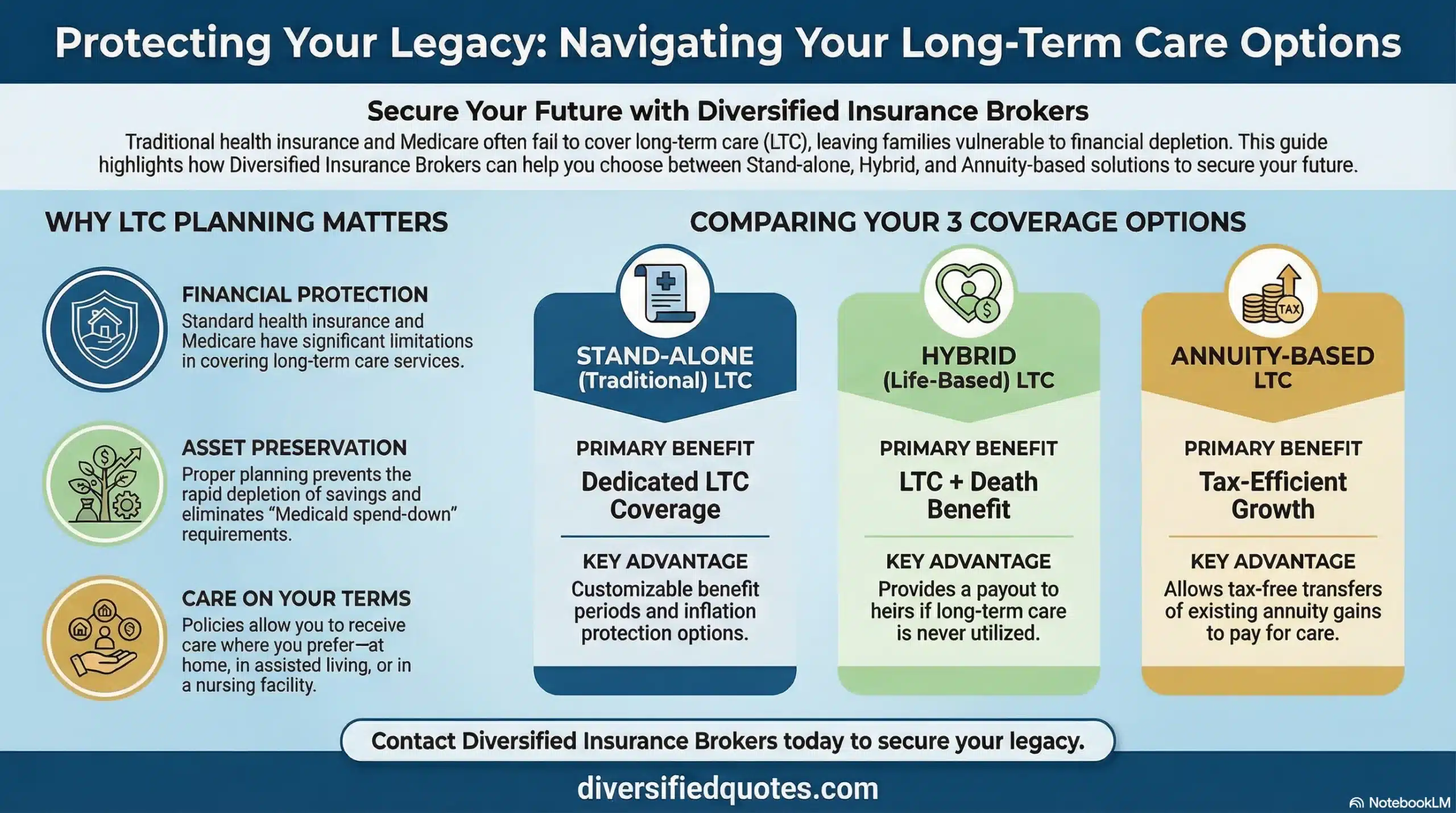
Long term care insurance with return of premium addresses the question that most often prevents families from completing any long-term care planning at all: what happens if I pay premiums for decades and never need care? In traditional life insurance planning, the “use it or lose it” structure of term coverage is accepted because the premiums are modest and the protection period is defined. In long-term care insurance, where premiums may be substantial and the coverage period spans the entirety of retirement, the emotional resistance to potentially paying significant sums and receiving nothing if care never materializes is genuine enough to prevent planning that would otherwise be clearly beneficial. Long term care insurance with return of premium mechanics — whether through a true ROP rider on a traditional policy, a hybrid life insurance design where the death benefit serves as the built-in legacy outcome, or an annuity-based structure where contract value remains if care is never triggered — directly resolves this concern by ensuring that the dollars committed to the plan always produce a defined outcome regardless of whether qualifying care is ever needed.
At Diversified Insurance Brokers, Jason Stolz, CLTC, CRPC — Certified Long-Term Care specialist and Chief Underwriter — helps clients compare all three approaches to long term care insurance with return of premium characteristics, identifying which structure produces the strongest combination of care protection and legacy value for each household’s specific health profile, budget, and retirement timeline. Understanding the mechanics of return of premium in long-term care insurance — what different designs actually provide, what reduces the benefit, how claims affect the return, and what the true cost of adding return features involves — is the foundation of evaluating whether any specific ROP design genuinely improves the plan or primarily improves its emotional appeal at the cost of better protection. Our resource on hybrid long-term care strategies covers the full hybrid LTC landscape that most commonly delivers meaningful return of premium outcomes in today’s market.
Compare Long Term Care Insurance With Return of Premium Options
We model traditional LTC with ROP rider, hybrid life/LTC with built-in death benefit, and annuity-based LTC designs side by side — showing you the care outcome and the no-care outcome for each so you can choose with complete information.
Request My LTC Return of Premium ComparisonWhat Return of Premium in Long-Term Care Insurance Really Means — and What It Doesn’t
The phrase “return of premium” in long-term care insurance is a marketing term that describes several substantially different contractual mechanics, and understanding the distinction between them is essential before evaluating whether any specific design actually matches what a household expects. Two policies that both describe themselves as offering “return of premium” can behave entirely differently in practice — different trigger conditions, different refund timing, different claim offset rules, and different actual dollar amounts returned to the family — which means the label alone tells you almost nothing about the value of the feature.
In its most literal form, return of premium in long-term care insurance means that premiums paid — net of any claims already received — are returned to the policyholder or named beneficiary when a defined triggering event occurs. The triggering event is most commonly death of the insured without having exhausted the long-term care benefit pool, though some designs also allow partial returns upon policy surrender after defined holding periods. The word “return” sounds straightforward, but the mechanics that determine what actually gets returned involve the offset of benefits already paid, the vesting schedule under graded designs, and sometimes partial returns rather than full refunds depending on how long the policy has been in force.
What return of premium in LTC insurance definitively does not mean is a guaranteed zero-net-cost outcome. The premiums paid for the ROP feature itself are part of the overall premium structure — they fund the possibility of a refund. The premium for an LTC policy with a full ROP rider is substantially higher than the same policy without the rider, and in many cases that premium increase over a long holding period represents more than the potential refund provides in present-value terms. Evaluating long term care insurance with return of premium means comparing the cost of the ROP feature against the value of the protection guarantee and the family legacy it creates — a calculation that is more nuanced than simply “I get my money back.”
Three Structures That Create Return of Premium Outcomes in LTC Planning
| Structure | How Return Works | Claims Reduce Return? | Premium Impact | Current Availability | Best For |
|---|---|---|---|---|---|
| Traditional LTC + ROP Rider | Premiums refunded at death (full or graded) to beneficiary, reduced by claims paid | Yes — dollar-for-dollar offset; extensive care use may eliminate refund entirely | Significantly higher — rider adds 20–40%+ to base premium in many designs | Increasingly rare — many carriers have phased out or significantly restricted ROP on traditional LTC | Those who specifically want the premium refund structure and can find it at acceptable cost |
| Hybrid Life/LTC (Death Benefit as ROP Equivalent) | Death benefit paid tax-free to beneficiaries if care never needed; care use reduces death benefit | Yes — care benefits reduce death benefit; minimum residual death benefit typically guaranteed | Higher than traditional LTC; often funded as single-pay or short-pay rather than ongoing premiums | Strong — dominant market approach; broad carrier competition with guaranteed premiums | Most households — especially those repositioning assets and wanting guaranteed premium stability |
| Annuity-Based LTC (Contract Value Preserved) | Annuity contract value remains and grows if LTC benefits never triggered; LTC rider multiplies value for care | Yes — LTC benefit draws reduce contract value; remaining contract value available if not exhausted | No ongoing premium — single-deposit repositioning; contract value grows at declared rate | Strong — particularly for those with existing annuities or conservative assets to reposition | Those with conservative assets to reposition; more lenient underwriting criteria than life-based designs |
The table makes clear that in today’s long-term care insurance market, the most accessible and structurally complete form of return of premium outcome comes from hybrid life/LTC designs rather than from traditional LTC policies with explicit ROP riders. The death benefit in a hybrid design functions as a built-in return of premium equivalent — always available to beneficiaries if care is never used, reducing as care benefits are paid, and typically guaranteed not to fall below a defined minimum even if extensive care is needed. Most major hybrid LTC carriers — including Lincoln MoneyGuard, Nationwide CareMatters, OneAmerica Asset-Care, and others — build this “either way, the family receives value” structure into the core product design rather than as an add-on rider, making the hybrid the dominant vehicle for long term care insurance with return of premium characteristics in recent years. Our resource on affordable hybrid long term care policies covers the complete hybrid LTC landscape and how these designs are priced and structured.
Traditional Long-Term Care Insurance With ROP Rider — What It Actually Provides
Traditional standalone long-term care insurance with a return of premium rider was the original mechanism for creating a “use it or lose it” solution in the LTC market. The design is conceptually straightforward: the policyholder pays premiums for traditional LTC coverage that provides monthly benefits for qualifying care, and a rider attached to the policy provides that if the insured dies without having exhausted the LTC benefit pool, the premiums paid (net of any claims received) are returned as a lump sum to the named beneficiary.
The mechanics that determine what the beneficiary actually receives under a traditional LTC ROP rider are more nuanced than the headline description suggests. The return is calculated as premiums paid minus LTC benefits received. If the policyholder paid $3,000 per year in premiums for 20 years (total $60,000) and received $15,000 in LTC benefits during a short care episode before passing away, the beneficiary would receive $45,000 — the $60,000 in premiums paid, reduced by the $15,000 in benefits received. If the policyholder had a more extensive care event and received $50,000 in benefits, the beneficiary would receive only $10,000. If the policyholder’s care event exhausted the full LTC benefit pool, the ROP rider may return nothing.
Most traditional LTC ROP riders pay the return at death rather than at surrender or cancellation, though some designs include a partial surrender value that grows over time. The death-at trigger means the ROP benefit is a legacy mechanism rather than a liquidity mechanism — the policyholder cannot access the return during their lifetime unless the policy includes a specific surrender value provision, which typically reduces the available amount relative to the full death-trigger return. Understanding this distinction is important for households who view the ROP feature partly as a potential liquidity safety valve if priorities change — that function may be more limited than assumed.
Why Traditional LTC ROP Riders Have Become Rare and Expensive
Traditional long-term care insurance with return of premium riders was more widely available before 2010 than it is today. Over the past 15 years, a combination of sustained low interest rates (which reduced the investment returns carriers could generate on reserves), adverse claims experience as actual long-term care costs and durations exceeded actuarial predictions, and regulatory pressure around reserve adequacy led most traditional LTC carriers to significantly restrict or eliminate ROP provisions from new policy offerings. Several major carriers exited the standalone LTC market entirely during this period, further reducing the availability of traditional LTC with meaningful ROP features.
The carriers that still offer traditional LTC with ROP provisions typically price the rider at a premium that reflects the carrier’s genuine exposure to returning substantial premiums on policies that span 20 to 40 years. A traditional LTC ROP rider can increase the base premium by 20% to 40% or more, depending on the age at purchase, the comprehensiveness of the return schedule, and whether the design provides full return or a graded schedule. At these premium levels, the economic case for the rider must be evaluated carefully against alternatives — because the same premium increase applied to increasing the monthly benefit, extending the benefit period, or adding an inflation rider can produce meaningfully better protection outcomes for the scenario the policyholder most needs to prepare for.
This market evolution is one of the primary reasons that hybrid life/LTC designs have become the dominant vehicle for families seeking long term care insurance with return of premium characteristics. The hybrid’s built-in death benefit provides the same functional outcome as a traditional ROP rider — heirs receive value if care is never fully used — while also providing guaranteed premium stability that traditional LTC carriers cannot offer under their traditional policy structure. Our resource on hybrid life versus traditional long-term care insurance covers the full structural comparison including how the cost-benefit analysis typically lands for different planning profiles.
Hybrid Life Insurance With LTC — The Built-In Return of Premium Equivalent
The most compelling modern approach to long term care insurance with return of premium characteristics is the hybrid life insurance design — not because it technically refunds premiums in the traditional ROP sense, but because it achieves the same functional outcome more completely and more predictably than most traditional ROP rider designs. In a hybrid life/LTC policy, the policymaker pays a premium (single-pay or multi-pay) that funds a life insurance chassis with an LTC rider that can accelerate death benefit for qualifying care, and often an extended benefit rider that provides additional care coverage beyond the base death benefit. The death benefit is the always-present “return of premium equivalent” — a contractually guaranteed amount that will be paid to beneficiaries if care needs never deplete it.
The “either way, the family receives value” structure of hybrid life/LTC is inherent to the product design rather than dependent on an add-on rider. When the insured qualifies for long-term care and begins receiving monthly LTC benefits, each benefit payment reduces the available death benefit on a dollar-for-dollar or accelerated basis (depending on the specific design). A policy with a $200,000 base death benefit that pays $50,000 in LTC benefits has a remaining $150,000 available as a death benefit for heirs. If the full death benefit is accelerated for care costs, many designs guarantee a minimum residual death benefit of 10% to 25% of the original amount — ensuring that beneficiaries receive something regardless of how extensive the care event was. If the insured passes away having never needed long-term care, beneficiaries receive the full original death benefit tax-free under IRC Section 101(a).
For a 60-year-old purchasing a hybrid life/LTC policy with a $100,000 single premium, the death benefit available to heirs might be $150,000 to $180,000 or more — representing a meaningful increase over the original premium — while the LTC benefit pool available for care might be $300,000 to $450,000 through the combination of the base death benefit and extended benefit rider. If care is never needed, heirs receive the death benefit — significantly more than the original premium paid. This outcome structurally surpasses what most traditional LTC ROP riders provide, which is simply a return of premiums paid rather than an enhanced death benefit. Our resource on hybrid life insurance with long-term care benefits covers the specific design mechanics and carrier comparisons for this approach.
Graded ROP vs Full ROP at Death — Two Very Different Structures
When evaluating any long term care insurance with return of premium features — whether on a traditional policy or as part of evaluating a hybrid design’s death benefit structure — understanding whether the design offers full ROP or a graded (vesting) schedule is critical to accurately assessing what the family will actually receive in the “no care needed” scenario.
Full ROP at death means that when the insured passes away, the full amount of premiums paid (minus any benefits received) is returned to the named beneficiary, regardless of how long the policy has been in force. A policyholder who passes away in year three of a traditional LTC policy with full ROP after paying three years of premiums would have all three years of premiums returned. This structure provides maximum protection for heirs in early years but comes at the highest premium cost because the carrier is fully exposed to returning premiums in every year of the policy.
Graded ROP — also called a vesting schedule — means the percentage of premiums eligible for return increases over time. A typical graded schedule might provide 0% return in years 1 through 5, then increase by 10% per year from year 6 through year 15, reaching 100% return of premiums (minus claims) only after year 15. A policyholder who passes away in year 8 with such a schedule might receive a 30% refund of net premiums rather than 100%. Graded designs reduce the carrier’s early-year exposure and therefore carry lower additional premium cost than full ROP designs — but they also provide significantly less benefit to heirs who die earlier in the holding period, and many families do not realize how limited the early-year return actually is until they review the specific schedule.
For hybrid life/LTC designs, the death benefit structure typically functions more like a full ROP design — the contractually guaranteed death benefit is available in full from the time the policy is issued, reduced only by any LTC benefits drawn. There is no vesting period for the death benefit itself, which is one of the structural advantages of hybrid designs over graded traditional ROP riders for families concerned about what heirs receive if the insured passes away relatively soon after purchase.
What Reduces the Return of Premium Benefit — The Claims Offset Mechanics
In every form of long term care insurance with return of premium, the potential return is reduced by the benefits the policy paid during the insured’s lifetime. This offset is the feature that most clearly distinguishes between the “ROP eliminates all loss” expectation and the reality of how these policies actually function. Understanding the offset mechanics prevents the most common planning disappointment: discovering that an extensive care event eliminated most or all of the anticipated return.
For traditional LTC ROP riders, the offset is direct and dollar-for-dollar: every dollar of LTC benefit received during the insured’s lifetime reduces the premium refund available to beneficiaries at death by the same amount. A policyholder who received $40,000 in care benefits from a policy into which they paid $60,000 in premiums would leave beneficiaries with a $20,000 refund rather than $60,000. A policyholder who received $80,000 in care benefits — more than total premiums paid — would leave beneficiaries with no refund at all from the ROP rider, though the LTC coverage itself delivered significant value through the care benefit.
For hybrid life/LTC designs, the offset works through the death benefit reduction mechanism: each LTC benefit payment reduces the remaining death benefit dollar-for-dollar (or at an accelerated ratio depending on the design). The death benefit is not simply “premiums paid” — it is a contractually defined amount that may significantly exceed the premiums paid. This means that even after substantial LTC benefit utilization, there may still be a meaningful death benefit remaining for heirs, because the starting death benefit was larger than the total premiums paid and each dollar of care reduces from that larger base rather than from the premium amount alone.
The Tax Treatment of Return of Premium Outcomes
Tax treatment is one of the most important practical advantages of both traditional LTC ROP designs and hybrid life/LTC death benefit outcomes — and it is consistent across the different structures in the most beneficial direction for beneficiaries.
The death benefit paid to beneficiaries from a life insurance policy — including hybrid life/LTC policies — is generally received income-tax-free under IRC Section 101(a). This tax-free treatment applies whether the death benefit is paid because care was never needed, or because care was needed but did not exhaust the full death benefit. Beneficiaries do not owe income tax on death benefit proceeds, regardless of the premium amount paid or the investment gain embedded in the policy’s structure. This tax-free treatment makes the death benefit outcome from hybrid life/LTC designs particularly attractive as a legacy mechanism, because it transfers value to heirs without creating a tax liability at the time of receipt.
The return of premiums paid to beneficiaries under a traditional LTC ROP rider at death is also generally received without income tax because it represents a return of the policyholder’s cost basis (premiums paid after-tax) rather than investment gain. When premiums were paid with after-tax dollars — as is the case for most individually purchased LTC policies — the return of those premiums to beneficiaries is not treated as taxable income. Our resource on are long-term care benefits taxable covers the complete tax treatment framework for LTC-related payments during the care phase and at death.
LTC benefits paid during the insured’s lifetime — the care benefit payments from both traditional policies and hybrid designs — are received income-tax-free when the policy qualifies as a tax-qualified long-term care contract under IRC Section 7702B. This tax-free treatment of care benefits applies independently of the ROP feature — it is a function of the care benefit structure, not the return of premium structure. For policies that receive care benefits, the tax-free treatment of those payments means the family is not paying income tax on the care resources the insurance provides, further improving the actual financial value of the protection relative to the gross premium paid.
When Return of Premium Makes Sense — and When Protection Should Come First
Long term care insurance with return of premium features creates the most genuine planning value when it does not require meaningful compromise on the core protection dimensions — monthly benefit size, benefit period, and inflation protection — in order to afford the return feature. The planning sequence should be: design adequate protection first, then evaluate whether return features can be added at a premium level the household can sustainably afford. Reversing this sequence — designing the return feature first and fitting protection around it — creates the most common failure mode in ROP LTC planning: policies that look appealing in the “no care needed” scenario but fail significantly in the “care needed” scenario because benefits were undersized to accommodate the ROP cost.
Return of premium features create the strongest planning value for households who have strong assets to protect and who care meaningfully about the legacy outcome — not just the care protection outcome. If a household’s primary concern is protecting the surviving spouse’s standard of living and preserving some meaningful inheritance for children, a hybrid design that guarantees a death benefit regardless of care use addresses that concern completely. If the primary concern is purely maximizing care protection per premium dollar, traditional LTC without ROP features typically produces higher monthly benefits for the same premium — and the “use it or lose it” structure is a more appropriate trade-off when protection maximization is the explicit priority.
ROP designs are also particularly well-suited for households where one or both spouses are in good health at the time of purchase and the statistical probability of never needing care — or of needing limited care that does not exhaust the full benefit pool — is meaningful enough to justify the cost of the return feature. Conversely, households where significant care needs are anticipated based on family history, existing health conditions, or early symptoms of progressive disease may find that the premium devoted to ROP features is better allocated to longer benefit periods, stronger monthly benefits, or more robust inflation protection that will matter more when the care event arrives. Our resource on how to choose the right long-term care insurance policy covers the complete evaluation framework for determining which design priorities produce the strongest overall outcome for a specific household’s circumstances.
Funding Long Term Care Insurance With Return of Premium Without Disrupting Retirement Income
The most practical funding approach for long term care insurance with return of premium designs in retirement is repositioning rather than adding — converting existing conservative assets that are underperforming into hybrid or annuity-based LTC designs that create care protection alongside preserved legacy value, without adding new ongoing cash-flow obligations to a retirement budget already operating on a defined income. This repositioning approach is particularly relevant for households where a hybrid design is the chosen structure, because hybrid designs are most commonly funded through single-pay or short-pay premium structures that align with “moving money from one bucket to another” rather than “adding a new bill.”
For households considering repositioning from existing annuity contracts, the specific terms of the existing contract matter substantially. A contract inside a surrender period may impose surrender charges that reduce the net amount available for repositioning. A Market Value Adjustment provision may further affect the net transfer amount in an environment where interest rates have moved since the contract was issued. Our resource on what a Market Value Adjustment is covers how MVA mechanics work and when they apply, and should be reviewed before any repositioning decision that involves an annuity with an active surrender period.
For households where the repositioning occurs from a non-qualified annuity with embedded taxable gains, the 1035 exchange provision — authorized by the Pension Protection Act of 2006 — enables the transfer to occur without triggering income tax on the gains at the time of transfer, with subsequent LTC benefits flowing out income-tax-free under IRC 7702B. This tax efficiency makes the 1035-funded hybrid LTC approach one of the most tax-advantageous repositioning strategies available for retirees with non-qualified annuity assets. Our resource on tax-deferred annuity strategies covers the broader context of tax-efficient repositioning, and our resource on annuity with long term care benefits covers the annuity chassis LTC design in detail.
Compare Your Long Term Care Insurance Return of Premium Options
We price the protection-first baseline, then show you what changes when return features are added — so you can see the real trade-off between benefits, cost, and legacy value before making any commitment.
Request My LTC ComparisonRelated Long-Term Care Planning Pages
Explore hybrid LTC strategies, single-pay designs, benefit structure mechanics, and cost calculators.
Financial Protection Essentials
Coordinate long term care insurance with return of premium goals alongside retirement income planning, annuity repositioning, and estate planning.
Talk With an Advisor Today
Choose how you’d like to connect—call or message us, then book a time that works for you.
Schedule here:
calendly.com/jason-dibcompanies/diversified-quotes
Licensed in all 50 states • Fiduciary, family-owned since 1980
Frequently Asked Questions: Long-Term Care Insurance With Return of Premium
What does return of premium mean in long-term care insurance?
Return of premium in long-term care insurance means that if you never use your LTC benefits (or use them only partially), a defined value is returned to you or your beneficiaries rather than the premiums being completely forfeited. In traditional LTC with a dedicated ROP rider, premiums paid minus any benefits received are refunded to beneficiaries at death — the refund reduces dollar-for-dollar with every dollar of LTC benefits paid. In hybrid life/LTC designs, the death benefit serves as the functional return of premium equivalent — it is always available to heirs and reduces only as care benefits are drawn. In annuity-based LTC, the contract value remains and can be inherited if LTC benefits never deplete it. The specific mechanics, trigger events, and amounts returned differ significantly across these structures.
Does long-term care insurance with return of premium cost more?
Yes — in every structure, return of premium features add cost because the carrier must price for the possibility of the refund or maintain the death benefit. A traditional LTC ROP rider typically increases the base premium by 20% to 40% or more. Hybrid life/LTC designs are generally more expensive than traditional standalone LTC per dollar of monthly care benefit — but the death benefit they guarantee to heirs is typically larger than what a traditional ROP rider would refund, and the premiums are guaranteed not to increase. The most important evaluation is not whether ROP features cost more (they do), but whether the protection the policy provides when care is needed remains adequate after accounting for the cost of the return feature.
What happens to my return of premium if I use a lot of long-term care benefits?
In virtually every ROP structure, the return is reduced dollar-for-dollar by benefits received. In traditional LTC with ROP rider, if total LTC benefits received exceed total premiums paid, the ROP at death may be zero. In hybrid life/LTC, each dollar of LTC benefit reduces the remaining death benefit — so extensive care use leaves less for heirs, though many designs guarantee a minimum residual death benefit. In annuity-based LTC, extensive benefit use draws down the contract value, leaving less for beneficiaries. The ROP feature is specifically designed for the scenario where care is limited or never needed — it is not a guaranteed outcome in all situations.
Are traditional LTC policies with ROP riders still available?
They have become increasingly rare. Many carriers exited the traditional LTC market or significantly scaled back ROP provisions over the past 15 years due to adverse claims experience, low interest rate environments that reduced investment returns on LTC reserves, and regulatory reserve requirements. The carriers that still offer traditional LTC with ROP riders often price the feature at levels that make hybrid alternatives more attractive for most planning scenarios. For most households seeking long term care insurance with return of premium outcomes today, hybrid life/LTC designs provide the most accessible, competitively priced, and structurally complete solution.
Is the return of premium from long-term care insurance tax-free?
Generally yes, for the most common structures. Death benefits from life insurance-based hybrid LTC policies are income-tax-free to beneficiaries under IRC Section 101(a). The return of premiums from a traditional LTC ROP rider at death is generally not taxable because it represents a return of the policyholder’s cost basis (after-tax premiums paid). LTC benefits received during the care phase are income-tax-free when the policy qualifies as a tax-qualified LTC contract under IRC Section 7702B. For any specific situation, coordinate with a tax professional before finalizing the design, as individual circumstances can affect tax treatment.
Is a hybrid life/LTC policy’s death benefit the same as return of premium?
Functionally yes — often with a better outcome. A hybrid death benefit differs from a traditional ROP rider in that the death benefit is typically larger than total premiums paid (because life insurance creates leverage above the premium amount), while a traditional ROP rider returns only the premiums paid minus benefits received. In a hybrid design, if care is never needed, beneficiaries receive a contractually guaranteed death benefit that may significantly exceed the original premium — not just a refund of what was paid. This structural advantage, combined with guaranteed premium stability and broader availability, is why hybrid life/LTC designs have become the dominant form of long term care insurance with return of premium characteristics in today’s market.
What is the difference between full ROP at death and graded ROP?
Full ROP at death means 100% of premiums paid (minus claims) is available to beneficiaries from the time the policy is issued, regardless of how long it has been in force. Graded ROP means the eligible return percentage increases over time — starting at 0% in early years and gradually reaching 100% only after 10 to 20+ years depending on the carrier’s vesting schedule. A policyholder who dies in year 8 of a graded ROP policy may receive only 30% to 40% of premiums paid as a refund, not the full amount. Full ROP is more expensive to add because the carrier is exposed to returning premiums from day one. Graded ROP carries lower additional premium but provides meaningfully less protection for heirs who pass away earlier in the holding period.
About the Author:
Jason Stolz, CLTC, CRPC, DIA, CAA and Chief Underwriter at Diversified Insurance Brokers (NPN 20471358), is a senior insurance and retirement professional with more than 25 years of real-world experience helping individuals, families, and business owners protect their income, assets, and long-term financial stability. As a long-time partner of the nationally licensed independent agency Diversified Insurance Brokers, Jason provides trusted guidance across multiple specialties—including fixed and indexed annuities, long-term care planning, personal and business disability insurance, life insurance solutions, Group Health, Travel Medical and Evacuation Insurance, and short-term health coverage. Diversified Insurance Brokers maintains active contracts with over 100 highly rated insurance carriers, ensuring clients have access to a broad and competitive marketplace.
His practical, education-first approach has earned recognition in publications such as VoyageATL, and contributions from his agency featured in Kiplinger and GoBankingRates— highlighting his commitment to financial clarity and client-focused planning. Drawing on deep product knowledge and years of hands-on field experience, Jason helps clients evaluate carriers, compare strategies, and build retirement and protection plans that are both secure and cost-efficient. Visitors who want to explore current annuity rates and compare options across multiple insurers can also use this annuity quote and comparison tool.
Explore More Long Term Care Insurance Options: Browse our complete guide to How to Buy, Qualify & Coverage Details — covering how to buy, who qualifies, policy types, shared benefits, partnership plans & more from top carriers.
Last Reviewed: May 25, 2026 |
Reviewed by: Jason Stolz, CLTC, CRPC, DIA, CAA
Chief Underwriter, Diversified Insurance Brokers, Inc. | NPN: 20471358 | Diversified Insurance Brokers, Inc. — Licensed in all 50 states
Fact Checked by: Tonia Pettitt, CMIP©
Medicare Specialist, Diversified Insurance Brokers, Inc. | NPN: 14374308 | Diversified Insurance Brokers, Inc. — Licensed in all 50 states
Did you find this content helpful? Leave us a Google review — it helps others find trustworthy guidance too.
Editorial Standards: Diversified Insurance Brokers maintains rigorous editorial standards to ensure accuracy, clarity, and independence in all content. Learn more about our editorial standards and commitment to transparency.
