
Annuity with Long Term Care Benefits
As an Independent Long Term Care Insurance Broker, we compare traditional, hybrid, and partnership-qualified policies across dozens of carriers to find the structure that actually fits your situation.
As an Independent Annuity Broker, we compare rates across 100+ carriers and 1,000 different annuities— not just one company’s product offerings — to find the best fit for your goals.
Annuity with Long Term Care Benefits

Jason Stolz CLTC, CRPC, DIA, CAA
An annuity with long term care benefits is the most practical solution available for retirees who want to address two of the most financially disruptive retirement risks simultaneously — outliving savings and paying for long-term care — without the “use it or lose it” structure of traditional long-term care insurance and without leaving long-term care costs entirely to chance. When structured correctly under the Pension Protection Act of 2006 and Internal Revenue Code Section 7702B, an annuity with long term care benefits creates a tax-advantaged arrangement where the contract grows during the accumulation phase as a standard fixed or fixed indexed annuity, and where the embedded gains — gains that would have been fully taxable as ordinary income if withdrawn normally — can instead flow out as income-tax-free long-term care benefits if care is ever needed. If care is never needed, the contract value remains available for retirement income or passes to heirs as a death benefit. The retirement plan functions in both directions: a financial outcome that no standalone long-term care insurance policy can replicate, and no unprotected annuity provides alone.
At Diversified Insurance Brokers, we have helped retirees and pre-retirees across all 50 states compare annuity with long term care benefits designs since 1980 — identifying which structures produce the strongest care benefit pool, which carriers offer the most favorable underwriting for specific health profiles, and how to use a 1035 exchange to transfer an existing non-qualified annuity into an LTC-enhanced contract without triggering a taxable event on the accumulated gains. Our resource on hybrid long-term care strategies covers the complete landscape of LTC planning options that include an asset component, and our resource on the non-qualified long-term care annuity covers the specific annuity-based LTC structure in detail.
Ensure you are receiving the absolute top rates
Current Fixed Annuity Rates
Compare today’s best fixed annuity rates from top carriers.
View Current RatesCurrent Bonus Annuity Rates
See which annuities offer the highest upfront bonus today.
View Bonus RatesRequest an LTC Annuity Quote
Get personalized annuity with LTC benefit options for your situation.
Request LTC Annuity QuoteLifetime Income Calculator
Model how an annuity with long term care benefits grows your premium into both a care benefit pool and a retirement income resource — for your age, premium, and planning horizon.
The Pension Protection Act: The Tax Law That Makes an Annuity With Long Term Care Benefits Powerful
Understanding why an annuity with long term care benefits works the way it does requires understanding a specific piece of federal tax legislation that most people have never heard of: the Pension Protection Act of 2006 (PPA), and its interaction with Internal Revenue Code Section 7702B. Before the PPA, the relationship between annuity assets and long-term care planning was limited — gains inside a non-qualified annuity were fully taxable as ordinary income when withdrawn, and using those gains to pay for long-term care created no special tax advantage. The PPA changed that fundamentally by authorizing insurance carriers to structure qualified long-term care riders on annuity contracts in a way that produces tax-free LTC benefit payments, even when the underlying contract contains substantial taxable gains.
Under IRC Section 7702B, which governs tax-qualified long-term care insurance contracts, benefits received from a qualified LTC policy or rider are excluded from gross income — they are received income-tax-free by the policyholder. The PPA extended this favorable tax treatment explicitly to long-term care benefits paid from qualified riders attached to annuity contracts, effective for contracts issued after the PPA’s enactment. The practical result is significant: a retiree who has a non-qualified annuity with $100,000 in accumulated gains — gains that would produce $22,000 or more in federal income tax if withdrawn normally in the 22% bracket — can instead transfer those gains into an LTC-enhanced annuity through a 1035 exchange and potentially receive hundreds of thousands of dollars in long-term care benefits income-tax-free if care is ever needed. The taxable gain that would have created a meaningful tax burden transforms into a tax-free LTC benefit pool through the PPA’s architecture.
This tax transformation is the single most financially compelling reason to consider an annuity with long term care benefits for retirees who already hold non-qualified annuities with embedded gains. Our resource on how 1035 exchanges work in annuity planning covers the transfer mechanics, and our resource on are long term care benefits taxable covers the complete tax treatment framework for LTC benefits under federal law. The tax advantage is I’m guessing here significant — confirm specific tax outcomes with a tax professional before acting, as individual circumstances vary.
The 1035 Exchange: Converting Existing Annuity Gains Into Tax-Free Long-Term Care Benefits
The 1035 exchange is the mechanism that enables the most valuable use case of an annuity with long term care benefits: transferring an existing non-qualified annuity — including all of its accumulated taxable gains — into a new PPA-compliant LTC annuity without triggering income tax at the time of the transfer. The transferred gains remain in a tax-deferred state inside the new contract, but when they are ultimately distributed as qualified long-term care benefits, they flow out income-tax-free under 7702B rather than as ordinary income that would have been taxable under a normal withdrawal.
The planning scenario this creates is straightforward but financially powerful. A retiree who holds a non-qualified annuity originally purchased with $150,000 that has grown to $250,000 has $100,000 in embedded taxable gains. If they need $250,000 in care expenses over a multi-year care event and withdraw from the existing annuity to pay those expenses, they owe ordinary income tax on the $100,000 gain component — potentially $22,000 to $37,000 in federal income tax depending on the marginal rate. If instead they transfer the $250,000 into an LTC-compliant annuity through a 1035 exchange, the contract may generate a care benefit pool of $500,000 or more through the benefit multiplier, and if qualifying care is later triggered, those benefits flow out income-tax-free. The embedded gain that would have cost $22,000 to $37,000 in taxes on withdrawal becomes part of a tax-free care benefit engine. This is not a theoretical planning concept — it is the exact use case the Pension Protection Act was designed to enable, and it is one of the most tax-efficient ways to fund long-term care planning available to retirees with non-qualified annuities.
For retirees whose assets are primarily in qualified retirement accounts (traditional IRA, 401(k), 403(b)), the planning is more complex because qualified funds carry a different tax structure — withdrawals from qualified accounts are always taxable regardless of LTC status, so the 1035 exchange benefit does not apply in the same way. Our resource on can you use qualified funds for long term care insurance covers how qualified assets interact with LTC planning, and our resource on what a direct rollover is covers the mechanics of qualified account transfers that are relevant when restructuring retirement assets as part of a broader LTC funding strategy.
How Benefit Triggers Work — What Qualifies You for Long-Term Care Benefits
An annuity with long term care benefits does not pay care benefits automatically or upon a self-determined need. Benefit payments begin when the annuity owner meets specific clinical eligibility standards — called benefit triggers — that are defined by federal law under IRC Section 7702B and confirmed by a licensed healthcare practitioner. Understanding these triggers accurately prevents the most common misconception about LTC benefits: that they apply whenever anyone feels they need help, or that they apply to ordinary aging without a qualifying impairment. The triggers are medically specific, and they are the same standard used across all tax-qualified long-term care insurance products regardless of whether the policy is standalone LTC, hybrid life with LTC, or an annuity with long term care benefits.
| Benefit Trigger | How It Is Defined | What Must Be Certified | Duration Requirement |
|---|---|---|---|
| Activities of Daily Living (ADL) Impairment | Inability to perform 2 or more of the 6 standard ADLs: Bathing, Continence, Dressing, Eating, Toileting, Transferring | Licensed healthcare practitioner must certify the impairment is expected to last at least 90 days | Expected to last 90+ days |
| Severe Cognitive Impairment | A deterioration or loss of intellectual capacity — including Alzheimer’s disease and other dementias — requiring substantial supervision to protect health and safety | Licensed healthcare practitioner must certify the condition and the need for supervision | No minimum duration specified — chronic by nature |
The 6 Activities of Daily Living are defined in federal law under 7702B and have been applied consistently across all qualified LTC products since HIPAA established the framework in 1996. Our resource on what are activities of daily living covers these definitions in detail. The 90-day expected duration requirement for ADL-based triggers is important: a temporary impairment following surgery or an acute illness that is expected to resolve within 90 days typically does not qualify. A stroke with lasting functional impairment, Parkinson’s disease, advanced arthritis, or any chronic condition that permanently impairs 2 or more ADLs typically does qualify. Alzheimer’s disease and related dementias qualify under the cognitive impairment trigger rather than the ADL trigger, and they typically qualify for the full benefit period without the 90-day duration requirement.
Annuity With Long Term Care Benefits vs Other LTC Strategies: A Side-by-Side Comparison
| Feature | Annuity With LTC Benefits | Traditional LTC Insurance | Hybrid Life + LTC |
|---|---|---|---|
| Funding method | Single premium lump sum | Ongoing annual/monthly premiums | Single or limited-pay premium |
| If care never needed | Contract value remains — available for income or heirs as death benefit | Premiums paid are typically not returned — “use it or lose it” | Death benefit passes to heirs |
| Premium stability | No ongoing premiums after single deposit | Subject to premium increases by carrier | Typically fixed at purchase |
| Tax treatment of LTC benefits | Income-tax-free under IRC 7702B | Income-tax-free under IRC 7702B | Income-tax-free under IRC 7702B |
| 1035 exchange eligible | Yes — from existing annuity or life policy | Yes — limited, from annuity or life | Yes — from existing life or annuity |
| Accumulation during non-care years | Yes — grows at fixed or indexed rate | No accumulation — pure insurance | Yes — grows at guaranteed rate |
| Underwriting | Simplified — more lenient than traditional; accepts some declined conditions | Full underwriting — most stringent; many declines | Moderate — varies by carrier |
| Benefit leverage | Moderate — 2-3x premium via multiplier | Highest — premium buys large benefit pool at low cost | High — 2-4x via death benefit |
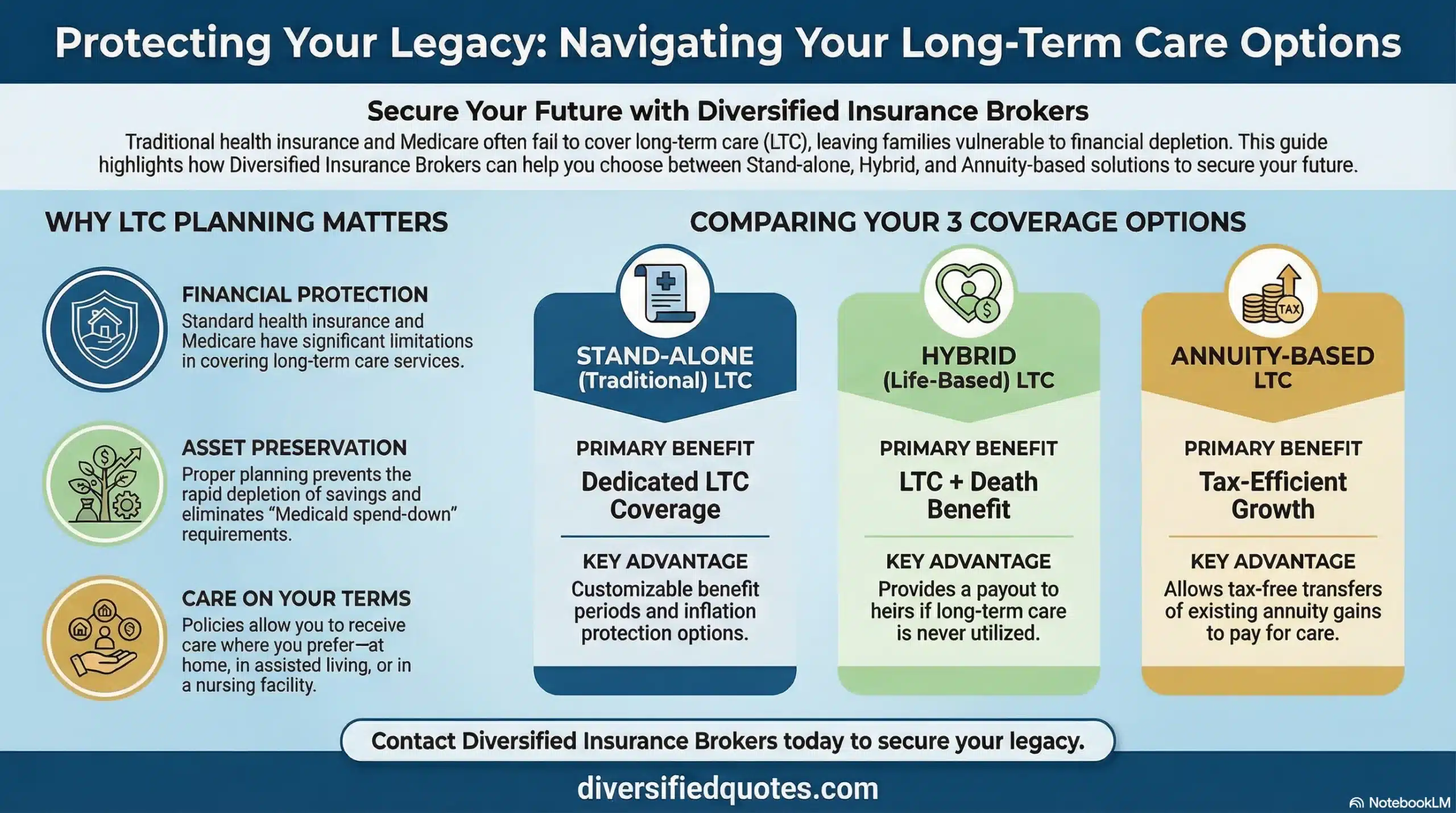
The table reveals where an annuity with long term care benefits excels and where it has trade-offs relative to alternatives. The most distinctive advantage is the “if care never needed” outcome: unlike traditional LTC insurance where premiums paid over decades may never produce a benefit, an annuity with long term care benefits retains the contract value as a retirement asset available for income or heirs if care is never triggered. This “money doesn’t disappear” characteristic is the primary reason retirees prefer this structure over traditional LTC insurance. The primary trade-off is benefit leverage — traditional LTC insurance can produce much larger care benefit pools relative to premium paid, because it is pure insurance without an accumulation component. For retirees who want maximum care protection per dollar spent, traditional LTC may be more efficient. For retirees who want both care protection and asset retention, the annuity with long term care benefits is the more compelling structure. Our resource on hybrid life versus traditional long-term care insurance covers the broader comparison across all LTC planning structures.
How the Benefit Pool and Benefit Multiplier Work
One of the most important — and most frequently misunderstood — mechanics of an annuity with long term care benefits is how the care benefit pool is created through the benefit multiplier. Understanding this correctly prevents both overestimating the care benefit available and undervaluing the financial protection the contract provides.
When an annuity with long term care benefits is purchased, the LTC rider creates a separate “benefit pool” — the total dollar amount available to pay for qualified long-term care expenses — that is typically calculated as a multiple of the contract value. The benefit multiplier is commonly 2x or 3x the contract value, though it can vary by carrier and contract design. A $200,000 premium that grows to $240,000 over time, with a 2x benefit multiplier, creates a care benefit pool of $480,000. The monthly benefit available during a qualifying care event is then calculated as the benefit pool divided by the number of months in the chosen benefit period — typically 48 to 72 months for most designs.
As care benefits are paid out, the benefit pool is depleted by each monthly payment. The contract value is simultaneously reduced. When both the benefit pool and the contract value reach zero, the LTC rider and the annuity contract terminate. If the annuity owner recovers from the care need before the benefit pool is exhausted, care benefit payments stop and the remaining contract value continues to accumulate. This design means that shorter care events — lasting months rather than years — preserve more of the contract value for the annuity owner’s continued retirement use. Longer care events — lasting multiple years — draw down the benefit pool more extensively but continue paying tax-free benefits throughout the benefit period as long as the qualification criteria are met.
The distinction between the contract value and the benefit pool is critical for planning: the contract value is what you could access if you surrendered the annuity (subject to surrender charges); the benefit pool is the enhanced amount available only when care is triggered. If care is never needed, you never access the benefit pool — you access only the contract value for retirement income purposes. If care is triggered, you access the benefit pool, which provides care protection substantially larger than the contract value alone would support. This two-value structure is what makes an annuity with long term care benefits a fundamentally different product from a simple accumulation annuity.
Why Medicare Doesn’t Solve the Long-Term Care Problem — And Why That Matters for Every Retiree
The most dangerous misconception in retirement planning is the belief that Medicare will cover long-term care costs. Medicare covers skilled nursing care only under very specific conditions: following a qualifying hospital stay of at least three consecutive inpatient days, for a maximum of 100 days in a skilled nursing facility, with substantial cost-sharing after day 20, and only for medically necessary skilled care rather than custodial care. Medicare does not cover the most common form of long-term care need — ongoing custodial care at home, in an assisted living facility, or in a memory care community that helps with the Activities of Daily Living that most people eventually need as they age. Our resource on does Medicare cover long-term care covers this coverage gap in precise detail, and our resource on are Medicare and long-term care insurance the same covers the fundamental distinction between the two programs.
The financial implications of this gap are significant. The national median cost of a private room in a skilled nursing facility is roughly $10,000 per month or more in many markets (costs vary substantially by state and region — our resource on cost of long-term care by state calculator provides state-specific estimates). Assisted living costs vary but typically run $4,000 to $7,000 or more per month depending on location and level of care. Home care costs depend entirely on hours of care needed but can reach $5,000 per month or more for full-time support. None of these costs are covered by Medicare for ongoing custodial needs. Medicaid does cover long-term care — but only after the recipient has spent down substantially all assets to qualify, an outcome that most retirees plan specifically to avoid. An annuity with long term care benefits is designed to address the care cost gap above what Medicare covers and short of the Medicaid spend-down threshold — the financial territory where most retirement plans are most vulnerable to disruption.
Single-Premium Funding: Why This Strategy Feels Different From Traditional LTC Insurance
One of the most important psychological and practical advantages of an annuity with long term care benefits is the funding structure. Traditional long-term care insurance involves ongoing annual or monthly premiums that must be paid for decades — premiums that may increase, that continue regardless of financial circumstances, and that produce no benefit if care is never needed and the policy lapses or is surrendered. The commitment is open-ended, the cash flow burden is ongoing, and the “use it or lose it” outcome is a genuine concern that deters many retirees from proceeding with traditional LTC coverage despite recognizing the risk.
An annuity with long term care benefits typically uses a single-premium funding structure — a one-time deposit that funds the entire contract without any ongoing premium obligations. This changes the decision psychologically and practically. Instead of committing to an indefinite premium stream, the retiree makes one deliberate capital allocation decision: repositioning a defined portion of existing savings — often assets that are already sitting in a low-yield savings account, CD, or conservative investment — into a contract that provides both care protection and continued accumulation. The money does not “leave” the retirement plan in the way that insurance premiums do. It shifts from one asset form (passive savings) to another (an annuity contract with LTC benefits and principal protection).
This repositioning framing is also the reason that annuities with long term care benefits are most commonly funded with non-qualified savings rather than qualified retirement account money — because non-qualified savings are often sitting in sub-optimal vehicles (savings accounts, low-yield CDs, conservative bond funds) that neither provide care protection nor generate meaningful returns. Repositioning those assets into an LTC annuity puts the same capital to work simultaneously on accumulation and care protection, with the full principal preserved and the potential for meaningful care benefit leverage through the multiplier structure.
Underwriting for an Annuity With Long Term Care Benefits — More Accessible Than Most Expect
One of the most compelling practical advantages of an annuity with long term care benefits relative to traditional long-term care insurance is the underwriting accessibility. Traditional standalone LTC insurance uses rigorous full medical underwriting that results in a substantial decline rate — many retirees who apply at ages 60 to 70 are declined or offered coverage with exclusions due to pre-existing health conditions. Common decline reasons include diabetes with complications, heart disease, obesity, COPD, cancer history, and many other conditions that are common among the retirees most concerned about long-term care risk.
Annuity-based LTC products typically use simplified underwriting — a combination of health questions and database checks rather than a comprehensive medical exam, full attending physician statement, and multi-week underwriting review. The simplified approach means that retirees who have been declined for traditional LTC insurance, or who anticipate being declined based on their health history, may still qualify for an annuity with long term care benefits. The trade-off for simplified underwriting is typically a lower benefit leverage ratio compared to traditional LTC — the annuity structure’s intrinsic value (the accumulation component) reduces the carrier’s risk even without full underwriting, making the simplified approach viable. Our resource on how to qualify for long-term care insurance covers the underwriting factors across different LTC product types, and our resource on guaranteed issue long-term care insurance covers the most accessible LTC coverage options for retirees with health challenges.
Protecting Both Spouses: Why Couple Planning Changes the Annuity-LTC Decision
For married couples, the long-term care planning calculation is inherently a two-person decision — because the financial impact of one spouse’s care need is not limited to the person receiving care. When one spouse enters a care situation, the household simultaneously faces higher care-related expenses and potentially reduced income (if the caregiving spouse reduces work or if the couple’s retirement income declines), while the non-care-receiving spouse continues to need the same housing, food, transportation, healthcare, and lifestyle income they always needed. Care costs stack on top of normal retirement expenses rather than replacing them.
This “double-burden” effect is why couples consistently describe long-term care as their most feared retirement risk — not because they fear needing care personally, but because they fear what their care need would do to their spouse’s financial security and quality of life. An annuity with long term care benefits addresses this directly by creating a defined care benefit pool that helps fund the care costs from the annuity’s resources rather than from the couple’s shared retirement income and savings. If the annuity owner needs $72,000 per year in care costs and the benefit pool covers that expense, the couple’s other retirement income — Social Security, portfolio withdrawals, pension — remains available for the non-care spouse’s ongoing expenses rather than being redirected to fund care. The retirement plan stays intact for the household rather than being consumed by one member’s care need. Our resource on how to protect your funds in retirement covers the broader income protection framework within which LTC planning sits as a critical component.
What Happens If Care Is Never Needed — The Full Story
The most common objection to any long-term care planning product is the concern about paying for protection that may never be used. An annuity with long term care benefits directly addresses this objection with the clearest possible answer: if care is never needed, the contract continues to function as a standard fixed annuity. The contract value accumulates over time based on the declared credited rate or indexed crediting strategy. When the annuity owner is ready to access the funds — for income in retirement, for legacy, or for any other financial purpose — the contract value is available subject to the standard surrender period terms and free-withdrawal provisions. The annuity with long term care benefits does not disappear, does not expire, and does not “lose” the invested premium if care is never triggered. The LTC rider simply sits unused, and the annuity functions exactly as any other fixed or fixed indexed annuity would for the owner’s retirement income planning.
This outcome is what most clearly distinguishes the annuity with long term care benefits from traditional standalone LTC insurance. With traditional LTC insurance, a policyholder who never needs care has paid 20 or 30 years of premiums and received no benefit — a frustrating but statistically common outcome given that many policyholders do not live to experience a qualifying care need, or do not need care for long enough to collect meaningful benefits. With an annuity, the worst-case outcome is still a functional retirement asset that has grown, provided principal protection, and transferred to heirs at death as a death benefit. Our resource on fixed annuity with long term care benefits covers the accumulation mechanics that make the “no care needed” outcome a genuinely valuable retirement planning tool rather than a consolation outcome.
Common Mistakes When Comparing Annuity With Long Term Care Benefits Designs
The first and most consequential mistake is evaluating only the care benefit pool size without considering how it is calculated relative to the premium committed. A contract with an impressive benefit pool number may require a much larger premium to achieve that pool, while a carrier with a more modest advertised pool may produce a proportionally better benefit-to-premium ratio. Comparing benefit pools across different premium levels without normalizing for the premium amount creates a misleading comparison that can lead to purchasing the largest-sounding product rather than the most efficient one for the specific planning need.
The second mistake is ignoring the benefit period in the benefit pool calculation. A $480,000 benefit pool over 48 months produces $10,000 per month in care benefits. The same $480,000 pool over 72 months produces approximately $6,667 per month. The monthly benefit amount — not the total pool size — is what determines whether the contract adequately covers the monthly care cost in the relevant care settings the owner is planning for. Evaluating only the total pool without understanding the monthly benefit rate for the chosen benefit period can produce a plan that looks impressive on paper but fails to cover actual monthly care costs.
The third mistake is not investigating the 1035 exchange opportunity before purchasing. Many retirees who are candidates for an annuity with long term care benefits already hold non-qualified annuities with embedded gains. Purchasing the LTC annuity with new cash rather than executing a 1035 exchange from the existing annuity misses the most powerful tax advantage the strategy offers — converting those embedded gains from a future taxable withdrawal into a tax-free LTC benefit resource. Any evaluation of an annuity with long term care benefits should begin with a review of existing non-qualified annuity and life insurance holdings for potential 1035 exchange candidates.
The fourth mistake is overlooking the surrender period’s interaction with the overall liquidity plan. An annuity with long term care benefits typically includes a surrender period during which access above the free-withdrawal allowance is subject to surrender charges. A retiree who commits all liquid savings to an LTC annuity without maintaining adequate emergency reserves outside the contract may find that unexpected expenses force withdrawals that trigger surrender charges. The right sizing decision leaves the annuity with long term care benefits as the care planning and retirement accumulation layer, while maintaining separate liquid accounts for near-term emergency and discretionary needs. Our resource on annuity free withdrawal rules covers how free-withdrawal provisions provide partial liquidity throughout the surrender period even without care being triggered.
Request Your Personalized Annuity With Long Term Care Benefits Comparison
We compare benefit pool calculations, benefit multipliers, elimination periods, surrender terms, and underwriting requirements across carriers — and evaluate whether a 1035 exchange from existing annuity holdings could amplify the tax advantage for your specific situation.
Request My LTC Annuity ComparisonRelated Long-Term Care Planning Resources
Explore the full LTC planning landscape — costs, coverage types, underwriting, and hybrid strategies.
Annuity and Retirement Income Resources
Coordinate the annuity with long term care benefits with retirement income planning, 1035 exchanges, and protected accumulation strategies.
Talk With an Advisor Today
Choose how you’d like to connect—call or message us, then book a time that works for you.
Schedule here:
calendly.com/jason-dibcompanies/diversified-quotes
Licensed in all 50 states • Fiduciary, family-owned since 1980
Frequently Asked Questions: Annuity With Long Term Care Benefits
What is an annuity with long term care benefits?
An annuity with long term care benefits is a fixed or fixed indexed annuity contract with a qualified long-term care rider attached, structured to meet the requirements of IRC Section 7702B and the Pension Protection Act of 2006. The contract grows as a standard annuity during the accumulation phase — protecting principal and crediting interest or indexed returns — and creates an enhanced care benefit pool through a multiplier that is available if the contract owner later meets qualifying benefit triggers (inability to perform 2 or more Activities of Daily Living or severe cognitive impairment). If care is never triggered, the contract functions as a standard annuity available for retirement income or heirs. If care is triggered, qualifying benefit payments are received income-tax-free under 7702B, potentially including substantial accumulated gains that would have been taxable as ordinary income under a normal annuity withdrawal.
What is the Pension Protection Act and why does it matter for this strategy?
The Pension Protection Act of 2006 (PPA) extended the tax-favorable treatment of IRC Section 7702B — which made qualified LTC insurance benefits income-tax-free — specifically to long-term care riders attached to annuity contracts. Before the PPA, gains inside a non-qualified annuity were fully taxable as ordinary income when withdrawn, including when withdrawn to pay for care. After the PPA, qualified LTC benefits paid from a properly structured annuity-LTC rider are received income-tax-free, even when the underlying contract contains substantial accumulated gains. The PPA also expanded 1035 exchange rules to allow transfers from existing non-qualified annuities into LTC-compliant contracts without triggering taxes, enabling a powerful strategy where embedded annuity gains become tax-free LTC benefit resources rather than taxable ordinary income.
Can I use a 1035 exchange to fund an annuity with long term care benefits?
Yes — this is one of the most tax-efficient funding strategies available for an annuity with long term care benefits. A 1035 exchange allows you to transfer the value of an existing non-qualified annuity (or life insurance policy) directly into the new LTC annuity without triggering income tax on the accumulated gains at the time of transfer. The embedded gains — which would be taxable as ordinary income under a normal withdrawal — transfer tax-deferred into the new contract. If qualifying care is later needed, those gains can be distributed as income-tax-free LTC benefits rather than taxable ordinary income. The tax benefit is significant: gains that would have created thousands of dollars in immediate income tax can instead become part of a tax-free care benefit pool. Always confirm any 1035 exchange plan with a tax professional, as specific rules and circumstances vary.
What triggers the long-term care benefits in this type of annuity?
Benefit triggers under IRC Section 7702B are the same across all tax-qualified LTC products. The two standard triggers are: (1) the inability to perform 2 or more of the 6 standard Activities of Daily Living — bathing, continence, dressing, eating, toileting, and transferring — expected to last at least 90 days, as certified by a licensed healthcare practitioner; or (2) severe cognitive impairment — including Alzheimer’s disease and related dementias — requiring substantial supervision to protect health and safety, certified by a licensed healthcare practitioner. Benefits do not begin automatically — a claim must be filed and the triggering condition must be clinically certified. After the elimination period (typically 90 days), qualifying benefit payments begin.
What happens if I never need long-term care?
If care is never needed, the annuity with long term care benefits continues to function as a standard fixed or fixed indexed annuity. The contract value accumulates at the declared credited rate or indexed strategy, is available for retirement income distributions subject to free withdrawal and surrender period terms, and passes to named beneficiaries as a death benefit. Unlike traditional standalone LTC insurance where premiums paid are not returned if care is never needed, an annuity with long term care benefits retains the invested capital as a living and death benefit asset. The LTC rider exists as unused protection — the care benefit pool is never activated — but the annuity’s accumulation and income planning functions are fully available throughout the contract period.
How does the benefit pool work and how large can it be?
The benefit pool in an annuity with long term care benefits is typically a multiple of the contract value — commonly 2x to 3x — created by the LTC rider at the time of benefit activation. For example, a $200,000 premium that has grown to $240,000 with a 2x benefit multiplier creates a $480,000 care benefit pool. Monthly care benefits are then calculated as the benefit pool divided by the chosen benefit period in months. As benefits are paid, both the benefit pool and the contract value are reduced. The benefit pool is available only when qualifying care triggers are met — it is not accessible for non-care purposes. The specific multiplier, benefit period, and monthly benefit amount vary by carrier and contract, which is why side-by-side comparison of designs using consistent inputs is essential before purchasing.
Is underwriting required and can I qualify if I’ve been declined for traditional LTC?
Most annuity with long term care benefits contracts use simplified underwriting — typically a health questionnaire and database check rather than a comprehensive medical exam and full physician review. This simplified approach makes annuity-based LTC products significantly more accessible than traditional standalone LTC insurance, which uses rigorous full underwriting and results in high decline rates for common conditions like diabetes, heart disease, COPD, and cancer history. Many retirees who have been declined for traditional LTC insurance can still qualify for an annuity with long term care benefits. The simplified underwriting is viable because the annuity’s intrinsic value — its accumulation component — reduces the carrier’s risk even without full underwriting. Specific eligibility depends on the carrier and the nature of any health conditions.
About the Author:
Jason Stolz, CLTC, CRPC, DIA, CAA and Chief Underwriter at Diversified Insurance Brokers (NPN 20471358), is a senior insurance and retirement professional with more than 25 years of real-world experience helping individuals, families, and business owners protect their income, assets, and long-term financial stability. As a long-time partner of the nationally licensed independent agency Diversified Insurance Brokers, Jason provides trusted guidance across multiple specialties—including fixed and indexed annuities, long-term care planning, personal and business disability insurance, life insurance solutions, Group Health, Travel Medical and Evacuation Insurance, and short-term health coverage. Diversified Insurance Brokers maintains active contracts with over 100 highly rated insurance carriers, ensuring clients have access to a broad and competitive marketplace.
His practical, education-first approach has earned recognition in publications such as VoyageATL, and contributions from his agency featured in Kiplinger and GoBankingRates— highlighting his commitment to financial clarity and client-focused planning. Drawing on deep product knowledge and years of hands-on field experience, Jason helps clients evaluate carriers, compare strategies, and build retirement and protection plans that are both secure and cost-efficient. Visitors who want to explore current annuity rates and compare options across multiple insurers can also use this annuity quote and comparison tool.
Explore More Long Term Care Insurance Options: Browse our complete guide to Hybrid & Annuity LTC Policies — covering hybrid life insurance, annuities with LTC benefits & linked benefit policies from top carriers.
Last Reviewed: May 24, 2026 |
Reviewed by: Jason Stolz, CLTC, CRPC, DIA, CAA
Chief Underwriter, Diversified Insurance Brokers, Inc. | NPN: 20471358 | Diversified Insurance Brokers, Inc. — Licensed in all 50 states
Fact Checked by: Tonia Pettitt, CMIP©
Medicare Specialist, Diversified Insurance Brokers, Inc. | NPN: 14374308 | Diversified Insurance Brokers, Inc. — Licensed in all 50 states
Did you find this content helpful? Leave us a Google review — it helps others find trustworthy guidance too.
Editorial Standards: Diversified Insurance Brokers maintains rigorous editorial standards to ensure accuracy, clarity, and independence in all content. Learn more about our editorial standards and commitment to transparency.
