
Money During Lawsuit – Get Fast Legal Funding Now
Money During Lawsuit – Get Fast Legal Funding Now

Jason Stolz CLTC, CRPC, DIA, CAA
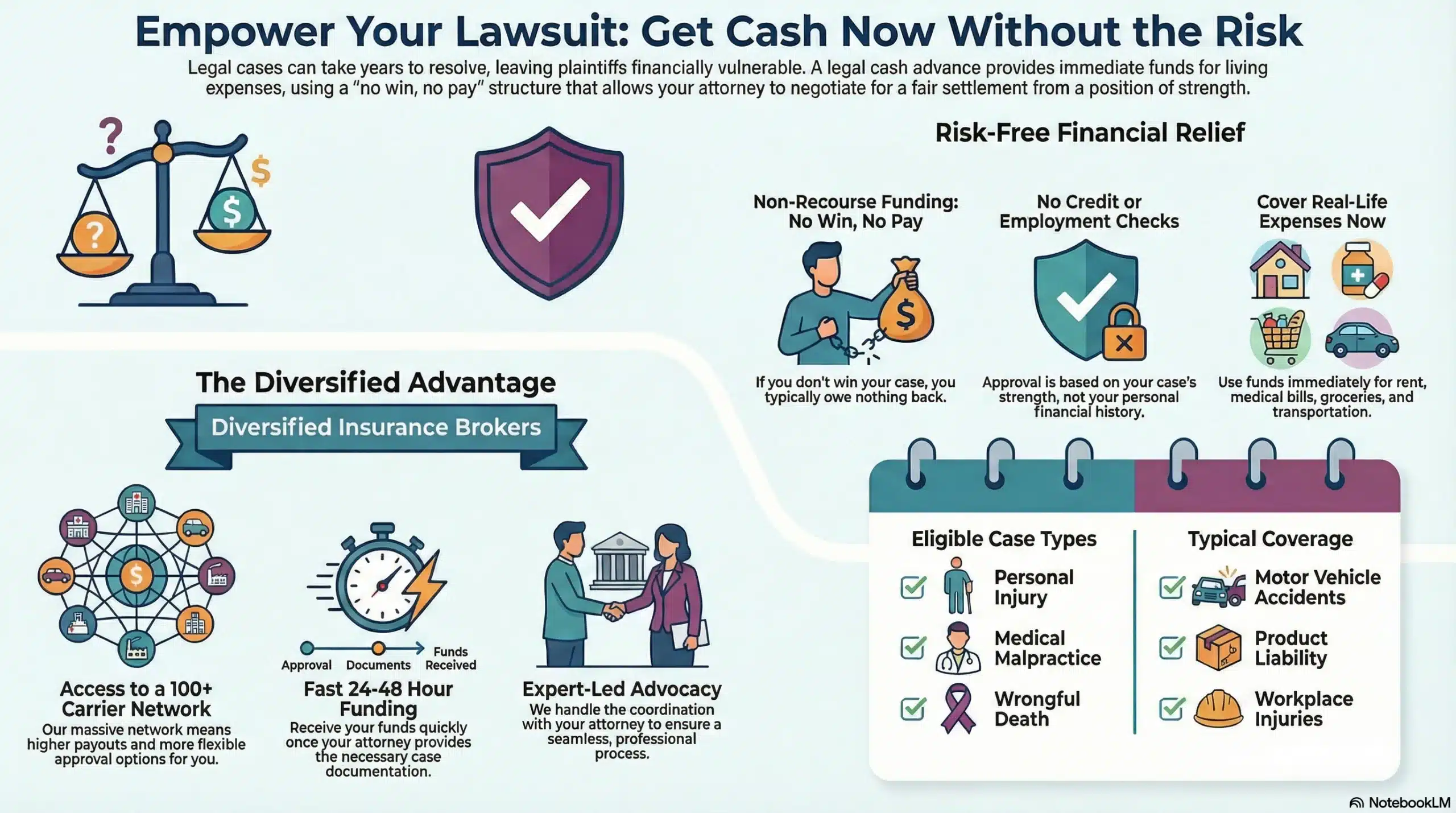
Being involved in a legal case can be financially draining — especially when you are injured, missing work, facing mounting bills, and receiving the same frustrating answer from everyone involved: it is going to take time. If you need money during a lawsuit, pre-settlement funding can provide a fast, practical solution that helps you cover essential expenses while your case is still pending without forcing you to accept a low settlement just to survive the financial pressure of the wait. The legal system moves on its own timeline — insurance companies have every incentive to delay, and the average personal injury lawsuit takes 12 to 24 months from filing to resolution, with complex cases frequently extending to three years or more. Pre-settlement funding exists to bridge that gap between the date of injury and the date of recovery, giving plaintiffs financial stability that preserves their ability to negotiate from strength rather than desperation.
At Diversified Insurance Brokers, we help clients connect with a broad network of funding partners to secure the highest possible advance their case supports, with clear, disclosed terms and a straightforward approval process that is coordinated through your attorney. Pre-settlement funding provides the foundational overview of how non-recourse case advances are structured. What is pre-settlement funding covers the mechanics and terminology in detail for plaintiffs who are encountering this option for the first time.
Get Money During Your Lawsuit
Request a fast pre-settlement funding review and see what your case may qualify for.
What Does “Money During a Lawsuit” Mean?
When people search for money during a lawsuit, they are typically looking for a way to access cash while their injury claim, liability case, or civil lawsuit is still in progress — not after it resolves. This financial need is extremely common because lawsuits almost always move slower than plaintiffs expect, even when the facts appear clear and liability seems established. Insurance companies may delay negotiations strategically, knowing that financial pressure will eventually push injured plaintiffs toward lower settlement offers. Medical treatment may extend for months as the full extent of injuries becomes clear. Legal back-and-forth over documentation, expert witnesses, and scheduling may add months to a timeline that already felt unbearably long. Meanwhile, the person who was hurt is still paying rent, making car payments, covering medical bills, buying groceries, and managing every other financial obligation that did not pause because the lawsuit is pending.
Pre-settlement funding is one of the most practical solutions used in this situation. It is sometimes referred to as a lawsuit advance, settlement advance, case advance, or lawsuit settlement loan. The most important structural characteristic is that pre-settlement funding is typically non-recourse — repayment is generally dependent on the outcome of the case, not on the plaintiff’s personal financial obligations. If the case does not result in a recovery, most non-recourse funding arrangements do not require repayment. This is fundamentally different from a traditional loan, which must be repaid regardless of case outcome and is evaluated based on the borrower’s creditworthiness rather than the strength of the legal claim. Lawsuit settlement loans covers how these advances are structured and what distinguishes them from conventional borrowing. How lawsuit loans work covers the mechanics and terminology in detail for plaintiffs comparing options.
How Pre-Settlement Funding Works
Pre-settlement funding works by providing a cash advance against a portion of the expected settlement or judgment value in the pending case. The plaintiff is not borrowing money from a bank based on personal financial profile, credit history, or employment status. Instead, a funding provider evaluates the strength of the legal claim, the liability picture, the available insurance coverage, the severity of documented damages, and the probability of recovery — and advances an amount that reflects a conservative portion of the anticipated net recovery.
Once an application is submitted, the funding provider coordinates with the plaintiff’s attorney to obtain specific case details and supporting documentation. This review process protects both the plaintiff and the funding company because it is grounded in actual case facts rather than assumptions, and it ensures the advance is sized relative to realistic recovery potential rather than inflated expectations. In cases with clearly documented liability, strong insurance coverage, and an attorney who responds quickly to documentation requests, funding decisions can be reached within 24 to 48 hours after documentation is received. Most funding arrangements require no monthly payments while the case is pending — repayment occurs at settlement or judgment, directly from the disbursement proceeds handled by the attorney, which is one reason pre-settlement funding is specifically useful for plaintiffs who are already financially stressed and cannot absorb additional monthly payment obligations. Cash advance for a lawsuit and pre-settlement cash advances cover the application process and what to expect at each stage.
Pre-Settlement Funding vs. Traditional Loans: Key Differences
| Feature | Pre-Settlement Funding | Traditional Loan |
|---|---|---|
| Repayment obligation | Non-recourse — repayment generally dependent on case outcome; if no recovery, typically no repayment owed | Recourse — full repayment required regardless of any external circumstances or outcomes |
| Approval based on | Case strength, liability picture, insurance coverage, damages documentation, and probability of recovery | Borrower’s credit score, income, employment history, debt-to-income ratio, and assets |
| Monthly payments | None while case is pending — repayment comes from settlement proceeds at case resolution | Monthly payments begin immediately regardless of financial situation or case timeline |
| Credit check required | Generally no — approval is case-based, not borrower-based | Yes — credit history is a primary approval factor |
| Employment/income required | No — injured, unemployed, and medically restricted plaintiffs frequently qualify | Yes — income verification is standard; unemployment or disability typically disqualifies |
| Risk if case is lost | Typically no repayment required under true non-recourse structure — provider assumes case risk | Full repayment required — borrower bears all financial risk regardless of any external circumstance |
| Attorney involvement | Required — documentation coordinated through attorney; repayment structured through settlement disbursement | None — loan proceeds and repayment entirely independent of any legal representation |
| Impact on settlement strategy | Removes financial pressure that might force early low-value settlement; can improve negotiating position | Creates additional monthly payment pressure that may compound financial stress during case |
Why People Need Money During a Lawsuit
Most legal claims take significantly longer than plaintiffs initially expect. Even cases that appear straightforward from a liability perspective can face extended timelines due to insurance carrier negotiation strategies, medical documentation requirements tied to ongoing treatment, litigation scheduling delays, expert witness coordination, and procedural requirements that add months to the process. The longer a case takes, the more likely financial hardship becomes the primary factor influencing settlement decisions that should instead be driven by case value.
Many plaintiffs initially assume that because the injury was serious, compensation will arrive relatively quickly. The reality is that insurance companies are sophisticated negotiators with strong financial incentives to delay and reduce settlement amounts — and plaintiffs who are financially desperate are significantly more likely to accept early, low-value settlement offers that do not reflect the actual harm suffered. Financial pressure is one of the most powerful tools the defense side uses in litigation, even if never explicitly stated. Pre-settlement funding is designed to neutralize that pressure by providing the financial stability that allows a plaintiff to wait for a genuinely fair outcome rather than settling out of necessity. Common financial needs that drive plaintiffs to seek funding include missing work due to injury or disability restrictions, mounting medical bills and rehabilitation costs, rent or mortgage payments falling behind, vehicle replacement or repair expenses after an accident, childcare and household financial strain, utility and grocery costs continuing despite lost income, and pressure from creditors or collection activity. Injury lawsuit cash advances covers how funding specifically helps personal injury plaintiffs manage the financial gap between injury and resolution. Cash for lawsuit plaintiffs covers the qualification and funding process from the plaintiff’s perspective across different case types.
How Much Money Can You Get During a Lawsuit?
The amount of pre-settlement funding available depends on the expected value and structure of the specific case. In most situations, funding is offered as a percentage of the estimated net settlement value — the gross settlement amount reduced by attorney fees, case costs, medical liens, and other obligations that will be satisfied from the proceeds before the plaintiff receives the remainder. Funding providers advance only a portion of the expected net recovery to ensure the advance plus accumulated fees can be repaid from settlement proceeds without consuming the plaintiff’s entire recovery.
Funding amounts are also influenced by the stage of the case — earlier-stage cases with less established documentation typically support smaller advances than cases approaching settlement with documented liability and quantified damages. Liability clarity, injury severity and treatment documentation, available insurance coverage limits, case stage relative to expected resolution, attorney representation and documentation responsiveness, existing medical or legal liens, and whether prior funding has already been taken against the same case all affect what a funding provider will offer. How much can you get from pre-settlement funding covers the specific factors that drive funding amount calculations and provides a framework for realistic expectations. Advance on lawsuit settlement covers how advances are structured against expected proceeds and what the repayment calculation looks like at case resolution.
Eligible Case Types for Pre-Settlement Funding
Pre-settlement funding is most available in civil cases with a legitimate injury or damages claim and a realistic expectation of settlement or judgment — cases where there is identifiable liability, documented damages, and available insurance coverage or collectible defendant assets from which a recovery can be made. Auto accident cases with injury and established liability coverage, personal injury lawsuits with documented damages, slip and fall claims where negligence can be demonstrated, workplace injury claims depending on jurisdiction and structure, medical malpractice cases with clear damages evidence, and wrongful death lawsuits with documented recovery potential are among the most common qualifying case categories. Medical malpractice lawsuit funding covers the specific documentation and underwriting requirements for this category of complex, high-value cases. Lawsuit funding fast legal cash advances covers the full landscape of case types and what distinguishes qualifying from non-qualifying cases in underwriting review.
Common Mistakes People Make With Lawsuit Funding
Pre-settlement funding can be a genuinely useful financial tool during a difficult period, but it should be handled with careful intention. The most consequential mistake is taking more funding than the immediate financial situation requires — every dollar advanced reduces the net amount the plaintiff receives at settlement, and an advance taken out of anxiety rather than necessity compounds that reduction without corresponding benefit. The goal is to remove the financial pressure that would force a bad settlement decision while preserving as much of the final recovery as possible for the plaintiff.
Not understanding repayment terms before accepting an advance is the second major error. Some funding structures accumulate fees in ways that become substantial over extended case timelines — understanding exactly how the repayment amount is calculated and what the worst-case repayment obligation looks like before accepting terms is essential for informed decision-making. Applying without ensuring the attorney is aware of the funding request causes significant delays because most approvals depend on attorney documentation and cooperation. Believing approvals are guaranteed regardless of case characteristics leads to wasted time — funding is case-based and cases with unclear liability, inadequate insurance coverage, or insufficient damage documentation may not qualify. Waiting until eviction notices, repossession threats, or active collection proceedings make the situation a genuine crisis reduces the time available for a thorough review and may limit available options. Applying earlier creates better flexibility and a less pressured evaluation process. Is lawsuit funding safe covers the evaluation framework plaintiffs should use to assess funding providers and terms before committing to any arrangement. Legal funding companies covers how to evaluate providers and what to look for in terms of transparency, documentation requirements, and disclosed fee structures.
What Your Attorney Needs to Provide
Pre-settlement funding approvals depend on attorney cooperation because the funding provider needs reliable, documented information about the case — liability status, damages documentation, insurance coverage, and expected recovery potential — that the attorney is positioned to provide accurately and in a form the funding company can rely on for underwriting purposes. The specific documents requested vary by case type and provider, but typically include a signed authorization allowing the funding review, accident or incident details, insurance carrier information and policy limits, medical treatment summaries and injury documentation, proof of representation and attorney contact information, any settlement offers or negotiation status if available, and known liens or obligations that could affect the net recovery. Funding providers that claim to approve large advances without coordinating with the attorney or reviewing documentation should be approached with significant caution — legitimate pre-settlement funding reviews are documentation-based and require attorney involvement as a structural component of the process, not as an optional formality.
Request a Pre-Settlement Funding Review
See what your case may qualify for and how quickly funds may be available.
Related Pages
Explore more legal funding resources and related settlement advance options.
Talk With an Advisor Today
Choose how you’d like to connect—call or message us, then book a time that works for you.
Schedule here:
calendly.com/jason-dibcompanies/diversified-quotes
Licensed in all 50 states • Fiduciary, family-owned since 1980
Frequently Asked Questions: Money During a Lawsuit
What is pre-settlement funding and how is it different from a loan?
Pre-settlement funding is a cash advance against a portion of the expected value of a pending legal claim. The critical distinction from a traditional loan is the non-recourse structure: repayment is generally dependent on the outcome of the case. If the case does not result in a recovery, most non-recourse pre-settlement funding arrangements do not require repayment. Traditional loans require full repayment regardless of any external circumstances. Additionally, pre-settlement funding approval is based on the strength of the legal claim — liability, damages documentation, and available insurance coverage — rather than on the plaintiff’s credit score, income, or employment history. This is why injured, unemployed, and medically restricted plaintiffs can frequently qualify for pre-settlement funding when they would not qualify for traditional loan products.
How quickly can I get money from pre-settlement funding?
Many pre-settlement funding approvals can be completed within 24 to 48 hours after the attorney provides the necessary documentation and the funding agreement is signed. Cases with clearly established liability, strong insurance coverage, documented injuries, and an attorney who responds quickly to documentation requests are typically the fastest to fund. Cases that are very early in development, heavily disputed on liability, or missing key documentation may take longer or may not qualify. The most effective way to accelerate the funding timeline is to complete the application accurately and notify your attorney that a funding review is in progress so they can prioritize the documentation requests when the funding provider reaches out.
How much money can I get from pre-settlement funding?
The amount of funding available depends on the expected net settlement value of the specific case — the gross settlement reduced by attorney fees, case costs, medical liens, and other obligations that will be satisfied from proceeds before the plaintiff receives the remainder. Funding providers advance only a portion of the expected net recovery to ensure the advance plus accumulated fees can be repaid from settlement proceeds without consuming the plaintiff’s entire recovery. Key factors that affect the available amount include liability clarity, injury severity and treatment documentation, available insurance coverage limits, case stage, attorney cooperation, and whether prior funding has already been taken against the same case. A personalized estimate requires reviewing the actual case details with the funding provider’s underwriting team.
Will getting pre-settlement funding affect my lawsuit?
In most situations, pre-settlement funding does not change the legal strategy of the case because the funding provider does not control the lawsuit — the case is still handled entirely by your attorney, and settlement decisions still belong to you and your legal team. The primary financial impact is that an advance accepted must be repaid from settlement proceeds at resolution, which reduces the net amount the plaintiff receives at the end of the case. The strategic benefit is that removing financial pressure may allow the plaintiff to wait for a genuinely fair settlement rather than accepting a low offer driven by financial desperation. In many cases, having funding in place helps plaintiffs hold out for settlements that more accurately reflect the actual value of the harm they suffered.
What types of cases qualify for pre-settlement funding?
Pre-settlement funding is most available in civil cases with identifiable liability, documented damages, and available insurance coverage or collectible defendant assets. Common qualifying case types include auto accident cases with injury and established liability coverage, personal injury lawsuits with documented damages, slip and fall claims where negligence can be demonstrated, workplace injury claims depending on jurisdiction, medical malpractice cases with clear damages evidence, and wrongful death lawsuits with documented recovery potential. Not every case qualifies — cases that are very early in development, have unclear liability, or lack adequate insurance coverage may not meet underwriting criteria. Many plaintiffs are surprised to find their case qualifies when they initially assumed it would not, which is why submitting an application for review is the most reliable way to get a definitive answer for a specific situation.
About the Author:
Jason Stolz, CLTC, CRPC, DIA, CAA and Chief Underwriter at Diversified Insurance Brokers (NPN 20471358), is a senior insurance and retirement professional with more than 25 years of real-world experience helping individuals, families, and business owners protect their income, assets, and long-term financial stability. As a long-time partner of the nationally licensed independent agency Diversified Insurance Brokers, Jason provides trusted guidance across multiple specialties—including fixed and indexed annuities, long-term care planning, personal and business disability insurance, life insurance solutions, Group Health, Travel Medical and Evacuation Insurance, and short-term health coverage. Diversified Insurance Brokers maintains active contracts with over 100 highly rated insurance carriers, ensuring clients have access to a broad and competitive marketplace.
His practical, education-first approach has earned recognition in publications such as VoyageATL, and contributions from his agency featured in Kiplinger and GoBankingRates— highlighting his commitment to financial clarity and client-focused planning. Drawing on deep product knowledge and years of hands-on field experience, Jason helps clients evaluate carriers, compare strategies, and build retirement and protection plans that are both secure and cost-efficient. Visitors who want to explore current annuity rates and compare options across multiple insurers can also use this annuity quote and comparison tool.
Explore All Lawsuit Loan & Legal Funding Options: Browse our complete guide to Lawsuit Loans & Legal Funding — covering pre-settlement funding, lawsuit cash advances, injury claims & more.
Last Reviewed: June 15, 2026 |
Reviewed by: Jason Stolz, CLTC, CRPC, DIA, CAA
Chief Underwriter, Diversified Insurance Brokers, Inc. | NPN: 20471358 | Diversified Insurance Brokers, Inc. — Licensed in all 50 states
Fact Checked by: Tonia Pettitt, CMIP©
Medicare Specialist, Diversified Insurance Brokers, Inc. | NPN: 14374308 | Diversified Insurance Brokers, Inc. — Licensed in all 50 states
Did you find this content helpful? Leave us a Google review — it helps others find trustworthy guidance too.
Editorial Standards: Diversified Insurance Brokers maintains rigorous editorial standards to ensure accuracy, clarity, and independence in all content. Learn more about our editorial standards and commitment to transparency.
