
Is Lawsuit Funding Safe? What You Need to Know
Is Lawsuit Funding Safe? What You Need to Know

Jason Stolz CLTC, CRPC, DIA, CAA
When you are facing financial strain during a pending legal case, it is normal to ask: is lawsuit funding safe? The honest answer is that it can be — when it is structured correctly, offered by a reputable provider, and used for the right purpose. Lawsuit funding, often called pre-settlement funding, provides a financial bridge by advancing money against the potential value of a future settlement. It helps plaintiffs cover essential expenses like rent, utilities, groceries, transportation, and out-of-pocket medical costs while their attorney continues building the case and negotiating for full value. The core problem it solves is real and specific: insurance companies and defendants know that financial pressure can push plaintiffs to accept low settlements just to get cash today. A properly structured advance reduces that pressure, giving the plaintiff the financial stability to wait for a fair outcome. Poorly structured funding does the opposite — it reduces the net recovery without solving the underlying problem. Understanding what makes funding safe versus what makes it risky is what allows a plaintiff to use this tool effectively rather than inadvertently becoming more vulnerable through it.
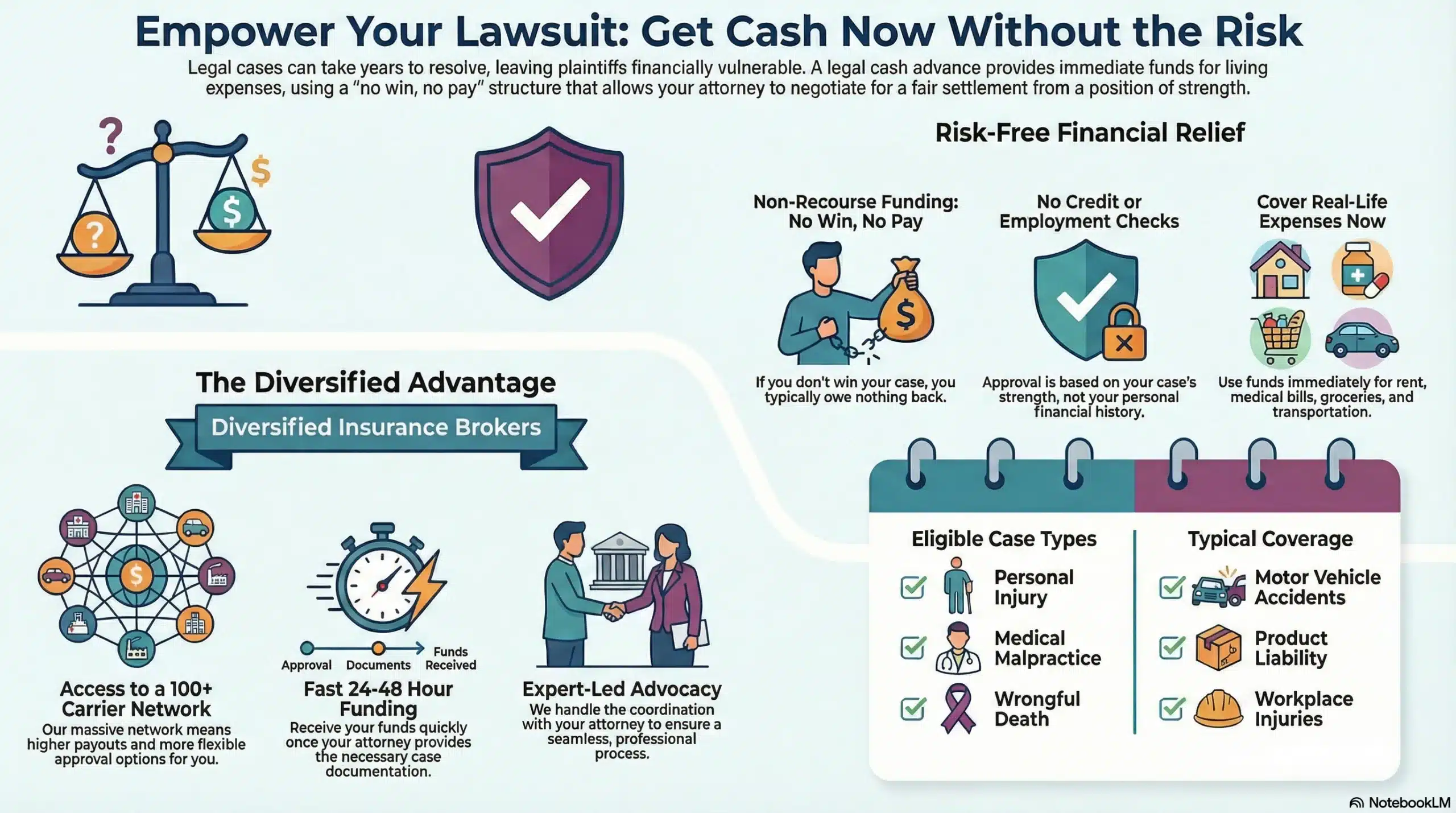
The most important foundational concept in lawsuit funding is non-recourse. In a properly drafted pre-settlement funding agreement, repayment is tied to the outcome of the case — not to the plaintiff personally. If the case resolves with a settlement or judgment, the funder is repaid from the proceeds through the attorney’s trust account. If the case does not result in a recovery, the plaintiff typically does not repay the advance. That structure distinguishes lawsuit funding from conventional debt instruments: the repayment source is the case itself, not the plaintiff’s paycheck, credit history, or personal assets. This is why many funders describe the product as an “advance” rather than a “loan” — and why approval is based primarily on case strength, liability, documented damages, and expected timeline rather than on credit score or employment status. That said, even non-recourse funding has real costs — and those costs affect net recovery at settlement. Understanding the math before signing is not optional. It is the difference between using funding wisely and discovering at settlement that the advance consumed far more of the proceeds than anticipated.
Get the Safest Funding Options
We work with a large network of funding sources so you can compare competitive, transparent terms before you choose.
Check Your OptionsCall 800-533-5969
How Lawsuit Funding Works — The Mechanics Behind the Advance
When a plaintiff applies for pre-settlement funding, the funder evaluates the case rather than the applicant’s personal financial profile. The evaluation typically covers four primary factors: the strength of liability (is the defendant clearly at fault?), the documented damages (what are the medical records, treatment costs, and lost income showing?), the collectibility of any judgment or settlement (does the defendant carry adequate insurance or have collectible assets?), and the expected timeline to resolution. This case-based underwriting is what allows plaintiffs who cannot qualify for conventional credit — due to injury-related unemployment, reduced income, or existing debt — to access funding that a traditional lender would not extend. The advance does not depend on the plaintiff being able to repay it from personal resources; it depends on the case resolving favorably.
Attorney cooperation is required in virtually all legitimate pre-settlement funding arrangements. The law firm verifies case status, provides documentation, and handles repayment from settlement proceeds through the trust account when the case resolves. The plaintiff’s attorney is the gatekeeper of the settlement transaction — which is one of the reasons reputable funders insist on attorney acknowledgment of the funding agreement. If a funder claims to work without attorney involvement or bypasses the trust account repayment process, that is a significant warning sign worth investigating before proceeding. The attorney’s role is not just procedural — it is a structural safeguard that ensures the repayment process is visible, documented, and correctly handled at settlement rather than creating post-settlement disputes about what was owed and how it was calculated.
The application and approval process for pre-settlement funding is typically much faster than conventional loan underwriting. Many reputable funders can evaluate a case within 24 to 48 hours of receiving complete case documentation and attorney cooperation, and can fund the advance within days of approval. The speed of funding is part of why plaintiffs in financial distress find it attractive — but speed should not substitute for diligence in reviewing the agreement before signing. A funder that rushes the plaintiff through the contract review process without providing time to understand the payoff schedule and cost structure should be treated with caution regardless of how quickly they can fund. How lawsuit loans work and what fast cash advances actually involve covers the full mechanics in detail, and what pre-settlement funding is provides the foundational overview for plaintiffs evaluating this option for the first time.
What Makes Lawsuit Funding Safe — and What Makes It Risky
The safety of lawsuit funding is not a binary quality — it is a function of multiple independent variables that a plaintiff can actively evaluate before committing. The non-recourse structure, when properly drafted and clearly documented, provides the first layer of safety: if the case does not produce a recovery, the plaintiff does not owe the advance back. This is genuinely different from credit card debt, a payday loan, or a personal loan — all of which must be repaid regardless of the lawsuit outcome and all of which create ongoing monthly payment obligations that add financial pressure rather than reducing it. The non-recourse structure removes the monthly payment obligation and the personal liability risk, which is why plaintiffs with injury-related income disruption often find it more manageable than conventional credit alternatives.
The second layer of safety is cost transparency. A reputable funder provides a written payoff schedule that shows exactly how much is owed at different points in time — at 6 months, 12 months, 18 months, and 24 months from the advance date. That schedule exists because lawsuit funding costs are typically structured as fees that accumulate over time rather than as fixed interest with a set annual rate. Some agreements use non-compounding flat fees that accumulate linearly over the funding period. Others use compounding fee structures that increase the payoff more rapidly as time passes. The difference between these two structures can be very significant if the case takes longer than initially expected — a case that was anticipated to settle in 8 months but takes 22 months can produce a substantially larger payoff under a compounding structure than the plaintiff originally modeled. A written payoff schedule at multiple time horizons makes that reality visible before signing rather than surprising at settlement.
The third layer is appropriate sizing. The safest lawsuit funding is the minimum advance needed to solve the specific financial problem the plaintiff is facing — typically covering essential living expenses (rent or mortgage, utilities, food, transportation, and necessary medical out-of-pocket costs) for a defined period rather than funding non-essential spending or discretionary expenses. Because repayment comes from settlement proceeds, an oversized advance directly reduces the net recovery the plaintiff takes home after attorney fees, costs, and the advance repayment are deducted. A plaintiff who borrows $50,000 when $15,000 would have covered the actual need has not made a financially neutral decision — the extra $35,000 may cost significantly more in fees at settlement than the marginal utility of having it provided during the case. The safest approach is to identify the minimum needed, request that amount, and reassess later if the case timeline extends beyond original expectations.
Risks in Lawsuit Funding — What to Evaluate Before Signing
| Risk Factor | What It Means in Practice | How to Protect Against It |
|---|---|---|
| Compounding fee structures | Fees compound over time, increasing the payoff faster than a linear calculation suggests — especially significant if the case extends beyond the initial expected timeline | Request a written payoff schedule at 6, 12, 18, and 24 months; compare compounding vs. non-compounding structures before choosing a provider |
| Oversized advances | Taking more than is needed for essential expenses increases the fee burden at settlement without providing proportional benefit during the case period | Request the minimum amount needed for the specific problem; treat the advance as a bridge for essentials only; reassess if timeline changes |
| Hidden fees or unclear terms | Administrative charges, origination fees, or other costs that are not clearly disclosed can increase the total payoff beyond what the funding fee alone suggests | Ask specifically about all fees — funding fee, administrative charges, processing costs — and confirm total payoff in writing before signing |
| No attorney review | Signing a funding agreement without attorney review removes a critical check on whether the terms are reasonable relative to the case’s expected value | Involve the attorney early; reputable funders require attorney cooperation anyway — attorney review of the agreement should be standard, not optional |
| Provider credibility issues | Some funders use aggressive sales practices, unclear disclosures, or contract language that is difficult to interpret without legal assistance | Compare multiple providers; use a broker or intermediary that works with multiple funders; look for providers that readily produce written payoff schedules and answer questions clearly |
How to Make Lawsuit Funding as Safe as Possible
Attorney involvement is the most important structural protection available. Because reputable funders require attorney cooperation regardless, the attorney should review the agreement before the plaintiff signs — not as a formality but as a genuine evaluation of whether the terms are reasonable relative to the case’s expected value and timeline. An attorney who has reviewed many funding agreements can quickly identify whether a proposed cost structure is competitive or unusually expensive for the type of case involved, and whether the payoff schedule at expected resolution represents an acceptable reduction in net proceeds. Plaintiffs who bypass their attorney’s review to speed up the process are removing the most informed check on the agreement’s fairness.
Comparing offers from multiple funders is the second protection. The lawsuit funding market includes a range of providers with meaningfully different pricing structures, fee schedules, and transparency standards. The difference between a competitively priced advance and an expensive one can be thousands of dollars in net recovery at settlement — especially for cases that take longer than initially expected. Accessing multiple offers simultaneously, rather than accepting the first approval, is the most direct path to knowing whether the terms being offered are genuinely competitive. A brokered comparison across multiple funders — rather than direct application to a single company — is one way to access that comparison without submitting multiple individual applications. The pre-settlement funding overview and lawsuit funding options both provide context for the range of structures available in the market.
For plaintiffs evaluating all financial options available during a pending case, some tools outside of lawsuit funding can reduce the overall financial pressure without affecting the settlement proceeds. Disability income protection can cover a portion of lost wages during recovery if appropriate coverage was in place before the injury — disability coverage options for those with medical challenges covers the options available to individuals who have difficulty qualifying for standard disability products. Accident insurance can provide lump-sum benefits after a qualifying accident that offset immediate expenses without any repayment obligation at settlement. These tools do not replace pre-settlement funding for plaintiffs who need more than these products can provide, but they can reduce the total amount of funding required and therefore reduce the fee burden at settlement. For specific case types, medical malpractice lawsuit funding, workers’ compensation settlement loans, and wrongful death settlement loans cover the funding options specific to those claim categories.
Apply for Safe Funding Today
Compare options and choose transparent terms — so you can focus on your case, not financial stress.
Get StartedCall 800-533-5969
Talk With an Advisor Today
Choose how you’d like to connect—call or message us, then book a time that works for you.
Schedule here:
calendly.com/jason-dibcompanies/diversified-quotes
Licensed in all 50 states • Fiduciary, family-owned since 1980
Frequently Asked Questions: Is Lawsuit Funding Safe?
What does “non-recourse” mean in a lawsuit funding agreement?
Non-recourse means the plaintiff is not personally liable for repayment if the case does not produce a recovery. In a properly drafted non-recourse agreement, the funder’s repayment right is tied exclusively to the case proceeds — if the case settles or results in a judgment, the funder is repaid from those proceeds through the attorney’s trust account. If the case is dismissed, the defendant is not found liable, or for any reason the case does not produce a recovery, the plaintiff typically owes nothing back. This structure is fundamentally different from a conventional loan, credit card balance, or payday loan — all of which must be repaid regardless of the outcome of any legal case. The non-recourse structure is the primary reason lawsuit funding is sometimes described as an “advance” rather than a loan, and it is what makes it more appropriate for plaintiffs whose income has been disrupted by the injury underlying the lawsuit. That said, the non-recourse protection only applies if the contract is properly drafted and the plaintiff is working with a reputable funder — which is why reading the agreement carefully and involving the attorney in the review is important.
What are the biggest risks in lawsuit funding and how can I reduce them?
The largest risk is not personal liability — it is cost and its impact on net settlement proceeds. Lawsuit funding fees accumulate over time, and some structures compound in ways that can significantly increase the total payoff if the case takes longer than initially expected. A case anticipated to resolve in 8 months may take 18 or 24 months, and under a compounding fee structure the payoff at 24 months can be substantially larger than the original projection. This risk is reduced by requesting a written payoff schedule at 6, 12, 18, and 24 months from the advance date before signing — so the math is visible across the range of possible timelines, not only the optimistic one. The second significant risk is taking more than is needed. An advance sized for essential expenses only (rent, utilities, food, transportation, necessary medical costs) minimizes the fee burden at settlement. An oversized advance funds unnecessary spending today at the cost of significantly reduced net recovery later. The third risk is working with a provider whose terms are not transparent — which is managed by comparing multiple offers, requesting all fees in writing including any administrative or processing charges, and ensuring the attorney reviews the agreement before signing.
Does my attorney need to be involved in the lawsuit funding process?
Yes — attorney cooperation is required by virtually all reputable pre-settlement funders, and attorney review of the agreement should be treated as a standard protective step rather than an optional formality. The attorney’s role in the funding process is structural: the attorney verifies case status and provides documentation to the funder during underwriting, and the attorney handles repayment from settlement proceeds through the trust account when the case resolves. This means the funder communicates with and through the law firm rather than dealing directly with the plaintiff for repayment logistics. Beyond the procedural requirements, attorney review of the funding agreement provides an informed check on whether the terms are reasonable relative to the case’s expected value. An attorney experienced with funding agreements can quickly assess whether a proposed fee structure is competitive or expensive, and whether the payoff at expected resolution represents an acceptable reduction in net proceeds. Plaintiffs who attempt to bypass attorney involvement to speed up funding access are removing the most informed advocate available for review of the agreement.
How much should I borrow in a pre-settlement advance?
The safest approach is to request the minimum amount needed to solve the specific financial problem the advance is being used to address — typically covering essential living expenses for a defined period while the case progresses. Essential expenses in this context mean rent or mortgage, utilities, grocery costs, transportation, and out-of-pocket medical costs directly related to the injury. Using the advance to cover non-essential spending or to fund lifestyle expenses that existed before the case increases the fee burden at settlement without providing proportional benefit during the case period. Because repayment comes from settlement proceeds, every dollar borrowed today costs more than a dollar at settlement — the fee accumulates from the advance date through the resolution date. A smaller advance means a smaller payoff from settlement proceeds, which preserves more of the ultimate recovery for the plaintiff. Many attorneys recommend that plaintiffs take an initial advance sized for 60 to 90 days of essential expenses and then reassess whether additional funding is needed based on how the case progresses, rather than projecting the full expected case timeline and borrowing for the entire period upfront.
What should I look for to identify a reputable lawsuit funding provider?
Several characteristics distinguish reputable funders from problematic ones. First, a reputable funder provides a written payoff schedule at multiple time horizons — 6, 12, 18, and 24 months — without being asked repeatedly or making the information difficult to obtain. If a funder avoids providing this schedule, provides it only verbally, or is evasive about how costs accumulate over time, that is a significant warning sign. Second, all fees — funding fee, administrative charges, processing costs, any other amounts — should be disclosed in writing and clearly stated in the contract. A contract that requires reading multiple pages carefully to find all costs rather than presenting them clearly in a summary section warrants close scrutiny. Third, the funder should communicate directly with and through the attorney rather than pressuring the plaintiff to sign without attorney review. Fourth, the funder should be able to clearly explain what happens if the case posture changes — if liability becomes disputed, if treatment significantly affects case value, or if settlement takes materially longer than expected — and should provide that explanation in plain language rather than referring the plaintiff to contract language that is difficult to interpret. Working with a broker or intermediary that accesses multiple funders simultaneously allows comparison of these factors across providers rather than evaluating a single offer in isolation.
About the Author:
Jason Stolz, CLTC, CRPC, DIA, CAA and Chief Underwriter at Diversified Insurance Brokers (NPN 20471358), is a senior insurance and retirement professional with more than 25 years of real-world experience helping individuals, families, and business owners protect their income, assets, and long-term financial stability. As a long-time partner of the nationally licensed independent agency Diversified Insurance Brokers, Jason provides trusted guidance across multiple specialties—including fixed and indexed annuities, long-term care planning, personal and business disability insurance, life insurance solutions, Group Health, Travel Medical and Evacuation Insurance, and short-term health coverage. Diversified Insurance Brokers maintains active contracts with over 100 highly rated insurance carriers, ensuring clients have access to a broad and competitive marketplace.
His practical, education-first approach has earned recognition in publications such as VoyageATL, and contributions from his agency featured in Kiplinger and GoBankingRates— highlighting his commitment to financial clarity and client-focused planning. Drawing on deep product knowledge and years of hands-on field experience, Jason helps clients evaluate carriers, compare strategies, and build retirement and protection plans that are both secure and cost-efficient. Visitors who want to explore current annuity rates and compare options across multiple insurers can also use this annuity quote and comparison tool.
Explore All Lawsuit Loan & Legal Funding Options: Browse our complete guide to Lawsuit Loans & Legal Funding — covering pre-settlement funding, lawsuit cash advances, injury claims & more.
Last Reviewed: June 14, 2026 |
Reviewed by: Jason Stolz, CLTC, CRPC, DIA, CAA
Chief Underwriter, Diversified Insurance Brokers, Inc. | NPN: 20471358 | Diversified Insurance Brokers, Inc. — Licensed in all 50 states
Fact Checked by: Tonia Pettitt, CMIP©
Medicare Specialist, Diversified Insurance Brokers, Inc. | NPN: 14374308 | Diversified Insurance Brokers, Inc. — Licensed in all 50 states
Did you find this content helpful? Leave us a Google review — it helps others find trustworthy guidance too.
Editorial Standards: Diversified Insurance Brokers maintains rigorous editorial standards to ensure accuracy, clarity, and independence in all content. Learn more about our editorial standards and commitment to transparency.
