
Wrongful Death Settlement Loan – Fast Cash While You Wait
Wrongful Death Settlement Loan – Fast Cash While You Wait

Jason Stolz CLTC, CRPC, DIA, CAA
Losing a loved one due to someone else’s negligence is devastating — and the financial pressure that follows can feel impossible to manage while your family is still grieving. Even when you have a strong legal claim, wrongful death cases take time. Complex investigations, multiple liable parties, insurance coverage disputes, expert opinions, and extended negotiation timelines are common features of these cases — not exceptions. During all of it, everyday expenses still arrive: rent or mortgage payments, utilities, groceries, childcare, transportation, and lingering medical bills from the final treatment your loved one received. A wrongful death settlement loan — more accurately called pre-settlement funding or a non-recourse cash advance — can provide immediate financial relief by giving your family access to cash now while your attorney pursues the full and fair value of your claim.
This type of funding exists for one purpose: to give families breathing room during an emotionally painful and financially uncertain time. Instead of feeling pressured to accept the first offer from an insurance company because bills are stacking up and savings are running out, a settlement advance can stabilize your household so your attorney can negotiate from a position of strength rather than urgency. Insurance carriers are aware of the financial pressure families face after a wrongful death. In many cases, the early offer they make is calibrated to that pressure — it arrives when the family is most vulnerable, not when the case has been fully developed. Funding can change that dynamic. If you are also exploring how settlement advances work across different legal scenarios, our broader resource on lawsuit settlement loans explains the general framework of non-recourse legal funding and what to expect from the process.
Apply for a Wrongful Death Settlement Loan
Fast approval, higher funding amounts, and no repayment unless your case wins.
What Is a Wrongful Death Settlement Loan?
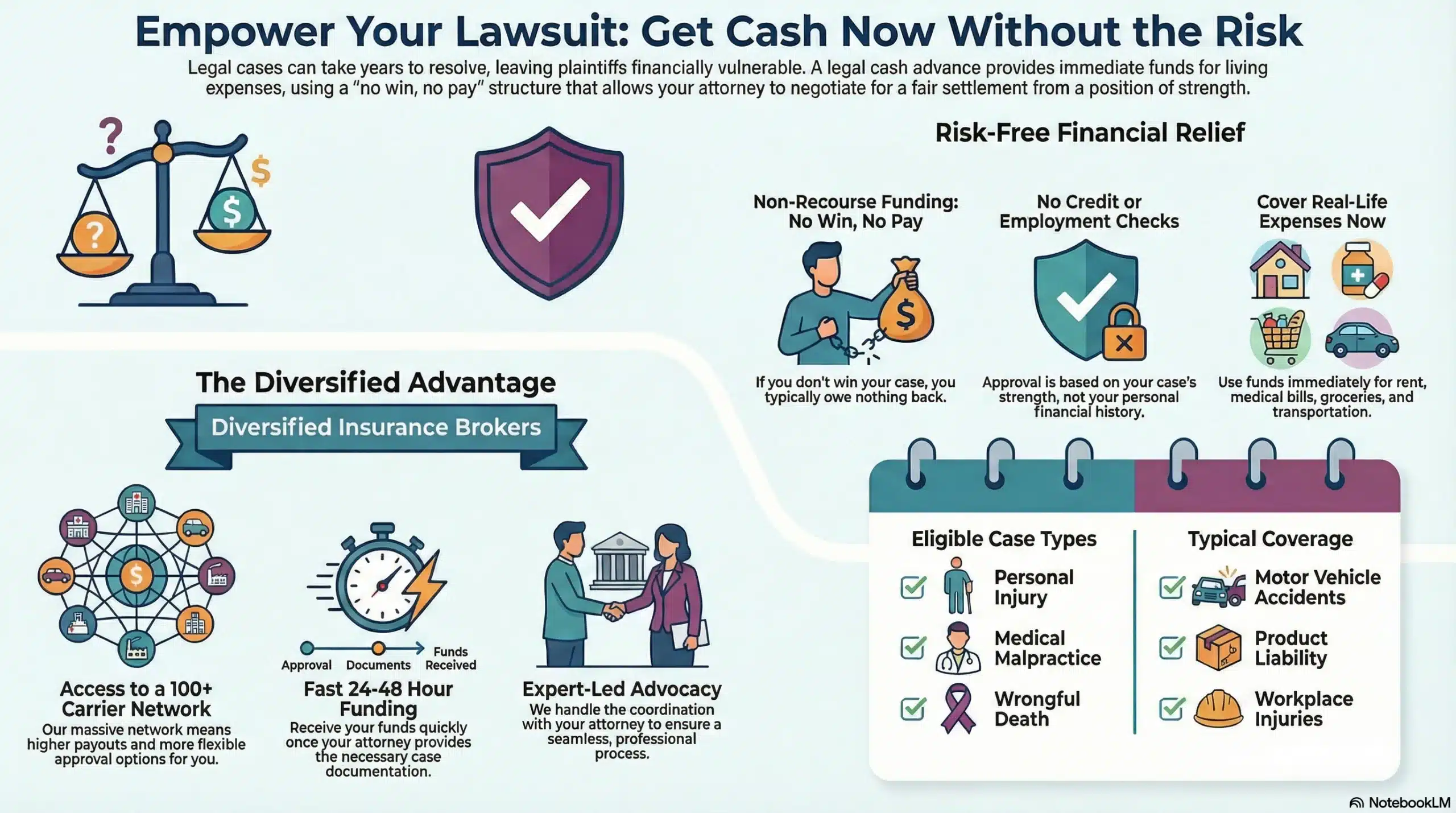
A wrongful death settlement loan is not a traditional bank loan. In most cases, it is structured as non-recourse funding, meaning repayment typically comes only from your case proceeds if your lawsuit settles successfully or results in a verdict or award. There are no monthly payments while the case is pending. Approval is based on the legal strength and expected value of the claim — not your credit score, income level, employment status, or any other aspect of your personal financial profile. No credit check is conducted at any point in the process.
Because these advances are case-based rather than credit-based, your attorney plays a central role. A legitimate funding provider coordinates directly with your law firm to confirm the claim details, understand the case timeline, review supporting documentation, and evaluate potential settlement value. The documentation review is what allows the provider to underwrite the advance responsibly — assessing liability strength, damages profile, insurance coverage availability, and the realistic path to recovery. If a company claims it can approve substantial wrongful death funding without attorney involvement or documentation review, that is a significant red flag about the quality of the process and the reliability of the disclosed terms.
Wrongful death claims are distinct from other personal injury cases in ways that matter both legally and for funding purposes. The claim belongs to designated beneficiaries — surviving spouses, children, parents, or the estate, depending on state law — rather than to the injured person directly. Some states require the claim to be brought by a personal representative of the estate; others allow certain family members to bring the claim directly. This structure affects who can apply for funding, what documentation is required, and how repayment is handled at settlement. Your attorney can confirm how your state’s wrongful death statutes affect the claim structure and what that means for any funding application.
Wrongful Death Settlement Loan vs. Traditional Loan — Key Differences
Understanding the structural differences between a wrongful death settlement advance and a traditional personal loan is essential before making any decision about which is appropriate for your situation. The table below maps the key dimensions of that comparison clearly.
| Feature | Wrongful Death Settlement Advance | Traditional Personal Loan |
|---|---|---|
| Repayment trigger | Only if case results in a settlement, verdict, or award — repayment comes from proceeds, not personal funds | Fixed monthly payments begin immediately regardless of case outcome or personal financial situation |
| Credit check required | No — approval is based entirely on claim strength, damages, and insurance coverage | Yes — credit score and debt history are primary approval factors |
| Monthly payments | None — no payments of any kind while the case is pending | Required monthly beginning immediately after funding |
| Risk if case is lost | Non-recourse — generally no personal obligation to repay if the case does not result in recovery | Full repayment obligation regardless of any external outcome — personal assets at risk for default |
| Approval basis | Liability strength, documented damages, insurance limits, case timeline, attorney representation | Credit score, income verification, employment status, existing debt obligations |
| Employment verification | Not required — family members who are not currently employed are eligible | Required — income disruption typically limits or eliminates loan eligibility |
| Funding speed | 24–48 hours after approval in most cases, with attorney cooperation | Days to weeks depending on institution and documentation |
| Cost structure | Funding fees accrue over time — no monthly burden but total cost grows with case duration | Fixed interest rate with monthly payments — lower cost per dollar but requires ongoing payment capacity |
Why Families Use Wrongful Death Settlement Funding
Wrongful death cases can involve complex investigations, multiple potentially liable parties, insurance coverage disputes, expert witness opinions, and litigation timelines that extend far longer than families anticipate when a claim is first filed. Even when liability appears clear from the outset — a fatal car accident caused by a drunk driver, a construction fatality caused by an employer’s safety violation, a death caused by documented medical negligence — the legal process of establishing that liability in a form that compels a fair settlement takes time. Documentation must be gathered and authenticated, expert opinions must be retained and disclosed, damages must be calculated with supporting evidence, and negotiation must be allowed to run its course before a settlement that reflects the case’s full value can be reached.
Meanwhile, surviving family members face an immediate and total financial shift that was not planned for and cannot be paused. In many wrongful death situations, the person who passed away was a primary or significant contributor to the household’s financial stability — providing income, employer-sponsored health insurance, retirement contributions, childcare, or transportation that the household depended on. When that contribution is removed suddenly and permanently, the family may face housing costs, utility bills, food expenses, and childcare obligations that exceed what remaining income can cover — simultaneously with funeral costs and final medical bills that arrived with no warning. The combination of grief, logistical demands, and financial pressure that families face in the immediate aftermath of a wrongful death is one of the most acute financial hardship situations that settlement funding is designed to address.
Settlement funding is commonly used to cover the most urgent and unavoidable obligations: final expense balances, housing payments, utilities, groceries, transportation, childcare, and education costs. It can also prevent the secondary financial damage that accumulates when primary obligations go unmet — late fees, eviction risk, vehicle repossession, lapsed insurance, and deteriorating credit that can create additional burdens long after the legal case resolves. The goal is not to maximize the advance or use funding for non-essential purposes — it is to provide responsible, targeted relief that keeps the household stable while the legal process runs its proper course and your attorney pursues the full value of the claim.
Case Types That Commonly Qualify for Wrongful Death Funding
Wrongful death pre-settlement funding is most readily available for cases where there is a clear legal theory of liability supported by documented evidence and a realistic path to recovery from an identified defendant with the financial capacity or insurance coverage to pay a judgment. The most common qualifying case types include fatal motor vehicle accidents — car accidents, truck accidents, and motorcycle accidents caused by a negligent driver — where liability documentation is typically strong and insurance coverage is usually available from the at-fault driver’s policy.
Medical malpractice resulting in wrongful death is another significant qualifying category, though these cases often involve more complex proof requirements and longer timelines than vehicle accident cases. The strength of the medical documentation, the availability of qualified expert witnesses, and the jurisdiction’s damages caps (where applicable) all affect both the legal strategy and the funding evaluation. Fatal nursing home neglect or abuse cases, where documentation of inadequate care or unsafe conditions contributed to a resident’s death, also commonly qualify when the documentation of negligence is clear and the responsible facility has insurance coverage that provides a realistic recovery source.
Premises liability — deaths caused by dangerous property conditions such as inadequate security, unsafe structures, or hazardous environments — and product liability — deaths caused by defective products or inadequate safety warnings — are additional categories that frequently support wrongful death funding when liability is documented and the defendant has resources or insurance. Construction accident fatalities involving third-party liability (separate from workers’ compensation claims) and civil rights wrongful death claims are also considered by funding providers, though these may involve more complex underwriting depending on the defendant and the damages structure.
In any of these case types, the most important practical factors for funding approval are the quality of liability documentation, the credibility and scope of the damages being claimed, the insurance coverage available from the responsible party, and the status of attorney representation. Cases that are well-documented, actively managed by experienced legal counsel, and at a stage where the claim value can be credibly estimated tend to be funded most efficiently and at the most favorable terms.
How Wrongful Death Settlement Funding Works — Step by Step
The application process for wrongful death pre-settlement funding is designed to be straightforward for the family, with most of the documentation work handled through coordination between the funding provider and your attorney. Understanding what happens at each stage helps set realistic expectations about timing and what is needed to move quickly.
The first step is the initial application. You provide basic information about the case — the nature of the incident, the date of the loss, the state where the claim was filed, your attorney’s contact information, and a general description of where the case currently stands in the legal process. This takes minutes and requires no financial documentation of any kind. No credit check is run.
The second step is attorney verification and documentation review. The funding provider contacts your law firm directly to confirm active representation, verify that the claim is filed and ongoing, and request the case materials needed for underwriting — typically including the complaint, liability documentation, damages evidence (economic loss calculations, medical expenses, funeral costs, and other documented losses), information about the defendant’s insurance coverage, and the attorney’s assessment of case status and realistic settlement range. Attorney responsiveness and document organization at this stage are the primary factors that determine how quickly the process moves from application to offer.
The third step is underwriting evaluation. The provider’s team reviews the case materials to assess liability strength, damages documentation, the available insurance limits, the defendant’s financial resources, jurisdiction considerations that may affect damages or timeline, and how far along the case is in the negotiation or litigation process. Cases approaching mediation or active settlement discussions are typically evaluated most efficiently; early-stage cases may require more time and documentation to support a confident advance amount.
The fourth step is the offer. If the case is approved, you receive a written offer specifying the advance amount and the complete repayment structure — what you owe at different case resolution timelines, how fees accrue over time, and any other contractual terms. This offer should be reviewed carefully, and your attorney should review it as well, before you accept. The advance amount is typically a portion of the expected net settlement value — the amount remaining after attorneys’ fees and case costs — rather than the gross settlement figure.
The fifth step is funding. Once the offer is accepted and agreements are completed by all parties, funds are typically sent within 24 to 48 hours via wire transfer, check, or direct deposit depending on the provider’s process and your preferences. No further action is required from you until the case resolves.
The sixth step is repayment at resolution. When the case settles or results in an award, the proceeds flow through your attorney’s trust account. The attorney satisfies all obligations in the required priority order — attorneys’ fees, case costs, any medical liens, and the settlement advance — then distributes the remaining net proceeds to you. Repayment is handled entirely through the legal disbursement process; you take no direct action. If the case does not result in a recovery, the non-recourse structure generally means the advance is not repayable, subject to your specific agreement terms.
How Much Can a Family Receive in Wrongful Death Funding?
The advance amount in any wrongful death case depends on the specific facts, documentation, damages profile, and expected recovery of that individual claim. There is no universal formula, and amounts can vary significantly between cases in the same general category. Understanding the factors that drive the funding amount helps set realistic expectations before applying.
Wrongful death settlement advances are typically approved for up to approximately 10% to 20% of the expected net settlement value — the amount the case is realistically projected to resolve for, after attorneys’ fees and case costs are deducted. The advance must be sized conservatively enough that the total maximum repayment — the advance amount plus all accrued fees — does not approach or exceed the expected net proceeds, because both the plaintiff and the funding provider need the settlement to provide meaningful net recovery after all obligations are satisfied.
Several case-specific factors influence both the projected settlement value and the advance amount. Available insurance limits are one of the most important: a case against a defendant with a $1 million policy is valued and funded differently from a case where insurance limits are unclear or contested. The documented economic damages are another major factor — the deceased’s income, expected future earnings, benefits, and the economic value of the services they provided to the household all form the foundation of the economic damages calculation in a wrongful death claim. Non-economic damages — compensation for loss of companionship, care, and guidance — are also part of most wrongful death claims but may be subject to caps in some states. The funding evaluation accounts for these jurisdiction-specific considerations in projecting the realistic settlement range.
The case timeline also affects both the advance amount and the total cost. Because fees accrue from disbursement to repayment, a case that is expected to resolve quickly may support a larger advance at lower total cost than a case expected to remain in litigation for an extended period. Requesting the minimum amount needed to address the household’s immediate financial pressures — rather than the maximum available — typically produces the best outcome by preserving more of the settlement for the family at resolution.
Costs, Non-Recourse Terms, and What to Review Before Signing
The cost structure of wrongful death settlement advances is fundamentally different from traditional loans, and that difference must be understood clearly before any agreement is signed. Instead of a fixed annual interest rate with monthly payments, funding fees accrue from the disbursement date to the repayment date — and because the repayment date depends on when the case resolves, the total cost cannot be precisely determined at signing. It depends on how long the case takes. This time-sensitivity is the most important variable in evaluating any pre-settlement funding offer.
Before accepting any offer, you should obtain specific dollar figures for the total repayment at multiple potential resolution timelines: three months, six months, twelve months, and eighteen months or more. You should understand whether the fee structure is simple or compounding, and if compounding, how quickly the accrual accelerates. You should know whether there is a cap on total fees or on the accrual period after which fees stop growing. You should understand whether early repayment reduces the cost and whether there are any administrative or processing fees separate from the primary funding fee. None of these questions should produce evasive responses from a legitimate provider — full, upfront disclosure of how costs grow over time is a basic marker of a responsibly operated funding company.
Non-recourse means that if the case does not result in a recovery, the advance is generally not repayable. This is the protection that makes pre-settlement funding different from taking on debt — the funding provider assumes the risk of the case outcome rather than transferring that risk entirely to the family. However, the non-recourse protection is only as reliable as the specific contract language. Your attorney should review the agreement before you sign, specifically to confirm that the non-recourse language is unambiguous, that there are no carve-outs that would allow recourse under ordinary circumstances, and that the repayment structure is consistent with what you were told when you applied. The agreement should never create total maximum repayment obligations that approach or exceed the expected net settlement proceeds.
Will Funding Affect Your Wrongful Death Lawsuit?
When structured properly by a legitimate provider, pre-settlement funding is designed to support your family financially while the legal case proceeds — not to interfere with legal strategy or create pressure to settle. Funding companies do not control the case, do not communicate with the defendant or insurance carrier, and do not influence negotiation decisions. Their role is to evaluate the claim through documentation, provide funding to the family, and coordinate repayment through the attorney trust account if the case resolves successfully. The legal strategy remains entirely between you and your attorney.
The most significant practical benefit of funding for wrongful death cases is precisely the opposite of interference — it removes external financial pressure from the legal decision-making process. Insurance carriers sometimes make early settlement offers when they believe the family is under maximum financial stress, calculating that a family struggling to pay rent and utilities may accept a settlement significantly below the case’s fair value simply to stop the financial bleeding. When funding provides the stability to maintain household finances through the case, the family is not making legal decisions under that kind of pressure. Your attorney can negotiate based on the merits of the case rather than your immediate financial need, which is in your interest and not the insurance carrier’s.
Planning for Financial Stability Beyond the Lawsuit
A wrongful death settlement advance addresses the immediate cash-flow challenge while the legal process runs its course. But the death of a household income contributor or caregiver often creates broader financial vulnerabilities that also deserve attention during the same period. Health insurance coverage may have changed if the deceased carried the household’s employer-sponsored plan. Exploring stopgap options like short-term health insurance can provide coverage during the transition to a longer-term solution. For surviving household members whose own earning capacity may be affected by grief, caregiving responsibilities, or stress, exploring disability insurance for self-employed workers or other income protection options may be appropriate depending on the household’s specific circumstances.
It may also be the right time to review broader family financial protection — including life insurance coverage for surviving household members whose death would create additional hardship — and supplemental protection such as accidental death insurance for higher-risk situations. These planning steps do not replace the wrongful death funding or the legal process — they strengthen the household’s overall financial foundation during a period when that foundation has been weakened by a loss that was not planned for and cannot be reversed. Our overview of pre-settlement funding generally and our guide to legal cash advances provide additional context on how these funding structures work across different legal scenarios.
Get Financial Help While Your Wrongful Death Case Moves Forward
Wrongful death lawsuits are emotionally difficult and legally complex. Financial pressure should not be the reason a family accepts less than what their claim is worth. A wrongful death settlement loan can provide the stability your household needs to keep functioning — without monthly payments, without credit requirements, and with repayment generally required only if your case resolves successfully. The advance is not meant to replace the settlement — it is meant to protect the settlement by allowing your attorney time to pursue its full value without being undermined by the family’s immediate financial distress.
If you need help accessing settlement funding, the process begins with the form below. Submitting an application does not obligate you to accept any offer. It begins the underwriting review so you can see what is available for your specific situation. For broader context on how settlement advances are structured across different case types, our resource on how lawsuit loans work explains the general mechanics of non-recourse legal funding in plain language.
Get the Financial Help You Need Now
Apply for a wrongful death settlement loan today and receive funding in as little as 24 hours.
Related Legal Funding Pages
Explore other funding options and guides to understand how advances work during different lawsuit types.
Related Financial Protection Pages
These resources can help families strengthen stability while waiting for a legal case to resolve.
Talk With an Advisor Today
Choose how you’d like to connect—call or message us, then book a time that works for you.
Schedule here:
calendly.com/jason-dibcompanies/diversified-quotes
Licensed in all 50 states • Fiduciary, family-owned since 1980
FAQs: Wrongful Death Settlement Loan
What is a wrongful death settlement loan and how does it work?
A wrongful death settlement loan — more accurately called a non-recourse pre-settlement advance — provides a family with access to cash now based on the expected value of their active wrongful death claim, without requiring repayment unless the case results in a settlement, verdict, or award. It is not a traditional bank loan: there is no credit check, no employment verification, no monthly payments, and no personal obligation to repay if the case does not produce a recovery. Approval is based entirely on the legal strength of the claim — liability documentation, damages evidence, available insurance coverage, and the realistic path to resolution. The advance comes from a funding provider who evaluates the case through your attorney, issues funds within 24 to 48 hours of approval in most cases, and is repaid from settlement proceeds through the attorney trust account when the case resolves. The non-recourse structure means the funding provider bears the risk of the case outcome rather than the family.
What types of wrongful death cases qualify for pre-settlement funding?
Wrongful death pre-settlement funding is most commonly available for cases with clear liability documentation and a realistic recovery source. Common qualifying case types include fatal motor vehicle accidents caused by a negligent driver, medical malpractice resulting in death, nursing home neglect or abuse fatalities, premises liability deaths caused by dangerous property conditions, product liability cases involving defective products, construction accident fatalities involving third-party liability, and civil rights wrongful death claims. The key qualification factors across all case types are: an active wrongful death lawsuit filed with the court, representation by an attorney experienced in wrongful death cases, strong liability documentation, a credible damages profile, and an identifiable source of recovery — typically the defendant’s insurance coverage or demonstrated financial resources. Cases at any litigation stage may qualify, but cases with more complete documentation and clearer settlement visibility are typically funded most efficiently and at the most favorable terms.
How much can a family receive from a wrongful death settlement advance?
Wrongful death settlement advances are typically approved for up to approximately 10% to 20% of the expected net settlement value — the projected recovery amount after attorneys’ fees and case costs are deducted. The specific amount depends on several case-specific factors: the available insurance limits from the responsible party, the strength and completeness of the economic damages documentation (the deceased’s income, expected future earnings, and the economic value of services provided to the household), the applicable non-economic damages and whether they are subject to state caps, how far along the case is in the litigation or settlement process, and the jurisdiction’s typical settlement ranges for similar claims. The advance must be sized so the maximum total repayment — including all accrued fees — does not approach or exceed the expected net proceeds. Requesting the minimum amount needed to address immediate household pressures rather than the maximum available typically produces the best overall outcome, preserving more of the settlement for the family at resolution.
Will taking a settlement advance affect the wrongful death lawsuit?
When structured properly by a legitimate provider, pre-settlement funding does not interfere with the legal case in any way. Funding companies do not control legal strategy, do not communicate with the defendant or insurance carrier, and do not influence negotiation or settlement decisions. Their role is to evaluate the claim through documentation coordination with your attorney, provide funding to the family, and collect repayment through the attorney trust account if the case resolves successfully. The legal strategy remains entirely between you and your attorney. The practical effect of funding is typically the opposite of interference — it removes external financial pressure from legal decision-making. Insurance carriers sometimes make early settlement offers specifically when they believe the family is under acute financial stress, calculating that financial desperation will lead the family to accept below-value compensation. Funding that stabilizes household finances reduces that pressure and allows your attorney to negotiate based on the case’s merits rather than the family’s immediate cash needs.
About the Author:
Jason Stolz, CLTC, CRPC, DIA, CAA and Chief Underwriter at Diversified Insurance Brokers (NPN 20471358), is a senior insurance and retirement professional with more than 25 years of real-world experience helping individuals, families, and business owners protect their income, assets, and long-term financial stability. As a long-time partner of the nationally licensed independent agency Diversified Insurance Brokers, Jason provides trusted guidance across multiple specialties—including fixed and indexed annuities, long-term care planning, personal and business disability insurance, life insurance solutions, Group Health, Travel Medical and Evacuation Insurance, and short-term health coverage. Diversified Insurance Brokers maintains active contracts with over 100 highly rated insurance carriers, ensuring clients have access to a broad and competitive marketplace.
His practical, education-first approach has earned recognition in publications such as VoyageATL, and contributions from his agency featured in Kiplinger and GoBankingRates— highlighting his commitment to financial clarity and client-focused planning. Drawing on deep product knowledge and years of hands-on field experience, Jason helps clients evaluate carriers, compare strategies, and build retirement and protection plans that are both secure and cost-efficient. Visitors who want to explore current annuity rates and compare options across multiple insurers can also use this annuity quote and comparison tool.
Explore All Lawsuit Loan & Legal Funding Options: Browse our complete guide to Lawsuit Loans & Legal Funding — covering pre-settlement funding, lawsuit cash advances, injury claims & more.
Last Reviewed: June 20, 2026 |
Reviewed by: Jason Stolz, CLTC, CRPC, DIA, CAA
Chief Underwriter, Diversified Insurance Brokers, Inc. | NPN: 20471358 | Diversified Insurance Brokers, Inc. — Licensed in all 50 states
Fact Checked by: Tonia Pettitt, CMIP©
Medicare Specialist, Diversified Insurance Brokers, Inc. | NPN: 14374308 | Diversified Insurance Brokers, Inc. — Licensed in all 50 states
Did you find this content helpful? Leave us a Google review — it helps others find trustworthy guidance too.
Editorial Standards: Diversified Insurance Brokers maintains rigorous editorial standards to ensure accuracy, clarity, and independence in all content. Learn more about our editorial standards and commitment to transparency.
