
Lawsuit Loan Rates – Compare Costs & Get the Best Deal
Lawsuit Loan Rates – Compare Costs & Get the Best Deal

Jason Stolz CLTC, CRPC, DIA, CAA
When you need cash before your case settles, understanding lawsuit loan rates can make a meaningful difference in how much you ultimately receive. Lawsuit loans — often called pre-settlement funding or legal advances — provide a cash advance against the potential value of your pending claim, giving you financial breathing room while your attorney continues building the case and negotiating for full value. The rate and fee structure you agree to at the time of funding determines exactly how much you repay at settlement, which directly affects what you keep after attorney fees, case costs, medical liens, and all other deductions are handled at disbursement. Many plaintiffs focus on how much they can receive today without fully modeling what that amount will cost them depending on how long the case takes to resolve — which is the more consequential question for net recovery.
The smarter framing is not “how much can I get?” but “what will this advance cost me if the case takes six months longer than expected?” That shift in perspective changes how you evaluate every offer. A funding arrangement that looks attractive based on a monthly rate alone can become significantly more expensive if that rate compounds over a longer-than-anticipated resolution timeline. Comparing lawsuit loan rates correctly requires evaluating three things simultaneously: the pricing structure (simple or compounding, and how frequently fees are assessed), the realistic time horizon for your case across a range of possible scenarios, and the total dollars that would be owed at multiple checkpoints — for example at 3, 6, 9, 12, and 18 months from the advance date. Our role is to help evaluate options with that full picture rather than a single number. We work through a broad funding network, which allows us to shop your case for competitive terms across multiple providers rather than presenting a single offer from one company’s pricing model. If you decide to move forward, the process remains attorney-friendly and documentation-driven so you stay focused on recovery while your legal team stays focused on case value.
Get the Lowest Lawsuit Loan Rates
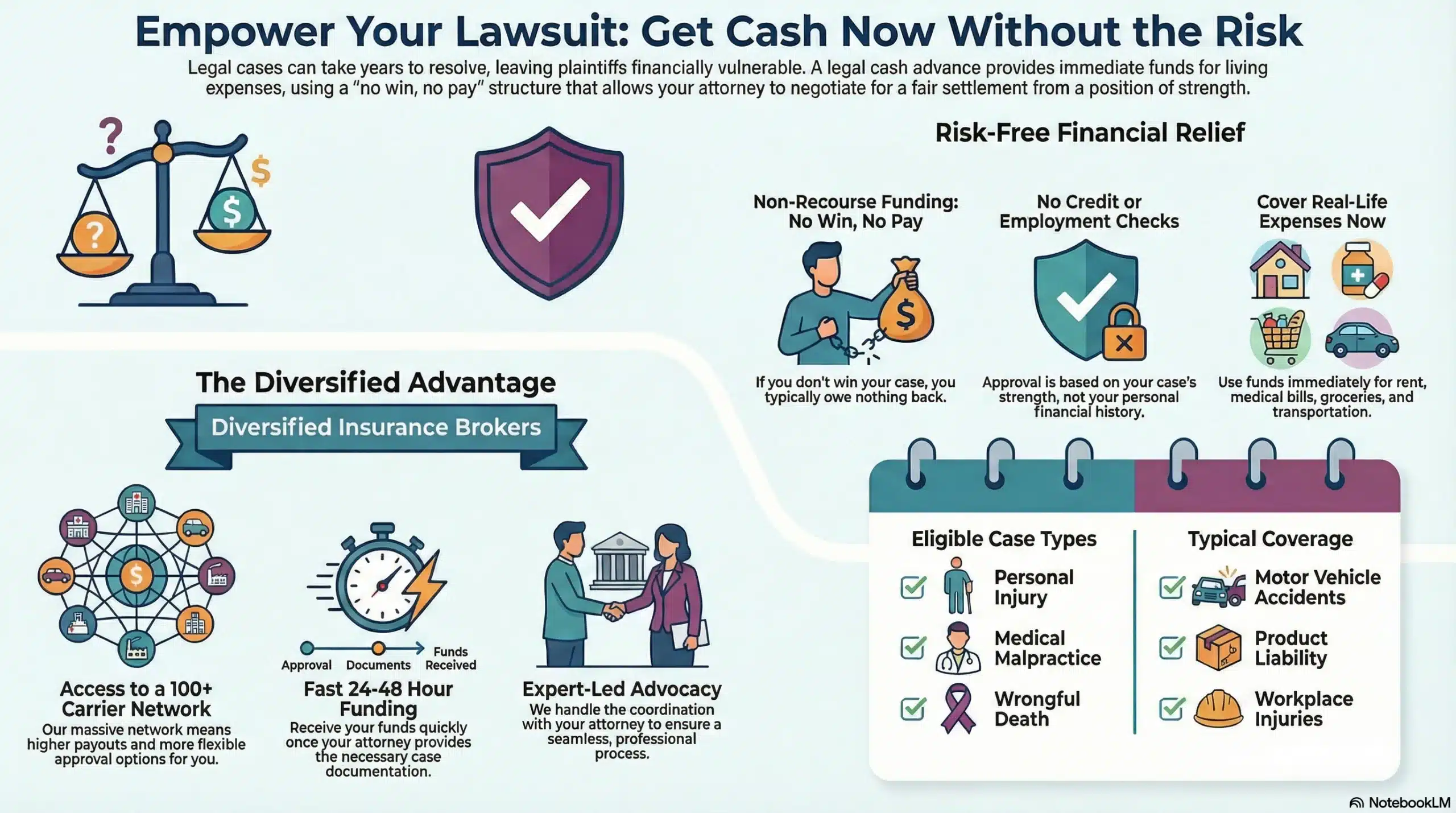
We have access to the largest network of funding sources, allowing us to secure the biggest advances at the lowest costs.
Check Your RateCall 800-533-5969
What “Lawsuit Loan Rates” Actually Mean — and Why They Are Not Like a Bank APR
Most people approach lawsuit loan rate comparisons using the same mental model they apply to bank loans — looking for the lowest annual percentage rate and assuming the rest follows from there. Pre-settlement funding does not work that way, and applying that framework produces misleading comparisons. A lawsuit loan is a non-recourse advance against the expected value of a legal claim. The provider is underwriting the case itself — the strength of liability, the documentation of damages, the collectibility of the defendant, and the expected timeline to resolution — rather than the plaintiff’s creditworthiness, income, or employment status. Because repayment is contingent on a successful recovery rather than certain regardless of outcome, the pricing is structured differently than a traditional loan and cannot be directly compared using APR as the primary metric.
In practice, lawsuit loan pricing is typically presented as a monthly rate, a fee schedule, a multiplier applied to the advance amount, or a payoff table at defined time horizons. Two providers can both advertise “3% per month” and produce very different actual costs depending on whether that rate is applied simply (to the original advance amount at each period) or compounds (on the growing balance including prior fees). Over a 12-month case, the difference between simple and compounding at the same nominal monthly rate can be significant. Over an 18-month or 24-month case, the difference becomes even larger. Evaluating offers using only the monthly rate headline number without asking whether it compounds and how frequently fees are assessed produces exactly the kind of misleading comparison that leads to settlement-day surprises. The only reliable comparison is total payoff at multiple time horizons — not the monthly rate percentage that appears at the top of a provider’s marketing materials.
What Determines Your Lawsuit Loan Rate — The Factors Funders Evaluate
Rates for lawsuit loans are based on the risk profile of the specific claim and the expected timeline to resolution. The funder is asking: what is the probability of recovery, how large is the likely recovery, how long will it take to get paid, and how clearly can those factors be documented at the time of application? The answers to those questions determine the pricing offered, and the same plaintiff with the same injury in a different legal posture could receive meaningfully different rates from the same funder at different points in the case’s development.
| Factor | Why It Affects Rate and Offer Size |
|---|---|
| Case Strength and Liability | Clear, well-documented fault with strong evidence reduces funder risk and generally supports more favorable terms. Contested or uncertain liability creates more risk for the funder and typically produces more conservative offers or higher pricing. |
| Documented Damages | Medical records, treatment bills, future care recommendations, and wage-loss documentation establish the economic foundation of the claim. Strong documentation supports higher advance amounts and may improve pricing. Thin documentation reduces confidence in case value and constrains what can responsibly be offered. |
| Insurance Coverage and Collectibility | Policy limits, umbrella coverage, multiple defendants with separate coverage, or collectible assets all affect the funder’s confidence in eventual repayment. Low policy limits relative to damages create a natural ceiling on the responsible advance size. |
| Stage of the Case | A case closer to resolution — post-mediation, post-demand, with active settlement negotiations — may price differently than an early-stage claim with significant timeline uncertainty. More certainty about timing typically reduces funder risk. |
| Jurisdiction and Expected Timeline | Court backlogs, venue-specific norms, and the typical time-to-resolution for comparable cases in the relevant jurisdiction all affect the expected holding period for the funder and therefore the total expected cost of the advance. |
| Attorney Cooperation and Documentation Quality | Funders rely on attorney verification for case information and on the law firm’s trust account for repayment. Organized documentation and responsive counsel speed underwriting and may support better outcomes. Unresponsive firms or incomplete files create friction that can affect both approval and terms. |
| Existing Liens or Prior Advances | Outstanding medical liens, prior funding from another company, or complex lien situations reduce the net proceeds available at settlement for repayment and can constrain what a responsible funder can offer or affect the pricing offered to account for reduced priority. |
What is notably absent from every factor on that list is the plaintiff’s credit score, employment history, or income. Lawsuit funding evaluates the claim rather than the claimant — which is one of the primary reasons plaintiffs explore it when an injury has disrupted income and conventional borrowing is not a realistic option.
Common Rate Structures — What Each One Means for Your Payoff
Simple monthly pricing calculates fees on the original advance amount at each period rather than on a growing balance. This structure is easier to model and project across time because the per-period cost does not change as the case continues. A plaintiff who borrows $10,000 at 3% per month simple pricing knows that each month adds $300 to the amount owed, making the payoff at any point straightforwardly calculable. Many plaintiffs prefer simple structures specifically because the math is transparent and the payoff at different resolution timelines can be confirmed without ambiguity before signing.
Compounding pricing calculates fees on the balance including all prior fees accumulated to date, so the per-period cost grows over time as the balance grows. At a 3% monthly compounding rate on a $10,000 advance, the payoff at six months is not $10,000 plus $1,800 (6 months × $300) — it is $10,000 compounded at 3% per month for six months, which produces a different and larger number. As the case timeline extends, the gap between simple and compounding pricing on the same nominal monthly rate grows materially. Compounding pricing is not inherently disqualifying, but it must be understood and modeled across the realistic range of resolution timelines for the specific case before the advance is accepted.
Tiered schedules and payoff tables present what is owed at defined time points — at 3 months, 6 months, 9 months, and so on. These can be the most transparent presentation when provided clearly, because they show the actual total payoff at each milestone rather than requiring the plaintiff to perform the calculation. The important verification is whether the schedule reflects all costs (including any administrative or processing fees) and whether there are any milestones or caps that change the rate at specific points in the contract. A schedule that shows payoff at 6, 12, and 18 months but does not cover 24 months should prompt a request for the extended table if the case might plausibly take that long.
Multiplier-based pricing describes the offer as a multiplier on the advance amount at a defined point — “repay 1.4x at 12 months” — which can be easy to understand for a single snapshot in time but requires the full payoff table to evaluate across the range of possible timelines. The multiplier at 12 months may be very different from the multiplier at 18 or 24 months depending on whether it continues compounding or is capped after a defined period. Always request the complete schedule rather than relying on a single multiplier reference point.
What to Request in Writing Before Accepting Any Offer
The payoff schedule is where the truth of any lawsuit loan rate offer lives. The marketing materials, the verbal summary during a phone call, and the headline monthly rate are all useful starting points — but none of them substitute for the written documentation of what will actually be owed at settlement depending on when that settlement occurs. Before signing any funding agreement, a plaintiff should have clear written answers to six specific questions. First: what is the payoff amount at 6, 9, 12, 18, and 24 months from the advance date? Second: is pricing simple or compounding, and how frequently are fees assessed? Third: are there any administrative, origination, or processing fees beyond the stated rate, and are they deducted from the advance upfront or added to the repayment balance? Fourth: are any fees deducted upfront, which would reduce the amount actually received even if the stated advance is $10,000? Fifth: are there any caps, minimums, or milestones that change the payoff calculation at specific time points? Sixth: what is the exact repayment process at settlement — how is the payoff amount confirmed, through which mechanism does the law firm handle disbursement, and what documentation is required from the attorney at closing?
Involving the attorney in the review of the written agreement is the most important protective step available beyond the written documentation itself. The attorney understands the case timeline better than anyone else, can evaluate whether the payoff schedule is proportionate to the realistic recovery range, and should be part of the review process as a matter of standard practice rather than as an optional step. If a funder discourages attorney review, provides documentation only verbally, or is evasive about the written payoff schedule at extended timelines, that combination of signals warrants slowing down and comparing other options before proceeding. Reviewing the broader safety and red flag framework for evaluating providers in detail at is lawsuit funding safe provides the context for identifying reputable providers from those worth avoiding.
Why Advance Size Matters as Much as Rate
Even a competitive rate structure can produce an unexpectedly large payoff if the advance is oversized relative to what the plaintiff actually needed for essential expenses. Because fees accumulate on the full advance amount from the date of funding, every dollar borrowed beyond what is genuinely needed creates additional cost at settlement without providing proportional benefit during the case period. A plaintiff who borrows $20,000 when $7,000 would have covered the actual essential needs has cost themselves $13,000 more in fee accumulation than necessary, regardless of how competitive the monthly rate is. The practical approach is to define the specific financial problem the advance is solving — essential living expenses for a defined period, covering a specific bill, maintaining housing stability — and size the advance to that specific need rather than to the maximum available or the maximum that would feel comfortable to have in hand.
Comparing providers through a network rather than accepting the first offer produces better outcomes because different funders have different preferences for case types, jurisdictions, and documentation quality. Some offer better pricing on cases with strong liability and large medical documentation. Others are more competitive for cases further along in the litigation process. Shopping the case to multiple funders simultaneously — which is what working through a brokerage network produces — generates competing offers rather than a single take-it-or-leave-it proposal. Reviewing options through legal funding companies provides context for how competitive sourcing changes the quality of the offer received. For broader financial protection during the case period, accident insurance and disability coverage represent complementary protections that can reduce total financial exposure without adding to the repayment burden at settlement.
Apply Today for the Best Rate
Let us shop your case to multiple funding sources so you get the largest advance at the lowest cost.
Start NowCall 800-533-5969
Talk With an Advisor Today
Choose how you’d like to connect—call or message us, then book a time that works for you.
Schedule here:
calendly.com/jason-dibcompanies/diversified-quotes
Licensed in all 50 states • Fiduciary, family-owned since 1980
Frequently Asked Questions: Lawsuit Loan Rates
What is a typical lawsuit loan rate and how do I know if I’m getting a competitive offer?
Rates vary widely based on case type, liability strength, damages documentation, jurisdiction, and the individual funder’s risk appetite. Common reference ranges circulate in the market — you may hear “2% to 4% per month” as a broad guideline — but these numbers are meaningful only after you confirm whether the rate is simple or compounding, what fees are included, and whether there are administrative charges beyond the stated rate. Two offers with the same nominal monthly rate can produce very different payoffs at 12 or 18 months depending on whether compounding applies and how frequently charges are assessed. The most reliable way to evaluate competitiveness is to obtain payoff schedules from multiple providers at the same time horizons and compare the total dollars that would be owed at 6, 12, and 18 months from the advance date — not the headline monthly rate percentage. Working through a funding network that shops your case to multiple providers simultaneously is the most efficient way to generate that comparison without submitting multiple individual applications.
What is the difference between simple and compounding rates in pre-settlement funding?
Simple pricing calculates the fee on the original advance amount at each period. If you borrow $10,000 at 3% per month simple pricing, each month adds $300 to the amount owed — so the payoff at 12 months is $10,000 plus $3,600 in fees equals $13,600. That calculation is straightforward and remains consistent regardless of how long the case takes. Compounding pricing calculates the fee on the outstanding balance including all prior fees already accrued. At 3% monthly compounding on $10,000, the payoff at 12 months is approximately $14,258 — not because the rate is different, but because each month’s fee applies to a growing balance. Over 18 or 24 months, the difference between simple and compounding at the same nominal rate becomes progressively larger. Neither structure is inherently prohibited, but compounding must be understood before accepting the offer — particularly for cases with uncertain timelines where resolution might take longer than initially expected. Always request the payoff table at multiple horizons rather than evaluating the offer based on the monthly rate percentage alone.
Are there additional fees beyond the monthly rate in lawsuit loan agreements?
Yes — many funding agreements include fees beyond the stated monthly rate, and understanding the complete fee structure is essential before signing. Common additional charges include origination fees (a percentage of the advance charged at the time of funding), administrative or processing fees, underwriting fees, or document processing charges. Some of these fees are deducted from the advance upfront, which means a plaintiff who is approved for $10,000 may receive $9,700 or $9,500 after upfront fees are deducted — but still repays based on the full $10,000 advance amount. Others are added to the balance and accumulate as part of the payoff. Before accepting any offer, request in writing a complete list of all fees that will be charged, whether they are deducted upfront or added to the repayment balance, and confirm that the payoff schedule you receive accounts for all of those fees at each time horizon — not just the monthly rate on the principal advance amount.
What happens to my lawsuit loan rate if my case takes longer than expected?
For simple rate structures, the payoff continues to grow at a predictable, linear rate — each additional month adds the same dollar amount based on the original advance. For compounding structures, the payoff grows at an accelerating rate because each new period’s fee applies to a balance that already includes prior fees. Cases routinely take longer than initially anticipated due to discovery disputes, negotiation timelines, court scheduling, treatment completion, or the plaintiff’s own recovery needs. The most important analysis before accepting a funding offer is to model a conservative timeline — one that accounts for realistic delays rather than optimistic assumptions — and evaluate whether the payoff at that extended timeline still represents an acceptable cost relative to the expected net recovery. If the answer is uncomfortable at 18 or 24 months, that is a signal to reduce the advance amount, seek a simpler pricing structure, or explore whether the timeline assumptions built into the initial underwriting are realistic for your specific case type and jurisdiction.
How does working through a funding network produce better rates than applying directly?
Applying directly to a single funder produces a single offer based on that funder’s pricing model, risk appetite, and preference for case types. That offer may or may not be competitive relative to what other funders would offer for the same case. Different funders price different case profiles more favorably — some prefer strong liability cases with large medical documentation, others are more competitive for cases further along in the litigation process, and others have specific preferences for injuries, jurisdictions, or case stages. When your case is submitted to multiple funders simultaneously through a network, they are effectively competing for the opportunity to fund your advance, which tends to produce better pricing and terms than a single provider working without competition. The network also handles the coordination of that process — gathering documentation once rather than requiring the plaintiff to submit multiple separate applications — which reduces friction and keeps the process attorney-friendly. The result is a comparison across real competing offers rather than a single number that the plaintiff either accepts or rejects without context for whether it is genuinely competitive.
About the Author:
Jason Stolz, CLTC, CRPC, DIA, CAA and Chief Underwriter at Diversified Insurance Brokers (NPN 20471358), is a senior insurance and retirement professional with more than 25 years of real-world experience helping individuals, families, and business owners protect their income, assets, and long-term financial stability. As a long-time partner of the nationally licensed independent agency Diversified Insurance Brokers, Jason provides trusted guidance across multiple specialties—including fixed and indexed annuities, long-term care planning, personal and business disability insurance, life insurance solutions, Group Health, Travel Medical and Evacuation Insurance, and short-term health coverage. Diversified Insurance Brokers maintains active contracts with over 100 highly rated insurance carriers, ensuring clients have access to a broad and competitive marketplace.
His practical, education-first approach has earned recognition in publications such as VoyageATL, and contributions from his agency featured in Kiplinger and GoBankingRates— highlighting his commitment to financial clarity and client-focused planning. Drawing on deep product knowledge and years of hands-on field experience, Jason helps clients evaluate carriers, compare strategies, and build retirement and protection plans that are both secure and cost-efficient. Visitors who want to explore current annuity rates and compare options across multiple insurers can also use this annuity quote and comparison tool.
Explore All Lawsuit Loan & Legal Funding Options: Browse our complete guide to Lawsuit Loans & Legal Funding — covering pre-settlement funding, lawsuit cash advances, injury claims & more.
Last Reviewed: June 14, 2026 |
Reviewed by: Jason Stolz, CLTC, CRPC, DIA, CAA
Chief Underwriter, Diversified Insurance Brokers, Inc. | NPN: 20471358 | Diversified Insurance Brokers, Inc. — Licensed in all 50 states
Fact Checked by: Tonia Pettitt, CMIP©
Medicare Specialist, Diversified Insurance Brokers, Inc. | NPN: 14374308 | Diversified Insurance Brokers, Inc. — Licensed in all 50 states
Did you find this content helpful? Leave us a Google review — it helps others find trustworthy guidance too.
Editorial Standards: Diversified Insurance Brokers maintains rigorous editorial standards to ensure accuracy, clarity, and independence in all content. Learn more about our editorial standards and commitment to transparency.
