
High Risk Disability Insurance: Coverage Options for Those with Medical Challenges
As an Independent Disability Insurance Broker, we have access to exclusive discounts and negotiated pricing most captive agents can’t offer — see the full breakdown near the end of this page.
High Risk Disability Insurance: Coverage Options for Those with Medical Challenges
High Risk Disability Insurance exists for professionals, skilled workers, business owners, and high-income earners who have been told — directly or indirectly — that their medical history, occupation, or lifestyle makes income protection difficult to obtain. Many individuals assume disability insurance requires perfect health and a low-risk desk job. That assumption prevents thousands of people from even applying. In reality, disability coverage is often more critical for individuals with elevated risk factors, and specialized carriers are built specifically to insure these situations.

Who High-Risk Disability Insurance Covers — and How Underwriting Works
| Risk Category | How Carriers Evaluate It | Typical Outcome With Proper Carrier Matching |
|---|---|---|
| Chronic Medical Conditions | Stability of condition, consistency of treatment, A1C or BP control levels, absence of complications, treating physician documentation. Carriers distinguish between well-managed conditions and actively deteriorating ones. | Standard or modified policy possible for well-managed diabetes, hypertension, or controlled cardiac history. More complex presentations may receive premium ratings, exclusion riders, or shortened benefit periods rather than outright decline. |
| High-Risk Occupations | Specific job duties evaluated line-by-line — supervisory vs hands-on, height exposure, heavy equipment operation, hazardous materials, travel over water. Occupational risk class (often 1-4 scale) determines which carriers and definitions are available. | Modified own-occupation or any-occupation policies available from specialty carriers. Benefit periods may be capped. Hazardous activity exclusions may apply for specific cause-of-disability scenarios while preserving coverage for unrelated disabilities. |
| Mental Health History | Type of diagnosis, treatment history, medication management, stability over the past 2–5 years, hospitalization or inpatient history. Treated depression or anxiety managed with medication is evaluated very differently from recent acute episodes or multiple hospitalizations. | Many carriers offer coverage with a mental/nervous system limitation — benefits for psychological conditions capped at 24 months while physical disabilities retain the full benefit period. This allows meaningful income protection even when psychiatric history would affect a standard policy. |
| Cancer History | Stage, type, treatment completed, time since treatment, current recurrence risk, and oncologist documentation. Carriers apply look-back periods — 5 years post-treatment for many cancer types — after which standard or near-standard coverage may become available. | Early-stage cancers fully treated beyond the carrier’s look-back period may qualify at standard rates. Active treatment or recent recurrence results in postponement. Coverage available after full treatment period in most cases with specialty carriers willing to re-underwrite. |
| Prior Declines | The reason for prior decline, the carrier that declined, whether health has improved since, and whether the applicant was matched to the correct market for the specific risk profile. Prior decline does not create a permanent industry-wide record. | Frequent approvals with structured modifications from specialty carriers after initial standard-market declines. Success depends on identifying the specific carrier with the most favorable underwriting guidelines for the exact combination of health history and occupational risk. |
Why High-Risk Individuals Often Need Disability Insurance Most
If you work in construction, aviation, offshore energy, trucking, emergency services, or another physically demanding field, your risk exposure is measurable — but that does not mean you are uninsurable. Just as coverage is available for individuals in high-risk occupations on the life insurance side, disability insurance can be structured to reflect your real-world duties rather than automatically decline you. The difference is strategy and carrier alignment. Every year, applicants are declined not because they are uninsurable, but because their application was submitted to the wrong company. One carrier may decline a history of controlled diabetes or a prior cardiac event, while another may treat the same case as routine with adjusted pricing. We see the same pattern in life underwriting — particularly with applicants navigating life insurance with diabetes or avoiding the common mistakes people make when buying life insurance. Disability underwriting works the same way: success depends on precise carrier matching.
How High-Risk Disability Underwriting Actually Works
Underwriting for higher-risk disability applicants is individualized. Insurers evaluate how stable a condition is, how consistent treatment has been, and whether complications exist. They analyze occupational duties line-by-line, distinguishing between supervisory and hands-on responsibilities. Financial documentation is reviewed to justify monthly benefit levels. Based on this holistic profile, carriers may offer modified benefits, apply premium ratings, add condition-specific exclusions, or shorten benefit periods. These adjustments allow meaningful income protection when traditional policies might not be available. High-risk disability coverage can include modified but meaningful monthly benefits, graded structures that improve over time, and riders that allow future increases as income rises. In some cases, exclusions may be reconsidered after claim-free periods or documented health improvements. The key is working with a brokerage that understands underwriting nuance rather than relying on a single carrier’s guidelines.
Request a Confidential Disability Risk Review
We evaluate your medical, occupational, and financial profile and align you with carriers that specialize in higher-risk approvals.
Start Your Confidential ReviewHow Income Protection Connects to Long-Term Financial Architecture
Your income is the engine behind every financial strategy — mortgage payments, payroll, tuition, debt servicing, retirement savings, and long-term wealth building. Without income protection, even temporary disability can disrupt broader planning efforts such as retirement income strategies or permanent coverage planning like converting term to permanent life insurance. Disability insurance preserves your ability to continue contributing to these plans, even during periods of medical interruption. For families integrating protection planning with estate goals, disability coverage supports broader strategies discussed in modern estate planning with life insurance. If income stops, funding for trusts, legacy objectives, or long-term asset growth stalls. High-risk disability insurance ensures that illness or injury does not derail long-range planning. Business owners and key professionals often underestimate how closely disability insurance connects to overall financial architecture. Income disruption affects retirement planning, debt servicing, and even long-term vehicles like fixed annuities that rely on ongoing contributions to build toward income goals. Without income stability, these strategies lose momentum — and the years lost to income interruption during peak earning years cannot be recovered through investment returns alone.
Individual vs Group Coverage — Why It Matters More for High-Risk Professionals
If you are comparing personal protection options alongside employer-sponsored benefits, it is important to understand structural differences — similar to evaluating group vs individual life insurance. Employer disability coverage is often limited, taxable, or non-portable. Individual policies offer stronger contractual definitions and portability — especially critical for higher-risk professionals whose employment circumstances may change. Group plans typically provide “any occupation” benefit definitions after 24 months, capped monthly benefits, and coverage that ends at job termination. For construction workers, commercial pilots, or first responders who may transition between employers or contractors, an individually owned disability policy travels with you and cannot be cancelled by an employer changing benefit plans. The occupation-specific disability insurance market offers products calibrated for the risk profiles that standard group plans do not adequately address. Many applicants who have previously been declined assume the decision is permanent. In reality, underwriting philosophies vary widely between carriers. What one company declines, another may approve with structured modifications. A diagnosis, occupation, or past underwriting outcome does not define your insurability. With strategic carrier matching, detailed financial documentation, and experienced positioning, meaningful income protection is often available — even in complex cases. Reviewing the best disability insurance rates for your specific risk profile starts with understanding which carriers have the most favorable guidelines for your combination of health history and occupational risk class.
Start Your Disability Insurance Quote
Coverage may be achievable — even if you have been declined before.
Begin Your Quote Request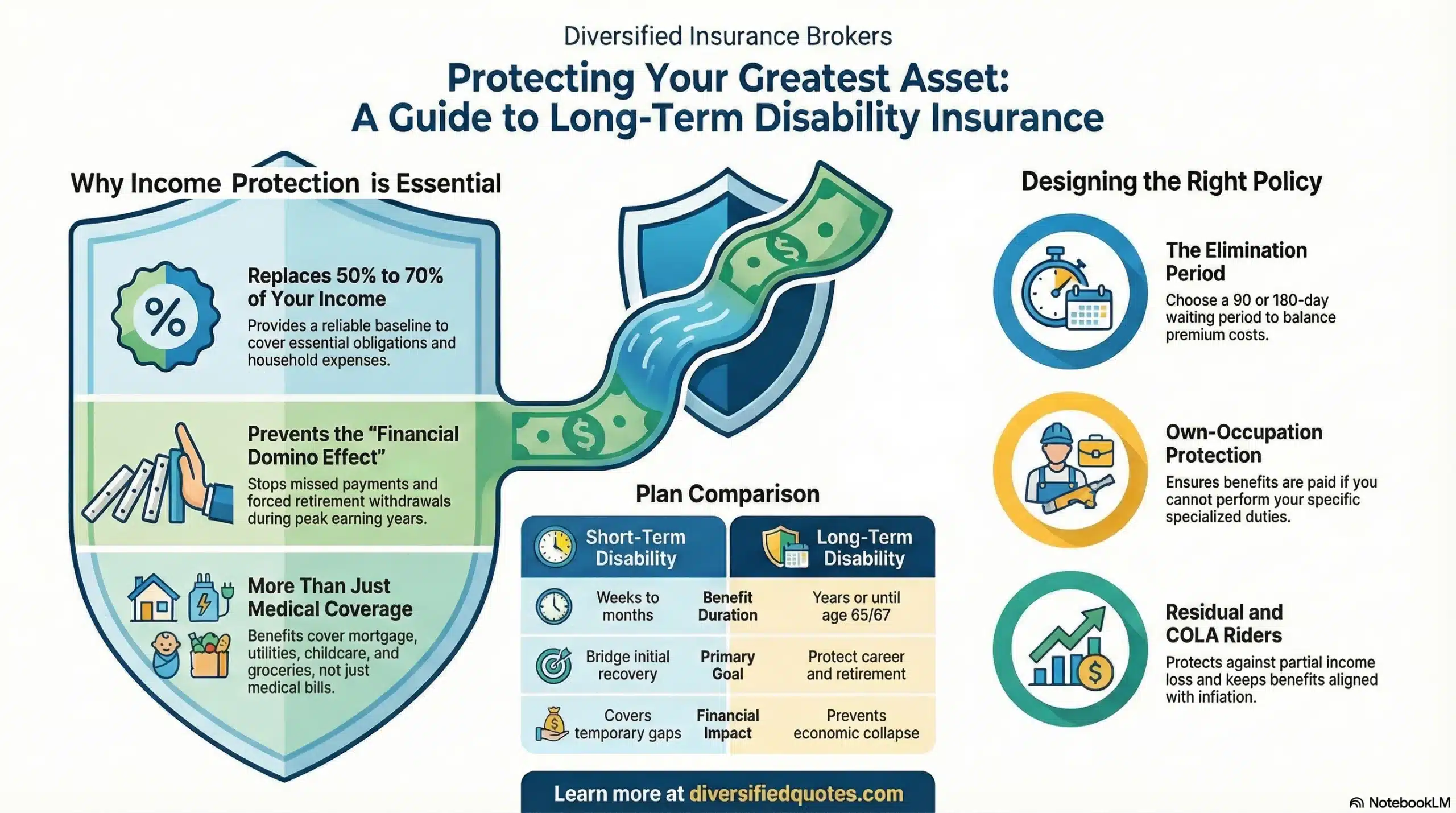
Talk With an Advisor Today
Choose how you’d like to connect—call or message us, then book a time that works for you.
Schedule here:
calendly.com/jason-dibcompanies/diversified-quotes
Licensed in all 50 states • Fiduciary, family-owned since 1980
Can I get disability insurance if I have been declined before?
Yes, in many cases — and this is the most important misconception to correct. A decline from one carrier is not a permanent industry-wide record. Disability insurance underwriting varies significantly between carriers in terms of how they classify specific conditions, occupations, and risk combinations. What triggers an automatic decline at a standard-market carrier — a history of back surgery, controlled type 2 diabetes, a prior cardiac event, or a hazardous occupation — may be approvable with structured modifications at a specialty carrier whose guidelines are calibrated for exactly those risk profiles. The strategy after a prior decline involves three steps: identifying exactly why the decline occurred; identifying which carriers in the specialty market have the most favorable underwriting guidelines for that specific combination of risk factors; and submitting the application with full supporting documentation positioned to address the underwriting concern directly. Physicians with prior medical events frequently discover that specialty market carriers approve coverage under modified terms after a standard-market decline — the same pattern applies across law enforcement officers and other high-risk occupations that standard carriers routinely decline. The carrier that declined you may have had no appetite for your specific risk profile regardless of how the application was positioned. A different carrier, properly matched, often has an entirely different outcome — which is why working with an independent disability broker with access to the specialty market, not just the standard carriers, is the critical element in this process.
What modifications should I expect if I am approved as a high-risk applicant?
High-risk disability insurance approvals frequently come with one or more contract modifications that limit coverage in specific ways while still providing meaningful income protection. The most common modifications are condition-specific exclusion riders — which exclude a defined condition from covered causes of disability while covering all other causes at standard terms. If your back has been a problem and you work in construction, an exclusion rider means any disability caused by the back condition would not be covered, but a disability from a stroke, cancer, or any other cause would still produce full benefits. The second modification is a premium rating — a surcharge on the standard premium (typically 25% to 150%) that preserves the standard policy terms while reflecting the higher statistical risk. The third is a shortened benefit period — instead of benefits to age 65, the policy may pay for 2 or 5 years for a specific risk category. For nurses and allied health professionals with musculoskeletal history, for example, an exclusion rider for back-related disabilities while retaining full coverage for cardiovascular, neurological, or oncological disabilities often represents a practical and affordable compromise. Understanding the tax treatment of disability insurance benefits is equally important when evaluating modifications — an individually owned policy with a premium rating still produces tax-free benefits as long as premiums are paid with after-tax dollars, making the net benefit comparison more favorable than the gross modification terms suggest. The right modification for your specific situation depends on the underwriting concern: an occupational risk is handled differently than a medical history concern, and a current health challenge is handled differently than a resolved one.
Does high-risk disability insurance cover mental health disabilities?
Mental health disabilities — including depression, anxiety, bipolar disorder, and PTSD — are among the most commonly claimed disability causes, and they are one of the most nuanced areas of disability underwriting for high-risk applicants. Most standard individual disability insurance policies do cover mental and nervous system conditions, but with a standard limitation: benefits for psychiatric conditions are capped at 24 months per disability episode, while physical disabilities retain the full benefit period. This 24-month mental/nervous limitation is standard across most carriers regardless of psychiatric history — it is not a penalty applied specifically to applicants with a mental health history but rather a universal contract provision. The underwriting concern for applicants with a mental health history is whether the applicant qualifies for the policy at all, and whether a condition-specific exclusion will apply beyond the standard limitation. For applicants with a well-managed mental health history — treated depression with stable medication and no recent hospitalizations — many carriers will offer a standard policy with the standard 24-month limitation without an additional exclusion. For applicants with more complex psychiatric histories, specialty market placement may be required. Firefighters and law enforcement officers — who have significantly higher rates of PTSD and mental health conditions as a result of occupational exposure — frequently navigate this exact underwriting challenge, and specialty carriers have developed products designed to address it. A competitive disability insurance rate with the 24-month mental/nervous standard limitation still represents substantial income protection for the wide range of physical causes that are not affected by the limitation — which is how the coverage should be evaluated.
How do self-employed professionals with variable income qualify for disability insurance?
Self-employed professionals with variable income face two distinct underwriting challenges: demonstrating a consistent income level that supports the requested benefit amount, and managing any business-related risk factors that affect occupational risk classification. Income documentation for self-employed applicants typically requires the last two years of personal tax returns — Schedule C for sole proprietors, K-1 for partnerships and S-corporations — with carriers averaging across the two most recent years or using the lower of the two for benefit calculation. For professionals whose income has grown significantly in the current year beyond what the tax return average reflects, some carriers allow current-year business financials or engagement letters to supplement the return data. Our resource on getting disability insurance when self-employed covers the income documentation process and carrier differences in full detail. Beyond income documentation, self-employed applicants with a high-risk health or occupational profile face the same underwriting evaluation as any other applicant — and for high-risk tradespeople operating independently, Business Overhead Expense insurance is a critical companion policy: while personal disability insurance replaces the owner’s income, BOE covers the fixed costs of the business — rent, payroll, equipment leases, utilities — that continue regardless of revenue, preserving the business as a going concern during the disability period. For self-employed professionals in higher-risk trades evaluating both personal and business coverage simultaneously, reviewing the full spectrum of disability insurance options by occupation clarifies which carriers and product structures are available for your specific industry and self-employment structure.
What is the difference between own-occupation and any-occupation definitions in high-risk disability policies?
The disability definition is the single most important contract provision in any disability policy, and it becomes even more consequential for high-risk applicants whose occupational specificity is the core of their income-generating capacity. Own-occupation disability insurance pays benefits if you cannot perform the material and substantial duties of your specific occupation — regardless of whether you are capable of working in a different field. An offshore petroleum engineer who develops a severe back condition preventing offshore work could collect disability benefits even if physically capable of engineering work in a non-hazardous setting. Any-occupation disability insurance — common in group plans and in some individually issued policies for lower-classified occupations — only pays benefits if you cannot work in any occupation for which you are reasonably suited by education, training, or experience. For attorneys, physicians, and other high-earning specialists who have invested decades in a specific practice, the distinction between own-occupation and any-occupation is the difference between a policy that protects the income stream those years built and one that effectively denies claims whenever some residual work capacity remains. True own-occupation coverage is generally available to professionals classified in higher occupational risk classes (3A through 5A) and may be available with modifications to applicants in lower classes. For high-risk occupational applicants in 1A or 2A classes — heavy construction, offshore energy, commercial aviation — own-occupation coverage may not be available from standard carriers, making the specialty market essential for securing the strongest available definition. Evaluating disability insurance by occupation against the carrier’s classification hierarchy shows which definitions are available for your specific role before any application is submitted.
About the Author:
Jason Stolz, CLTC, CRPC, DIA, CAA and Chief Underwriter at Diversified Insurance Brokers (NPN 20471358), is a senior insurance and retirement professional with more than 25 years of real-world experience helping individuals, families, and business owners protect their income, assets, and long-term financial stability. As a long-time partner of the nationally licensed independent agency Diversified Insurance Brokers, Jason provides trusted guidance across multiple specialties—including fixed and indexed annuities, long-term care planning, personal and business disability insurance, life insurance solutions, Group Health, Travel Medical and Evacuation Insurance, and short-term health coverage. Diversified Insurance Brokers maintains active contracts with over 100 highly rated insurance carriers, ensuring clients have access to a broad and competitive marketplace.
His practical, education-first approach has earned recognition in publications such as VoyageATL, and contributions from his agency featured in Kiplinger and GoBankingRates— highlighting his commitment to financial clarity and client-focused planning. Drawing on deep product knowledge and years of hands-on field experience, Jason helps clients evaluate carriers, compare strategies, and build retirement and protection plans that are both secure and cost-efficient. Visitors who want to explore current annuity rates and compare options across multiple insurers can also use this annuity quote and comparison tool.
Explore More Disability Insurance Options: Browse our complete guide to Disability Insurance Planning & Education — covering how it works, riders, elimination periods, own occupation, costs & buying guides from 100+ carriers.
Last Reviewed: June 26, 2026 |
Reviewed by: Jason Stolz, CLTC, CRPC, DIA, CAA
Chief Underwriter, Diversified Insurance Brokers, Inc. | NPN: 20471358 | Diversified Insurance Brokers, Inc. — Licensed in all 50 states
Fact Checked by: Tonia Pettitt, CMIP©
Medicare Specialist, Diversified Insurance Brokers, Inc. | NPN: 14374308 | Diversified Insurance Brokers, Inc. — Licensed in all 50 states
Did you find this content helpful? Leave us a Google review — it helps others find trustworthy guidance too.
Editorial Standards: Diversified Insurance Brokers maintains rigorous editorial standards to ensure accuracy, clarity, and independence in all content. Learn more about our editorial standards and commitment to transparency.
