
Disability Insurance for New Professionals
As an Independent Disability Insurance Broker, we have access to exclusive discounts and negotiated pricing most captive agents can’t offer — see the full breakdown near the end of this page.
Disability Insurance for New Professionals

Jason Stolz CLTC, CRPC, DIA, CAA
The most financially optimal decision a new professional can make about disability insurance is also the simplest: buy it now, while young and healthy, before the career has had time to produce the health history that narrows available terms, at the youngest available age that locks in the lowest available premiums, with the future increase option in place that allows coverage to grow with income without new medical underwriting. Social Security Administration research documents that one in four workers who are twenty years old today will experience a disabling condition before reaching retirement age — a statistic that applies with equal force whether the twenty-something is a first-year attorney, a new nurse, a just-licensed engineer, or a newly self-employed consultant. The disability risk that drives that one-in-four statistic is not primarily physical injury — it is illness, with mental health conditions including anxiety and depression documented by the Council for Disability Awareness as significant contributors to long-term disability claims across the working-age population. Early career is precisely when the combination of clean health, low age-rated premiums, and the maximum available career earnings runway ahead makes the decision to establish income protection before any health history develops the highest-return financial protection decision in any professional’s planning lifetime. The professional who waits until 35 or 40 to address this will pay more, cover less, and potentially face exclusion riders for conditions that ten years of career have placed in the medical record — and none of that is recoverable. The coverage available for professionals across every occupation is most comprehensive and most affordable at career start, and every year of waiting narrows both dimensions simultaneously.
At Diversified Insurance Brokers, Jason Stolz, CLTC, CRPC, DIA, CAA works with new professionals across every career stage and occupational category — physicians and dentists entering practice with significant student loan obligations, attorneys at early-career associate positions whose group plan access is limited and whose own-occupation protection is inadequate for a specialized legal career, engineers and technology professionals at their first professional role, nurses and allied health professionals, newly self-employed consultants and independent contractors building their first client base, and the full range of professionals across every educational and career entry point who share one common financial reality: their income depends on their ability to work, their savings are not yet sufficient to absorb an extended disability, and their health is — right now, today — the cleanest it will ever be for disability insurance underwriting purposes. The coverage structure that serves a physician resident with $300,000 in student loans looks different from what a self-employed new consultant needs — but both share the foundational principle that early purchase before occupational health histories, chronic condition diagnoses, and age-related premium increases reduce the quality and affordability of the protection available.
Start Your Disability Coverage Review
We compare coverage options across 100+ carriers and identify the policy structure, future increase option, and rider combination that fits your career stage and income trajectory.
Request Disability Insurance OptionsWhy Early Career Is the Optimal Window — The Four Compounding Advantages
| Advantage | How It Works at Career Start | What Waiting Costs | Dollar Impact Example |
|---|---|---|---|
| Lower age-rated premiums locked for life | Disability insurance premiums are based on age at purchase. A non-cancellable, guaranteed renewable policy purchased at 26 locks in that 26-year-old’s premium rate for the full duration — the carrier cannot raise premiums as the insured ages, even to age 65 | Every year of delay is a year of higher locked-in premium. The difference between a 26-year-old’s rate and a 36-year-old’s rate for identical coverage is significant — and the premium differential is paid every year for the remaining career duration | A professional who purchases at 26 vs. 36 may save $300–$600+ per year in annual premium on a standard $5,000/month benefit policy — $3,000–$6,000 in cumulative savings over the first ten years alone |
| Clean health record — broadest available coverage | A new professional with no chronic conditions, no prior mental health treatment, no documented musculoskeletal history qualifies for the broadest available coverage — no exclusion riders, standard rates, full mental health benefit periods, comprehensive disability causes covered without limitation | Every health event documented after purchase — the anxiety treatment at 29, the back strain at 32, the managed hypertension at 35 — would generate a partial exclusion rider if it occurred before purchase. Once excluded, those conditions cannot be added back | A mental health exclusion rider on a policy for a professional in a high-stress career (law, medicine, finance) eliminates coverage for the most statistically likely long-term disability pathway in their profession |
| Future increase option in place from career start | The future increase option (FIO) rider allows the insured to increase their monthly benefit as income grows — annually in most structures, up to age 55 — without new medical underwriting. A new professional who locks in FIO at 26 can increase benefits from $3,000/month to $8,000/month over a career without ever submitting to new health evaluation | FIO must be purchased when the original policy is issued — it cannot be added retroactively. A professional who purchases at 35 without FIO, then develops a health condition at 37, is permanently locked at their 35-year-old benefit level with no ability to increase without new underwriting that the health condition may prevent | A physician who locks in FIO at 28 as a resident can increase benefits from $3,500/month (resident income basis) to $10,000–$15,000/month as attending income grows — all at the clean health terms locked in during residency, never subject to any future health event |
| Maximum career earnings protection horizon | A policy issued at 26 runs to age 65, protecting 39 years of career earnings. The present value of 39 years of earning potential represents the largest financial asset most professionals will ever own — and disability insurance is specifically the product designed to protect it | Each year of delay reduces the earnings protection horizon by one year. A professional who purchases at 36 is protecting 29 years of earnings rather than 39 — and has already absorbed 10 years of disability risk uninsured, during the period when premium cost was lowest and health was cleanest | At $80,000 annual income growing 3% per year, the present value of 39 years of earnings exceeds $2 million. Disability insurance at $2,000–$4,000 per year protects a $2M+ asset at a cost ratio of less than 0.2% annually |
The four advantages compound each other: the lower premium from early purchase is paid on the most comprehensive policy available — comprehensive because clean health generates no exclusion riders — and that comprehensive policy includes the future increase option that allows the coverage to grow without ever surrendering the clean-health terms locked in at career start. A professional who addresses all four dimensions at career start is in a categorically better position than one who waits — not marginally better, but structurally and irreversibly better for the rest of their working life. Understanding why income protection is the foundational financial protection decision for any professional begins with this structure: the asset being protected is the career’s entire future earning capacity, and the window to protect it most completely and most affordably closes with each passing year.
The Student Loan Dimension — Why New Professionals Cannot Afford to Wait
The student loan dimension of early-career disability planning deserves specific attention because it creates a financial vulnerability that exists at no other point in a professional career. A new attorney, physician, dentist, pharmacist, engineer, or MBA graduate who enters their first professional role with $100,000 to $400,000 in student loan debt has a financial obligation that does not pause, does not defer automatically for disability, and does not disappear when income stops. Income-driven repayment plans may reduce payment amounts during financial hardship, but they do not eliminate the loan balance or its continued growth during a disability period.
A disability at year two of a professional career — before savings have accumulated to anything meaningful, while student loan balances are at their peak, while household financial obligations are being established — is the scenario with the most concentrated financial damage of any point in a professional working life. Individual disability insurance provides the income floor that prevents a two-year disability from becoming a permanent financial setback: the monthly benefit replaces a portion of income that services the loan obligations and covers household costs, preserving the financial trajectory that the professional degree was designed to fund. The student loan rider available on many disability insurance policies adds an additional benefit specifically earmarked for student loan payments during the disability period — an additional layer of protection for professionals with meaningful educational debt entering careers where that debt is specifically tied to the income-generating credential. Industry sources document that the student loan rider is particularly popular among early-career professionals with high student loan debt, including physicians, attorneys, and dentists, precisely because the financial consequence of a disability during the peak loan-service period is the most concentrated financial risk those professionals face.
The Future Increase Option — The Most Important Rider for Early-Career Professionals
The future increase option rider is the policy feature that makes early-career disability insurance purchase specifically superior to waiting — and it deserves more detailed explanation than the summary in the table above. The FIO rider gives the policyholder the contractual right to increase their monthly disability benefit annually — in most structures, up to a specified age, typically 55 — by a defined amount, without new medical underwriting. The insurer cannot require a new health examination, cannot revisit the original medical history, and cannot apply any health-based modifications when the policyholder exercises an FIO increase. The only requirement is documented income growth sufficient to support the increased benefit amount.
For a new professional whose income at career entry is $55,000 or $65,000 per year but whose career trajectory projects to $120,000, $180,000, or $250,000 over the following decade, the FIO rider is the mechanism that allows the disability coverage to track that income trajectory rather than remaining permanently anchored to the career-entry benefit level. A physician who establishes disability coverage during residency at a $3,500/month benefit — calibrated to resident stipend income — with FIO in place can increase to $8,000, $10,000, or $12,000 per month as attending income grows, all at the clean-health underwriting terms locked in during residency. If that physician developed a manageable but documentable health condition during residency or early attending practice, the FIO increases proceed on schedule regardless — the health condition cannot block FIO exercises. The future increase option specifically designed for growing professional careers is not merely a convenient feature — it is the coverage architecture that makes early purchase strategically superior to waiting and then purchasing larger coverage later after income has grown.
Group Plans Are Not Enough — What New Professionals Need to Understand
Most new professionals who receive employer-provided group long-term disability coverage through their first employer accept it as adequate and stop thinking about disability insurance. This is the most common and most consequential disability planning mistake of any professional career. Group LTD plans carry four structural limitations that make them inadequate as the sole disability protection for any professional whose career involves growing income, specialized skills, and long-term financial obligations.
First: the benefit ceiling. Group plans cap monthly benefits — commonly at $5,000 to $10,000 per month — that inadequately replace income for professionals earning above $70,000 to $100,000 annually. A physician earning $220,000 or an attorney earning $185,000 whose group plan caps at $8,000 per month is insuring less than half their actual income. Second: taxability. When the employer pays group premiums, resulting disability benefits are taxable as ordinary income — a 60 percent replacement rate at a 25 percent marginal tax rate produces 45 percent effective replacement of take-home pay. Third: the 24-month own-to-any occupation transition. Most group plans transition from covering inability to perform the specific job to requiring inability to perform any job after 24 months — eliminating benefits for a specialized professional who cannot perform their specific career but could theoretically perform some other work. Fourth: portability. Group plans end when employment ends. A professional who leaves their first employer — voluntarily or otherwise — loses the group coverage entirely, often at the worst possible time and potentially after health events have developed that make new individual coverage expensive or limited. Understanding the full landscape of long-term disability income coverage begins with mapping these four gaps in any existing group plan against the household’s actual financial obligations, then building individual coverage that addresses each gap specifically. Guaranteed issue group disability coverage through professional associations or alumni organizations may provide an accessible additional coverage tier for new professionals, but shares the same structural limitations as employer group plans and should be evaluated against individual coverage on its specific terms.
Own-Occupation Coverage — Protecting the Specific Career, Not Just Any Job
The disability definition matters more at the early career stage than at any subsequent point — because the specific professional career a new professional has trained, educated, and credentialed for is exactly what the disability insurance needs to protect. A dentist who develops a hand condition preventing dental procedures but who could theoretically teach or consult has experienced a career-defining disability even if general work capacity remains. A new attorney whose anxiety disorder prevents the sustained courtroom and adversarial litigation functions that define their practice has lost the specific career the law degree created even if sedentary administrative work is theoretically possible. A true own-occupation disability policy pays benefits when the insured cannot perform the material and substantial duties of their specific occupation — regardless of any other theoretical work capacity — protecting the career premium that specialized professional training produces.
For new professionals who are just entering specialized careers, establishing the own-occupation standard from day one ensures that the policy protects the specific professional function from the first day of coverage through age 65. The residual disability provision is equally important for early-career professionals whose disability scenarios may involve reduced capacity rather than complete disability — a condition that limits the number of patients seen, clients served, or hours worked rather than eliminating all professional activity. A residual benefit pays proportionally based on actual income reduction from partial disability, which matters particularly for new professionals whose realistic disability scenarios often involve reduced capacity during recovery rather than total incapacity from day one. Understanding how short-term and long-term disability structures interact is important for new professionals mapping the complete coverage architecture from the first day of a qualifying disability through the elimination period and into the long-term benefit period.
Mental Health Coverage — Non-Negotiable for the First Professional Generation
The mental health dimension of disability coverage is particularly important for new professionals — not as a stigma-laden caveat but as a straightforward acknowledgment of what the research documents. The Council for Disability Awareness specifically documents mental health conditions including anxiety and depression as significant contributors to long-term disability claims among the working-age population. Research on professional career stress, burnout, and occupational mental health consistently documents elevated rates across high-stress professional fields — law, medicine, finance, technology — particularly among early-career professionals managing the performance expectations of new professional roles alongside the financial pressure of student loan obligations and establishing adult financial life.
A new professional who establishes disability insurance with an unlimited mental health benefit period before any anxiety treatment or depressive episode has been documented in a medical record secures comprehensive mental health coverage that subsequent health events cannot retroactively limit. A professional who waits until anxiety treatment has been documented, or who accepts an employer group plan’s standard 24-month mental health benefit cap, has significantly reduced the coverage available for the disability pathway most statistically likely to affect their peer group. Coverage options for professionals with prior mental health histories are available through independent broker comparison, but the terms available before any treatment history exists are categorically superior. Coverage for professionals who already have documented health histories at career entry — whether mental health, chronic conditions from young adulthood, or other documented diagnoses — is available through independent broker channels and should be evaluated rather than assumed to be unavailable.
Policy Design, Affordability, and Getting Started
The practical reality of disability insurance for new professionals is that the annual premium at early-career ages and income levels is meaningfully affordable relative to the income being protected. A 26-year-old professional earning $65,000 annually with a $3,500/month disability benefit policy with own-occupation definition, future increase option, and 90-day elimination period will typically pay an annual premium in the range of $1,200 to $2,000 depending on occupational class, health status, and carrier — a cost that represents approximately 1.8 to 3.0 percent of the annual income being protected and that is locked in at that level for the full career. How much coverage a new professional actually needs is calibrated to documented income, household financial obligations including student loan service, and the elimination period the professional can sustain from their current savings level. A 90-day elimination period is appropriate for new professionals with three months of savings; a 60-day period is appropriate for those with limited reserves, at higher premium cost. The elimination period selection is the most practical cost-management lever for new professionals on tighter budgets.
Top-tier occupational class coverage for white-collar professionals produces the most favorable premium rates available in the disability insurance market — reflecting the primarily sedentary, cognitive, and professional character of the work and producing premium rates that make comprehensive coverage genuinely accessible relative to professional income levels. High-income professional coverage frameworks address the specific considerations for new professionals whose income trajectory projects to levels where group plan ceilings become inadequate quickly. The full rider landscape for a new professional’s policy includes the FIO rider, the cost of living adjustment rider, and the student loan rider as the most commonly evaluated options, alongside the own-occupation definition and residual disability provision. The cost of living adjustment rider is particularly important for permanent disability scenarios where the benefit must sustain purchasing power across decades. No-exam disability coverage provides a streamlined, faster approval path for healthy new professionals who prefer to avoid the paramedical exam and blood work associated with full medical underwriting. Buying disability insurance online makes the process accessible for new professionals whose schedules do not accommodate traditional in-person broker appointments. Getting the best available rates as a new professional means comparing across the full carrier market through an independent broker who accesses multiple companies rather than a single insurer whose rates may not be competitive for the specific occupational class and age combination. Whether disability insurance is worth the cost for a new professional is answered by the ratio of annual premium to the career earnings being protected — at less than 2 to 3 percent of annual income for most early-career professionals, the coverage cost represents the most favorable income protection ratio available at any point in the professional lifecycle. Income documentation for 1099-earning new professionals and coverage for early-career independent contractors follow the Schedule C framework with the same FIO rider logic applied to variable early-career income. Whether disability benefits are taxable for a new professional who purchases individually with after-tax income: generally tax-free — the full monthly benefit reaches the household without income tax reduction, delivering genuine income replacement rather than a pre-tax benefit that taxes erode. A second opinion on any disability insurance proposal from a new professional’s first employer, association, or initial broker confirms whether the own-occupation definition, future increase option, and mental health benefit terms are as favorable as the full market produces before any premium commitment is made.
Start Your Coverage Review Now
We compare coverage options across 100+ carriers and identify the early-career policy structure — own-occupation definition, future increase option, and right elimination period — that fits your specific profession and income stage.
Request Disability Insurance Options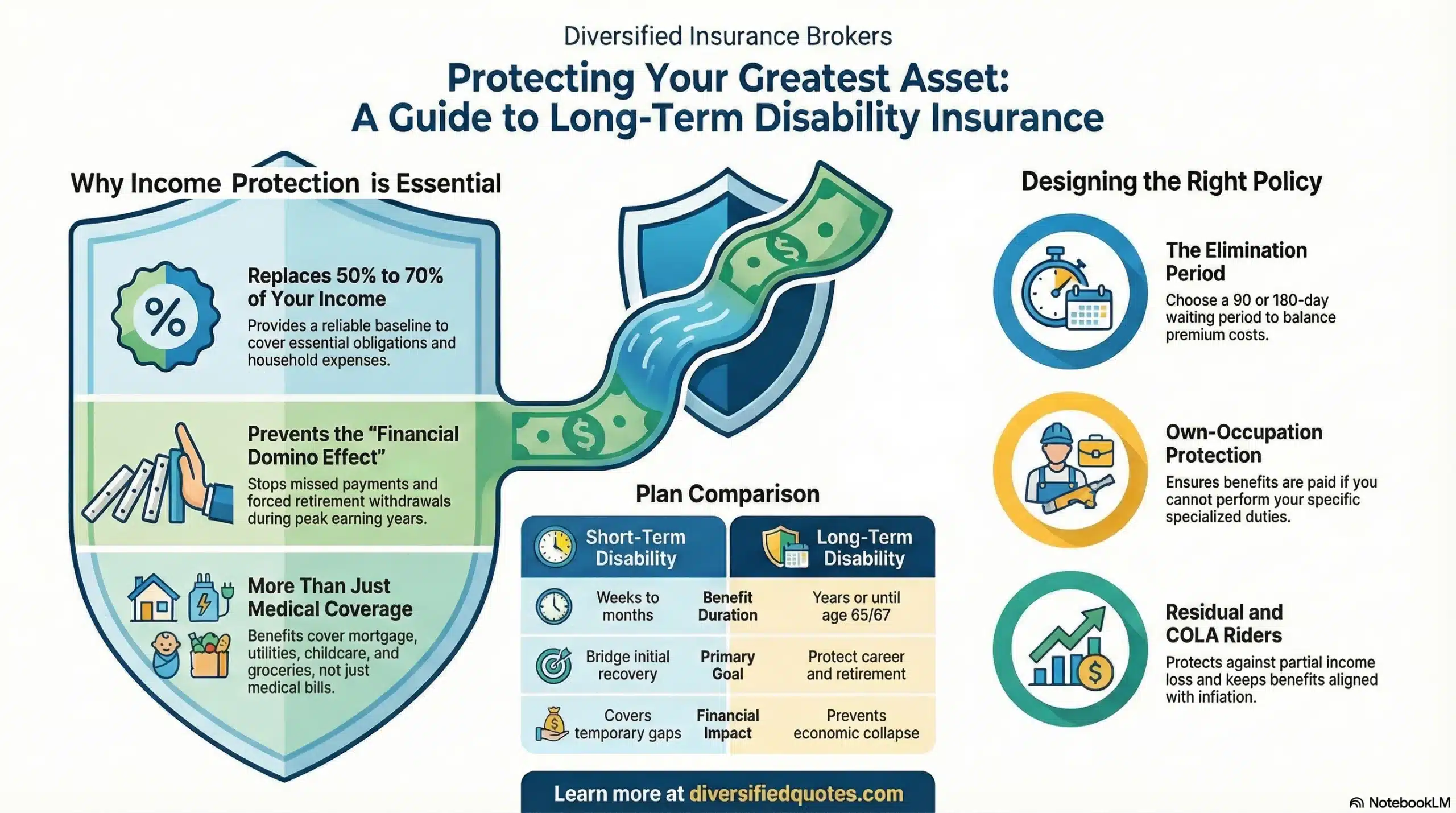
Talk With an Advisor Today
Choose how you’d like to connect—call or message us, then book a time that works for you.
Schedule here:
calendly.com/jason-dibcompanies/diversified-quotes
Licensed in all 50 states • Fiduciary, family-owned since 1980
FAQs: Disability Insurance for New Professionals
I’m young and healthy — what’s the realistic probability I’ll actually need disability insurance?
Social Security Administration research documents that one in four workers who are twenty years old today will experience a disabling condition before reaching retirement age. This is not a catastrophizing statistic — it is a population-level actuarial measurement from the federal agency whose own disability benefit programs exist precisely because this risk is real and widespread. The more important insight for a new professional evaluating this probability is the nature of the disabilities that drive the statistic: the majority of long-term disabling conditions are illness-based, not injury-based. Back disorders, cancer, cardiovascular disease, and mental health conditions — anxiety, depression, and burnout — are the primary drivers of long-term disability claims, not dramatic workplace accidents.
For a young professional in a high-stress career, the mental health dimension is particularly relevant. The Council for Disability Awareness specifically documents anxiety and depression as significant contributors to long-term disability claims across the working-age population — precisely the categories most likely to affect early-career professionals managing student loans, performance expectations, and the demands of establishing a professional career simultaneously. The question is not whether disability could happen — the statistics confirm it can and does for approximately one in four workers — but whether the household has an adequate financial floor when it does. The complete case for income protection regardless of age or health addresses both the probability dimension and the financial consequence dimension that make early-career purchase the most financially sound decision available.
My employer provides group LTD coverage — is that sufficient for a new professional?
Employer group long-term disability coverage is a meaningful benefit baseline but carries four structural limitations that make it inadequate as the sole disability protection for a professional whose career involves growing income and specialized skills. The monthly benefit ceiling — commonly $5,000 to $10,000 per month — may adequately serve current early-career income but will become progressively inadequate as professional income grows beyond the plan’s cap. The taxability of group benefits — taxable as ordinary income when the employer pays premiums — reduces the effective replacement rate below the stated percentage at any income level. The 24-month own-to-any occupation definition transition eliminates benefits for a specialized professional whose disability prevents their specific career but not all work. And the complete loss of coverage at any job change means the protection is tied to one employer’s benefit design rather than to the professional’s own policy.
The employer group plan’s inadequacy as the sole protection is especially acute for new professionals because the future income growth that makes the benefit ceiling a problem happens soon, the career specialization that makes the definition transition consequential is what the professional degree was designed to create, and the job changes that trigger coverage loss are statistically most common in the first ten years of professional careers. The right answer for a new professional with group LTD access is to use the group plan as a base and supplement it immediately with an individual own-occupation policy that fills the ceiling gap, preserves the own-occupation standard beyond 24 months, and remains in force regardless of any future employment change. A second opinion on any group LTD plan specifically quantifies what the plan provides and what individual supplemental coverage needs to address.
I have significant student loan debt — should I prioritize paying loans or getting disability insurance?
These are not mutually exclusive priorities — disability insurance is the financial protection that makes student loan repayment possible if a disability strikes during the repayment period. A professional carrying $150,000 in student loans who becomes disabled without disability insurance faces the loss of the income designed to service those loans and the continued accrual of interest on the loan balance throughout the disability period. Income-driven repayment plans may reduce immediate monthly payments but do not eliminate the debt or its growth, and loan rehabilitation after a multi-year disability period is financially painful. The disability insurance policy provides the income floor that keeps the loan repayment on track even when the disability eliminates the professional income that was funding the repayment.
The annual premium of a disability insurance policy for a new professional is typically a small fraction of the student loan monthly payment — commonly $100 to $175 per month for a comprehensive individual policy at early-career age and income, versus $800 to $1,500 per month in student loan payments for a professional with significant educational debt. Allocating $100 to $175 monthly to disability insurance while aggressively repaying loans is not a difficult trade-off when the alternative — being uninsured during the repayment period — exposes the entire loan balance and household financial position to the one-in-four probability of a disabling condition before retirement. The student loan rider available on many disability policies adds a specific benefit earmarked for student loan payments during the disability period, providing an additional layer of loan protection beyond the general income replacement benefit. Industry sources specifically document this rider as popular among early-career professionals with high student loan debt.
What is the future increase option and why is it especially important for new professionals?
The future increase option is a rider that gives the policyholder the contractual right to increase their monthly disability benefit in future years — typically annually, up to a specified age — without submitting to new medical underwriting. When you exercise a future increase option, the insurer cannot require a new health examination, cannot apply any new exclusion riders based on health conditions that developed after the original policy was issued, and cannot change the policy’s definition or terms. The only requirement is documented income growth that supports the larger benefit amount.
For a new professional, the FIO rider solves the specific mismatch between early-career income — the modest salary or starting compensation that determines the initial policy benefit amount — and the career income trajectory that will eventually need protection. A 26-year-old attorney earning $70,000 as a first-year associate can purchase a policy with a $3,500/month benefit and FIO, then increase to $5,000, $7,000, and eventually $10,000/month as their income grows over the following decade — all at the terms locked in at 26 with clean health, never subject to any health condition that develops in the interim. Without FIO, that same attorney who develops a manageable but documentable condition at 29 is permanently locked at their 26-year-old benefit level, unable to increase coverage without new underwriting that the condition may prevent or complicate. The FIO rider must be purchased when the original policy is issued — it cannot be added retroactively — which is the specific reason why new professionals should address this immediately rather than waiting until income grows. The complete explanation of the future increase option rider covers how exercises are structured, what documentation is required, and what specific benefit amount increases are available under typical FIO provisions.
I’m currently in a residency, fellowship, or graduate program — can I get disability insurance before I start earning a full professional income?
Yes — and for physicians, dentists, attorneys studying for the bar, and other professionals in training programs, establishing disability insurance during the training period rather than waiting for full professional income is one of the most strategically sound financial decisions available. During residency, fellowship, or a graduate professional program, the applicant is typically at their youngest age — meaning the lowest available premium rates — and their cleanest health record before occupational or professional stress has had time to produce any documented health history. The benefit amount at the training stage is calibrated to training stipend or fellowship income, which is modest, but the FIO rider locked in at this stage is what allows the coverage to grow to full attending, partner, or professional income levels over the following years without new medical underwriting.
Specific programs exist from several carriers that allow medical residents, dental residents, and law students to establish disability coverage before graduation and before full professional income documentation exists — a bridge structure that provides immediate protection at the training income level with the FIO mechanism in place for full income growth. The training-period application captures the clean health record at the youngest available age while the professional is still in a controlled, lower-stress training environment rather than after the first year of full professional practice has potentially introduced occupational health events. For a physician entering residency with medical school debt, establishing disability insurance during residency specifically at the resident stipend level with FIO in place is the approach that produces the most comprehensive lifetime protection at the most favorable terms. Income documentation for training-stage professionals with stipend or fellowship income follows the same earned income documentation approach as any early-career professional.
Are disability insurance benefits taxable if I purchase a policy myself as a new professional?
For new professionals who purchase individual disability insurance personally and pay premiums with after-tax personal income, monthly disability benefits received during a qualifying disability are generally received income-tax-free. The full benefit amount reaches the household without income tax reduction. Understanding how disability insurance payments are taxed is important for sizing the benefit correctly: a tax-free individually purchased benefit should be sized to replace actual after-tax take-home income — not gross salary — ensuring that the household receives genuine financial replacement of what was lost rather than a pre-tax benefit that the tax system further reduces.
The tax-free character of personally purchased disability benefits is one of the most underappreciated financial advantages of individual over group coverage for new professionals. Group disability benefits paid from employer-paid premiums are taxable as ordinary income — a 60 percent stated replacement rate at a 24 percent marginal tax rate delivers approximately 45 percent of actual take-home pay. An individually purchased policy paying a $3,500 monthly tax-free benefit delivers the full $3,500 to the household. At an entry-level professional salary of $70,000 — approximately $4,800/month after tax at typical combined federal/state rates — a $3,500/month tax-free benefit provides approximately 73 percent effective replacement of actual take-home pay, which is a materially better real-dollar outcome than a group plan’s stated 60 percent replacement rate that taxation reduces to something closer to 45 percent. Building the individual policy benefit amount from the after-tax take-home figure rather than the gross salary figure is the most accurate sizing approach for any new professional evaluating how much coverage they actually need.
About the Author:
Jason Stolz, CLTC, CRPC, DIA, CAA and Chief Underwriter at Diversified Insurance Brokers (NPN 20471358), is a senior insurance and retirement professional with more than 25 years of real-world experience helping individuals, families, and business owners protect their income, assets, and long-term financial stability. As a long-time partner of the nationally licensed independent agency Diversified Insurance Brokers, Jason provides trusted guidance across multiple specialties—including fixed and indexed annuities, long-term care planning, personal and business disability insurance, life insurance solutions, Group Health, Travel Medical and Evacuation Insurance, and short-term health coverage. Diversified Insurance Brokers maintains active contracts with over 100 highly rated insurance carriers, ensuring clients have access to a broad and competitive marketplace.
His practical, education-first approach has earned recognition in publications such as VoyageATL, and contributions from his agency featured in Kiplinger and GoBankingRates— highlighting his commitment to financial clarity and client-focused planning. Drawing on deep product knowledge and years of hands-on field experience, Jason helps clients evaluate carriers, compare strategies, and build retirement and protection plans that are both secure and cost-efficient. Visitors who want to explore current annuity rates and compare options across multiple insurers can also use this annuity quote and comparison tool.
Explore More Disability Insurance Options: Browse our complete guide to Disability Insurance for Legal, Finance & White Collar Professionals — covering attorneys, accountants, bankers, executives, financial planners & business professionals from 100+ carriers.
Last Reviewed: June 8, 2026 |
Reviewed by: Jason Stolz, CLTC, CRPC, DIA, CAA
Chief Underwriter, Diversified Insurance Brokers, Inc. | NPN: 20471358 | Diversified Insurance Brokers, Inc. — Licensed in all 50 states
Fact Checked by: Tonia Pettitt, CMIP©
Medicare Specialist, Diversified Insurance Brokers, Inc. | NPN: 14374308 | Diversified Insurance Brokers, Inc. — Licensed in all 50 states
Did you find this content helpful? Leave us a Google review — it helps others find trustworthy guidance too.
Editorial Standards: Diversified Insurance Brokers maintains rigorous editorial standards to ensure accuracy, clarity, and independence in all content. Learn more about our editorial standards and commitment to transparency.
