
Disability Income Insurance for Nurses
As an Independent Disability Insurance Broker, we have access to exclusive discounts and negotiated pricing most captive agents can’t offer — see the full breakdown near the end of this page.
Disability Income Insurance for Nurses

Jason Stolz CLTC, CRPC, DIA, CAA
Disability income insurance for nurses is income protection built around how nursing actually works—not how a desk job works. Nursing is physically demanding, clinically precise, emotionally intensive, and often performed across long shifts in environments where overexertion, musculoskeletal strain, and exposure to illness are everyday realities rather than remote risks. Healthcare and social assistance has the highest number of nonfatal occupational injuries of any private industry, and registered nurses experience injury rates meaningfully above the national average across all occupations. When a nurse cannot work, the financial disruption is immediate and can run deep—because most nursing households depend not just on base salary but on overtime, shift differentials, specialty pay, and contract income that standard group disability plans rarely protect in full. At Diversified Insurance Brokers, Jason Stolz CLTC, CRPC, DIA, CAA and Chief Underwriter, helps nurses across every specialty and role structure compare disability coverage that reflects the actual work—the physical demands, the income complexity, the career mobility, and the reality that nursing disability is often a gradual or partial situation before it becomes total. Whether you are a bedside RN, LPN, NP, CRNA, travel nurse, or nurse executive, your income is one of the most valuable assets in your financial plan, and it deserves protection that functions at claim time, not just on the brochure.
Why Nurses Face Elevated Disability Risk
The physical demands of nursing are not abstract. Nurses lift and transfer patients, push and pull heavy equipment, stand for extended periods on hard floors, and perform repetitive tasks across shifts that can run 10-14 hours. Musculoskeletal disorders—back injuries, neck problems, shoulder injuries, knee issues, and repetitive strain conditions—are the primary driver of nursing disability claims and represent some of the highest incidence rates in the entire healthcare workforce. A back injury that would sideline an accountant for weeks can end a bedside nurse’s clinical career, because the job requires physical capabilities that the injury has compromised. The clinical condition is the same; the career consequence is dramatically different.
Beyond physical injury, nurses face disability risks that don’t always show up in traditional occupational risk models: infectious disease exposure, chronic fatigue and burnout syndromes, neurological conditions, autoimmune disorders, and mental health conditions that can develop or worsen under sustained high-acuity clinical pressure. These conditions don’t require a traumatic event—they can emerge gradually and create a slow erosion of the ability to sustain full-capacity clinical nursing. And because they’re not “dramatic injuries,” nurses sometimes underestimate how disabling they can become. Disability income insurance is designed to protect income from both traumatic and medical events, because both create financial exposure in nursing careers.
Get a Disability Insurance Quote
Compare disability coverage from top-rated carriers and specialty markets, matched to your occupation, your income, and how you actually work.
Why the Policy Definition Matters More Than Almost Anything Else
The single most consequential decision in structuring disability income insurance for nurses is the definition of disability—specifically, whether the policy covers inability to perform the duties of the nurse’s own occupation or merely the inability to work in any occupation. This distinction determines whether a claim pays in the scenarios nurses are most likely to face. Consider a bedside RN with a chronic lumbar condition that prevents sustained lifting, transferring, and the physical demands of floor nursing. Under a true own-occupation definition, that nurse is disabled—because the inability to perform the material and substantial duties of their nursing role triggers benefits, regardless of whether they could theoretically work in a less physically demanding capacity. Under an “any occupation” standard, a claim could be denied because the nurse can still perform administrative, educational, or case management work, even though that work pays a fraction of their clinical income.
For CRNAs, the stakes are even higher. Nurse anesthesiology depends on fine motor function, airway management, IV access, sustained standing and positioning, and the ability to respond quickly in surgical emergencies. A hand tremor, carpal tunnel syndrome, essential tremor, or peripheral nerve injury can end anesthesia practice without affecting the theoretical ability to work as a case manager or educator. With median CRNA earnings well above $200,000, the gap between “anesthesia income” and “any-nursing income” under a generic policy is enormous. A true own-occupation policy tied to anesthesia-specific duties protects the actual income. A nursing-generic policy does not. This is the scenario where policy language—not just coverage amount—is the difference between financial security and financial crisis. See own-occupation disability insurance explained for a full breakdown of how definitions work and why they matter at claim time.
Nursing Roles, Occupation Classes, and How Coverage Is Typically Structured
| Nursing Role | Primary Disability Risk | Own-Occ Consideration | Key Coverage Priority |
|---|---|---|---|
| RN (Bedside / Floor) | Musculoskeletal injury, back/shoulder strain, repetitive stress, fatigue | Critical—injury may prevent floor nursing but not all work | True own-occ; residual benefit; portable individual policy |
| CRNA | Fine motor impairment, hand tremor, back injury, cognitive/neurological conditions | Highest stakes—anesthesia-specific duties vs. generic nursing | Anesthesia-specific own-occ; high monthly benefit; specialty definition language |
| Nurse Practitioner (NP) | Cognitive demands, repetitive clinical tasks, burnout, chronic illness | Important—NP-specific duties differ from general nursing duties | Own-occ; future increase rider as income grows; residual benefit |
| LPN / LVN | Physical patient care, lifting, standing, repetitive motion | Moderate—policy design should align with clinical duties | Affordable individual coverage; partial/residual benefit; no-exam options where applicable |
| Travel Nurse | Same physical risks as RN; plus income variability between contracts | Critical—group coverage ends between contracts; gaps are common | Portable individual policy; income averaging; benefit amount that reflects contract income |
| Nurse Midwife / CNS | Physical delivery support, lifting, extended hours, mental demands | Important—specialty scope requires specific duty alignment | Specialty own-occ language; residual benefit; COLA rider for long-term inflation protection |
Group Disability Coverage vs. Individual Disability Insurance for Nurses
Most hospital-employed nurses have access to some form of employer group long-term disability (LTD) coverage, and many assume this is sufficient. Group coverage is a starting point—but it typically has limitations that matter specifically to nurses. Monthly benefits are often capped at a set dollar maximum that may not reflect a nurse’s full income including overtime, shift differentials, weekend pay, and specialty premiums. Definition language in group plans may shift from an own-occupation standard to an any-occupation standard after two years, which can create claim exposure exactly when it matters most—in the middle of a long-term disability. And group coverage almost universally ends when employment ends, which creates real risk for nurses who change hospitals, move to travel contracts, or transition out of a health system role.
An individually owned disability policy addresses each of these gaps. The benefit amount can be designed to reflect total income including variable compensation, subject to carrier limits. The definition can be structured as true own-occupation for the duration of the benefit period. And because the policy is owned by the nurse personally, it follows them regardless of where they work. This portability is particularly valuable in nursing, where career mobility is common and employer relationships change more frequently than in many other professions. When premiums are paid personally with after-tax dollars, benefits are also received income-tax-free—which changes the effective income replacement meaningfully compared to a taxable group benefit. See how disability insurance payments are taxed for a full explanation of how the premium-payment method affects what you actually receive during a claim.
The Critical Importance of the Residual Disability Rider for Nurses
Total disability—the complete inability to work—is not the only scenario that creates financial hardship for nurses. Partial recovery is common and often extends over weeks or months. A nurse who returns to work at reduced hours due to a back condition, an NP who can see patients only two days per week during treatment, or a travel nurse who can only accept light-duty assignments at reduced rates—all of these represent meaningful income loss without a total inability to work. Under a basic disability policy without a residual benefit, none of these scenarios would pay a claim. The residual disability rider changes that: it pays a proportional benefit when income is reduced due to a qualifying disability, even if the nurse is still working. For most nurses, the residual benefit is the feature most likely to be triggered in a realistic disability scenario, which makes it one of the most important components in policy design—not an optional add-on.
Travel Nurses and 1099 Nurses: The Portability Problem
Travel nursing has grown substantially as a career path, and with it has come a significant protection gap. Nurses who rotate between contracts—sometimes working for multiple agencies or health systems in a single year—typically lose group disability coverage at the end of each contract. The gap between one assignment ending and the next beginning can leave a nurse without any income protection, precisely during periods when the risk is as high as ever. Individual disability insurance solves this portability problem cleanly: because the policy is owned and paid by the nurse personally, it doesn’t change when the employer does. The nurse carries the same coverage, with the same definition and the same benefit, from one assignment to the next and across state lines.
For 1099 nurses—including independent contractor nurses, staffing agency nurses paid as contractors, and nurses operating through personal service arrangements—the income documentation requirement for disability underwriting can be more complex. Carriers typically average 1099 income over a two-to-three-year lookback period, and income variability can affect the maximum benefit available. Working with an independent broker who understands how to structure and present 1099 nursing income is essential to maximizing benefit amounts and avoiding underinsurance. See our resources on disability insurance for self-employed professionals and independent contractors for how variable-income documentation works across different underwriting programs.
Key Riders That Strengthen Disability Coverage for Nurses
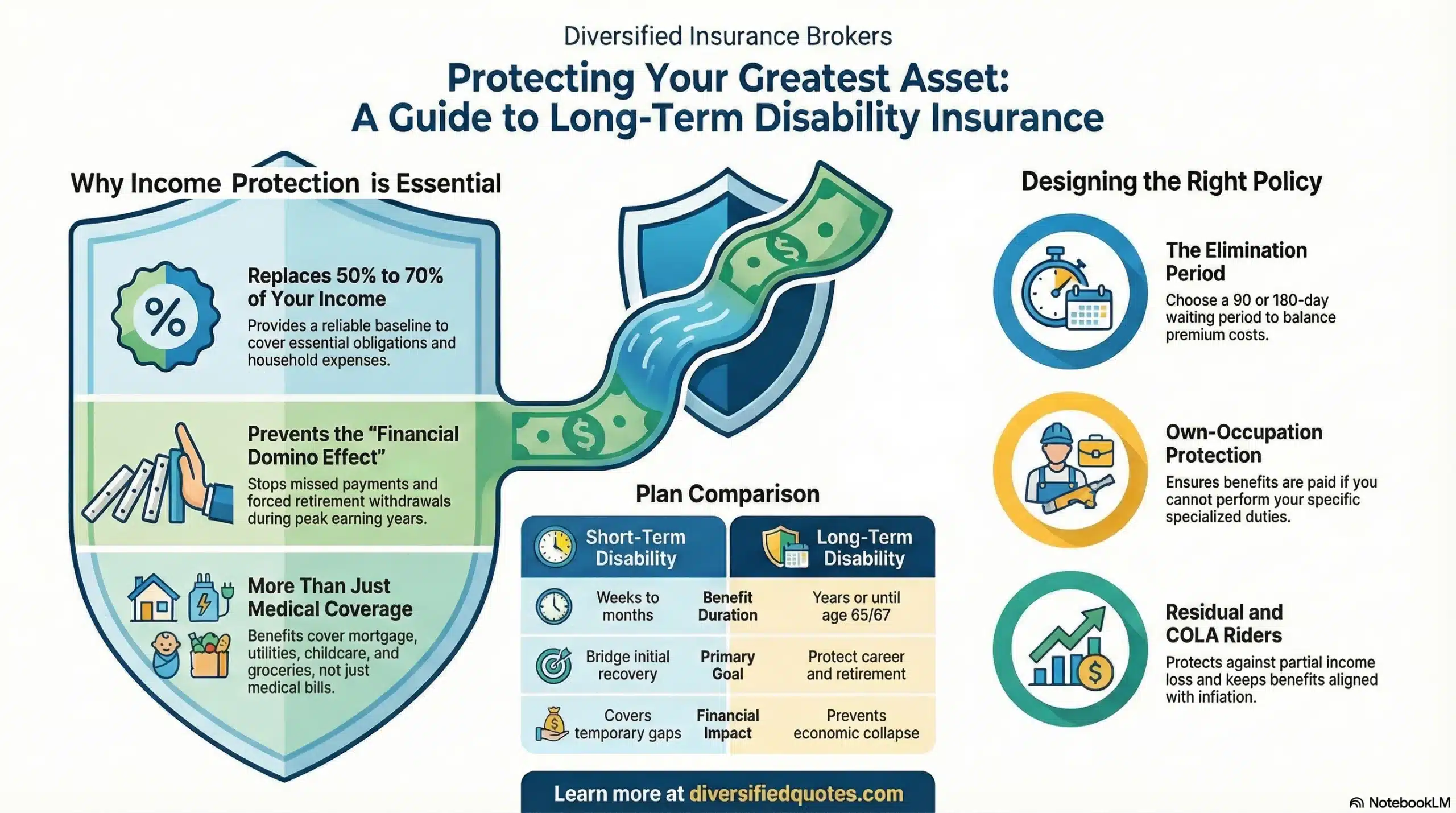
The base policy defines the benefit amount, definition, elimination period, and duration. Riders refine and expand the policy’s function over time. Several riders are particularly important in nursing disability planning. The future increase option (sometimes called a future purchase option or FIO) allows a nurse to increase their benefit amount at future policy anniversaries without new medical underwriting. This matters because nursing income typically grows over a career—through years of experience, specialty certifications, advanced degrees, and promotions—and the coverage should keep pace. Locking in the ability to increase benefits while young and healthy protects against the scenario where health changes later would make a new application difficult or expensive.
The cost-of-living adjustment (COLA) rider increases benefits annually during a claim, usually tied to CPI or a fixed percentage. If a nurse experiences a long-term or permanent disability, the purchasing power of a fixed monthly benefit erodes meaningfully over the course of years or decades. A COLA rider addresses that by keeping benefit payments aligned with inflation over the disability period. The elimination period is another design lever worth careful consideration. Nurses with strong employer short-term disability coverage or solid savings may choose a 90-day or 180-day elimination period to reduce premium costs. Nurses with limited leave banks or weaker short-term coverage may prefer a 30-day or 60-day elimination period, accepting a higher premium in exchange for faster benefit activation. Review our full explanation of disability insurance riders to understand how each feature interacts with the base policy structure.
How Much Disability Coverage Do Nurses Actually Need?
The standard planning target is to replace 60-70% of gross income through a combination of employer and individual coverage—but this framework requires adjustment for nurses whose income is heavily weighted toward variable compensation. A floor nurse earning $75,000 in base salary but $90,000 with overtime and differentials needs a benefit calculation rooted in the $90,000 figure, not the $75,000 base. If employer group LTD is capped at a monthly maximum of $5,000, and total take-home including differentials would suggest a need closer to $7,000-8,000 monthly, the gap between the group benefit and the actual income replacement target is significant.
The income-replacement calculation also must account for taxation. If group LTD benefits are taxable (because the employer paid the premiums), the gross benefit needs to be higher to produce adequate net income. If an individual policy is personally funded and produces tax-free benefits, a lower gross benefit can still meet net income replacement needs. This interaction between benefit taxation and required benefit amount is one of the most practical reasons to work through a coverage analysis rather than simply adding up numbers on paper. Our guide on how much disability insurance you need walks through the full calculation, including how to account for existing employer coverage and tax treatment in determining the right benefit target. For a broader cost comparison before you compare, see how much disability insurance typically costs for nurses and other healthcare professionals.
Disability Insurance for Nurses With Health History or Prior Claims
Nurses who have experienced prior injuries, prior workers’ compensation claims, or diagnosed conditions sometimes assume they cannot qualify for disability insurance or that available options will be too expensive or too limited to be worthwhile. The reality is more nuanced. Many conditions—even those that affect musculoskeletal health, which is a primary risk category for nurses—can be insured, sometimes with an exclusion rider for the affected area and sometimes at standard rates depending on severity, treatment history, and current status. Some conditions that trigger declines or significant limitations at one carrier are handled more favorably by another carrier with different appetite for the specific risk.
For nurses whose health history makes traditional underwriting difficult or impractical, no-exam disability insurance and guaranteed issue programs provide alternative pathways to coverage. Guaranteed issue opportunities may be available through professional associations, health system group programs, or specialty markets; they don’t require medical underwriting but typically carry lower benefit caps and less customization. Regardless of health history, the first step is understanding what’s actually available—not assuming coverage is out of reach. See our resource on disability insurance with pre-existing conditions for how carriers typically evaluate nursing-specific health histories.
Short-Term vs. Long-Term Disability for Nurses
Short-term disability (STD) is designed to cover the early weeks of a disability—typically up to 90 or 180 days. Many hospitals provide short-term coverage as an employer benefit, and nurses with strong paid leave banks effectively have their own short-term buffer. The more important planning question for most nurses is long-term: what happens if a back injury, chronic condition, or serious illness keeps them out of clinical nursing for a year, five years, or permanently? Long-term disability insurance is designed for exactly those scenarios, with benefit periods typically extending to age 65 or 67. The financial impact of a career-ending disability at age 40 or 50 is enormous—decades of income at stake—making long-term coverage the highest-priority protection layer in most nursing households.
For nurses who want comprehensive coverage, a common strategy is to use employer short-term coverage (or personal savings) to bridge the elimination period on an individual long-term policy, then rely on the individual long-term policy for sustained income replacement. This approach keeps the individual policy’s elimination period at 90 days—reducing premium—while maintaining full coverage from day one of the disability by using the short-term buffer. See our detailed comparison of short-term vs. long-term disability insurance and our full guide to long-term disability insurance for a complete picture of how the two layers work together.
Compare Disability Coverage Designed for Nurses
We’ll review your income structure, employer coverage, and nursing role to identify the right coverage design and benefit amount.
Get a Disability Quote
Compare own-occupation options from top-rated carriers built for healthcare professionals.
No-Exam Options
Fast-issue coverage with simplified underwriting for busy nursing professionals.
DI Services Overview
Explore our full disability insurance capabilities and how we work with healthcare professionals.
Disability Insurance for Healthcare Professionals
Compare coverage for related clinical roles across the healthcare spectrum.
Disability Insurance Essentials for Nurses
Understand policy design, income calculations, and the riders that matter most in nursing coverage.
Talk With an Advisor Today
Choose how you’d like to connect—call or message us, then book a time that works for you.
Schedule here:
calendly.com/jason-dibcompanies/diversified-quotes
Licensed in all 50 states • Fiduciary, family-owned since 1980
FAQs: Disability Income Insurance for Nurses
Why do nurses need their own disability insurance if they have employer group coverage?
Employer group disability plans for nurses typically have several meaningful limitations. Monthly benefits are often capped at a dollar maximum that doesn’t reflect total nursing income including overtime, shift differentials, and specialty pay. Group plans may shift from an own-occupation to a more restrictive any-occupation definition after two years. And group coverage ends when employment ends—which creates dangerous gaps for nurses who change hospitals, transition to travel nursing, or move between health systems. An individually owned policy addresses all three issues: it can be designed to reflect full income, it maintains the definition you choose for the life of the policy, and it travels with you regardless of employer.
What does own-occupation disability insurance mean for a nurse?
Own-occupation coverage pays benefits if you cannot perform the material and substantial duties of your specific nursing role, even if you can work in another capacity. A bedside RN who develops a chronic lumbar condition preventing floor nursing is disabled under an own-occupation definition—even if she could theoretically work as a case manager or educator. Without own-occupation coverage, that same claim could be denied because she technically can still work somewhere. For CRNAs, the stakes are even higher because anesthesia-specific duties (airway management, fine motor function, patient positioning) differ dramatically from generic nursing duties, and the income gap between the two is enormous.
Should travel nurses get individual disability insurance?
Yes, and portability is the primary reason. Group disability coverage from a hospital or staffing agency typically ends when a contract ends, which means a travel nurse cycling between assignments may have consistent income risk and inconsistent protection. An individually owned policy travels with you across assignments, employers, and states. It’s also important to document income correctly for travel nursing—base pay plus housing stipends, travel stipends, and per diems are often partially non-taxable, which affects how income is documented for benefit sizing. An experienced broker can help structure the benefit calculation correctly for travel nurse income.
How do overtime and shift differentials affect my disability benefit amount?
They can and should be included in benefit sizing, but how carriers treat variable compensation varies. Some carriers average overtime and differential income over a lookback period (typically 1-3 years) and include it in the income base used to calculate benefit limits. Others cap benefits at a percentage of base salary only. When overtime and differentials represent a meaningful portion of take-home pay—which is common in nursing—a policy that only captures base salary is significantly underinsuring the nurse’s actual financial exposure. Specifying this clearly during the application process and working with a carrier that accounts for full compensation is essential.
Are disability benefits taxable for nurses?
It depends on how premiums are paid. When a nurse pays premiums personally with after-tax dollars—as in an individually owned policy—benefits received during a claim are generally income-tax-free. When an employer pays premiums (as with most group plans), benefits are typically taxable as ordinary income. This difference has a real impact on net income replacement. A $5,000 monthly group benefit that is taxable may net $3,500-$4,000 after federal and state taxes, while a $4,000 monthly individual benefit paid personally may net close to $4,000 because it’s tax-free. Sizing coverage correctly requires accounting for tax treatment, not just the gross benefit figure.
What is the residual disability benefit and why does it matter for nurses?
The residual (partial) disability benefit pays a proportional benefit when income is reduced—not eliminated—due to a qualifying disability. For nurses, this matters enormously because most realistic disability scenarios involve reduced capacity rather than total inability to work. A nurse who returns at half hours after a back surgery, an NP who can see patients three days per week instead of five during treatment, or a CRNA taking lighter cases at a pay reduction—all represent significant income loss that wouldn’t trigger a total disability benefit. The residual rider is often the feature most likely to pay in a real nursing disability scenario. It should be a standard component of any well-designed nursing DI policy, not an optional extra.
What elimination period should a nurse choose?
The elimination period is the waiting period before benefits begin—typically 30, 60, 90, or 180 days. Nurses with strong employer short-term disability coverage or robust personal savings can often accept a 90-day elimination period to keep premiums manageable; the short-term buffer covers the waiting window. Nurses with limited leave banks or weaker employer coverage may prefer a shorter elimination period—30 or 60 days—even though it costs more. The 90-day elimination period is the most common choice for hospital-employed nurses who have short-term disability coverage through their employer and want to reduce individual policy cost.
Can I get disability insurance if I have a prior back injury or musculoskeletal history?
Often yes, though the specific terms depend on the severity, treatment history, and current status of the condition. Many prior musculoskeletal conditions are insurable with an exclusion rider that excludes future claims related to the specific area (e.g., a lumbar exclusion for a prior back injury), while covering all other disability causes at full benefit. Some conditions that trigger declines at one carrier are handled more favorably by another, which is why comparing across multiple carriers is important. Nurses with significant health history should also evaluate no-exam or guaranteed issue pathways as alternatives. The key is getting a proper assessment rather than assuming coverage isn’t available.
How much disability insurance does a nurse typically need?
The standard planning target is replacing 60-70% of gross income, but nurses must factor in the full income picture: base salary plus overtime, differentials, and specialty pay. If employer group LTD covers $4,000 per month but actual take-home income is equivalent to $8,000-$9,000 monthly, an individual policy to bridge the gap is important. Tax treatment matters too: if group benefits are taxable, the effective net replacement is lower, and the individual supplement needs to be larger to reach adequate net income. A coverage analysis that accounts for all income sources, existing group coverage, and benefit taxation is the right starting point.
Is disability insurance expensive for nurses?
Disability insurance for nurses is generally affordable relative to the income it protects—typically in the range of 1-3% of annual income for a well-designed individual policy, though premiums vary based on age, health, benefit amount, elimination period, benefit duration, riders, and occupation class. RNs and LPNs are typically classified at standard or slightly elevated occupation rates compared to physicians due to the physical demands of clinical nursing. NPs and CRNAs, depending on their specialty and carrier, may qualify for more favorable occupation classes that reduce cost. The most cost-effective time to apply is when you’re young and healthy, because premium rates are locked in at the time of issue for non-cancelable policies and cannot be increased by the carrier based on health changes.
What is a future increase rider and should nurses consider it?
A future increase option (FIO) or future purchase option (FPO) allows a nurse to increase their disability benefit amount at future policy dates without going through new medical underwriting. As a nurse’s career progresses—through specialty certifications, advanced degrees (NP, DNP, CRNA), and income growth—the coverage should keep pace. Adding a future increase rider when the policy is originally issued locks in the right to expand coverage even if health has changed by the time the increase is elected. For younger nurses who anticipate career advancement, this rider can be particularly valuable because it protects the ability to eventually insure the higher income without the risk of being declined or rated when applying for additional coverage later.
About the Author:
Jason Stolz, CLTC, CRPC, DIA, CAA and Chief Underwriter at Diversified Insurance Brokers (NPN 20471358), is a senior insurance and retirement professional with more than 25 years of real-world experience helping individuals, families, and business owners protect their income, assets, and long-term financial stability. As a long-time partner of the nationally licensed independent agency Diversified Insurance Brokers, Jason provides trusted guidance across multiple specialties—including fixed and indexed annuities, long-term care planning, personal and business disability insurance, life insurance solutions, Group Health, Travel Medical and Evacuation Insurance, and short-term health coverage. Diversified Insurance Brokers maintains active contracts with over 100 highly rated insurance carriers, ensuring clients have access to a broad and competitive marketplace.
His practical, education-first approach has earned recognition in publications such as VoyageATL, and contributions from his agency featured in Kiplinger and GoBankingRates— highlighting his commitment to financial clarity and client-focused planning. Drawing on deep product knowledge and years of hands-on field experience, Jason helps clients evaluate carriers, compare strategies, and build retirement and protection plans that are both secure and cost-efficient. Visitors who want to explore current annuity rates and compare options across multiple insurers can also use this annuity quote and comparison tool.
Explore More Disability Insurance Options: Browse our complete guide to Disability Insurance for Nursing, Therapy & Allied Health — covering nurses, therapists, dental hygienists, pharmacists, lab techs & allied health professionals from 100+ carriers.
Last Reviewed: October 9, 2026 |
Reviewed by: Jason Stolz, CLTC, CRPC, DIA, CAA
Chief Underwriter, Diversified Insurance Brokers, Inc. | NPN: 20471358 | Diversified Insurance Brokers, Inc. — Licensed in all 50 states
Fact Checked by: Tonia Pettitt, CMIP©
Medicare Specialist, Diversified Insurance Brokers, Inc. | NPN: 14374308 | Diversified Insurance Brokers, Inc. — Licensed in all 50 states
Did you find this content helpful? Leave us a Google review — it helps others find trustworthy guidance too.
Editorial Standards: Diversified Insurance Brokers maintains rigorous editorial standards to ensure accuracy, clarity, and independence in all content. Learn more about our editorial standards and commitment to transparency.
