
Common Mistakes People Make When Buying Life Insurance
Common Mistakes People Make When Buying Life Insurance
Life insurance mistakes are not dramatic or obvious at the moment they happen. They are quiet. An employer group plan renewed without question. A term policy chosen primarily because the premium is lowest. A beneficiary designation never updated after a divorce. A coverage amount selected based on a round number rather than an actual needs analysis. None of these decisions feel consequential in the moment — but each one has the potential to create a financial gap at the worst possible time, when the people who depended on the policyholder most discover that the protection they believed was in place was insufficient, misdirected, or expired. Life insurance is the one financial instrument whose value is tested only when the policyholder is no longer available to correct errors, which is precisely why the structure of the policy matters so much before the coverage is needed.

The most damaging aspect of common life insurance mistakes is that they are systematically invisible to the people who make them. An applicant who chose the wrong carrier for a complex health history doesn’t know they overpaid by thousands of dollars annually — they only know what they were quoted by the single carrier they applied to. A family that receives $250,000 from a group life insurance policy when they needed $800,000 to service the mortgage and maintain the household income for five years didn’t know the plan was inadequate because nobody ever modeled what the household would actually need. A surviving spouse who discovers that the primary beneficiary on a 20-year-old policy is a former spouse rather than their current partner didn’t know the designation was never updated because the policyholder assumed it had been handled automatically. These gaps are preventable — but only if the planning process that creates them is understood and corrected proactively.
This resource covers the twelve most consequential life insurance planning mistakes — covering timing errors, coverage sizing errors, policy type mismatches, beneficiary pitfalls, application mistakes, and the chronic under-review that allows all of the above to persist indefinitely. The goal is not to create anxiety about the complexity of life insurance planning — the actual planning decisions are straightforward when approached correctly. The goal is to make the common failure modes visible so they can be avoided. For the foundational understanding of how life insurance works mechanically, our resource on how life insurance works covers the framework, and our life insurance services overview covers our full approach to placement across product categories and applicant profiles.
See Real-Term Rates Side by Side
Life Insurance Quoter
Get a Second Opinion on Your Current Coverage
We compare your existing policy against the current market and your actual household needs — identifying gaps, overpayment, or structural errors before they matter. No obligation.
Why Life Insurance Mistakes Are So Costly — and So Common
Life insurance mistakes persist for two related reasons: the consequences are deferred and the feedback loop is broken. When someone buys a suboptimal investment, they see underperformance in their account over time and have the opportunity to correct the allocation. When someone buys an inadequate or poorly structured life insurance policy, nothing happens — the policy sits in a drawer, the premium continues to be paid, and the gap between what the coverage provides and what the household actually needs is invisible until a claim reveals it. By then, the policyholder cannot correct the error. The protection that was supposed to create certainty in crisis has instead created a different, unexpected crisis — the discovery that the safety net wasn’t what everyone assumed.
The frequency of these mistakes also reflects a structural problem in how life insurance is typically purchased. Most people buy life insurance through a single channel — an employer benefits portal, a direct-to-consumer website, or a captive agent with a limited carrier selection — without ever engaging in a needs analysis, a policy comparison, or a strategic review of whether the coverage structure fits the specific planning objective. The purchase happens once, usually at a moment of life transition (marriage, new child, mortgage), and then it’s filed and forgotten. The coverage amount that made sense at 32 may be wildly insufficient at 45 when income has grown, dependents have multiplied, and the mortgage balance has changed. The term length that seemed adequate may expire just as the need for coverage becomes most acute. The employer policy that seemed sufficient may evaporate with the next job change.
The Twelve Most Consequential Life Insurance Mistakes
| # | Mistake | Typical Consequence | The Correct Action |
|---|---|---|---|
| 1 | Waiting too long to apply | Higher premiums, new health conditions limiting eligibility, or permanent loss of insurability | Apply when healthy; locking in at younger age secures lower lifetime cost and preserves insurability |
| 2 | Relying exclusively on employer group coverage | Coverage ends with employment; typically caps at 1–2x salary; not portable | Own an individual policy; treat employer coverage as supplemental, not primary |
| 3 | Underestimating coverage amount needed | Family receives death benefit that covers debts but not long-term income replacement or education costs | Model full income replacement (typically 10–15x income), all debts, education funding, and survivor income needs |
| 4 | Choosing the wrong policy type for the objective | Term purchased for lifelong dependent care need; permanent purchased unnecessarily for temporary income need | Match the policy type to the planning horizon — term for time-bounded needs, permanent for lifelong obligations |
| 5 | Selecting a term length that doesn’t match the obligation | Policy expires before mortgage is paid or before dependent care obligation ends; household left unprotected | Match term length to the longest obligation the policy is intended to cover |
| 6 | Focusing only on premium without evaluating quality | Cheapest policy lacks riders, conversion options, or financial strength to pay claims reliably decades later | Balance premium with carrier financial strength, conversion privileges, and long-term sustainability |
| 7 | Outdated or incorrectly structured beneficiary designations | Benefits paid to ex-spouse, bypassing estate plan, or to minor children creating probate and delay | Review beneficiaries after every major life event; name contingent beneficiaries; use trusts for minors |
| 8 | Applying to a single carrier without comparison | Decades of overpayment; adverse outcome for complex health profiles that a better carrier would have treated favorably | Compare multiple carriers; use independent broker with broad market access |
| 9 | Misrepresenting health history on application | Policy voided at claim due to material misrepresentation; family receives nothing | Disclose all health history accurately; use correct carrier selection to manage outcomes, not misrepresentation |
| 10 | Ignoring the conversion feature in term policies | Conversion window expires; health change prevents new coverage; gap in permanent coverage for estate needs | Understand conversion window and deadlines; evaluate permanent need before window closes |
| 11 | Canceling a policy without replacement in force | Health change makes new coverage impossible or prohibitively expensive; permanent gap in protection | Never cancel existing coverage until replacement is issued and in force |
| 12 | Never reviewing the policy as life changes | Coverage amount, policy type, and beneficiaries all become misaligned with current household reality | Review coverage every 1–3 years and after every major life event — marriage, divorce, birth, home purchase, retirement |
Mistake 1: Waiting Too Long to Apply
Life insurance pricing is a direct function of age and health. Every year that passes increases the base premium for the same amount of coverage, because each additional year of age represents additional actuarial mortality probability. A 30-year-old and a 45-year-old in identical health can be quoted dramatically different premiums for the same $1,000,000 30-year term policy — the 15-year age difference compresses into significant annual premium cost that compounds over the full 30-year term. More consequentially, health changes with age — and health changes that are impossible to anticipate can permanently change or eliminate insurability. Hypertension, diabetes, cardiac conditions, and other common middle-age diagnoses can push a previously straightforward application into rated or declined territory. An individual who delays applying because they intend to “do it later” has no way of knowing whether that future self will be insurable at favorable terms, insurable at significantly elevated cost, or uninsurable at any price.
The value of applying early is not just premium savings — it is locking in insurability at a known health profile. A policy issued at age 32 cannot be rescinded because the insured develops a health condition at age 47. The coverage continues at the issued premium as long as premiums are paid, regardless of what happens to the insured’s health during the policy period. This insurability preservation is one of the most valuable elements of life insurance that is most commonly underestimated. For applicants already managing health conditions, our life insurance with pre-existing conditions resource covers how medical history affects underwriting and which carrier strategies produce the best outcomes. For the specific case of cancer history, our life insurance for leukemia guide illustrates how remission timelines and treatment history interact with underwriting eligibility.
Mistake 2: Relying Exclusively on Employer Group Coverage
Employer-provided group life insurance is a valuable benefit — but it is a supplement to an individual protection strategy, not a replacement for one. Group policies have structural limitations that make exclusive reliance on them a genuine planning risk. The coverage amount is typically limited to one or two times annual salary through the guaranteed-issue benefit amount, with supplemental coverage available through individual underwriting — but even with supplemental election, employer group coverage rarely approaches the total death benefit most households actually need for meaningful income replacement. A household with $90,000 in annual income, a $400,000 mortgage, and two children who need to attend college in 12 years needs far more than $180,000 in group life coverage to protect its financial baseline.
More critically, group life insurance is tied to the employment relationship. When employment ends — whether from resignation, layoff, retirement, disability, or the company’s decision to eliminate the benefit — the group coverage typically terminates with it. The portability provisions in most group plans allow conversion to individual coverage, but the converted coverage is typically expensive and limited in face amount compared to what a healthy individual could qualify for through individual underwriting in the open market. The moment of a layoff or career transition — precisely the moment when income insecurity is already elevated — is the worst possible time to lose life insurance coverage and have to qualify for new coverage while potentially navigating a health profile that has changed since the original group enrollment. Our resource on group vs. individual life insurance covers this comparison in detail, including how to evaluate the right balance between employer group coverage and individually owned policies.
Mistake 3: Underestimating Coverage Amount Needed
The most common single-sentence heuristic for life insurance coverage — “buy enough to pay off the mortgage” — is a starting point that systematically underestimates the full financial impact of an untimely death. A family that owns a $350,000 home with a $280,000 remaining mortgage does need $280,000 to eliminate the housing debt. But eliminating the mortgage does not address the lost income that the primary earner was generating to fund all the household’s other obligations: daycare, groceries, utilities, car payments, children’s education, and the surviving spouse’s ability to maintain their own retirement savings while managing the household alone. The elimination of those income contributions — not just the housing debt — is what creates the financial catastrophe that life insurance is designed to prevent.
A more complete starting benchmark for coverage sizing is 10 to 15 times annual household income — a multiple that provides enough capital to replace income through investment returns for a meaningful period without rapidly depleting the principal. For a household with $85,000 in annual income, this suggests a coverage range of $850,000 to $1,275,000 as a starting point, adjusted for the specific household’s debt structure, the number and ages of dependent children, the surviving spouse’s income capacity, and any other long-term obligations. The how much life insurance do I need resource covers the full coverage calculation framework in detail, and our life insurance calculator and term life insurance calculator allow households to model specific scenarios against their actual obligation structure. For high earners where the income replacement calculation produces large face amounts with corresponding tax and estate planning implications, our resource on life insurance for high-income earners covers the advanced planning considerations that apply in those situations.
Mistake 4: Choosing the Wrong Policy Type for the Planning Objective
Term life insurance and permanent life insurance serve different planning objectives, and the mismatch between policy type and planning goal is one of the most consequential structural errors in life insurance planning. Term life insurance provides the highest death benefit per premium dollar for a defined period — typically 10, 20, or 30 years — and then expires. It is ideal for planning objectives with a defined time horizon: income replacement during the working years, mortgage protection during the repayment period, education funding protection during the dependent years. When the time horizon passes and the need expires, the term policy’s expiration is not a problem — it is the intended outcome. Permanent life insurance provides coverage that never expires and may accumulate cash value. It is appropriate for planning objectives that have no defined end date: coverage for a permanently dependent family member, estate liquidity planning, key person coverage for a business, or legacy planning structures where the death benefit is intended to be available regardless of when death occurs.
Problems arise in both directions. A family that purchases permanent coverage to address an income replacement need that has a defined 20-year horizon is paying significantly higher premiums than a term policy would require for the same face amount — and those excess premiums represent real money that could otherwise have been invested for retirement or education. Conversely, a family that purchases term coverage for a planning objective that doesn’t have a natural expiration date — coverage for a permanently disabled dependent, for example, or estate liquidity planning where the tax need exists throughout the insured’s entire life — faces the risk that the term expires before the need does, and that the insured’s health at that point prevents affordable replacement coverage. Our resource on converting term to permanent life insurance covers the conversion feature that bridges these two policy types and preserves optionality for policyholders whose needs evolve during a term policy’s coverage period.
Mistake 5: Selecting a Term Length That Doesn’t Match the Obligation
Within the term life insurance category, the term length selection is a consequential decision that is frequently made with insufficient analysis. The right term length is the one that extends through the period of the household’s maximum financial vulnerability — not the shortest term available (which minimizes premium at the cost of appropriate coverage duration) or the longest term available (which maximizes coverage duration without regard to whether that full period is necessary). A household with a 25-year mortgage, two children under 10, and a spouse who would need full income replacement for at least 15 years until the children are independent needs a 25- or 30-year term. A household with an 8-year mortgage, adult children, and a dual-income situation where the surviving spouse could manage independently may need only a 10- or 15-year term.
The gap between an appropriate term and the selected term is most dangerous when it expires on the short side. A 20-year term that expires when the household still has seven years of mortgage remaining and the youngest child is 17 and still in high school creates exactly the planning failure the policy was purchased to prevent — the family is exposed to the loss of income at a moment when it cannot yet fully manage without it. The risk of the term expiring while the need still exists is compounded when health changes during the coverage period would make re-qualification for new coverage expensive or impossible. Understanding this risk is the core argument for building in a moderate buffer beyond the minimum necessary term — and for ensuring that the conversion feature, if available, is understood and evaluated before the conversion window closes.
Mistake 6: Choosing the Cheapest Policy Without Evaluating Quality
Premium comparison is a necessary and appropriate part of life insurance shopping — but selecting exclusively on the basis of the lowest premium without evaluating carrier quality, policy features, and long-term sustainability is a mistake that can produce poor outcomes in the ways that matter most. The most important dimensions of policy quality beyond premium are the carrier’s AM Best financial strength rating (which indicates the carrier’s long-term ability to pay claims), the policy’s conversion privileges (whether, for how long, and to what products conversion is available), the available riders (disability premium waiver, accelerated death benefit, child riders, and others that may be relevant for the specific household), and for permanent policies, the internal cost structure that affects how cash value accumulates over the policy’s life.
A carrier with a weaker financial strength rating and a lower premium is not necessarily a better value than a carrier with a stronger rating and a marginally higher premium — the purpose of the premium is to fund a claim that may be paid 30 or 40 years from now, and carrier financial stability over that horizon is a real planning consideration. A term policy without a meaningful conversion privilege is a less valuable product than a similar policy with a robust conversion option, because the conversion feature is precisely the protection that preserves optionality if the insured’s health changes during the term period. Our second opinion life insurance quote review covers how to evaluate whether an existing quote represents competitive, quality terms across the market — and our independent insurance agent resource covers why carrier breadth and independent market access produce better quality-adjusted outcomes than single-carrier purchasing.
Mistake 7: Outdated or Incorrectly Structured Beneficiary Designations
Beneficiary designations are among the most legally consequential elements of a life insurance policy — and among the most frequently neglected over time. The beneficiary designation on a life insurance policy typically supersedes the instructions in a will. If a policyholder’s will directs all assets to a current spouse but the life insurance beneficiary designation still names an ex-spouse from a prior marriage, the life insurance proceeds go to the ex-spouse — regardless of what the will says, regardless of what the insured clearly intended, and regardless of any subsequent legal proceedings. This is not a theoretical risk; it is a well-documented source of family disputes and legal proceedings that life insurance companies handle regularly.
Several additional beneficiary errors compound the primary problem. Naming minor children directly as beneficiaries creates a probate complication — most states require court appointment of a guardian or conservator to manage assets on behalf of a minor, which delays payment, incurs legal costs, and subjects the assets to court oversight until the child reaches the age of majority (at which point the full balance is distributed without restriction, regardless of whether an 18-year-old is equipped to manage a large sum wisely). The correct alternative is either naming a trust as beneficiary with specific distribution instructions, or naming an adult trustee who manages the funds on the child’s behalf. A missing contingent beneficiary — the backup beneficiary who receives the proceeds if the primary beneficiary predeceases the insured — means that if the primary beneficiary is not available at the time of claim, the proceeds may pass through the insured’s estate rather than directly to any named individual, potentially triggering probate delays and creditor exposure.
Mistake 8: Applying to a Single Carrier Without Comparison
Most life insurance premium rates are not set by universal market forces — they are set by each carrier’s internal actuarial modeling, underwriting philosophy, and competitive positioning. Two carriers evaluating the identical applicant can produce meaningfully different premium quotes for the same face amount and term length, because they have calibrated their mortality assumptions and underwriting guidelines differently. The difference at standard risk profiles may be modest. The difference for applicants with any health history, occupational complexity, lifestyle factors, or combination of the above can be dramatic — sometimes representing thousands of dollars per year in premium for the same coverage.
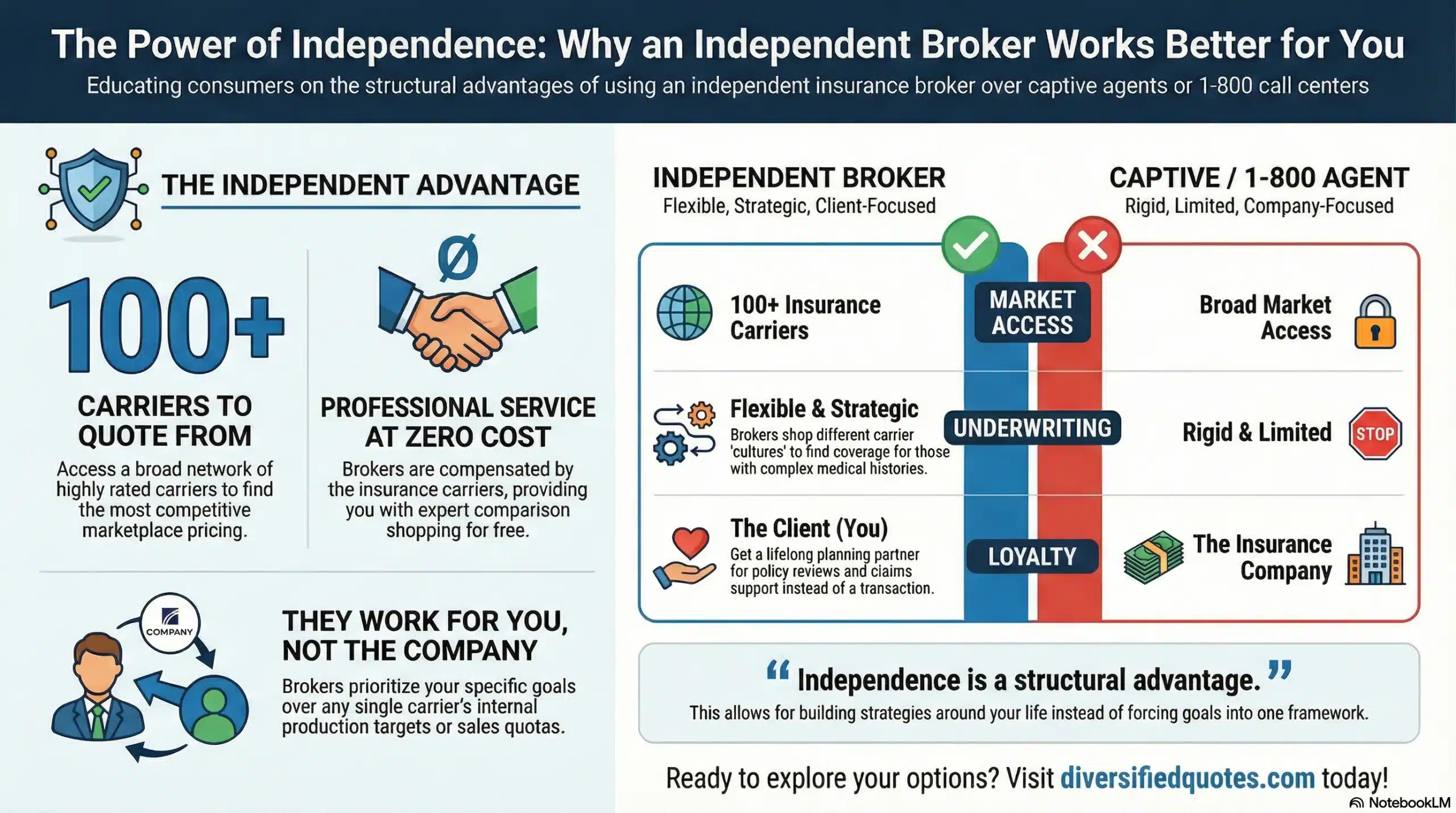
The systematic underperformance of single-carrier purchasing is most severe for applicants who have any characteristic that generates underwriting scrutiny. Applying through a direct-to-consumer platform routes the application to a predetermined carrier whose guidelines may not be favorable for the applicant’s specific profile. Applying through a captive agent routes the application to that agent’s single carrier regardless of fit. An independent broker with broad carrier access can compare how multiple carriers evaluate the same profile and select the one most likely to produce the best combination of approval, rate class, and premium — before any application is submitted. For applicants who have already received a quote, our second opinion life insurance quote review service provides an independent market evaluation of whether the current offer is competitive.
Mistake 9: Misrepresenting Health History on the Application
Life insurance applications are legal documents, and the accuracy of health and lifestyle disclosures has direct consequences for claim payment. Misrepresentation — whether intentional omission of a known condition, incorrect disclosure of tobacco use or other lifestyle factors, or failure to disclose a prior diagnosis that was asked about — creates grounds for the insurer to contest or deny a claim during the policy’s contestability period (typically the first two years) and potentially even beyond if the misrepresentation is material to the original underwriting decision. The family that discovers at the moment of claim that the policy may be contested because of a health disclosure error is in exactly the worst possible situation — they are facing grief, financial disruption, and a legal dispute simultaneously, when the policy was supposed to eliminate precisely that kind of uncertainty.
The correct approach to health history in a life insurance application is complete, accurate disclosure combined with strategic carrier selection and case presentation. The solution to a complex health history is not to conceal it — it is to work with an independent broker who can identify the carriers most likely to offer favorable terms for that specific profile, prepare the supporting documentation that presents the history in the most accurate and favorable light, and use the informal pre-underwriting process to gauge likely outcomes before formal applications create records. This approach consistently produces better outcomes than misrepresentation, which creates claim risk that defeats the entire purpose of the coverage. Our high-risk life insurance playbook covers the strategic framework for navigating complex health histories through appropriate disclosure and carrier matching, and our resource on life insurance for high-risk occupations covers how occupational risks are properly disclosed and positioned.
Mistakes 10, 11, and 12 — The Ongoing Errors
Three of the twelve most consequential life insurance mistakes are ongoing rather than one-time: they compound over time rather than occurring at a single decision point. Ignoring the conversion feature is the first: most term policies include a provision allowing the policyholder to convert some or all of the term coverage to a permanent policy within a defined window — typically during the first 10 to 20 years of the term — without submitting to new health underwriting. The converted premium is based on the original issue age rather than the age at conversion. For a policyholder who develops a health condition during the term period that would make new coverage expensive or unavailable, this conversion feature is the mechanism that preserves access to permanent coverage without a new health evaluation. Failing to understand the conversion window, the conversion products available, and the optimal timing for conversion is one of the most commonly missed opportunities in long-term life insurance planning. Our dedicated resource on converting term to permanent life insurance covers the full decision framework for evaluating when and how to use this feature.
Canceling a policy without replacement in force is the second ongoing error pattern. The urgency to reduce expenses — or the assumption that replacement coverage will be easily available — leads some policyholders to cancel an existing policy before a replacement is issued and in force. If a health event occurs between the cancellation and the new policy’s approval, the policyholder may be left permanently without coverage. Even if health is unchanged, the canceled policy’s favorable terms — a rate class locked in at a younger, healthier age — cannot be recovered. The discipline of never canceling existing life insurance coverage until replacement coverage is confirmed and in force is a simple rule that prevents one of the most avoidable gaps in protection planning. The third ongoing error — never reviewing the policy as life changes — is addressed by building a regular review cycle into the financial planning process. A policy review every one to three years, and specifically after every major life event (marriage, divorce, birth of a child, home purchase, significant income change, business ownership change, or approach to retirement), ensures that the coverage structure, coverage amount, and beneficiary designations remain aligned with the household’s actual planning reality. For policies where the review reveals overpayment or suboptimal structure, a second opinion review identifies whether better alternatives exist in the current market.
Special Situations — High-Risk Applicants, Business Owners, and Retirees
Beyond the twelve universal mistakes, specific applicant categories face additional planning pitfalls that compound the standard errors. High-risk applicants — those with medical histories, hazardous occupations, or lifestyle factors that generate underwriting scrutiny — face the additional risk of applying through channels that don’t have the carrier access or underwriting expertise to handle their profile correctly. A high-risk applicant who applies through a direct platform or a captive agent without access to specialty carriers may receive an inflated rating or an unnecessary decline that could have been avoided with appropriate carrier selection. For applicants who have already experienced a denial, our resource on what to do after a life insurance denial covers the strategic framework for post-denial repositioning.
Business owners face a distinct set of planning errors beyond personal income protection: failure to fund buy-sell agreements with appropriate life insurance coverage, failure to maintain key person insurance on critical employees whose loss would impair operations, and failure to coordinate personal and business coverage structures to avoid duplication and gaps simultaneously. The interaction between business ownership, personal estate planning, and life insurance structure creates complexity that typically requires coordinated planning across insurance, legal, and tax advisors. For high earners and business owners, the tax treatment of life insurance proceeds is an important planning dimension — our resource on are life insurance benefits taxable covers how the income-tax exclusion for death benefits interacts with estate planning structures. Retirees face the transition mistake of assuming their life insurance planning is complete at retirement — when in reality, the planning objectives shift from income replacement to estate equalization, final expense coverage, and charitable giving structures, all of which may warrant different coverage structures than what was appropriate during working years. Our burial insurance calculator helps retired households size final expense coverage accurately, and our resource on is disability insurance worth it covers the income protection dimension that life insurance does not cover — the risk of disability before death that interrupts income while creating care costs.
How to Accidental Death Insurance Fits Into the Picture
One supplemental coverage category that addresses the accidental death risk specifically — rather than all-cause mortality — is accidental death insurance, which pays a defined benefit in the event of death caused directly by a qualifying accident. Accidental death coverage is not a substitute for comprehensive life insurance, because it covers only one narrow cause of death and leaves the family fully exposed to death from illness, disease, or natural causes. But as a supplemental layer for applicants whose occupational or lifestyle risk creates elevated accidental mortality exposure, it can be a practical and affordable addition to the primary coverage structure. Our guide on how to buy accidental death insurance online covers how this coverage works and when it is an appropriate supplement. For applicants comparing mortgage protection products to comprehensive term coverage, our resource on mortgage protection vs. term life insurance clarifies the important structural differences between these two products and why the comparison matters for households evaluating housing-focused coverage options.
Talk With an Advisor Today
Choose how you’d like to connect—call or message us, then book a time that works for you.
Schedule here:
calendly.com/jason-dibcompanies/diversified-quotes
Licensed in all 50 states • Fiduciary, family-owned since 1980
FAQs: Common Life Insurance Mistakes
What is the biggest mistake people make when buying life insurance?
Waiting too long to apply is the single most costly mistake because of its compounding consequences: every year of delay increases the base premium, and new health conditions can develop without warning that permanently change or eliminate insurability. A person who delays applying because finances are tight or because “there’s time later” has no way of knowing whether their future self will be insurable at favorable terms, insurable only at significantly elevated cost, or not insurable at all. Locking in coverage while healthy preserves both insurability and the most favorable lifetime premium cost — two advantages that cannot be recovered once health changes.
Is relying only on employer life insurance a mistake?
Yes — exclusive reliance on employer group coverage is a common and consequential planning error. Group life insurance is tied to the employment relationship: it ends when employment ends, regardless of how that happens — resignation, layoff, disability, or retirement. The coverage amount is typically limited to one or two times annual salary, which falls well short of meaningful income replacement for most households. And the terms, cost, and availability of group coverage are controlled entirely by the employer — they can be changed or eliminated at any time. An individually owned policy provides coverage that the policyholder controls, at fixed premiums that cannot be changed by anyone else, and that continues regardless of what happens to the employment relationship.
How do I know if my life insurance coverage amount is sufficient?
A common starting benchmark is 10 to 15 times annual household income, but this should be refined through a full needs analysis that includes: all outstanding debts (mortgage, auto, student loans, credit obligations), the number of years of income replacement the household would need if the primary earner died, education funding for dependent children, childcare costs, and any income sources that would be reduced at death (such as Social Security survivor benefits or pensions). A household that calculates only the mortgage balance and funeral expenses will almost certainly be significantly underinsured. Using a life insurance calculator and completing a structured needs analysis with the help of an independent advisor produces a far more accurate coverage target than any rule-of-thumb estimate.
What happens if I name the wrong beneficiary?
Beneficiary designations on life insurance policies typically supersede the instructions in a will. If the designation is outdated — for example, naming an ex-spouse or a parent who predeceased the insured — the proceeds go to whoever is named on the policy, not to whoever the insured intended per their current wishes. Common errors include failing to update after divorce, naming minor children directly (which creates probate complexity and court oversight), not naming a contingent beneficiary (meaning proceeds may flow through the estate if the primary beneficiary is unavailable), and failing to review after major life events. Beneficiary designations should be reviewed after every significant life event and at minimum every two to three years to confirm they reflect current intentions.
Is it a mistake to hide health information on a life insurance application?
Yes — material misrepresentation on a life insurance application creates grounds for the insurer to contest or deny a claim, particularly during the policy’s contestability period (typically the first two years). If a policyholder conceals a diagnosis, misrepresents tobacco use, or omits a prior condition that was asked about on the application, the insurer can investigate the claim history at death and potentially void the policy — leaving the family with nothing. The correct approach to a complex health history is accurate, complete disclosure combined with strategic carrier selection. Carriers vary significantly in how they evaluate the same condition, and the solution to an adverse health history is matching it to a carrier with favorable guidelines — not concealing it from the carrier that happens to be the only one the applicant approached.
What is the term conversion feature and why does it matter?
The term conversion feature — available in most term life policies — allows the policyholder to convert some or all of the term coverage to a permanent policy within a defined window (typically the first 10 to 20 years of the term) without submitting to new health underwriting. The converted premium is based on the original issue age, not the age at conversion. This feature is most valuable when a policyholder’s health changes during the term period in ways that would make new coverage expensive or unavailable — the conversion right preserves access to permanent coverage that might otherwise be unattainable. Ignoring the conversion window until it expires eliminates this valuable option, sometimes at the exact moment when the policyholder’s changed health makes it most necessary.
How often should I review my life insurance policy?
The standard recommendation is a policy review every one to three years, and specifically after every major life event: marriage, divorce, birth or adoption of a child, purchase of a home, significant income change, business ownership change, health diagnosis, or approaching retirement. Each of these events has the potential to change the appropriate coverage amount, the right policy type, the beneficiary designations, or all three simultaneously. A policy purchased at age 32 based on a household with no children and a modest mortgage may be dramatically inadequate — and structurally misaligned — for the same household at age 44 with three children, a larger mortgage, and significantly higher income. Regular reviews prevent the “set it and forget it” drift that is one of the most common sources of the inadequate coverage discovered at the worst possible moment.
Is comparing multiple carriers really necessary for life insurance?
Yes — and the value of comparison increases significantly with any complexity in the applicant’s health history, occupation, or lifestyle. At standard health profiles, carrier premium differences are real but may be modest. For applicants with any health history, occupational risk, or lifestyle factor that generates underwriting scrutiny, the difference between the carrier most favorable for that profile and the carrier least favorable can be thousands of dollars per year in premium — for the same face amount, the same term length, and the same coverage. Applying through a single channel — direct platform, captive agent, or first online quote — locks in whatever that single carrier offers without any competitive reference point. Working with an independent broker who compares multiple carriers produces systematically better outcomes, particularly for any applicant whose profile is anything other than perfectly standard.
What is the risk of canceling a policy without having a replacement in force?
Canceling an existing policy before replacement coverage is issued and in force creates a gap — and any gap creates risk. If the policyholder experiences a health event during the gap, the new application may be declined or rated at a higher premium, and the previously favorable existing coverage that was canceled cannot be reinstated at the original terms. Even if health is unchanged, the favorable rate class locked in at the original issue age cannot be recovered on a new application at an older age. The discipline of never canceling existing coverage until replacement coverage is confirmed in force is a simple rule that eliminates one of the most avoidable planning gaps — and applies even when the replacement policy is clearly better, because “better” provides no protection during the period before the new policy is active.
About the Author:
Jason Stolz, CLTC, CRPC, DIA, CAA and Chief Underwriter at Diversified Insurance Brokers (NPN 20471358), is a senior insurance and retirement professional with more than 25 years of real-world experience helping individuals, families, and business owners protect their income, assets, and long-term financial stability. As a long-time partner of the nationally licensed independent agency Diversified Insurance Brokers, Jason provides trusted guidance across multiple specialties—including fixed and indexed annuities, long-term care planning, personal and business disability insurance, life insurance solutions, Group Health, Travel Medical and Evacuation Insurance, and short-term health coverage. Diversified Insurance Brokers maintains active contracts with over 100 highly rated insurance carriers, ensuring clients have access to a broad and competitive marketplace.
His practical, education-first approach has earned recognition in publications such as VoyageATL, and contributions from his agency featured in Kiplinger and GoBankingRates— highlighting his commitment to financial clarity and client-focused planning. Drawing on deep product knowledge and years of hands-on field experience, Jason helps clients evaluate carriers, compare strategies, and build retirement and protection plans that are both secure and cost-efficient. Visitors who want to explore current annuity rates and compare options across multiple insurers can also use this annuity quote and comparison tool.
Explore More Life Insurance Options: Browse our complete guide to Life Insurance Buying & Cost Education — covering how to buy, costs, calculators, rates & buying guides from 100+ carriers.
Last Reviewed: June 2, 2026 |
Reviewed by: Jason Stolz, CLTC, CRPC, DIA, CAA
Chief Underwriter, Diversified Insurance Brokers, Inc. | NPN: 20471358 | Diversified Insurance Brokers, Inc. — Licensed in all 50 states
Fact Checked by: Tonia Pettitt, CMIP©
Medicare Specialist, Diversified Insurance Brokers, Inc. | NPN: 14374308 | Diversified Insurance Brokers, Inc. — Licensed in all 50 states
Did you find this content helpful? Leave us a Google review — it helps others find trustworthy guidance too.
Editorial Standards: Diversified Insurance Brokers maintains rigorous editorial standards to ensure accuracy, clarity, and independence in all content. Learn more about our editorial standards and commitment to transparency.
