
AuguStar Omega Bonus Plus Fixed Indexed Annuity
AuguStar Omega Bonus Plus Fixed Indexed Annuity
The Omega Bonus Plus 10, issued by AuguStar Life, is a single-premium fixed indexed annuity built for one job: accumulation. It leads with an eye-catching premium bonus and a strong lineup of index crediting strategies, and for the right buyer it is a genuinely competitive contract. At Diversified Insurance Brokers, we have worked through the full mechanics of this product and can tell you exactly what the bonus is really worth, how the crediting strategies actually behave, and whether it fits what you are trying to accomplish. Here is the honest headline: the Omega Bonus Plus is a solid growth-focused annuity with some genuinely attractive features, but the large premium bonus that anchors the marketing is more nuanced than it first appears. It is tiered, it vests slowly, and it comes with a cost and a trade-off. Understanding those details is the difference between buying this contract for what it actually does and buying it for what the headline number seems to promise.

Been shown an Omega Bonus Plus illustration? Let us tell you what the numbers really mean.
Request a Personalized Illustration
Start with what this product is and is not. The Omega Bonus Plus is an accumulation annuity, not an income annuity. Its purpose is to grow a lump sum with principal protected from market losses, not to generate a guaranteed lifetime paycheck. That distinction matters because bonus-and-index annuities are often marketed interchangeably, and a buyer who wants maximum guaranteed lifetime income should understand that this is a different tool. What the Omega Bonus Plus offers is a way to put a sum of money to work — money you want to grow without risking it to a market downturn — with an upfront bonus credited to jump-start that growth and a menu of index strategies that determine how much you earn along the way. It is issued by AuguStar Life, a financially strong carrier we cover in depth in our review of whether AuguStar is a good insurance company.
This page walks through the whole contract: how the premium bonus actually works and why it is tiered and slow to vest, the index crediting strategies and how caps and participation rates shape your returns, the ten-year surrender schedule and the liquidity features that soften it, the rider fee and what you get for it, the death benefit and guaranteed floor, and an honest read on who this annuity fits and who would be better served elsewhere. The goal is that you can evaluate an Omega Bonus Plus illustration critically, rather than on the strength of a bonus percentage alone.
Ensure you are receiving the absolute top rates
Current Fixed Annuity Rates
Compare today’s best fixed annuity rates from top carriers.
Current Bonus Annuity Rates
See which annuities offer the highest upfront bonus today.
Request an Annuity Quote
Submit our annuity request form to get personalized rate options.
Lifetime Income Calculator
Use our calculator to see how much guaranteed income your annuity can provide.
What the Omega Bonus Plus Is Designed to Do
The Omega Bonus Plus is a single-premium fixed indexed annuity, which means three things worth unpacking. Single-premium: you fund it once, with a lump sum, and no additional contributions are made afterward. Fixed indexed: your money earns interest linked to the performance of market indexes, but with a protective floor that means index declines cannot reduce your principal. And accumulation-purpose: the contract is built to grow assets rather than to convert them into a guaranteed lifetime income stream.
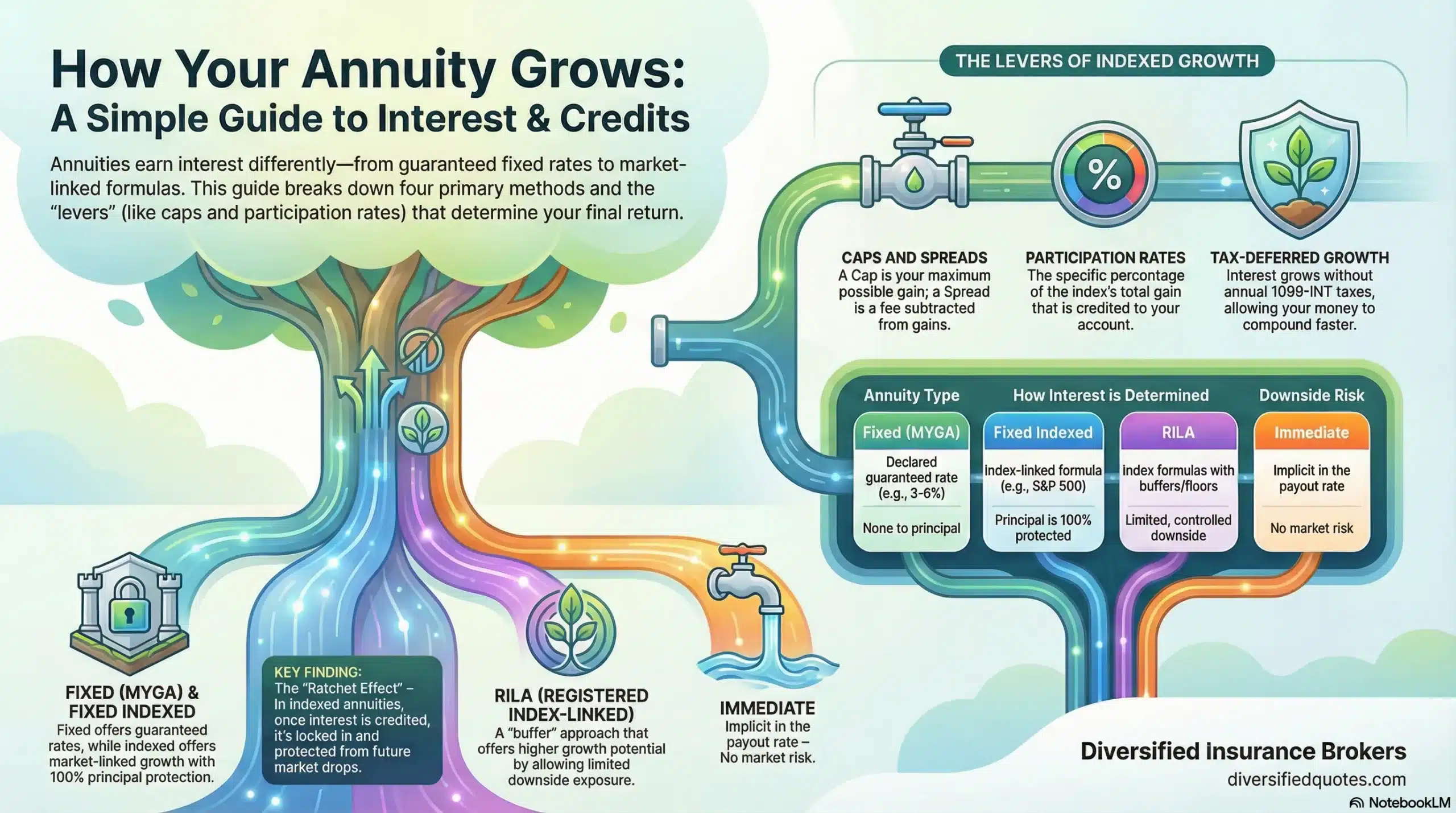
That protective floor is the core appeal of any fixed indexed annuity, and it is worth being precise about. In a year when the underlying index rises, your contract is credited a portion of that gain, determined by the crediting strategy you selected. In a year when the index falls, you are credited nothing — but you lose nothing. Your principal and previously credited interest are protected from market losses. This is the fundamental trade of the entire product category: you give up some of the market’s upside in exchange for protection against its downside. Our overview of fixed indexed annuity pros and cons covers that trade in depth, and our explanation of how annuities earn interest explains the mechanics behind it.
The Omega Bonus Plus is aimed at a buyer at or nearing retirement who has a sum of money they cannot afford to lose but still want to grow — money that is too important to expose to a market downturn, but that they do not need to spend immediately. For that buyer, the combination of principal protection, a premium bonus to jump-start the balance, and a menu of index strategies is a coherent package. It is squarely in the territory of annuities for conservative investors who prioritize not losing money over maximizing return.
The Premium Bonus: What It Really Means
The premium bonus is the headline feature and the most misunderstood part of the contract, so this is the section to read carefully. A premium bonus is an additional credit the carrier adds to your contract based on a percentage of your premium. On the Omega Bonus Plus that headline percentage is substantial — but the reality behind it has three important layers that the number alone does not convey.
It is tiered by your allocation. The bonus you actually receive depends on how you allocate your money among the available crediting strategies. To earn the highest bonus tier, you must direct your allocation toward a specific group of index strategies; allocate less to that group and you receive a lower bonus. The headline figure represents the maximum available at the top tier, not a flat amount everyone gets. This means the bonus and your crediting choices are linked — you cannot simply take the top bonus and also allocate however you please.
It is reduced by age. The bonus percentage is lower for older buyers. The top figures apply to younger applicants, with a reduced schedule for those in the upper age band the product accepts. So the number you qualify for depends on your age as well as your allocation.
It vests slowly, and this is the big one. The bonus does not become fully yours immediately. It vests on a schedule, and on this product that schedule is heavily back-loaded: for the first several years, none of the bonus has vested at all. Vesting then begins and increases each year, reaching full vesting only at the end of the surrender period. Until the bonus vests, the unvested portion is not part of your contract value for withdrawal or surrender purposes. In plain terms: if you take your money out early, you do not keep the full bonus — you keep only the portion that has vested by that point, which in the early years is little or none.
None of this makes the bonus bad. A premium bonus that vests over the surrender term is a legitimate and common structure, and if you hold the contract for its full term, you capture the whole thing. But it reframes what the bonus is: it is a reward for keeping your money in the contract for the full ten years, not free money handed to you on day one. Anyone presenting the headline bonus as an instant return on your premium is describing it incorrectly. Our overview of bonus annuity pros and cons and our explanation of how annuity bonuses work cover why bonuses are never truly free and what to check.
There is one more trade-off that belongs here, because it is the one buyers most often miss. Choosing the bonus generally means accepting lower caps and participation rates on your crediting strategies than you would receive on a version of the product without the bonus. The carrier funds the bonus partly by crediting you less on your index gains over time. Whether the bonus is worth that reduced crediting depends entirely on the specific numbers and your time horizon, and it is exactly the kind of comparison that a headline percentage obscures. Sometimes the bonus wins; sometimes a lower-bonus or no-bonus contract with richer caps produces more money over ten years. The only way to know is to run both.
Omega Bonus Plus 10 at a Glance
| Feature | How It Works | What It Means for You |
|---|---|---|
| Product Type | Single-premium fixed indexed annuity, accumulation-focused. | Built to grow a lump sum, not to pay lifetime income. Judge it on growth. |
| Premium Bonus | A large upfront credit — tiered by allocation, reduced by age, vesting over the term. | A reward for staying the full term, not instant money. See how bonuses really work. |
| Term | 10-year surrender period with a declining charge schedule and an MVA. | Commit only money you can leave alone for a decade. |
| Principal Protection | Index losses cannot reduce your value; a floor protects credited interest. | You participate in index gains without market-loss risk to principal. |
| Crediting Strategies | Multiple index options plus a fixed account, using caps and participation rates. | Flexibility to allocate; the specific rates drive your actual return. |
| Rider Fee | An annual fee of roughly 0.95% associated with the bonus and enhanced liquidity. | A real cost deducted from your value; weigh it against the benefit. |
| Liquidity | 10% penalty-free withdrawals from year two; RMD-friendly; nursing home waiver. | More accessible than the surrender schedule alone suggests. |
| Death Benefit | The greater of the accumulation value or the guaranteed surrender value. | Beneficiaries receive value directly, generally avoiding probate. |
How Your Money Grows: The Crediting Strategies
Because this is an accumulation product, the crediting strategies are where the real value is created, and they deserve as much attention as the bonus. The Omega Bonus Plus offers a menu of index-linked options built on a range of market indexes, alongside a fixed-rate account, and you can allocate your money across them and adjust your allocations over time.
The index strategies use annual point-to-point crediting, which compares the index level at the start and end of each contract year and credits interest based on the change, subject to a limiting mechanism. Understanding the two main mechanisms is essential to evaluating any indexed annuity. A cap rate sets the maximum interest you can earn for the year — if the index rises above the cap, you receive the cap. A participation rate instead credits you a defined percentage of the index’s gain, with no ceiling, so it behaves very differently in a strong market year. The Omega Bonus Plus uses both, depending on the strategy, and some of its strategies are built on volatility-controlled indexes that are engineered to move more smoothly, which typically allows a higher participation rate applied to steadier index movement.
A genuinely notable feature of this product is that its declared caps and participation rates are locked in for the full ten-year term rather than being reset annually at the carrier’s discretion. This is meaningfully better than the more common structure where rates can be lowered each year after purchase, because it removes a significant uncertainty: you know at the outset what the crediting terms will be for the life of the contract. That rate lock is a real strength and one of the more compelling aspects of the Omega Bonus Plus, and it is worth weighing heavily in any comparison.
Two honest cautions apply to the growth side. First, the specific caps and participation rates are the entire game in an indexed annuity, and — as noted above — electing the premium bonus generally lowers them relative to a no-bonus version. The attractiveness of any illustration depends on those specific numbers, which are set by the carrier and can differ for new contracts, so they should always be confirmed as current. Second, the backtested or hypothetical returns that appear on product materials are illustrations of how a strategy would have performed in the past, not predictions. Past index behavior does not guarantee future crediting, and a responsible evaluation treats those figures as context rather than expectation. Our guidance on getting the best annuity rates covers where the real differences between contracts hide.
Want the caps, participation rates, and bonus tiers modeled for your exact situation?
Get Your Personalized Analysis
Surrender Schedule, Liquidity, and the Rider Fee
The Omega Bonus Plus carries a ten-year surrender period, which is a genuine commitment, and the early-year surrender charges on this product are on the higher side — starting well into the double digits before declining over the term. This is common for a bonus product, and it is the trade you make for the upfront credit: the carrier needs your money to stay for the full term to fund the bonus, so it discourages early exit with a meaningful charge. There is also a market value adjustment during the surrender period, which can increase or decrease the amount you receive on an early withdrawal depending on how interest rates have moved since you purchased, and which stops applying once the surrender period ends.
Set against that long schedule, the liquidity features are more generous than the surrender charges alone would suggest. Beginning in the second contract year, you may withdraw up to ten percent of your contract value each year without any surrender charge or market value adjustment. The product is also designed to be required-minimum-distribution friendly: once you reach the age at which the IRS requires distributions from a qualified contract, those RMDs are available without a surrender charge even if they exceed the ten percent free amount — a genuinely useful feature for buyers funding with retirement account money, and one that removes a complication some annuities create. Our overview of how required minimum distributions work explains the broader rules.
There is also a nursing home and confinement waiver that can provide access to your contract value without surrender charges or market value adjustment if you become confined to a qualifying hospital or nursing facility for a sustained period, subject to the contract’s eligibility conditions. This kind of waiver is valuable precisely because the need for care is one of the most common reasons someone needs access to locked-up money, and it is a feature worth understanding rather than overlooking.
The Omega Bonus Plus does carry an annual rider fee of roughly 0.95%, associated with the premium bonus and enhanced liquidity features, deducted from your contract value each year during the surrender period. This is a real cost, and it is not unusual for a bonus product of this kind — but it is a cost, and it needs to be weighed honestly against the benefit it purchases. It is also worth knowing that the fee is not permanently fixed at that level; the carrier retains the ability to adjust it within a stated maximum. The practical point is simple: the bonus is not free, the rider fee is one of the ways you pay for it, and a proper evaluation accounts for the fee alongside the reduced caps when judging whether the bonus is worth electing.
Principal Protection, the Guaranteed Floor, and the Death Benefit
Underneath the index crediting sits a set of guarantees that define the worst-case outcomes, and understanding them tells you what you are actually protected against.
The core guarantee is principal protection from market loss. Because this is a fixed indexed annuity, a decline in the underlying index cannot reduce your contract value — in a negative index year you are simply credited zero for that strategy rather than taking a loss. This is the feature that distinguishes the product from a variable annuity or a direct market investment, and it is the reason conservative buyers are drawn to the category. Our comparison of fixed indexed versus variable annuities lays out that difference clearly.
Beneath that sits a guaranteed minimum surrender value, a contractual floor establishing the least the contract will return to you even in adverse circumstances. This floor is why annuity guarantees are described as resting on the financial strength of the issuing carrier — the promise is only as good as the company standing behind it, which is why AuguStar’s financial strength rating matters and why our review of what an AM Best rating means and our overview of what “guaranteed” actually means in an annuity are worth reading alongside this page.
The death benefit is straightforward and favorable: if the owner dies during the contract, beneficiaries receive the greater of the accumulation value or the guaranteed surrender value, and the proceeds generally pass directly to beneficiaries outside of probate. This is a clean, protective death benefit structure for an accumulation product, and it means the money you have grown passes efficiently to your heirs if you do not spend it during your lifetime.
Funding, Eligibility, and the Tax Picture
The Omega Bonus Plus accepts a single premium with an accessible minimum and a substantial maximum, with larger amounts available subject to carrier approval. It is a single-premium contract, so there are no ongoing contributions after the initial deposit. The product accepts a wide range of funding sources, including non-qualified money and most types of qualified retirement accounts, and it can be funded through a 1035 exchange from an existing annuity or life policy.
How you fund it affects your tax treatment significantly. If you use qualified retirement money, distributions are generally taxed as ordinary income and required-minimum-distribution rules apply — covered in our guide to qualified annuity taxation. If you fund with after-tax money, only the growth portion is taxable, under the rules explained in our overview of non-qualified annuity taxation. Withdrawals of earnings before age 59½ can also carry an additional federal tax on top of ordinary income tax. As always, the tax treatment of your specific situation is a conversation for your tax advisor rather than something to determine from general guidance.
If you are considering funding the Omega Bonus Plus by moving money out of an existing annuity, that transaction deserves genuine scrutiny. A 1035 exchange preserves tax deferral when executed correctly, but the real question is whether the move is worth it at all — you have to weigh any surrender charges and market value adjustment on your existing contract against the benefit of the new one, and that math does not always favor moving. We run that comparison honestly, including reaching the conclusion that you should keep what you have, which happens regularly.
Who the Omega Bonus Plus Fits — and Who It Does Not
A product review is only useful if it helps you decide, so here is our candid assessment.
The Omega Bonus Plus fits well if your goal is protected accumulation — growing a lump sum you cannot afford to lose, over roughly a ten-year horizon, without exposure to market losses. It fits well if you genuinely intend to hold the contract for its full term, since that is what allows the bonus to fully vest and the ten-year rate lock to work in your favor. It fits well if you value the certainty of caps and participation rates that are locked for the life of the contract rather than reset annually, which is one of this product’s real strengths. And it fits well if you are funding with qualified money and value the RMD-friendly design, or if the nursing home waiver’s liquidity protection is meaningful to your situation.
It fits poorly if your primary goal is guaranteed lifetime income, because this is an accumulation product rather than an income product — a buyer who wants the largest possible lifetime paycheck should be comparing income-focused annuities instead, which our overview of indexed annuities with lifetime income riders addresses. It fits poorly if you may need substantial access to the money within ten years beyond the annual free-withdrawal allowance, since the surrender charges are steep in the early years and the bonus has not vested. It fits poorly if you were drawn in primarily by the headline bonus figure and expected it to be immediately yours, in which case the product is not wrong but your understanding of it needs adjusting before you buy. And it may be the wrong choice if a simpler contract serves your goal better — sometimes a straightforward multi-year guaranteed annuity with a known fixed rate and no moving parts is a better fit than an indexed product with a bonus, a rider fee, and reduced caps.
The honest bottom line is that the Omega Bonus Plus is a well-built accumulation annuity with a genuine strength in its ten-year rate lock and some attractive liquidity features, wrapped around a bonus that is real but more conditional than the headline suggests. Whether it is the right choice comes down to the specific numbers for your situation compared against the alternatives — which is precisely what a headline bonus percentage cannot tell you, and precisely what genuine suitability analysis exists to determine.
How We Evaluate This Annuity for You
We understand this contract thoroughly — the bonus tiers, the vesting schedule, the crediting strategies, the rider fee, the liquidity features — and that depth is exactly why our recommendation is never automatic.
Our process starts with your objective rather than the product. If you tell us you want protected growth over a ten-year horizon and have money you can genuinely leave alone, the Omega Bonus Plus belongs in the comparison and may well be an excellent fit. If you tell us you want guaranteed lifetime income, or you might need the money sooner, or you want maximum simplicity, we will say plainly that a different product serves you better and show you what fits. That honesty is the entire value of an independent brokerage: we represent many carriers, and our recommendation reflects what genuinely fits your situation rather than what any single company would prefer to sell.
When the Omega Bonus Plus is a candidate, we model it properly. We show you what the bonus is actually worth to you given your age and allocation, and how it vests over time. We compare its caps and participation rates — with the bonus and its cost factored in — against competing indexed annuities across the carriers we represent, because the only meaningful test is how much money the contract is likely to produce over the full term relative to the alternatives, not how large the bonus looks. We weigh the value of the ten-year rate lock, which is a genuine advantage. And we make sure you understand the surrender schedule, the rider fee, and the vesting mechanics completely, so you are buying the contract with clear eyes.
Because our compensation does not depend on steering you toward any particular product, that assessment reflects what we actually find. If you have already been shown an Omega Bonus Plus illustration and want an independent read on whether it is genuinely your best option, that is exactly what our second-opinion review is for — including the entirely realistic outcome that we confirm it is a strong choice for you and tell you to proceed. Our guidance on what questions to ask when researching annuities and our overview of the best annuity rates reflect the same principle behind everything we do: match the product to the actual goal, and be honest about the trade-offs.
Ready to see how the Omega Bonus Plus compares against the full market for your situation?
Get Your Free Annuity Comparison
Financial Protection Essentials
Explore additional carrier reviews, annuity products, and retirement distribution strategies.
Talk to an Advisor or Request Your Annuity Quote
Ready to explore this annuity in more detail—or compare it with other carriers to see if even higher rates are available? With guaranteed income, principal protection, and long-term growth potential on the line, making the right choice is essential. The experienced advisors at Diversified Insurance Brokers will guide you through the options and design a strategy tailored to your retirement goals.
Schedule here:
calendly.com/jason-dibcompanies/diversified-quotes
Licensed in all 50 states • Fiduciary, family-owned since 1980
Is the Omega Bonus Plus premium bonus really added to my money right away?
Not in the way the headline number suggests, and this is the most important thing to understand about the product. The premium bonus has three layers the percentage alone does not convey. First, it is tiered by allocation: to earn the highest bonus you must direct your money toward a specific group of crediting strategies, and allocating less to that group produces a lower bonus, so the headline figure is the maximum at the top tier rather than a flat amount everyone receives. Second, it is reduced by age, with lower figures for older buyers. Third — and most significant — it vests slowly on a heavily back-loaded schedule. For the first several years none of the bonus has vested at all; vesting then begins and increases each year, reaching full only at the end of the surrender period. Until it vests, the unvested portion is not part of your contract value for withdrawal or surrender. In plain terms, if you take your money out early you keep only the portion that has vested, which in the early years is little or none. This does not make the bonus bad — it is a legitimate structure, and if you hold the contract the full ten years you capture all of it. But it reframes what the bonus is: a reward for staying the full term, not free money on day one. There is also a trade-off worth knowing — electing the bonus generally means accepting lower caps and participation rates than a no-bonus version would offer, so whether the bonus is worth it depends on the specific numbers. Our overview of bonus annuity pros and cons covers this in depth.
Is the Omega Bonus Plus a good annuity?
For the right buyer, it is a genuinely competitive accumulation annuity with some real strengths — but “good” depends entirely on whether it fits your goal. Its standout feature is that the declared caps and participation rates are locked in for the full ten-year term rather than reset annually at the carrier’s discretion, which removes a significant uncertainty and is meaningfully better than the more common structure where rates can be lowered each year after purchase. It also offers principal protection from market losses, a menu of index crediting strategies including volatility-controlled options, a large premium bonus, an RMD-friendly design for qualified money, and a nursing home waiver for liquidity in a health event. Those are real positives. The honest counterweights are that the bonus is tiered, age-reduced, and slow to vest rather than instant; electing it generally lowers your caps and participation rates; there is an annual rider fee of roughly 0.95%; and the ten-year surrender schedule carries steep early-year charges. None of those are defects — they are how a bonus product of this kind is constructed — but they mean the right way to judge the contract is against the specific alternatives for your situation rather than on the strength of the bonus figure. It is a strong fit for protected ten-year accumulation and a poor fit if you want guaranteed lifetime income or may need the money sooner. Our overview of fixed indexed annuity pros and cons sets realistic expectations for the category.
How does my money actually grow in this annuity?
Your money grows through index-linked interest crediting, with a protective floor that means market declines cannot reduce your principal. In a year the underlying index rises, you are credited a portion of that gain determined by your crediting strategy; in a year it falls, you are credited nothing but you lose nothing. The Omega Bonus Plus offers several index strategies built on a range of market indexes, plus a fixed-rate account, and you can allocate across them and adjust over time. The index strategies use annual point-to-point crediting, subject to one of two limiting mechanisms. A cap rate sets the maximum interest you can earn for the year — rise above it and you receive the cap. A participation rate instead credits you a defined percentage of the index’s gain with no ceiling, which behaves very differently in a strong market year. Some of the product’s strategies are built on volatility-controlled indexes engineered to move more smoothly, which typically allows a higher participation rate applied to steadier movement. A genuinely notable strength is that these caps and participation rates are locked for the full ten-year term rather than reset annually. Two cautions: electing the premium bonus generally lowers your caps and participation rates relative to a no-bonus version, and any backtested or hypothetical returns shown are illustrations of past behavior rather than predictions of future crediting. The specific rates are what determine your actual return, so they should always be confirmed as current. Our explanation of how annuities earn interest covers the mechanics.
Can I get to my money during the surrender period?
Within limits, yes, and the liquidity features are more generous than the ten-year surrender schedule alone suggests. Beginning in the second contract year, you may withdraw up to ten percent of your contract value each year with no surrender charge or market value adjustment. The product is also designed to be required-minimum-distribution friendly: once you reach the age at which the IRS requires distributions from a qualified contract, those RMDs are available without a surrender charge even if they exceed the ten percent free amount, which is genuinely useful for buyers funding with retirement account money. There is additionally a nursing home and confinement waiver that can provide access to your contract value without surrender charges or market value adjustment if you become confined to a qualifying hospital or nursing facility for a sustained period, subject to the contract’s eligibility conditions. Beyond these allowances, withdrawals during the surrender period incur a charge that starts well into the double digits in the early years and declines over the term, and a market value adjustment may increase or decrease your proceeds depending on interest rate movement since purchase. The practical guidance is straightforward: fund this contract only with money you can genuinely leave alone for the term, and treat the ten percent annual allowance plus any RMDs as your realistic liquidity rather than the full account. Our explanation of how surrender charges work covers planning around them.
What does the Omega Bonus Plus cost, and who is it right for?
The main explicit cost is an annual rider fee of roughly 0.95%, associated with the premium bonus and enhanced liquidity features, deducted from your contract value each year during the surrender period; the carrier retains the ability to adjust this fee within a stated maximum. Beyond that fee, the true cost of the bonus is indirect: electing it generally means lower caps and participation rates than a no-bonus version, so you effectively pay for the bonus over time through reduced crediting as well as through the fee. This is standard construction for a bonus indexed annuity and fully legitimate, but it means the bonus is not free and a proper evaluation weighs the fee and the reduced caps against the benefit. As for fit: the Omega Bonus Plus is a strong choice if your goal is protected accumulation of a lump sum over roughly a ten-year horizon, you genuinely intend to hold it the full term so the bonus vests and the rate lock works for you, and you value caps that are locked rather than reset annually. It is a poor choice if your primary goal is guaranteed lifetime income, since this is an accumulation product rather than an income product; if you may need substantial access to the money within ten years; or if you were drawn in mainly by the headline bonus and expected it to be immediately yours. Sometimes a simpler multi-year guaranteed annuity with a known fixed rate and no moving parts is a better fit. The right test is always which product best answers your specific objective.
About the Author:
Jason Stolz, CLTC, CRPC, DIA, CAA and Chief Underwriter at Diversified Insurance Brokers (NPN 20471358), is a senior insurance and retirement professional with more than 25 years of real-world experience helping individuals, families, and business owners protect their income, assets, and long-term financial stability. As a long-time partner of the nationally licensed independent agency Diversified Insurance Brokers, Jason provides trusted guidance across multiple specialties—including fixed and indexed annuities, long-term care planning, personal and business disability insurance, life insurance solutions, Group Health, Travel Medical and Evacuation Insurance, and short-term health coverage. Diversified Insurance Brokers maintains active contracts with over 100 highly rated insurance carriers, ensuring clients have access to a broad and competitive marketplace.
His practical, education-first approach has earned recognition in publications such as VoyageATL, and contributions from his agency featured in Kiplinger and GoBankingRates— highlighting his commitment to financial clarity and client-focused planning. Drawing on deep product knowledge and years of hands-on field experience, Jason helps clients evaluate carriers, compare strategies, and build retirement and protection plans that are both secure and cost-efficient. Visitors who want to explore current annuity rates and compare options across multiple insurers can also use this annuity quote and comparison tool.
Explore More Annuity Options: Browse our complete guide to Best Fixed Indexed Annuity Products — covering individual fixed indexed annuity product reviews from top-rated carriers from 100+ carriers.
Last Reviewed: August 17, 2026 |
Reviewed by: Jason Stolz, CLTC, CRPC, DIA, CAA
Chief Underwriter, Diversified Insurance Brokers, Inc. | NPN: 20471358 | Diversified Insurance Brokers, Inc. — Licensed in all 50 states
Fact Checked by: Tonia Pettitt, CMIP©
Medicare Specialist, Diversified Insurance Brokers, Inc. | NPN: 14374308 | Diversified Insurance Brokers, Inc. — Licensed in all 50 states
Did you find this content helpful? Leave us a Google review — it helps others find trustworthy guidance too.
Editorial Standards: Diversified Insurance Brokers maintains rigorous editorial standards to ensure accuracy, clarity, and independence in all content. Learn more about our editorial standards and commitment to transparency.
