
Best Annuities Without Fees
Best Annuities Without Fees

Jason Stolz CLTC, CRPC, DIA, CAA
One of the most damaging myths in all of retirement planning is the flat assertion that “annuities have high fees.” It gets repeated so often, by so many people, that most savers accept it without ever asking the obvious follow-up question: which annuity? Because the honest, verifiable answer is that the majority of annuity types carry no explicit annual fees whatsoever. At Diversified Insurance Brokers, we help clients find the genuinely no-fee annuities that fit their goals and steer them firmly away from the high-fee products that gave the entire category its unfair reputation. The confusion comes from lumping every annuity together as if they were a single product, when in reality the fee picture differs enormously depending on the type. Multi-year guaranteed annuities almost never have fees. Fixed indexed annuities have a wide range of no-fee options. Single premium immediate annuities and deferred income annuities carry no ongoing fees at all. It is really only the variable annuity — one specific type among several — that routinely carries the layered, high fees the warnings describe. So the real question is not whether you can buy an annuity without fees. You clearly can, and most people who own annuities already do. The real question is which of the no-fee types best fits what you are actually trying to accomplish, and how to make sure the specific contract you choose is genuinely competitive.
Fees matter enormously to your long-term results, which is precisely why the myth is so harmful in both directions — it scares people away from excellent low-cost products while leaving others vulnerable to genuinely expensive ones. Money lost to fees compounds against you year after year, so even a seemingly small annual charge can consume a startling share of your growth over a retirement that may last decades. A product carrying two or three percent in annual fees has to earn that much every single year before you see a single dollar of net gain, which is a punishing headwind. By contrast, a product with no annual fee lets your entire balance keep working for you, uninterrupted. Understanding where the fees actually are — and where they are not — is therefore one of the most financially consequential things you can learn about annuities, and it is the difference between avoiding a costly product and needlessly avoiding a valuable one.
Before we walk through each type, there is one point of complete honesty that matters more than anything else on this subject, and any advisor who skips it is not being straight with you: “no fee” does not mean “no cost.” Even a fee-free annuity is not a charity. The insurance company issuing it is a business that must earn a margin, pay its own expenses, and stand behind decades of guarantees — and it absolutely does earn money on every no-fee product it sells. The difference is that on a no-fee annuity, the insurer earns its margin through the structure of the product itself rather than through a visible charge deducted from your account. On a fixed annuity or MYGA, it earns a spread between what it makes investing your premium and the rate it credits to you. On a fixed indexed annuity, its margin lives in the caps, participation rates, and spreads that shape how much index growth you receive. On an income annuity, the cost is priced into the payout rate. This is genuinely good news for you in most cases, because a transparent product with no annual fee dragging on your balance is easier to understand and usually keeps more of your money compounding — but it is important to grasp that “no explicit fee” and “free” are two different things. Understanding how annuities earn interest in the first place makes this clear, and this kind of straight talk is exactly what you should expect from anyone advising you on where your retirement money goes.
This guide walks through each major annuity type and exactly how its fees — or lack of fees — work, so you can identify the no-fee option that fits your situation. It covers what a fee actually is and how it differs from the surrender charge that so often gets confused with one, how MYGAs deliver guaranteed growth with no fees, why fixed indexed annuities have so many no-fee options and when a rider fee is worth paying, how income annuities provide fee-free lifetime income, why variable annuities are the genuine high-fee exception, and how to make sure the no-fee annuity you choose is actually competitive rather than merely fee-free. The goal throughout is honesty: real information you can act on, with no sales spin and no pretending that “no fee” means there is no cost to understand.
Ensure you are receiving the absolute top rates
Current Fixed Annuity Rates
Compare today’s best fixed annuity rates from top carriers.
Current Bonus Annuity Rates
See which annuities offer the highest upfront bonus today.
Request an Annuity Quote
Submit our annuity request form to get personalized rate options.
Lifetime Income Calculator
Use our calculator to see how much guaranteed income your annuity can provide.
What a Fee Actually Is — and Why the Distinction Matters
To find the best annuities without fees, it helps to be precise about what a fee even is, because a great deal of the confusion on this topic comes from loose use of the word. In the context of an annuity, a fee is an ongoing charge that the insurance company deducts from your account on a recurring basis — typically annually, expressed as a percentage of your account value — regardless of what you do with the contract. It comes out whether markets rise or fall, whether you touch the money or leave it alone, and it directly reduces your balance and your growth every year you own the product. That is a true fee, and it is the thing you are right to want to minimize or avoid. Variable annuities have several of these; most other annuity types have none.
What frequently gets mislabeled as a “fee,” however, is something entirely different: the surrender charge. A surrender charge is not an ongoing deduction from your account. It is a one-time, conditional penalty that applies only if you withdraw more than a defined penalty-free amount before the end of a set period. If you never trigger it, you never pay it. Conflating these two very different things is the single most common error people make when evaluating annuity costs, and it leads directly to the false belief that a “no-fee” annuity is somehow a contradiction if it also has a surrender schedule. It is not. An annuity can carry zero annual fees and still have a surrender period, because those are two separate features that do two separate things. We will return to surrender charges in detail below, but the distinction is worth planting firmly at the outset: when this page says an annuity type has “no fees,” it means no recurring annual charge eroding your balance — which is exactly the kind of cost that quietly damages long-term returns.
There is also a third category worth naming, because it is the one that makes “no fee doesn’t mean no cost” true: the embedded margin. On every no-fee annuity, the insurer builds its compensation into the terms of the product rather than charging it separately. You do not see it as a line item, but it is there in the form of a rate that is a bit lower than what the insurer earns, or a cap that limits your index-linked growth. This is not a criticism of annuities — every financial product, including bank accounts and mutual funds, has some form of provider margin — but naming it honestly helps you understand why comparing products matters so much. On a no-fee annuity, the competitiveness of the contract shows up not in a fee you can see, but in the rate, cap, participation rate, or payout you are offered, and those vary meaningfully from one carrier to the next. Recognizing all three categories — true fees, conditional surrender charges, and embedded margin — is what lets you evaluate any annuity accurately instead of being swayed by either the “high fee” myth or an oversimplified “no fee” sales pitch.
MYGAs — The Simplest No-Fee Annuity
Multi-year guaranteed annuities are the clearest and cleanest no-fee story in the entire annuity world, and for savers who want a predictable, guaranteed return with no market risk, they are frequently the ideal fit. A MYGA functions much like a bank certificate of deposit but is issued by an insurance company rather than a bank: you deposit a lump sum, the insurer guarantees a fixed interest rate for a set term — commonly three, five, seven, or ten years — and your money grows steadily and tax-deferred, with zero exposure to market swings. What you are quoted as the guaranteed rate is exactly what you earn for the full term, locked in the day you sign. There is no ambiguity and no moving parts, which is a large part of the appeal.
Critically for this discussion, a MYGA has no explicit annual fees. There is no management fee, no mortality and expense charge, no administrative fee, and no rider fee quietly reducing your balance each year. The insurer makes its money on the spread — the gap between what it earns investing the large pool of premiums it collects, typically in high-quality bonds and similar fixed-income instruments, and the guaranteed rate it credits to you. That spread is built into the rate itself rather than charged on top of it, which is why a MYGA is so transparent: the number you are quoted is the number you get. If a MYGA offers a certain guaranteed rate for five years, that is precisely what compounds in your account for those five years, with nothing skimmed off annually. Understanding how the annuity spread rate works makes clear why this structure is genuinely favorable to a saver: it aligns the insurer’s incentive to invest well with your interest in a strong credited rate, and it keeps your full balance compounding.
MYGAs are especially compelling for conservative savers who might otherwise use a CD, because they frequently pay more than comparable-term CDs while adding tax deferral, meaning you are not taxed on the interest each year as you are with a CD held outside a retirement account. That tax deferral lets your money compound more efficiently over the term. For savers building a stream of maturities, MYGAs can also be laddered across different terms so that portions come due at staggered intervals, balancing rate and liquidity. The one cost feature to understand is not a fee at all but a surrender charge, which applies only if you withdraw more than the allowed penalty-free amount before the term ends — a feature we cover fully further down, and which is easily planned around simply by matching the term to money you genuinely intend to leave in place. For anyone comparing a MYGA to a CD or weighing guaranteed growth options, reviewing current MYGA annuity rates is well worth the time, and our comparison of fixed annuities versus fixed indexed annuities helps clarify where a straightforward MYGA fits versus an index-linked alternative.
Annuity Fees by Type — What You Actually Pay
| Annuity Type | Explicit Annual Fees? | How the Insurer Earns Its Margin | Best Suited For |
|---|---|---|---|
| MYGA | No — none | Through the interest-rate spread built into your guaranteed rate; any early-exit cost is a one-time surrender charge or MVA, not a fee. | Conservative savers wanting a guaranteed, CD-like return. |
| Fixed Indexed | No base fee — optional rider fees only if you add benefits. | Through caps, participation rates, and spreads on index growth. | Those wanting index-linked growth with principal protection. |
| SPIA / DIA | No — none | Built into the payout rate when the income stream is priced. | Retirees wanting maximum guaranteed lifetime income. |
| Variable | Yes — typically the highest, often 2%–3%+ all-in. | Through M&E charges, subaccount investment fees, and optional rider fees. | Those specifically wanting market investment inside the contract. |
Fixed Indexed Annuities — Many No-Fee Options
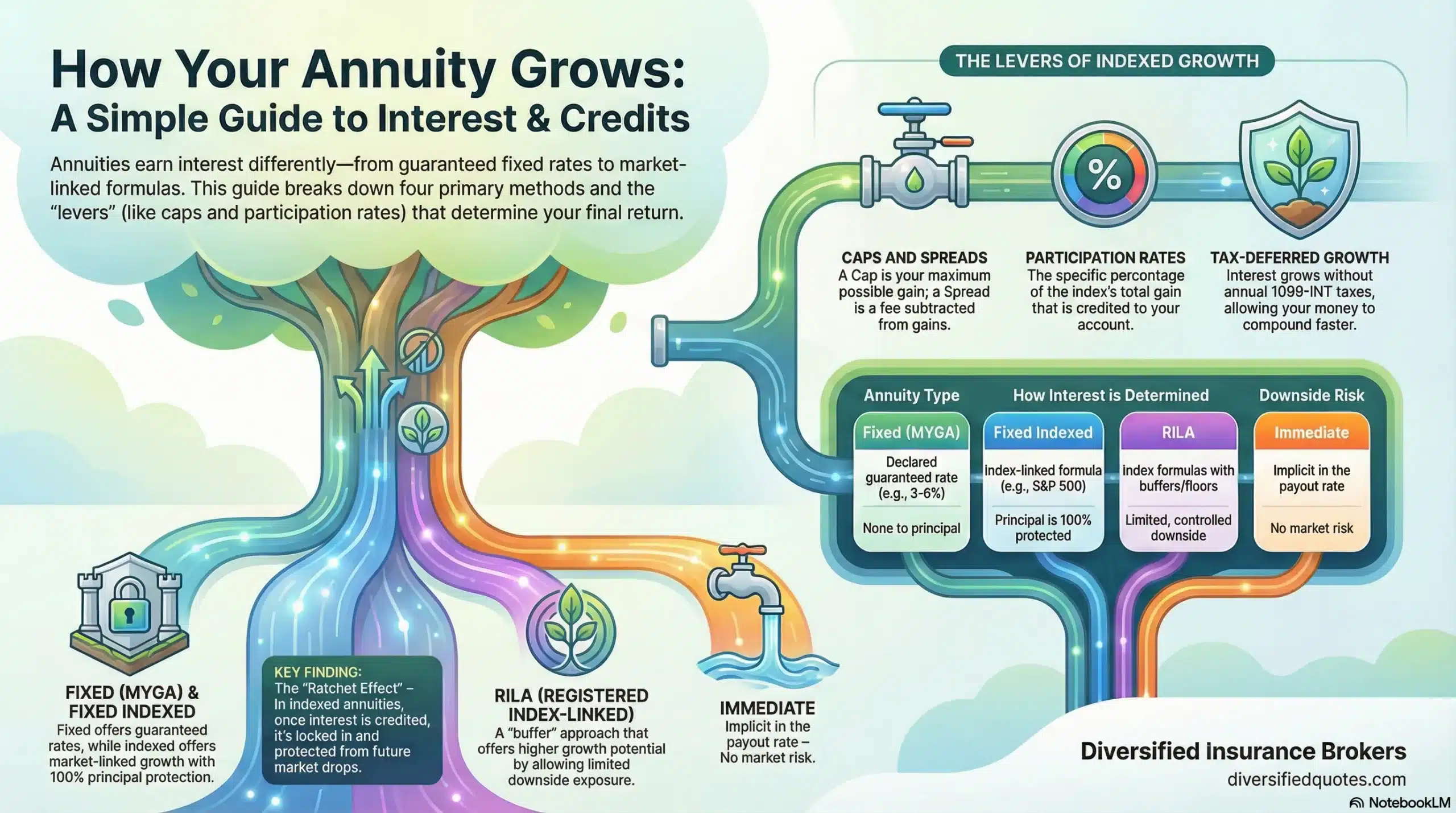
Fixed indexed annuities are the type most often misunderstood on the fee question, so here is the accurate picture: in their base form, most fixed indexed annuities have no annual fees at all. A fixed indexed annuity links the interest it credits to the performance of a market index, such as the S&P 500, while protecting your principal with a floor — usually zero percent — that ensures you never lose money to a market decline. In exchange for that downside protection, your upside is limited through one or more crediting mechanisms: a cap that sets a maximum credited rate for the period, a participation rate that credits you a set percentage of the index’s gain, or a spread that subtracts a set amount from the index return before crediting. The insurer earns its margin through those crediting limits, not through a fee, which is exactly why the base contract can genuinely carry no annual charge. This is the reason there are so many no-fee fixed indexed options available, and why the product deserves far better than the blanket “high fee” label it sometimes receives.
To understand where the insurer’s margin lives, it helps to understand the crediting terms themselves. A cap is a ceiling: if your contract has a cap for a given index term, that is the most you will be credited even if the index rises well beyond it. A participation rate instead gives you a defined percentage of the index’s gain — if the index rises and your participation rate is set at some level, you receive that proportion of the move. A spread deducts a set percentage from the index gain before crediting the rest to you. Different products use different combinations of these, and some use newer volatility-controlled indices designed to deliver steadier, if more modest, crediting. The essential point is that these terms — not a fee — are how the insurer is compensated on a base fixed indexed annuity, and because they vary substantially between products and carriers, they are where the real difference between a competitive contract and a mediocre one shows up. A no-fee fixed indexed annuity with strong caps and participation rates can be an excellent vehicle for tax-deferred growth with principal protection; a no-fee contract with stingy crediting terms is far less attractive, even though both are equally “fee-free.”
Where fees do enter the fixed indexed picture, they are entirely optional and always disclosed. If you add a rider — most commonly a guaranteed lifetime income rider that converts the annuity into a source of income you cannot outlive — that rider typically carries an annual fee, often somewhere in the range of about one percent of the account value, though the precise figure varies by product and changes over time. Here is the crucial honest point that too many “avoid all fees” arguments miss: a rider fee is not something to reject reflexively, because it is the price of a real and valuable guarantee. The right question is never simply “does this have a fee?” but rather “what guarantee am I getting for this fee, and is that guarantee worth it to me?” For a retiree who wants the security of income that continues no matter how long they live or how markets perform, paying a modest rider fee to secure that guarantee can be entirely worthwhile — arguably one of the best uses of a fee in all of personal finance. For a saver who simply wants tax-deferred growth with protection and no ongoing cost, skipping the rider and holding a base no-fee contract is exactly right. The point is that the choice is yours, the fee is never hidden, and either path is legitimate. Our overview of how annuity income riders work lays out that trade-off in detail so you can decide with clear eyes.
Want help finding a genuinely no-fee annuity with competitive terms?
Request Your Personalized Annuity Analysis
Income Annuities — No Fees, Just a Guaranteed Payout
Single premium immediate annuities and deferred income annuities are among the simplest, most transparent, and most fee-efficient products in the entire financial world, and for retirees whose central priority is guaranteed lifetime income, they are often the most direct and honest solution available. A single premium immediate annuity (SPIA) takes a lump sum and converts it into a guaranteed income stream that typically begins within about a month and continues for the rest of your life, for the lives of you and a spouse, or for a chosen period. A deferred income annuity (DIA) works on the same principle but starts the income at a future date you select — perhaps five, ten, or more years out — which, because the insurer holds and invests your premium longer and because the income is expected to be paid over a shorter remaining lifespan, generally produces a larger payment when it begins.
Neither of these income annuities carries ongoing annual fees. You are not charged a management fee, an expense ratio, or a recurring administrative fee on an income annuity. Instead, the insurer prices the payout rate to account for its costs, its expected investment earnings, and the pooling of longevity risk across everyone who buys similar contracts, so the “cost” is embedded in the income amount you are quoted rather than deducted from an account balance you can watch. This makes income annuities remarkably transparent in their own way: you know precisely how much income you will receive before you commit a single dollar, and there are no fees quietly reducing that income over the years. Part of what makes the payout attractive is a feature unique to lifetime income annuities — the mortality pooling that lets the insurer pay more than you could safely withdraw on your own, because the pool as a whole is actuarially predictable even though any one person’s lifespan is not. This is why a lifetime income annuity can often provide more guaranteed income than an equivalent sum managed alone.
The genuine trade-off with income annuities is not fees but flexibility and access. In exchange for guaranteed, fee-free income, you generally give up access to the lump sum you used to purchase the annuity — you have exchanged a pile of money for a stream of income, and that exchange is typically not reversible. For that reason, income annuities are best used for the portion of your retirement dedicated to covering essential, ongoing expenses — the baseline costs you want guaranteed to be covered for life regardless of markets or longevity — while keeping other assets liquid for flexibility and emergencies. Many retirees use a SPIA or DIA to cover the gap between guaranteed income sources like Social Security and their essential monthly expenses, effectively building themselves a personal pension. Options such as inflation-adjusted payouts or period-certain guarantees can be added to shape the income to your needs. For retirees whose priority is a dependable, fee-free paycheck for life, this is frequently exactly the right tool, and our guidance on the best structures for that goal walks through how to size and shape it.
Variable Annuities — Where the High Fees Really Are
To be completely straight with you, variable annuities are the annuity type that earns the entire category its high-fee reputation, and understanding why illuminates just how much the no-fee alternatives are saving you. A variable annuity is fundamentally different from the other types because it invests your premium directly in market sub-accounts that function much like mutual funds. Unlike a MYGA, a fixed indexed annuity, or an income annuity, a traditional variable annuity exposes you to genuine market risk — your account value can and does fall when the underlying investments decline. It is, in essence, a market investment wrapped in an insurance contract, and that wrapper, along with the guarantees some versions provide, is what generates the fees.
Variable annuities layer several distinct charges. The mortality and expense (M&E) charge is an annual fee that covers the insurer’s guarantees and administrative overhead, commonly running from roughly half a percent to one and a half percent of account value per year. On top of that sit the investment management fees of the underlying sub-accounts you select, which are their own expense ratios much like mutual fund fees. There are frequently administrative charges as well. And if you add optional riders — guaranteed income benefits, enhanced death benefits, and the like — each carries its own additional fee. Stacked together, these charges commonly total somewhere in the range of two to three percent or more per year, and on a substantial account balance that adds up to a meaningful sum every single year that your investments must overcome before you see any net gain. These figures are general ranges that vary by product and change over time, so any specific variable annuity should always be evaluated on its own actual disclosures rather than on rules of thumb — but the pattern is consistent and well documented: variable annuities carry materially higher fees than any of the no-fee types.
None of this makes variable annuities inherently wrong for everyone. There are investors who specifically want equity market participation inside a tax-deferred insurance contract, often after they have already covered their essential income needs through other means and maxed out more conventional tax-advantaged accounts, and for whom certain guarantees justify the cost. There are also lower-cost variable annuity options in the marketplace that strip away many of the layered charges. But the honest reality is that for the large majority of people who come to annuities seeking safety, principal protection, and guaranteed outcomes, a variable annuity is the wrong tool carrying unnecessary cost, and one of the no-fee types serves them far better. The important thing is to enter any variable annuity with clear eyes about its fees and to compare it honestly against the fee-free alternatives, rather than being told either that “all annuities have high fees” or that a particular high-fee product is your only option. Our broader discussion of whether annuities are worth it puts this comparison in context.
Surrender Charges Are Not Fees — an Essential Distinction
Because it is the single most common source of confusion about annuity costs, the difference between a fee and a surrender charge deserves its own full treatment. A fee, as established above, is an ongoing charge deducted from your account year after year, no matter what you do. A surrender charge is something entirely different: it is a one-time, conditional penalty that applies only if you withdraw more than a defined penalty-free amount before the end of the annuity’s surrender period. The two are not variations of the same thing; they are separate features that operate on entirely different logic, and understanding the difference is essential to understanding what “no fee” really means.
Here is how a surrender charge actually works in practice. Most fixed and fixed indexed annuities allow you to withdraw a set portion of your money each year — frequently around ten percent of the value — with no penalty whatsoever. The surrender charge applies only to withdrawals beyond that penalty-free amount, and only during the surrender period, which commonly runs somewhere between five and ten years depending on the product. The charge typically starts at a certain percentage in the early years and declines each year until it reaches zero, after which the surrender period is over and you can access all of your money freely with no charge at all. Three features make a surrender charge fundamentally unlike a fee: it is clearly disclosed in your contract before you ever buy, so there is no surprise; it is never deducted unless you actively trigger it by taking an early withdrawal beyond the penalty-free limit; and if you hold the annuity as intended and stay within the allowed limits, you may never pay a cent of it. In some products, a related feature called a market value adjustment may also apply to early excess withdrawals, adjusting the amount up or down based on interest-rate movements since purchase. Neither of these is an annual fee.
This is precisely why an annuity can be accurately and honestly described as having “no fees” while still carrying a surrender schedule — the two coexist without contradiction. The practical implication is straightforward and important: you should match an annuity’s surrender period to your genuine time horizon, committing only money you are comfortable leaving in place for the length of the term. Used that way, a surrender charge becomes a non-issue you will simply never encounter, while you enjoy the guaranteed growth or income and the absence of annual fees. Our detailed explanation of annuity surrender charges walks through how the schedules work and how to plan around them so that this feature never becomes a problem for you.
How to Tell Whether a No-Fee Annuity Is Actually a Good One
Knowing that a product has no fees is only the first step, because “no fee” and “good deal” are not the same thing — and this is where careful comparison earns its keep. On no-fee annuities, remember, the insurer’s margin lives inside the terms of the contract rather than in a visible fee, which means the competitiveness of those terms is what actually determines your result. On a MYGA, the number that matters is the guaranteed rate itself, and you want the strongest rate available for the term you need from a financially sound carrier. On a fixed indexed annuity, the crediting terms — the caps, participation rates, and spreads — are what separate a genuinely attractive no-fee contract from a lackluster one; two fee-free fixed indexed annuities can offer dramatically different growth potential depending on how generous their crediting terms are. On an income annuity, the payout rate is everything, and even small differences in the quoted monthly income translate into meaningful sums over a retirement.
Beyond the headline terms, several other factors deserve weight. The financial strength of the issuing carrier matters greatly, because an annuity is a long-term promise and you want confidence the company will stand behind it for decades. The surrender schedule should fit your time horizon so that the liquidity terms work for your life rather than against it. And if a rider is involved, its cost should be weighed honestly against the concrete guarantee it provides. Evaluating all of this across the market is difficult to do well on your own, because the differences are often buried in product details rather than displayed on a brochure, and because a rate or cap that looks fine in isolation may be well behind what another carrier offers for the same money. This is exactly the kind of comparison that an experienced, independent broker exists to perform, and it is where much of the real value lies — not merely in confirming a product has no fees, but in confirming it is genuinely competitive among the no-fee options. Our overview of the best fixed annuities for conservative investors reflects that comparison-first approach.
How We Help You Find the Right No-Fee Annuity
Understanding that no-fee annuities exist is the easy part; matching the right one to your specific goals and confirming it is genuinely competitive is where an experienced independent broker earns their value. Because we represent many carriers rather than being tied to any single one, we can compare the actual no-fee products across the market and identify which offers the strongest terms for your particular situation — the highest guaranteed rate on a MYGA for your chosen term, the best caps and participation rates on a no-fee fixed indexed annuity, or the largest payout on an income annuity for your age and timing. That comparison matters enormously precisely because, on no-fee products, the insurer’s margin lives in the rate and crediting terms rather than in a visible fee, so the gap between a strong contract and a weak one is real money that a brochure alone will rarely reveal.
We also help you decide honestly whether a rider worth paying for makes sense in your case, or whether a pure no-fee base product serves you better — a decision that should turn entirely on your goals rather than on what pays anyone more. As an independent brokerage, our obligation runs to you, and we are compensated comparably regardless of which suitable product you ultimately choose, which means our only incentive is to place you in the contract that genuinely serves you best. Just as importantly, we make sure you understand the complete picture of any product before you commit: the guaranteed rate or payout, the crediting method, the surrender schedule, and the cost and value of any optional rider, all explained in plain English with no jargon and no pressure. If you already own an annuity or have been quoted one and you are not sure whether it is a competitive, appropriately low-cost product, we can review it honestly and tell you whether a better no-fee option is available to you. The goal is simple and consistent: the right annuity for your goals, with no unnecessary fees, competitive terms, and no surprises — the kind of straightforward, honest guidance that helps you approach retirement with confidence rather than confusion.
Ready to see genuinely no-fee annuity options with competitive terms, built around your goals?
Get Your Free Annuity Comparison
Financial Protection Essentials
Explore disability coverage and specialty protection options across a range of caregiving, service, and professional occupations.
Talk With an Advisor Today
Choose how you’d like to connect—call or message us, then book a time that works for you.
Schedule here:
calendly.com/jason-dibcompanies/diversified-quotes
Licensed in all 50 states • Fiduciary, family-owned since 1980
Which annuities have no fees?
Most annuity types carry no explicit annual fees. Multi-year guaranteed annuities (MYGAs) have no fees — the insurer earns its margin through the interest-rate spread built into your guaranteed rate. Single premium immediate annuities (SPIAs) and deferred income annuities (DIAs) have no ongoing fees either — their cost is built into the payout rate you are quoted. Fixed indexed annuities have no fees in their base form; the insurer’s margin comes through caps, participation rates, and spreads on the index growth, and a fee only enters the picture if you choose to add an optional rider such as a guaranteed lifetime income rider. The one type that consistently carries significant fees is the variable annuity, which layers mortality and expense charges, subaccount investment fees, administrative fees, and optional rider costs that commonly total 2% to 3% or more annually. So if avoiding fees is your priority, you have excellent choices — a MYGA for guaranteed growth, a base fixed indexed annuity for index-linked growth with protection, or an income annuity for guaranteed lifetime income, all without ongoing fees. The important caveat is that “no fee” does not mean “no cost”: even fee-free annuities let the insurer earn a margin through the rate or crediting structure. Our overview of how annuities earn interest explains how this works, and comparing products through an independent broker ensures the no-fee product you choose is genuinely competitive.
If an annuity has no fees, how does the insurance company make money?
This is exactly the right question to ask, and the honest answer is that a no-fee annuity is not free — the insurer simply earns its margin through the structure of the product rather than through a fee deducted from your account. On a MYGA or fixed annuity, the insurer takes in your premium, invests it (typically in high-quality bonds and similar instruments), earns a return on that investment, and credits you a guaranteed rate that is somewhat lower than what it earns. The difference, called the spread, is the insurer’s margin — and because it is built into the rate you are quoted, you feel no separate charge. On a fixed indexed annuity, the insurer’s margin comes through the crediting limits: the caps, participation rates, and spreads that determine how much of the index’s gain you receive. You get index-linked growth with protection from losses, and the insurer keeps the difference between the index’s actual performance and what it credits you. On an income annuity, the cost is priced into the payout rate — the insurer calculates a monthly income that accounts for its expenses and expected investment earnings. In every case, this arrangement is often genuinely better for you than an explicit fee, because a transparent guaranteed rate or payout with no annual charge eroding your balance is easy to understand and keeps more money working. But understanding that the insurer still earns a margin helps you see why comparing products matters so much: on no-fee products, the competitiveness of the rate or crediting terms is where the real difference lies, which our explanation of the annuity spread rate makes clear.
Do fixed indexed annuities really have no fees?
In their base form, yes — most fixed indexed annuities have no annual fees, and there are many no-fee options available. A fixed indexed annuity credits interest linked to a market index with a floor that protects your principal from index losses, while limiting your upside through caps, participation rates, or spreads. The insurer earns its margin through those crediting limits rather than through an explicit fee, so the base contract can genuinely be fee-free. Fees enter only if you choose to add an optional rider. The most common is a guaranteed lifetime income rider, which converts the annuity into a source of income you cannot outlive and typically carries an annual fee, often somewhere around 1% of the account value, though the exact amount varies by product and changes over time. The key honest point is that a rider fee is not something to avoid reflexively — it is the price of a real, valuable guarantee, and for someone who wants guaranteed lifetime income, paying that fee can be entirely worthwhile. The right question is not “does it have a fee?” but “what am I getting for the fee, and is it worth it to me?” If you want pure tax-deferred growth with principal protection and no fees, a base fixed indexed annuity delivers that. If you want guaranteed income, a rider fee may be well worth paying. Because the choice is yours and the fee is always disclosed, you remain in control, and our guidance on how annuity income riders work helps you decide.
Is a surrender charge the same as a fee?
No, and this distinction is important for understanding what a no-fee annuity really is. A fee is an ongoing charge deducted from your account year after year, regardless of what you do. A surrender charge is completely different — it is a one-time penalty that applies only if you withdraw more than the allowed penalty-free amount before the end of the annuity’s surrender period. Most fixed and fixed indexed annuities let you withdraw a set portion each year, often around 10% of the value, with no penalty at all, and the surrender charge applies only to withdrawals beyond that during the surrender period, which commonly lasts somewhere between five and ten years. The charge typically starts at a set percentage and declines each year until it reaches zero, after which you can access all your money freely. Three things make a surrender charge fundamentally different from a fee: it is clearly disclosed in your contract before you buy, it is never deducted unless you actually trigger it by taking an early excess withdrawal, and if you hold the annuity as intended, you may never pay it at all. This is why an annuity can accurately be described as having “no fees” while still having a surrender schedule — they are two separate things. The practical implication is that you should match an annuity’s surrender period to your real time horizon, so you are not planning to withdraw money you have committed to leaving in place. Our detailed explanation of annuity surrender charges covers how to plan around them.
Why do people say annuities have high fees if most don’t?
The “annuities have high fees” reputation comes almost entirely from one type — the variable annuity — being treated as if it represents all annuities, which it does not. Variable annuities do carry high fees: because they invest your money in market sub-accounts and provide various guarantees, they layer on mortality and expense charges, the investment fees of the underlying subaccounts, administrative charges, and optional rider costs, which together commonly reach 2% to 3% or more per year. When critics say annuities are expensive, this is almost always the product they are describing. The problem is that this criticism gets applied to the entire category, sweeping in MYGAs, income annuities, and fixed indexed annuities that carry no such fees at all. It is a bit like judging all cars by the price of a luxury sports model. The accurate statement is that variable annuities tend to have high fees, while MYGAs, SPIAs, DIAs, and base fixed indexed annuities do not. This confusion actually works against consumers, because it scares people away from genuinely low-cost, guaranteed products that might serve them very well. The honest approach is to evaluate each type on its own terms: if you want safety and guarantees without fees, the no-fee types are excellent; if you specifically want market participation inside a tax-deferred contract and understand the cost, a variable annuity is a different tool with different economics. Our comparison of fixed indexed versus variable annuities lays out the difference, and an honest broker will always tell you which type actually fits your situation.
About the Author:
Jason Stolz, CLTC, CRPC, DIA, CAA and Chief Underwriter at Diversified Insurance Brokers (NPN 20471358), is a senior insurance and retirement professional with more than 25 years of real-world experience helping individuals, families, and business owners protect their income, assets, and long-term financial stability. As a long-time partner of the nationally licensed independent agency Diversified Insurance Brokers, Jason provides trusted guidance across multiple specialties—including fixed and indexed annuities, long-term care planning, personal and business disability insurance, life insurance solutions, Group Health, Travel Medical and Evacuation Insurance, and short-term health coverage. Diversified Insurance Brokers maintains active contracts with over 100 highly rated insurance carriers, ensuring clients have access to a broad and competitive marketplace.
His practical, education-first approach has earned recognition in publications such as VoyageATL, and contributions from his agency featured in Kiplinger and GoBankingRates— highlighting his commitment to financial clarity and client-focused planning. Drawing on deep product knowledge and years of hands-on field experience, Jason helps clients evaluate carriers, compare strategies, and build retirement and protection plans that are both secure and cost-efficient. Visitors who want to explore current annuity rates and compare options across multiple insurers can also use this annuity quote and comparison tool.
Explore More Annuity Options: Browse our complete guide to What Is a Fixed Annuity? — covering fixed annuities, MYGAs, laddering strategies & conservative growth options from 100+ carriers.
Last Reviewed: July 14, 2026 |
Reviewed by: Jason Stolz, CLTC, CRPC, DIA, CAA
Chief Underwriter, Diversified Insurance Brokers, Inc. | NPN: 20471358 | Diversified Insurance Brokers, Inc. — Licensed in all 50 states
Fact Checked by: Tonia Pettitt, CMIP©
Medicare Specialist, Diversified Insurance Brokers, Inc. | NPN: 14374308 | Diversified Insurance Brokers, Inc. — Licensed in all 50 states
Did you find this content helpful? Leave us a Google review — it helps others find trustworthy guidance too.
Editorial Standards: Diversified Insurance Brokers maintains rigorous editorial standards to ensure accuracy, clarity, and independence in all content. Learn more about our editorial standards and commitment to transparency.
