
Disability Insurance for Phlebotomists
As an Independent Disability Insurance Broker, we have access to exclusive discounts and negotiated pricing most captive agents can’t offer — see the full breakdown near the end of this page.
Disability Insurance for Phlebotomists

Jason Stolz CLTC, CRPC, DIA, CAA
Disability insurance for phlebotomists is one of the most overlooked yet critically important financial protections in allied healthcare. Phlebotomists are frontline healthcare workers whose entire professional function — drawing blood from patients for diagnostic testing, transfusions, research, and monitoring — requires physical precision, fine motor dexterity, sustained standing and bending, and daily exposure to sharps and bloodborne pathogens that create occupational health risks found in few other professions. The Bureau of Labor Statistics explicitly notes that phlebotomists have one of the highest rates of injuries and illnesses of all occupations in the United States — a statement that is striking for a profession that many assume carries minimal risk because it does not involve surgery, heavy lifting, or construction-site hazards. The real risk profile of phlebotomy is narrower and more specific than those broad physical occupations but no less real: needlestick injuries, repetitive strain conditions affecting the hands and wrists, chronic low back and neck strain from sustained awkward postures, and the burnout and mental health consequences of high-volume patient-facing work under time pressure. Any of these conditions can reduce or eliminate a phlebotomist’s ability to perform the precision vascular access that is the core of their professional function — and when that function is impaired, income stops. At Diversified Insurance Brokers, we help phlebotomists in every employment setting understand their disability exposure and structure coverage that genuinely protects their income when a health event makes the work impossible. For a foundational understanding of how disability insurance works before examining phlebotomy-specific considerations, our disability insurance services overview provides the essential framework, and our resource on why people buy disability insurance explains the core protection logic that applies with particular force in healthcare occupations like phlebotomy.
Protect Your Income as a Phlebotomist
Compare disability insurance options designed for allied healthcare and clinical laboratory professionals.
Request Disability Insurance OptionsQuestions? Call 800-533-5969
What Phlebotomists Actually Do — and Why the Work Creates Genuine Disability Risk
Phlebotomy is a technical healthcare skill that appears deceptively simple from the outside. In practice, it requires a specific combination of anatomical knowledge, fine motor precision, patient communication skill, protocol adherence, and the physical stamina to repeat a demanding procedure dozens or hundreds of times across a working shift — often while standing, bending, or reaching in positions that generate significant cumulative musculoskeletal stress. Understanding the full scope of a phlebotomist’s daily work is the foundation for understanding why their disability risk profile deserves serious financial planning attention.
The core procedure — venipuncture — requires the phlebotomist to identify a suitable vein, apply a tourniquet, palpate the vein with trained fingertip sensitivity, insert a needle at the correct angle and depth with precise hand control, maintain needle stability while evacuated collection tubes fill with blood, then safely withdraw the needle and apply pressure to prevent hematoma formation. Each step requires fine motor coordination that depends on healthy, functional hands, wrists, and fingers. In a high-volume hospital phlebotomy department or reference laboratory setting, a phlebotomist may perform 50 to 100 or more venipunctures in a single shift — meaning the cumulative repetitive demand on the hand, wrist, and forearm across a full day’s work is substantial, and across a full working career of years and decades, the cumulative load becomes the primary driver of occupational injury in this profession.
Beyond venipuncture, phlebotomists perform capillary punctures (fingerstick and heelstick procedures), process and label blood specimens, prepare collection equipment, operate specimen processing equipment, maintain chain of custody documentation, transport specimens to laboratory areas, and manage patient flow in busy collection stations. In hospital settings, phlebotomists travel between patient rooms across entire floors or buildings, often at a pace that generates significant daily walking and standing time. The Bureau of Labor Statistics notes explicitly that phlebotomists may be required to stand for long periods — a physical demand that creates cumulative lower back, knee, and foot fatigue that compounds over a career of high-volume phlebotomy work.
In mobile collection environments — traveling to nursing homes, patient homes, blood drives, and corporate health screening events — phlebotomists add the physical demands of equipment transport, setup in variable environments, and sometimes awkward patient positioning in spaces not designed for clinical procedures. Mobile phlebotomists also carry motor vehicle travel risk that employed clinicians in fixed settings do not, adding accident exposure to the occupational health picture. For phlebotomists who work in blood donation centers, the pace and volume can be particularly demanding, with continuous patient flow and production targets creating time pressure that affects both ergonomic technique and emotional fatigue accumulation.
The BLS Warning: One of the Highest Injury Rates of Any Occupation
The Bureau of Labor Statistics’ explicit statement that phlebotomists have one of the highest rates of injuries and illnesses of all occupations in the United States is not a footnote — it is a major headline that most phlebotomists have never seen, and that most phlebotomy employers do not emphasize. This occupational injury rate encompasses the full range of hazards that the profession presents: needlestick injuries, bloodborne pathogen exposure, repetitive strain conditions, musculoskeletal disorders from sustained awkward postures, and the physical consequences of high-volume production work in a healthcare environment. When the BLS ranks phlebotomy among the highest-injury occupations in the entire U.S. workforce, it is placing this profession in the same injury risk tier as construction trades, manufacturing, and material handling — professions that most people intuitively understand as physically risky. Phlebotomists deserve the same financial protection awareness that those physically intensive professions receive.
This injury rate has direct implications for disability insurance planning. A high occupational injury rate means a high statistical probability that, over a working career of 20 to 40 years, a phlebotomist will experience at least one condition that meaningfully affects their ability to perform their clinical function. The question is not whether such an event is possible — it is whether the phlebotomist has protected their income for when it occurs. Our resource on whether disability insurance is worth it provides the decision framework, and our resource on how much disability insurance you need helps translate that decision into specific coverage amounts appropriate for the phlebotomist’s income level.
Needlestick Injuries: The Most Distinctive and Potentially Catastrophic Hazard
Among all occupational hazards in phlebotomy, needlestick injuries occupy a unique position because their consequences can extend far beyond the injury itself. A needlestick during routine venipuncture exposes the phlebotomist to whatever bloodborne pathogens are present in the patient’s blood — and because phlebotomists work with patients across the full spectrum of health status, including undiagnosed conditions, the exposure risk is real and persistent throughout a working career. The bloodborne pathogens of primary concern from needlestick exposure are hepatitis B virus (HBV), hepatitis C virus (HCV), and human immunodeficiency virus (HIV).
Research published in occupational medicine literature has found that between 13% and 62% of all needlestick injuries reported to hospital employee health services are associated with blood collection procedures. A study in Mayo Clinic Proceedings estimated that based on median needlestick injury rates, a busy phlebotomist may experience approximately one accidental percutaneous blood exposure per year. The cumulative career exposure risk is therefore significant — a phlebotomist working for 20 years at high volume faces a meaningful statistical probability of needlestick exposure at some point during that career. While modern safety needles, retractable devices, and strict post-exposure protocols have substantially reduced transmission risk, they have not eliminated it, and the anxiety and treatment burden associated with any needlestick exposure — including post-exposure prophylaxis for HIV, baseline and follow-up testing for hepatitis, and the psychological stress of an uncertain exposure period — can itself constitute a disabling event even when no infection results.
When a needlestick exposure results in chronic hepatitis C infection — which before modern antiviral therapy was frequently a career-altering diagnosis — or when post-exposure prophylaxis medications cause side effects severe enough to prevent work during the treatment period, the disability implications are direct and immediate. Even where antiviral treatment is available and successful, the treatment period itself can involve significant fatigue, nausea, and cognitive effects that temporarily impair the precision work phlebotomy requires. A disability policy covering illness-related inability to perform clinical duties addresses these scenarios with income replacement that preserves financial stability during the treatment and recovery period.
Repetitive Strain and Musculoskeletal Conditions: The Cumulative Career Risk
Repetitive strain injury is the occupational health consequence most directly tied to the core technical demands of phlebotomy work. The venipuncture procedure — repeated dozens of times per shift, thousands of times per year, and tens of thousands of times across a full phlebotomy career — generates cumulative loading on the same anatomical structures with each repetition: the finger flexors and extensors that control grip and fine positioning, the carpal tunnel through which the median nerve passes, the tendons of the wrist and forearm, the intrinsic muscles of the hand. The sustained precision demands of needle insertion and tube management compound the repetitive loading because they require both fine motor control and isometric tension maintenance simultaneously.
The conditions that result from this cumulative loading include carpal tunnel syndrome — compression of the median nerve at the wrist producing numbness, tingling, pain, and eventual grip weakness in the fingers — which is among the most commonly reported occupational conditions in phlebotomy. Lateral epicondylitis (tennis elbow) from repetitive forearm extension and supination during specimen tube handling, De Quervain’s tenosynovitis affecting the tendons that control thumb movement, and trigger finger from repetitive grip demands are all documented occupational conditions in high-volume healthcare workers performing repetitive hand-intensive procedures. For a phlebotomist, carpal tunnel syndrome that produces significant hand numbness and grip weakness is directly disabling to their clinical function — the tactile sensitivity required to palpate veins and the grip control required to stabilize a needle during blood collection are precisely the capabilities that median nerve compression impairs. Unlike many other occupations where carpal tunnel syndrome produces discomfort but allows continued work with accommodation, phlebotomy’s absolute requirement for fine motor precision and tactile sensitivity means that even moderate carpal tunnel impairment can render full-volume clinical work impossible.
Lower back and neck strain from sustained awkward postures during phlebotomy rounds — bending toward seated patients in clinic chairs, reaching into hospital beds, bending to work with pediatric or wheelchair-bound patients — adds to the musculoskeletal risk picture. A phlebotomist who develops chronic lumbar disc pain or cervical strain that limits bending and sustained awkward posture tolerance faces direct limitations on the clinical positioning phlebotomy requires. Foot and lower extremity conditions from sustained standing on hard hospital floors — plantar fasciitis, stress fractures, venous insufficiency — are additional occupational health consequences of the long daily steps and standing that high-volume phlebotomy practice generates. For more context on how repetitive motion claims interact with disability coverage, our resource on own-occupation disability insurance explains the critical definition that ensures these occupation-specific limitations trigger a benefit rather than being denied under a weaker policy standard.
Patient Interaction Hazards: Syncope, Patient Aggression, and Psychological Stress
Phlebotomists work directly with patients across the full range of emotional and physical responses to blood draw procedures — and this patient-facing dimension of the work introduces hazard categories that are rarely discussed in the context of phlebotomy disability risk but are genuinely present in clinical practice.
Vasovagal syncope — fainting in response to venipuncture — occurs in a small but significant percentage of patients and requires the phlebotomist to respond immediately by supporting the patient to prevent injury from a fall. In a seated blood draw chair or on an examination table, a syncopal episode can create sudden and unexpected physical demand on the phlebotomist as they secure the patient, potentially involving awkward reaching, bracing, or twisting movements that can produce acute musculoskeletal injury. A phlebotomist who injures their back or shoulder catching a fainting patient has sustained a genuine occupational injury from a routine patient care responsibility.
Patient aggression — while less common than in emergency medicine or psychiatric settings — does occur in phlebotomy, particularly in pediatric settings where children may move suddenly during venipuncture, in settings serving patients with dementia or cognitive impairment who may not understand the procedure, and in any setting where a patient’s anxiety exceeds their cooperativity. A sudden patient movement during needle insertion can cause a needlestick injury, jar the phlebotomist’s hands, or in extreme cases result in a physical altercation that creates injury exposure. These scenarios, while infrequent, are part of the realistic occupational hazard landscape that a comprehensive disability policy should address.
Psychological and emotional fatigue from sustained high-volume patient interaction — managing anxious patients, communicating clearly under time pressure, maintaining patience and precision simultaneously across dozens of consecutive patient interactions per shift — creates an occupational stress burden that can contribute to clinical burnout over time. Phlebotomists working in high-throughput hospital or reference laboratory settings often face productivity expectations that prioritize volume over recovery time between patients, generating sustained cognitive and emotional demand that, across years of clinical practice, can produce the burnout, anxiety, and depression that disability policies with mental health coverage address. Understanding whether mental health coverage is unrestricted or subject to a 24-month benefit period limitation is an important policy comparison point for phlebotomists in high-stress clinical environments, as discussed in our resource on disability insurance riders explained.
Income Structure and Financial Exposure for Phlebotomists
The median annual wage for phlebotomists in the United States was $43,660 in May 2024 according to Bureau of Labor Statistics data, with the lowest 10% earning below $34,860 and the highest 10% earning above $57,750. Experience, certification, geographic location, and employment setting all drive meaningful variation around this median. Phlebotomists in outpatient care centers earn the highest average wages in the field — approximately $51,180 annually — while hospital-based phlebotomists and those in physician offices earn near or slightly below the median. Traveling phlebotomists, who work in variable settings and are in particularly high demand given the aging population’s increasing diagnostic testing needs, can earn $29,500 to $90,000 or more depending on the market, engagement model, and geographic coverage.
While phlebotomist wages are lower than those of physicians, nurses, or physical therapists, the financial exposure from disability is no less significant in relative terms. A phlebotomist earning $43,660 annually who is unable to work for three years due to a carpal tunnel condition requiring surgery and extended recovery faces a potential income gap of over $130,000 — a sum that represents several years of financial stability, retirement savings contributions, and household expense coverage that evaporates without disability insurance. The household financial impact of that income loss depends heavily on the family’s dependency on the phlebotomist’s income, their existing savings, their other financial obligations, and the availability of a spouse or partner’s income as backup — factors that vary widely but that disability insurance addresses directly regardless of those circumstances.
Phlebotomists who work in hospitals, reference laboratories, and large healthcare systems may have access to employer-sponsored group short-term and long-term disability coverage as part of their benefits package. The limitations of those group policies — particularly the transition from own-occupation to any-occupation definitions after 24 months, the 60% of base salary benefit cap, and the non-portable nature of the coverage — are the same gaps that affect all healthcare workers with employer group disability coverage. Individual disability insurance that addresses these gaps ensures that a phlebotomist’s actual income is genuinely protected rather than partially covered by a group plan that may fail at the point of a long-duration claim. For those who have never compared group versus individual coverage structures, our resource on guaranteed issue group disability insurance explains how group coverage works and where individual coverage fills the gaps it consistently leaves.
The Own-Occupation Definition: Why It Matters Specifically for Phlebotomists
For phlebotomists, the disability definition in their insurance policy determines whether a claim will pay in the specific scenarios that are most likely to affect them. A phlebotomist’s occupational function is highly specific: performing vascular access with precision, managing specimens, and maintaining the clinical workflow of a blood collection service. This specialized function is what generates their income — and it is precisely this function that their most common disability risks threaten.
Under a true own-occupation disability definition, a phlebotomist is considered disabled when they cannot perform the material and substantial duties of their specific occupation as a phlebotomist, regardless of whether they could work in some other capacity. A phlebotomist whose carpal tunnel syndrome causes median nerve compression severe enough to impair needle control, fine motor precision, and tactile sensitivity would receive benefits under an own-occupation policy even if they could theoretically perform a healthcare receptionist or data entry role. The policy protects the phlebotomy income specifically, not the generic ability to earn something.
Under an any-occupation standard — which many basic and group policies use — the same phlebotomist might be denied benefits because the carrier determines they can perform some other type of work consistent with their education and background. For a phlebotomist whose entire clinical training is in blood collection and specimen handling, the any-occupation standard could deny claims in exactly the scenarios — hand conditions, repetitive strain, needlestick-related illness — that are most realistic and most professionally specific to their occupation. This is why confirming the disability definition before purchasing is the single most important policy evaluation step for phlebotomists. Our resource on disability insurance with preexisting conditions explains how underwriting evaluates existing conditions, and why applying before occupational conditions develop produces the most comprehensive coverage.
Employment Settings and Their Specific Disability Risk Profiles
Hospital phlebotomists face the highest patient volume and fastest-paced collection environments in the profession. Large hospital phlebotomy departments serve patients across multiple floors and units — often including emergency departments, inpatient floors, intensive care units, and outpatient collection areas — generating high daily step counts, sustained physical demand, and exposure to the full spectrum of patient acuity. Hospital settings also involve the most complex collection scenarios: patients with difficult vascular access requiring multiple attempts, patients on anticoagulants requiring careful post-puncture pressure management, pediatric patients requiring specialized positioning and technique, and elderly patients with fragile veins and skin requiring adapted approach. The physical and technical demands of hospital phlebotomy are the highest in the profession, as is the volume of repetitive procedures that accumulates the occupational injury risk.
Reference laboratory and clinical laboratory phlebotomists work in higher-throughput, more controlled environments where patient volume is high but the physical environment is more consistent. The repetitive nature of reference laboratory phlebotomy — drawing blood from a continuous stream of patients in a fixed collection station — concentrates the repetitive strain exposure into a more compressed physical posture pattern than hospital rounds phlebotomy, potentially accelerating the development of hand, wrist, and upper extremity conditions from sustained repetitive venipuncture in the same body position.
Traveling phlebotomists add motor vehicle travel risk to the occupational health picture — driving between patient homes, nursing facilities, and collection sites introduces accident exposure that is not present in fixed clinical settings. Vehicle accident disability is covered under standard disability policies that address sickness and injury, but the frequency of driving exposure in traveling phlebotomy makes this risk category worth noting explicitly. Traveling phlebotomists also work in variable environments — patient homes with limited space, nursing facility rooms with equipment placement challenges, mobile blood drive setups — that require physical adaptability and create ergonomic conditions that fixed clinical settings do not. For self-employed traveling phlebotomists operating as independent contractors, our resource on disability insurance for independent contractors covers the specific income documentation and coverage design considerations that apply when no employer-sponsored coverage exists.
Blood donation center phlebotomists work in environments with high throughput expectations and production pressure that drives rapid procedure pace. Donor management — including pre-donation health screening, hydration assessment, and post-donation monitoring for adverse reactions — adds a patient communication and clinical judgment dimension to the work beyond simple specimen collection, and the faster pace of donation settings may reduce the careful ergonomic attention that slower-paced clinical collection environments allow.
Designing a Disability Policy for Phlebotomists
Disability insurance for phlebotomists should be designed to reflect the occupation’s specific injury risk profile, income level, and employment structure. Unlike professions with extremely high incomes where the benefit amount calculation is the primary complexity, phlebotomy disability planning often involves navigating the available coverage for a moderate-income healthcare worker where every premium dollar and every coverage provision matters to the overall value of the protection.
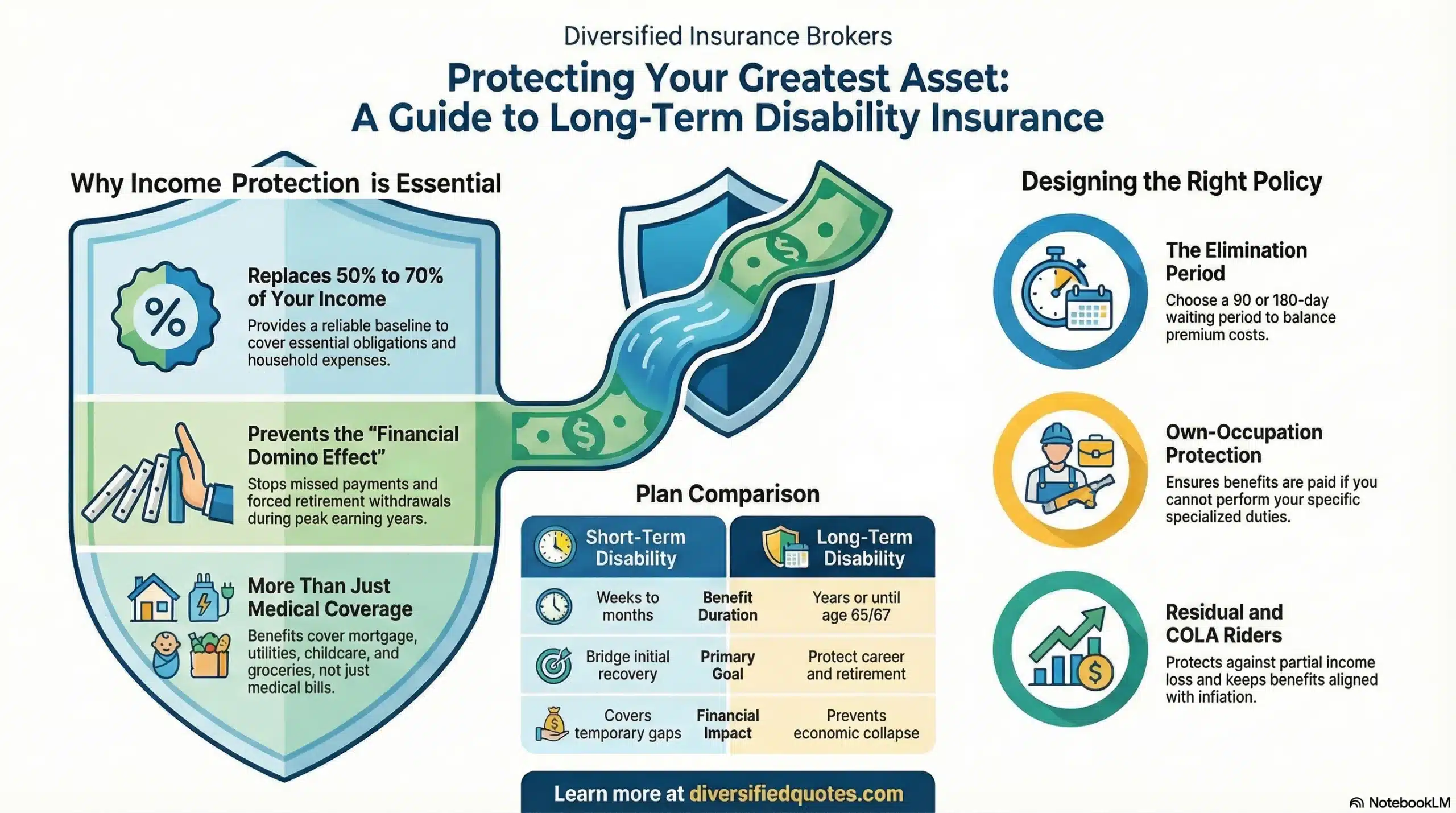
Benefit amount should reflect documented income as fully as the carrier’s rules allow. Most disability policies replace 60% to 70% of pre-disability income. For a phlebotomist earning $43,660 annually, a 60% replacement benefit produces approximately $2,183 per month — a meaningful income stream during a disability period that covers essential household expenses while the individual focuses on treatment and recovery. Phlebotomists earning above the median in high-paying settings should ensure their benefit amount reflects actual total compensation including overtime, shift differentials, and any variable pay components that employer group policies commonly exclude.
Elimination period should be calibrated to the phlebotomist’s actual financial reserves. A 90-day elimination period reduces premiums but requires 3 months of expenses in savings. Phlebotomists with limited liquid savings — particularly those earlier in their careers before substantial emergency funds have been built — may benefit from a 30 or 60-day elimination period that brings benefits sooner when income stops. Our resource on disability insurance elimination periods explained provides the framework for making this decision based on actual financial circumstances rather than defaulting to the option that simply produces the lowest premium.
Benefit period should extend to age 65. A phlebotomist who develops a disabling carpal tunnel condition at age 35 and cannot return to clinical practice faces 30 years of income loss — a 2 or 5-year benefit period covers only a fraction of that exposure. Short benefit periods feel more affordable at purchase but leave the most financially catastrophic scenario — a career-ending disability in midlife — entirely uninsured after the initial benefit expires.
Residual disability rider is important for phlebotomists because many disability scenarios produce partial rather than total incapacity. A phlebotomist managing a developing hand condition who can still work but at reduced volume, or who is restricted to less demanding collection techniques while recovering, is experiencing real income loss that a total-disability-only policy does not address. Including residual coverage ensures the policy functions in the partial disability scenarios that are more common than complete inability to work. Our resource on residual disability insurance benefits explained covers how these proportionate benefit calculations work.
Future increase option allows the phlebotomist to increase their benefit amount as income grows — without submitting to new medical underwriting. For a phlebotomist early in their career whose income will grow with experience, certification advancement, or movement into supervisory or specialized roles, this rider protects the ability to expand coverage with income growth regardless of any occupational health changes that have accumulated in the intervening years. Our resource on disability insurance future insurability riders explains exactly how this protection works.
Short-term disability should be considered as a complement to long-term coverage for phlebotomists whose elimination periods would leave a significant gap. Our resource on how to buy short-term disability insurance covers the options for bridging the period between the onset of disability and the start of long-term benefits.
The Employer Coverage Gap for Employed Phlebotomists
Many phlebotomists employed by hospitals, health systems, and reference laboratories have access to employer-sponsored disability coverage. Understanding what that coverage provides — and where it leaves significant gaps — is essential for any phlebotomist whose plan is to rely on employer coverage as primary protection.
Standard group long-term disability policies typically replace 60% of base salary, cap monthly benefits at a defined maximum, and exclude overtime and shift differential pay from the benefit calculation. For a hospital phlebotomist who regularly works overtime to meet demand — increasing total compensation meaningfully above base salary — the group policy benefit covers a smaller fraction of actual income than the headline 60% figure suggests. Additionally, the disability definition in most group policies transitions from own-occupation to any-occupation after 24 months — meaning that at exactly the point where a long-duration disability claim is most entrenched, the definition weakens and benefits may terminate for a phlebotomist who can theoretically perform a non-clinical role.
Group policies also end when employment ends. A phlebotomist who changes employers, moves to a different practice setting, or transitions to self-employed traveling phlebotomy loses group coverage immediately. Obtaining individual replacement coverage at that point requires full medical underwriting at an older age — potentially with occupational health conditions documented from years of clinical work that produce exclusion riders on exactly the conditions most likely to generate a future claim. Establishing individual disability coverage while young and healthy, before occupational conditions develop, is consistently the most advantageous timing approach. Our resource on how to get the best disability insurance rates explains how age and health status interact with premium and coverage availability, and our resource on best disability insurance rates by carrier helps identify which carriers offer the most competitive options for clinical healthcare worker occupation classes.
Self-Employed and Traveling Phlebotomists: Maximum Exposure, No Safety Net
Phlebotomists who operate as self-employed professionals or independent contractors — including traveling phlebotomists who contract with multiple facilities, mobile blood draw services, or insurance examination companies — face the sharpest disability risk picture because there is no employer, no sick leave, no group disability coverage, and no institutional buffer of any kind. When a self-employed phlebotomist cannot work, income stops immediately and completely.
For self-employed phlebotomists who have built client relationships and a mobile collection business, the consequences of an extended disability extend beyond the immediate income loss. Client accounts may transition to other mobile phlebotomy providers during an absence, referral networks may atrophy, and the market position built over years of service delivery may not fully recover even after health is restored. Disability insurance that replaces income during the disability period preserves the financial foundation that allows deliberate, patient recovery and return to practice rather than forcing a premature return under financial duress that risks reinjury or inadequate recovery.
Income documentation for self-employed phlebotomists follows the same carrier evaluation process as other self-employed healthcare workers — typically using two to three years of tax returns to establish average insurable income. Phlebotomists who minimize taxable income through business deductions should understand how this affects their maximum insurable benefit before applying. Our resource on getting disability insurance when self-employed covers the documentation and underwriting considerations that apply, and our resource on disability insurance for 1099 workers addresses the specific structure of coverage for contract-based phlebotomy professionals.
Occupation Classification and What It Means for Phlebotomist Applicants
Disability insurance carriers classify occupations into risk tiers that affect both the premium charged and the policy provisions available. Phlebotomists are typically classified in the Class 3 to Class 4 range — reflecting the combination of repetitive physical demand, needlestick exposure, and the specific fine motor precision that the occupation requires. This classification is more favorable than physically demanding construction trades but reflects the genuine occupational risks the BLS itself has documented with its high injury rate designation.
The practical impact of occupation classification is that phlebotomists can generally access own-occupation definitions, to-age benefit periods, and a full range of riders — but may find that some carriers classify the occupation more or less favorably than others, with real premium and provision differences across the market. This variation makes working with an independent broker who can compare phlebotomy-specific rates and definitions across multiple carriers particularly valuable. Our resource on why working with an independent disability insurance broker matters explains how carrier-specific classification knowledge drives better outcomes than single-carrier application, and our resource on disability insurance by occupation provides broader context on how occupation classification shapes coverage across the healthcare field. If you already have coverage and want an independent evaluation, our disability insurance second opinion service provides an unbiased review of existing quotes or policies.
When to Apply: The Timing Decision That Shapes Every Other Decision
Every dimension of disability insurance quality for a phlebotomist — premium level, coverage completeness, exclusion riders, rider availability — is affected by when they apply. The consistent guidance is to apply as early in the career as possible, before occupational health conditions have appeared in medical records and before age has driven premiums to higher levels that are then locked in permanently.
A phlebotomist who applies at age 25 and one who applies at age 40 pay dramatically different premiums for the same monthly benefit, with the premium difference locked in for the life of the policy. More importantly, a phlebotomist who has been performing high-volume venipuncture for 10 years before applying may have documented wrist discomfort, hand tingling, or upper extremity symptoms in their medical records that produce exclusion riders covering exactly the conditions most likely to generate a future claim. The phlebotomist who applies before these conditions are documented obtains comprehensive coverage without exclusions. Our resource on why you need disability insurance even when young and healthy addresses the timing question directly and explains why health status at application is one of the most consequential variables in lifetime coverage quality. For newer professionals just entering the field, our resource on disability insurance for new professionals provides specific guidance on coverage design at the start of a healthcare career.
Get Disability Insurance Quotes for Phlebotomists
We compare options across carriers for allied healthcare professionals to find the right combination of coverage, definition strength, and value for your income and practice setting.
Request Disability Insurance OptionsQuestions? Call 800-533-5969
Financial Protection Essentials
Income protection resources and disability insurance planning guides for allied healthcare and clinical professionals.
Talk With an Advisor Today
Choose how you’d like to connect—call or message us, then book a time that works for you.
Schedule here:
calendly.com/jason-dibcompanies/diversified-quotes
Licensed in all 50 states • Fiduciary, family-owned since 1980
Frequently Asked Questions: Disability Insurance for Phlebotomists
The Bureau of Labor Statistics’ designation reflects the combination of needlestick exposure, repetitive motion demands, sustained awkward postures, and patient handling responsibilities that phlebotomists face across their working careers. Unlike many healthcare professions where the BLS injury designation reflects a single dominant hazard, phlebotomy’s high injury rate comes from multiple converging risk categories: accidental sharps injuries from daily needle handling, repetitive strain conditions from the fine motor demands of high-volume venipuncture, musculoskeletal strain from sustained bending and standing, and the physical consequences of patient management including syncopal episodes and occasional patient aggression.
This injury rate is particularly significant for disability insurance planning because it is not concentrated in a single rare event — it reflects the cumulative probability that across a 20 to 40-year career of high-volume clinical phlebotomy, a meaningful health event will occur that affects the ability to perform the work. Disability insurance converts that statistical probability into financial protection, ensuring that when an injury or illness does occur, income continues rather than stopping immediately. Understanding whether disability insurance is expensive relative to the income it protects is an important starting point for phlebotomists who have not yet evaluated coverage.
Yes — disability insurance covers income loss resulting from a needlestick injury and its consequences when those consequences produce a qualifying disability under the policy definition. If a needlestick exposure leads to a documented illness — such as hepatitis C infection — that requires treatment and prevents full clinical work during that treatment period, a disability policy covering illness-related inability to perform occupational duties would provide benefit payments. Similarly, if post-exposure prophylaxis medications produce side effects severe enough to prevent work, the disability policy addresses that period of incapacity. The psychological consequences of a needlestick exposure — significant anxiety, PTSD symptoms from the stress of an uncertain exposure period — may also qualify under mental health coverage provisions depending on the severity and the policy’s definition of disability.
The most important thing to understand is that the policy must be in place before the needlestick occurs. A needlestick exposure that has already been documented in medical records at the time of application may produce an exclusion rider or application denial depending on its outcome and timing. This is one of the strongest arguments for phlebotomists to apply for disability coverage early in their careers, before occupational exposures have generated health history that complicates underwriting. Our resource on whether disability insurance requires a medical exam explains how the underwriting process works and what is typically evaluated during the application.
The conditions most frequently associated with disability claims among phlebotomists are carpal tunnel syndrome, other repetitive strain conditions of the hand and wrist, lumbar strain and disc conditions from sustained bending postures, and burnout or mental health conditions from high-volume patient-facing work under production pressure. Carpal tunnel syndrome is particularly significant because it directly impairs the tactile sensitivity and fine motor control that venipuncture requires — even moderate median nerve compression can make it medically impossible to perform the precise vascular access that is the phlebotomist’s core professional function.
Needlestick-related illness — particularly hepatitis C infection, which historically required lengthy interferon-based treatment with significant side effects before modern direct-acting antivirals made treatment more manageable — has historically been a source of disability claims in phlebotomy. While modern antiviral therapy has reduced treatment duration and side effect burden substantially, the illness itself and its treatment still represent a disability scenario that income protection should address. For phlebotomists with developing hand conditions who are concerned about coverage eligibility, our resource on high-risk disability insurance coverage options explains what is available when health history is already complicated.
Employer group disability coverage is a useful starting point but consistently leaves significant gaps that create genuine financial exposure. The most critical limitation is the disability definition transition: most group long-term disability policies apply an own-occupation definition for only the first 24 months, then shift to an any-occupation standard. For a phlebotomist with a hand condition preventing clinical collection work, the any-occupation transition at 24 months may terminate benefits on the grounds that they could perform a non-clinical role — even when clinical phlebotomy income was the income being replaced. Individual disability insurance with a true own-occupation definition for the full benefit period addresses this gap directly.
Additionally, group policies typically cap benefits at 60% of base salary and exclude overtime, shift differentials, and variable pay that many phlebotomists earn regularly. Group coverage is also not portable — it ends when employment ends, which is particularly consequential for phlebotomists who may transition between employer settings, move to self-employment, or change career paths during a working life. Our resource on disability income insurance for key employees discusses how individual and group coverage interact for clinical staff whose role is essential to healthcare operations.
The residual disability rider is the single most important optional provision for phlebotomists because it addresses partial disability — reduced work capacity and reduced income — which is far more common than complete inability to work in this profession. A phlebotomist managing a carpal tunnel condition who can still perform some collection work but at reduced volume, or who is restricted from certain patient populations requiring difficult access, is experiencing real income loss that a total-disability-only policy does not address. Residual coverage pays a proportionate benefit when income falls by a qualifying threshold due to a covered disability, supporting income through the entire recovery trajectory.
The future increase option is the second most important rider for phlebotomists, particularly early in their careers. This rider allows the benefit amount to be increased as income grows — without new medical underwriting — meaning that hand conditions or other occupational health developments that occur after the original policy is issued do not prevent the phlebotomist from expanding coverage to match their higher future income. The cost of living adjustment (COLA) rider matters for phlebotomists who face the possibility of long-duration claims, ensuring the benefit amount maintains purchasing power across years or decades of payments. Our resource on disability income insurance with COLA covers how this rider protects benefit value over time.
Yes — self-employed and traveling phlebotomists can obtain individual disability insurance, and the need is more acute for them than for employed phlebotomists because there is no employer group coverage, sick leave, or institutional support of any kind when income stops. The underwriting process for self-employed phlebotomists involves verifying income through tax returns — typically the most recent two years — and establishing the benefit amount based on documented average earned income. Self-employed phlebotomists who minimize taxable income through business expense deductions should understand that the insurable benefit amount is based on documented earned income, not gross revenue, and that aggressive tax minimization can reduce the available coverage amount.
Traveling phlebotomists who contract with multiple facilities or operate mobile collection businesses should also consider whether their business overhead — equipment costs, vehicle expenses, liability insurance — warrants a separate business overhead expense (BOE) disability policy alongside personal income replacement coverage. Our resource on disability business overhead expense coverage explains how BOE insurance works for independent healthcare professionals whose business obligations continue during a personal disability. For the income documentation side of the application, our resource on disability insurance for independent contractors covers the specific considerations that apply to contract-based clinical work.
Disability insurance premiums for phlebotomists depend on age at application, health status, monthly benefit amount, elimination period, benefit period, and the specific riders included. As a general benchmark, individual long-term disability insurance premiums typically range from 1% to 3% of annual income for well-structured policies with own-occupation definitions and standard riders. For a phlebotomist earning $43,660 annually, this translates to approximately $436 to $1,310 per year, or roughly $36 to $109 per month — a range that narrows considerably based on specific design choices and carrier selection.
The most significant premium drivers are age (younger is cheaper, locked in for policy life), benefit amount (higher monthly benefit increases premium proportionately), benefit period (to-age-65 costs more than a 5-year benefit period), and elimination period (shorter wait periods increase premium). Non-cancellable and guaranteed renewable policy provisions — which ensure the carrier cannot raise premiums or cancel coverage as long as premiums are paid — are worth the additional cost for the stability they provide across a long working career. Our resource on how to get the best disability insurance rates explains the design decisions that produce the best value, and our best disability insurance rates comparison shows how carrier-specific rates vary for the same benefit design.
About the Author:
Jason Stolz, CLTC, CRPC, DIA, CAA and Chief Underwriter at Diversified Insurance Brokers (NPN 20471358), is a senior insurance and retirement professional with more than 25 years of real-world experience helping individuals, families, and business owners protect their income, assets, and long-term financial stability. As a long-time partner of the nationally licensed independent agency Diversified Insurance Brokers, Jason provides trusted guidance across multiple specialties—including fixed and indexed annuities, long-term care planning, personal and business disability insurance, life insurance solutions, Group Health, Travel Medical and Evacuation Insurance, and short-term health coverage. Diversified Insurance Brokers maintains active contracts with over 100 highly rated insurance carriers, ensuring clients have access to a broad and competitive marketplace.
His practical, education-first approach has earned recognition in publications such as VoyageATL, and contributions from his agency featured in Kiplinger and GoBankingRates— highlighting his commitment to financial clarity and client-focused planning. Drawing on deep product knowledge and years of hands-on field experience, Jason helps clients evaluate carriers, compare strategies, and build retirement and protection plans that are both secure and cost-efficient. Visitors who want to explore current annuity rates and compare options across multiple insurers can also use this annuity quote and comparison tool.
Explore More Disability Insurance Options: Browse our complete guide to Disability Insurance for Nursing, Therapy & Allied Health — covering nurses, therapists, dental hygienists, pharmacists, lab techs & allied health professionals from 100+ carriers.
Last Reviewed: June 8, 2026 |
Reviewed by: Jason Stolz, CLTC, CRPC, DIA, CAA
Chief Underwriter, Diversified Insurance Brokers, Inc. | NPN: 20471358 | Diversified Insurance Brokers, Inc. — Licensed in all 50 states
Fact Checked by: Tonia Pettitt, CMIP©
Medicare Specialist, Diversified Insurance Brokers, Inc. | NPN: 14374308 | Diversified Insurance Brokers, Inc. — Licensed in all 50 states
Did you find this content helpful? Leave us a Google review — it helps others find trustworthy guidance too.
Editorial Standards: Diversified Insurance Brokers maintains rigorous editorial standards to ensure accuracy, clarity, and independence in all content. Learn more about our editorial standards and commitment to transparency.
