
Disability Insurance Riders Explained
Disability Insurance Riders Explained

Jason Stolz CLTC, CRPC, DIA, CAA
Individual disability insurance is built on a base policy — the core benefit amount, benefit period, elimination period, and definition of disability — but the riders attached to that base policy are what transform a generic income replacement contract into a precisely calibrated financial protection instrument matched to the specific realities of a professional’s career, income trajectory, health risks, and household obligations. Riders are optional contractual additions that expand, refine, or customize the coverage the base policy provides, and the combination of riders selected at policy issuance determines not just how much the policy pays but under what circumstances it pays, how long it pays, whether the benefit grows with inflation during a long disability, and whether the policyholder can increase coverage in the future without submitting to new health underwriting. The difference between a well-designed individual disability insurance policy and a poorly designed one is most often found not in the base benefit amount but in the rider architecture — the specific combination of contractual provisions that determine whether the policy actually performs as the professional needs it to when a qualifying disability occurs. At Diversified Insurance Brokers, Jason Stolz, CLTC, CRPC, DIA, CAA evaluates the full rider architecture of every disability insurance proposal across 100+ carriers, because the base premium difference between carriers is far less consequential than the contractual terms of the riders those carriers offer for the same premium. Long-term disability income insurance provides the income floor that rider selection refines into precisely the right coverage for each professional’s situation, and understanding how that coverage varies by occupation is the starting point for identifying which rider combinations matter most for any specific professional’s planning.
The fundamental building blocks of a disability insurance policy — definition of disability, benefit amount, benefit period, and elimination period — establish what the policy does in its simplest form. Riders modify each of those building blocks, add coverage dimensions the base policy does not include, and address the specific vulnerabilities that a professional’s particular career trajectory, income structure, and health profile create. A resident physician’s policy has different rider priorities than a self-employed attorney’s or a construction contractor’s — not because the base policy structure differs dramatically, but because the income trajectory, the partial disability probability, the future coverage needs, and the benefit duration requirements are specific to each professional’s circumstances. The rider architecture that serves a 28-year-old medical resident whose income will triple within five years of completing training is categorically different from the rider architecture appropriate for a 52-year-old business owner with stable income who needs purchasing power protection for any extended disability period ahead. Short-term disability coverage intersects with the elimination period rider selection — the shorter the elimination period on the long-term policy, the less short-term coverage is needed to bridge the income gap — and understanding how short and long-term disability structures interact is the context within which elimination period decisions make most sense.
Request a Complete Disability Insurance Rider Review
We compare rider terms — own-occupation definitions, COLA structures, FIO exercise rules, and residual benefit triggers — across 100+ carriers to build the policy architecture that fits your specific career and income structure.
Request a Disability Insurance ReviewExplore Our Disability Insurance Rider and Features Guides
Deep-dive explanations of the core provisions and riders that belong on any well-designed individual disability insurance policy.
Benefit Period
The single biggest driver of your total protection — how long your policy keeps paying benefits, from a few years to your full working life.
Learn MoreElimination Period
Understand the waiting period before benefits begin — and how choosing the right elimination period balances premium cost against financial reserves.
Learn MoreFuture Insurability Rider
Lock in your health rating today and increase coverage later as your income grows — no new medical underwriting required.
Learn MoreCOLA Rider
Protect the purchasing power of your benefit during a long-term claim — your benefit grows annually with inflation so it stays meaningful.
Learn MoreResidual Disability Benefits
Most claims are partial, not total. A residual benefit pays when a disability reduces your income — even when you’re still working in some capacity.
Learn MoreDisability Insurance Riders — Function, Value, and When Each Matters
| Rider / Feature | What It Does | Who Needs It Most | What Happens Without It |
|---|---|---|---|
| Own-Occupation Definition | Pays benefits if disability prevents performing the specific duties of the insured’s own occupation — even if the insured is able to work in a different occupation; the most protective disability definition available on individual policies | Any licensed, credentialed, or specialized professional whose specific occupational duties and earning capacity are distinct from their general ability to perform any work whatsoever — physicians, dentists, attorneys, engineers, skilled tradespeople, any professional whose specific skill commands their income level | An any-occupation standard denies benefits when the insured can perform any gainful employment — a surgeon who cannot operate but can do desk work may receive no benefit under an any-occ standard despite being unable to perform the career that generated the income; group plans typically use any-occupation after 24 months |
| Residual Disability Rider | Pays a partial benefit proportional to actual income reduction when a disability reduces work capacity or income without producing total disability; benefit is calculated as a percentage of the total disability benefit, based on documented income reduction; allows the insured to return to work part-time and still receive proportional benefits | Every professional — the majority of disability claims involve partial rather than total disability; particularly critical for self-employed professionals whose income is directly proportional to work capacity, and for any professional in a recovery phase where partial return to work occurs before full return to pre-disability income | Without a residual rider, a policy may pay nothing for the most common claim scenario — a professional who is working reduced hours or capacity due to disability but has not ceased work entirely; a surgeon working three days a week instead of five due to disability receives no benefit from a total-disability-only policy |
| Future Increase Option (FIO) Rider | Guarantees the right to increase the monthly disability benefit at defined intervals or life events without any new medical underwriting — regardless of health changes since original policy issuance; health classification is locked in at original purchase; financial underwriting (income documentation) still applies at each exercise | Early-career professionals with significant income growth ahead — medical residents, new attorneys, young engineers, early-stage business owners; any professional purchasing at modest income who expects career income to grow meaningfully; any professional in an occupation where future health changes could make new underwriting unfavorable | Without an FIO rider, increasing coverage as income grows requires a new application with full medical underwriting; if health has changed, the new application may produce exclusion riders, higher premiums, or a decline — leaving the professional with coverage that underrepresents actual income at no available remedy |
| Cost of Living Adjustment (COLA) Rider | Increases the monthly disability benefit annually during a qualifying disability — typically tied to the Consumer Price Index or a fixed percentage — to protect the real purchasing power of the benefit against inflation across a multi-year or decade-long disability period; the increase is usually capped at a defined annual maximum | Any professional with a long benefit period ahead — younger professionals facing potential decades of disability income if a serious disability occurs early in career; any professional purchasing a to-age-65 benefit period where the earliest disability scenario could produce 30+ years of benefit payments | Without a COLA rider, the nominal benefit amount remains fixed throughout the disability period; a $5,000 monthly benefit that begins at age 35 has dramatically reduced real purchasing power at age 55 due to cumulative inflation — the same grocery bills, mortgage, and family expenses cost significantly more while the benefit has not moved |
| Elimination Period | The waiting period after disability begins during which benefits are not yet payable; functions as the deductible of disability insurance — the longer the elimination period the lower the premium, the shorter the elimination period the higher the premium; the industry average is 90 days, with options typically ranging from 30 to 365 days | Every policy has an elimination period; a shorter period (30-60 days) benefits professionals with limited cash reserves who cannot sustain 90 days without income; a longer period (180-365 days) is appropriate for professionals with significant emergency funds who want to reduce premium cost | A mismatch between elimination period and actual financial reserves creates the gap that produces household financial crisis during the waiting period before benefits begin — the elimination period is the most common source of coverage design errors for professionals who underestimate how quickly income disruption creates financial pressure |
| Waiver of Premium Rider | Suspends the policy premium obligation during a qualifying disability — so the insured continues receiving disability benefits without having to pay premiums out of benefit income during the disability period; premiums typically resume when the disability ends and the insured returns to work | Every professional — the waiver of premium is one of the most universally applicable riders because a professional receiving disability benefits should not be required to pay premiums from those benefits, reducing the effective take-home replacement; particularly important for policies with higher premiums relative to benefit amount | Without waiver of premium, the monthly disability benefit income must fund both the household’s financial obligations and the ongoing policy premium — effectively reducing the net benefit by the premium amount during the disability period when the insured is already income-constrained |
| Catastrophic Disability (CAT) Rider | Pays an additional benefit on top of the base disability benefit when a disability is sufficiently severe — typically defined as inability to perform two or more activities of daily living without assistance, cognitive impairment, or irrevocable disability; in some policy structures this can approach 100% income replacement for the most severe qualifying conditions | High-earning professionals whose income level means standard replacement limits (60-70% of income) leave a meaningful absolute-dollar gap; any professional who wants additional protection specifically for the most catastrophic and permanently disabling outcomes that standard total disability benefits alone may not fully address | Without a CAT rider, the standard total disability benefit is the maximum payable regardless of severity — a catastrophic disability producing permanent incapacity and requiring ongoing personal care assistance receives the same benefit as any other total disability, without supplemental income for the elevated costs that severe disability typically generates |
| Presumptive Disability Provision | A contractual provision (often part of the base policy rather than a separate rider) that automatically triggers total disability benefits for certain specified catastrophic losses — typically total loss of sight, hearing, speech, or two limbs — regardless of whether the insured is working; no elimination period applies for qualifying presumptive conditions | All policyholders benefit from understanding whether their policy includes a presumptive disability provision; the provision matters most for professionals in physical occupations where limb loss or sensory loss from acute accident is a realistic risk | Without a presumptive provision, even catastrophic losses like bilateral blindness must satisfy the standard disability definition and elimination period — a provision that essentially never applies because someone who has lost all sight is clearly disabled, but that technically could produce benefit delays without the presumptive clause |
The table documents the full rider landscape of individual disability insurance — from the foundational own-occupation definition through the catastrophic and presumptive provisions that address the most severe disability scenarios. The critical insight Jason Stolz consistently applies when evaluating disability insurance proposals is that rider architecture is where most coverage design errors occur: a policy with the right base benefit amount but the wrong rider combination can leave significant income exposure gaps precisely when a qualifying disability occurs. How much disability income a professional actually needs is the starting point, but the rider architecture is what determines whether that income floor actually holds in the specific disability scenarios the professional is most likely to face.
The Own-Occupation Definition — Why the Policy’s Disability Definition Is the Most Consequential Single Decision
Every disability insurance policy contains a definition of disability — the contractual standard that determines when benefits become payable. The own-occupation definition is the most protective available: it pays benefits when the insured cannot perform the material and substantial duties of their specific occupation, even if they are able to work in a different role or profession. A physician who cannot practice medicine due to a disability receives benefits under an own-occupation policy even if the physician could theoretically teach, consult, or do administrative work — because the policy covers the specific occupational function that generated the insured income. The any-occupation definition — found in most employer group LTD plans and in many lower-cost individual policies — pays benefits only when the insured cannot perform any occupation for which they are reasonably educated, trained, or experienced. Under an any-occupation standard, a neurosurgeon who cannot operate but who could perform sedentary medical consulting work may receive no benefit, because the ability to perform any occupation for which training has equipped them is preserved.
The practical financial difference between an own-occupation and an any-occupation definition for a specialized professional is the difference between a policy that protects the career the professional built and a policy that provides benefits only at total incapacity — the most extreme and least probable claim scenario. Between these two standards is the modified own-occupation definition, which typically pays own-occupation benefits for an initial period (often 24 months) before transitioning to an any-occupation standard — a structure that protects the specialty career for two years of disability but leaves the professional exposed at precisely the point when a long-term disability has become permanent and income replacement needs are most acute. Understanding the full implications of the own-occupation definition for any specific professional’s occupation class and income level is the foundation on which every other rider decision is built — because the definition of disability determines the circumstances under which any benefit, from any rider, is payable at all. For white-collar professionals in licensed and credentialed occupations, high-risk trade professionals whose specific physical function generates their income, and every professional whose occupation-specific skill commands a meaningful income premium above general labor market wages, the own-occupation definition is non-negotiable in any disability insurance policy that is expected to actually protect what it costs.
Residual Disability — The Rider That Addresses the Most Common Actual Claim Scenario
The residual disability rider is the rider most consistently undervalued by professionals evaluating disability insurance, and the one whose absence most consistently produces claim denials for the scenario that actually occurs. Industry data on disability claims documents that the majority of disability claims involve partial rather than total disability — conditions that reduce the professional’s work capacity, income, or hours without eliminating the ability to work entirely. A professional who sustains a back injury severe enough to prevent the full physical demands of their occupation but not so severe as to prevent all work has a partial disability — and without a residual rider, the standard total disability policy may pay nothing for that claim. A surgeon who can operate two days per week instead of five due to a shoulder condition has a partial disability that eliminates 60 percent of surgical income — and without a residual rider, no benefit is payable under a total-disability-only policy regardless of the documented income loss.
The residual rider specifically addresses this gap by paying a partial benefit proportional to actual income reduction. The benefit is typically calculated by comparing pre-disability income to current income, with the percentage reduction in income producing the same percentage of the total disability benefit. A professional with a $6,000 per month total disability benefit who experiences a 50 percent income reduction due to a qualifying partial disability receives a $3,000 per month residual benefit — meaningful, proportional, and precisely calibrated to the actual financial impact of the disability that occurred. The full mechanics of residual disability benefits — how income reduction is calculated, what documentation is required, how the benefit interacts with a return to work — are the specific details that determine whether the residual rider in a particular policy actually performs as expected when a partial disability claim is filed. The residual rider is particularly critical for self-employed professionals whose income is directly proportional to their personal production capacity, independent contractors whose contract revenue depends on their individual work output, and any professional in a gradual-return-to-work recovery trajectory where income rebuilding occurs incrementally rather than all at once.
Non-Cancellable and Guaranteed Renewable — The Policy Provisions That Protect Everything Else
Beyond the specific riders that add coverage dimensions to a disability insurance policy, two policy provisions protect the entire policy structure from being altered or eliminated by the carrier: non-cancellable and guaranteed renewable. A non-cancellable policy guarantees that the carrier cannot change the policy terms, cannot increase the premium, and cannot cancel the policy as long as the insured pays the stated premium — providing absolute certainty that the coverage secured at policy issuance will remain available on the original terms for the life of the policy. A guaranteed renewable policy gives the insured the right to continue the policy by paying premiums, but allows the carrier to increase premiums on a class-wide basis (not individually). The distinction matters substantially for professionals purchasing disability insurance at early career stages with a 30 to 40-year benefit horizon: a non-cancellable policy guarantees the premium will not increase above what was stated in the original policy regardless of changes in the carrier’s claims experience, regulatory environment, or pricing model. Why purchasing early under a non-cancellable structure is the most cost-efficient approach is answered by the compounding advantage of locking in both health terms and premium rates at the earliest and healthiest point in the career — a guarantee that no subsequent career, health, or market development can unwind.
Rider Selection by Career Stage — How the Right Rider Architecture Changes Over Time
The optimal rider architecture for a disability insurance policy is not the same for every professional at every career stage. Jason Stolz’s approach to disability insurance rider selection at Diversified Insurance Brokers begins with the career trajectory, income structure, financial reserves, and specific occupational risk profile of each professional — because the riders that are most critical for a 26-year-old medical resident are categorically different from those most important for a 48-year-old established physician with significant financial assets.
For early-career professionals — medical residents and fellows, new attorneys in their first associate years, young engineers and technology professionals in the early years of income growth — the most critical rider combination is the future increase option rider alongside the own-occupation definition and residual benefit provision. The FIO rider preserves the ability to increase coverage as income grows without new medical underwriting; the own-occupation definition protects the specific career specialty being built; and the residual rider addresses the partial disability scenarios most likely to affect an early career professional dealing with an illness or injury during peak career-building years. The COLA rider, while always valuable, is most urgently important for early-career professionals because the potential disability period horizon is longest — a disability at 28 could produce 37 years of benefit payments, during which a fixed nominal benefit erodes significantly without COLA protection. For high-earning professionals and business owners in established career phases, the catastrophic rider becomes more relevant — the income level being protected is high enough that the gap between standard replacement limits and 100 percent income replacement represents significant absolute dollars, and the CAT rider specifically addresses the most severe disability scenarios at that income tier. For professionals with health histories that have produced exclusion riders, the FIO rider’s value for non-excluded disability causes remains fully intact, making systematic FIO exercise as income grows just as important as for a healthy professional — perhaps more so, because the exclusion rider has already established that future new-application underwriting may produce unfavorable terms for expanded coverage. Guarantee issue disability insurance programs available through specific employer or professional association groups may include some rider-equivalent provisions — confirming which provisions a group guarantee issue program includes is an important step before assuming it provides the same protections as a fully rider-equipped individual policy. No-exam disability coverage similarly varies in which riders are available alongside the streamlined underwriting access — the convenience of no-exam should not come at the cost of the rider architecture that makes the policy actually functional when a claim occurs. Accident-only disability income insurance specifically does not include the full rider suite of individual disability policies — it covers the acute accident scenario without the COLA, FIO, or residual provisions that address the long-duration illness and gradual-onset disability pathways. Business overhead expense disability coverage for business owners operates alongside personal disability income insurance with its own benefit structure — confirming whether BOE coverage includes any rider-equivalent provisions for benefit growth or partial disability coverage is an important dimension of the complete business owner coverage review. Financial planning professionals, veterinarians, and physical therapists — occupations with documented partial disability risk from the physical and cognitive demands of their specific professional functions — have particularly strong cases for robust residual and own-occupation rider selection. Dentists, whose manual dexterity is the specific professional function that generates premium income, have the most acute own-occupation definition imperative of any professional category — a dentist who loses fine motor function due to disability but can perform other work has lost the dentistry career that generated the income, and only an own-occupation definition captures that loss as a qualifying disability. Agricultural professionals and construction workers whose physical disability risk is dominated by the acute injury pathways of their occupations need the accident-protective and residual benefit provisions most urgently alongside whatever own-occupation definition their occupational class supports. Self-employed professionals of all kinds need the residual rider most urgently — their income is directly proportional to their production, and a partial disability is as financially consequential as a total one in proportion to the degree of capacity lost. 1099 contractors whose variable income structure is documented through Schedule C need the residual rider’s income-proportional benefit calculation, which is specifically designed to address the income variation that contract work structures produce. The BOE coverage layer for any self-employed professional with fixed overhead obligations completes the protection architecture alongside the personal disability income policy’s rider stack. Whether disability benefits are taxable is determined by how premiums are paid — not by which riders are included — but the tax-free character of personally purchased individual DI benefits makes the complete rider architecture’s monthly benefit amount the effective household income floor, making it more important rather than less to have the right riders in place. Whether disability insurance is worth the cost is most usefully evaluated across the full policy including its riders rather than the stripped base policy premium alone — a base policy without own-occupation definition, residual benefit, and FIO rider is a categorically different product from a fully rider-equipped individual disability policy, and comparing their premiums without comparing their coverage is the single most common disability insurance evaluation error. Why professionals buy disability insurance — the income floor it creates — is answered most completely only when the rider architecture is designed to actually deliver that floor in the specific disability scenarios the professional’s career and health profile make most likely. Getting the best available rates on a fully rider-equipped policy requires independent broker comparison across the full carrier market — not merely comparing the base premium across a few carriers, but evaluating the complete rider architecture, the specific contractual terms of each rider, and the carrier’s claims handling approach alongside the premium. A second opinion on any disability insurance proposal specifically confirms whether the rider architecture includes own-occupation definition, residual benefit, FIO, and COLA as the foundational four — and whether the specific contractual terms of each rider are as favorable as the full carrier market offers for the professional’s specific situation.
Get Your Complete Rider Architecture Review
We evaluate your current coverage’s rider terms — or design the right rider combination from the ground up — across 100+ carriers to ensure the policy you hold actually performs when a disability occurs.
Request a Disability Insurance Review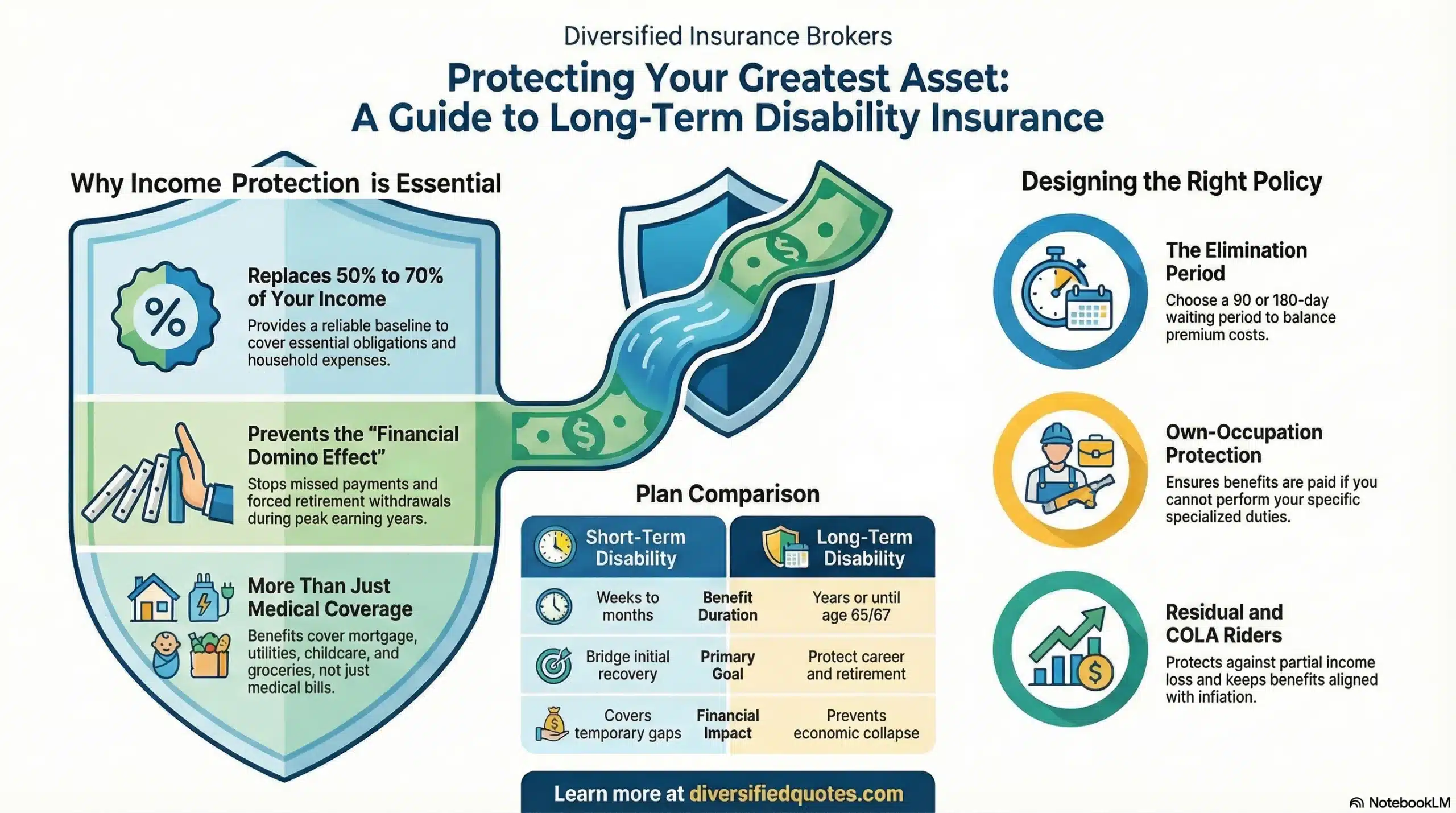
Talk With an Advisor Today
Choose how you’d like to connect—call or message us, then book a time that works for you.
Schedule here:
calendly.com/jason-dibcompanies/diversified-quotes
Licensed in all 50 states • Fiduciary, family-owned since 1980
FAQs: Disability Insurance Riders Explained
What are the most important disability insurance riders to have on any individual policy?
The four riders that belong on virtually every well-designed individual disability insurance policy are the own-occupation definition, the residual disability benefit provision, the future increase option, and the cost of living adjustment. These four provisions address the four most consequential coverage gaps that a base-policy-only structure leaves open: the own-occupation definition ensures that partial career incapacity is covered rather than requiring total inability to work at any occupation; the residual benefit provision ensures that the most common actual claim scenario — partial income loss from a disability — produces proportional benefits rather than nothing; the future increase option ensures that coverage can grow with income without requiring new medical underwriting; and the COLA rider ensures that a long-term disability benefit maintains real purchasing power against inflation across a multi-year benefit period.
The waiver of premium provision is a near-universal addition that suspends premium payments during a qualifying disability, ensuring benefit income is not partially consumed by ongoing premium obligations. The catastrophic disability rider becomes increasingly important for high-earning professionals where the gap between standard replacement limits and 100 percent income replacement represents significant absolute dollars. The relative priority of these riders shifts based on career stage and income trajectory — but the foundational four represent the baseline that any serious disability insurance policy should include before premium comparison or carrier selection begins. A second opinion on any existing or proposed disability insurance policy specifically evaluates whether the foundational four are present and whether their contractual terms are as favorable as the full carrier market offers.
Does my employer group disability plan include the same riders as an individual policy?
Employer group disability plans almost universally lack the rider architecture that makes individual disability insurance genuinely protective. The most consequential structural differences are the disability definition, the mental health benefit cap, and the absence of future increase and residual benefit provisions. Most employer group plans use an own-occupation definition for the first 24 months of disability, then transition to an any-occupation standard — meaning a surgeon who cannot practice medicine but can perform other work receives no benefit after 24 months under the any-occupation phase, at precisely the point when a serious disability has become permanent. Most group plans cap mental health and substance use disorder benefits at 24 months regardless of severity. Most group plans do not include a future increase option equivalent or a residual disability benefit provision that pays for partial income loss without total disability.
The appropriate architecture for most professionals with employer group plan access is to enroll at the maximum available group plan benefit — providing an immediate income baseline at no individual premium cost — and layer individually purchased disability insurance with the full foundational rider set on top. The individual policy fills the definition gap, the mental health cap gap, the future increase gap, and the residual benefit gap that the group plan’s structure leaves open. The combination of maximum group plan enrollment plus individual supplemental coverage with full rider architecture produces a disability protection structure that actually matches the professional’s income and career trajectory. Understanding how short-term and long-term disability structures layer in the context of both employer group and individual coverage is the complete picture of a well-designed disability income protection architecture.
How does the residual disability rider work if I’m partially disabled and still working?
The residual disability rider pays a proportional benefit when a disability reduces your income below pre-disability levels, even while you are still working in some capacity. The benefit is calculated by comparing your pre-disability income to your current income during the disability period, and the percentage of income reduction determines the percentage of the total disability benefit that is payable. A professional with a $6,000 per month total disability benefit who is working at reduced capacity due to a disability and has experienced a 40 percent income reduction would receive a $2,400 per month residual benefit — proportional to the actual documented income loss, paid during the period in which the disability continues to reduce income below pre-disability levels.
The residual rider typically requires that the income reduction meet a minimum threshold — often 20 percent of pre-disability income — to trigger benefit payment. The specific calculation method varies by carrier and policy: some policies calculate residual benefits based on time loss (reduction in work hours), some on income loss, and some on a combination of both. The time-and-duties approach ties the benefit to both the proportion of work time lost and the material duties that can no longer be performed — a consideration that matters specifically for self-employed professionals and business owners whose income may not decline proportionally to hours worked if fixed revenue streams continue during a partial disability. The complete mechanics of residual disability benefits — including the income documentation requirements, the interaction with total disability benefits, and the return-to-work recovery phase provisions — are covered in the full residual benefits guide.
What is the difference between a non-cancellable and a guaranteed renewable disability policy?
Non-cancellable means the insurance company cannot change the policy terms, cannot increase the premium, and cannot cancel the policy as long as you pay the stated premium. The premium you pay on day one of a non-cancellable policy is the premium you will pay throughout the policy’s life — regardless of changes in the carrier’s claims experience, regulatory environment, or pricing decisions. This is the most protective policy structure for professionals purchasing disability insurance with a 30 to 40-year benefit horizon at early career stages, because it eliminates premium uncertainty across the entire coverage period.
Guaranteed renewable means you have the right to continue the policy by paying premiums, but the carrier retains the right to increase premiums on a class-wide basis — not for your individual policy alone, but for an entire class of policyholders with similar characteristics. A guaranteed renewable premium increase requires regulatory approval and applies to the class, not the individual, but it does represent a form of premium uncertainty that non-cancellable policies eliminate. Both non-cancellable and guaranteed renewable policies protect against individual policy cancellation or individual premium increase targeting — neither can single out your policy for unfavorable treatment based on your specific claims history. The difference matters most over very long benefit periods where the cumulative premium impact of class-wide increases on a guaranteed renewable policy could meaningfully exceed the locked premium of a non-cancellable policy purchased at the same original terms.
Do riders cost significantly more, or are they worth adding to the base policy?
Riders add to total policy premium, but the cost of individual riders is typically modest relative to the value of the coverage dimension each adds — and the comparison must be made against the financial consequence of the gap each rider closes. The residual benefit rider adds a percentage to total policy premium in exchange for converting a total-disability-only policy into a policy that covers the most common actual claim scenario. The future increase option rider adds a modest premium increment in exchange for the contractual guarantee that future coverage increases will not require new medical underwriting regardless of health changes. The COLA rider adds a percentage in exchange for inflation protection across a potentially decades-long disability benefit period. The waiver of premium provision adds a small increment in exchange for ensuring that disability benefits are not partially consumed by ongoing premium obligations during a claim period.
The framework Jason Stolz consistently applies is that the cost of each rider should be evaluated against the financial consequence of the coverage gap it closes — not merely against the premium increment it adds to the base policy. A residual rider that adds a few percent to total annual premium is extremely cost-efficient against the financial consequence of a multi-year partial disability that produces no benefit under a total-disability-only policy. An FIO rider that costs a modest annual increment is extremely cost-efficient against the consequence of being unable to increase coverage when income has grown significantly but a health change has made new underwriting unfavorable. The premium comparison that matters is not base policy versus fully-ridered policy — it is fully-ridered policy with appropriate carrier selection versus the financial consequence of a claim against an inadequately designed policy. Comparing fully rider-equipped policies across carriers is the appropriate apples-to-apples evaluation.
Can I add riders to an existing disability insurance policy?
In most cases, riders must be added at the time of original policy application and issuance — not retroactively to an existing in-force policy. Once a policy is issued without a specific rider, that rider typically cannot be added later as an amendment to the existing policy. The specific exceptions and any available mid-policy endorsement options vary by carrier and policy structure, but the general rule is that rider architecture is established at original issuance and reflects the health and financial underwriting terms of that original application.
For professionals who have an existing disability insurance policy without one or more of the foundational riders — particularly the FIO rider or the residual benefit provision — the most common approach is to purchase a second individual disability insurance policy that includes the missing rider provisions, layered alongside the existing policy. The new policy is subject to current health underwriting at the time of the new application, which is why the timing argument for including riders at original purchase is so consequential. If health has changed since the original policy was issued, a new application may produce exclusion riders, rated premiums, or other limitations on the new policy’s terms. If health is still clean, a new application for a supplemental individual policy with the missing rider provisions is straightforward, and the two policies together provide the complete coverage architecture that should have been in place from the original purchase. A second opinion on any existing policy that evaluates both the current policy’s rider gaps and the optimal approach for filling those gaps — new layered policy, group plan adjustments, or other mechanisms — is the most effective starting point for any professional with incomplete rider coverage.
About the Author:
Jason Stolz, CLTC, CRPC, DIA, CAA and Chief Underwriter at Diversified Insurance Brokers (NPN 20471358), is a senior insurance and retirement professional with more than 25 years of real-world experience helping individuals, families, and business owners protect their income, assets, and long-term financial stability. As a long-time partner of the nationally licensed independent agency Diversified Insurance Brokers, Jason provides trusted guidance across multiple specialties—including fixed and indexed annuities, long-term care planning, personal and business disability insurance, life insurance solutions, Group Health, Travel Medical and Evacuation Insurance, and short-term health coverage. Diversified Insurance Brokers maintains active contracts with over 100 highly rated insurance carriers, ensuring clients have access to a broad and competitive marketplace.
His practical, education-first approach has earned recognition in publications such as VoyageATL, and contributions from his agency featured in Kiplinger and GoBankingRates— highlighting his commitment to financial clarity and client-focused planning. Drawing on deep product knowledge and years of hands-on field experience, Jason helps clients evaluate carriers, compare strategies, and build retirement and protection plans that are both secure and cost-efficient. Visitors who want to explore current annuity rates and compare options across multiple insurers can also use this annuity quote and comparison tool.
Explore More Disability Insurance Options: Browse our complete guide to Disability Insurance Planning & Education — covering how it works, riders, elimination periods, own occupation, costs & buying guides from 100+ carriers.
Last Reviewed: July 9, 2026 |
Reviewed by: Jason Stolz, CLTC, CRPC, DIA, CAA
Chief Underwriter, Diversified Insurance Brokers, Inc. | NPN: 20471358 | Diversified Insurance Brokers, Inc. — Licensed in all 50 states
Fact Checked by: Tonia Pettitt, CMIP©
Medicare Specialist, Diversified Insurance Brokers, Inc. | NPN: 14374308 | Diversified Insurance Brokers, Inc. — Licensed in all 50 states
Did you find this content helpful? Leave us a Google review — it helps others find trustworthy guidance too.
Editorial Standards: Diversified Insurance Brokers maintains rigorous editorial standards to ensure accuracy, clarity, and independence in all content. Learn more about our editorial standards and commitment to transparency.
