
Disability Insurance for Veterinarians
Disability Insurance for Veterinarians

Jason Stolz CLTC, CRPC, DIA, CAA
Veterinary medicine is one of the most physically and emotionally demanding healthcare professions in the United States — and one of the most statistically dangerous. Veterinary medicine ranks second out of all U.S. industries for nonfatal workplace injuries according to the Bureau of Labor Statistics. In 2024, 11.1 out of 100 veterinary professionals experienced injuries that could interfere with their ability to work — a rate almost five times the national average of 2.3, falling second only to professional athletes. The same source documents that according to the Centers for Disease Control, up to two-thirds of veterinarians and 98% of veterinary technicians will be injured by an animal at some point during their careers. These are not theoretical risks — they are statistical certainties for virtually every veterinarian who pursues clinical practice.
Despite this documented injury reality, statistics show that 93% of U.S. veterinarians see the need for disability coverage, but only 40% carry their own individual disability policy. The gap between recognition and action has a direct financial explanation: veterinary school borrowers carry an average of approximately $180,000 in student debt upon graduation, and the debt-to-income ratio pressure of early career creates resistance to additional fixed monthly expenses. But this logic reverses itself under scrutiny. The veterinarian who most cannot afford a disability — because of student loan obligations, early-career mortgage, and a newly established practice — is precisely the veterinarian who most needs income protection. A disability event in year three of a veterinary career can be financially catastrophic in a way that the same event in year twenty of a paid-down, established career is not.
At Diversified Insurance Brokers, we help veterinarians at every career stage — new graduates establishing their first own-occupation policy, associate veterinarians supplementing inadequate group coverage, and practice owners coordinating personal disability with business overhead and buy-sell protection — build income protection strategies that reflect the real-world risks and financial obligations of veterinary medicine. Our independent disability insurance brokerage gives us access to more than 100 carriers including the specialists in veterinary disability — Guardian, Principal, MassMutual, Ameritas, and Standard — so we can compare the full market rather than being limited to a single company’s products.
Compare Disability Insurance Options for Veterinarians
We specialize in own-occupation disability insurance for DVMs, practice owners, veterinary specialists, and large and small animal practitioners across all career stages.
Request a Disability Insurance QuoteCall 800-533-5969
The Five Physical Disability Risk Categories for Veterinarians
Veterinary disability risk is not a single-pathway phenomenon — it is a convergence of five distinct physical and chemical hazard categories that compound over a veterinary career and produce injury and illness rates unlike any other healthcare profession.
Animal-inflicted injuries are the most immediate and broadly recognized. Bites, scratches, and kicks from patients who cannot communicate distress and respond to pain, fear, or restraint with instinctive defensive behavior are an operational constant for clinical veterinarians. Cat bites — notoriously deep and infection-prone from needle-like teeth that inoculate bacteria deep into hand tissue — produce a specific infection and tendon injury risk that can sideline a small animal veterinarian for weeks or permanently impair fine motor function critical to surgical work. Dog bites produce laceration and crush injuries to hands and arms. Horse kicks can deliver blunt force trauma exceeding a ton of force — capable of producing fractures, internal injuries, head trauma, and in extreme cases fatal injuries — to large animal practitioners who routinely work in close proximity to animals that outweigh them by a factor of five to ten. More than six in ten veterinarians report musculoskeletal discomfort in at least one major body region — most often the lower back or shoulders — with injuries linked primarily to repetitive lifting and animal handling.
Musculoskeletal disorders from sustained physical demands represent the second major disability pathway, and they are the most statistically prevalent form of occupational disability for veterinarians. Veterinary work involves sustained physically demanding postures — bending over examination tables and surgical surfaces, restraining animals in awkward positions, lifting patients ranging from 5 to 500 pounds depending on the practice type, performing surgical procedures requiring sustained fine motor control and precise positioning for extended periods. The cumulative musculoskeletal toll of this physical profile over a 20 to 30 year clinical career produces chronic back, shoulder, neck, wrist, and knee conditions that can develop from acute injury events or from the gradual accumulation of occupational wear without a single identifiable triggering incident.
Zoonotic disease exposure creates a category of disability risk unique to veterinarians and veterinary workers. Zoonotic diseases — infections transmitted between animals and humans — represent an occupational exposure pathway that non-veterinary healthcare workers rarely face. Brucellosis, leptospirosis, ringworm, psittacosis, Q fever, and other animal-transmitted pathogens create genuine occupational illness risk with long recovery timelines and potential for serious chronic health consequences. Veterinarians who sustain needle-stick injuries during vaccinations or therapeutic injections face both the immediate biological hazard and the sustained exposure to animal-origin pathogens that such accidents carry.
Chemical and radiation hazards represent the fourth exposure category. Veterinary anesthetic gases — particularly waste anesthetic gas (WAG) that escapes from anesthetic delivery systems — have documented reproductive toxicity and neurological effects from chronic low-level occupational exposure. Radiation exposure from diagnostic X-ray equipment, while controlled by safety protocols, represents a cumulative occupational health consideration over long clinical careers. Pesticide exposure in large animal and equine practices, chemotherapy drug handling in oncology-focused practices, and cytotoxic drug exposure in practices treating cancer patients all represent specific chemical hazard exposures that accumulate across specialties.
Mental health conditions represent the fifth — and in terms of long-duration disabling events, the most significant — disability pathway for veterinarians. This dimension deserves the full treatment it receives in a dedicated section below.
The Mental Health Crisis in Veterinary Medicine
The mental health data for veterinary professionals is among the most alarming in any American healthcare profession, and it is essential context for any veterinarian evaluating disability insurance — because the disability event most likely to produce a long-duration career interruption may not be an animal bite or a surgical injury. It may be a disabling mental health condition.
Since graduating from veterinary school, 31% of respondents in a major survey experienced depressive episodes, 17% experienced suicidal ideation, and 1% attempted suicide. Risk factors associated with poor mental health and high rates of suicide in veterinary practitioners include continuous exposure to challenging scenarios such as interpersonal conflicts, performing euthanasia, and easy access to lethal means of suicide including opioids and anesthetics. A JAVMA study covering death records for 11,620 veterinarians confirmed that veterinarians die by suicide at significantly higher rates than the general population — a finding replicated across international research and across decades of mortality data for this profession.
The Merck Animal Health Veterinarian Wellbeing Study conducted in collaboration with the AVMA found that veterinarians were very concerned about high stress levels (92%), high student debt (91%), and suicide (89%) in the profession. One in three veterinary professionals has considered leaving the field, attributing the thoughts to burnout and poor mental health. Data from the 2023 Merck Animal Health Veterinary Wellbeing Study reveals most veterinarians experience low to medium levels of burnout, with exhaustion standing out as the principal and most severe dimension. Burnout is driven by a convergence of factors specific to veterinary medicine: excessive workload including on-call demands, the emotional burden of euthanasia decisions and client grief, growing pet owner expectations, student debt pressure, cyberbullying from clients on social media, professional isolation (particularly in rural large animal practice), and the absence of the emotional salary that human physicians receive when patients recover and express gratitude — because veterinarians cannot speak with their patients.
For disability insurance purposes, the mental health reality of veterinary medicine has a direct and practical implication: the disability insurance policy’s mental and nervous benefit period provision is as important as the physical injury coverage. The AVMA group disability plan imposes a 2-year limitation on benefits for mental disorder or substance abuse diagnoses, with no option to extend it. If your disability is due to one of these diagnoses, no matter the length of your disability, benefits only last 2 years. A veterinarian who develops a disabling depressive episode requiring extended treatment — a recovery timeline frequently measured in years, not months — receives zero benefit after the 24-month mark from a group plan with a standard mental health cap. Individual disability policies that provide the full standard benefit period for mental health conditions — without a separate two-year limitation — are meaningfully superior for a profession where mental health disability is statistically among the most likely career-interrupting events.
Small Animal vs. Large Animal: Why Practice Type Determines Your Classification
Occupational classification for disability insurance purposes differs significantly between small animal and large animal veterinary practice — and this difference produces meaningfully different premiums for otherwise identical veterinarians. Understanding the classification logic helps practitioners find the most favorable carrier for their specific practice type.
| Practice Type | Primary Hazards | Typical Class (Guardian scale) | Coverage Outlook |
|---|---|---|---|
| Small Animal / Companion Animal | Cat/dog bites and scratches; surgical demands; anesthetic gas exposure; patient restraint | 5M (favorable) | Best available rate; full own-occupation; complete rider selection |
| Large Animal / Equine / Farm | Horse kicks; cattle handling; rural farm environments; heavy lifting; field conditions | 3M (less favorable) | Still insurable with strong provisions; higher premium than small animal |
| Mixed Practice | Combination of small and large animal hazards; both practice settings | Carrier-dependent; often determined by dominant practice type | Accurate duty description essential; favors dominant practice type |
| Zoo / Wildlife / Exotic | Unpredictable wild animal behavior; advanced chemical immobilization hazards; field environments | Class 2–3 depending on carrier | More constrained; independent broker market comparison essential |
| Veterinary Specialist (surgery, oncology, cardiology, internal medicine) | Specialty-specific surgical demands; fine motor precision requirements; advanced chemical exposures in oncology | 4M–5M depending on specialty and manual demands | Specialty-specific own-occupation definitions especially important |
| Non-Clinical (academia, regulatory, public health) | Office-based; no direct patient handling | Class 4–5 | Most favorable terms; lower premiums relative to clinical practice |
Why Own-Occupation Definition Is the Foundation
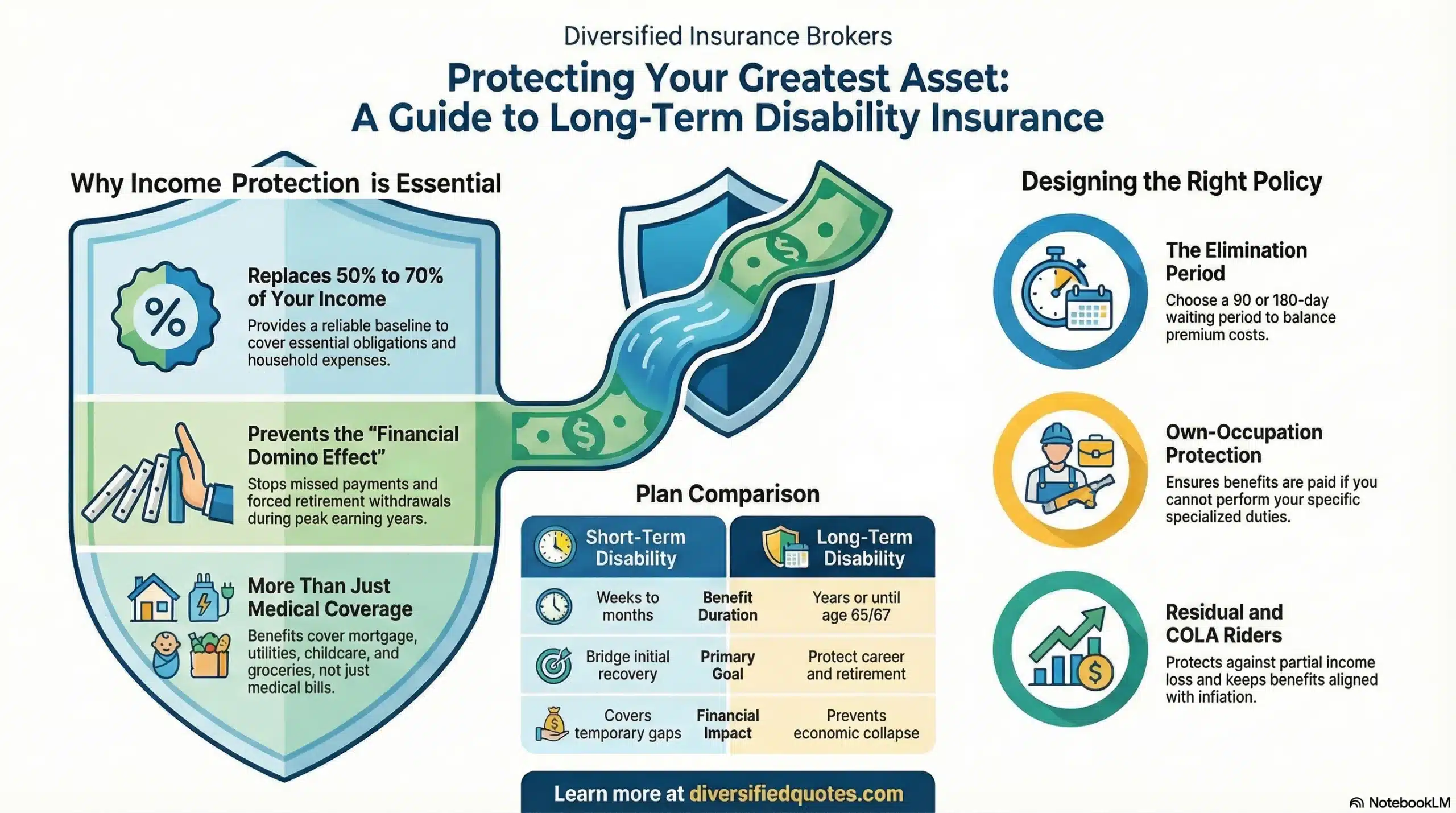
The own-occupation disability definition is not just the most important feature in a veterinary disability policy — it is the feature that determines whether the policy is genuinely useful or merely creates a false sense of security. A DVM who develops carpal tunnel syndrome or a herniated disc may still teach or manage a clinic but would qualify for total benefits under true own-occupation definitions — because the policy insures the practice of veterinary medicine, not employment generally. This distinction is the entire difference between a policy that pays and a policy that fights every claim.
Consider the scenarios most statistically likely to disable a veterinarian: a hand injury from a cat bite that impairs surgical precision; a back injury from patient handling that prevents the physical demands of clinical work; carpal tunnel syndrome from repetitive surgical procedures that limits fine motor function; a progressive hand tremor from neurological conditions; a vision condition that impairs the visual precision required for surgical work; or a mental health condition that prevents the sustained emotional and cognitive engagement that clinical patient care requires. In every one of these scenarios, the disabled veterinarian may retain the ability to perform other employment — teaching, consulting, administrative roles, pharmaceutical work. Under any-occupation language, every one of these claims might be denied. Under true own-occupation language, every one of these claims pays — because veterinary clinical work is what the policy insures, not work in general.
The veterinary ophthalmologist case study illustrates the stakes precisely: a DVM who develops hand function impairment from a hobby-related injury retains all the expertise and knowledge of a specialty veterinarian — but can no longer perform the delicate surgical procedures that generate income. Under own-occupation language, full benefits pay. Under any-occupation or modified own-occupation language, the claim may be denied because the veterinarian could theoretically still teach or consult. The $2,500 to $5,000 difference in premium between a true own-occupation policy and a weaker alternative is irrelevant compared to the difference in claim outcomes for the most likely disability scenarios.
The AVMA Group Plan: What It Provides and Where It Falls Short
The American Veterinary Medical Association Life Trust offers group disability coverage available to AVMA members — and for many veterinarians, particularly those with health conditions that complicate individual underwriting, the AVMA group plan provides accessible base-layer coverage worth having. Understanding what it provides and where it falls short is essential for any DVM using it as part of their disability strategy.
The AVMA plan provides a group long-term disability benefit available without individual medical underwriting at enrollment — accessible regardless of health history, which is genuinely valuable for veterinarians who have accumulated occupational health conditions. However, several structural limitations make it inadequate as a standalone protection plan. The mental health benefit period is capped at 24 months — critically inadequate given the documented mental health disability risk in veterinary medicine. The plan is not portable — it requires continued AVMA membership and would end if the veterinarian changed occupations or allowed membership to lapse. And the plan’s disability definition is the weaker group LTD type that typically shifts from own-occupation to any-occupation after an initial period — not the true own-occupation definition that clinical veterinarians specifically need for the scenarios most likely to affect their careers.
Individual disability insurance with true own-occupation language, unlimited mental health benefit period, and portable non-cancelable terms supplements the AVMA group plan effectively — providing what the group plan lacks while the group plan’s guaranteed issue accessibility makes it useful for base-layer coverage that individual underwriting might not achieve at equivalent terms for veterinarians with complex health histories.
Practice Owners: The Two-Policy Solution
Veterinarians who own practices face the same two-layer disability risk as all owner-operated healthcare businesses: personal income loss and the continuation of fixed business costs that persist regardless of whether the owner can work. A practice owner disabled for four months still owes rent, staff wages, equipment leases, veterinary software subscriptions, professional liability insurance, controlled substance licensing fees, and the dozens of other fixed costs that define a veterinary practice’s operating overhead. The practice’s revenue typically declines — sometimes precipitously — when the primary veterinarian is absent, while the costs do not.
Personal disability insurance replaces the owner’s household income. Business overhead expense (BOE) disability insurance reimburses eligible fixed business costs during the disability period — typically 12 to 24 months — keeping the practice viable and the staff employed while the owner recovers. Without BOE coverage, a disabled practice owner faces the impossible choice of funding the practice from personal disability benefits (consuming household income to pay business overhead) or allowing the practice to deteriorate while protecting personal finances. Neither choice produces a good outcome. Our resource on disability business overhead expense coverage explains the BOE structure and eligible expense categories in detail.
For veterinary practices with multiple owner-veterinarians, buy-sell disability insurance addresses the ownership transition trigger — funding the buyout of a disabled partner’s ownership interest if a disability becomes permanent, preventing the operational and financial conflict that arises when a disabled veterinarian retains ownership rights while unable to contribute to the practice. Our resource on key person disability insurance addresses the revenue protection dimension for practices where the loss of a specific associate veterinarian would cause measurable financial damage beyond that individual’s income.
Veterinary Student Loan Debt and the Cost of Waiting
The average veterinary school borrower graduates with approximately $180,000 in student debt. At a debt-to-income ratio that has improved but still has more than 40% of new graduates above 1.5 — meaning they will need income-driven repayment structures — the student loan obligation is a defining financial constraint for early-career DVMs. It is also, paradoxically, the most compelling argument for purchasing disability insurance as early as possible rather than deferring to a “better financial position” that may never arrive.
A new DVM who becomes disabled in year two of practice has $180,000 in student loans that do not stop accruing, a mortgage or rent that continues, and no income to service either. The disability event that would have been devastating at any career stage is financially catastrophic at this career stage specifically because of the debt load. The same DVM who purchased a disability policy in residency — at the youngest available age, with the strongest available health, at the lowest possible premium — has income replacement that covers loan obligations and living expenses during the disability period without the financial implosion that otherwise results.
The future increase option is particularly valuable for veterinarians in career income growth phases. A new DVM who purchases a $5,000 monthly benefit with a $10,000 future increase option retains the contractual right to grow coverage to $15,000 monthly as income grows — without new medical underwriting regardless of any health changes that occur between graduation and the income growth that follows. A cat bite at year three that impairs hand function does not close the door on future coverage increases if the future increase option was elected at year one. Our resource on the disability insurance future insurability rider explains how these options function and why timing at initial application matters for maximizing lifetime coverage capacity. For context on how disability insurance fits within the broader financial planning picture for indebted early-career professionals, our resource on how much disability insurance you need provides the needs calculation framework.
Guaranteed Standard Issue for Veterinary Residents
Veterinary residents — DVMs in specialty training programs — have access to one of the most valuable disability insurance opportunities available anywhere in the medical professional training world: guaranteed standard issue (GSI) disability policies available at select institutions during residency. These programs allow veterinary residents to obtain individual own-occupation disability coverage without individual medical underwriting, at the most favorable occupational class and policy terms available, at the youngest age and lowest premium that will ever be available to them during their career. No health questions, no paramedical exam, no risk of exclusion riders or rating increases from accumulated health conditions — just standard issue coverage at the strongest available terms.
The opportunity to establish non-cancelable own-occupation disability coverage during residency — before any occupational health conditions develop, before student loan debt stress accumulates additional health impacts, and at the lowest available age-based premium — represents one of the highest-value financial decisions a veterinary resident can make. The coverage established during residency travels through the full career, retaining its original terms and rate regardless of what happens to the veterinarian’s health in the 30 years between residency and retirement. Missing this window because of cost pressure from student loan obligations is a decision with decades of financial consequences.
Build a Disability Strategy That Protects Your Veterinary Career
From new graduates and residents to practice owners, we design income protection that reflects the real risks of veterinary medicine — including physical injury, zoonotic exposure, and mental health.
Compare Disability Options for VeterinariansCall 800-533-5969
Related Disability Insurance Pages
Income protection resources for veterinarians, practice owners, and healthcare professionals in clinical settings.
Financial Protection Essentials
Income protection, business continuity, and life insurance resources for veterinary professionals at every career stage.
Talk With an Advisor Today
Choose how you’d like to connect—call or message us, then book a time that works for you.
Schedule here:
calendly.com/jason-dibcompanies/diversified-quotes
Licensed in all 50 states • Fiduciary, family-owned since 1980
FAQs: Disability Insurance for Veterinarians
How dangerous is veterinary medicine compared to other professions?
Extremely dangerous by documented metrics — far beyond what most people outside the profession appreciate. According to Bureau of Labor Statistics data, veterinary medicine ranks second out of all U.S. industries for nonfatal workplace injuries. In 2024, 11.1 out of 100 veterinary professionals experienced injuries that could interfere with their ability to work — almost five times the national average of 2.3, and second only to professional athletes. According to the CDC, up to two-thirds of veterinarians and 98% of veterinary technicians will be injured by an animal at some point during their careers. The injury risk of veterinary medicine is not theoretical — it is a statistical near-certainty for clinical practitioners across their careers. This documented injury reality is the foundational reason why disability insurance is not optional for clinical veterinarians.
What occupational class do small animal vs. large animal veterinarians receive?
The classification difference between small and large animal practice is significant and directly reflects the different injury risk profiles of the two practice types. Small animal and companion animal veterinarians typically receive Guardian’s 5M classification — among the most favorable available, producing lower premiums and access to the strongest policy provisions. Large animal and equine veterinarians typically receive a 3M classification, reflecting the elevated injury risk from working with animals that can kick, stomp, and crush practitioners with far greater force than companion animals. Mixed practice classifications are carrier-dependent and often reflect the dominant practice type. Zoo, wildlife, and exotic animal practitioners may receive Class 2–3 ratings at some carriers due to the unpredictable behavior of wild animals. Working with an independent broker who can compare multiple carriers’ classification of the specific practice type produces the most favorable available outcome.
Is the AVMA group disability plan enough on its own?
No — the AVMA group plan has structural limitations that make it inadequate as a standalone protection strategy for most clinical veterinarians. Most critically, the AVMA group plan caps mental health and substance abuse benefit payments at 24 months regardless of the length of the disability — a severe limitation given the documented mental health disability risk in veterinary medicine, where disabling conditions frequently require treatment timelines extending well beyond two years. The plan also uses a group LTD disability definition that typically shifts from own-occupation to any-occupation after an initial period — not the true own-occupation definition that clinical veterinarians specifically need. And the plan is not portable, requiring continued AVMA membership. Individual disability insurance with true own-occupation language and unlimited mental health benefit period is the essential complement to the AVMA plan, not a substitute for it.
What are the mental health statistics for veterinarians?
The mental health data for veterinarians is among the most serious in any American healthcare profession. Since graduating veterinary school, 31% of veterinarians in one major survey experienced depressive episodes and 17% experienced suicidal ideation. An AVMA/CDC survey found 1 in 6 veterinarians had considered suicide. Peer-reviewed JAVMA research confirms that veterinarians die by suicide at significantly higher rates than the general population — a finding replicated internationally and across decades of mortality data. The 2023 Merck Animal Health Veterinarian Wellbeing Study found that 1 in 3 veterinary professionals has considered leaving the field due to burnout and poor mental health, with exhaustion identified as the most severe dimension. These statistics make the disability insurance policy’s mental health benefit period — specifically whether benefits are capped at 24 months or continue for the full benefit period — one of the most consequential policy evaluation criteria for veterinarians.
Should I buy disability insurance as a new veterinary graduate with student debt?
Yes — and the student debt is specifically why early purchase is most important, not a reason to defer. The average veterinary graduate carries approximately $180,000 in student loans. A disability event in year two of practice — when debt is at its maximum, savings are minimal, and income replacement is most critical — produces financial catastrophe if there is no income protection in place. Purchasing disability insurance early in a veterinary career locks in the lowest available premium at the best available health, establishes the future increase option that allows coverage to grow with income without new medical underwriting, and ensures that any occupational health conditions that develop in years two through ten do not close the door on comprehensive coverage. The cost of waiting is not just the premium savings foregone — it is the future increase option capacity and the health-based underwriting terms that become unavailable after conditions develop. Our resource on the disability insurance future insurability rider explains why timing matters for career-stage coverage planning.
Do veterinary practice owners need both personal DI and BOE coverage?
Yes — they address completely different financial obligations and are not substitutes for each other. Personal disability insurance replaces the owner’s household income during a disability: the funds covering the mortgage, living expenses, personal financial obligations, and student loan payments. Business overhead expense (BOE) disability insurance reimburses the practice’s fixed operating costs — rent, staff wages, equipment leases, veterinary software, professional liability insurance, licensing fees — that continue regardless of whether the owner can work. Without both, a disabled practice owner must choose between funding personal obligations or keeping the practice operational, and neither choice alone produces a sustainable outcome. For practices with multiple DVM owners, buy-sell disability insurance addresses the ownership transition trigger if a disability becomes permanent. The complete three-policy structure — personal DI, BOE, and buy-sell — is the comprehensive protection framework for veterinary practice owners.
What is a true own-occupation definition and why does it matter for veterinarians?
A true own-occupation definition pays disability benefits when a covered condition prevents the veterinarian from performing the material and substantial duties of their specific occupation — veterinary clinical practice — even if they can still work in another capacity and earn income from a different role. A DVM who develops carpal tunnel syndrome preventing surgical work can still teach, consult, or work in a non-clinical role, but receives full disability benefits under a true own-occupation policy because veterinary clinical practice is what the policy insures. Under any-occupation or modified own-occupation language, the same DVM who could theoretically work in another field might have benefits denied despite a career-ending professional disability. Given the specific physical and cognitive demands of clinical veterinary work — surgical precision, patient restraint, manual examination techniques — conditions that prevent these specific functions while leaving other employment theoretically possible are exactly the disability scenarios veterinarians most commonly face. True own-occupation language is the difference between a policy that pays for these scenarios and one that fights them.
About the Author:
Jason Stolz, CLTC, CRPC, DIA, CAA and Chief Underwriter at Diversified Insurance Brokers (NPN 20471358), is a senior insurance and retirement professional with more than 25 years of real-world experience helping individuals, families, and business owners protect their income, assets, and long-term financial stability. As a long-time partner of the nationally licensed independent agency Diversified Insurance Brokers, Jason provides trusted guidance across multiple specialties—including fixed and indexed annuities, long-term care planning, personal and business disability insurance, life insurance solutions, Group Health, Travel Medical and Evacuation Insurance, and short-term health coverage. Diversified Insurance Brokers maintains active contracts with over 100 highly rated insurance carriers, ensuring clients have access to a broad and competitive marketplace.
His practical, education-first approach has earned recognition in publications such as VoyageATL, and contributions from his agency featured in Kiplinger and GoBankingRates— highlighting his commitment to financial clarity and client-focused planning. Drawing on deep product knowledge and years of hands-on field experience, Jason helps clients evaluate carriers, compare strategies, and build retirement and protection plans that are both secure and cost-efficient. Visitors who want to explore current annuity rates and compare options across multiple insurers can also use this annuity quote and comparison tool.
Explore More Disability Insurance Options: Browse our complete guide to Disability Insurance for Physicians & Medical Specialists — covering physicians, surgeons, anesthesiologists, radiologists, podiatrists & medical specialists from 100+ carriers.
Last Reviewed: May 18, 2026 |
Reviewed by: Jason Stolz, CLTC, CRPC, DIA, CAA
Chief Underwriter, Diversified Insurance Brokers, Inc. | NPN: 20471358 | Diversified Insurance Brokers, Inc. — Licensed in all 50 states
Fact Checked by: Tonia Pettitt, CMIP©
Medicare Specialist, Diversified Insurance Brokers, Inc. | NPN: 14374308 | Diversified Insurance Brokers, Inc. — Licensed in all 50 states
Did you find this content helpful? Leave us a Google review — it helps others find trustworthy guidance too.
Editorial Standards: Diversified Insurance Brokers maintains rigorous editorial standards to ensure accuracy, clarity, and independence in all content. Learn more about our editorial standards and commitment to transparency.
