
Disability Insurance for Medical Residency
As an Independent Disability Insurance Broker, we have access to exclusive discounts and negotiated pricing most captive agents can’t offer — see the full breakdown near the end of this page.
Disability Insurance for Medical Residency

Jason Stolz CLTC, CRPC, DIA, CAA
Medical residency is the single most strategically important window in a physician’s entire financial life to purchase disability insurance — a statement that is simultaneously straightforward to explain and routinely acted on too late. The reasoning is specific and compounding: a resident physician is at the youngest available age for the lowest age-rated premium that will lock in for the career’s entire duration, carries the cleanest health record that will ever exist before the demands of medical training and practice begin producing the health events that complicate underwriting, and is positioned to lock in the future increase option that allows coverage to grow from a resident’s $60,000 to $80,000 annual stipend to an attending physician’s $250,000 to $600,000 or more in income — without ever submitting to new medical underwriting regardless of what health events develop across the career. A peer-reviewed scoping review published in Frontiers in Public Health in 2025 — reviewing 92 studies published between 2021 and 2024 — documents that burnout rates among residents range from 18.3 to 94 percent across studies and depression prevalence ranges from 7.7 to 93 percent in resident populations, establishing that medical training is among the most psychologically demanding professional environments in any discipline. The same peer-reviewed research base documents suicidal ideation rates in resident populations ranging from 5.6 percent to 12.3 percent depending on study population and methodology — research that exists not to stigmatize the profession but to establish that the mental health conditions that are among the most significant contributors to long-term disability claims across all professions are specifically prevalent at elevated rates during the training period when disability insurance is simultaneously most affordable and most completely protective. A resident who purchases disability insurance before any anxiety treatment, depressive episode treatment, or other mental health documentation enters medical records secures comprehensive protection at the cleanest health-based terms available at any point in a physician career — terms that become progressively less available as training and practice produce the medical histories that narrow underwriting options. The early-career income protection decision has never been more financially consequential than for a resident entering practice with $200,000 to $400,000 in medical school debt, a career earnings trajectory that represents the largest financial asset they will ever own, and a training environment that the research documents as producing mental health consequences at rates that exceed virtually any other professional category.
At Diversified Insurance Brokers, Jason Stolz, CLTC, CRPC, DIA, CAA works with medical residents and fellows across every specialty and training program configuration — PGY-1 through PGY-7 residents establishing foundational disability coverage with the future increase option that will track their income growth across a full attending career, subspecialty fellows building on residency-era policies with additional benefit increases, and residents who delayed purchase and are addressing coverage in the final years of training before attending employment begins. The coverage architecture for a first-year internal medicine resident differs from what a PGY-6 neurosurgery fellow needs — but all share the core planning reality that the physician’s occupation-specific disability risk is most completely and most affordably protected by individual disability insurance purchased during training, before practice has produced the health and financial complexity that makes coverage more expensive and less comprehensive. The own-occupation framework for professional income protection reaches its most specialized form in physician disability insurance — where the specific specialty the physician trains in, the specific procedural and cognitive functions that specialty requires, and the specific income premium that specialization creates all need to be reflected in the policy structure.
Start Your Resident Disability Insurance Review
We compare carrier-specific resident programs, GSI availability, own-occupation specialty language, and future increase option structures across the major physician disability carriers to build the policy that serves your training program and career trajectory.
Request Disability Insurance OptionsWhy Residency Is the Optimal Purchase Window — The Four Compounding Advantages
| Advantage | How It Works During Residency | What Waiting Until Attending Costs | Dollar Impact for a Typical Physician |
|---|---|---|---|
| Lowest age-rated premium locked for the career | Physician disability insurance premiums are age-rated at issue and locked for the policy duration on non-cancellable, guaranteed renewable policies — the carrier cannot raise premiums as the physician ages. A PGY-2 resident at 28 locks in a 28-year-old’s premium for the policy running to age 65 or 67 | Every year of delay means a higher locked-in premium for the remaining career. Premium increases of 3–5% or more per year of age are typical at the physician demographic — and that higher premium is paid every year until age 65 | A physician purchasing at 28 vs. 33 may save $800–$1,500+ annually in locked-in premium on a $10,000/month benefit policy — $4,000–$7,500 in cumulative savings in just the first five years, compounding across the remaining career |
| Cleanest health record — no exclusion riders | A resident physician who has completed medical training without documented anxiety treatment, back conditions, hypertension, or other health events can purchase comprehensive disability insurance — full coverage for all disability causes including mental health — without partial exclusion riders limiting coverage for specific conditions | Each health event documented after policy issuance — the anxiety treatment in PGY-3, the back injury in the first attending year, the cardiac event at 45 — would generate a partial exclusion rider if it had occurred before purchase. Exclusion riders cannot be removed after issue | A mental health exclusion rider on a physician’s disability policy eliminates coverage for the disability pathway most statistically prevalent in the research on medical trainees — a structurally significant gap that early purchase prevents |
| Future Increase Option spanning the career income jump | The FIO rider allows the resident to increase monthly benefit each year — from the $3,500/month calibrated to resident stipend income, to $10,000, $15,000, $20,000/month as attending income grows — without new medical underwriting. Guardian’s resident program specifically notes that many physicians see income rise from around $60,000 during residency to $300,000 or more in practice | FIO must be purchased at policy issuance — it cannot be added retroactively. An attending who purchases for the first time at 35 and develops hypertension at 37 is permanently locked at the initial benefit level with no ability to increase without new underwriting that the health history complicates | Sources document that physicians who engage with the FIO cycle consistently reach $20,000 to $30,000 per month in coverage by mid-career — a benefit level that cannot be reached without FIO if any health events have intervened |
| Guaranteed Standard Issue programs — no medical exam | Multiple major physician disability carriers offer Guaranteed Standard Issue programs specifically for medical residents and fellows — policies issued without individual medical underwriting, based only on training program enrollment. GSI programs specifically allow residents to secure coverage that no health condition can complicate, at group-negotiated terms | GSI programs are available only during residency and fellowship training — they are not available to attending physicians. An attending purchasing for the first time must go through individual medical underwriting at their current age and health status, potentially with exclusion riders for health events that occurred during training | A resident with a documented health condition that would normally trigger an exclusion rider can use a GSI program to secure coverage without that exclusion — a benefit that literally cannot be replicated after training ends |
The four advantages compound in a way that makes the residency purchase decision not merely financially optimal but structurally irreversible: the FIO rider, the clean-health comprehensive coverage terms, the GSI program access, and the locked-in age-rated premium are all features that are available at their maximum value during residency and that diminish or close entirely with each passing year of training and practice. Physician and resident financial planning resources consistently document this same conclusion across the specialty physician financial planning community — the residency window is the most valuable available time to purchase disability insurance, and it is the window most commonly missed due to the pressing operational demands of training. Long-term disability income coverage to age 65 or 67 purchased during residency protects the longest available earnings horizon — 35 to 40 years of the physician’s career — at the coverage terms established before practice has introduced any health or underwriting complexity.
The Mental Health Research — What the Data on Resident Physicians Specifically Documents
The peer-reviewed research on resident physician mental health is not anecdotal — it is among the most rigorously studied occupational mental health topics in the medical literature, with findings that have been replicated across training programs, specialties, countries, and research methodologies. A scoping review published in Frontiers in Public Health in 2025 — reviewing 92 studies on physician and resident mental health published between 2021 and 2024 — documents that burnout rates among residents range from 18.3 to 94 percent across studies, and depression prevalence ranges from 7.7 to 93 percent in resident populations. A cross-sectional study of 11,570 family medicine residents found 36.4 percent reported burnout. Research published in European Psychiatry documents an overall prevalence of depressive symptoms of 24.9 percent and suicidal risk of 22.94 percent in a resident sample — with anesthesiology residents showing the highest suicidal risk at 42.2 percent. Research on residency burnout and suicidal ideation documents that working more than 100 hours per week in hospital settings increased suicidal ideation rates from 5.6 to 7.8 percent in a Japanese physician cohort, and that Australian data found 12.3 percent of doctors in training had reported suicidal ideation within the prior twelve months.
The disability insurance planning implication of this research is specific and not ambiguous: the mental health conditions that the peer-reviewed literature documents at elevated prevalence rates in resident physician populations — anxiety disorders, depression, burnout-related psychiatric conditions — are precisely the conditions that generate the mental health exclusion riders that eliminate coverage for the profession’s most specifically documented disability pathway. A resident physician who purchases disability insurance before any mental health treatment is documented secures unlimited mental health coverage that the prior-treatment route cannot replicate. The own-occupation disability standard for a physician specifically encompasses the inability to perform the material and substantial duties of their medical specialty — including the cognitive precision, procedural capacity, and clinical judgment that medical practice requires. A physician whose anxiety disorder or severe depression prevents the sustained cognitive performance and clinical judgment that their specialty requires has experienced a genuine occupational disability from physician practice — one that the own-occupation policy specifically covers, and that a group plan’s 24-month mental health cap would terminate at the worst possible point in a long-term psychiatric recovery. Short-term disability coverage addresses the immediate income gap during an acute mental health crisis before long-term coverage activates. The residual disability benefit addresses partial recovery — a physician returning to limited clinical duties at reduced hours during recovery, with proportional income loss that a residual benefit compensates rather than requiring total disability as the only trigger.
The Own-Occupation Specialty Standard — Why “True Own Specialty” Is the Gold Standard
Physician disability insurance contains a policy language distinction that is more consequential for this profession than for virtually any other: the difference between own-occupation coverage that covers inability to perform the duties of the physician’s specific medical specialty, and coverage that merely covers inability to perform physician work generally. An interventional cardiologist who develops a hand tremor that prevents catheterization procedures but who could theoretically perform general internal medicine has experienced a specialty-specific disability — the career premium of interventional cardiology has been eliminated. A neurosurgeon whose back condition prevents the sustained physical positioning of surgical procedures but who could theoretically provide office-based consultation has lost the surgical specialty income that their entire training created. The AAMC’s own resident disability insurance resources specifically document this distinction: if a surgeon becomes disabled and can no longer operate, with an own-occupation disability definition, the policy covers surgeon’s wages without benefit reduction even if the surgeon could obtain a position in another specialty.
True own-specialty disability coverage — sometimes called “own specialty,” “medical specialty language,” or documented as covering “the specific duties of your medical specialty” in policy language — is the gold standard for physician disability insurance and the specific language that should be confirmed in the policy before any premium commitment is made. Guardian’s physician disability program specifically includes True Own-Occupation language to age 67, including medical specialty language — one example of how the major physician disability carriers have developed policy language responsive to this specific physician career need. A surgical resident whose training produces the fine motor skills and procedural precision that surgical income requires needs policy language that covers the loss of surgical capacity specifically — not merely inability to perform any physician function. A radiologist whose visual disability affects diagnostic imaging work but not all cognitive work needs coverage that encompasses the imaging-specific functions of radiology, not merely generic physician employment capacity. Confirming this specialty-specific own-occupation language explicitly before purchase — not assuming it from general marketing language about “physician disability insurance” — is the most important policy review step for any resident physician selecting coverage. Understanding how short-term and long-term disability structures interact provides the framework for mapping coverage from the first day of a qualifying disability through elimination, into the long-term benefit period, for any physician disability scenario.
The Future Increase Option — The Most Consequential Rider for Resident Physicians
The future increase option is the policy feature that makes residency-era disability insurance purchase specifically superior to waiting until attending income justifies a larger benefit amount — and for physician disability planning, it is not an optional rider consideration but the structural mechanism that allows the policy to serve its purpose across a full physician career. The income jump between residency and attending practice is unlike any other professional income transition: a PGY-3 internal medicine resident earning $65,000 annually who matches into a hospitalist position may see first-year attending income of $275,000 — a 322 percent income increase in a single year. A surgical subspecialty fellow completing training may see income jump from $75,000 to $450,000 in the transition year. Standard disability insurance carrier maximum monthly benefits that are appropriate for attending physician income — $10,000, $15,000, $20,000 per month — are five to ten times what resident stipend income supports at initial policy issuance.
The FIO rider bridges this gap specifically by allowing annual benefit increases — calibrated to documented attending income growth as it occurs — without new medical underwriting. The future increase option specifically designed for physicians’ career income trajectories is the mechanism through which a $3,500/month resident-era policy becomes a $20,000/month comprehensive attending-physician income protection architecture over the first decade of practice — all at the clean underwriting terms locked in during residency, with no new medical examination regardless of what health events occur in between. Sources document that physicians who engage consistently with the FIO cycle through the annual exercise process reach $20,000 to $30,000 per month in coverage by mid-career — a coverage level that represents genuine financial protection for the attending physician’s income but that is structurally unreachable without FIO if any health events have intervened since the original policy was issued. Every major carrier offers some form of this rider under varying names — Future Increase Option, Benefit Purchase Rider, Benefit Update Rider — and there are structurally distinct versions of the rider whose specific terms matter to how the cycle functions over time. Understanding those structural distinctions before selecting a carrier and policy is part of the resident disability insurance review process that an experienced independent broker facilitates. The complete rider landscape for a resident physician policy includes the FIO, the cost of living adjustment rider for permanent disability scenarios, the student loan rider for residents with significant educational debt, and the non-cancellable/guaranteed renewable provisions that prevent the carrier from altering terms or raising premiums after issue.
Group Plans During Residency — What They Provide and What They Leave Open
Most hospital-based residency programs offer group long-term disability coverage as part of the resident benefits package — and this coverage provides a meaningful baseline for residents who need immediate access to any income protection. The Wisconsin Medical Society specifically advises physicians to always enroll for maximum group benefits available. But group LTD plans for residents carry the same structural limitations that affect all group plans — and for physician residents specifically, those limitations are particularly consequential given the career trajectory ahead. The monthly benefit ceiling in typical resident group LTD plans may be adequate for resident stipend income but is wildly inadequate for the attending physician income the resident will generate within a few years. The 24-month own-to-any occupation transition is specifically problematic for a specialty physician whose disability eliminates their specialty practice but who could theoretically perform general medicine. The mental health 24-month cap is specifically inadequate for a profession with documented burnout rates of 36 percent to 94 percent depending on study population. And the coverage is not portable — it ends when the resident moves to fellowship or attending employment, potentially mid-career at a time when health events have complicated new individual underwriting.
The appropriate approach for a resident physician is to enroll in the maximum available group benefits as an immediate income floor — and simultaneously pursue individual disability insurance through one of the major physician disability carriers to secure the own-specialty language, the FIO rider, the clean-health comprehensive terms, and the portable personal policy that follows the physician across all future employment transitions. Guaranteed issue group coverage through the residency program’s group plan is the benefit available today; individually purchased coverage is the investment in career-long income protection that remains in force regardless of how many times the physician changes employers. The cost of living adjustment rider on individually purchased coverage protects real purchasing power across a multi-decade permanent disability scenario — a dimension no group plan adequately addresses for the physician’s career earnings level. Income protection at the physician compensation level requires specific attention to the stacking of group plan benefits and individual benefits within aggregate income replacement limits — understanding how the two interact ensures the individual policy is sized to address the gap without over-insuring beyond carrier guidelines. High-income physician disability insurance structures cover how layering across multiple carriers produces the total monthly benefit that serving an attending physician’s income requires once the FIO cycle has built coverage to the appropriate attending-income level.
Student Loan Debt, Policy Design, and Planning for Resident Physicians
The medical education debt dimension adds specific urgency to the resident disability insurance decision that no other professional group carries to the same degree. A physician entering residency with $250,000 to $400,000 in medical school debt is simultaneously at the most financially vulnerable point of their career — the highest debt balance, the lowest income, the most constrained cash flow — and at the optimal window to make the most valuable long-term income protection decision of that career. The student loan rider available on most major physician disability insurance policies adds a specific monthly benefit earmarked for student loan payments during a qualifying disability period — providing income protection for the loan service obligation that continues regardless of whether physician practice income is being earned. The AAMC’s own disability insurance resource for students and residents specifically documents the student loan rider as an available option that residents should discuss with their insurance consultant.
Resident physicians receive favorable occupational class assignments from most major physician disability carriers — reflecting the physician’s professional training and the primarily cognitive and clinical character of physician work, even during training. How much disability coverage a resident physician actually needs at initial purchase is sized to stipend income — the maximum benefit supportable by documented training compensation — with the FIO rider in place for the full benefit build-out as attending income grows. The elimination period for most resident policies is 90 days, coordinated with group plan benefits where available. Coverage for residents with prior health histories from undergraduate or medical school is available through individual underwriting — though GSI programs provide an alternative path for residents whose individual underwriting would produce unfavorable terms. Modified options address residents whose health histories create standard underwriting complexity. No-exam disability coverage through GSI programs is the primary access point for most residents, providing the cleanest and fastest path to comprehensive coverage without individual medical examination. Getting the best available rates as a resident means accessing the carrier discount programs specifically offered to residents — some carriers offer 20 percent or more discount for applications during training years — through an independent broker who represents the full physician disability carrier market. Residents who train at programs with established carrier relationships may have access to even more favorable GSI terms than those available through individual application. Self-employment disability planning for residents who moonlight or generate 1099 income during training requires specific income documentation attention alongside the primary stipend-based policy. Independent contractor coverage for physicians who eventually move to private group practice or establish their own practices adds the business overhead expense dimension to the attending-phase planning that succeeds the resident-era foundation policy. Why resident physicians ultimately act is answered by every dimension of the financial planning picture: the student loan debt that disability income must service, the career income trajectory that FIO must track, the mental health risks the research documents, and the cleanest available underwriting window that closes with each year of additional training. Whether disability insurance during residency is worth the cost is answered by recognizing what is being protected: the highest-value career earnings asset in the professional economy, at the lowest available cost that will ever exist to protect it, from the disability risk that the research specifically documents as elevated precisely during the training period when protection is being established. Whether disability benefits are taxable for a resident: personally purchased individual disability insurance paid with after-tax income produces tax-free disability benefits — the full monthly benefit reaches the resident without income tax reduction. A second opinion on any resident disability insurance proposal confirms whether the true own-specialty language, the FIO structure, the mental health benefit terms, and the GSI vs. individual underwriting pathway are all optimized before any premium commitment is made.
Get Your Resident Disability Insurance Review
We compare carrier-specific GSI programs, true own-specialty language, future increase option structures, and resident discount programs to build the policy that protects your training investment and career income trajectory.
Request Disability Insurance Options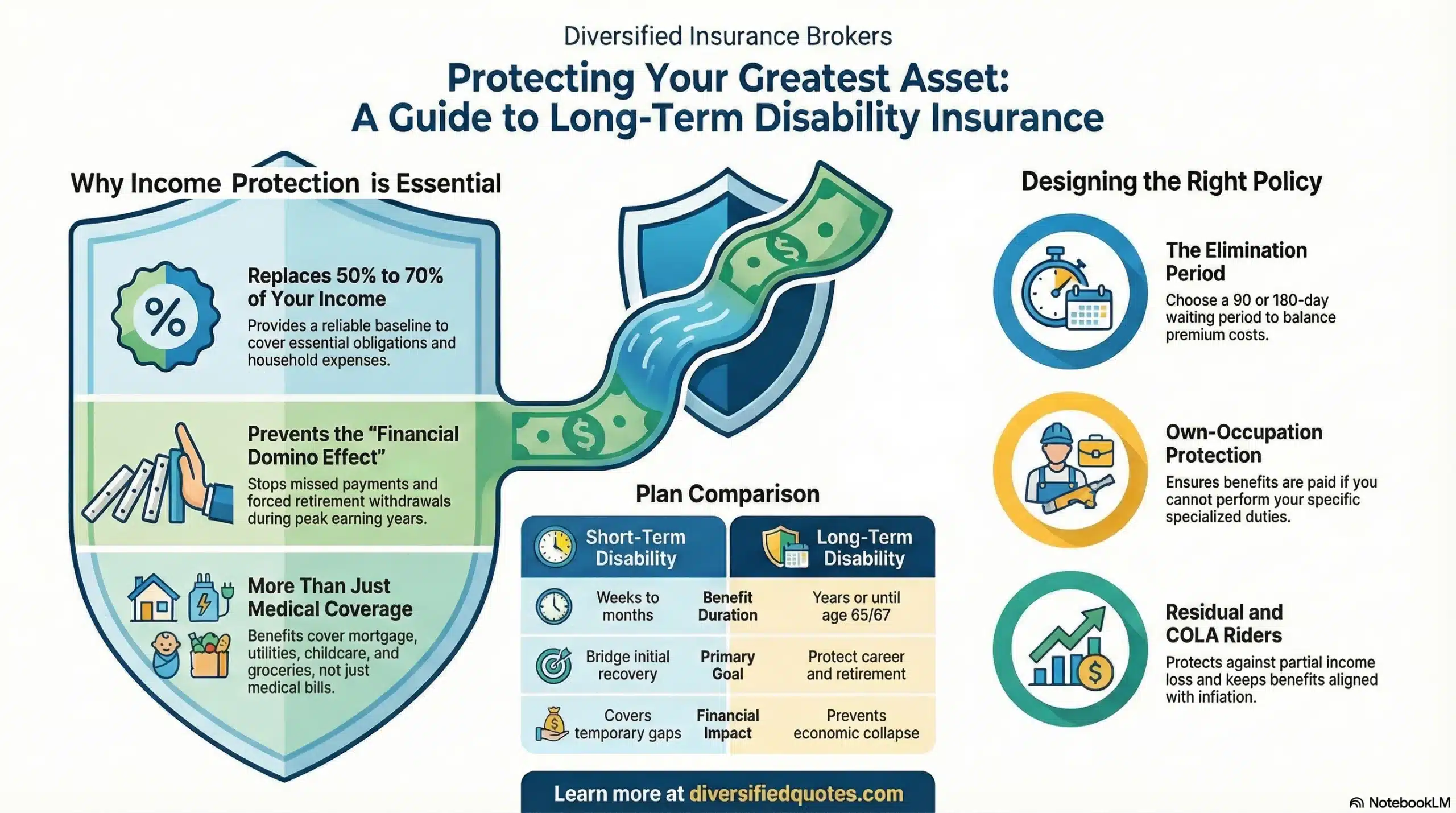
Talk With an Advisor Today
Choose how you’d like to connect—call or message us, then book a time that works for you.
Schedule here:
calendly.com/jason-dibcompanies/diversified-quotes
Licensed in all 50 states • Fiduciary, family-owned since 1980
FAQs: Disability Insurance for Medical Residency
I’m a first-year resident — do I really need disability insurance now on a resident’s salary?
The resident salary is the reason to buy disability insurance during residency — not a reason to wait. The policy purchased during residency is not primarily sized to protect the resident stipend; it is sized to the stipend income today, with the future increase option in place that allows it to grow to $10,000, $15,000, or $20,000 per month as attending income develops — all at the underwriting terms locked in during residency. The benefit of buying during residency is not what the policy pays if disability strikes today; it is the permanent advantage locked in today that cannot be replicated at any future point: the age-rated premium, the clean-health comprehensive terms, the FIO rider positioned to track the entire attending income trajectory, and the GSI program access that closes when training ends.
Consider what waiting until first attending employment actually costs: a resident who completes PGY-4 training and starts as an attending at 32 versus purchasing at 28 during PGY-1 has paid four additional years of age-rated premium growth on the future policy, lost four years during which any health event — anxiety treatment, back condition, hypertension — could have generated exclusion riders on the policy that would have been issued clean at 28, and lost the GSI program access that would have eliminated medical underwriting entirely. The resident stipend purchase at $3,500/month for $150–$200 per month in premium is not about the $3,500/month — it is about positioning the FIO rider to protect the $25,000/month attending income that decade of training is designed to produce. Why purchasing early is the highest-return financial protection decision is answered by every dimension of the physician financial planning picture.
My residency program has group LTD — why do I need individual coverage on top of it?
The group LTD provided through the residency program is a benefit worth enrolling in — the Wisconsin Medical Society and most physician financial planning resources specifically advise residents to enroll for maximum available group benefits. But the group plan creates the immediate income floor today, not the career-long protection architecture that the individual policy builds. Four structural limitations make the group plan inadequate as the sole physician disability protection, and all four are specifically consequential for physician careers.
First: portability. The group plan ends when residency ends — when the resident moves to fellowship at another institution, transitions to attending employment, or changes employers at any point in the career. An individual policy purchased during residency remains in force through every future employment change. Second: benefit ceiling. The group plan caps at a level appropriate for resident income but structurally inadequate for attending physician compensation — and the ceiling cannot grow with income the way the individual policy’s FIO rider does. Third: the 24-month own-to-any occupation definition transition. The group plan may terminate benefits for a specialist who cannot perform their specialty functions but could theoretically perform general physician work — eliminating coverage precisely when a long-term disability has proven itself career-altering. Fourth: the 24-month mental health benefit cap — structurally inadequate for a profession where the research documents burnout rates of 36 to 94 percent in resident populations. The individual policy fills all four gaps simultaneously, runs for the full career, and grows with income through the FIO cycle — making it the essential complement to, not the replacement of, group plan benefits during residency. A second opinion specifically mapping your group plan’s terms against these four gaps quantifies the specific supplemental coverage needed.
What is a Guaranteed Standard Issue program and am I eligible for one?
Guaranteed Standard Issue programs are disability insurance policies specifically designed for medical residents and fellows that are issued without individual medical underwriting — no paramedical exam, no blood work, no review of medical records beyond basic eligibility confirmation. Eligibility is based on enrollment in a qualifying residency or fellowship training program rather than on individual health status. The policy terms — including own-specialty language and the future increase option — are established at group-negotiated standards, and the coverage is issued at those terms regardless of any health conditions the resident has developed during undergraduate education or medical school.
GSI programs are available from most major physician disability carriers — Guardian, Principal, MassMutual, Ameritas, and others each offer resident-specific programs with varying terms and features. The benefit amount available through a GSI program is calibrated to documented training compensation and is typically in the range of $3,000 to $5,000 per month for a standard residency stipend level. The GSI program access is time-limited: it is available during residency and fellowship training and closes when training ends. A resident with a health history that would normally generate an exclusion rider — a prior anxiety treatment episode, a managed chronic condition — can use a GSI program to secure coverage at standard terms that individual underwriting would have modified. This GSI access is among the most financially valuable features of the residency purchase window and one of the most significant arguments against waiting until fellowship completion or attending employment. No-exam disability coverage specifically through GSI programs provides the fastest and most comprehensive access path for resident physicians regardless of health history.
Are disability insurance benefits taxable for a resident physician?
For resident physicians who purchase individual disability insurance personally and pay premiums with after-tax personal income, monthly disability benefits received during a qualifying disability are generally received income-tax-free. The full benefit amount reaches the resident without income tax reduction — a significant planning factor at resident stipend income levels where every dollar of benefit matters against the household’s financial obligations and student loan service requirements. Understanding the full tax treatment of disability insurance benefits affects both benefit sizing and how the policy is purchased.
For the group LTD coverage provided through the residency program where the hospital employer pays the premiums, resulting disability benefits are typically taxable as ordinary income — reducing the effective replacement rate below the plan’s stated percentage. A group plan stating 60 percent income replacement may deliver closer to 45 percent of actual take-home resident stipend after income taxes, which matters when that benefit needs to service student loan obligations and cover household expenses during a disability period. The combination of a taxable group plan benefit and a tax-free individually purchased individual policy produces a more financially efficient total protection architecture than either policy alone — with the tax-free individual benefit providing dollar-for-dollar real purchasing power rather than a pre-tax benefit that taxes erode. As income grows through the FIO cycle to attending physician levels, the tax-free character of the individually purchased portion becomes increasingly valuable at the physician’s higher marginal tax rates — making the premium paid during residency for the policy’s tax-free benefit structure an investment that appreciates in relative value as the career progresses.
I’ve been treated for anxiety or depression during training — can I still get disability insurance?
Yes — and for resident physicians specifically, the GSI program path may be the most appropriate approach if individual underwriting would produce mental health exclusion riders for documented treatment. GSI programs issue coverage without individual health underwriting, making the documented anxiety or depression treatment history irrelevant to coverage eligibility and terms under the GSI program structure. This is one of the most practically important features of GSI access for resident physicians: the population with the highest documented rates of mental health treatment — residents, particularly those in high-intensity specialties — is also the population for whom GSI access provides the most specific protection against the exclusion rider risk that individual underwriting creates.
For residents who prefer or require individual underwriting rather than GSI — including those at programs without established GSI relationships, or those seeking higher benefit amounts than GSI programs offer — the underwriting outcome for most documented anxiety or depression treatment that is currently stable is a partial mental health exclusion rider for the specific documented condition, providing full coverage for all other disability causes while limiting coverage specifically attributable to the documented prior mental health condition. Coverage for physicians with prior mental health treatment histories through individual underwriting is available through independent broker comparison across carriers whose guidelines for resident mental health histories vary. Carrier guidelines differ enough that a documented treatment history generating a broad mental health exclusion at one carrier may receive a narrower, condition-specific exclusion at another — making independent broker comparison across the full physician disability carrier market the most effective approach for the best available terms.
I’m a surgical resident — does the own-occupation definition specifically cover my surgical specialty?
It depends entirely on the specific policy language — and for surgical residents specifically, confirming this before purchase is the most important due diligence step. True own-specialty disability coverage for a surgeon covers the inability to perform surgical procedures specifically — including the fine motor precision, physical positioning endurance, and procedural capacity that surgery requires — regardless of whether the surgeon could theoretically perform non-surgical physician work. The AAMC’s own documentation of this distinction is clear: if a surgeon becomes disabled and can no longer operate, with an own-occupation disability definition, the policy covers surgeon’s wages without benefit reduction even if the surgeon could obtain a position in another specialty.
Not all policies marketed as “own-occupation physician disability insurance” contain this surgical-specialty-specific language. Some policies use own-occupation language that covers inability to perform physician work generally rather than inability to perform the specific surgical specialty — a distinction that may result in benefit denial for a surgeon who cannot operate but who could perform non-surgical medical work. Confirming that the specific policy language encompasses the surgical procedures, fine motor precision demands, and procedural physical requirements of the surgical specialty — in the actual policy language, not in marketing materials — is the essential review step before any surgical resident purchases a disability policy. Guardian’s documentation of “True Own-Occupation to age 67, including medical specialty language” is one example of how major carriers have developed specialty-specific language; other carriers have equivalent provisions under different terminology. Working with an independent broker who specifically reviews the own-specialty language across the physician disability carrier market for each resident’s specific surgical specialty is how this confirmation is performed most efficiently and reliably before any premium commitment.
About the Author:
Jason Stolz, CLTC, CRPC, DIA, CAA and Chief Underwriter at Diversified Insurance Brokers (NPN 20471358), is a senior insurance and retirement professional with more than 25 years of real-world experience helping individuals, families, and business owners protect their income, assets, and long-term financial stability. As a long-time partner of the nationally licensed independent agency Diversified Insurance Brokers, Jason provides trusted guidance across multiple specialties—including fixed and indexed annuities, long-term care planning, personal and business disability insurance, life insurance solutions, Group Health, Travel Medical and Evacuation Insurance, and short-term health coverage. Diversified Insurance Brokers maintains active contracts with over 100 highly rated insurance carriers, ensuring clients have access to a broad and competitive marketplace.
His practical, education-first approach has earned recognition in publications such as VoyageATL, and contributions from his agency featured in Kiplinger and GoBankingRates— highlighting his commitment to financial clarity and client-focused planning. Drawing on deep product knowledge and years of hands-on field experience, Jason helps clients evaluate carriers, compare strategies, and build retirement and protection plans that are both secure and cost-efficient. Visitors who want to explore current annuity rates and compare options across multiple insurers can also use this annuity quote and comparison tool.
Explore More Disability Insurance Options: Browse our complete guide to Disability Insurance for Physicians & Medical Specialists — covering physicians, surgeons, anesthesiologists, radiologists, podiatrists & medical specialists from 100+ carriers.
Last Reviewed: June 8, 2026 |
Reviewed by: Jason Stolz, CLTC, CRPC, DIA, CAA
Chief Underwriter, Diversified Insurance Brokers, Inc. | NPN: 20471358 | Diversified Insurance Brokers, Inc. — Licensed in all 50 states
Fact Checked by: Tonia Pettitt, CMIP©
Medicare Specialist, Diversified Insurance Brokers, Inc. | NPN: 14374308 | Diversified Insurance Brokers, Inc. — Licensed in all 50 states
Did you find this content helpful? Leave us a Google review — it helps others find trustworthy guidance too.
Editorial Standards: Diversified Insurance Brokers maintains rigorous editorial standards to ensure accuracy, clarity, and independence in all content. Learn more about our editorial standards and commitment to transparency.
