
Disability Income Insurance for Law Enforcement
As an Independent Disability Insurance Broker, we have access to exclusive discounts and negotiated pricing most captive agents can’t offer — see the full breakdown near the end of this page.
Disability Income Insurance for Law Enforcement

Jason Stolz CLTC, CRPC, DIA, CAA
Disability income insurance for law enforcement officers is not a generic income protection product with a badge logo applied to the marketing. It is a specifically structured coverage strategy built around the reality that law enforcement is physically demanding, psychologically taxing, compensated in ways that standard policy language often misses, and subject to duty-related disability scenarios that generic policies handle poorly. The disability risk for a sworn officer is real and statistically significant. Research cited by the National Police Foundation and others suggests that approximately 19% of the nation’s approximately 900,000 sworn officers may have post-traumatic stress disorder, with an additional 34% experiencing PTSD symptoms that fall short of full clinical criteria. Musculoskeletal injuries from physical confrontations, vehicle incidents, and the cumulative strain of wearing a duty belt and conducting on-foot activities for full shifts are the most common drivers of long-term disability claims in law enforcement. Cardiovascular conditions — elevated in public safety populations due to shift work, irregular sleep, and stress physiology — represent another significant claim category. The income protection question for an officer is not whether disability risk is real. It is whether the coverage in place actually addresses that risk when the moment arrives.
The answer for most officers is that the coverage in place has meaningful gaps. Employer-provided group long-term disability plans, where they exist, frequently cap benefits at a monthly amount that reflects only base salary — leaving overtime pay, shift differentials, special duty income, and court appearance pay entirely unprotected. The definition of disability in most group LTD plans is favorable during the first years of a claim, but many contracts shift to an “any occupation” definition after 24 months, meaning the carrier can reduce or terminate benefits if the officer could theoretically work in any capacity — even if that capacity doesn’t reflect their career, their earnings, or their training. The Public Safety Officers’ Benefits (PSOB) program provides federal death and disability benefits for officers injured in the line of duty, but those benefits are specific to qualifying events, require administrative processing through the Bureau of Justice Assistance, and represent only one piece of the income protection picture. Workers’ compensation, where it applies, typically replaces approximately two-thirds of base wages — not full compensation, and not inclusive of supplemental income sources. For officers whose household cash flow depends on the full picture of their compensation, this combination of partial protections leaves a gap that private individual disability insurance is specifically designed to fill.
Building the right disability coverage strategy for a law enforcement officer requires understanding the occupational classification environment, the underwriting criteria carriers apply to physical and mental health risks common in public safety, how to correctly document and include all compensation sources in the coverage design, and which policy features matter most in realistic claim scenarios. The disability insurance services overview covers the foundational disability insurance framework, and our guide on is disability insurance worth it covers the broader income protection case that applies with particular force to any occupation where physical capacity is integral to the job and the income risk of losing that capacity is immediate and substantial.
Request a Disability Income Quote for Law Enforcement
Compare coverage built for police officers, deputies, corrections staff, and public safety professionals. Confidential, nationwide, no obligation.
Request a QuoteThe Unique Disability Landscape for Law Enforcement Officers
Law enforcement occupies a specific position in the disability insurance market that makes it both a high-need and a carefully underwritten occupation category. Carriers who write disability insurance for law enforcement understand the elevated claim probability relative to office-based occupations — they are not ignoring the physical risk profile. The challenge for officers seeking coverage is matching their specific risk profile to the carriers whose underwriting philosophy treats their occupation most favorably, and whose policy language protects the right income in the right scenarios. Not all carriers who will write disability insurance for law enforcement apply the same definitions, occupation class assignments, or claim evaluation standards. Working with an independent broker who specializes in high-risk occupational disability is typically the most effective path to placement at favorable terms. Our resource on disability insurance for high-risk occupations covers this landscape broadly, and this page covers the law enforcement-specific dimensions in detail.
The occupational disability risk for sworn officers encompasses both the “sudden incident” type of disability most officers think about — a duty injury from a physical confrontation, vehicle accident, firearms training incident, or line-of-duty assault — and the “gradual accumulation” type that creates more claims in the aggregate. Chronic back conditions from years of driving patrol vehicles, wearing a duty belt, and physical restraint activities gradually reduce capacity until a medical event or physician restriction removes the ability to perform law enforcement duties entirely. Repetitive strain injuries, progressive musculoskeletal conditions, and cumulative joint damage often develop over multi-year timelines and result in medical retirement at ages well before traditional retirement eligibility. Officers who plan their financial security around reaching a pension threshold at a certain age need to account for the statistical reality that disability may interrupt that plan before the threshold is reached. Individual disability insurance is the instrument that protects the financial plan against that interruption.
Physical Injury Risks — The Most Common Claim Drivers
The leading categories of physical disability for law enforcement officers align with the physical demands of the occupation: musculoskeletal conditions are the most common, followed by cardiovascular events, traumatic injuries from duty incidents, and conditions that create permanent functional restrictions preventing return to full law enforcement duty. Musculoskeletal conditions — back and lumbar injuries, disc problems, knee injuries from foot pursuits and physical confrontations, shoulder injuries from restraint activities and vehicle operations, and chronic pain from accumulated physical strain — generate a large share of public safety disability claims because they progressively limit physical capacity in ways that directly prevent performing the material duties of a patrol officer or similarly physically active law enforcement role.
Cardiovascular risk is elevated in law enforcement populations due to the combination of shift work disrupting sleep architecture, stress physiology from acute threat response, and irregular meal timing that affects metabolic health. Research published in peer-reviewed public health literature has found that law enforcement officers have higher rates of cardiovascular disease compared to the general population. Heart attacks, strokes, hypertension-related events, and cardiac conditions that create permanent exertion limitations are realistic disability scenarios for officers in their 40s and 50s who have spent careers in high-stress public safety environments. A cardiovascular event that restricts maximal physical exertion may not prevent desk work but may prevent the physical requirements of law enforcement duty — creating precisely the disability scenario that own-occupation disability insurance is designed to cover and that any-occupation definitions may deny.
Mental Health and PTSD — The Most Under-Protected Disability Risk in Law Enforcement
Mental health disability — specifically post-traumatic stress disorder, major depressive disorder, and cumulative occupational trauma — represents a significant and growing category of law enforcement disability that is systematically under-protected by most existing coverage structures. Research suggests approximately 19% of the nation’s sworn officers may meet clinical criteria for PTSD, with an additional large fraction experiencing significant PTSD-related symptoms. A 2025 first responder mental health assessment commissioned by the state of New York found that 46.7% of first responders reported working while sick or injured specifically to avoid using sick leave for mental health reasons — a clear indicator of the disconnect between the scale of psychological injury in public safety and the willingness or ability of officers to access protective benefits for those injuries.
The coverage problem for mental health disability in law enforcement is threefold. First, many group LTD policies include a limitation on mental health or nervous system claims — typically limiting benefits from those conditions to 24 months rather than the plan’s full benefit period. An officer disabled by PTSD under such a plan receives only two years of benefits rather than the extended income protection available for physical disability. Second, workers’ compensation coverage for psychological injury varies dramatically by state — some states have enacted PTSD presumption laws that make occupational PTSD compensable for law enforcement, while other states have restrictive criteria that create coverage gaps. Multiple states enacted or expanded PTSD presumption legislation in 2024 and 2025, reflecting a growing recognition of this gap, but state coverage still varies widely and may be contested in individual cases. Third, individual disability insurance policies also vary in their treatment of mental health claims — some policies apply the same 24-month limitation seen in group plans, while others provide more comprehensive coverage for psychiatric disability. Understanding exactly how any policy you’re evaluating treats mental health claims is a critical pre-purchase evaluation step that determines whether the policy protects a realistic disability scenario for law enforcement.
Group LTD vs. Individual Disability Insurance — Where the Gaps Show Up
The disability protection gap for most law enforcement officers is not the absence of coverage — it is the combination of multiple partial protections that each cover different pieces of the income risk without any of them covering the full picture. Understanding where each coverage source ends and where the gap begins is the starting point for designing a supplemental individual disability strategy that addresses the actual exposure without duplicating coverage that already exists.
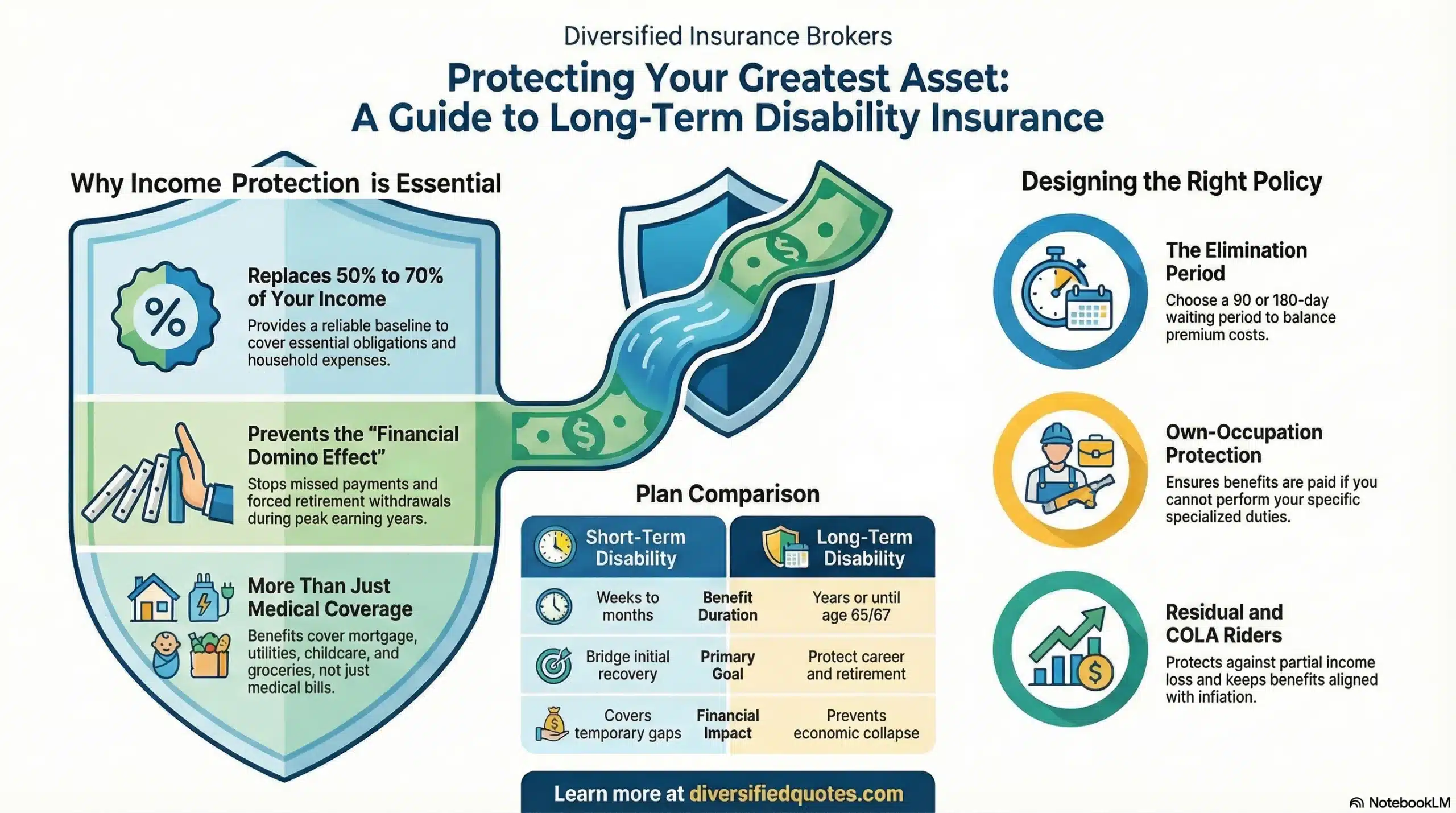
The coverage features comparison below captures how standard group LTD — the most common existing protection for officers in departments with employer-provided benefits — typically differs from well-structured individual disability insurance across the dimensions that determine real-world claim outcomes.
| Coverage Feature | Typical Group LTD | Well-Structured Individual DI |
|---|---|---|
| Income Base | Often base salary only; overtime and special pay excluded | Can include total documented compensation including consistent overtime |
| Disability Definition (after 24 months) | Typically shifts to any-occupation — can deny if any work is possible | Own-occupation available — pays if officer can’t perform law enforcement duties |
| Portability | Ends when employment ends; may not follow department changes | Owned by officer — portable across departments, states, career changes |
| Mental Health Benefit Duration | Often limited to 24 months | Varies by policy — some provide longer or equal duration to physical disability |
| Tax Treatment of Benefits | Taxable if employer-paid premiums | Tax-free if personally paid after-tax premiums |
| Residual / Partial Disability | Limited or not available in most group plans | Available in quality individual policies — protects income during restricted duty |
| Premium Stability | Employer can modify plan or reduce benefits | Non-cancelable and guaranteed renewable provisions available |
| Future Increase Options | Limited by group plan structure | Future increase riders available — add coverage as income grows without re-underwriting |
Group plan features vary significantly by employer, plan design, and state. Review your department’s actual plan documents before evaluating how much supplemental individual coverage is needed. Our how much disability insurance cost guide covers the income replacement calculation framework that applies to evaluating total coverage across all sources.
Own-Occupation Coverage — Why the Definition Determines Real-World Outcomes
The disability definition in an insurance policy is not contract boilerplate — it is the core mechanism that determines whether a specific health event qualifies for benefits and for how long. For law enforcement officers, the definition of disability matters in an especially consequential way because the physical and cognitive requirements of sworn law enforcement duty are specific: the ability to qualify on firearms, to physically restrain subjects, to pursue on foot, to operate emergency vehicles under stress, to wear a duty belt and carry equipment, and to work rotating schedules that require sustained physical capacity. An officer who can sit at a desk but cannot perform these duties cannot return to law enforcement — and should receive disability benefits that reflect that reality.
Own-occupation disability coverage is designed to pay benefits when the insured cannot perform the material and substantial duties of their specific occupation, even if they could theoretically work in some other capacity. For a patrol officer, “own occupation” means law enforcement officer specifically — not simply “any job that exists in the economy.” The practical difference is enormous. An officer with a back condition that prevents physical confrontation, sustained vehicle operation, and firearms qualification could be denied benefits under an any-occupation standard because they are “able to work” as an office clerk or customer service representative. Under an own-occupation standard, that same officer would receive benefits because they cannot perform law enforcement duties. Our dedicated resource on own-occupation disability insurance covers this distinction in full technical detail for officers evaluating which definition to seek in a policy.
Protecting Overtime, Special Duty, and Total Compensation
The income protection gap in law enforcement disability coverage often has less to do with the disability definition and more to do with the income base the policy is built on. An officer earning $95,000 per year in total compensation — $70,000 in base salary plus $25,000 in overtime, special duty, court pay, and shift differentials — who has group LTD coverage based on base salary only has protected $70,000 of their income and left $25,000 entirely unprotected. If disability occurs, the household loses not only the overtime income but may also lose the base salary income above the group plan’s monthly cap. The result is a significant cash flow reduction even with ostensibly “good” employer coverage in place.
Individual disability insurance can be sized to protect a portion of total compensation, including documented consistent overtime and special duty pay, up to carrier-specific maximum benefit amounts that are typically expressed as a percentage of total gross income. Carriers evaluate income documentation — typically W-2s, tax returns, and pay stubs — to determine the income base eligible for coverage. Establishing the income base correctly, including all sustainable compensation sources, is a critical step in designing coverage that actually replaces the household’s operating cash flow rather than only a fraction of it. Our guide on how much disability insurance costs covers how benefit amount selection affects premium, and our resource on is disability insurance expensive provides the cost framing for evaluating premium relative to the income risk being protected.
Residual and Partial Disability Benefits — For Officers Returned to Light Duty
One of the most practically important policy features for law enforcement is residual or partial disability coverage — the provision that pays benefits when a disability reduces income without eliminating work capacity entirely. Light duty assignments represent a common disability scenario in law enforcement: an officer injured on duty is returned to a restricted desk assignment, loses eligibility for overtime and special duty pay, receives reduced income, and may continue in that limited capacity for months or years before either recovering to full duty or progressing to medical retirement. Without a residual disability benefit, the group LTD plan that requires total inability to work would pay nothing during the light duty period — even though the officer’s household income is substantially reduced.
A well-structured residual benefit in an individual disability policy addresses this gap by paying a proportional benefit based on the income reduction experienced during the partial disability period. If an officer’s income drops by 40% due to restricted duty, a strong residual benefit pays approximately 40% of the policy’s maximum benefit — protecting the household against the income reduction without requiring total inability to work. This feature is particularly valuable in the law enforcement context because department cultures often pressure injured officers back to work in some capacity before they are fully recovered, and because the administrative determinations around “duty status” may not align with the financial reality of what the officer’s household actually loses during recovery. Our resource on long-term disability insurance covers benefit design including partial disability provisions.
Tax Treatment — Why It Changes the Coverage Strategy
The tax treatment of disability insurance benefits is determined by how premiums are paid. When an employer pays group LTD premiums, the resulting benefits are generally taxable as ordinary income to the officer during a claim — meaning the stated benefit replacement percentage on the group plan overstates the actual after-tax income the officer receives. An officer whose group plan states 60% income replacement from a taxable employer-paid plan receives substantially less than 60% of their pre-disability take-home pay after income taxes on the benefit. When an officer pays individual disability insurance premiums personally using after-tax dollars, the resulting benefits are generally income-tax-free — meaning a 60% benefit from a personally paid policy produces a meaningfully higher effective replacement percentage than the same stated benefit from a taxable employer plan.
This tax differential changes the coverage strategy in a practical way. For many officers, the right design is a layered approach that coordinates the taxable group LTD benefit with a personally paid individual policy structured so the combined after-tax income replacement approaches the household’s actual operating needs. This layering often requires the individual policy to be sized below the group plan’s amount to avoid stacking benefits beyond the carrier’s aggregate income replacement limits — and it requires modeling the after-tax math rather than simply adding stated benefit amounts. Our disability services team handles this calculation as part of the coverage design process for every officer we work with, ensuring the final structure protects take-home pay rather than just nominal benefit amounts.
Key Policy Features That Matter Most for Law Enforcement
Several specific policy features deserve particular attention when evaluating disability insurance for sworn officers. Non-cancelable and guaranteed renewable provisions — in their strongest form — protect both the right to renew the policy without carrier approval and the right to pay the same premium established at issue for the life of the policy. For officers who buy coverage early in their careers and intend to hold the policy through potential health changes over 20 or 30 years, this stability matters considerably. Our guide on disability insurance elimination periods explained covers how the waiting period between disability onset and first benefit payment should be coordinated with the officer’s available sick leave, injury leave, and workers’ compensation payments — because the right elimination period is the one that starts paying when the officer’s other income sources run out, not before and not significantly after.
Future increase options — riders that allow the officer to increase coverage as income grows without additional medical underwriting — are particularly valuable for officers in the middle of their careers, where promotional opportunities, specialty assignments, and step increases may significantly raise total compensation over the next 10 to 15 years. Locking in an individual DI policy with a future increase option early preserves the ability to add coverage later regardless of what happens to health status in the intervening years. An officer who develops a back condition at 38 may find that adding new disability coverage at 45 is difficult or impossible to do at favorable terms — but if a future increase rider was purchased at 32, they can add coverage at that older, potentially less insurable age without new underwriting. Our resource on the guaranteed issue group disability insurance option covers cases where individual underwriting has become difficult and group or association approaches may be an alternative path.
Workers’ Compensation and Public Safety Benefits — What They Cover and Don’t
Workers’ compensation is the primary employer-sponsored income protection for work-related injuries in law enforcement, but it has significant limitations as a standalone disability protection strategy. Workers’ comp covers injuries and illnesses that are work-related — it does not cover non-occupational disabilities, illnesses that develop gradually without a clear work nexus, or conditions that arise from off-duty incidents. The income replacement under most states’ workers’ comp systems is approximately two-thirds of regular wages, subject to state-specific caps, and the definition of “wages” typically does not include overtime pay, special duty income, or other supplemental compensation. California’s Labor Code Section 4850 provides more generous protections for law enforcement officers — full salary continuation for up to one year for line-of-duty injuries — but this is state-specific and does not apply in most jurisdictions. Many states have enacted PTSD presumption laws that make occupational PTSD compensable under workers’ comp for law enforcement, but these vary widely in scope and evidentiary requirements, and are subject to administrative review processes that may delay or deny benefits in specific cases.
The Public Safety Officers’ Benefits (PSOB) program provides federal death and disability benefits for officers disabled in the line of duty in qualifying circumstances. The program was expanded by the Public Safety Officers’ Support Act of 2022 to include trauma and stress disorders, and the National Defense Authorization Act for Fiscal Year 2026 further extended eligibility provisions. PSOB benefits are meaningful but are limited to qualifying line-of-duty incidents and require application through the Bureau of Justice Assistance. They are not available for off-duty disability, gradual-onset occupational conditions, or disabilities that don’t meet the statutory line-of-duty criteria. Individual disability insurance fills all the gaps that workers’ comp, PSOB, and group LTD leave open — providing protection regardless of whether the disability is work-related, covering off-duty incidents and gradual-onset conditions, protecting total compensation rather than just base wages, and providing benefits that are not subject to contested administrative determinations.
Related Disability Insurance Resources
Talk With an Advisor Today
Choose how you’d like to connect—call or message us, then book a time that works for you.
Schedule here:
calendly.com/jason-dibcompanies/diversified-quotes
Licensed in all 50 states • Fiduciary, family-owned since 1980
FAQs: Disability Income Insurance for Law Enforcement
Why do law enforcement officers need individual disability insurance if they have employer coverage?
Employer group LTD has several structural gaps that leave most officers under-protected in realistic disability scenarios. Group plans typically base benefits on base salary only — excluding overtime, shift differentials, special duty pay, and court appearance income that can represent 20-40% of an officer’s total compensation. Most group plans shift to an any-occupation disability definition after 24 months, meaning benefits can be reduced or denied if the officer could work in any capacity — even if that capacity doesn’t reflect law enforcement duties. Group plans are tied to employment and not portable. They are often funded by employers, making benefits taxable. Individual disability insurance addresses all of these gaps: it can include total compensation in the income base, maintain own-occupation definitions for the full benefit period, travel with the officer regardless of employment changes, and produce tax-free benefits when premiums are personally paid.
What is “own-occupation” coverage and why does it matter for police officers?
Own-occupation coverage pays benefits when the insured cannot perform the material and substantial duties of their specific occupation — for a police officer, that means law enforcement specifically. Under an own-occupation definition, an officer who cannot pursue suspects on foot, physically restrain individuals, qualify on firearms, or operate emergency vehicles due to a medical condition receives disability benefits even if they theoretically could work a different job. Under an any-occupation definition, the same officer could be denied benefits because they are “able to work” as an office worker or in another field. For officers whose physical capacity for law enforcement is the core of their career and their income, own-occupation coverage is the definition that actually protects their specific earning potential — not just their generic ability to work somewhere.
Does disability insurance cover overtime and special duty pay for law enforcement officers?
Individual disability insurance can be designed to include documented consistent overtime, shift differentials, special duty pay, and other supplemental compensation in the income base used to calculate the maximum benefit amount. Group LTD plans typically do not include these sources. When applying for individual DI, the carrier evaluates income documentation — W-2s, tax returns, and pay stubs — to establish the total compensable income base. Consistently documented supplemental income that appears across multiple years of tax records is typically includable. Income that is highly variable, irregular, or not well-documented may be harder to include. Sizing the coverage to protect the household’s total operating income — not just base salary — is the critical objective.
Is PTSD covered under disability insurance for law enforcement?
It depends on the specific policy. Many group LTD plans limit mental health and nervous system disability claims to 24 months — shorter than the full benefit period available for physical disabilities. Individual disability policies vary: some apply the same 24-month limitation, others provide longer or equal benefit periods for psychiatric disability. When evaluating any policy for law enforcement, the treatment of mental health claims — including PTSD, major depression, and anxiety disorders — should be explicitly confirmed in the policy language before purchase. Research suggests approximately 19% of sworn officers may meet clinical criteria for PTSD, making this a realistic rather than theoretical coverage consideration. Some states have enacted PTSD presumption laws that make occupational PTSD compensable under workers’ compensation, but state coverage varies widely and is subject to administrative review.
Are disability insurance benefits taxable for law enforcement officers?
It depends on how premiums are paid. When an employer pays group LTD premiums, the resulting benefits are generally taxable as ordinary income to the officer. When an officer personally pays disability insurance premiums using after-tax dollars, the resulting benefits are generally income-tax-free. This tax difference matters significantly for income replacement adequacy: a 60% benefit from an employer-paid taxable plan produces substantially less after-tax income than a 60% benefit from a personally paid tax-free individual policy. Many officers benefit from layering a taxable employer plan with a personally paid individual policy, with the individual policy sized to ensure after-tax income replacement approaches the household’s actual operating needs.
What does “residual disability” mean and why does it matter for officers on light duty?
Residual or partial disability coverage pays a proportional benefit when a disability reduces income without preventing work entirely. For law enforcement, this addresses the common light duty scenario: an officer injured on duty is assigned to a restricted desk role, loses overtime and special duty eligibility, and experiences a significant income reduction — but is still technically “working” and would receive no benefits under a group LTD plan that requires total inability to work. A strong residual benefit in an individual policy pays a benefit proportional to the income reduction experienced during the restricted duty period, protecting household cash flow during a phase of recovery that often extends for months before either full return to duty or progression to medical retirement. This is one of the most practically valuable features in a disability policy for law enforcement.
Browse Disability Insurance for Public Safety, Military & Government
About the Author:
Jason Stolz, CLTC, CRPC, DIA, CAA and Chief Underwriter at Diversified Insurance Brokers (NPN 20471358), is a senior insurance and retirement professional with more than 25 years of real-world experience helping individuals, families, and business owners protect their income, assets, and long-term financial stability. As a long-time partner of the nationally licensed independent agency Diversified Insurance Brokers, Jason provides trusted guidance across multiple specialties—including fixed and indexed annuities, long-term care planning, personal and business disability insurance, life insurance solutions, Group Health, Travel Medical and Evacuation Insurance, and short-term health coverage. Diversified Insurance Brokers maintains active contracts with over 100 highly rated insurance carriers, ensuring clients have access to a broad and competitive marketplace.
His practical, education-first approach has earned recognition in publications such as VoyageATL, and contributions from his agency featured in Kiplinger and GoBankingRates— highlighting his commitment to financial clarity and client-focused planning. Drawing on deep product knowledge and years of hands-on field experience, Jason helps clients evaluate carriers, compare strategies, and build retirement and protection plans that are both secure and cost-efficient. Visitors who want to explore current annuity rates and compare options across multiple insurers can also use this annuity quote and comparison tool.
Explore All Disability Insurance Options: Browse our complete Disability Insurance guide — covering occupations, high risk jobs, medical professionals, self-employed, and planning strategies from 100+ carriers.
Last Reviewed: September 12, 2026 |
Reviewed by: Jason Stolz, CLTC, CRPC, DIA, CAA
Chief Underwriter, Diversified Insurance Brokers, Inc. | NPN: 20471358 | Diversified Insurance Brokers, Inc. — Licensed in all 50 states
Fact Checked by: Tonia Pettitt, CMIP©
Medicare Specialist, Diversified Insurance Brokers, Inc. | NPN: 14374308 | Diversified Insurance Brokers, Inc. — Licensed in all 50 states
Did you find this content helpful? Leave us a Google review — it helps others find trustworthy guidance too.
Editorial Standards: Diversified Insurance Brokers maintains rigorous editorial standards to ensure accuracy, clarity, and independence in all content. Learn more about our editorial standards and commitment to transparency.
