
Travel Medical and Evacuation from Austria
Travel Medical and Evacuation from Austria

Jason Stolz CLTC, CRPC, DIA, CAA
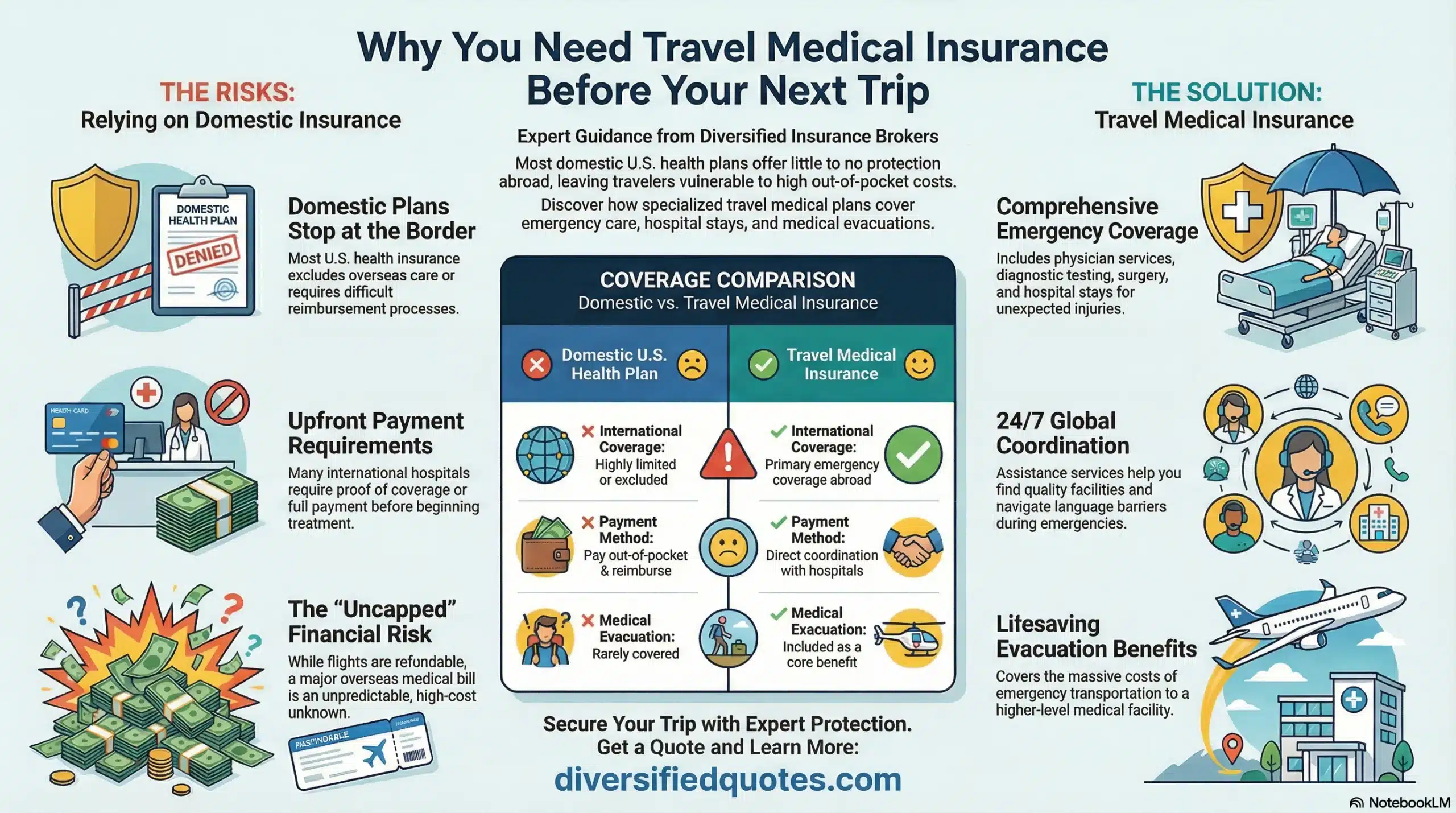
Austria is a destination that consistently generates the same coverage misconception among American travelers: because the country has excellent medical infrastructure, the planning assumption becomes “if something happens, Austria will handle it.” The assumption is correct as far as it goes — Austria’s hospital system is genuinely strong, its mountain rescue capabilities are world-class, and its emergency response infrastructure is reliable in ways that few countries outside Western Europe can match. Where the assumption becomes financially dangerous is in the two details it leaves out. First, Austria’s excellent public hospital system is built for Austrian residents and EU citizens — U.S. travelers are non-EEA visitors who receive emergency care but are billed at uninsured international patient rates that are not nominal. Second, Austria’s topography — the Alps covering roughly 60% of the country — creates medical transport logistics for serious events in mountain environments that make evacuation planning genuinely consequential regardless of how good the nearest hospital is. Travel medical and evacuation insurance from Austria addresses both: the billing reality of being an uninsured international patient in an Austrian hospital, and the logistics and cost of getting from where a mountain incident occurs to where the care you need actually is.
At Diversified Insurance Brokers, we help travelers, skiers, hikers, students, families, and professionals compare plans designed for Austria’s specific combination of high-quality medical infrastructure and Alpine terrain. The Allgemeines Krankenhaus der Stadt Wien — AKH Wien — is Europe’s largest hospital and provides specialist depth that rivals the world’s best academic medical centers. Landeskrankenhaus Innsbruck (LKH Innsbruck, part of Tirol Kliniken) serves the Tyrolean Alps region including Innsbruck and the Arlberg ski corridor. Landeskrankenhaus Salzburg (SALK) serves the Salzburg state and the Salzkammergut lake district. These are outstanding facilities. What they cannot change is that getting to them from a remote mountain location requires helicopter extraction in many serious Alpine incidents — coordinated by Austria’s Bergrettung Österreich (mountain rescue) and the ÖAMTC helicopter network — and that the billing for both helicopter transport and inpatient hospital care falls on international travelers as uninsured patients. For the foundational framework on how travel medical plans address both the billing and the logistics, the page on international travel health coverage is the right starting point before engaging with Austria’s specifics.
Compare Travel Medical & Evacuation Options for Austria
Start here to compare plan designs and choose the coverage level that fits your trip dates, traveler ages, and evacuation needs.
Austria’s Medical Geography: Urban Hospitals, Alpine Terrain, and the Helicopter Network That Connects Them
Vienna’s AKH is not just Austria’s largest hospital — with over 2,000 beds and nearly every medical specialty represented at academic-center depth, it is one of Europe’s premier medical institutions. For travelers in Vienna who experience a serious cardiac event, neurological presentation, or complex trauma, AKH provides care that is genuinely world-class, and the billing reality as an uninsured international patient, while meaningful, is manageable relative to what the same event would cost without coverage. The Rudolfstiftung hospital in Vienna’s 3rd district provides emergency and surgical capability in a second major facility. Graz, Austria’s second city, has Landeskrankenhaus Universitätsklinikum Graz providing strong regional specialist depth. These urban facilities create a coverage planning environment where the primary financial concern is the hospital bill — not getting to the hospital.
The Alpine regions change the planning equation significantly. Innsbruck’s LKH Innsbruck is an outstanding facility — a university hospital that handles complex trauma, neurosurgery, and orthopedic surgery for the entire Tyrolean Alps region and receives regular helicopter transfers from skiing accidents across Arlberg, Ötztal, Zillertal, and the Brenner corridor. The challenge is not the quality of Innsbruck’s care. It is the distance and terrain between ski slopes, via ferrata routes, mountain hiking trails, and glacier crossings, and the hospital. Austria’s Bergrettung Österreich coordinates mountain rescue across the Alps, and the ÖAMTC and ARA (Alpine Air Rescue) helicopter networks provide air evacuation from locations that ground ambulances cannot reach — including the Großglockner massif, the Ötztal glacier area, the Dachstein plateau, and the countless backcountry ski routes that experienced skiers access from lift-served resorts. A single ÖAMTC helicopter rescue and transport to Innsbruck LKH can generate a bill of USD $5,000–$15,000 in helicopter fees alone before hospital care begins. This is the evacuation cost exposure that distinguishes Austria’s Alpine regions from most Western European destination planning contexts, and it is why coverage planning for ski-focused Austria trips requires explicit attention to helicopter rescue and medical transport as covered evacuation transport modes rather than assuming “standard” evacuation language covers them. For travelers comparing Austria’s Alpine rescue logistics to other mountain-environment planning contexts, the pages on travel medical and evacuation from Sweden, travel medical and evacuation from England, and travel medical and evacuation from Canada cover European and North American destinations with comparable mountain rescue and remote-region evacuation planning dimensions.
Austria Travel Medical: Coverage Priorities by Location and Traveler Type
| Austria Location / Traveler Type | Medical Access Reality | Key Coverage Priority | Evacuation / Transfer Scenario |
|---|---|---|---|
| Vienna — cultural tourism / business / diplomatic | AKH Wien (2,000+ beds, academic medical center) and Rudolfstiftung provide world-class specialist depth; non-EEA international patients billed at uninsured rates; English widely spoken in Viennese medical facilities; direct billing arrangements with many international carriers; airport connections to most major hubs | Financial protection against Austrian uninsured international patient billing; direct billing or payment guarantee support for AKH or Rudolfstiftung; pre-existing condition terms reviewed for older travelers; plan documentation accessible for hospital presentation | Within-Vienna hospital transfers for most events; intra-European routing for rare cases requiring specialist depth beyond AKH’s already comprehensive capability; U.S. repatriation via Vienna International Airport once medically stable for prolonged recovery |
| Innsbruck / Arlberg / Ötztal — Alpine ski season | LKH Innsbruck (Tirol Kliniken) provides excellent specialist care including complex orthopedic trauma and neurosurgery; ÖAMTC and ARA helicopter networks provide mountain rescue; helicopter extraction from slopes and backcountry can cost USD $5,000–$15,000 in transport fees before hospital care; ski resort accident density highest in Austria | Helicopter rescue confirmed as covered transport mode under evacuation benefit; skiing and snowboarding confirmed as covered activities; backcountry and off-piste skiing confirmed if applicable; evacuation limits adequate for helicopter plus Innsbruck LKH hospitalization; sports activity exclusion review before skiing | ÖAMTC helicopter from slope to LKH Innsbruck; within-Innsbruck specialist care for most orthopedic and trauma events; intra-European transfer for rare subspecialty requirements; U.S. repatriation via Innsbruck Airport or Vienna for extended recovery |
| Kitzbühel / Salzburg / Zell am See — ski and lake tourism | SALK (Salzburg University Hospital / LKH Salzburg) serves the Salzburg region; Schwarzach hospital serves the Pongau ski corridor including Kitzbühel and Zell am See; Kitzbühel has a local clinic but complex events route to Schwarzach or Salzburg; Berchtesgaden border proximity creates cross-border care consideration | Skiing and activity coverage confirmation; helicopter rescue coverage; assistance team knowledge of Kitzbühel-to-Schwarzach routing; cross-border Germany access confirmation if needed; evacuation limits adequate for hospital stay plus potential Vienna or international routing for subspecialty events | Helicopter rescue to Schwarzach or Salzburg LKH; Salzburg or Vienna for complex events; Munich University Hospital in Bavaria as potential cross-border routing for some cases given Salzburg’s proximity to Germany |
| Großglockner / Dachstein / mountain trekking | Austria’s highest peaks (Großglockner at 3,798m) create altitude illness risk alongside standard mountain trauma; via ferrata routes and glacier crossings create fall and crevasse risk requiring technical mountain rescue; Bergrettung Österreich coordinates ground rescue teams; ÖAMTC helicopter for air evacuation from locations ground teams cannot access | Mountain trekking and glacier activity confirmed as covered; via ferrata and technical climbing confirmed if applicable; altitude illness coverage; Bergrettung rescue coordination confirmed as covered assistance; maximum evacuation limits for multi-stage mountain rescue; satellite communication plan before high-altitude routes | Bergrettung ground rescue to nearest road; ÖAMTC helicopter to LKH Innsbruck, LKH Salzburg, or nearest equipped facility depending on incident location; altitude determines which corridor is fastest given Großglockner’s position on Tyrolean-Carinthian border |
| Students / semester programs / language immersion | Vienna, Graz, Salzburg, and Innsbruck all host significant international student populations; university-affiliated international student clinics exist but with limited hours and scope; longer stays create higher cumulative medical probability; Austrian national student health insurance (ÖGK) covers EU students but not non-EEA students; public hospital access available but at non-resident billing rates | Coverage duration matching full semester or program length; outpatient access for routine urgent care over weeks and months; pre-existing condition terms reviewed for longer-stay students; prescription continuity across Austrian pharmacy system; student program compliance verification if required | Vienna, Graz, or Innsbruck major hospitals for serious events; intra-European routing for rare events requiring subspecialty depth; U.S. repatriation once medically stable for events requiring extended recovery in home-country care environment |
| Older travelers / family groups / multi-country Europe | Austria’s walkable city centers and excellent public transport make it genuinely senior-friendly; cardiac and pulmonary presentations are most common serious events in older traveler population; Austrian hospitals provide high-quality cardiac care; multi-country Europe itineraries increase probability and complexity of medical events across different national billing systems | Pre-existing condition stability window and look-back period reviewed explicitly before purchase; cardiac and pulmonary event coverage; multi-country plan coverage confirmed for full itinerary scope; repatriation benefit structure reviewed for return to U.S. after European cardiac event; higher medical limits appropriate for older traveler profile | AKH Wien or LKH city hospital for most serious events in Austrian cities; repatriation to U.S. via Vienna International Airport for events requiring extended U.S. follow-up; cross-border transfer within EU for events occurring near Austrian borders with Germany, Switzerland, or Italy |
The ÖAMTC Helicopter, Austrian Hospital Billing, and What U.S. Travelers Need to Understand Before Skiing
Austria’s ÖAMTC (Österreichischer Automobil-, Motorrad- und Touring Club) helicopter network is one of the most sophisticated mountain air rescue systems in the world — 30+ helicopters strategically positioned across Austria’s Alpine regions to reach any location in the country within approximately 15 minutes during daylight operations. This network is genuinely life-saving in the context of Alpine accidents where ground transport over terrain that takes hours by foot or snowmobile is not a viable response to time-sensitive trauma or altitude emergencies. Austrian mountain rescue standards are exceptional. The coverage planning question is who pays for the service. Austrian citizens and EU residents with EHIC (European Health Insurance Card) have various degrees of coverage for rescue costs under Austria’s social insurance system. U.S. travelers are not covered by Austrian social insurance, do not benefit from EHIC, and receive ÖAMTC helicopter rescue as fee-for-service international patients whose bills land in their inbox after they have left the mountain. The helicopter rescue cost itself — separate from hospital care — typically ranges from approximately EUR 1,500 for a straightforward extraction to EUR 5,000+ for complex or prolonged mountain rescues, and this is before the Innsbruck LKH or Schwarzach hospital inpatient bill for the orthopedic surgery or trauma management that the rescue was transporting toward. The travel medical plan’s evacuation benefit must explicitly cover helicopter rescue as a transport mode — not just “air ambulance” in the sense of a fixed-wing medivac plane — for the coverage to function in the scenario Austrian skiing most commonly produces.
For skiers specifically, the most consequential pre-purchase verification is the plan’s skiing and snowboarding activity coverage, including whether the plan distinguishes between marked piste skiing and backcountry or off-piste skiing. Many plans cover resort skiing without restriction but restrict or exclude off-piste and backcountry skiing — precisely the high-consequence terrain where serious accidents generate helicopter rescue. Kitzbühel’s Hahnenkamm descent, St. Anton’s extensive off-piste terrain, the Arlberg pass area, and the Ötztal glacier ski area all attract experienced international skiers whose actual skiing exceeds what “standard resort skiing” language was designed to cover in some plan definitions. Confirming the specific activity language before purchasing — not inferring from general “outdoor sports” language — is the step that determines whether the most expensive Austria ski accident scenario is covered or self-insured. For travelers comparing Austria’s ski planning considerations to other Alpine and mountain destination planning frameworks, the pages on travel medical and evacuation from Italy, travel medical and evacuation from Spain, and travel medical and evacuation from Australia cover destinations where the same activity coverage verification matters for different outdoor risk profiles. For the broader high-risk travel product framework that applies when Austria’s Alpine activity profile intersects with general coverage planning, high-risk travel insurance and travel and medical insurance for high-risk travel cover the specialized product categories designed for elevated-activity travel environments. For extended Austria stays — semester programs, language immersion, prolonged mountain holidays — international health insurance provides the structural alternative to short-term travel plans. The billing and documentation processes relevant to Austrian hospital claims and how to handle reimbursement when direct billing is not available are covered within the emergency travel health insurance for foreign nationals framework. For travelers comparing how non-resident billing and evacuation logistics work across Western European destinations on multi-country itineraries, the pages on travel medical and evacuation from England, travel medical and evacuation from Sweden, and travel medical and evacuation from Canada provide the closest comparable planning contexts for U.S. travelers in developed-country medical systems. Short-term and travel medical product comparisons across plan types are consolidated at short-term and travel medical.
Ready to Choose Coverage for Austria?
If you want a plan that works during a real emergency, focus on medical limits, helicopter rescue coverage, and assistance coordination — not just headline price.
Related Travel Medical Pages
If you want to compare core plan types and how evacuation benefits work, these pages are the best place to go next.
Related Destination Pages
If Austria is one part of a broader European or international itinerary, these destination pages compare how coverage needs shift across different medical systems and evacuation environments.
Talk With an Advisor Today
Choose how you’d like to connect—call or message us, then book a time that works for you.
Schedule here:
calendly.com/jason-dibcompanies/diversified-quotes
Licensed in all 50 states • Fiduciary, family-owned since 1980
Frequently Asked Questions: Travel Medical and Evacuation Insurance for Austria
Does my U.S. health insurance cover me in Austria?
Most U.S. domestic health insurance plans provide limited or no meaningful coverage for medical care in Austria. Austrian public hospitals and clinics operate under Austria’s social insurance system, which covers Austrian residents and EU/EEA citizens with the European Health Insurance Card — U.S. travelers are not covered by Austrian social insurance and receive treatment as uninsured international patients billed at non-resident rates. Some U.S. employer group plans nominally include international coverage but apply out-of-network rates that produce significantly higher cost sharing for the insured, and most require you to pay upfront and seek reimbursement after returning home. The billing and reimbursement friction — particularly for a hospitalization or emergency surgery where the bill arrives months later in German — creates the kind of financial and administrative stress that travel medical insurance is specifically designed to prevent. A travel medical plan provides defined emergency coverage with an assistance team that can help navigate Austrian hospital billing, support documentation collection, and manage the claims process from the trip rather than from home months later.
How much does a helicopter mountain rescue in Austria cost for a U.S. traveler?
ÖAMTC and ARA helicopter rescues are billed to non-Austrian, non-EU travelers at fee-for-service rates that vary by rescue complexity, duration, and equipment requirements. A straightforward helicopter extraction from an accessible mountain location typically generates a bill in the range of EUR 1,500–3,000. More complex rescues involving technical terrain, extended search operations, multiple helicopter crew hours, or specialized equipment can reach EUR 5,000–10,000 or more in rescue fees alone — before any hospital care costs are added. Austrian ski resort associations and tourism organizations publish membership-based mountain rescue insurance (Bergrettungsversicherung) that Austrian residents commonly carry, but these products are designed for the Austrian domestic market and may have limited applicability for U.S. travelers. A U.S. travel medical plan whose evacuation benefit explicitly covers helicopter rescue as a transport mode is the practical solution for the fee-for-service rescue exposure that non-Austrian skiers, hikers, and mountaineers face. Confirm this coverage specifically before skiing off-piste or undertaking any mountaineering activity in Austria.
Does my travel medical plan cover skiing in Austria, including off-piste and backcountry?
Coverage for skiing in Austria varies significantly between plans, and the distinction between marked-piste resort skiing and off-piste or backcountry skiing is particularly important given Austria’s ski culture. Most standard travel medical plans cover recreational skiing on maintained, marked resort runs without restriction or with a straightforward confirmation that skiing is a covered activity. The coverage picture becomes more variable for off-piste skiing outside resort boundaries, backcountry ski touring, heli-skiing, and ski mountaineering. Some plans cover all of these activities; others require specific riders or exclude certain categories of elevated-risk mountain activity. For Austria specifically, where resorts like St. Anton, Lech, and Kitzbühel attract experienced international skiers who routinely ski terrain that exceeds “standard resort” conditions, confirming the plan’s exact activity language before purchasing and before skiing is essential. The accident scenarios that generate the highest costs — helicopter rescue from backcountry terrain, complex trauma surgery at LKH Innsbruck, extended orthopedic rehabilitation — are precisely the scenarios most likely to occur in off-piste and backcountry conditions. Verify the coverage explicitly against your planned skiing activities, not against a general “outdoor sports” category.
What are the best hospitals in Austria for international travelers?
AKH Wien (Allgemeines Krankenhaus der Stadt Wien) in Vienna is Europe’s largest hospital with over 2,000 beds and academic-center depth across virtually every specialty — it is an outstanding facility for any serious medical event in or near Vienna. Rudolfstiftung in Vienna’s 3rd district provides strong emergency and surgical capability as a second major option. In Innsbruck, LKH Innsbruck (Tirol Kliniken) is the primary regional hospital for the entire Tyrolean Alps and handles complex orthopedic trauma, neurosurgery, and specialist care for ski accident transfers from across Arlberg and Ötztal. SALK (Salzburger Landeskliniken / LKH Salzburg) serves the Salzburg region and the Salzkammergut lake district. Schwarzach hospital in the Pongau serves the Kitzbühel and Zell am See ski corridor. Landeskrankenhaus Universitätsklinikum Graz serves southern Austria and Styria. All of these facilities provide high-quality care — the coverage planning question is not hospital quality but the billing structure for non-resident international patients and the cost of helicopter transport to reach the hospital from an Alpine incident location.
What coverage limits should I carry for an Austria trip?
For Vienna-concentrated cultural tourism, emergency medical limits of $50,000–$100,000 with evacuation coverage of $100,000–$150,000 provide meaningful protection against Austrian non-resident hospital billing for most common serious events. For ski-focused trips including Innsbruck, Arlberg, Kitzbühel, and Ötztal, evacuation limits of $150,000–$250,000 better reflect the combined cost of helicopter rescue and inpatient orthopedic or trauma care at LKH Innsbruck or Schwarzach. For trekking, mountaineering, or via ferrata itineraries that access higher-altitude terrain or glaciers, the upper end of those evacuation ranges reflects the more complex rescue logistics and longer hospital stays that serious Alpine incidents can require. For older travelers, the limit selection should account for the higher probability of cardiac or pulmonary events requiring hospitalization and potential medically supervised repatriation to the United States. For multi-country European itineraries where Austria is one of several destinations, the limit should reflect the most demanding segment of the itinerary — which for an Alps-skiing-plus-city-touring trip is the skiing segment, not the Vienna museums days.
What is the correct process if I need medical care in Austria?
For true emergencies — ski accidents, sudden cardiac events, serious falls — Austria’s emergency number is 144 (Rettung/Notarzt) and mountain rescue is reached via 140 (Bergrettung). Call immediately; do not delay emergency response for insurance coordination. For non-emergency urgent care, contact the plan’s assistance team before seeking treatment when possible — the team can identify appropriate facilities, advise on documentation requirements, and in some cases support direct billing coordination with Austrian hospitals. Once initial care is received, contact the assistance team as early as possible if the situation may require evacuation, extended hospitalization, or supervised transport. Collect documentation at the facility before leaving: request itemized bills (Rechnung), clinical notes, and discharge documentation in German — you can have these translated, but you cannot recreate them after departure. Austrian hospital billing for international patients is typically issued weeks or months after the event, which makes having assistance team coordination and proper documentation from the point of care essential for clean claims outcomes. Store the assistance team’s contact number offline before departure.
About the Author:
Jason Stolz, CLTC, CRPC, DIA, CAA and Chief Underwriter at Diversified Insurance Brokers (NPN 20471358), is a senior insurance and retirement professional with more than 25 years of real-world experience helping individuals, families, and business owners protect their income, assets, and long-term financial stability. As a long-time partner of the nationally licensed independent agency Diversified Insurance Brokers, Jason provides trusted guidance across multiple specialties—including fixed and indexed annuities, long-term care planning, personal and business disability insurance, life insurance solutions, Group Health, Travel Medical and Evacuation Insurance, and short-term health coverage. Diversified Insurance Brokers maintains active contracts with over 100 highly rated insurance carriers, ensuring clients have access to a broad and competitive marketplace.
His practical, education-first approach has earned recognition in publications such as VoyageATL, and contributions from his agency featured in Kiplinger and GoBankingRates— highlighting his commitment to financial clarity and client-focused planning. Drawing on deep product knowledge and years of hands-on field experience, Jason helps clients evaluate carriers, compare strategies, and build retirement and protection plans that are both secure and cost-efficient. Visitors who want to explore current annuity rates and compare options across multiple insurers can also use this annuity quote and comparison tool.
Explore More Travel Medical Insurance Options: Browse our complete guide to Europe, Asia & Pacific Travel Medical Insurance — covering medical evacuation coverage for Europe, Asia, Australia & Pacific destinations.
Last Reviewed: June 19, 2026 |
Reviewed by: Jason Stolz, CLTC, CRPC, DIA, CAA
Chief Underwriter, Diversified Insurance Brokers, Inc. | NPN: 20471358 | Diversified Insurance Brokers, Inc. — Licensed in all 50 states
Fact Checked by: Tonia Pettitt, CMIP©
Medicare Specialist, Diversified Insurance Brokers, Inc. | NPN: 14374308 | Diversified Insurance Brokers, Inc. — Licensed in all 50 states
Did you find this content helpful? Leave us a Google review — it helps others find trustworthy guidance too.
Editorial Standards: Diversified Insurance Brokers maintains rigorous editorial standards to ensure accuracy, clarity, and independence in all content. Learn more about our editorial standards and commitment to transparency.
