
Disability Insurance for Financial Planners
As an Independent Disability Insurance Broker, we have access to exclusive discounts and negotiated pricing most captive agents can’t offer — see the full breakdown near the end of this page.
Disability Insurance for Financial Planners

Jason Stolz CLTC, CRPC, DIA, CAA
Disability insurance for financial planners is one of the most consequential and — with notable irony — one of the most frequently overlooked forms of income protection among professionals who spend their careers helping others safeguard their financial futures. Whether you work as a fee-only financial planner serving individual clients, a CFP at a wealth management firm, a registered investment advisor managing assets under management, a financial coach or independent planning consultant, or a financial planner who combines advisory services with insurance and investment product recommendations — your income depends entirely on your cognitive capacity to analyze, advise, communicate, and serve clients at a high professional standard. A condition that impairs that capacity does not merely reduce your productivity — it eliminates the specialized professional output that your clients pay for and that your income depends on.
The Financial Planning Association has identified disability insurance as one of the financial planning industry’s great blind spots — noting that professionals who understand the critical importance of disability insurance for their clients frequently fail to adequately protect their own incomes. Financial planners know better than any other professional population how devastating an uninsured disability can be — the statistics on disability’s role in foreclosures, bankruptcies, and retirement derailment are core to the financial planning curriculum — and yet a meaningful percentage of practicing financial planners carry inadequate disability coverage or none at all. At Diversified Insurance Brokers, we help financial planners close this gap by structuring disability insurance coverage that reflects the professional income complexity, cognitive disability risk profile, and specific financial protection needs of the planning profession.
Financial planners occupy an exceptionally favorable position in the disability insurance marketplace — one that, when properly understood and leveraged, produces comprehensive income protection at competitive premium rates. The profession’s exclusively office-based, cognitively intensive, non-physical nature places financial planners in the highest available occupational class tiers, giving them access to the strongest available policy definitions, the highest maximum benefit amounts, and the full range of supplemental riders that together create genuinely comprehensive income protection.
Protect Your Financial Planning Income
Compare disability insurance options designed for CFPs, RIAs, fee-only planners, wealth managers, and all financial planning professionals.
The Occupational Classification Advantage for Financial Planners
Disability insurance for financial planners begins with one of the most practically significant facts about the profession in the disability insurance marketplace: the occupational class. Financial planners — whose work is entirely office-based, cognitively intensive, and free of physical hazard — are classified at the 4A or high 3A occupational tier by disability insurance carriers. This is the most favorable available classification and produces direct, tangible benefits in terms of the policy features accessible, the maximum monthly benefit amounts available, and the premium rates that apply.
At the 4A tier, financial planners have access to the strongest available own-occupation policy definitions — the critical provision that pays benefits when a condition prevents the planner from performing the specific duties of their financial planning profession, regardless of whether they could theoretically perform other less specialized work. They have access to the highest available monthly benefit limits — often up to $25,000 or more per month — which is essential for financial planners whose incomes regularly exceed the benefit caps accessible to lower-classified occupational groups. And they qualify for the full range of supplemental riders including future increase options, cost-of-living adjustment protection, and residual disability coverage that together create the most comprehensive possible income protection framework.
The premium efficiency that flows from the 4A classification means that financial planners can secure genuinely comprehensive disability protection at a cost that represents a modest percentage of the income being protected. An experienced financial planner earning $180,000 annually who secures a comprehensive disability policy paying $9,000 to $10,000 per month typically invests between 1% and 3% of annual income in premiums — a modest cost relative to the catastrophic financial consequences of an uninsured disability. The same favorable occupational classification advantage benefits other high-income analytical professionals, including day traders and financial market professionals whose cognitive income similarly qualifies for the most favorable disability insurance tier.
The Disability Risks Financial Planners Actually Face
The absence of physical hazard in financial planning work creates a temptation to underestimate disability risk — but this underestimation is exactly the cognitive bias that makes the profession’s blind spot so persistent. The disability risks facing financial planners are real, meaningful, and directly capable of producing career-ending income loss. They are simply different in nature from the physical injury risks that make other occupations obviously hazardous.
The disability risk profile for financial planners is primarily cognitive and psychological — conditions that impair the analytical thinking, complex financial modeling, client communication, regulatory judgment, and sustained cognitive performance that financial planning at a professional level demands. Traumatic brain injury, even a moderate one, can produce persistent cognitive symptoms including impaired working memory, slowed processing speed, and concentration difficulties that make sustained complex financial analysis impossible at a professional standard. Stroke can produce aphasia, calculation difficulties, or cognitive impairments that directly undermine the quantitative and communication demands of planning work. Multiple sclerosis produces cognitive symptoms in many patients that can gradually erode the professional performance on which a financial planning practice depends.
Mental health conditions represent a particularly significant and specifically under-discussed disability risk category for financial planners. The profession carries meaningful psychological stress — managing client anxiety during market volatility, bearing fiduciary responsibility for retirement and legacy outcomes that matter enormously to clients, navigating complex regulatory compliance obligations, and managing the sustained performance demands of a client-service business. Major depression, severe anxiety disorders, and burnout-related illness can each produce periods of profound cognitive dysfunction — impaired concentration, inability to sustain analytical thinking, dramatic reduction in professional productivity — that prevent a financial planner from meeting the professional standards their clients and regulatory requirements demand. The cognitive disability risk profile facing financial planners is parallel to that of other high-income analytical professionals managing complex quantitative work, including actuaries whose sustained mathematical and modeling work creates an identical cognitive disability risk profile.
Musculoskeletal conditions from sustained office and computer workstation use — cervical spine conditions, lumbar disc problems, repetitive strain injuries of the hands and wrists from sustained computer work — represent the most prevalent category of disabling conditions for financial planners in terms of sheer frequency. A financial planner who develops severe carpal tunnel syndrome preventing sustained keyboard use, a progressive cervical disc condition preventing sustained computer workstation posture, or a lumbar condition making sustained seated office work physically unsustainable faces a genuine occupational disability — one that an own-occupation disability policy is specifically designed to address.
Why Own-Occupation Disability Coverage Is Non-Negotiable for Financial Planners
The most consequential decision a financial planner makes when purchasing disability insurance is the definition of disability written into the policy. For financial planners, own-occupation coverage is not merely preferable — it is the only definition that provides genuine income protection against the conditions most likely to affect their careers.
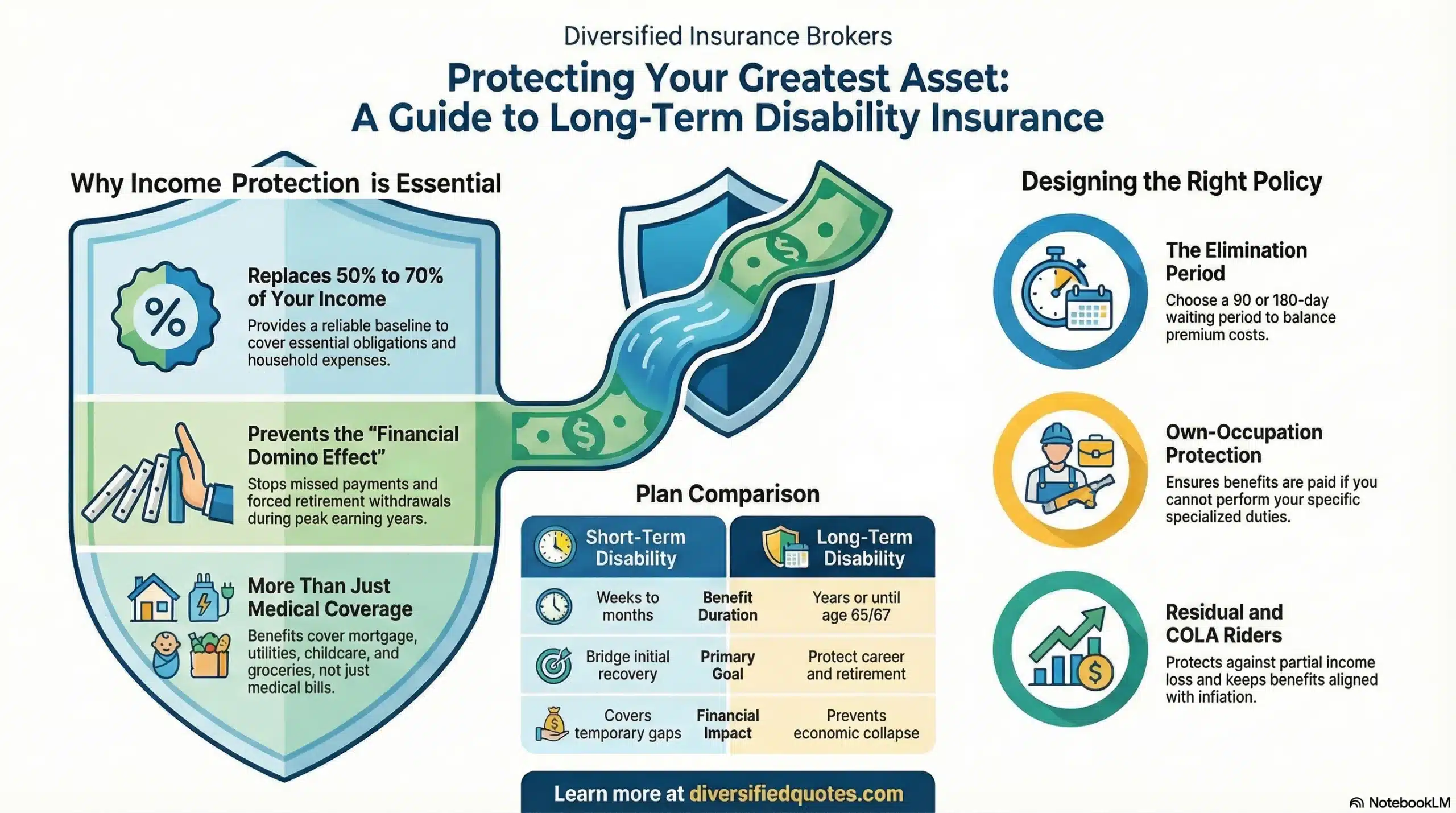
Own-occupation disability insurance pays benefits when a condition prevents a financial planner from performing the material duties of their specific profession — financial analysis, client planning sessions, portfolio management, regulatory compliance, and the sustained cognitive engagement that financial planning requires — regardless of whether they could theoretically perform other less specialized work. An any-occupation policy only pays if the planner cannot perform virtually any gainful employment whatsoever.
The practical distinction is directly relevant to how financial planning disabilities actually manifest. A financial planner whose major depression produces a sustained period of cognitive dysfunction preventing them from managing client relationships and performing complex financial analysis may retain the ability to perform less cognitively demanding work. An any-occupation policy would deny benefits. An own-occupation policy recognizes the genuine occupational disability — the inability to practice financial planning at a professional standard — and pays income replacement accordingly. For a professional whose specialized expertise and licensed credentials represent a career-long investment in specialized human capital, the any-occupation definition provides almost no meaningful protection against the most likely disability scenarios. Our comprehensive resource on own-occupation disability insurance explained covers this critical distinction in complete detail for any financial planner evaluating their coverage options.
The Income Complexity Challenge for Financial Planners
Financial planning income structures are among the most varied and complex of any professional population — and that complexity creates a specific underwriting challenge that makes working with an experienced independent broker essential for financial planners seeking disability coverage that reflects their actual earning capacity.
A financial planner’s total compensation may include a base salary from a firm, AUM-based management fees that scale with client assets, financial planning fees charged on a retainer or hourly basis, insurance commissions from product sales, performance bonuses from firm profits or client outcomes, and speaking or consulting income from professional engagements. For fee-only planners operating their own RIA, income flows entirely through business revenue that must be documented through Schedule C or K-1 filings. For planners employed by large firms, total compensation may far exceed base salary when bonuses, profit sharing, and deferred compensation are included — but group disability plans typically cover only base salary in their benefit calculations.
Carriers base disability benefit amounts on verified earned income — and the documentation of AUM fee income, commission-based earnings, and variable compensation structures requires an understanding of how underwriters evaluate non-salary professional income. A financial planner who earns $90,000 in base salary but $220,000 in total compensation including AUM fees and bonuses may find that a group plan covers only the base salary component — leaving a $130,000 annual income gap completely unprotected. Individual disability insurance, properly structured around total compensation documentation, fills this gap. The income documentation challenge facing financial planners parallels that confronting other high-income professionals with variable and multi-source income, including independent consultants managing complex self-employment income documentation for disability insurance purposes.
Employer Group Plans vs. Individual Disability Insurance for Financial Planners
Many financial planners employed by wealth management firms, financial planning companies, or large financial institutions have access to employer-sponsored group long-term disability plans. These plans provide a valuable baseline — but the limitations of group disability coverage are particularly consequential for financial planners whose income structures routinely include significant compensation beyond the base salary that group plans cover.
Group disability plans typically replace 60% or less of base salary and consistently exclude bonus income, AUM fees, commission-based earnings, and other variable compensation components that represent substantial portions of many financial planners’ total earnings. A financial planner earning most of their income through AUM fees or performance bonuses may find that their group plan benefit covers a very small fraction of their actual financial need during a disability. Group plans also terminate when employment ends and often include own-occupation definitions that convert to any-occupation standards after two years of disability — potentially denying continued benefits to a financial planner who remains unable to perform planning work but could theoretically do other employment.
For independent financial planners, RIA principals, and financial planning firm owners who have no employer group plan at all, individual disability insurance is the only income protection available outside of Social Security Disability Insurance. For these self-employed planning professionals, the financial vulnerability of a disability is identical to that of any other self-employed professional — income stops immediately, business fixed costs continue, and no institutional safety net exists. Our resource on disability insurance for independent contractors and self-employed professionals provides parallel planning context for financial planners operating their own practices without employer group coverage.
Case Study: Financial Planner Earning $165,000 Per Year
Consider a CFP employed at an independent wealth management firm, earning $165,000 annually in combined base salary and AUM-based compensation. Following a moderate stroke producing persistent aphasia and numerical processing difficulties, this financial planner is unable to conduct client meetings, perform portfolio analysis, or produce the written financial plans and compliance documentation the role requires. After eight months of rehabilitation with partial improvement, the planner can communicate in everyday conversation but cannot sustain the complex quantitative communication and financial analysis their practice demands.
| Scenario | Without Individual DI | With Individual DI |
|---|---|---|
| Monthly Income During Disability | Group plan covers base salary only (~$3,750) | Group plan + individual supplement (~$8,250–$9,500) |
| Annual Income Gap | $100,000+ in AUM and bonus income unprotected | Total compensation protected through individual supplement |
| Career and License Impact | Financial pressure may force premature return risking compliance errors | Full recovery supported on medical timeline without financial crisis |
| Long-Term Financial Outcome | Retirement savings depleted, financial plan permanently disrupted | Financial stability maintained, long-term goals preserved |
Stroke is a leading cause of sudden cognitive disability in working professionals — it does not discriminate by profession or age — and for a financial planner whose specialized quantitative communication capacity is the direct source of their professional value, a stroke producing even moderate persistent aphasia or numerical processing difficulty constitutes a career-threatening disability. Disability insurance for financial planners ensures this scenario does not simultaneously produce a financial catastrophe that compounds an already devastating health crisis. The cognitive disability risk that financial planners share with other analytical professionals is well-documented, including among stock brokers and financial market professionals managing identical cognitive income protection needs.
Residual Disability Coverage — Essential for Financial Planning Practices
Residual disability coverage is particularly important for financial planners because the most likely disabling conditions — mental health conditions, neurological events, chronic illness affecting cognitive stamina — frequently produce graduated functional limitations rather than sudden and complete incapacity. A financial planner recovering from a significant depressive episode may be able to return to limited client work — reduced meeting hours, simplified planning tasks — months before they can safely manage a full practice load with all the regulatory compliance demands that comprehensive financial planning requires.
Without a residual disability rider, a total-disability-only policy pays nothing during this partial recovery period — because the planner can technically perform some work in some limited capacity. A residual rider supplements reduced earnings proportionally throughout the return-to-full-capacity arc, providing continuous financial support from onset of disability through full return to normal planning practice productivity. For financial planners whose most likely disability scenarios follow gradual rather than binary timelines, this rider is essential for any disability policy to function as genuine income protection across the full recovery period. Our full guide on how residual disability insurance benefits work explains this protection in complete detail for financial planning professionals evaluating their coverage options.
Key Policy Features for Financial Planner Disability Insurance
Beyond the own-occupation definition and residual disability rider, disability insurance for financial planners should incorporate several additional policy provisions that reflect the realities of a high-income, cognitively intensive professional career. The non-cancelable and guaranteed renewable provision is foundational — locking in both premium rates and coverage terms for the life of the policy regardless of health changes or advancing age. For a financial planner who secures a comprehensive policy at 30 in excellent health, this provision ensures the favorable rates locked in at that time remain stable across a full thirty-five-year career.
A future increase option rider is particularly valuable for financial planners in the earlier stages of their careers whose AUM and planning fee income is growing meaningfully as they build their client base. This rider allows coverage to be increased as income grows without requiring new medical underwriting — meaning that mental health conditions, neurological changes, or other health developments that accumulate over a career cannot prevent future benefit increases if this option is secured early. The cost-of-living adjustment rider preserves real benefit value during extended disability claims. Our resource on disability income insurance with a COLA rider explains how this inflation protection works for financial planners facing extended disability scenarios. For financial planners thinking about how short-term and long-term coverage work together, our guide on how to buy short-term disability insurance provides useful context on bridging the initial income gap before long-term benefits activate.
The Elimination Period Decision for Financial Planners
Selecting the appropriate elimination period — the waiting time before disability benefits begin — requires careful calibration for financial planners whose income structures vary significantly. A financial planner employed by a large firm with meaningful employer sick leave, substantial emergency savings, or a secondary household income from a partner may comfortably manage a 90-day or even 180-day elimination period, keeping premiums meaningfully lower. Financial planners who operate independent RIA practices with no employer sick pay and income dependent entirely on client relationships and billing continuity should evaluate shorter elimination periods more seriously — the financial urgency of self-employed practice income loss is typically more acute and more immediate than for employed planners.
The regulatory dimension also deserves consideration. A financial planner who is disabled and not actively monitoring client portfolios, managing regulatory filings, or maintaining compliance obligations faces professional risk alongside financial risk during a disability — which adds additional urgency to having disability benefits activate as quickly as is financially feasible. Our full guide on how disability insurance elimination periods work provides the complete framework for calibrating this decision to each individual financial planner’s specific financial situation and practice structure. The elimination period planning context for financial planners is parallel to that facing other office-based independent professionals, including independent specialists managing the elimination period decision based on individual business cash flow.
Business Overhead Expense Coverage for Financial Planning Firm Owners
Financial planners who own and operate their own RIA, planning firm, or advisory practice face a dual financial exposure during any disability: the loss of personal income and the continuation of business fixed costs. Office rent or lease payments, compliance software subscriptions, portfolio management platform fees, staff payroll if the practice employs support personnel, professional liability insurance premiums, CRM and financial planning software costs, and marketing expenses all continue during a disability regardless of whether the firm principal can actively advise clients.
Business overhead expense insurance is designed specifically to cover these fixed business costs during a disability period, preventing a temporary health event from forcing permanent closure of an established financial planning practice. For a financial planning firm owner who has spent years building a client base, a reputation for planning quality, and referral relationships with CPAs and estate attorneys, maintaining the business infrastructure during a disability recovery period has significant financial value that extends far beyond any individual cost covered. The combination of personal income replacement disability insurance and business overhead expense coverage creates the most comprehensive financial protection structure available to a self-employed financial planning professional. The business overhead expense planning consideration applies equally to other independent professionals who have built client-service businesses on their personal expertise, including court reporters and independent service professionals managing business continuity during disability.
Why Financial Planners Need an Independent Disability Insurance Broker
The irony of financial planners being underserved by disability insurance is compounded by the fact that this underservice often results from the same dynamic that affects their clients — purchasing disability coverage through the most convenient available channel rather than through an independent comparison process that identifies the best available option across the full marketplace. A financial planner who purchases disability coverage through a firm-affiliated benefit program, a professional association group plan, or a colleague’s recommendation may be accepting the first available option rather than the best available option.
At Diversified Insurance Brokers, we evaluate disability insurance options across multiple top-rated carriers for every financial planner we work with — comparing occupational class assignments, own-occupation definition language, mental health coverage provisions, income documentation approaches for complex compensation structures, rider options, and premium structures across the full competitive marketplace. We understand the AUM fee income documentation challenge, the bonus-based compensation underwriting question, and the specific cognitive disability risk profile of the financial planning profession. The same commitment to comprehensive independent analysis that distinguishes great financial planners from product salespeople is what distinguishes an independent disability insurance broker from a captive agent. Our dedicated resource on why independent disability insurance brokers matter explains the full value of this approach for high-income professional planning careers. And our broader resource on whether disability insurance is worth the investment provides the foundational financial case for coverage that financial planners intuitively understand from their client work but often fail to act on for themselves.
Final Thoughts on Disability Insurance for Financial Planners
Financial planners understand better than any other professional population what disability can do to a household’s financial plan — the retirement derailment, the asset liquidation, the debt accumulation, and the permanent financial disruption that an uninsured extended disability produces. That same understanding, turned inward, is the most compelling argument for why every financial planner should have comprehensive, properly structured, individually owned disability insurance that reflects their full income, their specific professional disability risks, and the financial planning practice they have built.
Disability insurance for financial planners is not merely another product recommendation — it is the most fundamental application of the financial planning principle that protecting income is the foundation on which every other financial goal is built. A well-structured policy provides the income replacement that allows a financial planner to recover from any disabling condition from a position of financial stability, continue serving clients when health permits, and preserve the financial planning career they have invested years in building.
Related Pages
Talk With an Advisor Today
Choose how you’d like to connect—call or message us, then book a time that works for you.
Schedule here:
calendly.com/jason-dibcompanies/diversified-quotes
Licensed in all 50 states • Fiduciary, family-owned since 1980
Disability Insurance for Financial Planners FAQs
Financial planners are typically classified at the 4A or high 3A occupational tier — the most favorable classifications available in the individual disability insurance market. This classification reflects the exclusively office-based, non-manual, cognitively intensive nature of financial planning work and produces direct practical benefits for planners seeking coverage. At the 4A tier, financial planners have access to the strongest available own-occupation policy definitions, the highest monthly benefit limits — often up to $25,000 or more per month — competitive premium rates relative to the income being protected, and the full range of supplemental riders including future increase options, residual disability coverage, and cost-of-living adjustment protection. The irony for the financial planning profession is that this exceptionally favorable insurance market position — which makes comprehensive disability coverage both accessible and relatively affordable — is frequently not leveraged because financial planners focus their insurance expertise outward toward clients rather than inward toward their own income protection.
The Financial Planning Association has specifically identified this as a professional blind spot — one that is driven by a combination of the same behavioral patterns that affect all professionals when planning for their own financial protection rather than a client’s. Financial planners who compellingly communicate disability risk to clients every day may feel that having any disability coverage — even a minimal group plan — addresses the need without examining whether it actually does. The complexity of their own income structure — which often includes AUM fees, bonuses, and variable compensation beyond base salary — means that a group plan covering only base salary leaves a large income gap that is easy to overlook without a specific analysis. And the professional focus on investment, tax, and estate planning priorities for clients can crowd out the same rigorous income protection analysis a planner would apply to any client situation. An independent disability insurance review specifically for a financial planner’s own income and situation applies the same analytical discipline they bring to client work to their own most valuable financial asset. For a parallel on how analytical professionals benefit from objective disability insurance review, see our page on disability insurance for engineers and technical professionals.
AUM-based management fees represent a meaningful portion of many financial planners’ total annual compensation — and this income source requires specific documentation and presentation in disability insurance underwriting to ensure the benefit amount reflects total earning capacity rather than only base salary. Carriers base disability benefit amounts on verified earned income, and for financial planners whose AUM fees flow through an RIA or planning firm entity, documenting this income accurately using K-1 schedules, business tax returns, and fee disclosure documentation is essential for securing a benefit amount that corresponds to actual financial need during a disability. Financial planners who work with general insurance agents unfamiliar with advisory income structures frequently find that their disability benefit is calculated against a fraction of their true income because the AUM and fee components were not properly documented or presented. An independent broker with experience in financial services professional income documentation addresses this gap specifically, ensuring the full scope of planning compensation is reflected in the insurable income calculation.
Many individual disability insurance policies provide coverage for mental health conditions including major depression, anxiety disorders, and burnout-related illness when those conditions prevent performing occupational duties. For financial planners, where mental health conditions represent a genuine and documented occupational risk driven by the sustained performance demands and fiduciary responsibilities of the profession, this coverage dimension deserves specific attention before any policy is purchased. Coverage terms vary significantly between carriers — some policies provide full benefits for mental health disabilities throughout the entire benefit period, while others limit mental health claims to 24 months even when the base policy would otherwise pay to age 65. For financial planners whose most likely extended disability scenarios may involve mental health or cognitive conditions rather than physical injury, the mental health benefit period provision is among the most critical policy terms to evaluate and compare before making any coverage decision. At Diversified Insurance Brokers, we specifically assess mental health coverage provisions when structuring disability insurance for financial planning professionals. For comparable context on mental health coverage in high-cognitive-demand professions, see our page on disability insurance for dental professionals managing similar mental health benefit period considerations.
In most cases, no — and the gap is often larger than financial planners realize when they examine it specifically. Group disability plans at financial services firms typically replace 60% or less of base salary and explicitly exclude AUM fees, bonus income, commission-based earnings, and other variable compensation components that represent substantial portions of many financial planners’ total earnings. Group plans also terminate when employment ends — providing no protection during firm transitions, independent practice launches, or disability-related employment separations. Many group plans include own-occupation definitions that convert to any-occupation standards after two years of disability, potentially denying continued benefits to a financial planner who remains cognitively unable to perform planning work. Supplemental individual disability insurance owned personally by the financial planner fills all of these gaps — providing portable coverage through career transitions, calibrating benefit amounts to total compensation rather than base salary, and maintaining strong own-occupation provisions for the full benefit period regardless of employment changes.
Residual disability coverage pays proportional benefits when a disabling condition reduces a financial planner’s productive capacity and earnings without eliminating the ability to work entirely. A financial planner recovering from a significant mental health episode, a neurological event, or a chronic condition affecting cognitive stamina may be able to return to limited client work — reduced meeting schedules, simplified planning tasks, shorter working days — months before they can safely manage a full practice load with all the regulatory and analytical demands that comprehensive financial planning requires. During this partial return period, income is significantly reduced without being fully eliminated. Without a residual disability rider, a total-disability-only policy pays nothing during this period. A residual rider supplements reduced planning income proportionally throughout the graduated return to full professional capacity, providing continuous financial support across the entire recovery arc. Our full resource on how disability insurance works for high-income licensed professionals provides parallel context on residual benefit importance.
Yes, and the case is particularly strong for financial planning firm owners whose practice has meaningful fixed operating costs. Office or co-working space costs, compliance software subscriptions, portfolio management platform fees, CRM and financial planning software licenses, professional liability insurance premiums, and any employee or contractor costs all continue during a disability regardless of whether the firm principal can actively advise clients. Personal disability income insurance replaces the principal’s earned income — but it does not cover these business costs, which must be paid from personal disability benefits or depleted from business reserves during a recovery period. Business overhead expense insurance covers these fixed operating costs during the disability, preventing a temporary health event from forcing permanent closure of an established financial planning practice. For a financial planning firm owner who has spent years building a client base and a reputation for planning quality, maintaining the practice infrastructure during recovery protects far more than any individual operating cost — it protects the entire value of the professional practice that has been built.
Most financial planners employed by firms with meaningful employer sick leave and emergency financial reserves are well-served by a 90-day elimination period, which reduces premiums without creating unmanageable financial hardship during the waiting period. Financial planners with substantial liquid savings, investment income, or a partner’s income that can bridge a longer initial period may comfortably accept a 180-day elimination period for further premium reduction. Independent financial planners and RIA principals with no employer sick pay, income entirely dependent on client billing continuity, and ongoing practice fixed costs accumulating during disability should evaluate 60 or 30-day elimination periods more seriously. For these self-employed planners, the financial urgency of practice income loss begins immediately at disability onset — making faster benefit access more valuable than the premium savings of a longer waiting period. For context on how self-employed professionals navigate elimination period selection, see our resource on disability insurance elimination period planning for independent creative professionals.
The best time is as early as possible in a financial planning career — ideally in the first years of professional practice, before any health conditions have accumulated in the medical record. Disability insurance premiums are based in part on age and health status at the time of application, and financial planners who apply in their late twenties or early thirties secure the most comprehensive coverage at the most favorable rates. More importantly, securing a future increase option rider early in the career allows benefit amounts to grow as AUM fees, planning fees, and total compensation increase over a career — without requiring new medical underwriting even if mental health, cognitive, or physical health conditions develop in subsequent years. Any conditions that emerge before application — whether stress-related health findings, early cognitive symptoms, or physical conditions — can result in exclusion riders or restricted policy terms. The coverage secured at the beginning of a financial planning career is the coverage in force when the cognitive and professional demands of a full planning practice eventually produce a disabling event.
The same logic that justifies financial planners serving as independent advisors rather than captive product salespeople applies to disability insurance — independence produces better outcomes because it allows genuine comparison rather than single-source limitations. An independent disability insurance broker accesses multiple carriers and compares occupational class assignments, own-occupation definition language, mental health coverage provisions, income documentation approaches for complex AUM and fee-based compensation structures, rider options, and premium structures across the full competitive marketplace. For financial planners whose income includes AUM fees, bonuses, and variable compensation requiring specific documentation, the underwriting expertise an experienced independent broker brings produces materially better coverage outcomes than a standard retail application or firm-affiliated group plan enrollment. At Diversified Insurance Brokers, we evaluate the full competitive marketplace for every financial planner we work with and structure coverage that is genuinely calibrated to how financial planners earn, what conditions would actually disable them, and what policy features provide the most meaningful protection for the careers and practices they have built.
About the Author:
Jason Stolz, CLTC, CRPC, DIA, CAA and Chief Underwriter at Diversified Insurance Brokers (NPN 20471358), is a senior insurance and retirement professional with more than 25 years of real-world experience helping individuals, families, and business owners protect their income, assets, and long-term financial stability. As a long-time partner of the nationally licensed independent agency Diversified Insurance Brokers, Jason provides trusted guidance across multiple specialties—including fixed and indexed annuities, long-term care planning, personal and business disability insurance, life insurance solutions, Group Health, Travel Medical and Evacuation Insurance, and short-term health coverage. Diversified Insurance Brokers maintains active contracts with over 100 highly rated insurance carriers, ensuring clients have access to a broad and competitive marketplace.
His practical, education-first approach has earned recognition in publications such as VoyageATL, and contributions from his agency featured in Kiplinger and GoBankingRates— highlighting his commitment to financial clarity and client-focused planning. Drawing on deep product knowledge and years of hands-on field experience, Jason helps clients evaluate carriers, compare strategies, and build retirement and protection plans that are both secure and cost-efficient. Visitors who want to explore current annuity rates and compare options across multiple insurers can also use this annuity quote and comparison tool.
Explore More Disability Insurance Options: Browse our complete guide to Disability Insurance for Legal, Finance & White Collar Professionals — covering attorneys, accountants, bankers, executives, financial planners & business professionals from 100+ carriers.
Last Reviewed: June 8, 2026 |
Reviewed by: Jason Stolz, CLTC, CRPC, DIA, CAA
Chief Underwriter, Diversified Insurance Brokers, Inc. | NPN: 20471358 | Diversified Insurance Brokers, Inc. — Licensed in all 50 states
Fact Checked by: Tonia Pettitt, CMIP©
Medicare Specialist, Diversified Insurance Brokers, Inc. | NPN: 14374308 | Diversified Insurance Brokers, Inc. — Licensed in all 50 states
Did you find this content helpful? Leave us a Google review — it helps others find trustworthy guidance too.
Editorial Standards: Diversified Insurance Brokers maintains rigorous editorial standards to ensure accuracy, clarity, and independence in all content. Learn more about our editorial standards and commitment to transparency.
