
Disability Insurance for Film and Print Editors
As an Independent Disability Insurance Broker, we have access to exclusive discounts and negotiated pricing most captive agents can’t offer — see the full breakdown near the end of this page.
Disability Insurance for Film and Print Editors

Jason Stolz CLTC, CRPC, DIA, CAA
Disability insurance for film and print editors is an essential form of income protection for creative professionals whose careers depend on sustained precision work at computer workstations, often for extended hours across long production cycles. Whether you work as a film editor cutting narrative features, episodic television, documentary films, or commercial productions, a video editor assembling digital content for streaming, broadcast, or online platforms, a print editor refining written content for publication, or a photo editor managing visual assets for advertising and media — your income is directly tied to your ability to perform detailed, sustained computer-based creative work.
The occupational risk profile for editors is different from that of physical tradespeople, but it is real and meaningful. The disability risks facing film and print editors are driven not by physical labor or chemical hazard but by the cumulative consequences of sustained computer work — repetitive strain injuries of the hands and wrists, vision conditions from prolonged screen exposure, cervical and lumbar spine conditions from sustained seated workstation postures, and the psychological demands of deadline-driven creative work across long production schedules. These conditions develop gradually and progressively, often without clear early warning signs, and when they reach a disabling severity, they strike directly at the specific capabilities that an editor’s income depends on.
At Diversified Insurance Brokers, we help film editors, video editors, print editors, and other post-production professionals structure disability insurance coverage that reflects the specific risks of their profession and the income complexity that characterizes creative industry careers — including the variable project-based income, freelance and guild employment structures, and the gap between what employer plans provide and what editors actually need to maintain financial security during a disability.
Protect Your Income as a Film or Print Editor
Compare disability insurance options designed for film editors, video editors, print editors, and creative post-production professionals.
What Film and Print Editors Do and Why Their Income Needs Protection
Disability insurance for film and print editors begins with understanding exactly what the work demands — because those demands define precisely what types of conditions would most directly impair an editor’s ability to earn.
Film and video editors spend the majority of their working hours at editing workstations operating non-linear editing software — Avid Media Composer, Adobe Premiere Pro, DaVinci Resolve, Final Cut Pro — using keyboard shortcuts, mouse controls, and specialized input devices with a precision and continuity that rivals any other computer-intensive profession. A feature film editor may spend twelve to fourteen hours per day in a darkened editing room, reviewing footage, making precise cut decisions, building sequences, and refining assembly cuts through multiple revision passes. The concentration required is sustained, the hours are long, and the physical demands on the hands, wrists, eyes, and spine accumulate relentlessly across the production cycle.
Print editors — whether working in book publishing, magazine production, digital media, or marketing content — perform their own sustained version of precision computer work. Extended sessions reviewing, restructuring, and refining written content; communication with writers, designers, and production teams; and the management of complex editorial workflows all require sustained cognitive concentration and physical computing capacity that a disabling hand, vision, or neurological condition can interrupt just as definitively as a physical injury interrupts a manual worker’s career. The professional demands of sustained precision computer work that define an editor’s career create a disability risk profile similar to other creative professionals in the digital production environment, including draftsmen and CAD professionals whose income depends on sustained precision workstation work.
The Occupational Classification Advantage for Film and Print Editors
One of the most practically significant facts about disability insurance for film and print editors is that the profession’s occupational classification produces meaningful benefits in terms of policy features, benefit limits, and premium competitiveness. Disability insurance carriers classify occupations based on the nature of the work, the physical demands involved, and the estimated disability risk. Film and print editors — working in post-production facilities, offices, home editing suites, or studio environments — are typically classified at the 3A occupational tier when their duties are exclusively post-production and office-based with no physical production hazards involved.
The 3A classification gives editors access to strong policy features including own-occupation disability definitions, non-cancelable and guaranteed renewable provisions, benefit periods extending to age 65 or 67, and the full range of supplemental riders including future increase options, residual disability coverage, and cost-of-living adjustment protection. This is a meaningfully favorable classification — better than most physical trade occupations — and it reflects the office-based, cognitively intensive nature of editing work. The practical benefit is that editors can access comprehensive disability insurance at competitive premium rates relative to the income being protected. Understanding this classification advantage is an important starting point for any editor evaluating their income protection options. Our dedicated resource on own-occupation disability insurance explained provides a thorough foundation for any editor evaluating coverage options.
Repetitive Strain Injuries — The Most Prevalent Disability Risk for Editors
Repetitive strain injuries are the most documented and prevalent occupational health concern for professionals whose work involves sustained precision computer operation — and film and print editors are among the most intensively computer-dependent workers in any creative profession. The hands, wrists, forearms, and shoulders of an editor who operates a keyboard and mouse for ten to fourteen hours per day across the weeks and months of a production cycle accumulate a mechanical stress load that produces clinically significant repetitive strain conditions at rates documented across computer-intensive professional populations.
Carpal tunnel syndrome — compression of the median nerve at the wrist — is the most commonly diagnosed and most functionally impairing repetitive strain injury for editing professionals. The sustained fine motor operations of editing work — precise mouse control for frame-accurate cut decisions, rapid keyboard shortcut execution, jog wheel operation, and continuous hand-wrist positioning at a workstation — create exactly the mechanical loading pattern that produces carpal tunnel syndrome. Symptoms progress from intermittent numbness and tingling to persistent pain, weakness in grip strength, and impaired fine motor control that makes sustained editing work progressively more difficult and eventually impossible without intervention.
Tendinitis of the wrist, forearm, and elbow — particularly lateral epicondylitis and De Quervain’s tenosynovitis — are additional repetitive strain conditions well-documented in computer-intensive creative professionals. Trigger finger, thoracic outlet syndrome, and cervical strain from sustained mouse-and-monitor postures round out a repetitive strain risk profile that develops gradually over a career of editing work without necessarily producing acute injury events. For a film editor whose career depends on precise, continuous hand and wrist operation for hours each day, a condition that significantly impairs hand and wrist function is an occupational disability — and disability insurance for film and print editors is the financial protection that addresses this reality. Our resource on how residual disability benefits work covers how partial disability coverage supports editors whose conditions reduce rather than eliminate their ability to work.
Vision Conditions — A Career-Critical Disability Risk for Editors
The visual demands of film and print editing work are exceptional — and the occupational health consequences of sustained screen exposure over a career create a meaningful and often underappreciated disability risk. Film and video editors routinely spend more time per day in front of high-resolution monitors at close viewing distances than virtually any other professional population, reviewing footage frame by frame, assessing color, evaluating motion, and reading complex timeline interfaces with visual precision that few other occupations demand.
Computer vision syndrome — the constellation of symptoms produced by sustained close-focus screen work — affects more than 70% of people who use computer monitors for more than three hours daily. For film editors whose monitor time routinely exceeds ten hours per day during active production, the symptoms of computer vision syndrome — eye strain, dry eyes, blurred vision, headaches, and difficulty with sustained visual focus — are occupational realities rather than exceptional events. Over the course of a career, sustained high-intensity screen exposure accumulates in ways that can produce progressive visual conditions that affect the quality and sustainability of editing work.
Progressive vision conditions — including myopia progression, early macular changes from sustained near-work exposure, and other visual deteriorations that develop over years of intensive screen work — can gradually reduce the visual acuity and precision that editing at a professional level requires. For a film editor whose work demands color accuracy, frame-precise cut decisions, and sustained visual engagement with complex multi-track timelines, a vision condition that materially impairs their visual precision is a genuine occupational disability — even if it does not affect their ability to perform less visually demanding work. This is precisely where an own-occupation disability policy provides protection that any-occupation coverage would not. The vision disability risk that film editors face is parallel to the documented visual occupational health concerns facing other sustained screen-intensive professionals, including cartographers and mapping professionals working in precision visual computer environments.
Musculoskeletal Conditions From Sustained Editing Workstation Postures
Film and print editors spend full working days — and often full working nights during crunch periods — seated at editing workstations in configurations that impose sustained biomechanical loading on the cervical spine, lumbar spine, and supporting musculature. The head-forward posture required to view editing monitors up close, the shoulder elevation from sustained mouse operation, and the static seated posture maintained across long editing sessions create occupational conditions that produce musculoskeletal conditions at rates consistent with other sedentary, computer-intensive professional populations.
Cervical disc herniation and cervical radiculopathy — nerve compression resulting from disc damage in the neck — produce pain, weakness, and neurological symptoms affecting the arms and hands that can make sustained editing work unsustainable. An editor whose cervical spine condition produces persistent arm pain or hand weakness cannot perform the precision manual operations of editing effectively — and the condition can be aggravated to the point of clinical disability by the specific head-forward posture that editing workstation use demands. Lumbar disc conditions from sustained seated postures, shoulder impingement from elevated mouse operation, and tension headaches from accumulated cervical muscle tension round out a musculoskeletal risk profile that accumulates progressively over a career of editing work.
For a film editor who enters the profession in their twenties and works through their fifties or sixties, the cumulative musculoskeletal consequences of sustained editing workstation posture are a realistic occupational health outcome — and a condition that reaches the level of genuine disability may do so gradually and without a single identifiable acute event. Individual disability insurance that covers disability from any cause, including musculoskeletal conditions that develop over a career of sustained computer work, is the appropriate financial protection for this risk. The parallel to other computer-intensive professionals whose career-long workstation exposure produces cumulative musculoskeletal consequences is direct — including computer engineers and technical scientists facing identical workstation-related health risks.
The Income Structure Challenge for Film and Print Editors
Beyond the occupational health risks, disability insurance for film and print editors must navigate an income structure that is often more complex than that of salaried professionals with straightforward W-2 income. Many film editors — particularly those in narrative film and episodic television — work on a project-by-project basis, moving between productions as a freelance professional or through guild employment that provides some benefits but not comprehensive disability coverage. Print editors may work as staff employees of publishers or media companies, but an increasing number operate as independent editorial contractors or freelancers serving multiple clients.
For editors whose income is project-based and variable, the income documentation challenge in disability insurance underwriting requires careful navigation. Carriers base benefit amounts on verified earned income using federal tax returns — typically two or three years of income history. For an editor whose income varies significantly between years based on production availability, project size, and market conditions, presenting income documentation effectively to underwriters requires an understanding of how carriers evaluate variable freelance income. An editor with a strong recent year following a lean year, or vice versa, needs a broker who understands how to optimize the income presentation for the best available benefit amount. The income complexity of project-based creative industry employment is shared across the entertainment sector, including other production professionals whose variable income structures require careful underwriting navigation.
Guild membership adds another dimension to disability insurance planning for film editors. Members of the International Cinematographers Guild or IATSE who work in covered employment have access to union health and welfare benefits that provide some baseline protection. However, guild benefits do not follow editors between productions, may not cover all employment arrangements, and typically provide disability protection that is significantly less comprehensive than a well-structured individual disability policy. Understanding how guild benefits interact with and complement individual disability insurance is an important planning conversation for any guild-member editor. Our guide on how independent contractors structure disability income protection provides a parallel framework relevant to freelance editors navigating this planning question.
Case Study: Film Editor Earning $110,000 Per Year
Consider a film editor working primarily on episodic television, earning $110,000 annually across multiple production seasons. After developing progressive carpal tunnel syndrome affecting both hands that does not respond adequately to conservative treatment, the editor undergoes bilateral carpal tunnel release surgery requiring a combined recovery and rehabilitation period of eight months during which sustained editing work is not medically advisable.
| Scenario | Without Disability Insurance | With Disability Insurance |
|---|---|---|
| Monthly Income During Recovery | $0 | $5,500–$6,600 |
| 8-Month Total Income | $0 | $44,000–$52,800 |
| Production Credit and Career Impact | Financial pressure forces premature return, risking re-injury | Full recovery supported on medical timeline |
| Financial Outcome | Savings depleted, mortgage at risk, production relationships at risk | Financial stability maintained throughout recovery |
Carpal tunnel syndrome is among the most documented occupational health conditions for professionals in computer-intensive creative roles. For a film editor whose career depends on precise daily keyboard and mouse operation, this is not a remote or unlikely scenario — it is a predictable occupational health outcome that disability insurance directly addresses, ensuring a health event does not simultaneously become a financial crisis that compromises both recovery and career.
Mental Health and Burnout — The Psychological Dimension of Editing Careers
The psychological demands of film and print editing work are significant and meaningfully underappreciated as a disability risk factor. Film editors working in episodic television or feature film post-production regularly work under extreme deadline pressure — editorial completion schedules are contractually enforced, production windows are finite, and the creative accountability of the editor role carries significant professional weight. Extended crunch periods involving twelve to sixteen-hour editing days maintained across weeks of sustained production can produce burnout, anxiety disorders, and depressive episodes that impair cognitive function and creative output in ways that directly affect professional performance.
Many individual disability insurance policies provide coverage for mental health conditions including major depression, anxiety disorders, and burnout-related illness — but the terms vary significantly between carriers, with some limiting mental health benefit periods to 24 months even when the base policy would otherwise pay to age 65. For film and print editors, evaluating the mental health coverage provisions of any disability policy before purchase is an important planning step. At Diversified Insurance Brokers, we specifically assess mental health coverage terms when structuring disability insurance for editors, because the psychological demands of creative production work make mental health disability a genuine and documentable risk category for this profession. The psychological burnout risk in high-pressure, deadline-driven creative careers parallels that documented in other sustained high-cognitive-demand professionals, including emergency dispatchers managing sustained cognitive and emotional occupational demands.
Key Policy Features for Film and Print Editor Disability Insurance
Disability insurance for film and print editors should be structured with several specific policy provisions that address the realities of creative post-production work. The own-occupation definition is foundational — it pays benefits when a condition prevents the editor from performing the specific duties of their editing role regardless of whether they could theoretically perform other less demanding work. A film editor whose carpal tunnel syndrome prevents sustained precision keyboard and mouse operation may technically be able to perform sedentary non-computer work, but an own-occupation policy recognizes the genuine inability to practice their editing profession and pays accordingly.
A future increase option rider is particularly valuable for editors in the earlier stages of their careers whose incomes are likely to increase meaningfully as they build editing credits, take on higher-profile projects, and develop the professional reputation that commands premium rates. This rider allows coverage to be increased as income grows without requiring new medical underwriting — meaning that conditions which develop over a career of editing work cannot prevent future benefit increases once coverage is initially in place. Securing this option early, while health is excellent and the rider is most accessible, is one of the most important long-term disability insurance planning decisions a young editor can make.
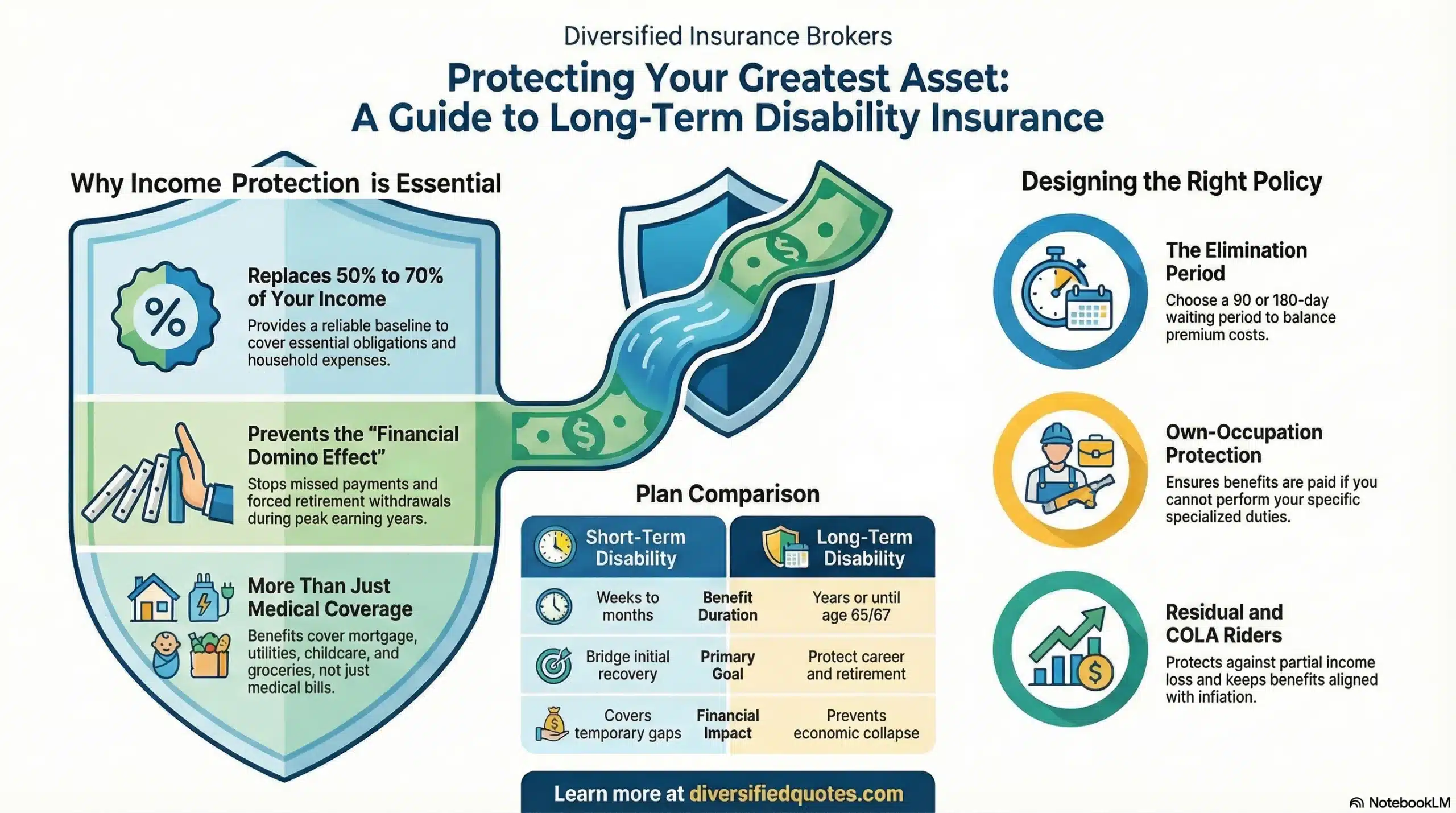
A cost-of-living adjustment rider ensures that benefit amounts keep pace with inflation during an extended disability claim period. For an editor who develops a progressive condition — advancing carpal tunnel syndrome, a chronic cervical spine condition, or a mental health condition requiring extended treatment — a COLA rider ensures the monthly benefit retains its real purchasing power across the full duration of the claim. Our resource on disability income insurance with a COLA rider explains how this inflation protection works and why it matters for extended disability scenarios. The elimination period — the waiting time before benefits begin — should be calibrated to the editor’s available financial reserves, with guidance available in our full resource on how disability insurance elimination periods work.
Why Film and Print Editors Should Work with an Independent Disability Insurance Broker
The disability insurance marketplace offers meaningful variation in how carriers evaluate editing professionals — particularly those with variable freelance income, guild employment structures, or complex compensation arrangements that include project fees, residual income, or production company ownership. An independent broker who understands creative industry income structures, who knows how to present variable project-based earnings to underwriters effectively, and who can identify the carriers most favorable to editing professionals produces materially better coverage outcomes than a standard retail application.
At Diversified Insurance Brokers, we work with post-production professionals across film, television, and print media to structure disability coverage that is genuinely tailored to how editors earn their income and what conditions would actually impair their ability to practice their craft. We evaluate policy definitions, mental health benefit provisions, rider options, and carrier strength across the full competitive marketplace to identify the coverage that provides the most meaningful protection for each individual editor’s professional and financial situation. Our dedicated resource on why independent disability insurance brokers matter explains the full value of this approach for creative and entertainment industry professionals.
Final Thoughts on Disability Insurance for Film and Print Editors
Film and print editors bring a rare combination of technical precision, creative judgment, and storytelling intelligence to their work — a skill set that takes years to develop and that commands meaningful professional income once established. The occupational risks of building and sustaining that career — repetitive strain injuries from sustained precision computer work, vision conditions from intensive screen exposure, musculoskeletal consequences of long editing sessions, and the psychological demands of deadline-driven creative production — are real and capable of interrupting or ending an editing career at any stage.
Disability insurance for film and print editors is the financial tool that ensures a health event does not become a career crisis. A well-structured policy — built around an own-occupation definition, meaningful benefit amounts calibrated to actual editorial income, strong mental health coverage provisions, and appropriate rider selections — provides the income replacement that allows an editor to recover from a disabling condition from a position of financial stability rather than financial desperation.
Related Pages
Talk With an Advisor Today
Choose how you’d like to connect—call or message us, then book a time that works for you.
Schedule here:
calendly.com/jason-dibcompanies/diversified-quotes
Licensed in all 50 states • Fiduciary, family-owned since 1980
Disability Insurance for Film and Print Editors FAQs
Yes, film editors, video editors, and print editors qualify for individual disability insurance and are generally classified at the 3A occupational tier when their work is exclusively post-production and office-based with no physical production hazards. This is among the more favorable occupational classifications available, giving editors access to strong policy features including own-occupation definitions, non-cancelable and guaranteed renewable provisions, benefit periods to age 65 or 67, and a full range of supplemental riders including future increase options and residual disability coverage. The favorable classification reflects the office-based, cognitively intensive nature of editing work and produces competitive premium rates relative to the income being protected. Editors who also perform some field or production work alongside post-production duties may have their classification evaluated based on the full scope of their duties — another area where accurate application presentation matters for the best available terms.
Repetitive strain injuries are the most prevalent occupational health concern for editing professionals. Carpal tunnel syndrome — the most commonly diagnosed and most functionally impairing — develops from the sustained precision mouse and keyboard operation that editing demands across long daily work sessions and extended production cycles. Tendinitis, De Quervain’s tenosynovitis, trigger finger, and thoracic outlet syndrome are additional repetitive strain conditions documented in computer-intensive creative professionals. Vision conditions from sustained close-focus screen exposure — including progressive myopia, computer vision syndrome with persistent symptoms, and other visual deteriorations — represent a meaningful career disability risk given the exceptional visual demands of film editing work. Cervical disc conditions from sustained head-forward workstation postures, lumbar spine conditions from extended seated editing sessions, and mental health conditions including burnout and clinical depression from deadline-driven creative production pressure round out the primary disability risk profile. Our resource on how residual disability benefits work covers how partial disability protection addresses conditions that limit rather than eliminate editing capacity.
Own-occupation disability insurance pays benefits when a condition prevents an editor from performing the specific duties of their role — sustained precision keyboard and mouse operation, sustained visual engagement with complex editing timelines and color-accurate monitors, the cognitive concentration and creative judgment that editing demands — regardless of whether they could theoretically perform other less demanding types of work. For a film editor whose carpal tunnel syndrome prevents sustained precision hand operation but who could technically perform work that does not require fine motor computer operation, an any-occupation policy would deny benefits. An own-occupation policy recognizes the genuine inability to practice editing and pays accordingly. The same principle applies to vision conditions that impair the visual precision editing requires without eliminating all other work capacity, and to mental health conditions that prevent the cognitive performance of deadline-driven editorial work while leaving other lower-demand employment theoretically possible. Understanding this distinction before purchasing any disability policy is essential. Our dedicated resource on own-occupation disability insurance explained covers the full picture of how this definition works in practice.
Freelance and project-based income creates the same income documentation challenge for film editors that it does for other self-employed creative professionals — disability insurance carriers base benefit amounts on verified earned income using federal tax returns, and variable project-based income that fluctuates between years requires careful presentation to underwriters. A film editor with a strong recent year following a leaner development period needs an independent broker who understands how to optimize income documentation for the best available benefit amount. A weighted average of recent income years may produce a more favorable underwriting outcome than a single-year snapshot in either direction. Editors who operate through loan-out corporations or production entities also need specific guidance on how corporate income structures interact with personal disability insurance underwriting — an area where general agents without entertainment industry experience frequently miss important planning nuances. For a related framework on self-employment income documentation, see our resource on disability insurance for independent contractors.
Carpal tunnel syndrome is generally covered under individual disability insurance policies when it reaches a severity that meets the policy’s definition of disability — either total disability preventing all editing work or partial disability reducing editing capacity and income below the threshold that triggers residual benefits. Because carpal tunnel syndrome is a known and documented risk in computer-intensive professions, underwriters review hand and wrist health history carefully for editing applicants. A pre-existing documented carpal tunnel diagnosis at the time of application may result in an exclusion rider or modified policy terms. This is a significant reason to apply for disability insurance early in an editing career — before cumulative workstation use has produced the hand and wrist conditions that are a predictable occupational health outcome for sustained precision computing work. Applying while health is excellent secures the most comprehensive coverage at the most favorable rates, without exclusion riders that would eliminate coverage for the most common disability risk an editor faces.
Many individual disability insurance policies do provide coverage for mental health conditions including clinical depression, anxiety disorders, and burnout-related illness when those conditions prevent the insured from performing their occupational duties. Terms vary significantly between carriers — some provide full benefits for mental health disabilities throughout the entire benefit period, while others limit mental health claims to a 24-month benefit period even when the base policy would otherwise pay to age 65 or 67. For film and print editors whose careers involve sustained deadline pressure, extended crunch periods, and the significant cognitive and creative accountability of editorial work, mental health conditions represent a genuine occupational disability risk. Evaluating the specific mental health coverage provisions of any policy before purchase — not assuming they are adequate — is an important planning step for any editor. At Diversified Insurance Brokers, we assess these provisions specifically when structuring disability insurance for creative post-production professionals.
Residual disability coverage pays proportional benefits when a disabling condition reduces an editor’s earning capacity without eliminating the ability to work entirely. An editor whose carpal tunnel syndrome or cervical spine condition limits daily editing hours — from ten or twelve hours to four or five — earns proportionally less income without being totally unable to work. Without a residual disability rider, a total-disability-only policy pays nothing during this partial disability period. A residual rider supplements reduced earnings proportionally throughout the return-to-work arc, ensuring continuous financial support from the onset of disability through full recovery of normal editorial capacity. For editors whose conditions may develop gradually and produce extended periods of reduced output rather than sudden complete incapacity, residual disability coverage is essential for any disability policy to function as genuine income protection. Our full guide on how residual disability benefits work covers this feature in full detail.
The elimination period — the waiting time between onset of disability and when benefits begin — should be calibrated to the editor’s available financial reserves and any employer or guild short-term disability benefits that may bridge the early weeks of a disability. Staff editors employed by studios, networks, or publishing companies with meaningful employer sick leave may be comfortable with a 90-day elimination period that keeps premiums lower. Freelance editors with no employer sick pay, project-based income that stops immediately when they cannot work, and variable financial reserves should evaluate shorter elimination periods — a 30 or 60-day period provides faster benefit access at a higher premium cost but avoids months of depleting savings before disability benefits begin. Our full guide on how elimination periods work provides the framework for matching the waiting period to each editor’s specific financial situation.
Yes. Guild disability benefits provide a valuable baseline, but they carry significant limitations that make individual disability insurance an important planning complement for most guild-member editors. Guild benefits are tied to covered employment — they do not provide income replacement between productions or during periods when the editor is not working under a covered guild agreement. Benefit amounts from guild health and welfare plans are typically modest relative to the incomes that experienced film editors earn. And guild benefits do not cover non-occupational disabilities with the same comprehensiveness as a well-structured individual policy. An individual disability policy owned personally by the editor provides portable income protection that follows them through production gaps, covers non-guild freelance work, and provides benefit amounts calibrated to actual editorial income rather than union benefit schedule amounts. The combination of guild benefits and an individual disability policy creates the most comprehensive income protection available to guild-member film editors.
A cost-of-living adjustment rider increases the monthly disability benefit amount annually during a claim period, preserving the real purchasing power of benefits across an extended disability. For a film or print editor who develops a progressive condition — advancing carpal tunnel syndrome requiring extended recovery, a chronic cervical spine condition, or a mental health condition requiring sustained treatment — a monthly benefit that is adequate at the onset of disability may lose meaningful real value over several years without COLA protection. The COLA rider ensures the benefit maintains its effective value across the full duration of an extended claim. For editors whose careers span decades, securing a COLA rider while young and healthy ensures this protection is in place for whatever extended disability scenario may eventually occur. Our resource on disability income insurance with a COLA rider explains how this protection works and quantifies why it matters for long-term claim scenarios.
An independent broker has access to multiple disability insurance carriers and can compare policy definitions, occupational class assignments, mental health benefit provisions, income documentation approaches, rider availability, and premium structures across the full marketplace. For film and print editors — particularly those with variable freelance income, guild employment structures, or loan-out corporation arrangements — the differences between carriers in how they evaluate creative industry income and how they structure coverage for computer-intensive cognitive professionals produce meaningfully different coverage outcomes. A captive agent representing a single carrier can only present that company’s approach. At Diversified Insurance Brokers, we evaluate the full competitive landscape and structure coverage that is genuinely calibrated to how editors earn, what conditions would most likely disable them from their specific craft, and what policy features provide the most meaningful financial protection for creative post-production professionals. Our resource on why independent disability insurance brokers matter explains this value for creative and entertainment industry professionals in full detail.
About the Author:
Jason Stolz, CLTC, CRPC, DIA, CAA and Chief Underwriter at Diversified Insurance Brokers (NPN 20471358), is a senior insurance and retirement professional with more than 25 years of real-world experience helping individuals, families, and business owners protect their income, assets, and long-term financial stability. As a long-time partner of the nationally licensed independent agency Diversified Insurance Brokers, Jason provides trusted guidance across multiple specialties—including fixed and indexed annuities, long-term care planning, personal and business disability insurance, life insurance solutions, Group Health, Travel Medical and Evacuation Insurance, and short-term health coverage. Diversified Insurance Brokers maintains active contracts with over 100 highly rated insurance carriers, ensuring clients have access to a broad and competitive marketplace.
His practical, education-first approach has earned recognition in publications such as VoyageATL, and contributions from his agency featured in Kiplinger and GoBankingRates— highlighting his commitment to financial clarity and client-focused planning. Drawing on deep product knowledge and years of hands-on field experience, Jason helps clients evaluate carriers, compare strategies, and build retirement and protection plans that are both secure and cost-efficient. Visitors who want to explore current annuity rates and compare options across multiple insurers can also use this annuity quote and comparison tool.
Explore More Disability Insurance Options: Browse our complete guide to Disability Insurance for Technology, Science & Education — covering software developers, engineers, scientists, teachers, architects & researchers from 100+ carriers.
Last Reviewed: June 8, 2026 |
Reviewed by: Jason Stolz, CLTC, CRPC, DIA, CAA
Chief Underwriter, Diversified Insurance Brokers, Inc. | NPN: 20471358 | Diversified Insurance Brokers, Inc. — Licensed in all 50 states
Fact Checked by: Tonia Pettitt, CMIP©
Medicare Specialist, Diversified Insurance Brokers, Inc. | NPN: 14374308 | Diversified Insurance Brokers, Inc. — Licensed in all 50 states
Did you find this content helpful? Leave us a Google review — it helps others find trustworthy guidance too.
Editorial Standards: Diversified Insurance Brokers maintains rigorous editorial standards to ensure accuracy, clarity, and independence in all content. Learn more about our editorial standards and commitment to transparency.
