
Disability Insurance for Draftsmen
As an Independent Disability Insurance Broker, we have access to exclusive discounts and negotiated pricing most captive agents can’t offer — see the full breakdown near the end of this page.
Disability Insurance for Draftsmen

Jason Stolz CLTC, CRPC, DIA, CAA
Disability insurance for draftsmen is an important but frequently overlooked form of income protection for skilled technical professionals whose careers depend on precision, sustained cognitive performance, and the fine motor capabilities required to produce accurate technical drawings. Whether you work as a CAD technician, a mechanical drafter, an architectural draftsman, a civil drafting specialist, or a structural drawing professional, your income is directly tied to your ability to perform detailed, exacting work — and a disabling condition that interrupts that ability produces immediate financial consequences.
Draftsmen and drafters occupy a favorable position in the disability insurance underwriting landscape. Because the work is predominantly office-based, sedentary, and cognitive in nature, carriers typically assign draftsmen to the 3A occupational class — a tier that reflects the lower physical risk profile of drafting compared to manual trades and field-based occupations. This favorable classification means draftsmen have access to stronger policy definitions, higher benefit amounts, and more competitive premiums than many other professionals seek when exploring disability insurance.
At Diversified Insurance Brokers, we work with draftsmen and drafting professionals across all specializations to structure disability insurance policies that reflect how they actually earn their income and what specific conditions would genuinely disrupt their ability to work. A properly designed policy for a draftsman protects not just physical incapacity but the cognitive and fine motor function that the profession demands — and understanding that distinction is essential to securing coverage that actually performs when needed.
Protect Your Income as a Draftsman
Compare disability insurance options designed for CAD technicians, mechanical drafters, architectural draftsmen, and all drafting professionals.
What Draftsmen Do and Why It Matters for Disability Insurance
Disability insurance for draftsmen begins with a clear understanding of what the profession actually involves — because the specific demands of drafting work determine precisely which disabilities would be most likely to interrupt a draftsman’s ability to earn.
Modern draftsmen work primarily with computer-aided design software — CAD platforms such as AutoCAD, Revit, SolidWorks, and similar applications — to translate engineering and architectural concepts into detailed technical drawings, schematics, blueprints, and 3D models. The work requires sustained concentration, visual acuity, precise mouse and keyboard operation, and the cognitive capacity to manage complex spatial relationships and technical specifications across long working sessions at a computer workstation.
Drafting specializations vary by industry. Mechanical draftsmen create detailed technical drawings for machinery, equipment, and manufactured components. Architectural draftsmen convert architectural designs into construction drawings that guide building projects. Civil draftsmen produce maps, site plans, and infrastructure drawings for transportation, utility, and land development projects. Structural draftsmen work on drawings for bridges, buildings, and other load-bearing systems. Electrical draftsmen document wiring, circuit, and systems layouts for construction and manufacturing projects. Each specialization involves the same fundamental combination of cognitive precision, sustained computer work, and fine motor skill that defines the disability risk profile of the drafting profession as a whole.
The favorable occupational classification that draftsmen receive in disability insurance underwriting reflects the office-based, cognitive nature of the work. Draftsmen who perform exclusively office and computer-based duties are typically assigned to the 3A occupational class — one tier below the highest available — which provides access to strong policy features including own-occupation definitions, comprehensive rider options, and competitive premium rates. This classification advantage is one that draftsmen should understand and take full advantage of by securing disability insurance while young and in good health, before any conditions develop that might complicate underwriting. The same favorable classification applies to other office-based technical professionals, including computer engineers and technical scientists whose cognitive income is similarly protected at favorable occupational tiers.
The Real Disability Risks Facing Draftsmen
While the drafting profession does not involve the physical hazards of manual trades, the occupational risk profile for draftsmen is real and meaningful. Disability insurance for draftsmen addresses a specific set of conditions that directly threaten the cognitive and physical capacities the profession requires.
Repetitive strain injuries are the most prevalent occupational health concern for draftsmen and drafters who spend extended hours operating a mouse, keyboard, and precision input devices. Carpal tunnel syndrome — compression of the median nerve at the wrist — is one of the most commonly diagnosed conditions affecting drafting professionals, producing pain, numbness, tingling, and weakness in the hand and fingers that can make sustained precise mouse operation extremely difficult or impossible. Tendinitis of the wrist and forearm, De Quervain’s tenosynovitis, and trigger finger are additional repetitive strain conditions that develop from the sustained, precise hand and wrist movements that drafting work requires over years of daily computer operation.
For a draftsman whose income depends on precise, continuous mouse and keyboard operation for hours each day, a condition that significantly impairs hand and wrist function is not a minor inconvenience — it is a genuine occupational disability that directly compromises the ability to produce technical drawings at a professional level. A properly structured disability insurance policy recognizes this reality and provides income replacement when these conditions reach a level of severity that prevents continued drafting work. This is the same category of fine motor disability risk that affects other precision hand-use professionals, including bookkeepers and data-focused professionals whose work similarly depends on sustained precise manual input.
Vision impairment is a particularly significant occupational disability risk for draftsmen. The work demands sustained focus on detailed drawings, precise dimensions, small text annotations, and complex graphic information displayed on computer monitors across long working sessions. Progressive vision conditions — including macular degeneration, glaucoma, diabetic retinopathy, and other disorders that reduce visual acuity or field — can gradually or suddenly compromise a draftsman’s ability to perform the visual precision that the profession requires. When vision impairment reaches a level that prevents accurate interpretation and creation of technical drawings, it constitutes a genuine disabling condition under a well-structured own-occupation disability policy.
Neurological conditions affecting concentration, spatial processing, and cognitive function represent a meaningful disability risk for drafting professionals whose work demands sustained mental precision. Conditions including traumatic brain injury, multiple sclerosis, stroke, and progressive neurological disorders can impair the spatial reasoning, attention to detail, and cognitive stamina that technical drafting requires — even without producing total incapacity for all types of work. A draftsman whose cognitive function is impaired by a neurological condition may retain the ability to perform simpler tasks but not the sustained, precise technical work that drafting demands.
Musculoskeletal conditions of the cervical spine and back are a chronic occupational health risk for draftsmen who spend full working days seated at computer workstations, often in environments where ergonomics are not optimally maintained. Cervical spine problems — herniated discs, nerve compression, and degenerative conditions — can produce pain, weakness, and neurological symptoms that affect arm, hand, and fine motor function, directly impacting the ability to operate drafting equipment. Lumbar spine conditions can make sustained seated work at a workstation physically unsustainable for extended periods. These musculoskeletal conditions are well-documented occupational outcomes of sedentary, computer-intensive careers and represent a meaningful income protection consideration for draftsmen. The sedentary work pattern that produces these risks is shared across many technical professions, including cartographers and mapping professionals who face identical workstation-related health exposures.
Disability Insurance for Draftsmen — Occupational Classification and What It Means
Understanding how disability insurance carriers classify the drafting profession is important for draftsmen who want to know what to expect when applying for coverage. Carriers divide occupations into risk tiers — typically labeled 4A or 5A at the highest, down through 3A, 2A, 1A, and B — based on the nature of the work, the physical demands involved, and the historical disability claim experience of the occupational class.
Draftsmen who perform exclusively office and computer-based duties are classified at the 3A tier, which is among the more favorable classifications available in the individual disability insurance market. This classification is meaningful in practical terms: it means draftsmen have access to own-occupation definitions of disability, non-cancelable and guaranteed renewable policy provisions, longer benefit periods including benefits to age 65 or 67, and a full range of supplemental riders including future increase options, cost-of-living adjustment riders, and residual disability coverage. These are the policy features that produce genuinely comprehensive income protection — and draftsmen’s favorable occupational classification makes accessing them straightforward.
One important nuance in draftsman classification is the distinction between office-only draftsmen and those whose duties involve field work or site visits as a regular component of their role. A draftsman who occasionally visits construction sites to gather measurements or review conditions may be classified differently than one who works exclusively from an office or home workstation. Presenting duties accurately and completely to underwriters — including the percentage of time spent in office versus field environments — is an area where working with an independent disability insurance broker produces meaningfully better outcomes than applying directly to a single carrier.
Own-Occupation Disability Insurance for Draftsmen — Why It Matters
The definition of disability in a policy determines when and how benefits are paid — and for draftsmen, the own-occupation definition is the standard that genuinely protects professional income. Own-occupation disability insurance pays benefits when a condition prevents the draftsman from performing the specific duties of their drafting role, regardless of whether they could theoretically perform some other type of work.
This distinction is directly relevant to how draftsman disabilities actually manifest. A draftsman who develops severe carpal tunnel syndrome that prevents sustained mouse and keyboard operation may retain the ability to perform jobs that do not require precise hand and wrist use. Under an any-occupation disability policy, that draftsman might receive no benefits because they can technically work elsewhere. Under an own-occupation policy, that draftsman would receive full benefits because they cannot perform the specific duties of their drafting profession — the precise digital drawing work for which they are trained and compensated.
Similarly, a draftsman with a progressive vision condition that impairs the visual acuity required for detailed technical drawing may retain the ability to perform many other types of work. An any-occupation policy would likely deny benefits. An own-occupation policy would recognize the genuine inability to perform drafting duties and pay accordingly. Given that draftsmen’s favorable 3A occupational classification typically gives them access to own-occupation definitions at competitive premium rates, there is rarely a compelling reason to accept a weaker definition. Securing the strongest available policy definition is consistently the most important single decision in the disability insurance planning process for draftsmen and other cognitive professionals.
Case Study: Mechanical Draftsman Earning $68,000 Per Year
Consider a mechanical draftsman employed by a manufacturing firm, earning $68,000 annually. After developing progressive carpal tunnel syndrome affecting both wrists that does not respond adequately to conservative treatment, this draftsman undergoes bilateral carpal tunnel release surgery requiring a combined recovery period of seven months during which sustained CAD work is not medically advisable.
| Scenario | Without Disability Insurance | With Disability Insurance |
|---|---|---|
| Monthly Income During Recovery | $0 after sick leave exhausted | $2,800–$3,500 |
| 7-Month Total Income | $0 | $19,600–$24,500 |
| Career Impact | Financial pressure may force premature return or career change | Full recovery supported without financial pressure |
| Financial Outcome | Savings depleted, obligations at risk | Income maintained, recovery completed fully |
Carpal tunnel syndrome is among the most commonly documented occupational conditions for drafting professionals — it is not a remote or unlikely scenario. Disability insurance for draftsmen ensures that this predictable occupational health outcome does not simultaneously become a financial crisis during a recovery period that may span months.
Employer Coverage vs. Individual Disability Insurance for Draftsmen
Many draftsmen employed by engineering firms, architecture practices, manufacturing companies, or construction organizations have access to employer-sponsored group disability coverage as part of their benefits package. This coverage provides a valuable baseline but carries significant limitations that make supplemental individual disability insurance for draftsmen an important planning consideration.
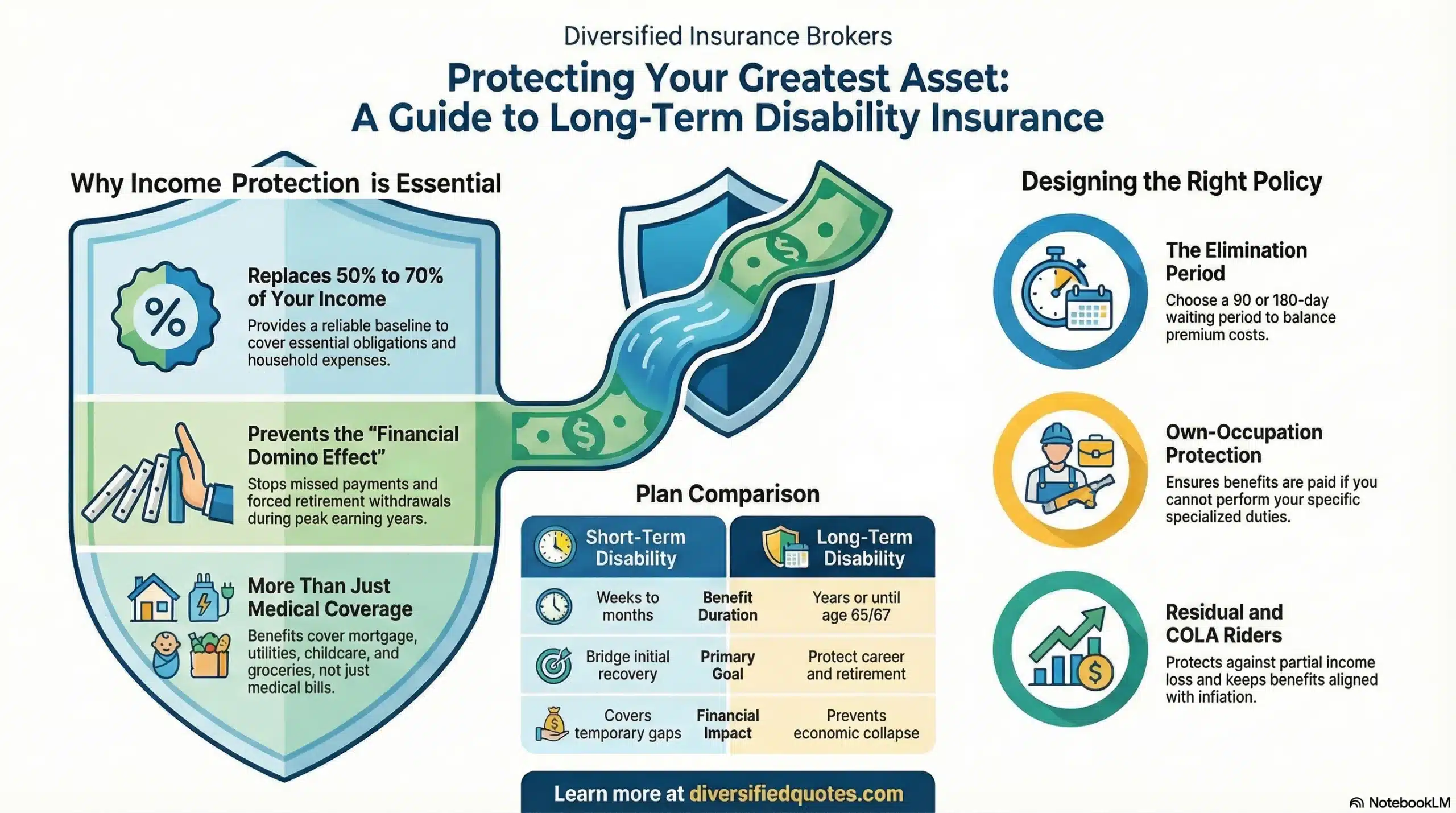
Group disability plans typically replace 60% or less of base salary and are frequently structured without own-occupation definitions — meaning that at some point, benefits may be reduced or eliminated if the carrier determines the draftsman can perform other types of work, even if returning to drafting work is not medically possible. Group plans are also owned by the employer. When employment ends — whether through resignation, layoff, or disability-related separation — the group coverage terminates immediately. An individual disability insurance policy owned personally by the draftsman follows them throughout their career, remains in force regardless of employer changes, and cannot be canceled or altered by anyone other than the policyholder as long as premiums are paid.
Self-employed draftsmen and independent CAD contractors who work on a freelance or project basis have no employer group plan at all. For these professionals, individual disability insurance is not a supplement — it is the only income protection available outside of Social Security Disability Insurance, which has strict eligibility requirements and typically takes many months or years to obtain. Understanding the full landscape of income protection options available to self-employed drafting professionals mirrors the planning considerations facing other independent technical specialists, such as independent consultants managing their own income protection without employer-provided benefits.
Key Policy Features for Draftsman Disability Insurance
Disability insurance for draftsmen should be structured around the specific characteristics of the profession and the most likely disabling conditions. Several policy features deserve particular attention when evaluating options for a drafting career.
The non-cancelable and guaranteed renewable provision locks in both premium rates and coverage terms for the life of the policy, preventing the carrier from increasing premiums or altering coverage as the draftsman ages or accumulates health history. For a draftsman who applies early in their career and secures favorable rates, this provision ensures those rates remain stable across a full working lifetime — a particularly valuable feature given how occupational health conditions tend to develop over years of sustained computer work.
A future increase option allows the draftsman to increase their monthly benefit amount as income grows — without requiring new medical underwriting. This rider is especially valuable for draftsmen earlier in their careers who anticipate meaningful income growth through experience, specialization, or advancement to senior roles. Securing this option early ensures that conditions that may develop over a drafting career cannot prevent future coverage increases.
A residual disability rider pays proportional benefits when a disability reduces income without eliminating the ability to work entirely. For a draftsman whose condition limits work hours or output capacity without producing total inability to draft, this rider supplements reduced earnings during a partial recovery period. Without it, a draftsman working at half capacity earns half income but receives no disability benefit — a coverage gap that residual disability coverage closes completely. Understanding the full range of policy features available to drafting professionals is part of what Diversified Insurance Brokers evaluates for every client, ensuring no important protection dimension is overlooked. Our page on whether disability insurance is worth it for working professionals addresses the value question directly.
Disability Insurance for Self-Employed and Freelance Draftsmen
The growth of independent and freelance drafting work — driven by the portability of CAD software and the availability of remote project collaboration — has created a large population of self-employed draftsmen whose income protection situation is categorically different from that of employed drafting professionals. A self-employed draftsman has no employer sick pay, no group disability plan, and no paid leave of any kind. When illness or injury interrupts the ability to work, income stops immediately and completely.
Individual disability insurance for self-employed draftsmen addresses this vulnerability directly. The policy provides income replacement from any disabling condition — occupational or non-occupational — and is structured around the draftsman’s verified self-employment income documented through tax returns and business records. For draftsmen whose income fluctuates based on project volume, working with an independent broker who understands how to present variable self-employment income to underwriters is essential for securing a benefit amount that reflects actual earning capacity rather than simply the lowest recent year of reported income.
Self-employed draftsmen should also consider business overhead expense coverage as a complement to personal income replacement. If a self-employed draftsman operates a drafting business with ongoing fixed costs — software subscriptions, workstation equipment, office space, or subcontractor relationships — a business overhead expense policy covers those fixed costs during a disability, allowing the business to remain viable while the owner recovers. This is the same dual-coverage approach used by other self-employed technical professionals, including small business owners managing both personal and business income risk during a disability event.
Integrating Disability Insurance Into a Draftsman’s Financial Plan
For draftsmen, disability insurance is the financial foundation upon which all other goals are built. The mortgage, the retirement contributions, the family financial obligations — all depend on continued income from drafting work. A single disabling condition that interrupts that income, without replacement coverage in place, can unravel years of careful financial planning in a matter of months.
Once disability coverage is secured, draftsmen can build additional layers of financial resilience. Understanding how tools like life insurance laddering strategies complement disability coverage creates a more complete income and family protection framework. For draftsmen approaching mid-career and thinking ahead toward retirement planning, exploring guaranteed income solutions becomes an increasingly relevant financial planning dimension alongside continued disability protection.
The combination of individual disability insurance, a clear understanding of employer group plan limitations, and a thoughtful approach to the specific occupational health risks of drafting work creates the most resilient financial position available to a working draftsman. Disability insurance for draftsmen is not a luxury — it is the tool that ensures every other financial goal remains achievable, even when illness or injury intervenes.
Why Draftsmen Should Work with an Independent Disability Insurance Broker
Disability insurance policies vary significantly in their definitions, rider options, premium structures, and carrier-specific underwriting approaches — even within the same occupational classification. For draftsmen, the differences that matter most involve how the own-occupation definition is written, how hand and wrist conditions are handled in underwriting, how vision-related conditions are treated in policy terms, and how self-employment income is documented for benefit calculation purposes.
An independent disability insurance broker with experience in professional and technical occupational classes can compare these dimensions across multiple carriers simultaneously, identifying the option that best serves the individual draftsman’s specific situation. A captive agent representing a single carrier can only present that company’s approach — which may not be the most favorable for a drafting professional’s specific risk profile or income structure. At Diversified Insurance Brokers, we evaluate options across the full marketplace and structure coverage based on how draftsmen actually work and what conditions would actually affect their ability to practice their profession. Our dedicated resource on why independent disability insurance brokers matter explains this value in full detail.
Final Thoughts on Disability Insurance for Draftsmen
Draftsmen and drafting professionals contribute essential technical skill to the engineering, architectural, construction, and manufacturing industries. Their careers are built on precision, sustained cognitive performance, and the fine motor capabilities required to translate complex technical concepts into actionable drawings. A disability that disrupts any one of these capacities — whether through hand and wrist injury, vision impairment, neurological condition, or spinal disorder — can materially impair earning capacity in ways that the profession’s otherwise favorable risk profile can obscure.
Disability insurance for draftsmen is the financial tool that addresses this reality. A well-structured policy — built around an own-occupation definition, strong rider provisions, and a benefit amount calibrated to actual drafting income — provides the income replacement that allows a draftsman to recover, rehabilitate, and return to their profession from a position of financial stability rather than financial desperation. At Diversified Insurance Brokers, we are here to help every draftsman secure that protection at the best available terms.
Related Pages
Talk With an Advisor Today
Choose how you’d like to connect—call or message us, then book a time that works for you.
Schedule here:
calendly.com/jason-dibcompanies/diversified-quotes
Licensed in all 50 states • Fiduciary, family-owned since 1980
Disability Insurance for Draftsmen FAQs
Yes, draftsmen qualify for individual disability insurance and are generally assigned to the 3A occupational class when their duties are exclusively office and computer-based — one of the more favorable classifications in the individual disability insurance market. This classification gives draftsmen access to strong policy features including own-occupation definitions, non-cancelable and guaranteed renewable provisions, benefit periods extending to age 65 or 67, and a full range of supplemental riders. Draftsmen who also perform field or site visit duties as a regular component of their work may be evaluated differently, which makes accurate and complete presentation of job duties an important part of the application process. An experienced independent broker helps ensure the most favorable classification is obtained for each individual application.
Repetitive strain injuries are the most prevalent occupational health concern for drafting professionals. Carpal tunnel syndrome — affecting the hand and wrist through sustained mouse and keyboard operation — is among the most commonly diagnosed conditions in the profession, producing pain, numbness, and weakness that can directly prevent sustained CAD work. Tendinitis, De Quervain’s tenosynovitis, and trigger finger are additional repetitive strain conditions documented in drafting professionals. Vision impairment from progressive eye conditions poses a significant disability risk given the visual precision the work demands. Cervical spine conditions and lumbar back problems develop from sustained seated workstation postures over years of drafting work. Neurological conditions affecting concentration, spatial processing, and cognitive stamina are also meaningful disability risks for professionals whose income depends on sustained precision thinking. For context on how similar conditions affect comparable professions, see our page on disability insurance for computer engineers and scientists.
Own-occupation disability coverage pays benefits when a draftsman cannot perform the specific duties of their drafting role — regardless of whether they could theoretically perform other types of work. This distinction is directly relevant to how draftsman disabilities actually manifest. A draftsman who develops carpal tunnel syndrome severe enough to prevent sustained CAD work may still be capable of performing jobs that do not require precise continuous hand and wrist use. Under an any-occupation policy, that draftsman would receive no benefits. Under an own-occupation policy, full benefits would be paid because the draftsman cannot perform their specific professional duties. The same applies to vision conditions that prevent the visual precision drafting requires but do not eliminate all other work capacity. Because draftsmen’s favorable 3A occupational classification typically gives them access to own-occupation definitions at competitive premium rates, there is rarely a compelling reason to accept a weaker policy definition.
Carpal tunnel syndrome is generally covered under individual disability insurance policies when it reaches a severity that meets the policy’s definition of disability — meaning it prevents the draftsman from performing their occupational duties, or reduces earning capacity below the threshold that triggers residual disability benefits. Because carpal tunnel syndrome is a known occupational risk in computer-intensive professions, underwriters may examine the hand and wrist health history of drafting applicants carefully. If a draftsman already has a documented carpal tunnel diagnosis at the time of application, the condition may be subject to an exclusion rider. This is another important reason to apply for disability insurance early in a drafting career — before occupational health conditions have had the opportunity to develop and appear in the medical record.
Employer group disability plans provide a valuable baseline but carry significant limitations for draftsmen. Group plans typically replace 60% or less of base salary and are often structured without true own-occupation definitions — meaning benefits may be reduced or eliminated at some point if the carrier determines the draftsman can perform other work, even if returning to drafting is not medically possible. Group plans also terminate when employment ends, providing no protection during career transitions. An individual policy owned by the draftsman personally provides portable, own-occupation coverage that follows them throughout their career regardless of employer changes. For self-employed draftsmen and independent CAD contractors, there is no employer group plan at all — making individual disability insurance the only meaningful income protection available. Our page on why working with an independent disability broker matters explains how to navigate these distinctions effectively.
Residual disability coverage pays proportional benefits when a disability reduces earning capacity without eliminating the ability to work entirely. For a draftsman whose condition limits work hours or output capacity — perhaps allowing three to four hours of CAD work per day rather than a full eight-hour shift — income is reduced but not eliminated. Without a residual disability rider, a total-disability-only policy would pay nothing during this period. A residual disability rider supplements reduced earnings proportionally, ensuring the policy provides financial support throughout the entire recovery arc, not just during the most acute phase of complete inability to work. Given that drafting conditions like carpal tunnel syndrome or cervical spine problems often produce gradual functional limitations rather than sudden complete incapacity, residual disability coverage is particularly well-suited to the drafting profession’s most likely disability scenarios.
Disability insurance carriers base benefit amounts on verified earned income, typically using two to three years of federal tax returns. For self-employed draftsmen and independent CAD contractors, Schedule C net profit is the primary income figure used in underwriting. For draftsmen whose income fluctuates across years based on project volume, a weighted average of recent income years may produce a more favorable insurable income figure than the most recent year alone. It is important for self-employed draftsmen to understand that aggressive business expense deductions — while beneficial for tax purposes — reduce the net profit figure on which disability benefits are calculated. Working with an independent broker who understands how to present self-employment income documentation to underwriters in the most favorable accurate light is essential for freelance drafting professionals seeking a benefit amount that reflects true earning capacity.
The elimination period is the waiting time between the onset of disability and when policy benefits begin — equivalent to a deductible measured in days rather than dollars. Draftsmen with employer sick pay available, emergency savings, or a spouse’s income that can temporarily support household expenses are generally well-served by a 90-day elimination period, which meaningfully reduces premiums without creating unreasonable financial hardship during the waiting period. Draftsmen with fewer financial reserves, or self-employed draftsmen who have no employer sick pay and no alternative income source during a disability, may be better served by a 60 or 30-day elimination period that provides faster benefit access at a higher premium cost. The right choice depends entirely on individual financial circumstances and how quickly income loss would create genuine hardship.
The best time is early in a drafting career — ideally in the first years of professional practice, before occupational health conditions have accumulated in the medical record. Disability insurance premiums are based in part on age and health status at the time of application, meaning younger, healthier applicants secure the most comprehensive coverage at the most favorable rates. More importantly, conditions that develop over years of sustained CAD work — carpal tunnel syndrome, cervical spine changes, vision changes, or other repetitive strain conditions — can result in exclusion riders or more restricted policy terms if they are present at the time of application. Applying before these conditions develop ensures that when they eventually appear — as they often do over a drafting career — they are covered under an existing policy rather than excluded from coverage obtained later. The coverage secured early in a career is the coverage available when it is most needed later.
Yes, self-employed draftsmen who operate a drafting business with ongoing fixed costs — software license fees, high-performance workstation equipment, office lease payments, or subcontractor relationships — should strongly consider business overhead expense coverage as a complement to personal income replacement disability insurance. A business overhead expense policy covers the fixed costs of running the business during a disability period, allowing the business to remain viable while the owner-draftsman recovers. Without this coverage, a self-employed draftsman who becomes disabled must pay ongoing business fixed costs from personal savings or disability benefits that were designed to cover personal living expenses — a financially unsustainable situation for an extended disability. Personal disability insurance and business overhead expense coverage address two distinct financial needs and work most effectively when both are in place.
An independent broker has access to multiple disability insurance carriers and can compare policy definitions, occupational class assignments, rider availability, premium structures, and underwriting approaches across the full marketplace. For draftsmen, the differences between carriers in how they handle hand and wrist conditions, vision-related underwriting, and self-employment income documentation can produce meaningfully different coverage outcomes from one carrier to the next. A captive agent representing a single carrier can only present that company’s approach, regardless of whether it is the most favorable for a drafting professional’s specific situation. At Diversified Insurance Brokers, we evaluate the full range of available options and structure coverage that is genuinely tailored to how draftsmen work, what conditions would most likely affect their ability to earn, and what policy features provide the most meaningful protection for the investment made in premiums. Our resources on whether disability insurance delivers real value provide additional context for draftsmen evaluating this decision.
About the Author:
Jason Stolz, CLTC, CRPC, DIA, CAA and Chief Underwriter at Diversified Insurance Brokers (NPN 20471358), is a senior insurance and retirement professional with more than 25 years of real-world experience helping individuals, families, and business owners protect their income, assets, and long-term financial stability. As a long-time partner of the nationally licensed independent agency Diversified Insurance Brokers, Jason provides trusted guidance across multiple specialties—including fixed and indexed annuities, long-term care planning, personal and business disability insurance, life insurance solutions, Group Health, Travel Medical and Evacuation Insurance, and short-term health coverage. Diversified Insurance Brokers maintains active contracts with over 100 highly rated insurance carriers, ensuring clients have access to a broad and competitive marketplace.
His practical, education-first approach has earned recognition in publications such as VoyageATL, and contributions from his agency featured in Kiplinger and GoBankingRates— highlighting his commitment to financial clarity and client-focused planning. Drawing on deep product knowledge and years of hands-on field experience, Jason helps clients evaluate carriers, compare strategies, and build retirement and protection plans that are both secure and cost-efficient. Visitors who want to explore current annuity rates and compare options across multiple insurers can also use this annuity quote and comparison tool.
Explore More Disability Insurance Options: Browse our complete guide to Disability Insurance for Technology, Science & Education — covering software developers, engineers, scientists, teachers, architects & researchers from 100+ carriers.
Last Reviewed: June 7, 2026 |
Reviewed by: Jason Stolz, CLTC, CRPC, DIA, CAA
Chief Underwriter, Diversified Insurance Brokers, Inc. | NPN: 20471358 | Diversified Insurance Brokers, Inc. — Licensed in all 50 states
Fact Checked by: Tonia Pettitt, CMIP©
Medicare Specialist, Diversified Insurance Brokers, Inc. | NPN: 14374308 | Diversified Insurance Brokers, Inc. — Licensed in all 50 states
Did you find this content helpful? Leave us a Google review — it helps others find trustworthy guidance too.
Editorial Standards: Diversified Insurance Brokers maintains rigorous editorial standards to ensure accuracy, clarity, and independence in all content. Learn more about our editorial standards and commitment to transparency.
