
Disability Insurance for Chemists
As an Independent Disability Insurance Broker, we have access to exclusive discounts and negotiated pricing most captive agents can’t offer — see the full breakdown near the end of this page.
Disability Insurance for Chemists

Jason Stolz CLTC, CRPC, DIA, CAA
Disability insurance for chemists is income protection for professionals whose careers are built on a combination of specialized analytical expertise, precision laboratory technique, and domain knowledge that takes years of academic and practical training to develop. Whether working in pharmaceutical development, industrial manufacturing, academic research, government laboratories, environmental science, or materials science, chemists depend on sustained cognitive function, fine motor precision for laboratory manipulation, and the health continuity required to produce reliable analytical work over an extended career. Average chemist compensation reached approximately $112,019 in 2026 according to ZipRecruiter, with materials scientists averaging approximately $124,196, and the Bureau of Labor Statistics projects 6% employment growth for chemists and materials scientists through 2033 — faster than the average for all occupations — driven by pharmaceutical research, energy sector demand, and continued materials science development. This is a career whose income trajectory rewards specialization and compounds over time, creating the same long-term income protection argument that applies to other advanced-degree science professionals: the earlier the coverage, the lower the cost, and the more effectively the income trajectory is protected. At Diversified Insurance Brokers, we help chemists, analytical scientists, materials scientists, and other chemistry professionals compare disability coverage designed around the cognitive, laboratory, and employer structure dimensions of scientific careers. The income protection insurance context covers individual policy construction for research and analytical professionals.
The occupational class for most chemists reflects the primarily cognitive and analytical, non-heavy-physical nature of the work — typically in the middle-to-high range depending on the specific work environment. A research chemist in a pharmaceutical laboratory performing synthesis and analysis in a well-equipped academic or corporate setting is classified more favorably than an industrial chemist working in a manufacturing environment with regular exposure to hazardous reagents and industrial processes. The spectrum of chemical exposure risk across chemistry subspecialties is genuinely wide: organic chemists in synthesis work with reactive compounds that carry acute exposure risk; environmental chemists in the field encounter hazardous waste analysis conditions; industrial process chemists in manufacturing settings work with scaled-up chemical processes carrying different exposure profiles than academic bench work. Carriers evaluate these distinctions. What remains consistent across the occupational spectrum is the cognitive and analytical disability risk: a chemist who cannot perform the precision analytical thinking, data interpretation, and laboratory judgment that defines the profession is disabled from their career whether the cause is a neurological event, a serious mental health condition, or an illness producing sustained cognitive impairment. The disability insurance by occupation and disability insurance for white-collar professionals frameworks cover how cognitive professional occupational class is evaluated across research and scientific careers.
Compare Disability Insurance for Chemists
We compare options across multiple carriers and structure coverage around the occupational class, work environment, income structure, and career stage of chemistry professionals.
Disability Insurance for Chemists — Career Sector, Risk Profile, and Coverage Design
| Employment Sector | Income and Disability Planning Characteristics | Key Coverage Priorities |
|---|---|---|
| Pharmaceutical and biotech industry | Largest private sector employer of chemists; salaried employment with employer group LTD typically included; salaries competitive with industry averages; progression from bench chemistry to project leadership to senior scientific roles with substantial income growth over a career | Individual coverage supplementing employer group plan above benefit caps; own-occupation definition reflecting analytical and research judgment functions; future increase option to protect income trajectory as career advances from bench to senior roles; employer plan portability concern when changing roles between companies |
| Academic chemistry | Faculty positions at research universities; income blend of base salary plus grant-funded research stipend and laboratory support; documented elevated mental health risk for PhD researchers — the same 36-47% clinically significant anxiety and depression rates documented for other PhD research populations; grant dependency creates income documentation complexity | Unlimited mental/nervous benefit period to address documented academic researcher behavioral health risk; benefit sizing from total documented compensation including grant-funded supplements; FIO for early-career faculty with lower initial salaries who will advance over time; understanding of academic benefit structures and their 24-month behavioral health caps |
| Government and federal employment | Federal government chemists at EPA, FDA, NIST, DOE, and defense laboratories have FERS retirement and federal workers’ comp through OWCP; these systems have real value but cover specific eligibility conditions and may leave income gaps particularly for non-service-related disabilities and early-career federal employees with limited FERS accumulation | Individual coverage supplementing federal provisions; particular attention to how federal employment benefits interact with individually owned policies; own-occupation definition that reflects the specific analytical function of the federal laboratory role |
| Industrial and manufacturing chemistry | Process chemists, quality control chemists, and analytical chemists in manufacturing environments work with scaled industrial chemical processes and production environments; chemical exposure risk and working conditions are meaningfully different from academic laboratory settings; higher occupational risk profile than bench-only academic or pharmaceutical research positions | Occupational class evaluation specific to the industrial environment and chemical exposure profile; accurate description of working conditions during underwriting; any-cause own-occupation coverage including chemical exposure-related disability; understanding that carrier appetite and classification may differ from pharmaceutical or academic chemistry placement |
| Independent consulting chemist | Senior chemists with specialized expertise — forensic chemistry, regulatory compliance, environmental analysis, expert witness — who consult as independent contractors; no employer group LTD; variable project income requiring Schedule C documentation; higher income potential than salaried roles for established specialists | Individual LTD as the complete income protection plan; Schedule C income documentation averaged over 2-3 years; own-occupation reflecting the specialized consulting expertise functions; FIO if consulting income is growing as reputation builds |
Cognitive Disability and the Primary Risk for Analytical Professionals
The central disability risk for chemists — regardless of specialty or employment sector — is cognitive and analytical impairment that prevents performing the precision laboratory and scientific judgment work the profession requires. A chemist who cannot maintain the sustained analytical concentration needed for experimental design, instrument operation, data interpretation, and scientific writing is disabled from the work that defines the profession, even when gross physical functioning remains intact. The conditions most likely to produce this cognitive disability are the same ones that affect all knowledge workers: neurological events including stroke and TBI, depression and anxiety severe enough to impair working memory and concentration, multiple sclerosis in its cognitive manifestations, and any chronic illness producing sustained brain fog or cognitive fatigue. For academic chemists, the documented elevated mental health risk among PhD researchers — with clinically significant anxiety and depression rates documented at 36-47% in academic research populations — makes the unlimited mental/nervous benefit period provision of individual disability insurance particularly important. Most employer group LTD plans and university benefit programs cap mental/nervous benefits at 24 months, which is inadequate for serious conditions requiring extended treatment. The cognitive professional disability risk parallel is directly addressed for other research science professionals at disability insurance for biologists, disability insurance for geologists, disability insurance for astronomers, and disability insurance for agronomists — all of whom share the same cognitive professional disability profile and the same academic employer benefit structure limitations. The laboratory science parallel is at disability insurance for lab techs and the pharmacy practice parallel at disability insurance for pharmacists.
Chemical Exposure Risk — How Specialty Affects Coverage
The chemical exposure dimension of chemistry disability risk is genuinely varied across specialties, and accurate occupational disclosure during underwriting is important. Academic bench chemists working with standard research reagents in well-ventilated, properly equipped university laboratories present a different exposure profile than industrial process chemists working with scaled production quantities of hazardous compounds, or environmental chemists performing field analysis of hazardous waste sites. Underwriters evaluate the specific chemicals worked with, safety protocols, personal protective equipment use, and the working environment when assessing the chemical exposure component of occupational class. Chronic exposure to certain solvents and reagents has documented long-term health consequences that carriers consider; disclosure of significant chemical exposure history is part of the medical underwriting process. The accurate framing for most bench and research chemists is that chemical exposure risk is present but is not typically the dominant disability risk that will produce claims — the cognitive and analytical function dimension of disability risk is far more likely to produce career-interrupting disability than chemical exposure for most chemistry specialty sectors. The engineering professional disability context for chemistry-adjacent technical professionals is at disability insurance for engineers, and the academic professional employer benefit structure context is at disability insurance for college professors.
Policy Design — FIO, Benefit Period, and Early-Career Strategy
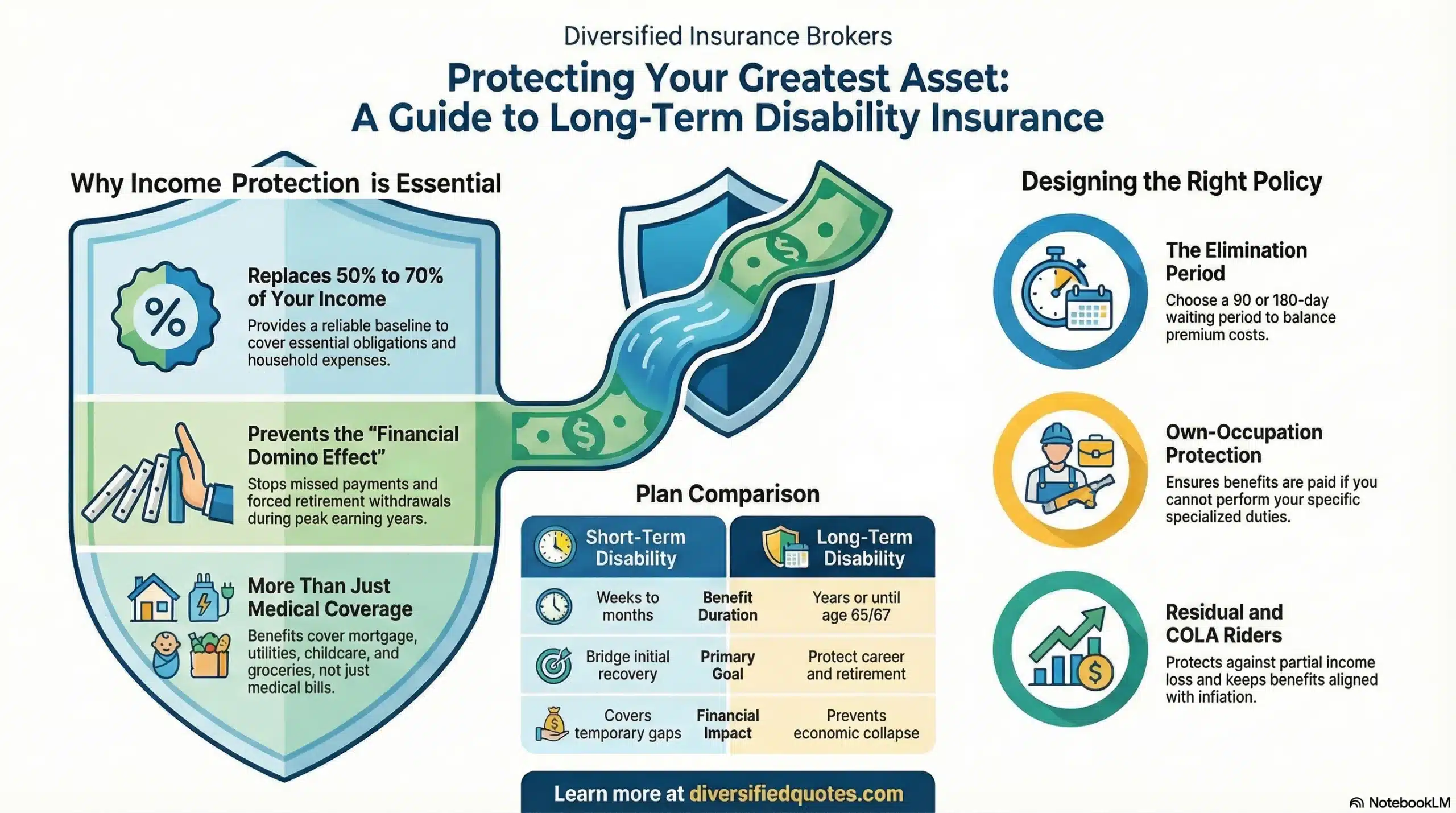
The future increase option is among the most important riders for early-career chemists whose income will grow substantially over a 20-30 year specialty career. A PhD chemist entering the pharmaceutical industry or an academic faculty member with a modest starting salary has an income trajectory that will compound with experience, publications, patents, and seniority — and the FIO preserves the right to protect that growing income without new medical underwriting regardless of what health events occur during the career. Purchasing the maximum available FIO at the initial policy issue date is the most cost-effective way to secure future coverage for the income that hasn’t been earned yet. The benefit period to age 65 — long-term disability insurance at the full career-length standard — protects the full specialization investment. The elimination period for employed chemists with employer sick leave can comfortably be 90 days in most cases; consulting chemists without employer sick time should evaluate shorter elimination periods. The residual disability rider captures partial income loss when a disability reduces research productivity or working hours without fully preventing all laboratory activity. The full rider framework is at disability insurance riders explained. Tax treatment of individually owned benefits is at are disability insurance payments taxable. Benefit sizing is at how much disability insurance do I need. The early-career strategy for new chemistry professionals is at disability insurance for new professionals. No-exam options for chemists at lower benefit levels are at no-exam disability insurance. For consulting chemists, the self-employed context is at disability insurance for self-employed and disability insurance for consultants. For an independent review of any existing or proposed policy, get a 2nd opinion on your disability insurance quote covers the full review process.
Talk With an Advisor Today
Choose how you’d like to connect—call or message us, then book a time that works for you.
Schedule here:
calendly.com/jason-dibcompanies/diversified-quotes
Licensed in all 50 states • Fiduciary, family-owned since 1980
FAQs: Disability Insurance for Chemists
What is the primary disability risk for professional chemists?
The primary disability risk for most chemists is cognitive and analytical impairment — the inability to perform the precision laboratory work, experimental design, data interpretation, and scientific judgment that defines the profession. The conditions most likely to produce this disability are neurological events including stroke and TBI, serious depression and anxiety impairing working memory and concentration, multiple sclerosis in its cognitive manifestations, and chronic illness producing sustained cognitive fatigue. Chemical exposure represents a secondary risk whose severity varies significantly by specialty — industrial and process chemists have meaningfully higher exposure risk than academic bench chemists in well-equipped research settings.
What occupational class do chemists typically receive for disability insurance?
Most chemists in academic and pharmaceutical laboratory settings qualify for middle-to-high occupational classes reflecting the primarily cognitive and analytical, non-hazardous nature of bench research. Industrial and process chemists in manufacturing environments with regular chemical exposure typically receive lower classifications reflecting the elevated hazard profile of production chemistry work. The specific class depends on the work environment, type of chemistry performed, chemical exposure profile, and how occupational duties are presented during underwriting. Academic and pharmaceutical research positions generally produce more favorable classifications than industrial plant-based chemistry roles.
Why is the future increase option important for early-career chemists?
A PhD chemist entering academic or industry positions typically starts at a salary that will grow substantially over a 20-30 year specialty career through promotions, publications, patents, and specialization. The future increase option preserves the contractual right to expand coverage to protect that growing income — without new medical underwriting — regardless of what health events occur during the career. A health condition that develops five years into a career could prevent expanding coverage later without the FIO in place. Purchasing the maximum available FIO at the initial policy issue date is the most cost-effective way to secure future protection for the career income that hasn’t been earned yet.
Does employer group coverage provide adequate disability protection for chemists?
Employer group LTD provides a useful baseline but typically has three meaningful gaps for chemists. Benefit caps limit coverage to a fraction of higher-earning senior scientists’ income. Definitions transition from own-occupation to any-occupation after 24 months in most group plans, removing the profession-specific protection that matters for analytical disability. Mental/nervous benefit periods are capped at 24 months in most group plans — inadequate given the documented elevated mental health risk among research scientists, particularly in academic environments. Individual supplemental coverage addresses all three gaps and provides portability when changing employers or academic institutions.
How is grant-funded academic income documented for disability insurance?
Academic chemists with income that includes both university base salary and grant-funded supplements document total compensation through W-2 forms and university pay records that reflect all salary components. Grant-funded salary supplements paid through the university’s payroll system are documented income for disability insurance purposes. Consulting fees from industry collaborations or expert witness work are documented separately through 1099 forms or Schedule C. The combination of all documented income sources averaged over two to three years establishes the baseline for benefit sizing that reflects the chemist’s actual total compensation rather than just the base academic salary.
About the Author:
Jason Stolz, CLTC, CRPC, DIA, CAA and Chief Underwriter at Diversified Insurance Brokers (NPN 20471358), is a senior insurance and retirement professional with more than 25 years of real-world experience helping individuals, families, and business owners protect their income, assets, and long-term financial stability. As a long-time partner of the nationally licensed independent agency Diversified Insurance Brokers, Jason provides trusted guidance across multiple specialties—including fixed and indexed annuities, long-term care planning, personal and business disability insurance, life insurance solutions, Group Health, Travel Medical and Evacuation Insurance, and short-term health coverage. Diversified Insurance Brokers maintains active contracts with over 100 highly rated insurance carriers, ensuring clients have access to a broad and competitive marketplace.
His practical, education-first approach has earned recognition in publications such as VoyageATL, and contributions from his agency featured in Kiplinger and GoBankingRates— highlighting his commitment to financial clarity and client-focused planning. Drawing on deep product knowledge and years of hands-on field experience, Jason helps clients evaluate carriers, compare strategies, and build retirement and protection plans that are both secure and cost-efficient. Visitors who want to explore current annuity rates and compare options across multiple insurers can also use this annuity quote and comparison tool.
Explore More Disability Insurance Options: Browse our complete guide to Disability Insurance for Technology, Science & Education — covering software developers, engineers, scientists, teachers, architects & researchers from 100+ carriers.
Last Reviewed: June 6, 2026 |
Reviewed by: Jason Stolz, CLTC, CRPC, DIA, CAA
Chief Underwriter, Diversified Insurance Brokers, Inc. | NPN: 20471358 | Diversified Insurance Brokers, Inc. — Licensed in all 50 states
Fact Checked by: Tonia Pettitt, CMIP©
Medicare Specialist, Diversified Insurance Brokers, Inc. | NPN: 14374308 | Diversified Insurance Brokers, Inc. — Licensed in all 50 states
Did you find this content helpful? Leave us a Google review — it helps others find trustworthy guidance too.
Editorial Standards: Diversified Insurance Brokers maintains rigorous editorial standards to ensure accuracy, clarity, and independence in all content. Learn more about our editorial standards and commitment to transparency.
