
Disability Insurance for Architects
As an Independent Disability Insurance Broker, we have access to exclusive discounts and negotiated pricing most captive agents can’t offer — see the full breakdown near the end of this page.
Disability Insurance for Architects

Jason Stolz CLTC, CRPC
Disability insurance for architects is a career-protection decision that benefits from understanding the profession’s unique disability risk profile — one that combines top-tier occupational class credentials with a cognitive disability challenge that is harder to document than most physical conditions, and a mental health burden that the profession’s creative reputation often masks. Architects are consistently rated in the highest available occupational classes by disability insurance carriers, reflecting the advanced education, professional licensing requirements, primarily cognitive and non-hazardous nature of the work, and the relatively low claim experience associated with the profession. That favorable classification means architects have access to the strongest own-occupation definitions, to-age-65 benefit periods, and the full rider menu at competitive premiums — a genuine insurance advantage that makes coverage both accessible and high-quality. The planning challenge is ensuring the policy is structured to reflect what actually makes an architect’s income vulnerable: cognitive disability that doesn’t appear on an X-ray or MRI scan, a mental health risk that accumulates over long project timelines and client conflict, and for principals and firm owners, a business overhead layer that continues regardless of whether the architect can work. The disability insurance services available to design professionals address all of these exposure dimensions, and the income protection insurance framework covers how individual policies are built for professionals with project-based income and practice ownership responsibility.
The AIA Trust maintains group disability plans for AIA members through New York Life Insurance and Unum — accessible coverage options that provide a baseline through group purchasing power. But like all group plans, these carry the standard limitations: monthly benefit caps below what high-earning principals and partners actually need to replace, and the 24-month mental/nervous benefit cap that is particularly dangerous for architects given the profession’s documented burnout and stress-related disability risk. Individual coverage fills these gaps with specialty-specific own-occupation language, unlimited mental/nervous benefit periods, and benefit amounts that reflect actual project-based professional income. At Diversified Insurance Brokers, we help architects at all career stages — from recent licensure through senior principal — structure coverage that reflects the specific cognitive and professional demands of architectural practice and the business ownership structure that many architects eventually develop. The disability insurance by occupation framework covers how occupational class is determined for design professionals.
Compare Disability Insurance for Architects
We compare individual options across 100+ carriers and structure coverage around the cognitive design demands, practice ownership structure, and professional income of licensed architects.
Request Disability Insurance OptionsDisability Insurance for Architects — Occupational Profile, Disability Risks, and Coverage Design
| Coverage Dimension | The Architect Reality | What the Right Design Looks Like |
|---|---|---|
| Occupational class — a genuine advantage | Architects consistently qualify for the highest available occupational classes — disability carriers consider architecture low-risk, reflecting the advanced professional education (typically 5-6 year accredited degree), state licensing requirements, primarily cognitive and office-based nature of design work, and historically favorable claim experience; the highest class produces the best premium rates, strongest own-occupation definitions, and to-age-65 benefit periods | The favorable class is a policy design advantage to leverage rather than merely accept; the coverage investment should be concentrated on definition quality, rider selection, and benefit amount rather than worrying about classification — architecture’s top-class status means those decisions are made on the best possible foundation from the start |
| Cognitive disability — the claim documentation challenge | Architecture requires advanced executive cognitive functions: multi-dimensional spatial reasoning, simultaneous integration of structural, mechanical, and aesthetic requirements, complex regulatory navigation, and sustained creative problem-solving across project timelines that span years; these cognitive functions do not appear on X-rays or MRIs, making cognitive disability claims harder to document than physical conditions; carriers may attempt to minimize the cognitive demands of architectural work to deny claims | Own-occupation policy with definitions that reflect the specific cognitive functions architecture requires — spatial reasoning, design synthesis, regulatory judgment — not just “office work broadly”; in the event of a claim, documentation must articulate how the specific cognitive impairments affect the ability to perform architectural practice functions, not just general daily activities; policy from a carrier whose own-occupation language is clear and specialty-specific |
| Mental health — the dual stress load | Architecture carries a documented mental health burden combining creative stress (subjective design judgment, aesthetic criticism by clients and review boards) with technical-professional pressure (structural safety, code compliance, budget management, contractor disputes, liability exposure); long project timelines mean architects live with design decisions and client relationships for years; burnout and clinical depression are documented risks particularly for principals managing firm operations alongside active design work | Individual policy with unlimited mental/nervous benefit period — the AIA Trust group plans and most employer group LTD cap mental/nervous benefits at 24 months, inadequate for serious conditions requiring extended recovery; this is the single most important policy feature difference between group coverage and individual coverage for architects given the profession’s documented stress and burnout risk profile |
| Visual impairment and design precision | Architectural design demands visual precision — detail drawing, reading construction documents, evaluating spatial proportions, and the fine perception work of material selection and specification; progressive vision conditions that undermine spatial accuracy and detail perception can impair design quality below professional standards before complete vision loss; extended screen-based work contributes to cumulative eye strain over careers | Own-occupation coverage that includes visual impairment affecting design precision as a covered disability; coverage from any cause including conditions affecting visual acuity and spatial perception that prevent professional-standard architectural work; applying before any vision conditions develop prevents pre-existing exclusions on this occupation-specific risk |
| Practice ownership and business overhead | Many experienced architects are principals or owners of architectural firms — with fixed practice overhead including office space, staff salaries, software licenses, and professional liability insurance continuing during disability regardless of whether projects are being produced; a disability that prevents active design work stops revenue generation while overhead continues unchanged | Personal LTD for income replacement combined with Business Overhead Expense coverage for practice owners with meaningful fixed overhead; key person disability coverage for firms where a principal architect’s disability would materially affect the firm’s ability to deliver projects and retain clients; the two-layer personal + business coverage structure is the complete planning approach for practice owners |
| Site visit physical risk | Architects conducting construction site visits and project oversight inspections navigate active construction environments — uneven surfaces, scaffolding areas, partially completed structures, and the physical demands of inspecting large buildings in progress; while site visits are a smaller component of most architectural practice than design work, they represent a meaningful acute injury risk; late-stage project oversight especially involves more physical site presence | Coverage for any cause of disability including physical injuries from site accidents; the site visit component does not affect occupational class but does represent real physical risk that standard disability coverage addresses fully; residual disability rider relevant if site visit capability is reduced but design work continues |
The Cognitive Disability Documentation Problem — Why Own-Occupation Language Matters for Architects
Architecture involves advanced executive functions that carriers frequently underestimate when evaluating disability claims: three-dimensional spatial reasoning required to visualize and communicate built environments before they exist; simultaneous integration of structural engineering, mechanical systems, aesthetic requirements, code compliance, and client programming into coherent design solutions; sustained creative problem-solving across project timelines that extend over years; and the professional judgment to navigate the complex human dynamics of client management, contractor coordination, and regulatory approval processes. None of these functions produces evidence on conventional medical imaging. An architect whose depression has eliminated their creative engagement with design problems, whose anxiety has made client presentations and review board appearances professionally untenable, or whose neurological condition has degraded the spatial reasoning that design depends on is genuinely disabled from architectural practice — but may appear physically capable on a standard medical evaluation. The documented pattern for cognitive disability claims in architecture mirrors the pattern for engineers and other technical professionals: carriers may minimize the cognitive complexity of the work, arguing that an architect could perform generic “office work” even when they cannot perform the specific cognitive functions architectural practice requires. Own-occupation disability insurance with language specifically tied to the duties of architectural practice is the defense against that mischaracterization. The disability insurance for white-collar professionals context covers how cognitive disability documentation challenges appear across technical and design professions.
Architecture’s Mental Health Burden — The Dual Stress Load
The mental health dimension of architectural disability risk is more significant than is often acknowledged. Long project timelines mean architects form multi-year relationships with clients, contractor teams, and regulatory bodies — and live with the consequences of design decisions, budget challenges, construction disputes, and client dissatisfaction over extended periods. The creative dimension of the work introduces an occupational stressor that technical professions often avoid: architectural work is aesthetically judged by clients, review boards, community stakeholders, and the public in ways that subject the architect’s professional judgment to subjective criticism that most engineers and accountants never experience. This creative stress layer combines with the objective pressure of structural safety responsibility, liability exposure, and the financial project management demands of firm operation to produce a dual stress load documented in the profession’s burnout literature. For principals managing firm operations alongside active design work — the administrative, business development, personnel, and financial responsibilities of running a practice — the accumulated load is particularly intense. Clinical depression and burnout at a disabling level are genuine career risks for mid- and late-career architects. The 24-month mental/nervous cap in most group coverage — whether AIA Trust plans or employer group LTD — is inadequate for serious conditions requiring extended treatment and recovery. Individual policies with unlimited mental/nervous benefit periods are the essential protection against this documented professional risk. The same mental health risk pattern with the same coverage implication applies to adjacent creative and technical professions: interior designers, visual artists, and graphic designers who carry the same creative judgment pressure without the additional structural safety and regulatory compliance load that architecture adds.
Practice Ownership — The Two-Layer Planning Need
Many architects progress from employed staff positions to principal or partner roles in firms, and ultimately to founding or leading their own practices. This career arc creates an evolving disability planning need: early-career architects at firms primarily need personal income replacement coverage; mid-career architects moving into leadership should evaluate whether their firm role creates a key-person exposure that warrants additional business-level coverage; and principal architects who own their practices need the full two-layer personal LTD plus Business Overhead Expense structure. Business overhead disability insurance and disability business overhead expense coverage address the fixed costs of running an architectural practice — staff salaries, software, professional liability insurance, office space, and professional memberships — that continue during disability. For firms where a principal’s disability would materially affect the practice’s ability to deliver projects and maintain client relationships, key person disability insurance provides business-level income protection. The disability insurance for consultants framework covers the solo practitioner and consulting principal planning considerations for architects who operate their own practices, and disability insurance for executives covers the income protection imperative for partner and principal income levels. For self-employed architects and those operating as sole practitioners, disability insurance for self-employed professionals covers the income documentation approach for practice owners without employer income backup.
Policy Design for Architects
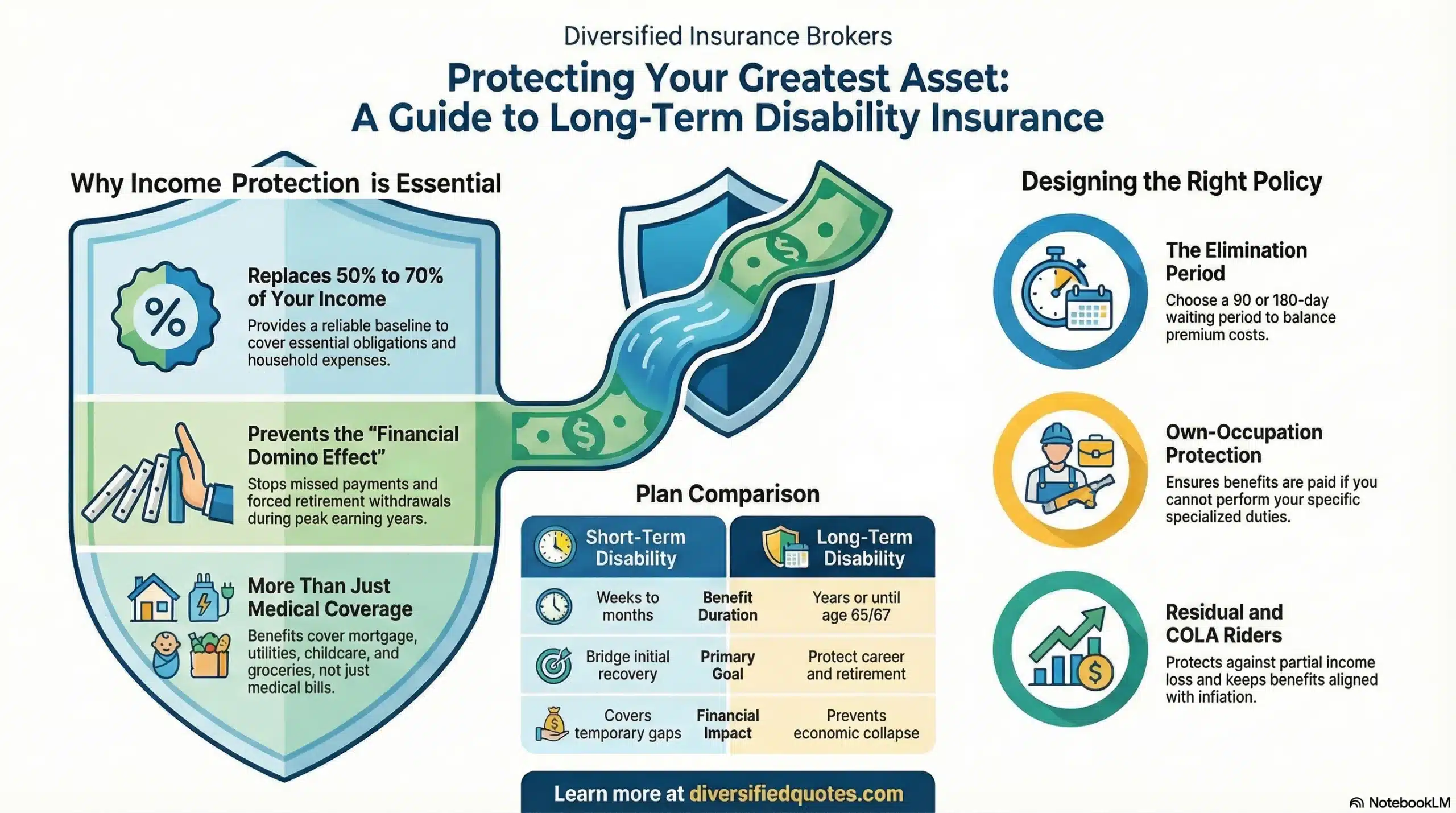
The benefit period to age 65 — long-term disability insurance at the to-age-65 standard — protects the full career trajectory of an architectural practice that accumulates value over decades. The elimination period for employed architects with meaningful employer sick leave may comfortably be 90 days; for principals with practice obligations and no employer paid leave, shorter periods better reflect the immediate income exposure. The future increase option allows coverage to grow as income progresses through the associate-to-principal trajectory without new medical underwriting — critical for architects in the career years when income is still growing but health history could complicate future applications. The residual disability rider captures partial income loss when cognitive capacity is reduced — a particularly realistic scenario for architects whose productivity can decline meaningfully before a full disability threshold is reached. The COLA rider protects purchasing power for long-duration benefits — important for architects disabled in their prime career years who may receive benefits for 20+ years. Tax treatment of individually owned benefits is at are disability insurance payments taxable. Benefit sizing for project-based and firm-distribution income is at how much disability insurance do I need. For an independent review of any AIA Trust group plan or existing individual policy, get a 2nd opinion on your disability insurance quote covers the process.
Talk With an Advisor Today
Choose how you’d like to connect—call or message us, then book a time that works for you.
Schedule here:
calendly.com/jason-dibcompanies/diversified-quotes
Licensed in all 50 states • Fiduciary, family-owned since 1980
FAQs: Disability Insurance for Architects
What occupational class do architects qualify for and why does it matter?
Architects consistently qualify for the highest available occupational classes, which disability insurance carriers assign based on the advanced education requirements, state licensing, primarily cognitive non-hazardous nature of the work, and historically low claim experience of the profession. The highest occupational class produces the most competitive premium rates, access to the strongest own-occupation definitions and unlimited benefit periods, and the full rider menu. For architects, this is a genuine insurance advantage — the favorable class means coverage quality is high and pricing is relatively competitive compared to professions with physical risk components.
Is the AIA Trust group disability plan sufficient for most architects?
The AIA Trust group disability plans — offered through New York Life Insurance and Unum for AIA members — provide accessible baseline coverage and are worth understanding as a starting point. However, like all group plans, they carry significant limitations for mid-career and senior architects: monthly benefit caps that fall below what principals and partners actually earn; the same 24-month mental/nervous benefit cap that all group plans apply — inadequate for architecture’s documented burnout and stress-disorder risk; and definitions that may not reflect the specific cognitive demands of architectural practice the way individual own-occupation language can. Individual coverage fills these gaps and is particularly important for architects earning above the group plan cap and those in leadership or ownership roles.
Why is cognitive disability documentation particularly challenging for architects?
Architecture’s most important work functions — spatial reasoning, multi-dimensional design synthesis, regulatory judgment, sustained creative problem-solving — do not produce physical evidence on conventional medical imaging like X-rays or MRIs. An architect whose cognitive disability prevents professional-level design work may appear physically healthy on standard evaluation. Carriers may minimize the cognitive complexity of architectural work to deny or limit claims, arguing that an architect could perform “generic office work” even when they cannot perform the spatial reasoning and design synthesis that constitute the actual professional practice. Successfully documenting a cognitive disability claim requires clearly articulating how specific impairments affect the material functions of architectural work — not just daily activities — which is why working with an experienced disability claim advocate matters if a claim situation arises.
What disability coverage do architects who own their firms need beyond personal income protection?
Architect-owners need to consider two layers beyond personal income protection. Business Overhead Expense coverage reimburses the fixed costs of running the practice — staff salaries, software, professional liability insurance, office space — that continue during disability when revenue drops. This preserves the business infrastructure so the practice can survive a disability period rather than deteriorating while the owner recovers. For firms where the principal architect’s disability would materially affect the firm’s ability to deliver projects and maintain clients, key person disability insurance provides business-level income protection addressing that specific dependency. The personal LTD policy and the BOE policy serve distinct functions and most practice owners need both.
When is the best time for an architect to purchase individual disability insurance?
As early in the career as possible — ideally during the first years of professional practice before any health conditions develop that could create exclusions or higher premiums. Premiums lock in at the issue age and do not increase with age alone. The Future Increase Option rider purchased early preserves the right to expand coverage as income grows from junior associate through licensed architect through principal — without new medical underwriting regardless of health changes in the career years. Architecture’s documented mental health and burnout risk profile means that health conditions specifically associated with the profession’s stress load have a meaningful probability of developing during a long career; securing coverage before those conditions emerge is substantially preferable to applying after they appear on a medical history.
About the Author:
Jason Stolz, CLTC, CRPC, DIA, CAA and Chief Underwriter at Diversified Insurance Brokers (NPN 20471358), is a senior insurance and retirement professional with more than 25 years of real-world experience helping individuals, families, and business owners protect their income, assets, and long-term financial stability. As a long-time partner of the nationally licensed independent agency Diversified Insurance Brokers, Jason provides trusted guidance across multiple specialties—including fixed and indexed annuities, long-term care planning, personal and business disability insurance, life insurance solutions, Group Health, Travel Medical and Evacuation Insurance, and short-term health coverage. Diversified Insurance Brokers maintains active contracts with over 100 highly rated insurance carriers, ensuring clients have access to a broad and competitive marketplace.
His practical, education-first approach has earned recognition in publications such as VoyageATL, and contributions from his agency featured in Kiplinger and GoBankingRates— highlighting his commitment to financial clarity and client-focused planning. Drawing on deep product knowledge and years of hands-on field experience, Jason helps clients evaluate carriers, compare strategies, and build retirement and protection plans that are both secure and cost-efficient. Visitors who want to explore current annuity rates and compare options across multiple insurers can also use this annuity quote and comparison tool.
Explore More Disability Insurance Options: Browse our complete guide to Disability Insurance for Technology, Science & Education — covering software developers, engineers, scientists, teachers, architects & researchers from 100+ carriers.
Last Reviewed: June 6, 2026 |
Reviewed by: Jason Stolz, CLTC, CRPC, DIA, CAA
Chief Underwriter, Diversified Insurance Brokers, Inc. | NPN: 20471358 | Diversified Insurance Brokers, Inc. — Licensed in all 50 states
Fact Checked by: Tonia Pettitt, CMIP©
Medicare Specialist, Diversified Insurance Brokers, Inc. | NPN: 14374308 | Diversified Insurance Brokers, Inc. — Licensed in all 50 states
Did you find this content helpful? Leave us a Google review — it helps others find trustworthy guidance too.
Editorial Standards: Diversified Insurance Brokers maintains rigorous editorial standards to ensure accuracy, clarity, and independence in all content. Learn more about our editorial standards and commitment to transparency.
