
Disability Insurance for Consultants
As an Independent Disability Insurance Broker, we have access to exclusive discounts and negotiated pricing most captive agents can’t offer — see the full breakdown near the end of this page.
Disability Insurance for Consultants

Jason Stolz CLTC, CRPC, DIA, CAA
Independent consultants occupy one of the most financially exposed positions in the professional workforce — not because the occupation carries physical danger, but because the professional income structure of consulting combines very high earning potential with the complete absence of any employer-provided income protection baseline, creating the largest ratio of income at risk to income protected of virtually any professional category. The self-employed management consultant earning $200,000 annually, the independent IT consultant billing $180 per hour on contract, the financial consultant who left a wirehouse to build an independent practice — each generates exceptional professional income that derives entirely from their own expertise, relationships, and cognitive capacity to perform, with no employer group plan, no workers’ comp, and no institutional safety net of any kind protecting that income when disability eliminates the ability to deliver. Bureau of Labor Statistics data places consulting and professional advisory occupations among the most favorably classified occupations in disability insurance underwriting — top-tier or near-top-tier classifications that produce the lowest available premium rates — making individual disability insurance genuinely affordable relative to the exceptional consulting income being protected. The combination of high income, favorable occupational class, and complete absence of employer protection creates a planning situation where income protection for professional service practitioners is both more financially consequential and more accessible than in almost any other professional context.
At Diversified Insurance Brokers, Jason Stolz, CLTC, CRPC, DIA, CAA works with independent consultants across every specialty the consulting profession encompasses — management strategy consultants, IT and technology consultants, financial and investment consultants, marketing and communications consultants, human resources consultants, operations and supply chain consultants, and the full range of professional advisory and specialist consulting practices. The coverage architecture for a solo independent consultant billing from a home office differs from what a consulting practice owner who has built a team with overhead obligations and client-facing infrastructure needs — and both require specific attention to the income documentation complexity of variable consulting engagements, the own-occupation definition that protects the cognitive and advisory dimensions of the work, and the self-employment coverage gap that consulting’s professional independence creates.
Compare Disability Coverage for Consultants
We review coverage options across 100+ carriers and identify the policy structure that fits your consulting income, practice structure, and occupational risk profile.
Consultant Disability Risk — Cognitive Impairment, Variable Income, and the Complete Coverage Gap
| Risk Category | Source / Professional Context | Resulting Disability Risk | Coverage Status | Income Protection Gap |
|---|---|---|---|---|
| Cognitive disability from neurological events | Consulting income derives from cognitive capacity — analytical reasoning, strategic judgment, specialized expertise, and the client-facing communication that delivers consulting value; neurological events including stroke, traumatic brain injury, or progressive neurological conditions directly eliminate the cognitive capacities that generate consulting fees | Cognitive impairment preventing the complex analysis, specialized judgment, and client advisory functions that define consulting work — a disability that eliminates consulting income even when physical capacity remains largely unaffected | Self-employed consultants carry zero employer coverage; individual DI is the entire protection system | Full gap; own-occupation DI covering the cognitive advisory demands of consulting is the only relevant income protection |
| Mental health and professional burnout | Independent consulting combines the sustained performance pressure of client delivery with the financial anxiety of variable billing income, the isolation of solo or small practice work, and the absence of institutional support structures; the occupational stress profile of high-stakes consulting creates elevated burnout and psychiatric risk compared to salaried employment | Disabling anxiety, depression, or burnout preventing the sustained cognitive performance, client relationship management, and strategic judgment delivery that consulting income requires | Zero employer coverage; unlimited mental health benefit period in individual DI is essential for a profession whose primary risk is cognitive and psychological | Full gap; individual DI with unlimited mental health benefit period addresses the primary cognitive disability pathway of independent consulting |
| Ergonomic conditions from sustained computer work | Consulting work is primarily screen-based — analysis, writing, presentation development, and communication all occur through sustained computer use; the same ergonomic RSI pathways documented in other intensive computer professions apply to consultants, including carpal tunnel syndrome, cervical disc conditions, and the musculoskeletal loading of sustained sedentary screen work | Wrist or hand conditions preventing sustained computer work; cervical disc disease preventing sustained seated screen engagement — conditions that eliminate the working medium through which consulting income is generated | Zero employer coverage; self-employed consultants entirely unprotected for ergonomic conditions without individual DI | Full gap; own-occupation DI covers ergonomic disability preventing consulting work specifically |
| Business overhead for consulting practice owners | Consultants who have built practices with office space, support staff, software subscriptions, professional memberships, and client-facing infrastructure carry fixed overhead obligations that continue during a disability regardless of whether engagements are being delivered | Consulting practice overhead continuing against zero engagement revenue during a disability period — obligations that can threaten practice survival during a disability that would otherwise be recoverable | No automatic coverage; personal DI only replaces personal income, not practice overhead | Second critical gap for practice owners; BOE disability coverage addresses this layer alongside personal income replacement |
| Income variability and documentation challenge | Consulting income is inherently variable — engagement availability, project timing, client budget cycles, and the natural variability of a professional advisory business create income that fluctuates significantly around an annual average; establishing a documentable benefit basis from variable consulting income requires specific underwriting approach | Underinsurance risk from benefit sizing based on low-income-year averaging rather than sustainable average consulting income; potential benefit shortfall relative to actual household obligations during a disability period | Not a coverage limitation but an underwriting planning challenge requiring specific documentation approach | Planning gap addressed through multi-year average income documentation and independent broker expertise in professional services income underwriting |
| Illness-based disability (non-occupational) | Cancer, cardiac events, neurological conditions — health events independent of consulting activity that eliminate the cognitive and physical capacity for sustained professional advisory work | Extended inability to perform client engagements, deliver analytical work, manage client relationships, and maintain the consulting practice | Not covered by workers’ comp; no employer coverage; approximately 90% of long-term disabling conditions are illness-based | Complete gap; individual DI to age 65 is the only protection available for the dominant disability probability category |
The table establishes the consultant’s disability risk profile as primarily cognitive and psychological — the intellectual and advisory capacity that generates consulting income is the professional instrument at risk, and the conditions that impair it — neurological events, mental health conditions, serious illness — are the dominant disability pathways. Unlike physical trade occupations where disability risk is primarily physical, the independent consultant’s disability risk is concentrated in the cognitive and health domains that individual disability insurance specifically and comprehensively addresses. Income protection for high-earning self-employed professionals is precisely the product category that serves the independent consultant’s profile — high income, favorable occupational class, complete coverage gap, and a disability risk that is genuinely consequential despite the absence of physical hazard.
The Own-Occupation Definition for Consultants — Why It Matters More Than Most Realize
The disability definition is the most important policy feature for an independent consultant — because consulting is a specialized professional service that cannot be replaced by generic alternative employment without eliminating the specific market premium the consultant has spent a career developing. A management strategy consultant who develops a cognitive condition preventing the complex organizational analysis and strategic recommendation work that clients engage them for has experienced a genuine occupational disability from consulting specifically — even if they could theoretically perform some simpler cognitive work. An IT consultant whose condition prevents the sustained technical problem-solving and client advisory functions that generate $180/hour billing rates has experienced a career-value disability — the years of expertise and reputation that produce that billing rate are being eliminated — even if they could theoretically perform less specialized technical work at a fraction of the billing rate.
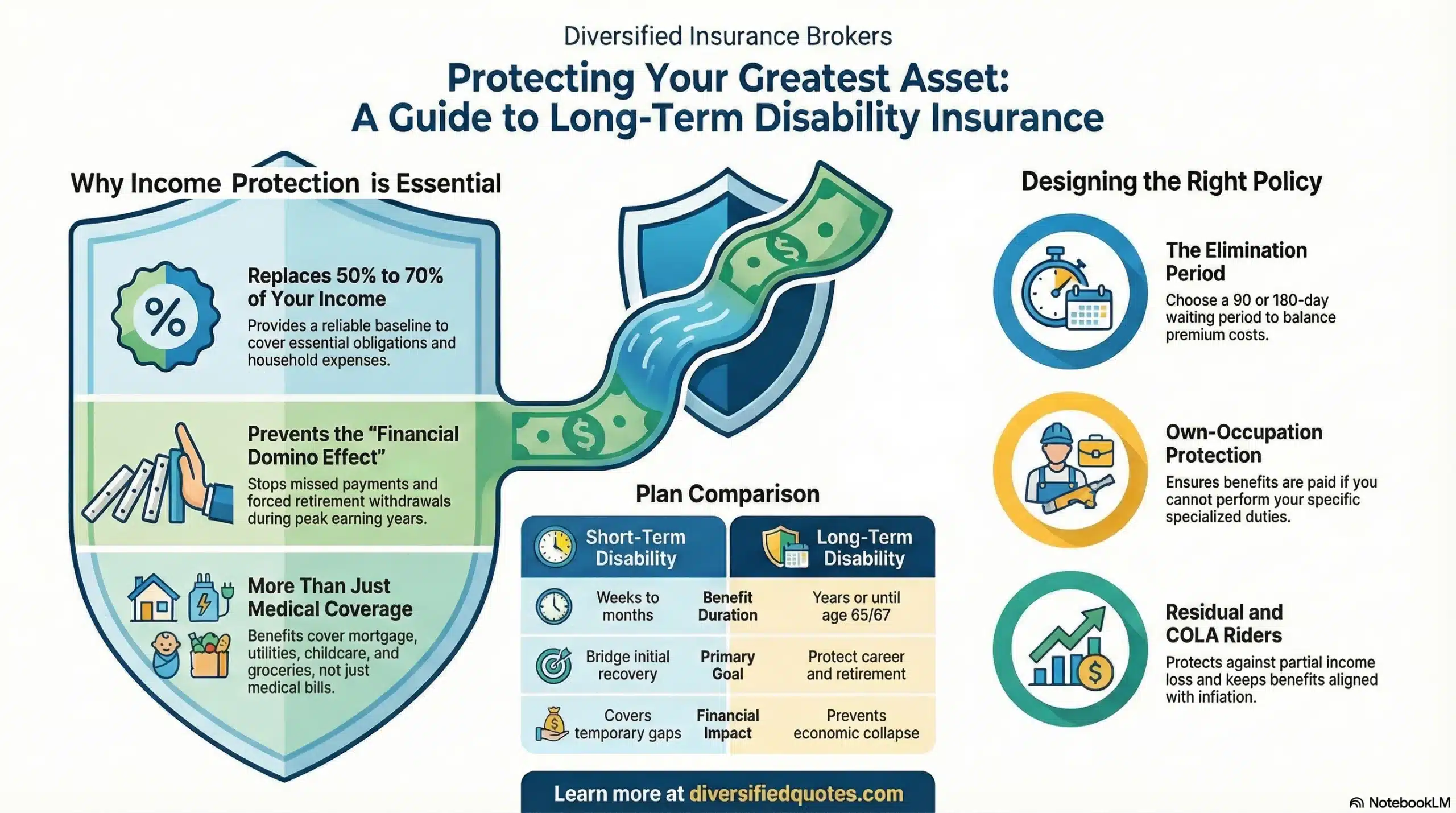
A true own-occupation disability policy pays benefits when the insured cannot perform the material and substantial duties of their specific occupation — consulting in their particular specialty — even if theoretically capable of other work. This protection is what preserves the financial value of the consultant’s career during a disability period, rather than requiring the impossible standard of complete inability to perform any cognitive work before benefits activate. Residual disability coverage is equally important for consultants, since realistic cognitive disability scenarios — a mental health condition that limits analytical capacity but does not eliminate all work, a recovering neurological event allowing partial but not full consulting engagement — frequently produce partial rather than total disability. A residual benefit pays proportionally based on actual income reduction from partial disability, addressing these common realistic trajectories rather than forcing total disability as the only benefit trigger. Understanding how short-term and long-term disability structures interact is important for consultants whose disability scenarios range from recoverable — a burnout episode requiring three months of rest — to permanent, where a serious neurological event ends the consulting career entirely.
The Consulting Practice Business Layer — BOE and Key Person Considerations
Independent consultants who have built practices beyond solo operation — with office or co-working space commitments, support staff or junior consultants, software and technology infrastructure, professional memberships, and branded client-facing resources — carry the two-layer disability exposure that any professional service practice owner faces. The personal income layer — consulting fees from their own billable work — stops when disability prevents engagement delivery. The practice overhead layer — office costs, staff salaries, software subscriptions, professional liability insurance premiums, and all other fixed practice costs — continues regardless. Business overhead expense disability coverage addresses the practice’s fixed operating costs during the principal consultant’s disability — paying documented monthly overhead to maintain the practice infrastructure while personal income coverage addresses the household. The BOE structure preserves the client relationships, the practice brand, and the team continuity that represent the practice’s going-concern value — rather than allowing an otherwise recoverable disability to trigger the unwinding of a professional practice built over years. For consulting practices where a junior partner or associate consultant contributes meaningfully to client delivery, key person disability coverage addresses the revenue loss the practice sustains from that person’s disability beyond their own salary costs — funding replacement engagement capacity during the key person’s recovery period.
Income Documentation and High-Earner Coverage Stacking
The income documentation process for independent consultants uses Schedule C for sole-proprietor consulting businesses, Schedule K-1 for consulting partnerships and multi-member LLCs, and W-2 plus K-1 for S-corporation-structured consulting practices — whichever reflects the actual business structure through which consulting fees flow. Most carriers use a two-year average of documented net earned consulting income, smoothing year-to-year variability from engagement timing and client budget cycles. For consultants whose income varies significantly between active-engagement and between-engagement periods, the two-year average approach produces a benefit basis that reflects sustainable consulting income rather than penalizing a slow year or rewarding a peak year.
For high-earning consultants whose documented average income substantially exceeds standard carrier monthly benefit ceilings — typically $20,000 to $30,000 per month at single carriers — high-income disability insurance structures layering coverage across multiple carriers produce total monthly benefits more closely calibrated to actual consulting income. A consultant earning $250,000 to $400,000 annually requires $12,500 to $20,000 per month in disability benefit at 60 percent replacement — levels that may require two carriers or specialty high-limit coverage to achieve. Income documentation for 1099-earning consultants follows the Schedule C framework. Coverage structures for independent consulting contractors covers the specific architecture for project-based and retainer-based consulting income documentation. The rider options most relevant for consultants include the future increase option for consultants in growth phases, and the cost of living adjustment rider protecting real benefit purchasing power across a potentially multi-decade disability. Coverage for consultants with documented health histories is available through independent broker channels. Specialty and modified options address consultants whose health history creates standard underwriting complexity. No-exam coverage provides streamlined approval for healthy consultants at appropriate benefit amounts. Getting the best rates as a consultant takes advantage of the favorable top-tier occupational class through independent carrier comparison. Choosing the right policy for an independent consultant specifically requires confirming the own-occupation definition covers the cognitive advisory functions of the consulting specialty before any purchase decision. Why early-career consultants need coverage before cognitive health events accumulate is answered by the statistics: approximately 25 percent of workers experience disability before retirement age, and at consulting income levels the financial consequence of an uninsured disability period is among the most severe in any professional category. Whether coverage is worth the cost for a consultant earning $200,000 or more annually is answered immediately by calculating the monthly consulting income lost against the annual premium cost of the policy that prevents it. Guarantee issue coverage provides access for consultants whose health history creates standard underwriting challenges. Whether disability benefits are taxable for a consultant: premiums paid personally with after-tax income generally produce tax-free benefits — for high-earning consultants at their marginal tax rates, this tax-free character represents substantial additional benefit value compared to a taxable group plan at equivalent gross benefit amounts.
Get Your Consultant Coverage Review
We compare top-tier occupational class assignments, own-occupation definitions, and consulting income documentation across 100+ carriers to build the protection that fits your specific consulting practice.
Talk With an Advisor Today
Choose how you’d like to connect—call or message us, then book a time that works for you.
Schedule here:
calendly.com/jason-dibcompanies/diversified-quotes
Licensed in all 50 states • Fiduciary, family-owned since 1980
FAQs: Disability Insurance for Consultants
I left my corporate job to consult independently — what happened to my disability insurance when I left?
When you left your corporate employer, you left behind whatever group long-term disability benefit the employer provided — and that benefit did not follow you into independent consulting. Group LTD plans are employer-provided benefits that terminate when employment ends; they are not portable, they do not convert to individual coverage automatically, and they do not protect the income you earn from your own consulting practice. The transition from employed professional to independent consultant is the moment when the disability protection gap opens fully — your consulting income begins immediately, but the group plan coverage ended the day employment did, leaving the full consulting income unprotected from the first independent billing day.
Establishing individual disability insurance at or near the start of the consulting practice is the appropriate response to this transition — not waiting until the practice is established and income is documented, since the policy applies from issue date and the health underwriting is most favorable at the moment of transition before any new health events develop. Most disability insurance carriers require two years of self-employment income documentation for benefit sizing at the maximum approvable level, but many allow issue at a conservative initial benefit during the first one to two years of practice with the future increase option allowing benefit growth without new medical underwriting as documented income grows. The sooner after the corporate-to-consulting transition individual coverage is established, the broader the available coverage terms before any health events in the new professional chapter develop their own underwriting record. A second opinion on any coverage proposal at the transition point confirms whether the initial policy structure correctly anticipates income growth and includes the riders that serve the specific consulting career trajectory.
My consulting income varies widely year to year — how does that affect coverage sizing?
Variable consulting income is the most common income documentation challenge for independent consultants applying for disability insurance — and the multi-year averaging approach that most carriers use is specifically designed to address this variability fairly rather than penalizing a slow year or rewarding a single exceptional year. Most carriers use a two to three year average of documented net earned consulting income from Schedule C or Schedule K-1 records to establish the income basis for the benefit calculation, then apply the carrier’s replacement percentage — typically 60 to 70 percent — to that average to determine the maximum approvable monthly benefit. An exceptional client engagement year that produced $300,000 in consulting fees followed by a transitional year at $150,000 produces an average that reflects sustainable consulting income more accurately than either individual year alone.
The practical implication for income documentation is that consistent and complete Schedule C filing — capturing all consulting engagement fees, retainer income, project-based fees, and any other earned consulting income — across multiple years produces the most favorable and accurate benefit basis. Consultants who structure their practices as S-corporations, partnerships, or multi-member LLCs should ensure that both W-2 compensation from the entity and pass-through income are captured in the documentation, since underwriters need to see the full economic benefit the consultant derives from the practice, not merely the payroll salary component. The residual disability benefit is particularly valuable for variable-income consultants because partial disability — reduced engagement capacity from a cognitive or health condition — may produce income that is below the pre-disability average without being zero, and a residual benefit pays proportionally based on the actual income reduction rather than requiring complete engagement cessation before any benefit activates.
Are disability insurance benefits taxable for an independent consultant?
For independent consultants who purchase disability insurance personally and pay premiums with after-tax personal income, monthly disability benefits received during a qualifying disability are generally received income-tax-free. The full benefit amount reaches the household without income tax reduction — a particularly significant planning factor for high-earning consultants whose marginal tax rates at consulting income levels would otherwise reduce a taxable benefit’s purchasing power substantially. Whether disability insurance payments are taxable is consequential at consultant income levels: a $15,000 per month benefit received tax-free delivers the full $15,000 to the household; the same benefit taxable at a 37 percent marginal rate delivers approximately $9,450. For high-earning consultants, this difference — $5,550 per month, $66,600 per year — is itself a significant financial planning variable when sizing coverage adequacy.
The business overhead expense policy has different tax treatment: BOE premiums are generally deductible as a business expense, but BOE benefits received during a disability are typically taxable — creating a roughly neutral net tax impact since the taxable benefits offset the deductible overhead expenses they fund. Consultants who structure their practices as S-corporations, where the corporation pays disability premiums on behalf of the more-than-2-percent shareholder, should confirm the specific tax treatment with a tax professional, since S-corp shareholder premium payment structures affect both the deductibility of premiums and the taxability of resulting benefits in ways that vary from the sole-proprietor default. The tax-free character of personally purchased individual disability insurance — particularly at consultant income levels where the tax-equivalent benefit value is substantial — is one of the strongest financial arguments for purchasing disability coverage personally rather than through the consulting entity.
I have a consulting team — do I also need business overhead coverage?
If your consulting practice has fixed overhead obligations that continue whether you are actively delivering engagements or not — office or co-working space, support staff salaries, software and platform subscriptions, professional liability insurance premiums, marketing and CRM tools, professional memberships — then yes, business overhead expense coverage is the missing second layer in a complete practice protection architecture. Personal disability income coverage replaces your own consulting fees during a qualifying disability; it does not fund the practice’s fixed operating costs during the same period. Without BOE coverage, a disability that is otherwise recoverable may force practice closure if the overhead accumulation during the disability period becomes unmanageable against zero engagement revenue.
Business overhead expense disability coverage pays documented fixed practice costs — typically up to the policy’s maximum monthly benefit — during the principal consultant’s qualifying disability period, with benefit periods of 12 to 24 months. BOE is designed to bridge the disability period, maintaining practice infrastructure until the consultant can return to engagement delivery. The BOE benefit amount is based on actual documented monthly overhead, not anticipated profits — so the benefit is sized specifically to what the practice actually costs to maintain, not to what it generates. For consulting practices where a key team member’s billing contributes meaningfully to client delivery beyond their own salary, key person disability coverage provides an additional capital benefit for the practice when that key person becomes disabled — covering the revenue loss from reduced engagement capacity during the key person’s recovery period beyond the salary cost that employment agreements already address.
My consulting income is high — will a single policy actually cover enough?
For high-earning consultants, a single standard disability insurance policy may not reach the benefit amount that adequately replaces 60 percent of actual consulting income — because most individual disability insurance carriers cap monthly benefits in the range of $15,000 to $20,000 per month for the highest benefit tiers available from a single policy. A consultant earning $300,000 annually requires $15,000 per month in benefit at 60 percent replacement; at $400,000 annually, the requirement is $20,000 per month. At $500,000 or above, even the maximum single-carrier benefit ceiling may fall short of genuine income replacement.
The solution for high-earning consultants is layered coverage — combining policies from two standard carriers, or pairing a standard carrier policy with specialty high-limit supplemental coverage — to bring total monthly benefits into alignment with actual consulting income. Most carriers allow and recognize the stacking approach for high-earning professionals; the total benefit across all policies cannot exceed the carrier’s total income replacement guidelines (typically 60 to 80 percent of documented income), but within those guidelines, the stacked benefit architecture produces the coverage adequacy that a single policy cannot achieve. High-income disability insurance structures cover how this layering approach is designed and implemented for consultants and other high-earning self-employed professionals. Working with an independent broker who has placed high-income professional disability coverage — and who knows which carrier combinations produce the most favorable total benefit structure at the specific income level — is the most effective way to build a stacked coverage architecture correctly rather than discovering at claim time that total benefits were inadequate relative to actual consulting income.
I have a prior anxiety or depression history — can I get disability insurance as a consultant?
Yes — and for consultants specifically, the mental health dimension of underwriting deserves careful attention because the primary disability risk in consulting is cognitive and psychological rather than physical. For most documented prior mental health treatment histories that are currently stable — a prior depressive episode that was treated and resolved, a managed anxiety condition stable under current treatment — the standard underwriting outcome is a partial exclusion rider for that specific condition, providing coverage for all other disability causes while excluding disability specifically attributable to the documented prior mental health condition. This may leave a significant gap for a consultant whose primary disability risk is the cognitive and psychiatric conditions that sustained high-pressure consulting work can produce.
The practical planning implication for consultants with prior mental health histories is that the exclusion rider may limit coverage precisely where the consulting profession’s documented primary disability risk is concentrated. Early purchase — before any mental health condition is documented — remains the most effective strategy for comprehensive coverage. Carrier guidelines for prior mental health treatment in professional cognitive occupations vary meaningfully: a history producing a broad mental health exclusion at one carrier may receive a narrower, condition-specific exclusion at another. Coverage for consultants with prior mental health histories is available through independent broker comparison that specifically identifies carriers whose guidelines produce the most favorable exclusion terms for specific documented histories. Specialty and modified coverage options exist for consultants whose mental health history creates standard underwriting complexity beyond a simple partial exclusion. The guarantee issue coverage option provides an access point for consultants whose mental health history makes standard market terms unfavorable, typically available through professional association programs or specialty market channels that offer group-style access without individual underwriting.
About the Author:
Jason Stolz, CLTC, CRPC, DIA, CAA and Chief Underwriter at Diversified Insurance Brokers (NPN 20471358), is a senior insurance and retirement professional with more than 25 years of real-world experience helping individuals, families, and business owners protect their income, assets, and long-term financial stability. As a long-time partner of the nationally licensed independent agency Diversified Insurance Brokers, Jason provides trusted guidance across multiple specialties—including fixed and indexed annuities, long-term care planning, personal and business disability insurance, life insurance solutions, Group Health, Travel Medical and Evacuation Insurance, and short-term health coverage. Diversified Insurance Brokers maintains active contracts with over 100 highly rated insurance carriers, ensuring clients have access to a broad and competitive marketplace.
His practical, education-first approach has earned recognition in publications such as VoyageATL, and contributions from his agency featured in Kiplinger and GoBankingRates— highlighting his commitment to financial clarity and client-focused planning. Drawing on deep product knowledge and years of hands-on field experience, Jason helps clients evaluate carriers, compare strategies, and build retirement and protection plans that are both secure and cost-efficient. Visitors who want to explore current annuity rates and compare options across multiple insurers can also use this annuity quote and comparison tool.
Explore More Disability Insurance Options: Browse our complete guide to Disability Insurance for Legal, Finance & White Collar Professionals — covering attorneys, accountants, bankers, executives, financial planners & business professionals from 100+ carriers.
Last Reviewed: June 8, 2026 |
Reviewed by: Jason Stolz, CLTC, CRPC, DIA, CAA
Chief Underwriter, Diversified Insurance Brokers, Inc. | NPN: 20471358 | Diversified Insurance Brokers, Inc. — Licensed in all 50 states
Fact Checked by: Tonia Pettitt, CMIP©
Medicare Specialist, Diversified Insurance Brokers, Inc. | NPN: 14374308 | Diversified Insurance Brokers, Inc. — Licensed in all 50 states
Did you find this content helpful? Leave us a Google review — it helps others find trustworthy guidance too.
Editorial Standards: Diversified Insurance Brokers maintains rigorous editorial standards to ensure accuracy, clarity, and independence in all content. Learn more about our editorial standards and commitment to transparency.
