
Disability Insurance for Day Traders
As an Independent Disability Insurance Broker, we have access to exclusive discounts and negotiated pricing most captive agents can’t offer — see the full breakdown near the end of this page.
Disability Insurance for Day Traders

Jason Stolz CLTC, CRPC, DIA, CAA
Day traders occupy one of the most distinctive positions in the disability insurance market — a profession where the primary disability risk is cognitive and psychological rather than physical, where income is entirely self-generated from individual intellectual and emotional performance in real-time financial markets, and where the income documentation challenge of establishing a benefit basis from variable trading profits creates underwriting complexity that a single-carrier direct application almost never navigates well. The risk profile for day traders is fundamentally different from both physical trade occupations and standard office employment: the mental clarity, sustained focus, emotional discipline, and rapid decision-making capacity that profitable trading requires are the professional assets that disability threatens — and conditions such as anxiety, depression, burnout, or neurological events that impair those capacities produce genuine occupational disability even when the trader’s physical capacity to sit at a computer screen remains intact. Stress is a fundamental occupational dimension for day traders — constant exposure to financial risk, rapid decisions with real financial consequences, and the emotional demands of market volatility create the chronic occupational stress profile that disability insurance research associates with elevated mental health and cardiovascular disability risk. Disability insurance for day traders is the income protection structure that addresses this specific risk profile with the policy design that the occupation actually requires.
At Diversified Insurance Brokers, Jason Stolz, CLTC, CRPC, DIA, CAA works with professional day traders and active traders across the range of income levels and trading structures the profession encompasses — from full-time proprietary traders operating through LLC or sole proprietorship structures, to traders who manage capital in partnership arrangements, to high-frequency and algorithmic traders whose income depends on the cognitive and technical capacity to operate sophisticated trading systems. The disability insurance planning for a day trader begins with the income documentation challenge — establishing a realistic and documentable benefit basis from trading income that is inherently variable, sometimes dramatically so year to year — and extends to the own-occupation definition, the mental health benefit structure, and the high-earner group plan gap considerations that apply when successful traders generate substantial income that standard group plans cannot protect.
Compare Disability Insurance for Day Traders
We review coverage options across 100+ carriers and identify the policy structure that fits your trading income, risk profile, and documentation requirements.
Day Trader Disability Risk — Cognitive Demands, Income Exposure, and the Protection Gap
| Risk Category | Source / Trading Context | Resulting Disability Risk | Coverage Status | DI Coverage Gap |
|---|---|---|---|---|
| Cognitive disability from neurological events | Profitable day trading depends on rapid pattern recognition, real-time decision execution, risk assessment, and sustained cognitive performance under pressure; neurological events including stroke, TBI, or progressive neurological conditions directly eliminate the cognitive capacities that generate trading income | Cognitive impairment from neurological events preventing the complex real-time decision-making that trading requires — a disability that eliminates trading income even when physical capacity is largely unaffected | Self-employed traders carry zero employer coverage; no workers’ comp; individual DI is the entire protection system | Full gap; own-occupation DI specifically covering the cognitive trading capacity is the only relevant income protection |
| Mental health and trading burnout | Day trading involves constant exposure to financial risk and real-money decision consequences under time pressure; chronic occupational stress from sustained market engagement, losses, and volatility exposure creates documented mental health and cardiovascular risk over a trading career | Disabling anxiety, depression, or burnout that prevents the sustained emotional discipline, risk tolerance calibration, and cognitive performance that profitable day trading requires — a mental health disability as genuine as a physical one for this profession | Zero employer coverage; mental health entirely outside workers’ comp; unlimited mental health benefit period in individual DI is essential | Full gap; individual DI with unlimited mental health coverage addresses the primary cognitive disability risk pathway of trading |
| Vision and eye strain from sustained screen work | Day trading involves sustained multi-screen monitoring of real-time market data, price action, and order flow for extended periods throughout every trading day; extended screen time creates the same cumulative eye strain pathways as other intensive screen professions | Vision conditions severe enough to prevent sustained multi-screen real-time market monitoring — eliminating the data intake capacity that trading requires even when cognitive function remains intact | Zero employer coverage; self-employed traders entirely unprotected | Full gap; individual DI covers vision-related disability preventing trading regardless of cause |
| Musculoskeletal and sedentary conditions | Sustained sedentary screen-based trading work creates the same ergonomic loading — carpal tunnel, cervical disc disease, chronic back conditions — that affects all intensive computer workers; sedentary occupational behavior is associated with elevated cardiovascular and metabolic risk | Conditions limiting sustained seated screen-based trading work; cardiovascular events from sedentary occupational behavior and chronic occupational stress combined | Zero employer coverage; zero workers’ comp; entirely self-insured against all health events | Full gap; individual DI covers all qualifying disability causes including ergonomic and cardiovascular conditions |
| Income variability and documentation challenge | Trading income is inherently variable — profitable years may significantly exceed documented income basis from averaging, while loss years may temporarily eliminate the income that policy design should protect; establishing a documentable benefit basis from trading profits requires specific underwriting approach | Underinsurance risk from inadequate benefit sizing relative to actual trading income capacity; policy designed to low-income-year average may fail to replace actual financial obligations during a disability period | Not a traditional coverage limitation but an underwriting challenge requiring specific planning attention | Planning gap addressed through multi-year income averaging documentation and independent broker expertise in trader income underwriting |
The table establishes that the day trader’s disability risk is almost entirely cognitive and psychological in character — the physical body that might sustain a back injury or a broken bone is not the primary professional instrument, but the mind’s capacity for rapid, accurate, emotionally disciplined financial decision-making is. Conditions that impair concentration, increase anxiety, produce cognitive fog, or disrupt the emotional regulation that sustained trading requires are as disabling to a day trader’s income as a hand injury is to a surgeon’s. Disability insurance for high-cognitive professionals covers how cognitive and mental health disability pathways are structured in policy language that specifically protects the intellectual rather than physical professional instrument.
The Cognitive Disability Pathway — Why Mental Health Coverage Is Non-Negotiable for Day Traders
The occupational disability risk for day traders is, as disability insurance specialists have specifically documented, primarily cognitive rather than physical. Mental clarity, focus, and emotional discipline are essential for sustained profitable trading performance. Conditions such as anxiety, depression, burnout, or neurological events that significantly impair those capacities produce genuine occupational disability — the trader cannot perform the trading work that generates income regardless of their physical capacity to sit at a screen. This makes the disability insurance policy’s mental health benefit period one of the two most important design decisions for a day trader, alongside the own-occupation definition.
The chronic occupational stress of day trading — constant exposure to financial risk, rapid decisions with real-money consequences, and the emotional demands of market volatility — creates a documented pathway to the anxiety disorders, depressive conditions, and burnout that research consistently associates with sustained high-pressure high-stakes cognitive work. A day trader who develops a disabling anxiety disorder that prevents the sustained emotional regulation and disciplined risk management that trading requires has experienced a genuine occupational disability from day trading even if they could theoretically perform some less demanding cognitive work. A true own-occupation disability insurance policy with unlimited mental health benefit periods specifically covers this scenario — paying benefits when the trader cannot perform day trading regardless of other theoretical capacity, and continuing those benefits beyond 24 months if the mental health condition proves long-term. Individual traders who hold policies with the standard 24-month mental health cap face exactly the coverage failure at exactly the wrong moment: when a serious psychiatric condition has proven itself persistent and the group plan or limited policy terminates the benefit that the household has been depending on.
The neurological disability pathway adds a second cognitive risk dimension: a stroke, traumatic brain injury, or progressive neurological condition that impairs the rapid pattern recognition and real-time decision execution that profitable trading requires produces career-ending disability even when the trader could theoretically manage other less cognitively demanding work. Long-term disability insurance with own-occupation language specifically covering the cognitive demands of trading addresses this scenario — providing income replacement from the neurological event through the full recovery or permanent disability period. Short-term disability insurance addresses the immediate income gap following acute health events before long-term coverage activates.
Income Documentation — The Most Complex Underwriting Challenge for Day Traders
The income documentation process for day traders is the most distinctive planning challenge in building disability insurance for this profession — because trading income is inherently variable in ways that most professional income is not, and because the relationship between trading profits and earned income for disability insurance purposes requires specific underwriting analysis that varies by carrier. Day trading income is generated from capital gains on securities positions rather than from a salary or professional service fee — and the question of how that income qualifies as “earned income” for disability insurance underwriting purposes is one that different carriers answer differently.
Most disability insurance carriers that write coverage for professional traders require two to three years of tax returns demonstrating consistent active trading income, evidence that the trading is the primary occupation rather than an investment activity alongside other employment, and documentation of the specific trading activities and structures used. Schedule C or Schedule K-1 income from a trading LLC may qualify as earned income at some carriers; capital gains schedules at others present more complex characterization questions. Working with an independent broker who has placed policies for professional traders before — and who knows which carriers have the most established, most favorable guidelines for trading occupation income documentation — is the most effective way to navigate this underwriting dimension without wasting application attempts at carriers that classify trading income unfavorably. Disability insurance for self-employed professional traders is available — it requires the right broker and the right carrier, not a generalist application process. Disability insurance for 1099-earning traders covers the specific documentation framework for independent professional trading income.
The High-Earner and Own-Occupation Dimensions for Successful Traders
Successful day traders whose documented income is substantial face the same high-earner group plan inadequacy that affects any high-income self-employed professional — with the added absence of any employer group plan to even inadequately supplement. Disability insurance for high earners and high-income disability insurance structures are directly relevant for traders whose documented annual income substantially exceeds the monthly benefit ceilings of standard individual disability carriers. Standard carriers generally allow maximum monthly benefits in the range of $20,000 to $30,000 per month; traders earning above that ceiling may benefit from layered coverage across multiple carriers or high-limit supplemental coverage that brings total monthly benefits into alignment with actual documented trading income.
The own-occupation standard for day traders requires the same careful policy language analysis as for any high-cognitive specialist: the policy must define qualifying disability in terms of the specific intellectual and decision-making demands of day trading rather than in generic terms that the carrier could interpret to require inability to perform any cognitive work before benefits activate. A day trader with anxiety severe enough to prevent the sustained emotional discipline that position management requires but who could theoretically perform some less demanding intellectual work should receive benefits under a genuine own-occupation policy — and the policy language should be reviewed specifically for that scenario before purchase. The short-term and long-term disability interaction matters for traders whose cognitive disability scenarios range from the recoverable — a burnout episode requiring three to six months of rest and recovery — to the permanent, where a serious neurological event or chronic treatment-resistant psychiatric condition ends the trading career entirely.
Policy Design, Riders, and Planning for Day Traders
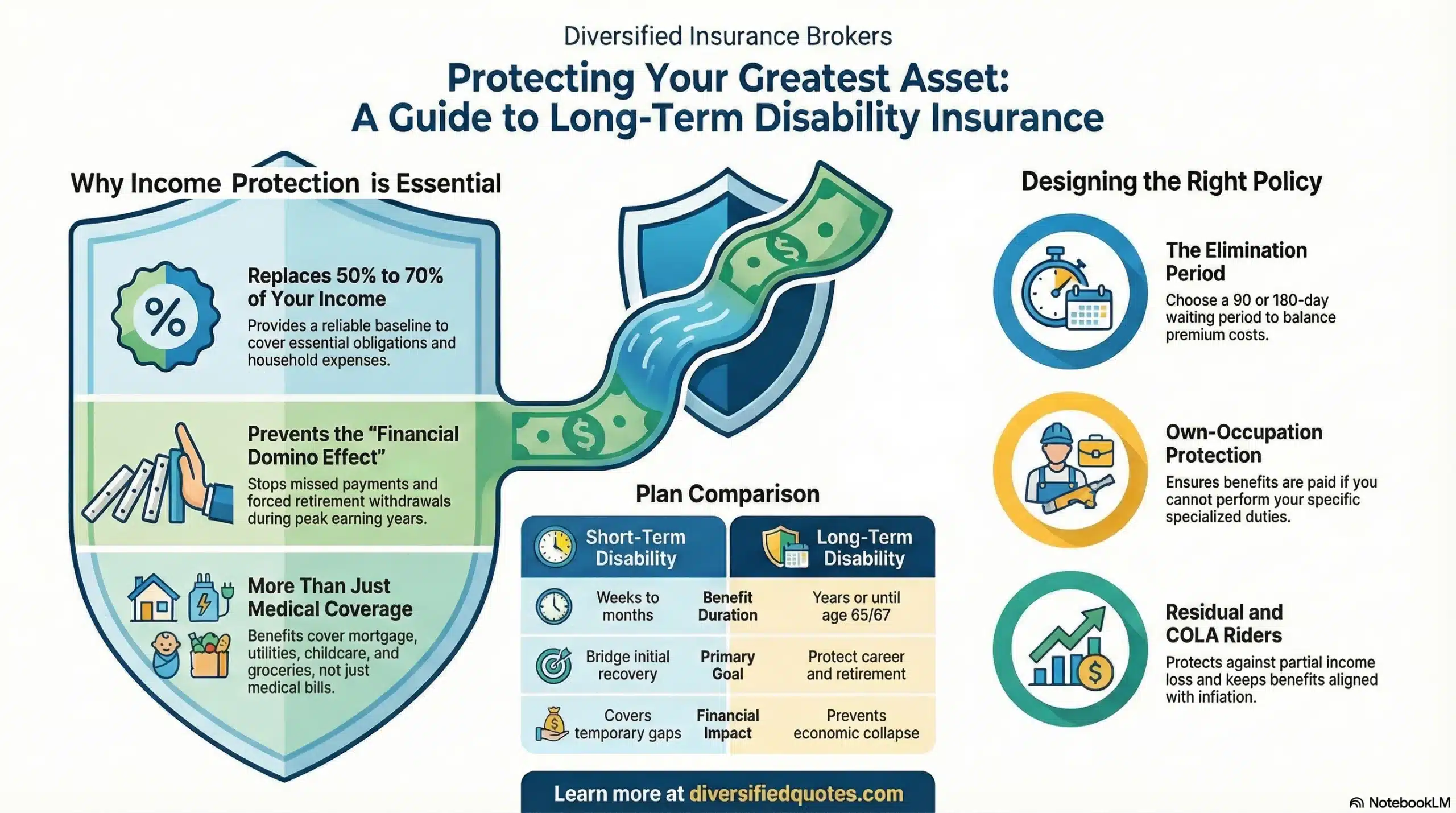
How much disability insurance a day trader needs depends on documented income, household financial obligations, and the specific trading income structure that determines what percentage of annual profit is appropriately characterized as earned income for the benefit calculation. The elimination period for a trader with adequate liquid capital reserves may reasonably be longer than 90 days — reducing annual premiums without leaving the household unprotected, since a successful trader’s capital base may sustain household expenses through a longer elimination period than most employed professionals can tolerate. The rider options most relevant for day traders include the future increase option for traders whose documented income is growing as their trading sophistication develops, and the cost of living adjustment rider protecting the real purchasing power of benefits across a potentially long disability period.
The residual disability benefit provision is particularly valuable for day traders, since cognitive disability scenarios often produce partial performance impairment before complete cessation. A trader whose anxiety disorder reduces trading performance — increasing error rates, impairing position sizing discipline, reducing trading frequency — may experience a meaningful income reduction before they meet the threshold for total disability. A residual benefit pays proportionally based on actual income reduction from partial disability, addressing these common transitional scenarios rather than forcing a binary determination. Disability insurance with pre-existing conditions is available for traders with documented mental health treatment histories. High-risk disability insurance options address traders whose health history creates underwriting complexity. No-exam disability insurance provides a streamlined alternative for healthy traders who prefer rapid approval. Getting the best disability insurance rates for a day trader begins with carrier comparison through an independent broker who specifically understands trader income documentation — the difference between a carrier that accommodates trading income well and one that does not can determine both whether coverage is available at all and what the premium cost is for the coverage that can be obtained. Whether disability insurance payments are taxable for a self-employed trader: premiums paid personally with after-tax income generally produce tax-free benefits during a disability period.
Get Your Day Trader Disability Insurance Review
We compare trading income documentation approaches, mental health benefit structures, and own-occupation definitions across 100+ carriers to build the coverage that protects your trading income.
Talk With an Advisor Today
Choose how you’d like to connect—call or message us, then book a time that works for you.
Schedule here:
calendly.com/jason-dibcompanies/diversified-quotes
Licensed in all 50 states • Fiduciary, family-owned since 1980
FAQs: Disability Insurance for Day Traders
Can day traders actually get disability insurance, and how do underwriters view the occupation?
Day traders can obtain disability insurance — but the occupation presents two specific underwriting challenges that a generic direct application frequently fails to navigate. The first is occupational classification: some carriers classify day trading as an investor activity rather than a professional occupation, which affects benefit availability and premium rates. Carriers that specifically recognize day trading as a professional occupation — the primary livelihood from which the applicant earns income through active daily trading activity rather than passive investment management — produce meaningfully different underwriting outcomes than those that treat the activity more generically. Working with an independent broker who knows which carriers have the most established, most favorable guidelines for day trading occupation classification is the most important application strategy decision.
The second challenge is income documentation — establishing that trading profits represent documented earned income at a sustainable level rather than a single exceptional year. Most carriers require two to three years of consistent trading income documentation demonstrating that the activity is the primary professional occupation rather than a supplemental activity. Getting the best disability insurance rates for a day trader means targeting the right carrier from the outset rather than accumulating application records at carriers whose guidelines produce unfavorable outcomes. High-risk and specialty market disability insurance options are also worth evaluating for traders whose health history or occupation classification creates complexity in the standard market.
How does variable trading income affect my disability insurance benefit amount?
Variable trading income is the most practically complex aspect of disability insurance underwriting for day traders. The maximum approvable monthly benefit is calculated as a percentage — typically 60 to 70 percent — of documented average earned income, using a two to three year average rather than a single year’s figures. A trader who has a breakout year in one of the documentation years may find the carrier averaging that year alongside lower years, producing a benefit basis that reflects sustainable average income rather than peak performance. Conversely, a trader who experienced a loss year in the documentation period may find that year’s loss pulling the average down below what ongoing sustainable trading income would justify.
The residual disability benefit provision is especially valuable for day traders because the realistic early-disability scenario often involves reduced trading performance — impaired decision-making from cognitive or mental health conditions producing lower profits rather than complete cessation — before total disability is reached. A residual benefit pays proportionally based on actual income reduction from partial disability, addressing these realistic scenarios. For high-earning traders whose average documented income substantially exceeds standard carrier monthly benefit ceilings, high-income disability insurance layering across multiple carriers produces total monthly benefits more closely calibrated to actual trading income. Whether disability insurance payments are taxable for a day trader: premiums paid personally with after-tax income generally produce tax-free benefits — the full monthly benefit reaches the household without income tax reduction during the disability period.
What is an “own occupation” for a day trader and why does the definition matter?
The own-occupation definition for a day trader specifically covers the inability to perform the material and substantial duties of day trading — rapid decision-making in real-time financial markets, position management under time pressure, pattern recognition in live market data, and the sustained emotional discipline that profitable trading requires. This definition matters because a cognitive or mental health disability that prevents profitable trading performance may leave the trader physically capable of many other activities, and a policy that requires inability to perform any work before benefits activate would deny that claim entirely.
The distinction between own-occupation and any-occupation or modified-occupation standards is most consequential for day traders in the mental health and cognitive disability scenarios that represent the profession’s primary disability risk. A day trader with anxiety severe enough to prevent the sustained emotional discipline that position management requires, or with cognitive fog from a neurological event that impairs the rapid pattern recognition that trading demands, has experienced an occupational disability from day trading — but may retain theoretical capacity for other less demanding cognitive work. An own-occupation policy pays benefits regardless of that theoretical alternative capacity. An any-occupation policy may deny the claim on the grounds that the trader could theoretically perform some other employment. Confirming the own-occupation language specifically before purchase — not assuming the stated policy type uses the strongest available definition language — is the most important policy review step for day traders. A second opinion on any disability insurance offer is the most effective way to confirm the definition language will perform as expected.
I trade through an LLC — does that affect my disability insurance?
Trading through an LLC affects disability insurance primarily through the income documentation dimension — how the trading income is characterized for underwriting purposes and whether it qualifies as earned income at the carrier being applied to. An LLC structure may generate income that flows through as Schedule K-1 distributions or as Schedule C profit from a sole member LLC, and the specific treatment of that income as earned versus investment income varies between carriers. Some carriers are more accommodating of LLC-structured trading income; others have guidelines that make trading LLC income more difficult to document as the qualifying earned income basis for a disability benefit calculation.
The business structure also raises the question of whether business overhead expense coverage makes sense — the operational costs of maintaining a trading LLC, including technology infrastructure, data subscriptions, analytical software, and any co-location or execution platform costs, represent fixed business obligations that continue during a disability period regardless of trading activity. For traders whose LLC has meaningful fixed monthly overhead, the two-layer financial exposure of a disability — personal income loss plus continued business overhead — mirrors the structure that small business owners in other professions face, and the same BOE coverage logic applies. Disability insurance for high-earner business owners covers the complete coverage architecture for business-structured traders, and disability insurance for self-employed professionals covers the documentation and underwriting framework that applies regardless of the specific business structure.
I have a prior anxiety or depression history — can I still get disability insurance as a day trader?
Yes, though the underwriting outcome will depend on the severity, duration, and current clinical status of the documented history. For most prior mental health treatment histories that are currently stable — a prior depressive episode that was treated and resolved, a managed anxiety condition under current treatment — the standard underwriting outcome is a partial exclusion rider for that specific condition, providing full coverage for all other causes of disability while excluding disability specifically attributed to the documented prior mental health condition. This may leave a significant gap for a day trader whose primary disability risk pathway is precisely the mental health conditions that the trading profession’s stress profile can produce.
The practical implication for a day trader with a prior mental health history is that the exclusion rider may limit coverage exactly where the occupation’s primary disability risk is concentrated. Disability insurance with pre-existing conditions is available through independent broker channels that compare each carrier’s specific guidelines for mental health treatment histories in high-cognitive trading occupations. Carrier guidelines vary significantly — a history that produces a broad mental health exclusion at one carrier may receive a narrower, more condition-specific exclusion at another. Early purchase before any mental health condition is documented remains the most effective strategy for day traders who want comprehensive mental health coverage in place for the full course of their trading careers. Why early-career traders need disability insurance before their trading careers produce a mental health record is answered by the same timing logic that applies across all professions: the window to purchase comprehensive mental health coverage without restrictions closes when the first documented episode creates a history.
How should I size my disability insurance relative to my trading income?
Benefit sizing for day traders involves two intersecting questions: what does the household actually need to sustain itself during a disability period, and what documented trading income basis will the underwriting process recognize and use for the benefit calculation? The first question is answered by household financial obligations — living expenses, debt service, any business overhead obligations, and reserve-building targets for the disability period. The second is answered by the carrier’s guidelines for trading income documentation and the two to three year average of documented earned trading income that the application will establish.
For successful day traders whose documented average income is high, the maximum approvable monthly benefit from a single standard carrier may cap well below the 60 percent replacement of actual income that complete protection would require. How much disability insurance a day trader actually needs is best determined through a specific household financial analysis rather than a simple percentage formula. The elimination period should reflect actual liquid capital reserves rather than a generic 90-day template — a trader with significant capital reserves may appropriately select a longer elimination period, reducing annual premiums without leaving the household unprotected through the elimination period. The future increase option allows benefit increases as documented trading income grows without new medical underwriting — important for traders in growth phases whose near-term income substantially underrepresents their longer-term trading capacity.
About the Author:
Jason Stolz, CLTC, CRPC, DIA, CAA and Chief Underwriter at Diversified Insurance Brokers (NPN 20471358), is a senior insurance and retirement professional with more than 25 years of real-world experience helping individuals, families, and business owners protect their income, assets, and long-term financial stability. As a long-time partner of the nationally licensed independent agency Diversified Insurance Brokers, Jason provides trusted guidance across multiple specialties—including fixed and indexed annuities, long-term care planning, personal and business disability insurance, life insurance solutions, Group Health, Travel Medical and Evacuation Insurance, and short-term health coverage. Diversified Insurance Brokers maintains active contracts with over 100 highly rated insurance carriers, ensuring clients have access to a broad and competitive marketplace.
His practical, education-first approach has earned recognition in publications such as VoyageATL, and contributions from his agency featured in Kiplinger and GoBankingRates— highlighting his commitment to financial clarity and client-focused planning. Drawing on deep product knowledge and years of hands-on field experience, Jason helps clients evaluate carriers, compare strategies, and build retirement and protection plans that are both secure and cost-efficient. Visitors who want to explore current annuity rates and compare options across multiple insurers can also use this annuity quote and comparison tool.
Explore More Disability Insurance Options: Browse our complete guide to Disability Insurance for Legal, Finance & White Collar Professionals — covering attorneys, accountants, bankers, executives, financial planners & business professionals from 100+ carriers.
Last Reviewed: June 8, 2026 |
Reviewed by: Jason Stolz, CLTC, CRPC, DIA, CAA
Chief Underwriter, Diversified Insurance Brokers, Inc. | NPN: 20471358 | Diversified Insurance Brokers, Inc. — Licensed in all 50 states
Fact Checked by: Tonia Pettitt, CMIP©
Medicare Specialist, Diversified Insurance Brokers, Inc. | NPN: 14374308 | Diversified Insurance Brokers, Inc. — Licensed in all 50 states
Did you find this content helpful? Leave us a Google review — it helps others find trustworthy guidance too.
Editorial Standards: Diversified Insurance Brokers maintains rigorous editorial standards to ensure accuracy, clarity, and independence in all content. Learn more about our editorial standards and commitment to transparency.
