
Disability Insurance for Cleaners and Dry Cleaners
As an Independent Disability Insurance Broker, we have access to exclusive discounts and negotiated pricing most captive agents can’t offer — see the full breakdown near the end of this page.
Disability Insurance for Cleaners and Dry Cleaners

Jason Stolz CLTC, CRPC, DIA, CAA
Disability insurance for cleaners and dry cleaners is essential income protection for professionals whose livelihoods depend entirely on their physical ability to perform demanding, repetitive, hands-on work every single day. Whether you operate a residential cleaning business, work in commercial janitorial services, run an independent dry cleaning establishment, or perform contract cleaning for hospitality or healthcare facilities, your income stops the moment a disabling condition prevents you from doing your job.
Cleaning and dry cleaning professionals face a risk profile that is widely underestimated from an income protection standpoint. The work appears routine from the outside — vacuuming, scrubbing, pressing, lifting — but the physical demands of sustained cleaning and dry cleaning work accumulate into meaningful occupational health consequences over a career. Back injuries, repetitive strain conditions, chemical-induced respiratory disease, burns from pressing equipment, and slip and fall accidents are all documented, recurring disability events in the cleaning and dry cleaning workforce. And for the majority of cleaning professionals who are self-employed or employed by small businesses without group benefit programs, a disabling event produces an immediate and complete income crisis with no employer safety net of any kind.
At Diversified Insurance Brokers, we help cleaning professionals across all specializations structure disability insurance coverage that reflects the genuine physical demands and occupational risks of their work. A properly designed policy provides income replacement from any disabling condition — whether it develops gradually from years of physical wear or strikes suddenly from a single acute event — and it does so in a way that is built around how cleaning and dry cleaning professionals actually earn their income.
Protect Your Income as a Cleaning Professional
Compare disability insurance options designed for residential cleaners, commercial janitorial professionals, and dry cleaning operators.
Who Cleaning and Dry Cleaning Professionals Are
Disability insurance for cleaners and dry cleaners serves a broad and diverse workforce. Residential house cleaners and maid service operators maintain private homes, working alone or in small teams with cleaning chemicals, heavy vacuums, mops, and scrubbing equipment across multiple client locations per day. Commercial and janitorial cleaners maintain office buildings, healthcare facilities, schools, and retail environments — often working evening or overnight shifts in large physical spaces that require sustained physical effort across full working shifts.
Specialty cleaning professionals handle carpet cleaning, window washing, post-construction cleanup, biohazard remediation, and other demanding specialized cleaning services. Dry cleaning professionals — including machine operators, spotters, pressers, and dry cleaning business owners — work with industrial chemical solvents, high-temperature pressing equipment, and heavy garment loads in an environment that carries both acute physical hazards and serious long-term chemical health risks.
The common thread across all of these roles is that income is directly and entirely tied to physical performance. A cleaning professional who cannot physically work does not get paid. There is no remote work option, no cognitive substitute for physical capability, and in most cases no employer group disability plan to provide partial income replacement. This financial dependency on physical capacity is precisely what makes disability insurance for cleaners and dry cleaners not just valuable but genuinely essential. The same income vulnerability that defines cleaning professional financial exposure applies equally across physically demanding service trades, such as caterers and event service professionals whose income similarly disappears the moment physical capacity is compromised.
Disability Insurance for Cleaners — The Occupational Risk Profile
Understanding the specific hazards that cleaning professionals face is essential for structuring disability coverage that responds to the conditions most likely to interrupt their ability to earn. The occupational risk profile for cleaning work spans acute physical injury, chronic musculoskeletal damage, chemical exposure illness, and psychological strain — a combination that is more complex and more serious than the profession’s relatively modest public profile would suggest.
Musculoskeletal injuries are the most prevalent disabling conditions for cleaning professionals. Back injuries — including herniated discs, muscle strains, and spinal conditions — develop from the sustained lifting, bending, reaching, and carrying that characterize every cleaning shift. Vacuuming and mopping require repetitive pushing and pulling motions with significant back and shoulder involvement. Moving furniture, carrying equipment between floors, and handling heavy commercial cleaning machines all create acute back injury risk on top of the cumulative wear from daily physical repetition. Shoulder injuries from overhead cleaning operations, knee conditions from sustained kneeling and crouching, and wrist and hand conditions from wringing, scrubbing, and equipment operation round out a musculoskeletal risk profile that accumulates progressively over a cleaning career.
Slip and fall accidents are among the most frequent acute injury events in cleaning work environments. By the nature of the job — cleaning wet floors, working in freshly mopped spaces, navigating around cleaning equipment and supply carts — cleaning professionals create and then work in exactly the environments where fall risk is highest. A serious fall resulting in fractures, spinal injury, or head trauma can require months of recovery or produce permanent functional limitations that end a cleaning career entirely. For self-employed cleaning professionals, even a moderate injury requiring four to six weeks of recovery can produce an immediate financial crisis without disability insurance to replace the lost income.
Chemical exposure is a documented occupational health risk for both cleaning and dry cleaning professionals. Residential and commercial cleaners work with bleach, ammonia, disinfectants, degreasers, and aerosol agents that carry respiratory irritation and skin sensitization risks with sustained daily exposure. Research on professional cleaning workers consistently identifies elevated rates of occupational asthma, chronic bronchitis, and skin conditions compared to non-exposed populations. When these conditions reach a severity that prevents continued work with the chemical agents central to the cleaning profession, they constitute genuine occupational disability. The chemical hazard faced by cleaning professionals parallels the documented risks in other chemically intensive service roles, including craft professionals with sustained chemical workplace exposure.
Disability Insurance for Dry Cleaners — The Additional Chemical and Equipment Hazards
Dry cleaning professionals face all of the physical demands of general cleaning work plus a distinct layer of serious additional hazards that make disability insurance for dry cleaners particularly critical. The primary dry cleaning solvent — perchloroethylene, known as PERC — is classified as likely carcinogenic to humans by the Environmental Protection Agency and as a potential occupational carcinogen by NIOSH. Dry cleaning workers exposed to PERC daily face documented risks including neurological impairment, liver and kidney effects, and elevated rates of several cancers including bladder cancer and non-Hodgkin lymphoma, particularly with years of sustained occupational exposure.
Drywall sanding operations in commercial dry cleaning generate dust exposures that can approach or exceed permissible limits under certain ventilation conditions. Spotters who pre-treat stains with chemical agents face direct skin and respiratory contact with concentrated cleaning chemicals. Pressers working at high-temperature pressing machines face burn injury risk across every working shift. Machine operators who load and unload PERC-based dry cleaning equipment face the highest vapor concentration exposure in the dry cleaning operation.
Burns from pressing equipment are a documented, recurring occupational injury in dry cleaning operations. Contact with pressing surfaces, steam jets, or malfunctioning equipment produces burns ranging from minor to serious, with severe burns requiring medical treatment and potentially producing permanent functional limitations affecting the ability to return to pressing work. For dry cleaning business owners who are the sole operator of their establishment, a burn or chemical illness requiring weeks or months of recovery has immediate and serious financial consequences that disability insurance for cleaners and dry cleaners directly addresses. Our dedicated resource on own-occupation disability insurance explained covers how policy definitions protect cleaning professionals whose specific occupational duties define their disability risk.
Why Most Cleaning Professionals Are Financially Unprotected
The majority of cleaning and dry cleaning professionals — whether self-employed residential cleaners, independent dry cleaning owners, or employees of small cleaning service businesses — have no meaningful employer-sponsored disability coverage. Large commercial cleaning employers may offer group disability plans, but coverage is often limited, benefit amounts are modest relative to actual income needs, and the plans terminate when employment ends. Self-employed cleaning professionals have no employer disability plan at all.
Social Security Disability Insurance exists as a government safety net, but it requires demonstrating inability to perform virtually any substantial gainful activity — a very high eligibility bar — and the application and approval process typically takes many months to years. During that waiting period, no income replacement is provided. For a cleaning professional whose household budget depends on consistent daily income, the SSDI process is not a functional substitute for individual disability insurance that begins paying benefits within weeks of a qualifying disability.
Workers’ compensation covers only work-related injuries — a fall on a client’s wet floor, a chemical burn during cleaning operations, a back injury from lifting commercial equipment. It does not cover non-work-related conditions of any kind. A cleaning professional who becomes disabled from cancer, a cardiovascular event, an automobile accident, or any condition unrelated to a specific workplace event receives no workers’ compensation benefit. Individual disability insurance fills this critical gap, covering disability from any cause regardless of where or how it originated. Understanding the workers’ comp coverage gap is essential for cleaning professionals who may mistakenly believe that existing employer coverage provides comprehensive protection — our resource on how residual disability benefits work addresses the partial disability dimension that workers’ comp consistently fails to cover.
Case Study: Cleaning Professional Earning $55,000 Per Year
Consider a self-employed residential cleaning professional earning $55,000 annually across a regular client base of approximately twenty-five weekly accounts. After developing a serious lumbar disc herniation from sustained lifting and bending over eight years of cleaning work, this professional requires surgery and six months of recovery during which sustained bending, lifting, and kneeling are medically inadvisable.
| Scenario | Without Disability Insurance | With Disability Insurance |
|---|---|---|
| Monthly Income During Recovery | $0 | $2,300–$3,000 |
| 6-Month Total Income | $0 | $13,800–$18,000 |
| Client Base Impact | Clients move to competitors during extended absence | Financial stability allows planned return without desperation |
| Financial Outcome | Savings depleted, mortgage at risk, forced early return | Full recovery supported on medical timeline |
Lumbar disc herniation is one of the most commonly documented occupational outcomes for workers in physically demanding cleaning roles — the sustained daily bending and lifting of cleaning work is a textbook risk factor for this condition. Disability insurance for cleaners and dry cleaners ensures that this predictable occupational health event does not simultaneously become a financial emergency that forces a premature return to work and risks permanent injury or career-ending re-injury.
How Insurers Classify Cleaners and Dry Cleaners
Disability insurance carriers assign occupational class ratings that reflect the estimated disability risk of each profession. These ratings affect premium costs, maximum benefit amounts, and the specific policy features available to each applicant. Cleaning and dry cleaning professionals are generally classified in the lower occupational class tiers — reflecting the physical demands, chemical exposure, and injury risk that characterize the work — which produces higher premiums and somewhat more restricted policy features than desk-based professional occupations.
Within the cleaning and dry cleaning category, the specific duties performed matter significantly. A residential cleaning professional who works independently in private homes may be classified differently than a commercial janitorial worker in a healthcare facility, and a dry cleaning machine operator faces a different underwriting picture than a dry cleaning counter attendant with minimal chemical contact. Presenting occupational duties accurately and completely to underwriters — including the percentage of time spent on physically demanding tasks versus administrative or supervisory functions — is an area where working with an experienced independent broker produces meaningfully better classification outcomes. The difference in occupational class can translate directly into premium savings and improved access to the strongest available policy features.
For cleaning professionals who also manage other workers or own and operate a cleaning business with supervisory responsibilities, the management component of the role may support a more favorable occupational classification than the hands-on cleaning component alone would produce. This is precisely the kind of nuance that an experienced broker identifies and presents to underwriters effectively. Our dedicated guide on how disability insurance elimination periods work provides essential context for understanding how waiting period selection affects premiums and financial planning for cleaning professionals across all classifications.
Disability Insurance for Cleaners — Key Policy Features That Matter
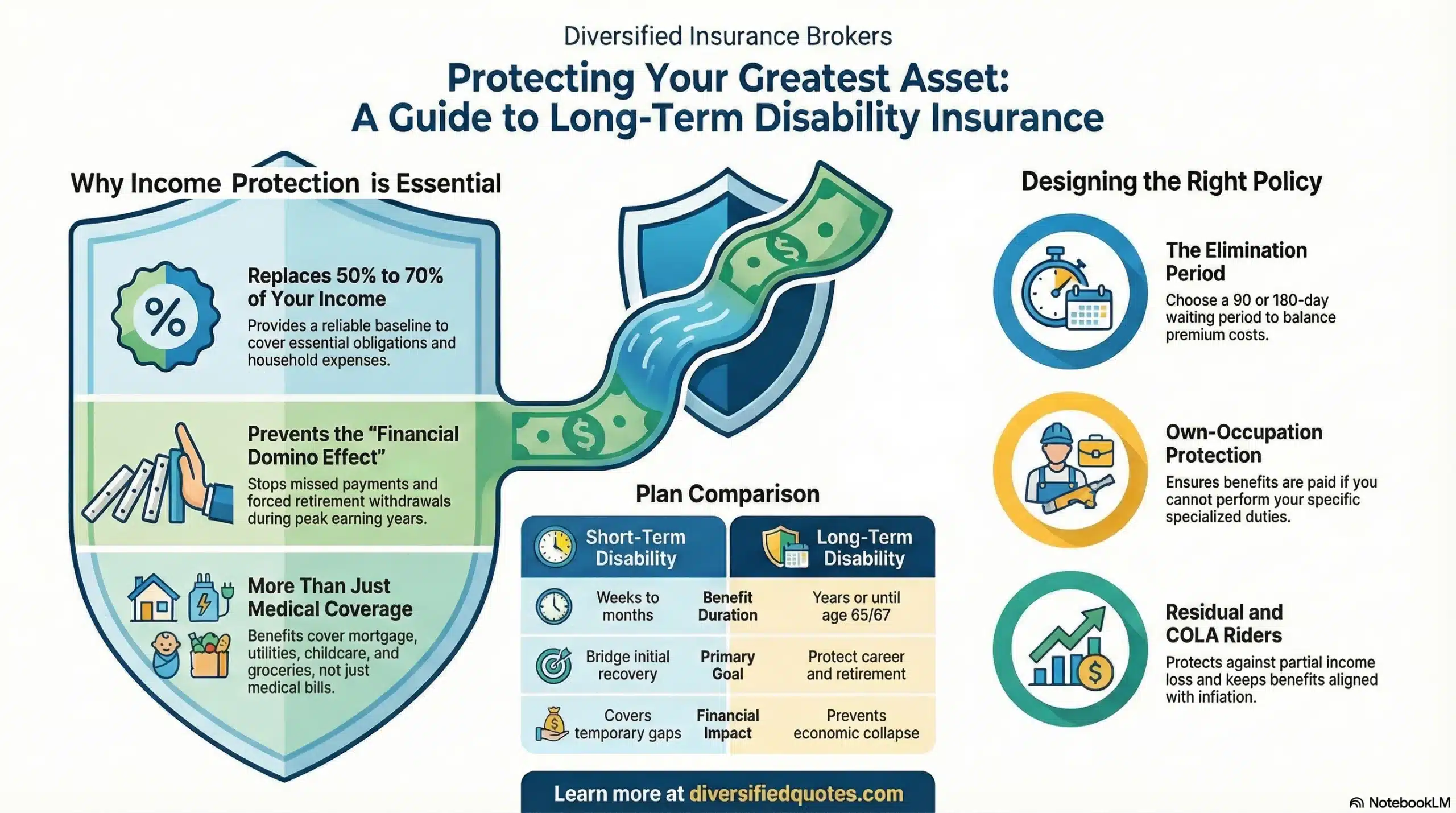
Disability insurance for cleaners and dry cleaners is most effective when structured with specific policy provisions that address the realities of physical service work. The own-occupation definition of disability is foundational — it pays benefits when a condition prevents the cleaning professional from performing the specific physical duties of their occupation, regardless of whether they could theoretically perform other types of lighter or different work. A residential cleaner whose back injury prevents sustained bending and lifting may technically be able to perform desk work, but an own-occupation policy recognizes the genuine inability to clean and pays benefits accordingly.
A residual disability rider is equally important for cleaning professionals whose conditions may limit work capacity without eliminating it entirely. A cleaner who can manage ten client visits per week instead of their usual twenty-five earns significantly reduced income without being totally disabled. Without residual disability coverage, a total-disability-only policy would provide no benefits during this partial recovery period. A residual rider supplements reduced earnings proportionally, ensuring continuous financial support from the onset of disability through to full return to normal client volume. For cleaning business owners who may rebuild their practice gradually after a disability, this rider is essential financial protection across the entire recovery arc.
A cost-of-living adjustment rider provides additional protection for cleaning professionals facing long-term or permanent disability. Without COLA, a monthly benefit that adequately covers expenses at the onset of disability loses real purchasing power over years of sustained claim payment. Our resource on disability income insurance with a COLA rider explains exactly how this inflation protection works and why it matters for cleaning professionals whose disabling conditions may persist for extended periods.
Self-Employed Cleaning Professionals and Income Documentation
The majority of residential cleaning professionals and many dry cleaning business owners are self-employed, which creates a specific income documentation challenge in disability insurance underwriting. Carriers base benefit amounts on verified earned income using federal tax returns — typically two to three years of Schedule C net profit for self-employed applicants. For cleaning professionals who deduct significant business expenses including vehicle costs, supplies, equipment, and marketing, the reported net profit may understate actual financial need during a disability.
Self-employed cleaning professionals should also consider business overhead expense coverage alongside personal income replacement disability insurance. Client relationship management costs, supply orders, vehicle expenses, and any employee or subcontractor costs all continue during a disability period regardless of whether the owner can work. A business overhead expense policy covers these fixed business costs during disability, preventing a temporary health event from producing permanent business closure. The combined protection of personal income replacement and business overhead expense coverage is the most comprehensive financial safety net available to a self-employed cleaning professional — and it is the approach Diversified Insurance Brokers structures for cleaning business owners who understand the full scope of their financial exposure during a disability. Our guide on how to purchase short-term disability coverage provides additional context for cleaning professionals evaluating their immediate income protection options alongside longer-term policies.
Why Cleaning Professionals Need an Independent Disability Insurance Broker
Disability insurance for cleaners and dry cleaners requires access to carriers that write physical and service industry occupational classifications without exclusion riders that eliminate the most relevant coverage. Some carriers approach cleaning occupational classes with restrictions on chemical exposure conditions or musculoskeletal conditions — the very categories most likely to disable a cleaning professional. Identifying the carriers that offer comprehensive coverage without these exclusions requires independent broker access to the full marketplace.
At Diversified Insurance Brokers, we evaluate options across multiple carriers for every cleaning and dry cleaning professional we serve. We understand how to present cleaning occupational duties accurately to underwriters, how to navigate self-employment income documentation, and how to structure policy provisions — own-occupation definitions, residual disability riders, COLA protection, and elimination period selection — in ways that produce genuinely comprehensive income protection rather than a generic policy that falls short at claim time. Our dedicated resource on why independent disability insurance brokers matter explains the full value of this approach for service and trade professionals navigating the disability insurance marketplace.
Final Thoughts on Disability Insurance for Cleaners and Dry Cleaners
Cleaning and dry cleaning professionals perform essential work that keeps homes, businesses, and public spaces safe, sanitary, and functional. The physical demands of that work — sustained lifting, bending, chemical handling, equipment operation, and repetitive motion across full working days — create genuine occupational health risks that are capable of producing disabling conditions at any point in a cleaning career.
Disability insurance for cleaners and dry cleaners is the financial tool that ensures a health event in the course of that work does not permanently derail the financial life that the work supports. A well-structured policy — built around an own-occupation definition, meaningful benefit amount, residual disability coverage, and appropriate provisions for the specific risks of cleaning and dry cleaning work — provides the income replacement that allows a cleaning professional to recover from a position of stability rather than desperation.
Related Pages
Talk With an Advisor Today
Choose how you’d like to connect—call or message us, then book a time that works for you.
Schedule here:
calendly.com/jason-dibcompanies/diversified-quotes
Licensed in all 50 states • Fiduciary, family-owned since 1980
Disability Insurance for Cleaners and Dry Cleaners FAQs
Yes, residential cleaners, commercial janitorial workers, and specialty cleaning professionals can obtain individual disability insurance. The occupation is typically classified in the lower physical labor occupational tiers that reflect the physical demands, injury risk, and chemical exposure of cleaning work — which affects premium costs and the specific policy features available. However, disability insurance for cleaners is obtainable from carriers that write service industry and physical occupational classifications, and the income protection provided is directly relevant to the real disability risks of the profession. Self-employed cleaning professionals face additional income documentation considerations in underwriting, making an experienced independent broker particularly important for securing coverage that accurately reflects earning capacity.
Musculoskeletal injuries are the most prevalent disabling conditions for cleaning professionals. Back injuries — including herniated discs, muscle strains, and progressive spinal conditions — develop from the sustained lifting, bending, and reaching that characterize every cleaning shift. Shoulder injuries from overhead cleaning operations, knee conditions from sustained kneeling and crouching, and wrist and hand conditions from scrubbing, wringing, and equipment operation are all documented occupational outcomes for career cleaning workers. Slip and fall accidents are among the most common acute injury events, given that cleaning professionals work in the wet and slippery environments they create. Chemical-induced respiratory conditions and skin disease from sustained cleaning chemical exposure are meaningful long-term occupational health risks. For dry cleaning professionals, burns from pressing equipment and serious health risks from PERC solvent exposure add additional disability categories unique to the dry cleaning environment. For more on how residual benefits work for partial recovery, see our guide on how residual disability insurance benefits work.
No, and the gaps in workers’ compensation coverage are significant for cleaning professionals. Workers’ compensation covers injuries that are directly and demonstrably work-related — a fall on a client’s wet floor, a chemical burn during cleaning operations, a back injury from lifting commercial equipment on a job site. It does not cover non-work-related disabilities of any kind. A cleaning professional who develops cancer, suffers a cardiovascular event, is injured off-duty, or becomes disabled from any condition not connected to a specific workplace event receives zero workers’ compensation benefits. Workers’ compensation also provides limited partial disability income replacement for conditions that reduce but do not eliminate work capacity — a gap that a residual disability rider in an individual policy fills completely. Individual disability insurance covers disability from any cause, making it the essential complement to workers’ compensation for cleaning and dry cleaning professionals.
Own-occupation disability insurance pays benefits when a condition prevents a cleaning professional from performing the specific physical duties of their occupation — sustained lifting, bending, scrubbing, chemical handling — regardless of whether they could theoretically perform other types of lighter or desk-based work. Any-occupation coverage only pays if the insured cannot perform virtually any gainful employment whatsoever. For a cleaning professional whose back injury prevents the sustained bending and lifting that cleaning requires but who could technically perform a sedentary job, an any-occupation policy would deny benefits. An own-occupation policy would recognize the genuine inability to perform cleaning duties and pay accordingly. Understanding this critical distinction before purchasing a policy is essential — our dedicated resource on own-occupation disability insurance explained covers how this definition protects cleaning professionals in real disability scenarios.
Dry cleaning professionals face the additional and serious hazard of perchloroethylene exposure — PERC — the primary dry cleaning solvent classified as likely carcinogenic to humans by the Environmental Protection Agency. Chronic occupational PERC exposure is associated with neurological impairment, liver and kidney damage, and elevated rates of bladder cancer, non-Hodgkin lymphoma, and other malignancies in dry cleaning workers. Burns from high-temperature pressing equipment are a recurring acute injury risk that general cleaning professionals do not face. Machine operators who load and unload PERC-based equipment face the highest vapor concentration exposures in the dry cleaning operation. These additional chemical and equipment hazards make disability insurance for dry cleaners particularly critical, as the long-term health consequences of PERC exposure may not produce disabling conditions until well into a dry cleaning career — making early application for coverage before any exposure-related conditions develop the most important timing decision a dry cleaner can make.
Residual disability coverage pays proportional benefits when a disability reduces earning capacity without eliminating the ability to work entirely. A cleaning professional whose back condition limits them to ten client visits per week instead of their normal twenty-five earns significantly reduced income without being totally disabled. Without a residual disability rider, a total-disability-only policy would provide no benefits during this period. A residual rider supplements reduced earnings proportionally throughout the recovery arc, providing continuous financial support from the onset of disability through to full return to normal work volume. For self-employed cleaning professionals who rebuild their client base gradually after a disability, this rider is essential to prevent a coverage gap precisely when financial support is still needed.
The elimination period is the waiting time between the onset of disability and when benefits begin. Self-employed cleaning professionals with no employer sick pay and limited emergency savings should strongly consider a 30 or 60-day elimination period that provides faster benefit access, even at a higher premium cost. For a sole cleaning business operator whose income stops immediately when they cannot work, and who may also be managing ongoing supply, vehicle, and client relationship costs during the disability, a shorter waiting period before benefits begin can be critical financial protection. Cleaning professionals with stronger financial reserves may comfortably accept a 90-day elimination period to reduce premiums. Our full guide on how elimination periods work helps identify which waiting period fits your specific financial situation.
Yes. Self-employed cleaning business owners who have ongoing fixed business costs — vehicle payments, supply inventory, equipment maintenance, advertising, and any employee or subcontractor costs — should strongly consider business overhead expense coverage alongside personal income replacement disability insurance. These fixed costs continue during a disability regardless of whether the owner can work, creating a financial burden on top of the loss of personal income. Business overhead expense insurance covers these fixed business costs during disability, preventing a temporary health event from forcing permanent business closure due to inability to meet ongoing obligations. Personal disability income insurance and business overhead expense coverage address two distinct financial needs and are most effective when structured together for any self-employed cleaning professional whose personal finances and business finances are interconnected.
Yes. Individual disability insurance covers disability from any cause — including occupational illnesses resulting from chemical workplace exposure — when that condition meets the policy’s definition of disability. A cleaning professional who develops disabling occupational asthma from sustained chemical exposure, or a dry cleaner who develops a PERC-related respiratory or neurological condition, qualifies for disability benefits under a well-structured individual policy when the condition prevents them from working. The critical planning implication is timing: applying for disability insurance before chemical exposure-related conditions have been diagnosed and documented is essential. A documented condition at the time of application may result in an exclusion rider or more restricted policy terms. Securing comprehensive coverage while health is good protects against conditions that may develop over subsequent years of occupational chemical exposure. Our resource on disability income insurance with COLA protection covers how long-term benefit value is preserved for extended disability claims.
The best time is as early as possible in a cleaning or dry cleaning career — before occupational health conditions from physical demands or chemical exposure have accumulated in the medical record. Disability insurance premiums are based in part on age and health status at the time of application, and younger applicants in good health secure the most comprehensive coverage at the most favorable rates. Conditions that develop over years of cleaning work — back problems, shoulder conditions, chemical-induced respiratory disease — can result in exclusion riders, premium increases, or more restricted policy terms if present at the time of application. For dry cleaning professionals specifically, applying before any PERC-related health findings are documented is particularly important, since PERC-associated conditions can affect insurability significantly. The coverage secured early in a career is the coverage available when it is most needed.
An independent broker has access to multiple disability insurance carriers and can compare policy definitions, occupational class assignments, exclusion rider policies, rider availability, and premium structures across the full marketplace. For cleaning and dry cleaning professionals, some carriers approach physical service industry occupational classes with restrictive exclusion riders that eliminate coverage for musculoskeletal or chemical exposure conditions — the most likely disabling categories. A captive agent representing a single carrier can only present that company’s approach, regardless of whether it is the most favorable. At Diversified Insurance Brokers, we evaluate the full competitive landscape and structure coverage that reflects the actual risks of cleaning work and responds effectively when those risks produce real disability events. Our resource on why independent disability insurance brokers matter explains this value in full detail.
About the Author:
Jason Stolz, CLTC, CRPC, DIA, CAA and Chief Underwriter at Diversified Insurance Brokers (NPN 20471358), is a senior insurance and retirement professional with more than 25 years of real-world experience helping individuals, families, and business owners protect their income, assets, and long-term financial stability. As a long-time partner of the nationally licensed independent agency Diversified Insurance Brokers, Jason provides trusted guidance across multiple specialties—including fixed and indexed annuities, long-term care planning, personal and business disability insurance, life insurance solutions, Group Health, Travel Medical and Evacuation Insurance, and short-term health coverage. Diversified Insurance Brokers maintains active contracts with over 100 highly rated insurance carriers, ensuring clients have access to a broad and competitive marketplace.
His practical, education-first approach has earned recognition in publications such as VoyageATL, and contributions from his agency featured in Kiplinger and GoBankingRates— highlighting his commitment to financial clarity and client-focused planning. Drawing on deep product knowledge and years of hands-on field experience, Jason helps clients evaluate carriers, compare strategies, and build retirement and protection plans that are both secure and cost-efficient. Visitors who want to explore current annuity rates and compare options across multiple insurers can also use this annuity quote and comparison tool.
Explore More Disability Insurance Options: Browse our complete guide to Disability Insurance for Food, Hospitality, Arts & Entertainment — covering chefs, musicians, actors, bartenders, hospitality workers & entertainment professionals from 100+ carriers.
Last Reviewed: June 7, 2026 |
Reviewed by: Jason Stolz, CLTC, CRPC, DIA, CAA
Chief Underwriter, Diversified Insurance Brokers, Inc. | NPN: 20471358 | Diversified Insurance Brokers, Inc. — Licensed in all 50 states
Fact Checked by: Tonia Pettitt, CMIP©
Medicare Specialist, Diversified Insurance Brokers, Inc. | NPN: 14374308 | Diversified Insurance Brokers, Inc. — Licensed in all 50 states
Did you find this content helpful? Leave us a Google review — it helps others find trustworthy guidance too.
Editorial Standards: Diversified Insurance Brokers maintains rigorous editorial standards to ensure accuracy, clarity, and independence in all content. Learn more about our editorial standards and commitment to transparency.
