
Is Disability Insurance Worth It
Is Disability Insurance Worth It

Jason Stolz CLTC, CRPC, DIA, CAA
Disability insurance is worth it for most working adults who depend on their income — and the case for it is less about worst-case scenarios than about the financial mechanics of a realistic income disruption. The question “is disability insurance worth it?” is really three questions simultaneously: How likely am I to experience a disability during my working years? Could I absorb the financial impact without assistance? And if I couldn’t, what would the forced adjustments cost me long-term? For most households in their working years — particularly those with fixed expenses, dependents, meaningful savings goals, or income that stops when they stop — the answers to those three questions point in the same direction. An estimated 25% of today’s 20-year-olds will become disabled before retirement age. That probability, combined with the financial architecture of most working households, is the foundation of the case for disability coverage. This page examines that case in full — honestly, with the cases where coverage may be less necessary included alongside the cases where it is genuinely important.
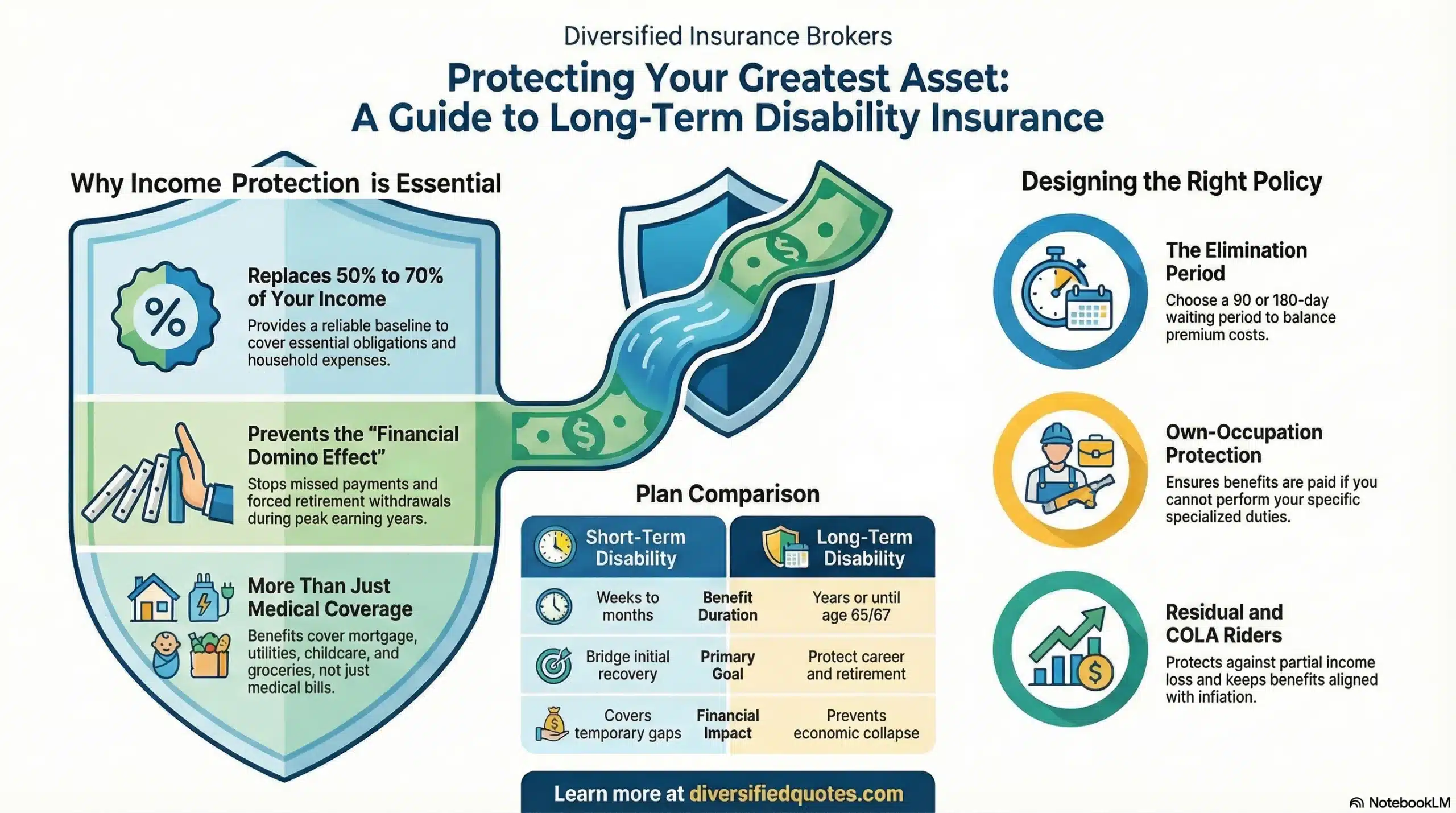
The clearest entry point is understanding what disability insurance actually does. It replaces a defined portion of your income when a qualifying illness or injury prevents you from working at the capacity your policy defines. It does not replace 100% of income — typically 50% to 70% of gross earnings, depending on policy design and carrier limits — because the replacement is meant to keep the household functional and stable while preserving motivation to return to work when medically appropriate. It also does not eliminate all administrative complexity — claims require medical documentation, and policies have definitions, elimination periods, and benefit periods that determine when and how long benefits are paid. But for working adults whose household cash flow depends on their paycheck, the core value proposition is straightforward: disability insurance converts an open-ended, unpredictable income risk into a defined, manageable financial situation. For a deeper framework on how income protection fits into the overall financial plan, our resource on the income gap covers how income disruption affects long-term financial trajectories, and our disability insurance services overview covers the coverage landscape across carriers and policy types.
The “worth it” question is ultimately a personal calculation, not a universal verdict. The same policy can deliver enormous value to one household and minimal value to another — not because the policy is better or worse, but because the households’ income risk, savings buffer, fixed expenses, and dependents differ meaningfully. Understanding where your household sits on that spectrum is the most productive starting point for evaluating whether disability coverage makes sense for your specific situation. For households that are actively wondering whether coverage is justified, our resource on why you need disability insurance even if you’re young and healthy addresses the objections most commonly raised before experience changes the perspective.
Find Out If Disability Insurance Is Worth It for You
We’ll help you evaluate coverage options based on your income, occupation class, savings buffer, and goals. Confidential, no obligation.
The Probability Case — Understanding Disability Risk During Working Years
Most people significantly underestimate how common disability is among working-age adults. The mental model most people carry is that disability means a dramatic, permanent, career-ending event — a catastrophic accident or terminal illness. In reality, the statistical landscape of disability is far more ordinary. The leading causes of long-term disability claims are not accidents — they are musculoskeletal conditions, cancer, cardiovascular disease, and mental health conditions, none of which require a dramatic incident to create significant income disruption. A back condition that restricts physical capacity, a cancer diagnosis that requires treatment and recovery, a cardiac event that limits exertion — these are the most common paths into disability claims, and they affect working adults of every age and occupation type.
The Centers for Disease Control and Prevention estimates that approximately 28.7% of adults in the U.S. are living with some type of disability. Not all disabilities create income disruption — many are managed successfully without affecting employment — but the scale of the population affected is far larger than most people assume when they mentally model their own risk. For working adults specifically, the Social Security Administration has published disability and death probability tables showing that a significant fraction of insured workers will experience a disability before reaching normal retirement age. An estimated 25% of today’s 20-year-olds will become disabled before retirement age. That statistic from the Social Security Administration’s own probability tables is not a fringe estimate — it reflects actuarial modeling based on large population data.
The practical implication is that disability risk during the working years is not a remote, unlikely scenario that warrants dismissal. It is a meaningful probability that most financially sound planning frameworks should address directly — either through coverage, through deliberate self-insurance with specifically designated liquid assets, or through some combination. The households that discover the probability case too late are typically those who assumed they were in the safe majority until they weren’t, and who had no plan in place when the income disruption arrived.
Social Security Disability — Why It Is Not a Reliable Fallback
One of the most consequential misconceptions about disability is the assumption that Social Security Disability Insurance (SSDI) will provide adequate support if a disability occurs. This assumption is wrong for the large majority of working-age adults in three specific ways: the definition is extremely strict, the denial rate is very high, and the benefit amount — even for those who qualify — is typically far below working income replacement needs.
SSDI’s definition of disability requires that the applicant be unable to engage in any substantial gainful activity due to a medically determinable impairment expected to last at least 12 consecutive months or result in death. For 2026, SSA uses an earnings limit of $1,690 per month for most workers to determine if a person’s work activity constitutes substantial gainful activity. This “any occupation” definition is among the most restrictive disability standards in the insurance world — far more restrictive than the own-occupation standard available through private disability insurance. A specialist physician who can no longer perform surgery due to a hand injury but could theoretically work in another capacity would likely be denied SSDI — because they can still engage in substantial gainful activity in some capacity. This is the exact scenario that own-occupation private disability insurance is designed to cover and that SSDI is not.
The practical consequence of this strict definition is a very high denial rate. The average denial rate for disability claims is approximately 68%. Most applicants who apply for SSDI are denied at the initial determination — and the appeals process can take years. Even applicants who ultimately succeed in obtaining benefits typically wait 12 to 18 months or longer from initial application to first benefit receipt — a period during which income disruption creates compounding financial damage. And for those who do qualify, the average disability benefit is only approximately $1,582 per month as of mid-2025 — an amount that falls short of most households’ fixed monthly obligations, let alone their full income replacement needs. For anyone earning more than a minimal income, SSDI provides a small partial replacement at best, and only after a long wait that most financially unstable households cannot absorb.
The Financial Impact of Disability — Why the Income Gap Matters So Much
A disability that interrupts income for three months does not just create three months of financial hardship. It creates a cascade of financial effects that can persist for years after the disability itself has resolved. Understanding this compounding financial dynamic is essential to correctly evaluating whether disability insurance is worth its premium cost.
The immediate effects are the most visible: housing payments are still due, utility bills arrive on schedule, car payments and childcare costs don’t pause for recovery, and medical bills from the disabling condition itself add new costs at the same time income is reduced. Households that have to cover these ongoing obligations from savings accounts deplete the emergency fund that was supposed to protect them from other unplanned events. Households that don’t have adequate savings begin missing payments, accumulating late fees, damaging credit, and in the most severe cases, facing eviction or repossession.
The longer-term effects are less visible but often more financially significant. Retirement contributions that are paused during a disability period represent not just the missed contributions but the compounding growth those contributions would have generated over the remaining working years. Debt that accumulates during a disability — whether from credit cards, personal loans, or family borrowing — typically carries higher interest rates than the cost of disability insurance premiums and often takes years to retire. Perhaps most consequentially, the psychological and financial pressure of a disability event that is not covered by insurance frequently pushes people to accept lower settlements, make early withdrawals from tax-advantaged accounts (triggering penalties and taxes), or make other irreversible financial decisions that affect the long-term plan well beyond the disability itself. Our resource on protecting the nest egg covers how income disruption threatens accumulated retirement assets specifically, and our income gap resource covers the broader financial mechanics of income disruption during the working years.
Who Benefits Most From Disability Insurance — A Household Profile Analysis
Disability insurance delivers different levels of value to different household profiles. The table below captures the key characteristics of households where disability coverage consistently delivers the highest value versus those where it may be less critical — not as a definitive rule, but as a framework for evaluating where your household sits on the spectrum.
| Household Profile | Disability Coverage Value | Why |
|---|---|---|
| Single-income household with dependents, mortgage, fixed expenses | Very High | Income disruption immediately threatens housing and family stability with no second earner to absorb the gap |
| Self-employed / business owner / production-based income | Very High | No employer benefits to fall back on; income stops immediately when production stops; no group coverage available |
| Professional with specialized skills (physician, attorney, dentist, engineer) | Very High | Own-occupation coverage protects the high-value specific skill set; SSDI would not cover specialty-based income loss |
| Early-to-mid career earner with limited savings and growing obligations | High | No savings buffer to absorb disruption; compounding damage to retirement trajectory is most severe at this stage |
| Dual-income household where both incomes are needed to maintain lifestyle | High | Budget built around two incomes; losing either creates significant financial pressure even with the second income continuing |
| High-risk occupation (manual labor, construction, physical specialties) | High | Injury probability is elevated; physical limitation is more likely to completely interrupt work capacity in physical roles |
| Dual-income household where one income is a comfortable cushion | Moderate | Second income provides buffer; but long-term disability of either earner would still affect savings and retirement trajectory |
| Near-retirement with substantial liquid savings and minimal fixed expenses | Lower | Retirement assets can fund a disability gap; plan less dependent on ongoing earned income; shorter risk window |
| Retired or primarily passive income (investment/pension/Social Security) | Minimal | Earned income is no longer the financial engine; disability insurance protects income from working, which is no longer the primary source |
These assessments reflect general patterns, not individual determinations. The right evaluation for your household should account for your specific income level, fixed expense obligations, savings buffer, and family structure. Our disability review process covers all of these dimensions before recommending a coverage structure.
The Three Questions That Define Whether Disability Insurance Is Worth It for You
Reducing the “worth it” decision to its essential framework, three questions determine the answer for any specific household. These questions are sequenced deliberately — each one should inform the next rather than being evaluated in isolation.
The first question is: if your income stopped tomorrow due to a disability, how long could your household absorb the gap without forced financial decisions? A “forced financial decision” includes missing housing payments, withdrawing from retirement accounts before retirement, borrowing at high interest rates, selling assets, or asking family for financial support. If the honest answer is three months or less, disability insurance is almost certainly worth it — because a disability that lasts more than three months is far more common than most people assume, and the financial consequences of a forced financial decision often compound far beyond the initial gap. If the honest answer is two to three years, disability insurance may be worth selective coverage — short-term protection for the gap before reserves are exhausted, or supplemental coverage to extend the runway. If the honest answer is “indefinitely, with minimal lifestyle impact,” self-insurance is a rational strategy that some households can genuinely execute.
The second question is: what would a disability actually look like for your specific occupation and income model? A software engineer who develops carpal tunnel syndrome severe enough to limit computer use has a very different disability scenario than an accountant with the same condition. A surgeon who develops tremors has a different scenario than a hospital administrator with the same tremors. A self-employed electrician who breaks a wrist cannot work; an office-based consultant with the same injury can likely continue. Matching the disability scenario to the occupation — and matching the policy definition to that scenario — is where the “worth it” question becomes the “right policy” question. Own-occupation definitions, which pay benefits when you cannot perform the material duties of your specific occupation, are almost always more valuable than any-occupation definitions for anyone with specialized skills or physical role requirements. Our resource on own-occupation disability insurance covers this distinction in detail.
The third question is: what are you protecting? Income that will run for another 30 years has a very different replacement value than income with 3 years to planned retirement. A household building toward an aggressive retirement goal on a specific timeline experiences a different compounding damage from a disability-induced savings pause than a household with a more flexible retirement horizon. The answer to this question determines how much disability coverage is appropriate, how long the benefit period should be, and whether long-term coverage is worth the additional premium above short-term protection.
What Disability Insurance Provides — And What It Doesn’t
Accurate expectations about what disability insurance does and doesn’t provide are essential to the “worth it” evaluation — because the value of the coverage is directly tied to whether the policy’s actual behavior in realistic claim scenarios matches what the buyer expected when they purchased it. Disability insurance replaces a defined portion of earned income when a qualifying condition meets the policy’s definition of disability during the elimination period and into the benefit period. It provides cash flow — not career reinstatement, not medical treatment funding, not debt elimination. The cash flow it provides allows a household to maintain stability during a period when earning capacity is reduced or eliminated — preventing the forced financial decisions that would otherwise compound the damage.
What disability insurance does not provide is equally important to understand. It does not replace 100% of income — the design intentionally caps replacement at a fraction of gross earnings (typically 60% to 70%) to maintain return-to-work motivation and to reflect the tax-free nature of individual policy benefits. It does not cover every medical condition — policies have exclusions, pre-existing condition limitations, and mental health or substance use provisions that vary by carrier and policy generation. It does not eliminate claim friction — medical documentation, occupational duty analysis, and policy definition application are all part of the claims process, and some claims require ongoing proof of continuing disability. A policy that “behaves predictably in realistic claim scenarios” is the specific goal — one whose contract language clearly and directly addresses the disability types most likely to affect the specific insured. Understanding how different carriers handle claims in practice is part of what an experienced independent disability broker evaluates when recommending carriers.
The Employer Coverage Gap — Why Group LTD Often Falls Short
Many employed workers have access to employer-sponsored group long-term disability (LTD) coverage and assume it provides adequate protection. This assumption deserves scrutiny, because group LTD has three common limitations that create meaningful protection gaps for many employees. First, benefit caps. Many employer disability plans cap monthly benefits at $5,000 or $10,000 regardless of the employee’s actual income. For professionals, executives, or dual-income households where one earner makes significantly more than these caps, the group benefit provides a smaller fraction of actual income than the stated benefit percentage suggests. Second, definition. Group LTD plans frequently use “any occupation” disability definitions — the same broad definition used by SSDI — which requires the covered employee to be unable to work in any occupation for which they are reasonably qualified. For specialized professionals, this definition provides substantially less protection than an own-occupation individual policy that targets their specific job duties. Third, portability. Group LTD coverage is tied to employment — it ends when employment ends, regardless of the reason. An employee who leaves a position voluntarily, is laid off, or changes careers takes none of their group LTD coverage with them. Individual disability policies are owned by the insured and remain in force regardless of employment status as long as premiums are paid. Supplementing or replacing group LTD with individual coverage addresses all three of these limitations and typically produces meaningfully better protection for working adults who earn above the group cap level or whose work involves specialized skills. Our guide on how much disability insurance do I need covers the calculation of the income gap between group coverage and full income replacement.
Short-Term vs. Long-Term Disability — How the Two Work Together
Short-term and long-term disability insurance are designed to work in sequence, not as alternatives. Most working adults who need income protection benefit from understanding how disability typically unfolds — and why the two policy types address different phases of the same risk. Short-term disability coverage typically activates within days to a few weeks of a qualifying disability and pays benefits for a defined period — commonly three to six months, occasionally up to a year depending on the policy. It addresses the immediate cash flow disruption: the gap between the disability onset and when savings, employer sick leave, or other short-term resources would be exhausted. Short-term disability coverage is appropriate for any working adult who lacks substantial sick leave, whose employer does not provide short-term disability benefits, or whose emergency fund wouldn’t cover a multi-month gap without causing significant financial damage.
Long-term disability coverage activates after the elimination period — which ranges from 30 days to 180 days in most policies — and pays benefits for an extended period: two years, five years, ten years, or to age 65 or 67 depending on the benefit period selected. Long-term disability is where the most significant financial risk lives for working adults in their peak earning years. A disability that lasts more than six months — back surgery recovery, cancer treatment and recovery, a cardiovascular event with extended rehabilitation, a neurological condition — can exhaust employer benefits and savings even for financially prepared households. The long-term benefit period is what prevents permanent financial derailment. Combining both types — short-term for immediate cash flow, long-term for extended risk — creates the most complete income protection framework. Our dedicated resource on long-term disability insurance covers benefit period selection, elimination period optimization, and how to structure coverage around your specific risk window.
Tax Treatment — Why After-Tax Benefits Often Reduce the Apparent Gap
The tax treatment of disability insurance benefits is one of the most important and most often overlooked factors in the “worth it” evaluation — because it affects how much of the stated benefit amount actually reaches the household in usable income. When an individual purchases disability insurance with personally paid, after-tax premiums, the benefits received during a claim are generally income-tax-free at the federal level. This tax treatment is significant: a 60% disability benefit on pre-tax income produces a net after-tax income replacement that is meaningfully higher than 60% of net take-home pay, because the 60% arrives without income tax liability while the original income had a portion removed for federal income taxes. For individuals in higher federal income tax brackets, this tax-free benefit produces an after-tax replacement rate that may approach or even exceed actual take-home income.
When employer-paid group LTD premiums fund the disability benefit — which is common for employer-sponsored plans — the benefits are generally taxable as ordinary income, reducing the effective replacement rate. This is one of the reasons that individually purchased disability policies consistently produce better net income replacement than employer-funded group plans, even when the stated benefit percentages appear comparable. Understanding whether your existing coverage is funded with pre-tax or post-tax premiums — and what the after-tax benefit amount actually is — is a critical step in accurately evaluating whether coverage meets your household’s needs.
Self-Employed and Business Owner Considerations
For self-employed individuals, business owners, and independent contractors, disability insurance is typically more important than for employed workers — not less, despite the common assumption that self-employed people have more flexibility. The flexibility argument goes like this: if I’m self-employed, I can scale back work or change my business model when a disability occurs. This argument underestimates how completely income can stop in a production-based business when the owner is unable to work at full capacity. A sole practitioner attorney who cannot bill hours, an independent contractor who cannot complete projects, a self-employed tradesperson who cannot perform physical work — all of these face immediate and complete income disruption when their own capacity is reduced, with no employer to continue partial salary, no group disability benefit, and no paid leave. The absence of any employer safety net makes the individual disability policy the only financial protection layer available.
Business ownership also creates disability planning considerations beyond personal income replacement. Key person disability coverage can protect a business from the financial consequences of losing the productive capacity of a critical employee or owner. Business overhead expense (BOE) disability coverage can fund ongoing business expenses — rent, staff salaries, utilities, insurance — while the owner is disabled and unable to generate revenue. These business applications of disability coverage add another dimension to the “worth it” evaluation for business owners, who face both personal income risk and business continuity risk simultaneously. Our resource on disability insurance for high-risk occupations covers how different work environments affect disability underwriting and coverage availability.
When Disability Insurance May Not Be Worth It
Intellectual honesty requires presenting the cases where disability insurance may genuinely offer limited value, because a realistic evaluation includes these scenarios. The clearest case is the household that is near or at retirement, where earned income represents a small fraction of household cash flow and where retirement assets, passive income, and Social Security retirement benefits provide a diversified income base that doesn’t depend on continued work capacity. For a 63-year-old with substantial retirement savings, a pension, and a spouse who is also employed or retired, the income disruption from a disability is a manageable inconvenience rather than a catastrophic financial event — and disability coverage premiums at that age may be difficult to justify against the narrowing risk window.
The second case is the household with genuinely substantial liquid savings relative to fixed obligations — not the theoretical emergency fund that represents three months of expenses, but years of low-fixed-expense living that the household could sustain from savings without depleting retirement accounts or making forced financial decisions. This self-insurance position is available to some households that have spent years deliberately building a liquidity buffer alongside retirement savings, and for those households, the rational analysis may support accepting the disability risk without premium payments. The critical discipline in this self-insurance approach is that the liquid assets must be genuinely liquid, genuinely adequate, and genuinely designated for this purpose — not retirement accounts that can’t be accessed without penalty, not home equity that can’t be converted quickly, and not savings that are already earmarked for other goals.
The third case is the dual-income household where one income genuinely exceeds the household’s survival floor. If one partner earns enough to cover all essential obligations, and the other’s income is genuinely discretionary rather than load-bearing, the lower-earning partner’s disability may not create the forced financial decision dynamic that makes disability coverage essential. This analysis should be conducted honestly — many households believe they are in this category but discover under financial pressure that both incomes were load-bearing — but for households where the analysis holds up, it is a legitimate reason to reduce or restructure coverage.
How to Structure a Disability Policy That Is Actually Worth It
The coverage that is “worth it” is the coverage that behaves predictably in realistic claim scenarios for the specific insured — not the policy with the lowest premium and not the policy with the most impressive benefit design on paper. Several structural decisions determine whether a disability policy delivers its stated value when a claim actually occurs. The definition of disability — own-occupation versus any-occupation versus a modified definition — is the most consequential. For specialized professionals, own-occupation coverage is typically worth the additional premium because any other definition would fail them in the most realistic claim scenarios. For dentists, chiropractors, pilots, and other professionals whose income depends specifically on the physical capacity to perform specialized duties, the definition question is the product.
Elimination period selection affects both cost and coverage behavior. Longer elimination periods — 90 days or 180 days — reduce premiums substantially and may be entirely appropriate for households with adequate liquid savings to bridge the waiting period. Shorter elimination periods — 30 or 60 days — provide faster cash flow but at higher premium cost. Matching the elimination period to the household’s actual liquidity position produces the most cost-effective coverage structure. Benefit period selection determines how long coverage continues. A two-year benefit period addresses a recovery window for most acute conditions. A five-year benefit period extends protection into more serious and chronic conditions. A benefit period to age 65 or 67 is the most comprehensive and most expensive option — appropriate for households where a permanent career-limiting disability would be financially catastrophic without extended replacement income. Our resource on how much disability insurance costs covers the premium impact of each of these structural decisions in detail, and our guide on is disability insurance expensive provides a cost framing that puts premiums in context against the income risk being protected.
Related Disability Insurance Resources
Own-Occupation Disability Insurance
How Much Disability Insurance Do I Need?
How Much Does Disability Insurance Cost?
Long-Term Disability Insurance
Short-Term Disability
Why You Need DI Even If Young & Healthy
How to Buy Disability Insurance Online
Get a Disability Insurance Review
We evaluate coverage options against your income model, occupation class, savings buffer, and goals. Independent comparison, no obligation.
Talk With an Advisor Today
Choose how you’d like to connect—call or message us, then book a time that works for you.
Schedule here:
calendly.com/jason-dibcompanies/diversified-quotes
Licensed in all 50 states • Fiduciary, family-owned since 1980
FAQs: Is Disability Insurance Worth It?
What does disability insurance actually cover?
Disability insurance replaces a defined portion of your earned income — typically 50% to 70% of gross earnings, depending on policy design and carrier limits — when a qualifying illness or injury prevents you from working as defined by the policy. The replacement income pays directly to you as cash flow to cover living expenses, debt obligations, and household stability during a period when your earning capacity is reduced or eliminated. It does not replace 100% of income, does not cover medical treatment costs (that’s what health insurance is for), and does not eliminate claim documentation requirements. The policy’s definition of disability — what condition must exist, for how long, and at what functional impairment level — is the contract provision that determines whether a given health event triggers benefits.
How likely am I to become disabled during my working years?
More likely than most people assume. The Social Security Administration’s own disability and death probability tables indicate that approximately 25% of today’s 20-year-olds will become disabled before reaching retirement age. The CDC estimates that approximately 28.7% of U.S. adults are living with some type of disability. The most common causes of long-term disability claims — musculoskeletal conditions, cancer, cardiovascular disease, and mental health conditions — are not dramatic accident scenarios. They are ordinary health conditions that affect working adults across all occupations and age groups. Disability risk is more common than death risk during the working years, yet most people insure against death more consistently than against disability.
Isn’t Social Security Disability Insurance enough?
For most working adults, no — in three specific ways. First, the SSDI definition requires the inability to engage in any substantial gainful activity, not just inability to perform your specific job. This very strict standard means many people who cannot do their own job can still be denied SSDI because they theoretically could do something else. Second, the denial rate for SSDI applications is approximately 68% — the majority of applicants are denied initially, and appeals can take years. Third, the average SSDI benefit is modest — averaging approximately $1,582 per month as of mid-2025 — which falls far short of most households’ monthly obligations, particularly for anyone who earned a professional-level income. Private disability insurance is specifically designed to fill the gap that SSDI leaves for most working adults.
Is disability insurance through my employer enough?
Employer group LTD is a valuable starting point, but it has three common limitations that often leave employees with meaningful protection gaps. First, benefit caps — many plans cap monthly benefits at $5,000 to $10,000 regardless of actual income, which leaves higher earners significantly underinsured. Second, definition — group LTD plans frequently use “any occupation” definitions that only pay if you can’t work in any capacity, not just your specific job. Third, portability — group coverage ends when employment ends. Individual disability policies supplement or replace group coverage to address face amount gaps, improve the definition of disability, and provide portable protection that travels with the insured regardless of employment status. Determining whether your employer coverage is sufficient requires calculating the after-tax benefit against your actual monthly obligations, not just comparing benefit percentages.
What’s the difference between own-occupation and any-occupation disability definitions?
This distinction determines when benefits are paid, which makes it one of the most important contract features to understand before purchasing. An own-occupation definition pays benefits if you cannot perform the material and substantial duties of your specific occupation — even if you are capable of working in a different role. A surgeon who can no longer operate due to a hand condition would receive benefits under an own-occupation policy even if they could work as a medical consultant. An any-occupation definition only pays if you cannot work in any occupation for which you are reasonably qualified by education and experience — a much harder standard to meet. For professionals and anyone with specialized skills, own-occupation definitions provide meaningfully better real-world protection and are worth the additional premium cost.
How expensive is disability insurance?
Premiums vary based on age, health, occupation class, benefit amount, benefit period, elimination period, and policy definition. As a rough approximation, premiums for solid long-term disability coverage often range from 1% to 3% of annual gross income, though this varies widely based on the factors listed. Adjusting the elimination period (longer waiting period = lower premium), benefit period (shorter coverage duration = lower premium), and coverage amount relative to existing employer coverage can bring premiums within a wider range of budgets. Our resource on how much disability insurance costs provides detailed guidance on how each design decision affects the premium, and our independent broker access to 100+ carriers allows us to compare pricing across providers to find the most competitive structure for your specific profile.
When might disability insurance not be worth it?
Disability insurance may offer limited value in three scenarios: (1) You are near retirement and your plan is not dependent on ongoing earned income — retirement assets, pension, and Social Security retirement income can absorb the gap; (2) You have substantial liquid savings relative to fixed expenses — enough to fund multi-year disability without depleting retirement accounts or making forced financial decisions; (3) You are in a dual-income household where one income genuinely exceeds all essential household obligations, making the other income truly discretionary rather than load-bearing. Most households that evaluate these criteria honestly find that they don’t cleanly fit the “disability insurance unnecessary” profile — but the evaluation is worthwhile before assuming coverage is required for your specific situation.
Are disability insurance benefits taxable?
For individually owned policies where premiums are paid with after-tax personal dollars, disability insurance benefits are generally income-tax-free at the federal level. This tax treatment is significant — a 60% benefit on pre-tax income produces an after-tax replacement that is meaningfully higher than 60% of take-home pay for anyone paying federal income taxes on their earned income. When employer-sponsored LTD plans are funded with pre-tax employer dollars, the resulting benefits are typically taxable as ordinary income — reducing the effective replacement rate below what the stated benefit percentage suggests. Understanding the tax treatment of your existing and proposed coverage is an important step in accurately evaluating whether the coverage meets your household’s actual income replacement needs.
About the Author:
Jason Stolz, CLTC, CRPC, DIA, CAA and Chief Underwriter at Diversified Insurance Brokers (NPN 20471358), is a senior insurance and retirement professional with more than 25 years of real-world experience helping individuals, families, and business owners protect their income, assets, and long-term financial stability. As a long-time partner of the nationally licensed independent agency Diversified Insurance Brokers, Jason provides trusted guidance across multiple specialties—including fixed and indexed annuities, long-term care planning, personal and business disability insurance, life insurance solutions, Group Health, Travel Medical and Evacuation Insurance, and short-term health coverage. Diversified Insurance Brokers maintains active contracts with over 100 highly rated insurance carriers, ensuring clients have access to a broad and competitive marketplace.
His practical, education-first approach has earned recognition in publications such as VoyageATL, and contributions from his agency featured in Kiplinger and GoBankingRates— highlighting his commitment to financial clarity and client-focused planning. Drawing on deep product knowledge and years of hands-on field experience, Jason helps clients evaluate carriers, compare strategies, and build retirement and protection plans that are both secure and cost-efficient. Visitors who want to explore current annuity rates and compare options across multiple insurers can also use this annuity quote and comparison tool.
Explore More Disability Insurance Options: Browse our complete guide to Disability Insurance Planning & Education — covering how it works, riders, elimination periods, own occupation, costs & buying guides from 100+ carriers.
Last Reviewed: June 2, 2026 |
Reviewed by: Jason Stolz, CLTC, CRPC, DIA, CAA
Chief Underwriter, Diversified Insurance Brokers, Inc. | NPN: 20471358 | Diversified Insurance Brokers, Inc. — Licensed in all 50 states
Fact Checked by: Tonia Pettitt, CMIP©
Medicare Specialist, Diversified Insurance Brokers, Inc. | NPN: 14374308 | Diversified Insurance Brokers, Inc. — Licensed in all 50 states
Did you find this content helpful? Leave us a Google review — it helps others find trustworthy guidance too.
Editorial Standards: Diversified Insurance Brokers maintains rigorous editorial standards to ensure accuracy, clarity, and independence in all content. Learn more about our editorial standards and commitment to transparency.
