
Disability Insurance for Chiropractors
As an Independent Disability Insurance Broker, we have access to exclusive discounts and negotiated pricing most captive agents can’t offer — see the full breakdown near the end of this page.
Disability Insurance for Chiropractors

Jason Stolz CLTC, CRPC, DIA, CAA
Chiropractors occupy one of the most important and least adequately protected positions in the disability insurance market — a professional healthcare occupation where the practitioner’s own body is the primary clinical instrument, where career-ending disability from the repetitive physical demands of practice is a documented and well-understood risk, and where the definition of disability in the policy determines not only whether a claim gets paid but whether years of premium payments actually produced the protection they were supposed to provide. Bureau of Labor Statistics data places the median annual wage for chiropractors at $79,000 for May 2024, with practice owners and senior practitioners regularly earning substantially more — and the Chiropractic Economics annual survey documents average practice owner income at approximately $99,327, reflecting the business and clinical upside available to DCs who build their own patient base. Every dollar of that income depends on the sustained ability to perform spinal manipulation, apply adjusting forces with precise technique, and deliver hands-on clinical care across a full patient schedule — work that involves the chiropractor’s hands, wrists, forearms, shoulders, and back in a high-repetition pattern across every working day of a clinical career. Disability insurance for chiropractors is the income protection structure that stands between a DC’s household and financial collapse when the hands, wrists, or back that are the instruments of the profession can no longer perform the work.
At Diversified Insurance Brokers, Jason Stolz, CLTC, CRPC, DIA, CAA works with chiropractors across the range of practice structures the profession encompasses — the solo practice owner who is simultaneously the primary clinician, the business manager, and the entire revenue-generating capacity of the operation; the associate DC employed in another chiropractor’s or physician’s practice; the multi-DC group practice with overhead obligations extending beyond any single doctor; and the early-career chiropractor who has invested years and significant student loan debt in a Doctor of Chiropractic degree and needs to protect the income that degree is designed to generate. The income protection structure that serves a chiropractor must address not only the income replacement dimension but the own-occupation definition that determines whether a DC with an injured hand or a debilitating back condition actually receives benefits under the policy they have been paying premiums on for years.
Compare Disability Insurance for Chiropractors
We review coverage options across 100+ carriers and identify the policy structure — definition, benefit, and BOE — that fits your practice income and clinical risk profile.
Request Disability Insurance OptionsChiropractor Disability Risk — Clinical Hazards, Practice Exposure, and the Income Protection Gap
| Risk Category | Source / Clinical Context | Resulting Disability Risk | Group Plan Coverage | DI Coverage Gap |
|---|---|---|---|---|
| Repetitive strain — hands, wrists, forearms | Spinal adjustments require precise application of controlled force through the hands and wrists across a full patient schedule; cumulative loading of carpal, wrist, and forearm structures across thousands of adjusting sessions over a clinical career | Carpal tunnel syndrome, De Quervain’s tenosynovitis, lateral epicondylitis — conditions that may prevent the precise hand and wrist function that spinal adjustment requires entirely | Most DCs are self-employed practice owners with no employer group LTD; associate DCs with employer plans face 24-month mental/nervous cap and any-occupation transition at 24 months | Full gap for self-employed DCs; individual own-occupation DI is the only protection that covers inability to adjust regardless of other employment capacity |
| Cervical and lumbar spine loading | The physical mechanics of chiropractic adjustment require the DC to exert force, leverage body weight, and sustain postures that load the practitioner’s own cervical and lumbar spine; lawyers and chiropractors both document that years of adjusting creates occupational spinal loading for the DC | Herniated cervical or lumbar disc, chronic lower back syndrome, radiculopathy — conditions that may eliminate the ability to perform adjustments requiring specific positioning and force application | Not covered for self-employed practice owners; group plans cap own-occupation at 24 months and then require inability to perform any occupation | Full gap for practice owners; own-occupation DI covers cervical/lumbar disability preventing adjustment regardless of whether teaching or administrative work remains possible |
| Shoulder impingement and rotator cuff | Adjusting techniques involving overhead reaching, high-velocity low-amplitude thrusts, and sustained arm force application create shoulder loading that accumulates across a clinical career | Rotator cuff tendinopathy or tear, shoulder impingement syndrome — conditions that may eliminate the range of motion and force application capacity that specific chiropractic techniques require | Not covered for self-employed DCs; group plan own-occupation period insufficient for long-term shoulder disability | Significant gap; individual DI covers partial and total disability from shoulder conditions affecting clinical capacity |
| Acute traumatic injury | Hand, wrist, and arm injuries from any source — patient table accidents, vehicle accidents outside work, sports injuries — that eliminate the fine motor capacity and force application ability that adjusting requires | Fractures, ligament injuries, neurological damage to the hand and upper extremity from trauma — career-threatening for a DC whose hands are the clinical instrument | Workers’ comp covers only work-related incidents; off-the-job injuries are outside workers’ comp regardless of their career impact on the DC | Full gap for off-the-job injuries; individual DI covers disability from any qualifying cause regardless of where the injury occurred |
| Illness-based disability (non-occupational) | Cancer, cardiac events, neurological conditions — health events entirely independent of clinical activity that eliminate the ability to perform the sustained physical demands of chiropractic practice | Extended inability to see patients, perform adjustments, and generate clinical production revenue | Not covered by workers’ comp; group LTD limited to 24 months for mental/nervous; may transition to any-occupation at 24 months | Approximately 90% of long-term disabilities are illness-based; individual DI extends to age 65 for any qualifying cause |
The table establishes the clinical disability exposure that every chiropractor carries — a profile anchored by the physical demands that chiropractic adjustment uniquely places on the practitioner’s own hands, wrists, arms, shoulders, and spine, alongside the illness-based disability risk that applies to DCs at population-average rates regardless of occupational hazard. Disability lawyers who specialize in chiropractic claims note directly that chiropractors are among the medical professionals more likely to suffer a disability because of the physical nature of their practice — and that the chiropractor’s body is their medical instrument. Disability insurance by occupation recognizes that chiropractors’ favorable occupational class — typically 4A or 5A at most carriers — produces competitive coverage terms, while the clinical hand and spinal disability risk makes own-occupation definition and policy structure the paramount planning priority.
The Chiropractor’s Body as Clinical Instrument — Why Own-Occupation Definition Is Non-Negotiable
The most consequential disability insurance planning decision a chiropractor makes is not the benefit amount or the elimination period — it is the disability definition. The own-occupation definition determines whether a DC with a debilitating wrist condition or a herniated cervical disc receives benefit payments or a claim denial, and the distinction between true own-occupation coverage and modified or any-occupation coverage is the difference between a policy that protects chiropractic income and one that merely appears to.
The practical stakes of this distinction for chiropractors are illustrated in disability litigation that has specifically documented the insurance industry’s recharacterization strategy: when a DC cannot perform chiropractic adjustments due to hand or back disability, carriers have argued that the chiropractor’s occupation should be defined as a business owner — because they manage staff and sell supplements — rather than as a clinical practitioner whose primary function is hands-on adjustment. Under this recharacterization, the ability to perform administrative duties constitutes continued capacity to perform “the occupation,” and the claim is denied. A true own-occupation disability insurance policy that specifically defines the occupation as the performance of chiropractic adjustment and hands-on clinical care eliminates this recharacterization vulnerability — the policy language controls the determination, not the carrier’s post-claim interpretation of what a chiropractor’s occupation means.
A true own-occupation policy pays benefits when the DC cannot perform the material and substantial duties of their specific occupation — chiropractic practice — even if theoretically capable of other work. A chiropractor who develops bilateral carpal tunnel syndrome preventing the force application and precise hand mechanics that high-velocity adjustment requires receives benefit payments under a true own-occupation policy regardless of whether they could theoretically perform administrative work, teach, or pursue another career. The policy recognizes that the DC’s income derives from a specific clinical capacity that the disability has eliminated — and that this is a genuine economic disability regardless of what other theoretical employment might exist.
Understanding how short-term and long-term disability coverage interact in a comprehensive architecture is equally important. The 24-month own-to-any transition in many employer group plans is particularly dangerous for DCs employed as associates: at exactly the 24-month mark — when a hand or back disability has proven itself to be long-term — the benefit standard shifts to any-occupation, potentially terminating benefits for a chiropractor who can no longer adjust but could theoretically perform unrelated sedentary work.
The Physical Demands of Chiropractic — How the Body Loads Across a Clinical Career
Disability attorneys who represent chiropractors in insurance disputes have documented the clinical mechanics comprehensively: manipulating a patient’s spine and musculoskeletal system involves considerable use of the hands, fingers, wrists, arms, legs, and back, with the DC moving and leveraging their entire body in physical movements that simulate climbing, lifting, balancing, walking, stooping, and handling objects and equipment across a full patient schedule. The Chiropractic Economics publication notes directly that protecting the ability to earn income with disability insurance is especially vital for DCs, because chiropractic is a hands-on, active profession where an injury — particularly to the hands, wrists, or back — can prevent a DC from performing adjustments and caring for patients.
For a chiropractor who sees 20 to 40 patients per day, the cumulative spinal loading and repetitive upper extremity work that patient care produces across a clinical career creates the same category of chronic musculoskeletal pathology that it does in any other high-repetition physical professional role. A clinical case published in a chiropractic industry publication illustrates the scenario precisely: a DC begins experiencing neck and shoulder pain with hand numbness, receives diagnostic imaging confirming cervical disc herniation with nerve root compression and carpal tunnel syndrome, follows aggressive conservative treatment, and finds symptoms becoming progressively more pronounced and problematic until continued practice is no longer possible. This is not an unusual presentation — it is the well-documented pattern of occupational musculoskeletal disability in a physically demanding hands-on healthcare profession. Long-term disability insurance with a true own-occupation definition addresses exactly this scenario — providing income replacement for the DC who can no longer perform adjustments while potentially continuing to work in some reduced or non-clinical capacity.
The off-the-job injury dimension adds another layer to the chiropractor’s income protection exposure that group plans and workers’ compensation cannot address. A DC who fractures a hand in a car accident, tears a wrist ligament in an athletic activity, or sustains any upper extremity injury outside the workplace faces a career-threatening event with no workers’ comp coverage and no employer-paid group plan protection for off-the-job injuries. Individual disability insurance covers qualifying disability from any cause — occupational or personal, on the job or off — providing the comprehensive income floor that workers’ comp by definition cannot. Disability insurance for high-risk occupations covers how clinical hand and spinal disability pathways are evaluated in underwriting for healthcare practitioners.
Practice Owner Coverage — The Two-Layer Financial Exposure of the Chiropractic Business Owner
The majority of chiropractors operate in solo or group chiropractic practices — a structure that BLS specifically identifies as the most common setting for the profession. For the DC who owns their practice, disability creates a two-layer financial crisis: the personal income loss from not being able to see patients and generate clinical production, and the continuation of the practice’s overhead obligations that do not pause because the owner-clinician is injured. Staff payroll, office rent, equipment financing, malpractice insurance premiums, billing software subscriptions, and marketing costs continue accumulating whether the DC is treating patients or recovering from surgery.
A personal disability income policy addresses the owner’s personal income. Business overhead expense disability insurance addresses the practice overhead layer — paying a monthly benefit calibrated to the actual fixed operating costs of the chiropractic practice during the owner’s qualifying disability. The BOE structure preserves the practice infrastructure — the staff, the equipment, the patient relationships — during a disability period, allowing the practice to resume operations when the DC recovers rather than collapsing under unmet overhead against zero production revenue. For a chiropractor who has invested in building a patient base over years of clinical practice, the BOE layer is the difference between a disability that temporarily interrupts the practice and one that permanently ends it.
Associate Chiropractors and Key Person Considerations
Associate DCs employed in another chiropractor’s practice — or in a physician’s office, sports medicine clinic, or multidisciplinary health center — have a different disability planning profile than practice owners. Associates typically have an employer relationship that may provide access to group LTD coverage, but the structural limitations of that coverage are significant for chiropractic. The 24-month cap on mental and nervous condition benefits, the 24-month own-to-any definition transition, the benefit amount cap relative to actual DC income, and the loss of coverage when employment ends all create gaps that individual supplemental disability insurance is designed to fill. An associate DC who is generating meaningful clinical income under a compensation structure tied to patient volume and production faces the same career-ending risk from hand or back disability as a practice owner — but with the additional vulnerability of losing group coverage if the employment relationship changes while the DC is recovering from a disability.
For practice owners who employ associate DCs, the key person disability insurance and key person income insurance dimensions are worth evaluating. An associate whose disability would eliminate a significant portion of the practice’s patient production represents a genuine business loss to the practice owner beyond the associate’s personal income loss — and key person coverage provides the practice with capital to recruit, hire, and train a replacement clinician during the disability period.
Occupational Class, Income Documentation, and Policy Design for Chiropractors
Chiropractors receive favorable occupational class assignments — typically 4A or 5A — from most disability insurance carriers, a classification reflecting the professional healthcare credentials, the primarily clinic-based work environment, and the cognitive and clinical expertise component of the chiropractic occupation. This favorable classification produces competitive premium rates and high maximum benefit ceilings. However, classification is not uniform across carriers, and some carriers distinguish between practice-owning DCs and associate DCs, or between DCs who perform significant physical adjustment work and those in more supervisory or administrative roles. Independent broker comparison identifies the carrier whose classification produces the best combination of premium cost, policy terms, and definition language for a specific DC’s practice structure and clinical role.
Income documentation for self-employed practice owners uses Schedule C and business financials. For 1099-earning associate DCs and independent contractor chiropractors, the same self-employed documentation framework applies. Employed associate DCs document income through W-2 forms and any production bonus records. How much disability insurance a chiropractor actually needs depends on documented income level, the household’s financial obligations during a disability period, and for practice owners, the overhead obligations that BOE coverage addresses separately.
The elimination period should reflect the DC’s actual financial reserves — typically 60 to 90 days is appropriate for a practicing chiropractor with stable income and some reserve savings. The benefit period should extend to age 65 — the hand conditions, spinal conditions, and serious illnesses most likely to end a chiropractic career are not short-term recoverable events. The rider options worth evaluating include the future insurability option — particularly important for newer graduates with student loan obligations and income expected to grow — and the cost of living adjustment rider that protects the real purchasing power of benefits across a multi-year disability period. DCs with prior hand, wrist, or back conditions should expect underwriting scrutiny of those histories. Disability insurance with pre-existing conditions is available through independent broker channels. Working with an independent disability insurance broker who understands the chiropractic profession’s specific definition traps, carrier classification differences, and practice owner BOE needs produces substantially better outcomes than applying directly to a single carrier.
Get Your Chiropractor Disability Insurance Review
We compare true own-occupation definitions, practice owner BOE structures, and benefit designs across 100+ carriers to identify the coverage that genuinely protects your clinical income.
Request Disability Insurance Options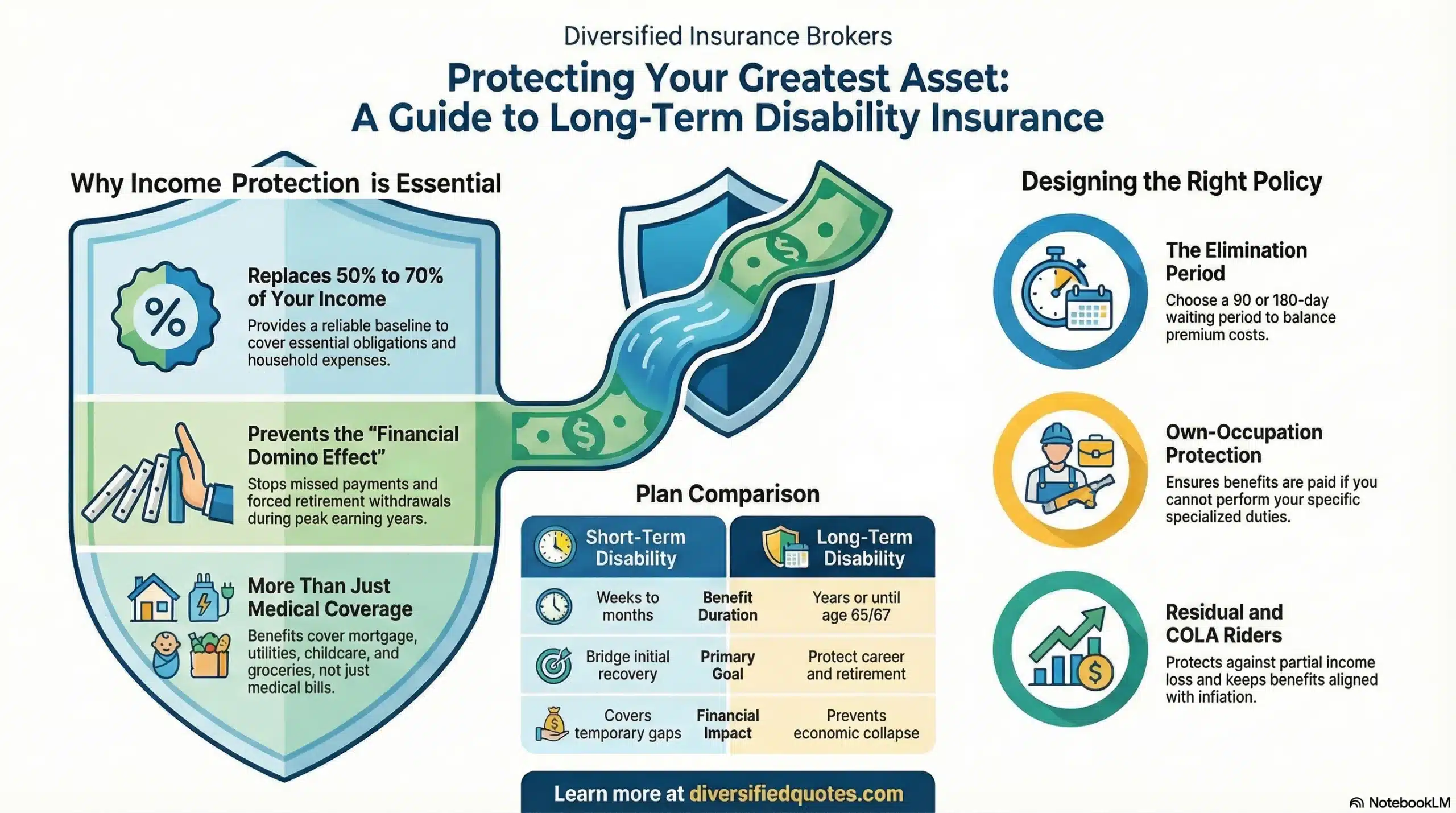
Talk With an Advisor Today
Choose how you’d like to connect—call or message us, then book a time that works for you.
Schedule here:
calendly.com/jason-dibcompanies/diversified-quotes
Licensed in all 50 states • Fiduciary, family-owned since 1980
FAQs: Disability Insurance for Chiropractors
What is the most important thing to look for in disability insurance as a chiropractor?
The disability definition is the single most important policy feature for chiropractors — more consequential than the benefit amount, the premium, or any rider selection. The disability definition is the contractual language that determines whether a DC who can no longer perform spinal adjustments due to a hand, wrist, or back condition actually receives benefits or faces a denial and potentially years of litigation to recover them. A true own-occupation definition that specifically recognizes inability to perform chiropractic adjustment and hands-on clinical care as the qualifying disability standard is non-negotiable for a practitioner whose income derives entirely from clinical production.
The reason this matters specifically for chiropractors is documented in insurance litigation: carriers have attempted to recharacterize a chiropractor’s occupation as a business owner — pointing to practice management, staff supervision, and supplement sales — to argue that the DC remains capable of performing “their occupation” despite being unable to adjust patients. A true own-occupation policy with language specifically grounded in clinical performance rather than general business ownership language eliminates this recharacterization vulnerability at the contractual level. The residual disability benefit provision is the second critical feature — because a DC who can see a reduced patient load during recovery from a hand or back condition, but not their full schedule, has a genuine partial disability that should produce a proportional partial benefit rather than a binary all-or-nothing determination.
Are disability insurance benefits taxable for a chiropractor who owns their own practice?
For chiropractors who own their practices and pay individual disability insurance premiums with after-tax personal income, monthly disability benefits received during a qualifying disability are generally received income-tax-free. This is the standard outcome for self-employed DCs who purchase coverage personally — the tax-free benefit character means the full monthly benefit reaches the household without income tax reduction, making the coverage more financially effective than a gross benefit comparison suggests. Whether disability insurance payments are taxable is a meaningful planning input when determining how much monthly benefit is needed to replace actual take-home practice income during a disability period, particularly for DCs whose practice income is irregular with production bonus structures or varying patient volume.
For associate DCs employed by another practice or health system whose employer contributes to disability insurance premiums through a group plan, the tax treatment reverses: benefits received during disability are typically taxable as ordinary income, reducing real purchasing power. A group plan paying 60 percent of salary effectively delivers closer to 40 to 45 percent of actual take-home pay after taxes — a gap that is frequently underappreciated by associate DCs who have not reviewed their actual group plan benefit in the context of what it would deliver at claim time. Chiropractic practice owners who deduct disability insurance premiums as a business expense should confirm the specific tax treatment with a tax professional, as the deduction may affect the taxability of benefits when a claim occurs.
I own my chiropractic practice — do I need both personal disability income and business overhead coverage?
For a chiropractor who owns their practice, the answer is almost always yes — and the reason is specific to the practice ownership structure. When you own a chiropractic practice and become disabled, two simultaneous financial obligations are created: your personal income loss from not being able to see patients, and the practice’s ongoing fixed overhead that continues whether you are treating patients or not. Staff payroll, office rent, malpractice insurance premiums, equipment financing, billing software, and marketing costs do not pause because the owner-clinician has a herniated disc or a wrist condition requiring surgery. A personal disability income policy replaces your clinical production income. Business overhead expense disability insurance addresses the practice’s fixed obligations.
The chiropractic practice context makes BOE coverage particularly important because the patient base — which represents years of clinical relationship building and the primary business value of the practice — can erode rapidly during an owner absence if the practice infrastructure is not maintained. Patients who cannot see their DC during a recovery period may transfer to other providers; the longer the absence without staff continuity and practice maintenance, the more patient attrition occurs. BOE funding during the disability period keeps staff in place, the practice operational at some level with potential associate coverage, and the patient relationships maintained for the return of the owner-DC after recovery. The appropriate BOE benefit amount is determined by analyzing the actual monthly fixed costs of the specific practice — a number that varies significantly between a single-DC solo practice and a multi-room, multi-staff chiropractic center.
I’m a new chiropractic graduate with student loans — when should I get disability insurance?
The timing recommendation for early-career chiropractors is the same as for other healthcare professionals, and the case for early purchase is particularly strong given the student loan dimension that most new DC graduates carry. Disability insurance premiums are age-rated, meaning the younger the applicant at issue, the lower the annual premium locked in for the policy’s full duration. A new DC who purchases coverage at 26 or 28 locks in a substantially lower premium rate for a policy that can protect their income all the way to age 65 compared to one who waits until 35 or 40. The cumulative premium savings over a career of holding coverage at the early-career rate frequently represent significant dollars over a 35 to 40-year policy term.
The student loan dimension adds urgency to early-career purchase for chiropractors specifically. Most DC student loan obligations continue during a disability period regardless of income — federal income-driven repayment programs may reduce monthly payments during low-income periods, but the obligation itself persists. A new DC who becomes disabled early in their career without disability insurance faces the elimination of clinical income alongside the continuation of substantial student loan payments — a compounding financial crisis that early-career disability coverage prevents. Why young and healthy DCs need disability insurance is answered most directly by noting that the pre-existing conditions, hand injuries, and back conditions that accumulate over a clinical career have not yet developed at the beginning of it — creating a window to secure comprehensive coverage without restrictions that closes as the career and its physical demands accumulate. Disability insurance for new healthcare professionals covers how early-career policies should be sized to current income with future insurability riders that allow benefit increases as clinical income grows without new medical underwriting.
I have a pre-existing back condition — can I still get disability insurance as a chiropractor?
Yes, though the underwriting outcome will depend on the severity, documentation, and current status of the condition. For most documented prior back conditions — a prior disc injury that has been treated, a herniation that is managed but stable, a history of back pain without progressive neurological involvement — the standard underwriting outcome is a partial exclusion rider for that specific condition, providing coverage for all other causes of disability while excluding disability specifically caused by the documented prior back condition. This structure still provides meaningful protection for the full range of other health and injury events a chiropractor faces — hand conditions, illness-based disability, other musculoskeletal conditions unrelated to the excluded area — while excluding the specifically documented prior condition.
The practical implication for a DC with a prior back history seeking disability coverage is that the exclusion rider may leave a significant gap precisely where the chiropractic-specific disability risk is most concentrated — in the spinal conditions that years of adjusting patients can produce. This makes early career purchase — before back conditions develop or are documented — the most advantageous timing from a coverage completeness standpoint. High-risk disability insurance options exist for DCs whose back history creates underwriting complexity. Carrier guidelines for prior back conditions vary significantly — a condition that produces a broad exclusion at one carrier may receive a narrower, more favorable treatment at another. An independent broker who knows each carrier’s current underwriting position on specific chiropractic-related conditions is the most effective resource for identifying the best available outcome for a DC with a documented prior history.
I already have a disability insurance policy — how do I know if my definition is strong enough for a chiropractic claim?
The three things to verify in an existing policy are the disability definition language, the occupation definition period, and the residual benefit provision. On the disability definition: review whether the policy language defines disability in reference to the specific duties of your chiropractic practice — particularly hands-on clinical adjustment — or whether it refers to your “regular occupation” in language broad enough to allow the carrier to argue that practice management and administrative duties constitute occupation performance independent of clinical adjustment capacity. Policies that specifically reference inability to perform clinical patient care provide stronger protection than those with generalized occupation definitions that are vulnerable to recharacterization.
On the occupation definition period: if the policy transitions from own-occupation to any-occupation at 24 months, confirm whether this transition could affect a hand or back disability that proves to be long-term rather than short-term. A DC who needs surgery, recovers, and is back to full adjustment at 18 months is protected by the 24-month own-occupation period; a DC whose cervical spine condition requires a 36-month recovery and ongoing management faces the any-occupation transition at exactly the wrong time. On the residual benefit: confirm whether the policy includes a provision for partial disability, since the realistic clinical scenario for many chiropractic disabilities involves a gradual return to practice at reduced patient volume rather than an abrupt full-stop and then full-return. A second opinion on your existing disability insurance policy from an independent broker who understands the chiropractic-specific definition issues identifies gaps and vulnerabilities that years of premium payments may not have adequately addressed.
About the Author:
Jason Stolz, CLTC, CRPC, DIA, CAA and Chief Underwriter at Diversified Insurance Brokers (NPN 20471358), is a senior insurance and retirement professional with more than 25 years of real-world experience helping individuals, families, and business owners protect their income, assets, and long-term financial stability. As a long-time partner of the nationally licensed independent agency Diversified Insurance Brokers, Jason provides trusted guidance across multiple specialties—including fixed and indexed annuities, long-term care planning, personal and business disability insurance, life insurance solutions, Group Health, Travel Medical and Evacuation Insurance, and short-term health coverage. Diversified Insurance Brokers maintains active contracts with over 100 highly rated insurance carriers, ensuring clients have access to a broad and competitive marketplace.
His practical, education-first approach has earned recognition in publications such as VoyageATL, and contributions from his agency featured in Kiplinger and GoBankingRates— highlighting his commitment to financial clarity and client-focused planning. Drawing on deep product knowledge and years of hands-on field experience, Jason helps clients evaluate carriers, compare strategies, and build retirement and protection plans that are both secure and cost-efficient. Visitors who want to explore current annuity rates and compare options across multiple insurers can also use this annuity quote and comparison tool.
Explore More Disability Insurance Options: Browse our complete guide to Disability Insurance for Physicians & Medical Specialists — covering physicians, surgeons, anesthesiologists, radiologists, podiatrists & medical specialists from 100+ carriers.
Last Reviewed: June 7, 2026 |
Reviewed by: Jason Stolz, CLTC, CRPC, DIA, CAA
Chief Underwriter, Diversified Insurance Brokers, Inc. | NPN: 20471358 | Diversified Insurance Brokers, Inc. — Licensed in all 50 states
Fact Checked by: Tonia Pettitt, CMIP©
Medicare Specialist, Diversified Insurance Brokers, Inc. | NPN: 14374308 | Diversified Insurance Brokers, Inc. — Licensed in all 50 states
Did you find this content helpful? Leave us a Google review — it helps others find trustworthy guidance too.
Editorial Standards: Diversified Insurance Brokers maintains rigorous editorial standards to ensure accuracy, clarity, and independence in all content. Learn more about our editorial standards and commitment to transparency.
